
CTE REGIONAL MEETINGS September 2017 Missouri Department of
CTE REGIONAL MEETINGS September 2017 Missouri Department of Elementary and Secondary Education
Welcome and Overview
Topics 3 CTE Funding High Quality CTE Programs CTE Certificate
Purpose of CTE Regional Meetings 4 Provide LEAs with an understanding of how state CTE funding will be calculated and distributed beginning with the 2018 -19 school year. Discuss High Quality CTE Programs Provide LEAs with the opportunity to ask questions regarding the new CTE certificate.
CTE Funding
CTE Funding Current funding structure in place since 2001 Charge from Department Leadership to review current funding and develop a new plan for redistribution of state CTE funding. New funding plan in place for the 2018 -19 school year
CTE Funding 7 Convened CTE Ad Hoc Advisory Committee Area Career Center Directors CTE Teachers High School Principals Superintendents Higher Education Representatives – 2 - and 4 -year State Technical College of Missouri
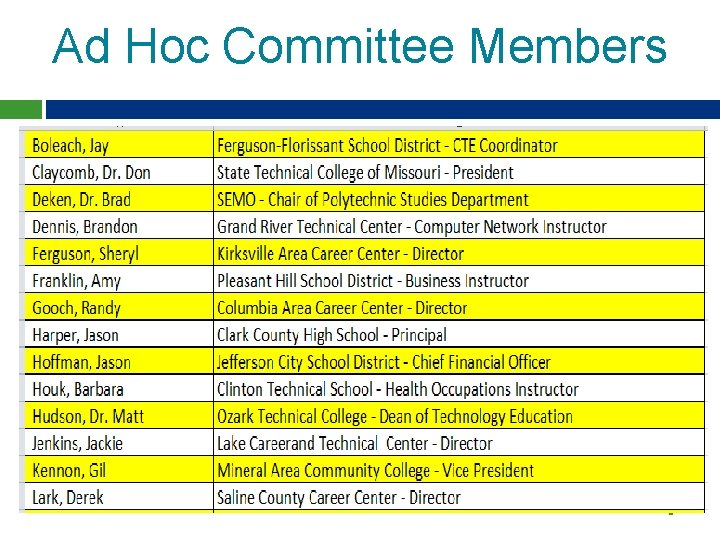
Ad Hoc Committee Members
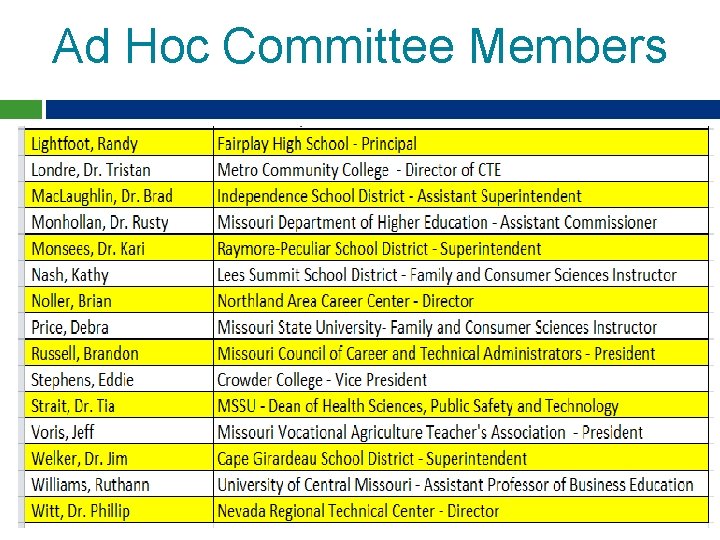
Ad Hoc Committee Members
CTE Funding 10 Facilitated by Central Comprehensive Center, College and Career Readiness and Success Center, and Center on Innovation in Learning in conjunction with staff from OCCR. Seven meetings held over a 10 -month time frame (6 face-to-face and 1 webinar)
CTE Funding 11 New Funding Strategies Comprehensive High Schools Area Career Centers Postsecondary Adult Use Common Criteria and Quality Indicators as basis for funding eligibility (Phase in)
Area Career Centers
Area Career Centers (ACCs) 13 ACCs will receive base funding to assist with the costs of implementing career and technical education programs. Funding can be used as follows: Offset salary of CTE teachers, CTE counselors and CTE administrators Equipment purchases – cannot be used as match for other state CTE programs, ie. 50/50 Equipment and Resource Grants, Vocational-Technical Enhancement Grants, etc. Supplies Professional Development Other expenditures that the district deems appropriate to support CTE programs (See State CTE Grant – List of Allowable and Unallowable Costs)
ACC Funding 14 Three Components: 1. Core Support 2. Career Ed Time Devoted (CTD) 3. Student Credits Earned
Core Support 15 Each Area Career Center will receive core support of $75, 000.
Career Ed Time Devoted (CTD) 16 The Department will use the October Cycle in Core Data—Educator (Screen 18) and Course & Assignment (Screen 20) to obtain the educator FTE and CTD data. The Department will total the FTE and CTD for educators at each LEA who are properly certificated and teaching DESE approved CTE programs. The Department will multiply the total CTD for each LEA by $2, 500.
Student Credits Earned 17 The Department will use the June Student Course Completion file in MOSIS to obtain the credits earned data. The Department will total the number of credits earned for each LEA (credits will be capped at 1, 750). The Department will then divide the LEA’s number of credits earned by the state-wide total of credits earned in order to calculate a credits earned percentage. The Department will multiply the credits earned percentage for each LEA by the total funds available for CTE Base Funding.
Rationale 18 Core support funding is the same for all 57 area career centers. Provides support for teachers, which is consistent with the funding for comprehensive high schools. Provides additional support through CTE credits earned that rewards area career centers for students served and courses offered. Keeps area career centers operating at or near their current level of state funding. Consistent with current programming being offered.
3 -Year Phase In – Area Career Centers Only 19 3 -year phase in will be based on 2016 -2017 data only. 2018 -19 – Gain/Loss – amount received is 1/3 of the difference between the new calculation and 2008 allocation 2019 -20 – Gain/Loss – amount received is 2/3 of the difference between the new calculation and 2008 allocation 2020 -21 – Gain/Loss – amount received is the 2016 -17 calculation
Comprehensive High Schools
Comprehensive High Schools (CHSs) 21 CHSs will receive base funding to assist with the costs of implementing career and technical education programs. Funding can be used as follows: Offset salary of CTE teachers, CTE counselors and CTE administrators Equipment purchases – cannot be used as match for other state CTE programs, ie. 50/50 Equipment and Resource Grants, Vocational-Technical Enhancement Grants, etc. Supplies Professional Development Other expenditures that the district deems appropriate to support CTE programs (See State CTE Grant – List of Allowable and Unallowable Costs)
CHS Funding Calculation 22 CTE Base Funding for CHSs will be calculated as follows: The Department will use the October Cycle in Core Data— Educator (Screen 18) and Course & Assignment (Screen 20) to obtain the educator FTE and CTD data. The Department will total the FTE and CTD for educators for each LEA who are properly certificated and teaching DESE approved CTE programs. The Department will then divide the LEA’s number of CTD by the state-wide total of CTD in order to calculate a CTD percentage. The Department will multiply the CTD percentage for each LEA by the total funds available for CTE Base Funding.
Rationale 23 Provides support for CTE teachers in comprehensive high schools that recognize the growth in CTE programs in this particular venue. Funding at the comprehensive high school now includes Family Consumer Sciences (FCS) and Human Services teachers. PLTW courses are not included in funding calculations. Note: The goal is that the allocation per FTE CTE will be maintained at an amount of at least $2, 500.
Secondary Reminders
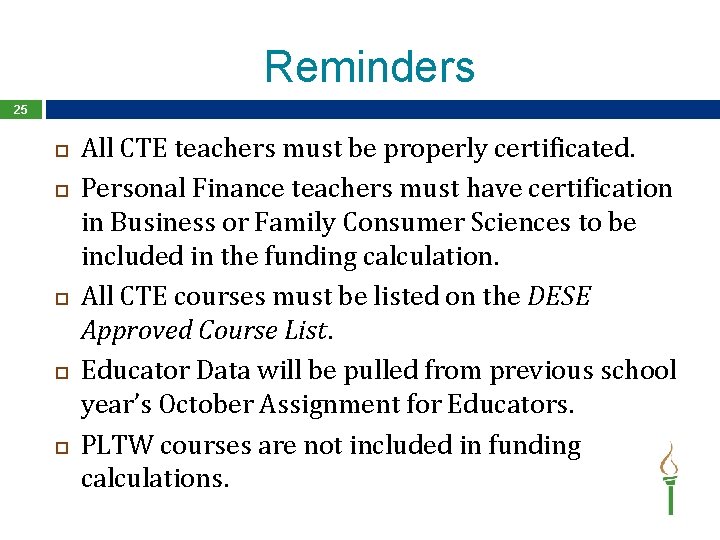
Reminders 25 All CTE teachers must be properly certificated. Personal Finance teachers must have certification in Business or Family Consumer Sciences to be included in the funding calculation. All CTE courses must be listed on the DESE Approved Course List. Educator Data will be pulled from previous school year’s October Assignment for Educators. PLTW courses are not included in funding calculations.
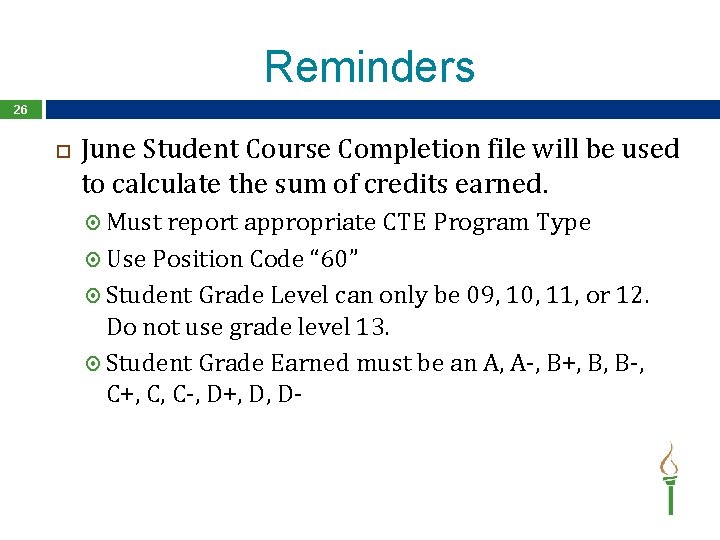
Reminders 26 June Student Course Completion file will be used to calculate the sum of credits earned. Must report appropriate CTE Program Type Use Position Code “ 60” Student Grade Level can only be 09, 10, 11, or 12. Do not use grade level 13. Student Grade Earned must be an A, A-, B+, B, B-, C+, C, C-, D+, D, D-
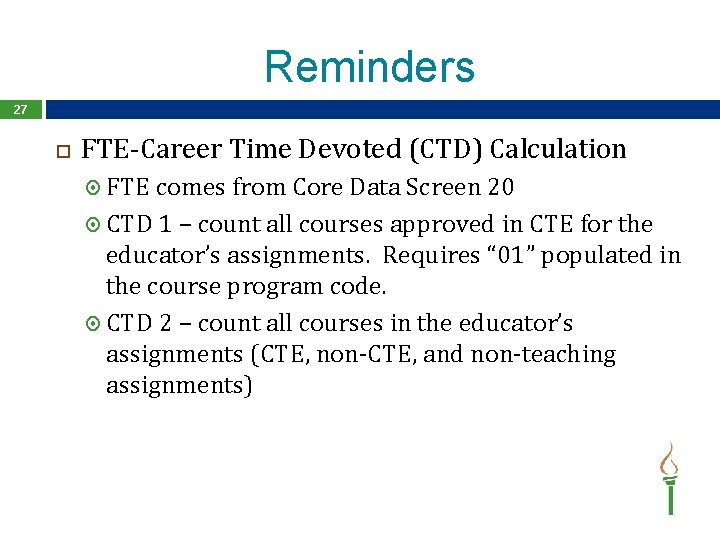
Reminders 27 FTE-Career Time Devoted (CTD) Calculation FTE comes from Core Data Screen 20 CTD 1 – count all courses approved in CTE for the educator’s assignments. Requires “ 01” populated in the course program code. CTD 2 – count all courses in the educator’s assignments (CTE, non-CTE, and non-teaching assignments)
Reminders 28 As per the Core Data/MOSIS Manual: The district and school where the educator provides instruction or services will report Course Assignment records.
Postsecondary
(Two-year and Four-Year Institutions) 30 Postsecondary institutions will receive base funding to assist with the costs of implementing career and technical education programs. Funding can be used as follows: Offset salary of CTE teachers, CTE counselors and CTE administrators Equipment purchases – cannot be used as match for other state CTE programs, ie. 50/50 Equipment and Resource Grants, Vocational-Technical Enhancement Grants, etc. Supplies Professional Development Other expenditures that the institution of higher education deems appropriate to support CTE programs (See State CTE Grant – List of Allowable and Unallowable Costs)
Postsecondary Funding Calculation 31 CTE Base Funding for postsecondary institutions will be calculated as follows: The Department will use the PS/Adult Course Assignment file in MOSIS to obtain the credit hour data. The Department will total the number of credit hours taught in DESE approved CTE programs for each LEA. The Department will then divide the LEA’s number of credit hours by the state-wide total of credit hours in order to calculate a credit hour percentage. The Department will multiply the credit hour percentage for each LEA by the total funds available for CTE Base Funding.
Rationale 32 Provides support for CTE programs at the postsecondary level. Recognizes the growth in CTE programs by awarding funds based on CTE credits offered.
Adult
Adult 34 Base funding will be provided to assist with the costs of implementing adult programs (both fulltime and short-term). Funding will be used to offset salaries of instructors only. Priority will be given to full-time adult programs. Short-term adult funding will be based on availability of funds.
Full-Time Adult Funding Calculation 35 The Department will use the PS/Adult Course Assignment file in MOSIS to obtain the instructor and contact hour data. The Department will total the number of educators at each LEA who are properly certificated and teaching 500 or more contact hours of instruction in DESE approved CTE programs. The Department will then multiply the LEA’s number of full-time educators by $15, 000.
Short-Term Adult Funding Calculation 36 The Department will use the PS/Adult Course Assignment file in MOSIS to obtain the instructor and contact hour data. The Department will give funding priority to CTE programs in high demand occupations. The LEA must complete and submit a Short-Term Adult Application. For programs approved for funding, the Department will multiply the educator’s number of contract hours of instruction by $10 (Up to 499 contact hours of instruction)
Rationale 37 This approach continues the long-standing support of training adults for new careers and skill upgrades.
CTE Performance Funding
CTE Performance Funding 39 ACCs and CHSs will receive CTE Performance Funding (formerly Effectiveness Index Formula) for CTE programs that achieve success in positive placement of program completers (based 100% on placement).
CTE Performance Funding 40 CTE Performance Funding will assist with the costs of implementing career and technical education programs. Funding can be used as follows: Offset salary of CTE teachers, CTE counselors and CTE administrators Equipment purchases – cannot be used as match for other state CTE programs, ie. 50/50 Equipment and Resource Grants, Vocational-Technical Enhancement Grants, etc. Supplies Professional Development Other expenditures that the district deems appropriate to support CTE programs (See State CTE Grant – List of Allowable and Unallowable Costs)
Funding Calculation 41 CTE Performance Funding will be calculated by: Totaling the number of completers that were positively placed in employment, continuing education, or military. The positive placement percentage will be calculated by dividing the LEA’s number of completers that were positively placed. The positive placement percentage is then multiplied by the total funds available.
Tentative Timeline 42 September 2017 – release estimates based on 2016 data. October 1, 2017 – March 31, 2018 – LEAs review 2016 -17 data to ensure accuracy April 2018 – DESE prepares LEA budgets May 2018 – DESE releases 2018 -19 budgets
Focusing on High Quality CTE
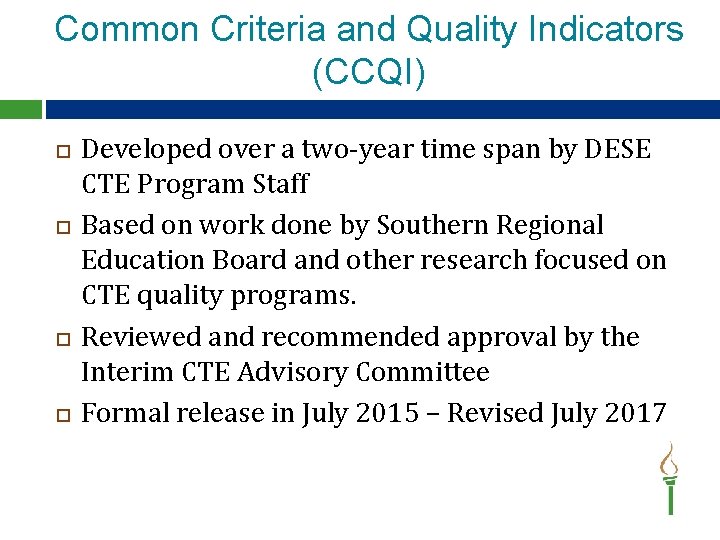
Common Criteria and Quality Indicators (CCQI) Developed over a two-year time span by DESE CTE Program Staff Based on work done by Southern Regional Education Board and other research focused on CTE quality programs. Reviewed and recommended approval by the Interim CTE Advisory Committee Formal release in July 2015 – Revised July 2017
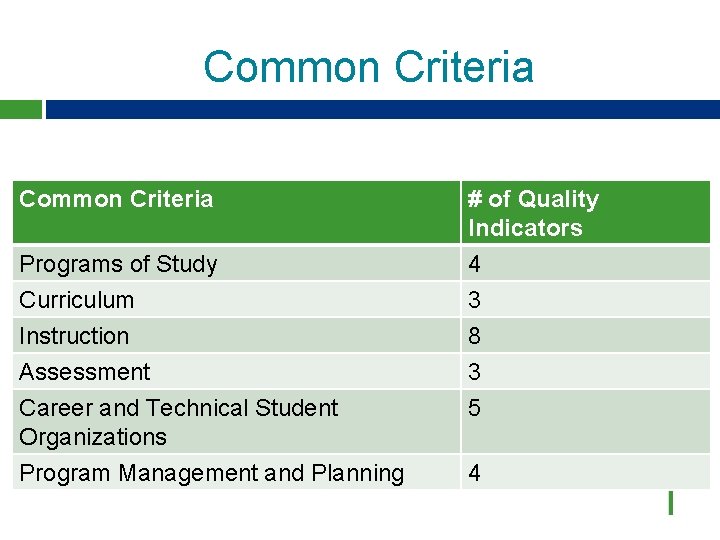
Common Criteria # of Quality Indicators Programs of Study Curriculum 4 3 Instruction Assessment Career and Technical Student Organizations 8 3 5 Program Management and Planning 4
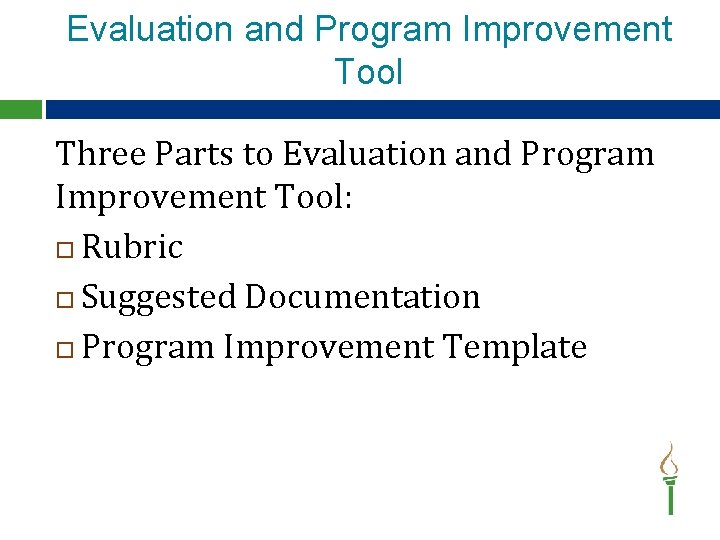
Evaluation and Program Improvement Tool Three Parts to Evaluation and Program Improvement Tool: Rubric Suggested Documentation Program Improvement Template
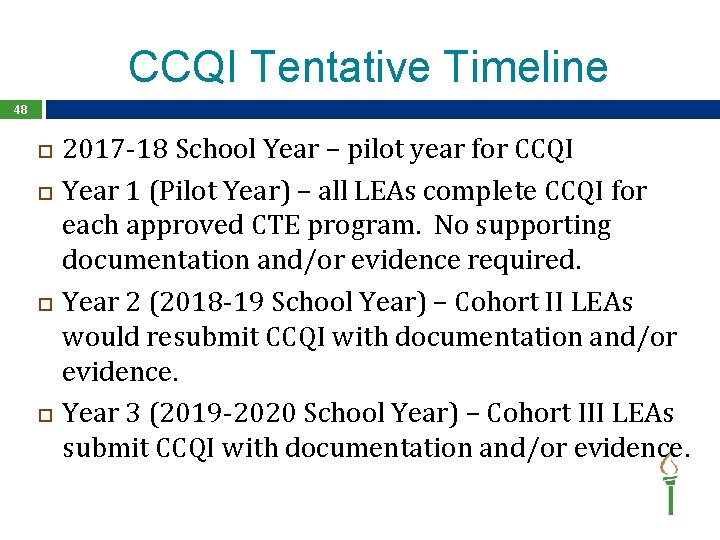
CCQI Tentative Timeline 48 2017 -18 School Year – pilot year for CCQI Year 1 (Pilot Year) – all LEAs complete CCQI for each approved CTE program. No supporting documentation and/or evidence required. Year 2 (2018 -19 School Year) – Cohort II LEAs would resubmit CCQI with documentation and/or evidence. Year 3 (2019 -2020 School Year) – Cohort III LEAs submit CCQI with documentation and/or evidence.
CCQI Timeline (Cont. ) 49 Tiered Monitoring System will be available October 1, 2017 – March 31, 2018 (Tentative)
CTE Certificate
CTE Certificate Legislation was passed in 2016 by the 98 th Missouri General Assembly (SBs. 620 & 582) State Board of Education, in consultation with the CTE Advisory Council, established minimum requirements for a career and technical education (CTE) certificate. Approved by State Board of Education in June 2017 CTE certificate will be earned by students in addition to his or her high school graduation diploma.
CTE Certificate Students must meet all requirements in order to receive the CTE certificate. Schools support student efforts to accomplish these requirements through the development and monitoring of the Individual Career and Academic Plan (ICAP).
CTE Certificate Students entering high school in school year 2017 -2018 and thereafter shall be eligible to earn a CTE certificate.
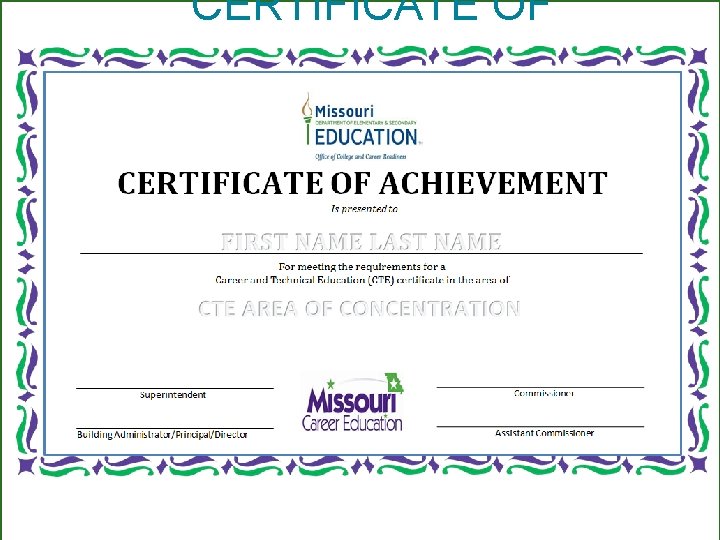
CERTIFICATE OF ACHIEVEMENT Is presented to For meeting the requirements for a Career and Technical Education (CTE) certificate in the area of Superintendent Building Administrator/Principal/Director Commissioner Assistant Commissioner
CTE Certificate Criteria Meet all graduation requirements. Qualify as a Career and Technical Education (CTE) concentrator. Maintain a minimum Grade Point Average (GPA) of 3. 0 on a 4. 0 point scale in the CTE area of concentration.
CTE Certificate Criteria Pass an approved Technical Skill Assessment (TSA) and/or earn an approved Industry Recognized Credential (IRC). Complete a minimum of 50 hours of appropriate work-based learning experiences aligned with the CTE area of concentration. Maintain at least a 95% attendance record overall for grades 9 -12.
CTE Certificate Criteria Demonstrate attainment of soft-skills/business skills. Achieve a score at or above the state standard on any department-approved measure(s) of college and career readiness. * * Schools are to use the. 75 student weighted measures described in the Assessment Scores Matrix, as the state standard. This matrix is found in Appendix C of the MSIP 5 Comprehensive Guide to the Missouri School Improvement Program, 2016.
CTE Certificate 58 Information is available on the DESE website at: https: //dese. mo. gov/college-careerreadiness/career-education/career-and-technicaleducation-certificate

Questions and Further Information Dennis D. Harden, Ed. D. Coordinator, Career Education DESE, Office of College and Career Readiness (573) 751 -3500 Dennis. harden@dese. mo. gov The Department of Elementary and Secondary Education does not discriminate on the basis of race, color, religion, gender, national origin, age, or disability in its programs and activities. Inquiries related to Department programs and to the location of services, activities, and facilities that are accessible by persons with disabilities may be directed to the Jefferson State Office Building, Office of the General Counsel, Coordinator – Civil Rights Compliance (Title VI/Title IX/504/ADA/Age Act), 6 th Floor, 205 Jefferson Street, P. O. Box 480, Jefferson City, MO 65102 -0480; telephone number 573 -526 -4757 or TTY 800 -7352966; email civilrights@dese. mo. gov.
- Slides: 59