DEPARTAMENTO DE CIENCIAS HUMANAS Y SOCIALES CARRERA DE
- Slides: 30
DEPARTAMENTO DE CIENCIAS HUMANAS Y SOCIALES CARRERA DE LICENCIATURA EN LINGÜÍSTICA APLICADA AL IDIOMA INGLÉS RESEARCH PROJECT THE INFLUENCE OF THE QUIZSTAR TOOL ON THE DEVELOPMENT OF LISTENING SKILLS ON FIRST YEAR BACHILLERATO STUDENTS AT “LAURO GUERRERO” MILITARY EDUCATIONAL UNIT, LOJA, SCHOOL YEAR 2014 -2015 AUTHOR: LLUMIQUINGA GUAMÁN, LUIS IVÁN THESIS DIRECTOR: MSC. LLUMIQUINGA, MARÍA TERESA THESIS CO-DIRECTOR: MSC. ESPÍN, CARLOS SANGOLQUÍ, 2015
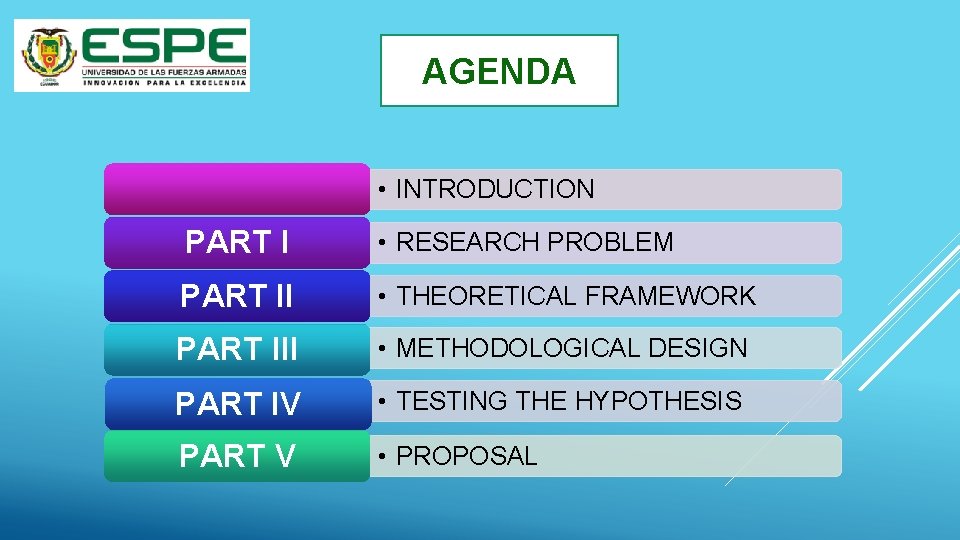
AGENDA • INTRODUCTION PART I • RESEARCH PROBLEM PART II • THEORETICAL FRAMEWORK PART III • METHODOLOGICAL DESIGN PART IV • TESTING THE HYPOTHESIS PART V • PROPOSAL
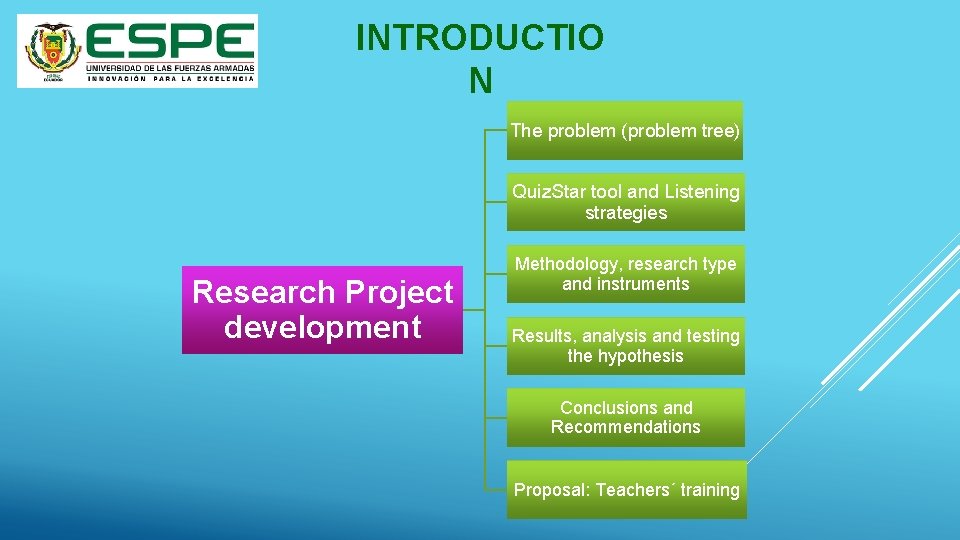
INTRODUCTIO N The problem (problem tree) Quiz. Star tool and Listening strategies Research Project development Methodology, research type and instruments Results, analysis and testing the hypothesis Conclusions and Recommendations Proposal: Teachers´ training
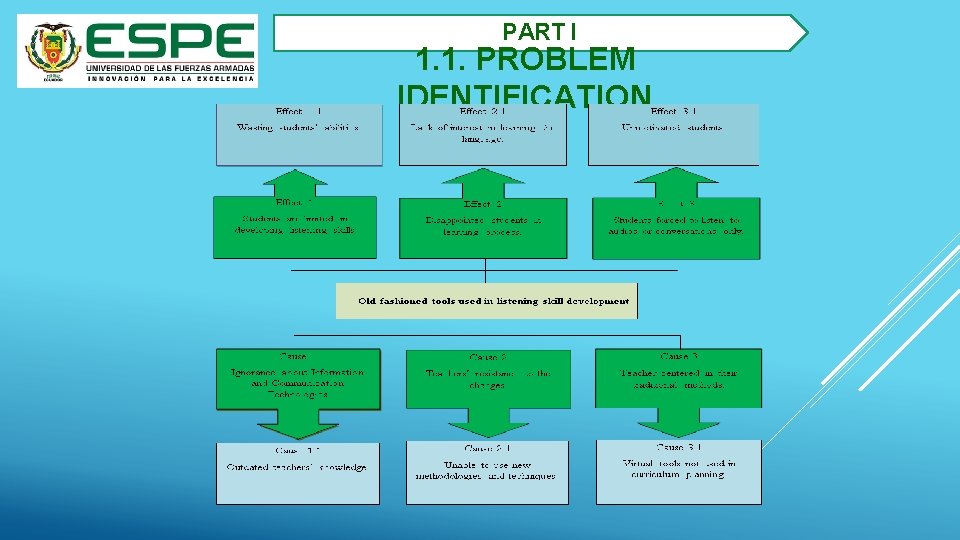
2. PART I 1. 1. PROBLEM IDENTIFICATION
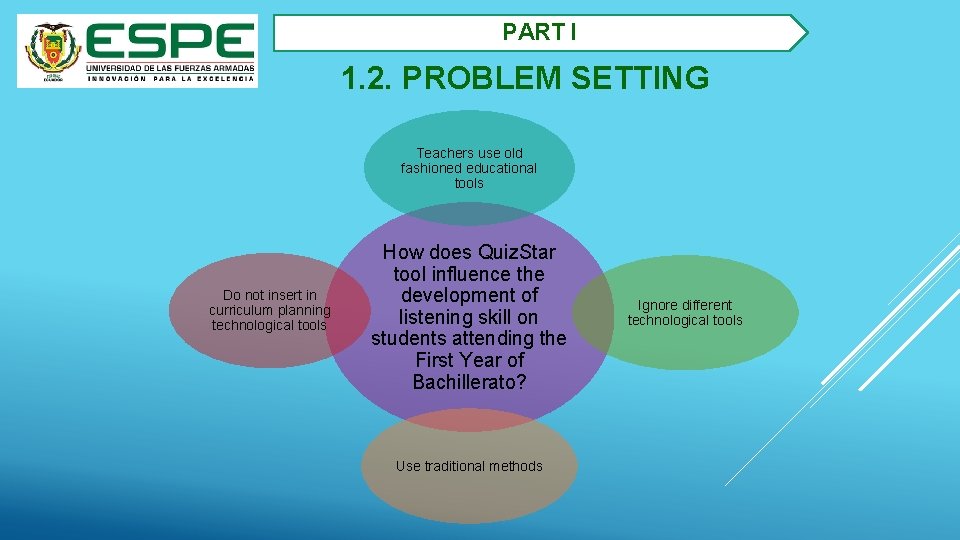
2. PART I 1. 2. PROBLEM SETTING Teachers use old fashioned educational tools Do not insert in curriculum planning technological tools How does Quiz. Star tool influence the development of listening skill on students attending the First Year of Bachillerato? Use traditional methods Ignore different technological tools
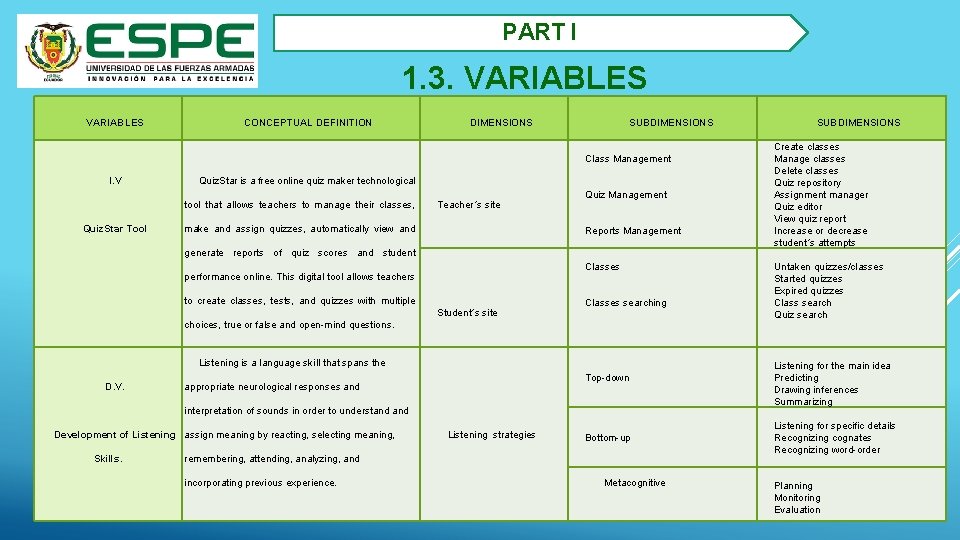
2. PART I VARIABLES I. V 1. 3. VARIABLES CONCEPTUAL DEFINITION DIMENSIONS Quiz. Star is a free online quiz maker technological tool that allows teachers to manage their classes, Quiz. Star Tool make and assign quizzes, automatically view and Teacher´s site generate reports of quiz scores and student performance online. This digital tool allows teachers to create classes, tests, and quizzes with multiple Student´s site SUBDIMENSIONS Class Management Quiz Management Reports Management Classes searching choices, true or false and open-mind questions. SUBDIMENSIONS Create classes Manage classes Delete classes Quiz repository Assignment manager Quiz editor View quiz report Increase or decrease student´s attempts Untaken quizzes/classes Started quizzes Expired quizzes Class search Quiz search D. V. Listening is a language skill that spans the appropriate neurological responses and interpretation of sounds in order to understand Development of Listening assign meaning by reacting, selecting meaning, Skills. remembering, attending, analyzing, and incorporating previous experience. Top-down Listening strategies Bottom-up Metacognitive Listening for the main idea Predicting Drawing inferences Summarizing Listening for specific details Recognizing cognates Recognizing word-order Planning Monitoring Evaluation
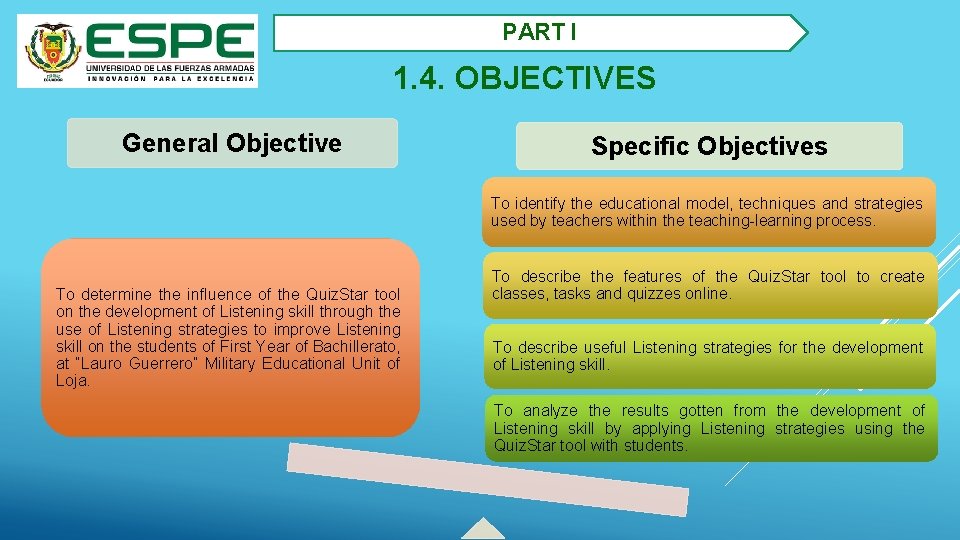
2. PART I 1. 4. OBJECTIVES General Objective Specific Objectives To identify the educational model, techniques and strategies used by teachers within the teaching-learning process. To determine the influence of the Quiz. Star tool on the development of Listening skill through the use of Listening strategies to improve Listening skill on the students of First Year of Bachillerato, at “Lauro Guerrero” Military Educational Unit of Loja. To describe the features of the Quiz. Star tool to create classes, tasks and quizzes online. To describe useful Listening strategies for the development of Listening skill. To analyze the results gotten from the development of Listening skill by applying Listening strategies using the Quiz. Star tool with students.
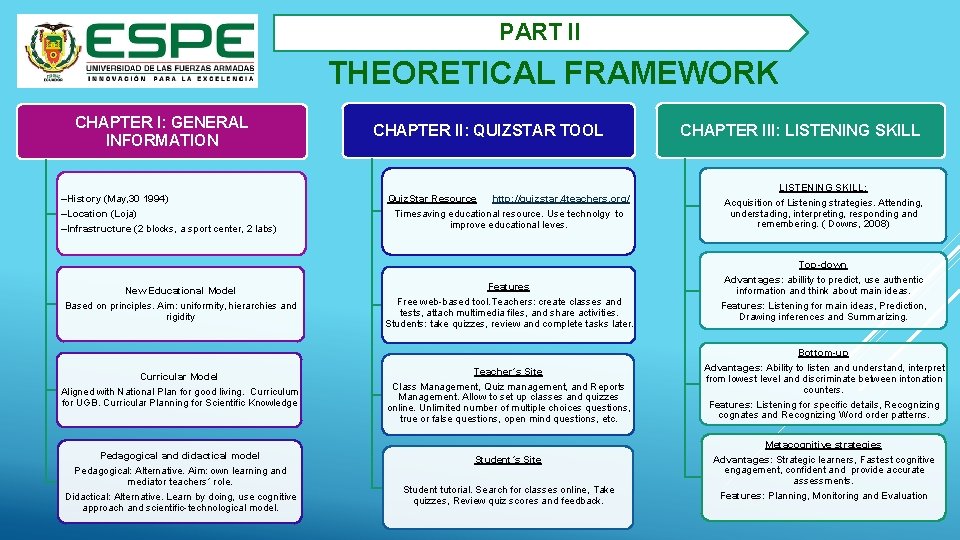
2. PART II THEORETICAL FRAMEWORK CHAPTER I: GENERAL INFORMATION CHAPTER II: QUIZSTAR TOOL CHAPTER III: LISTENING SKILL –History (May, 30 1994) –Location (Loja) –Infrastructure (2 blocks, a sport center, 2 labs) Quiz. Star Resource http: //quizstar. 4 teachers. org/ Timesaving educational resource. Use technolgy to improve educational leves. New Educational Model Based on principles. Aim: uniformity, hierarchies and rigidity Features Free web-based tool. Teachers: create classes and tests, attach multimedia files, and share activities. Students: take quizzes, review and complete tasks later. LISTENING SKILL: Acquisition of Listening strategies. Attending, understading, interpreting, responding and remembering. ( Downs, 2008) Top-down Advantages: abillity to predict, use authentic information and think about main ideas. Features: Listening for main ideas, Prediction, Drawing inferences and Summarizing. Curricular Model Aligned with National Plan for good living. Curriculum for UGB. Curricular Planning for Scientific Knowledge Teacher´s Site Class Management, Quiz management, and Reports Management. Allow to set up classes and quizzes online. Unlimited number of multiple choices questions, true or false questions, open mind questions, etc. Pedagogical and didactical model Pedagogical: Alternative. Aim: own learning and mediator teachers´ role. Didactical: Alternative. Learn by doing, use cognitive approach and scientific-technological model. Student´s Site Student tutorial. Search for classes online, Take quizzes, Review quiz scores and feedback. Bottom-up Advantages: Ability to listen and understand, interpret from lowest level and discriminate between intonation counters. Features: Listening for specific details, Recognizing cognates and Recognizing Word order patterns. Metacognitive strategies Advantages: Strategic learners, Fastest cognitive engagement, confident and provide accurate assessments. Features: Planning, Monitoring and Evaluation
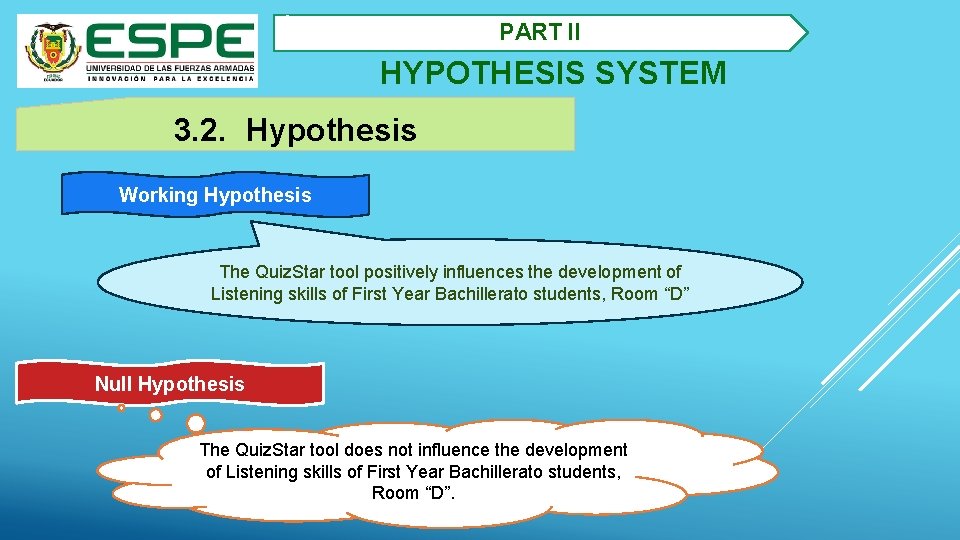
2. PART II HYPOTHESIS SYSTEM 3. 2. Hypothesis Working Hypothesis The Quiz. Star tool positively influences the development of Listening skills of First Year Bachillerato students, Room “D” Null Hypothesis The Quiz. Star tool does not influence the development of Listening skills of First Year Bachillerato students, Room “D”.
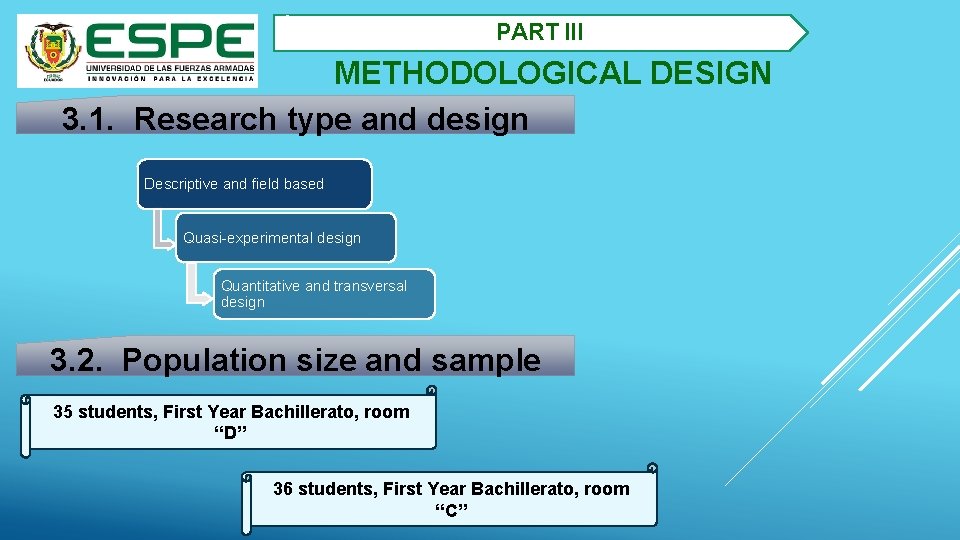
2. PART III METHODOLOGICAL DESIGN 3. 1. Research type and design Descriptive and field based Quasi-experimental design Quantitative and transversal design 3. 2. Population size and sample 35 students, First Year Bachillerato, room “D” 36 students, First Year Bachillerato, room “C”
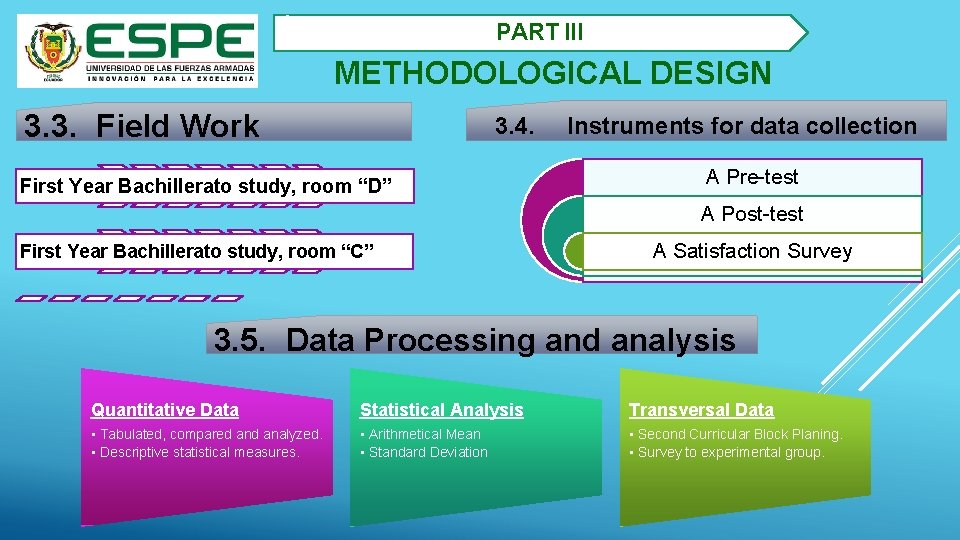
2. PART III METHODOLOGICAL DESIGN 3. 3. Field Work 3. 4. Instruments for data collection First Year Bachillerato study, room “D” A Pre-test A Post-test First Year Bachillerato study, room “C” A Satisfaction Survey 3. 5. Data Processing and analysis Quantitative Data • Tabulated, compared analyzed. • Descriptive statistical measures. Statistical Analysis Transversal Data • Arithmetical Mean • Standard Deviation • Second Curricular Block Planing. • Survey to experimental group.
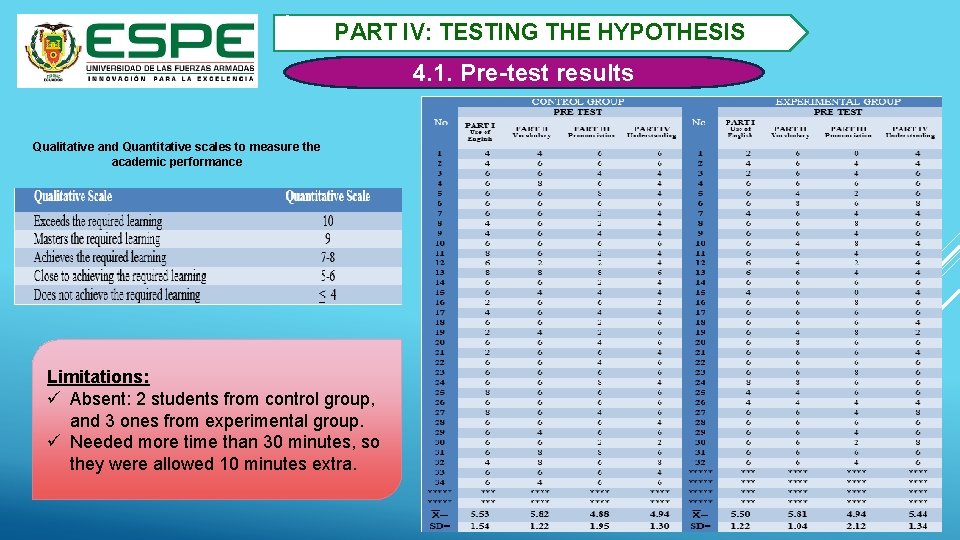
2. PART IV: TESTING THE HYPOTHESIS Qualitative and Quantitative scales to measure the academic performance Limitations: ü Absent: 2 students from control group, and 3 ones from experimental group. ü Needed more time than 30 minutes, so they were allowed 10 minutes extra. 4. 1. Pre-test results
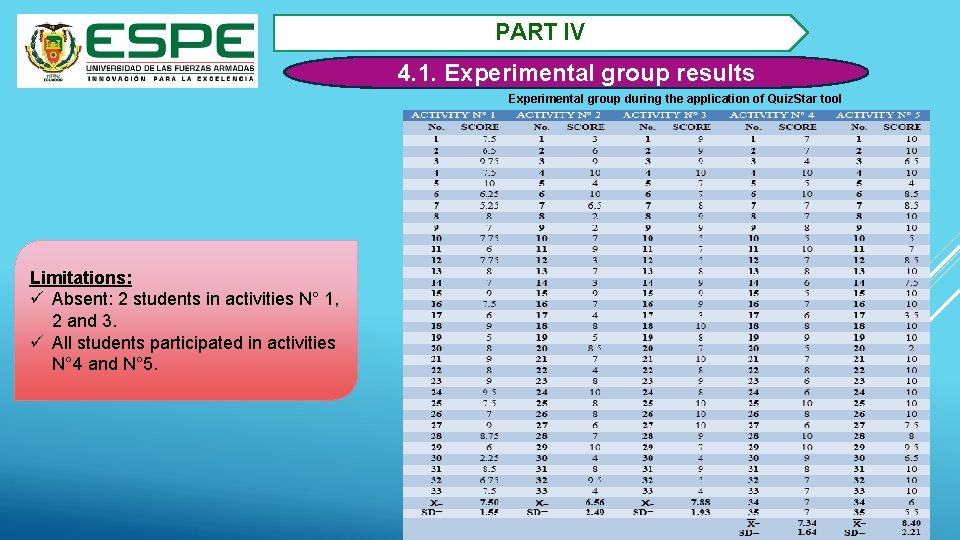
PART IV 4. 1. Experimental group results Experimental group during the application of Quiz. Star tool Limitations: ü Absent: 2 students in activities N° 1, 2 and 3. ü All students participated in activities N° 4 and N° 5.
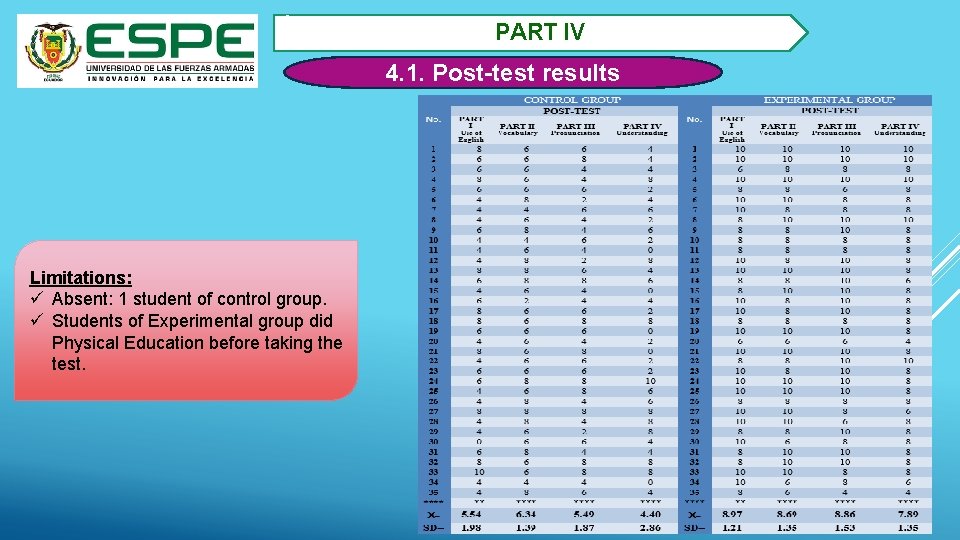
2. Limitations: ü Absent: 1 student of control group. ü Students of Experimental group did Physical Education before taking the test. PART IV 4. 1. Post-test results
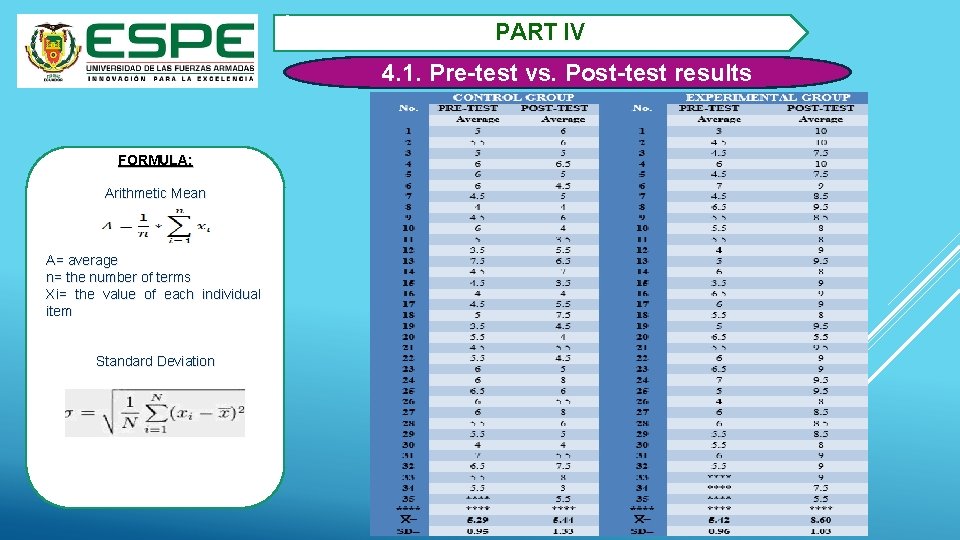
2. FORMULA: Arithmetic Mean A= average n= the number of terms Xi= the value of each individual item Standard Deviation PART IV 4. 1. Pre-test vs. Post-test results
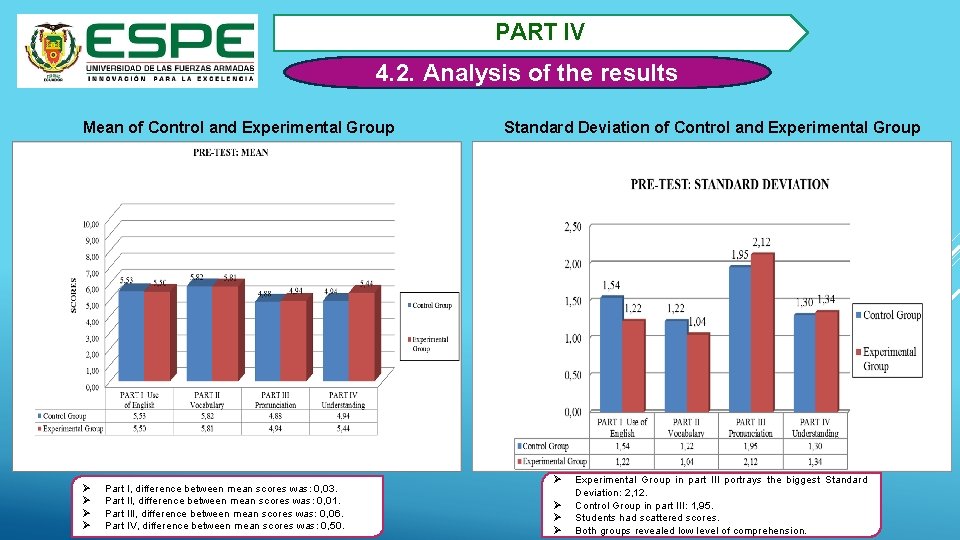
PART IV 4. 2. Analysis of the results Mean of Control and Experimental Group Ø Ø Part I, difference between mean scores was: 0, 03. Part II, difference between mean scores was: 0, 01. Part III, difference between mean scores was: 0, 06. Part IV, difference between mean scores was: 0, 50. Standard Deviation of Control and Experimental Group Ø Ø Experimental Group in part III portrays the biggest Standard Deviation: 2, 12. Control Group in part III: 1, 95. Students had scattered scores. Both groups revealed low level of comprehension.
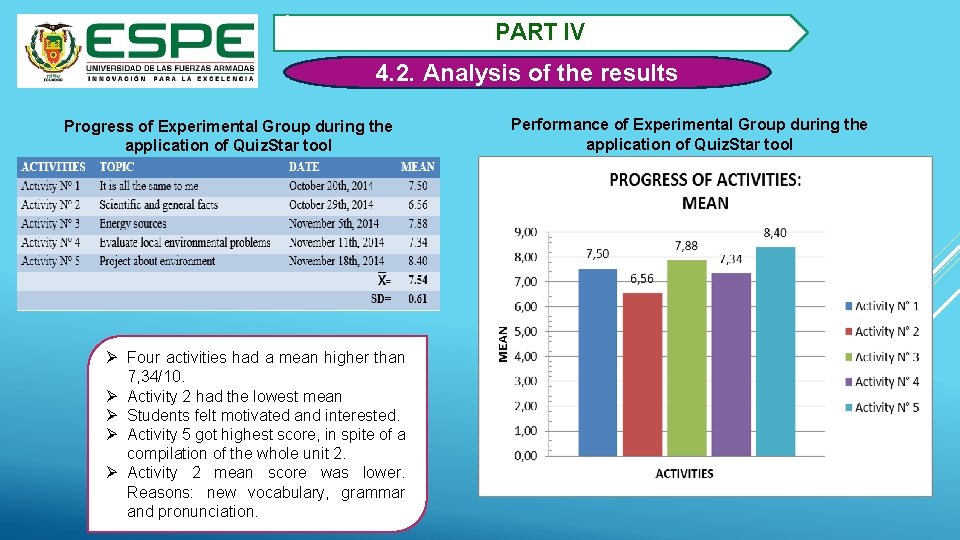
2. PART IV 4. 2. Analysis of the results Progress of Experimental Group during the application of Quiz. Star tool Ø Four activities had a mean higher than 7, 34/10. Ø Activity 2 had the lowest mean Ø Students felt motivated and interested. Ø Activity 5 got highest score, in spite of a compilation of the whole unit 2. Ø Activity 2 mean score was lower. Reasons: new vocabulary, grammar and pronunciation. Performance of Experimental Group during the application of Quiz. Star tool
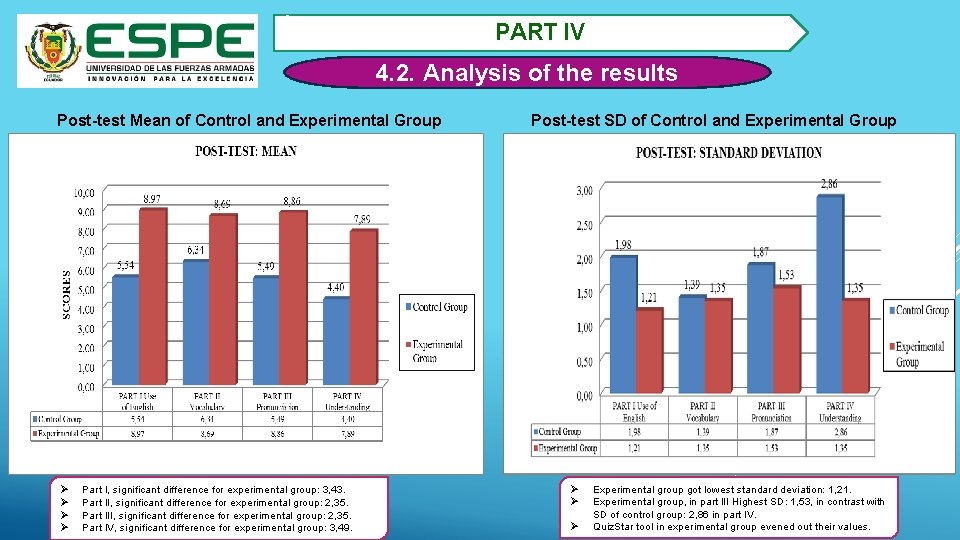
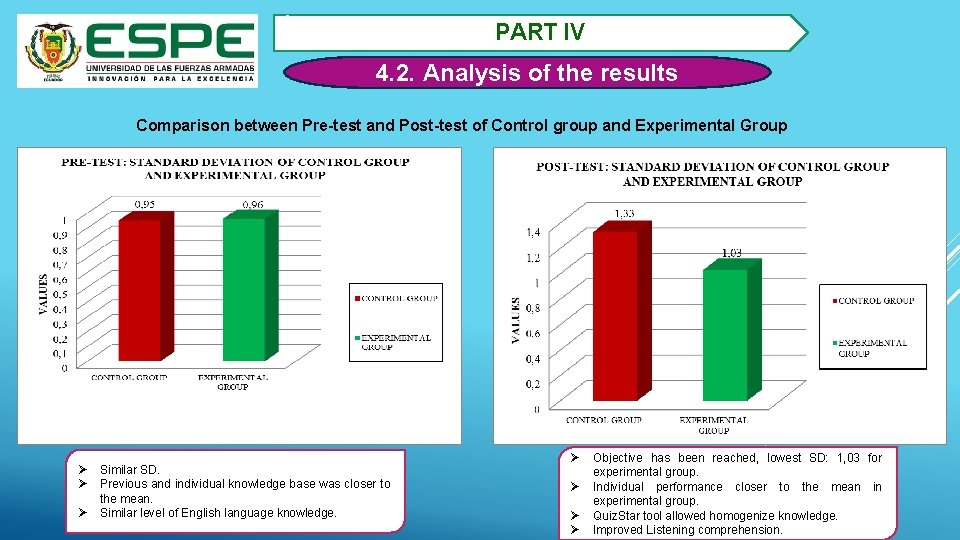
2. PART IV 4. 2. Analysis of the results Post-test Mean of Control and Experimental Group Post-test SD of Control and Experimental Group Ø Ø Part I, significant difference for experimental group: 3, 43. Part II, significant difference for experimental group: 2, 35. Part III, significant difference for experimental group: 2, 35. Part IV, significant difference for experimental group: 3, 49. Ø Ø Ø Experimental group got lowest standard deviation: 1, 21. Experimental group, in part III Highest SD: 1, 53, in contrast with SD of control group: 2, 86 in part IV. Quiz. Star tool in experimental group evened out their values.
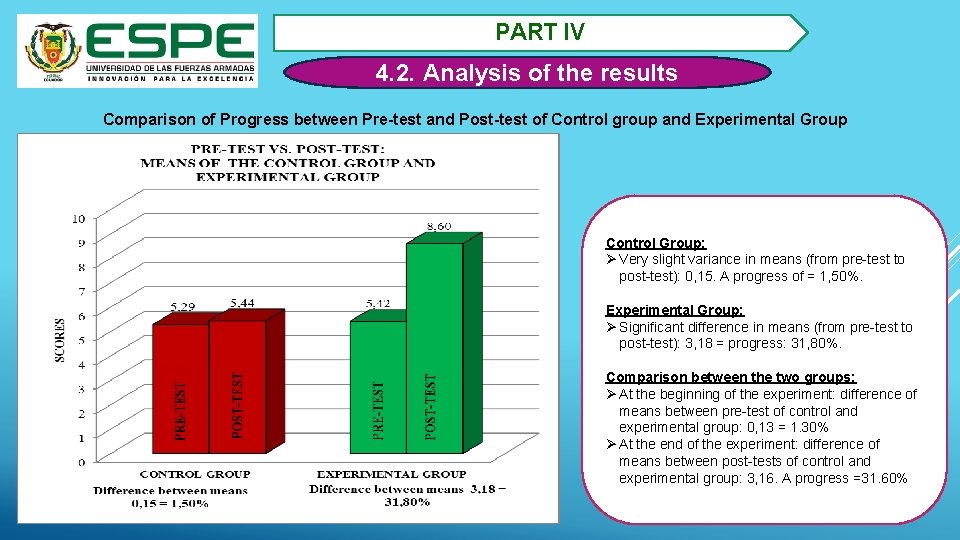
PART IV 4. 2. Analysis of the results Comparison of Progress between Pre-test and Post-test of Control group and Experimental Group Control Group: Ø Very slight variance in means (from pre-test to post-test): 0, 15. A progress of = 1, 50%. Experimental Group: Ø Significant difference in means (from pre-test to post-test): 3, 18 = progress: 31, 80%. Comparison between the two groups: Ø At the beginning of the experiment: difference of means between pre-test of control and experimental group: 0, 13 = 1. 30% Ø At the end of the experiment: difference of means between post-tests of control and experimental group: 3, 16. A progress =31. 60%
2. PART IV 4. 2. Analysis of the results Comparison between Pre-test and Post-test of Control group and Experimental Group Ø Ø Ø Similar SD. Previous and individual knowledge base was closer to the mean. Similar level of English language knowledge. Ø Ø Objective has been reached, lowest SD: 1, 03 for experimental group. Individual performance closer to the mean in experimental group. Quiz. Star tool allowed homogenize knowledge. Improved Listening comprehension.
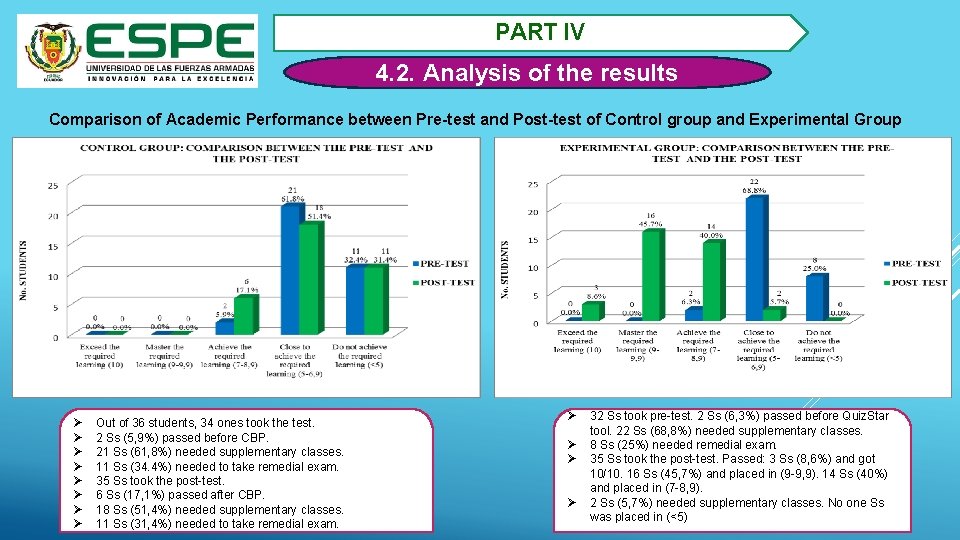
PART IV 4. 2. Analysis of the results Comparison of Academic Performance between Pre-test and Post-test of Control group and Experimental Group Ø Ø Ø Ø Out of 36 students, 34 ones took the test. 2 Ss (5, 9%) passed before CBP. 21 Ss (61, 8%) needed supplementary classes. 11 Ss (34. 4%) needed to take remedial exam. 35 Ss took the post-test. 6 Ss (17, 1%) passed after CBP. 18 Ss (51, 4%) needed supplementary classes. 11 Ss (31, 4%) needed to take remedial exam. Ø Ø 32 Ss took pre-test. 2 Ss (6, 3%) passed before Quiz. Star tool. 22 Ss (68, 8%) needed supplementary classes. 8 Ss (25%) needed remedial exam. 35 Ss took the post-test. Passed: 3 Ss (8, 6%) and got 10/10. 16 Ss (45, 7%) and placed in (9 -9, 9). 14 Ss (40%) and placed in (7 -8, 9). 2 Ss (5, 7%) needed supplementary classes. No one Ss was placed in (<5)
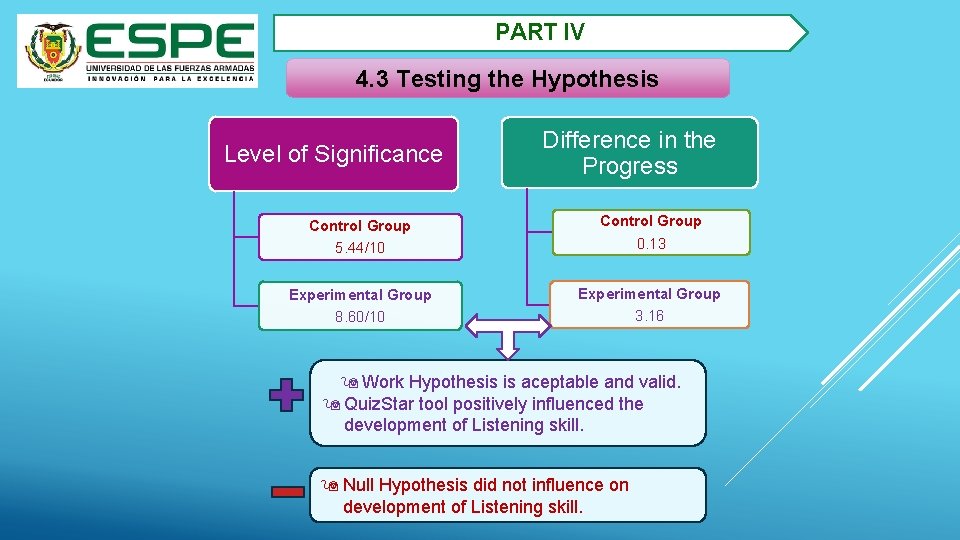
PART IV 4. 3 Testing the Hypothesis Level of Significance Difference in the Progress Control Group 5. 44/10 Control Group 0. 13 Experimental Group 8. 60/10 Experimental Group 3. 16 Work Hypothesis is aceptable and valid. Quiz. Star tool positively influenced the development of Listening skill. Null Hypothesis did not influence on development of Listening skill.
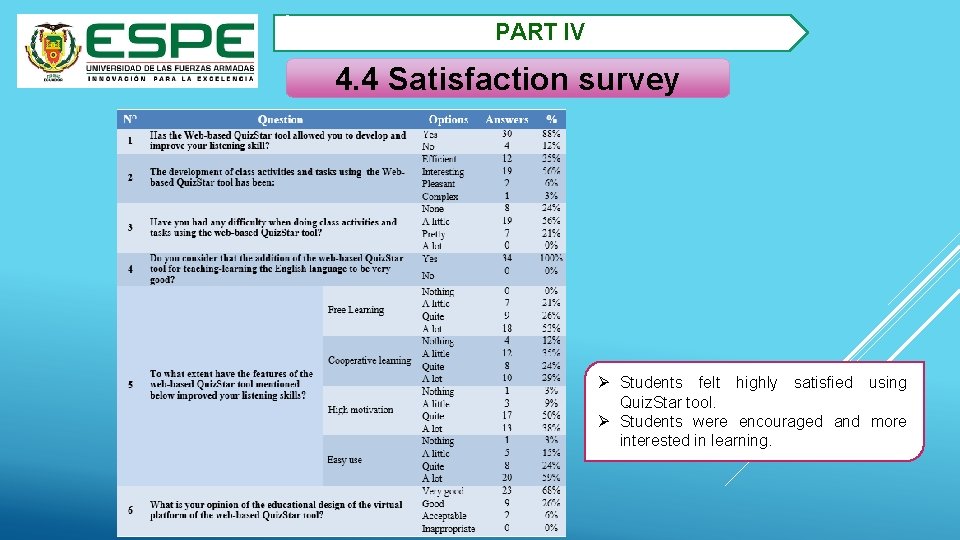
2. PART IV 4. 4 Satisfaction survey Ø Students felt highly satisfied using Quiz. Star tool. Ø Students were encouraged and more interested in learning.
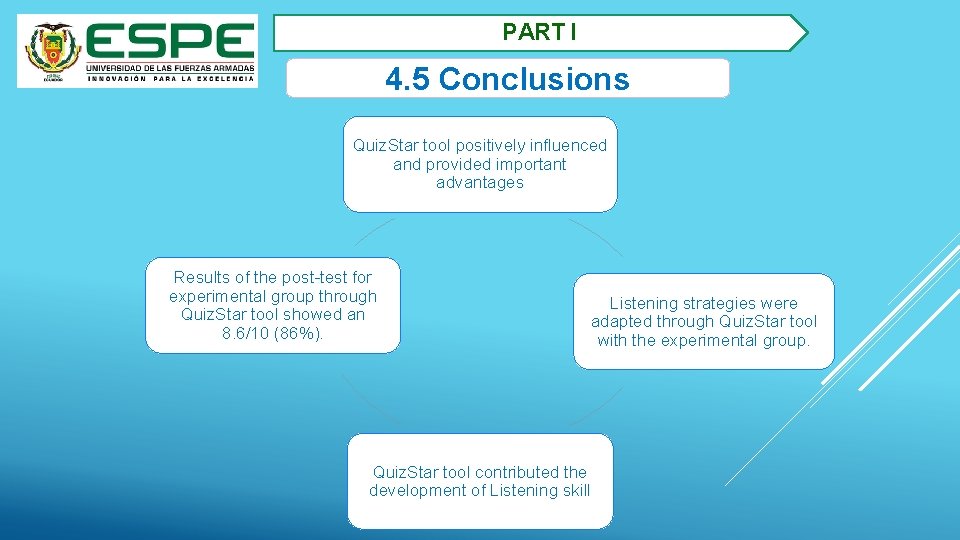
PART I 4. 5 Conclusions Quiz. Star tool positively influenced and provided important advantages Results of the post-test for experimental group through Quiz. Star tool showed an 8. 6/10 (86%). Listening strategies were adapted through Quiz. Star tool with the experimental group. Quiz. Star tool contributed the development of Listening skill
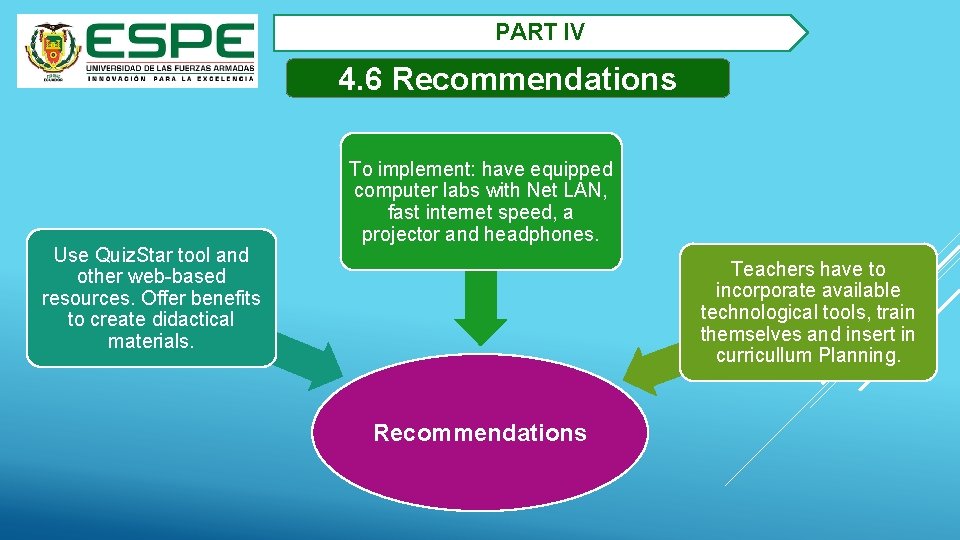
PART IV 4. 6 Recommendations Use Quiz. Star tool and other web-based resources. Offer benefits to create didactical materials. To implement: have equipped computer labs with Net LAN, fast internet speed, a projector and headphones. Teachers have to incorporate available technological tools, train themselves and insert in curricullum Planning. Recommendations
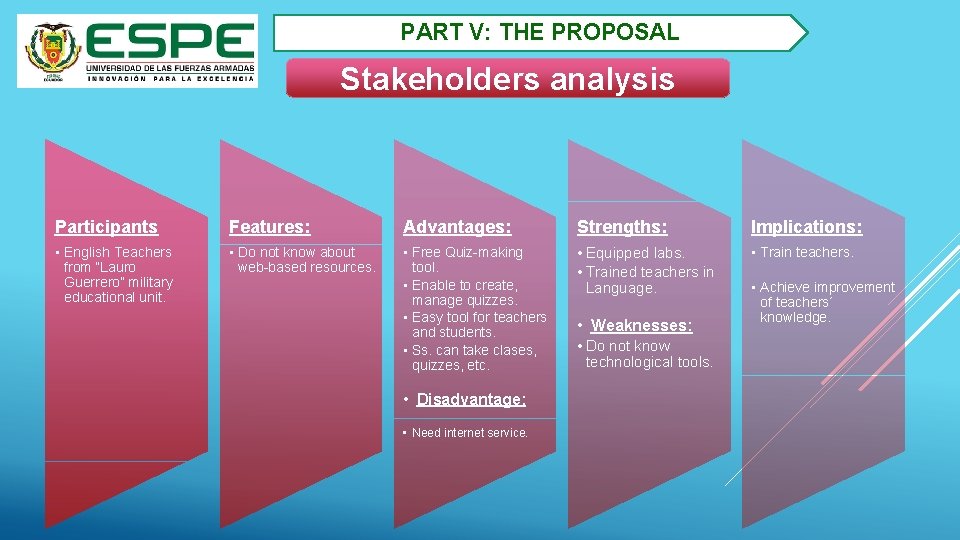
PART V: THE PROPOSAL Stakeholders analysis Participants Features: Advantages: Strengths: Implications: • English Teachers from “Lauro Guerrero” military educational unit. • Do not know about web-based resources. • Free Quiz-making tool. • Enable to create, manage quizzes. • Easy tool for teachers and students. • Ss. can take clases, quizzes, etc. • Equipped labs. • Trained teachers in Language. • Train teachers. • Disadvantage: • Need internet service. • Weaknesses: • Do not know technological tools. • Achieve improvement of teachers´ knowledge.
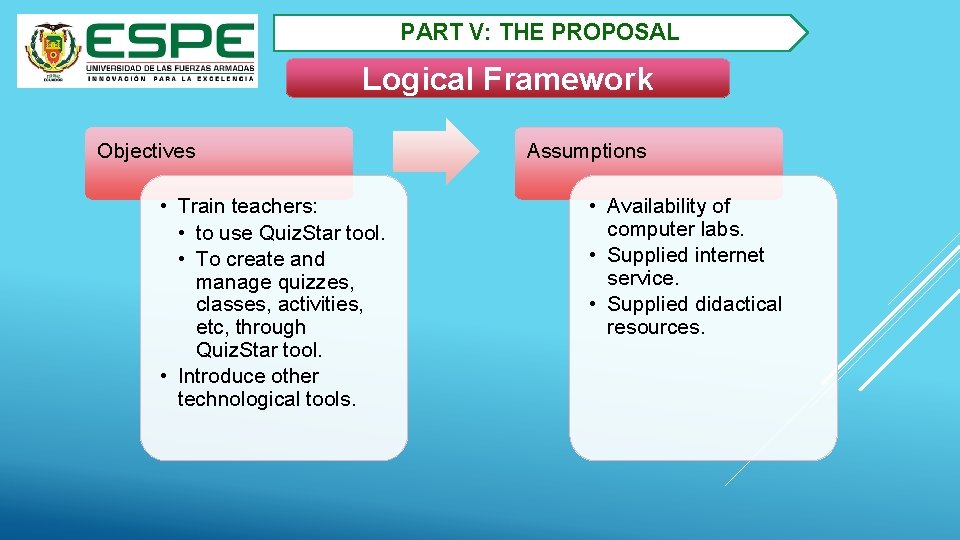
PART V: THE PROPOSAL Logical Framework Objectives • Train teachers: • to use Quiz. Star tool. • To create and manage quizzes, classes, activities, etc, through Quiz. Star tool. • Introduce other technological tools. Assumptions • Availability of computer labs. • Supplied internet service. • Supplied didactical resources.
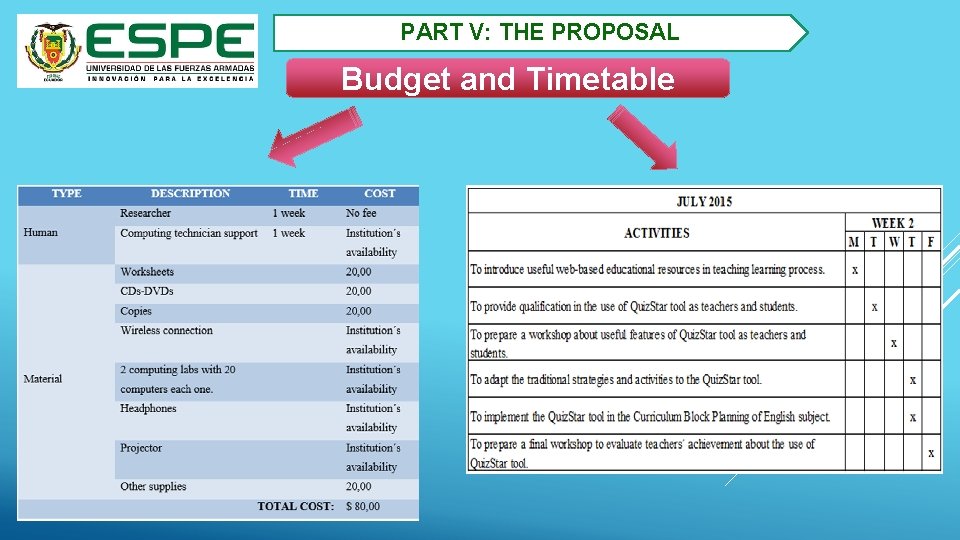
PART V: THE PROPOSAL Budget and Timetable
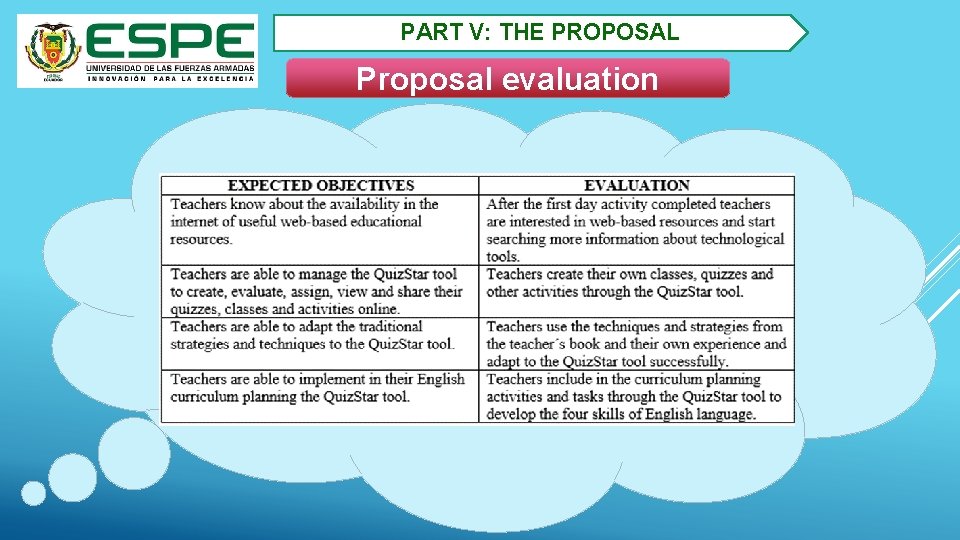
PART V: THE PROPOSAL Proposal evaluation
THANK YOU