Dating Love Sexuality n n n Sexual activity
- Slides: 42
Dating, Love, & Sexuality n n n Sexual activity Cultural standards with regard to sex before marriage Sexual scripts for males and females Sexuality among gay, lesbian, and bisexual adolescents Problems in adolescence (e. g. contraception, pregnancy, abortion, parenthood) Sex education programs Adolescence and Emerging Adulthood: A Cultural Approach by Jeffrey Jensen Arnett. Copyright © 2004 by Pearson Education. All rights reserved.
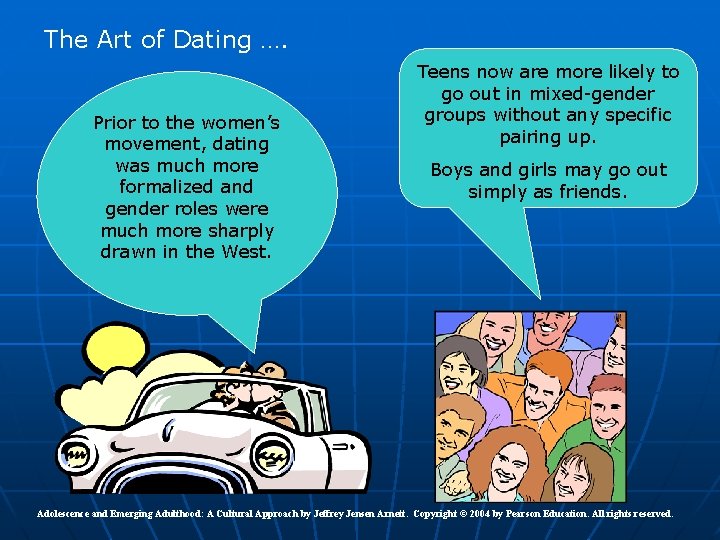
The Art of Dating …. Prior to the women’s movement, dating was much more formalized and gender roles were much more sharply drawn in the West. Teens now are more likely to go out in mixed-gender groups without any specific pairing up. Boys and girls may go out simply as friends. Adolescence and Emerging Adulthood: A Cultural Approach by Jeffrey Jensen Arnett. Copyright © 2004 by Pearson Education. All rights reserved.
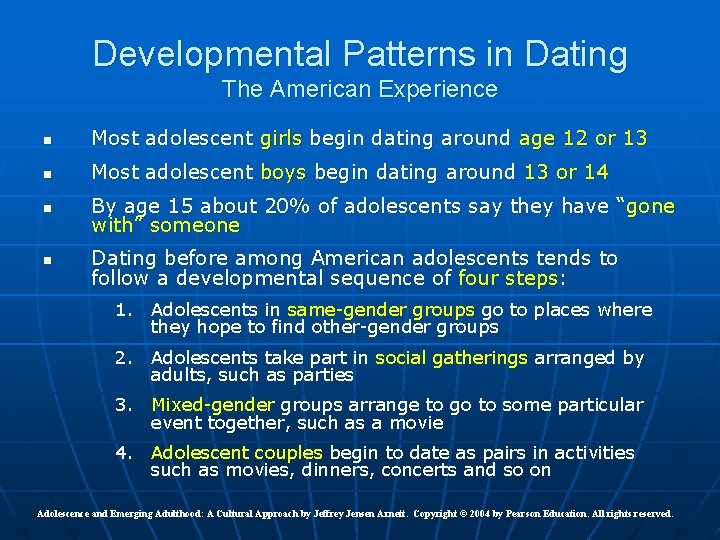
Developmental Patterns in Dating The American Experience n Most adolescent girls begin dating around age 12 or 13 n Most adolescent boys begin dating around 13 or 14 n By age 15 about 20% of adolescents say they have “ gone with” someone n Dating before among American adolescents tends to follow a developmental sequence of four steps: 1. Adolescents in same-gender groups go to places where they hope to find other-gender groups 2. Adolescents take part in social gatherings arranged by adults, such as parties 3. Mixed-gender groups arrange to go to some particular event together, such as a movie 4. Adolescent couples begin to date as pairs in activities such as movies, dinners, concerts and so on Adolescence and Emerging Adulthood: A Cultural Approach by Jeffrey Jensen Arnett. Copyright © 2004 by Pearson Education. All rights reserved.
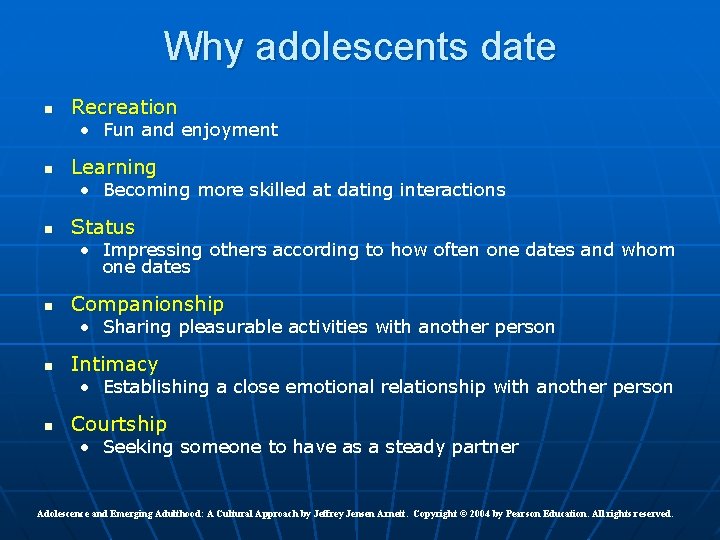
Why adolescents date n Recreation • Fun and enjoyment n Learning • Becoming more skilled at dating interactions n Status • Impressing others according to how often one dates and whom one dates n Companionship • Sharing pleasurable activities with another person n Intimacy • Establishing a close emotional relationship with another person n Courtship • Seeking someone to have as a steady partner Adolescence and Emerging Adulthood: A Cultural Approach by Jeffrey Jensen Arnett. Copyright © 2004 by Pearson Education. All rights reserved.
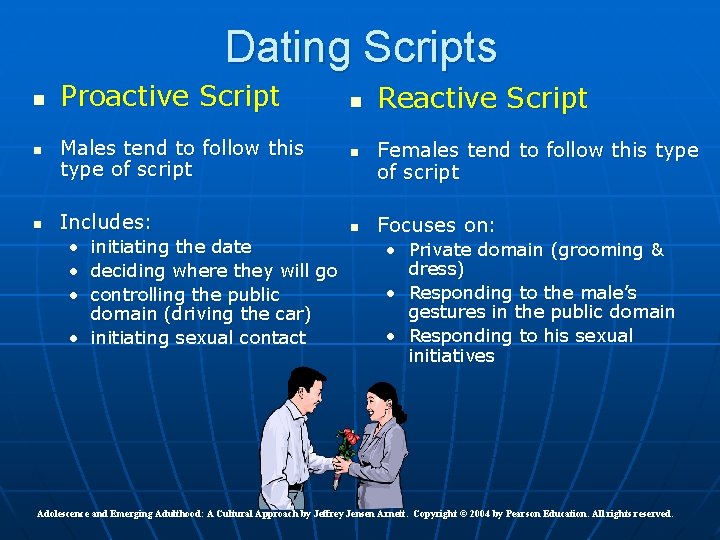
Dating Scripts n n n Proactive Script n Males tend to follow this type of script n Includes: n • initiating the date • deciding where they will go • controlling the public domain (driving the car) • initiating sexual contact Reactive Script Females tend to follow this type of script Focuses on: • Private domain (grooming & dress) • Responding to the male’s gestures in the public domain • Responding to his sexual initiatives Adolescence and Emerging Adulthood: A Cultural Approach by Jeffrey Jensen Arnett. Copyright © 2004 by Pearson Education. All rights reserved.
Sternberg’s Theory of Love n n Different types of love involve combining three fundamental qualities of love in different ways These three qualities are: 1. Passion • Involves physical attraction and sexual desire 2. Intimacy • Feelings of closeness and emotional attachment 3. Commitment • The pledge to love someone over the long run, through the ups and downs that are often part of love Adolescence and Emerging Adulthood: A Cultural Approach by Jeffrey Jensen Arnett. Copyright © 2004 by Pearson Education. All rights reserved.
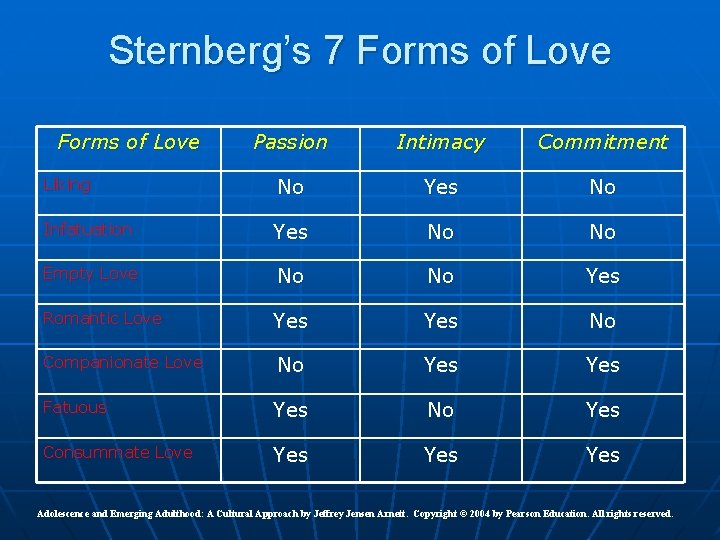
Sternberg’s 7 Forms of Love Passion Intimacy Commitment Liking No Yes No Infatuation Yes No No Empty Love No No Yes Romantic Love Yes No Companionate Love No Yes Fatuous Yes No Yes Consummate Love Yes Yes Adolescence and Emerging Adulthood: A Cultural Approach by Jeffrey Jensen Arnett. Copyright © 2004 by Pearson Education. All rights reserved.
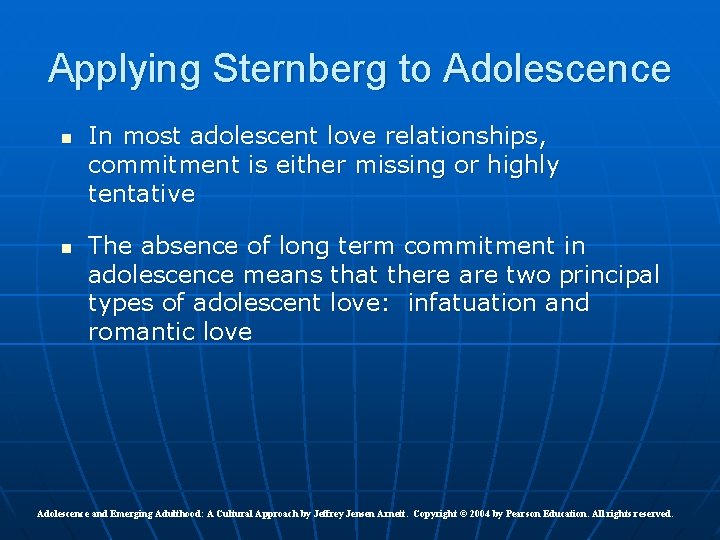
Applying Sternberg to Adolescence n n In most adolescent love relationships, commitment is either missing or highly tentative The absence of long term commitment in adolescence means that there are two principal types of adolescent love: infatuation and romantic love Adolescence and Emerging Adulthood: A Cultural Approach by Jeffrey Jensen Arnett. Copyright © 2004 by Pearson Education. All rights reserved.
Adolescent Passion in Non-Western Culture n n n Of 186 traditional cultures representing 6 distinct geographical regions around the worlds – it was found that there was evidence that young people fell passionately in love in all but one of the cultures However …. This does not mean that young people in all cultures are allowed to act on their feelings of love On the contrary … romantic love as a basis for marriage is a fairly new cultural idea Adolescence and Emerging Adulthood: A Cultural Approach by Jeffrey Jensen Arnett. Copyright © 2004 by Pearson Education. All rights reserved.
Falling in Love n Consensual validation • People like to find in others an agreement, or consensus, with their own characteristics • Finding this consensus supports, or validates, their own way of looking at the world n People of all ages tend to have romantic relationships with people who are similar to them in characteristics such as: • Intelligence • Social class • Ethnic background • Religious beliefs • Physical attractiveness Adolescence and Emerging Adulthood: A Cultural Approach by Jeffrey Jensen Arnett. Copyright © 2004 by Pearson Education. All rights reserved.
Attachment Styles n Attachment styles between lovers have been found to resemble the parent-child attachment styles • Secure n Characterized by emotional support and concern for the partner’s well-being • Anxious-ambivalent n Characterized by overdependence on the romantic partner along with insensitivity to the partner’s needs • Anxious-avoidant n Involve keeping emotional distance from the romantic partner and inhibiting self-disclosure Adolescence and Emerging Adulthood: A Cultural Approach by Jeffrey Jensen Arnett. Copyright © 2004 by Pearson Education. All rights reserved.
Brown’s Model of Adolescent Love n n Bradford Brown (1999) has proposed a developmental model of adolescent love that recognizes the important role played by peers and friends Brown’s model contains four phases: 1. Initiation phase • 2. First tentative explorations of love which are usually superficial, brief and often fraught with anxiety, fear, and excitement Status phase • • 3. Begin to gain confidence in their interaction skills with potential romantic partners Adolescents remain acutely aware of the evaluations of their friends and peers Affection phase • • 4. Adolescents come to know each other better and express deeper feelings for each other Being to engage in more extensive sexual activity Bonding phase • • The romantic relationship becomes more enduring and serious – partners begin to discuss the possibility of a lifelong commitment This phase usually occurs in emerging adulthood rather than adolescence Adolescence and Emerging Adulthood: A Cultural Approach by Jeffrey Jensen Arnett. Copyright © 2004 by Pearson Education. All rights reserved.
When Love Goes Bad n How can adolescent egocentrism and the personal fable contribute to feelings of breaking up? Adolescence and Emerging Adulthood: A Cultural Approach by Jeffrey Jensen Arnett. Copyright © 2004 by Pearson Education. All rights reserved.
Breaking Up – Understanding Emerging Adults n Based on a study of 200 college couples for 2 years (Hill, Rubin, & Peplau, 1979) • 45% of the couples had broken up • Those who had broken up n n n reported lower levels of intimacy and love were less likely to be similar on characteristics such as age, SAT scores and physical attractiveness were less balanced (one partner indicated substantially more commitment to the relationship than the other) • Women were more likely to end the relationship • Rejected men tended to be lonelier, unhappier and more depressed than rejected women • Rejected men found it harder than rejected women to accept the end of the relationship and to stay friends Adolescence and Emerging Adulthood: A Cultural Approach by Jeffrey Jensen Arnett. Copyright © 2004 by Pearson Education. All rights reserved.
Choosing a Marriage Partner n n The Study: 10, 000 young people in 37 countries from all over the world (Africa, Asia, Eastern and Western Europe, & North and South America) The Findings: Highest Ranking Mutual attraction High Rankings: Dependable character Emotional stability & Maturity Pleasing disposition Lowest Ranking: Religious & political backgrounds Low Rankings: Good financial prospects Having a lot of money The sharpest cross-cultural division was on the issue of chastity Adolescence and Emerging Adulthood: A Cultural Approach by Jeffrey Jensen Arnett. Copyright © 2004 by Pearson Education. All rights reserved.
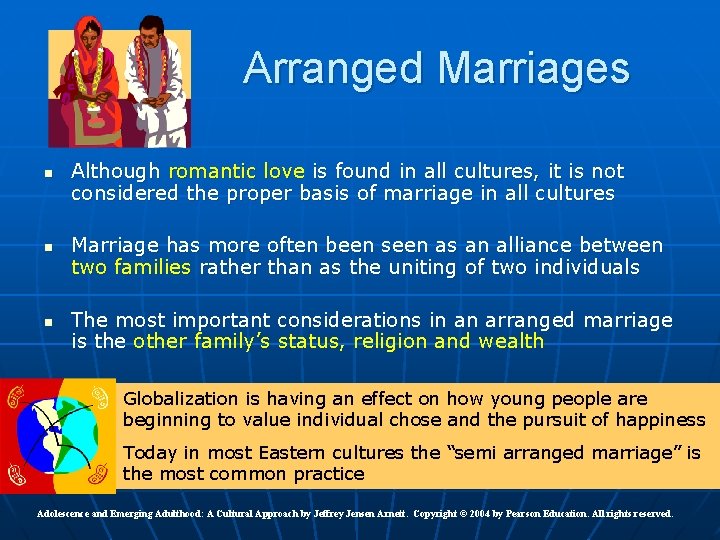
Arranged Marriages n n n Although romantic love is found in all cultures, it is not considered the proper basis of marriage in all cultures Marriage has more often been seen as an alliance between two families rather than as the uniting of two individuals The most important considerations in an arranged marriage is the other family’s status, religion and wealth Globalization is having an effect on how young people are beginning to value individual chose and the pursuit of happiness Today in most Eastern cultures the “semi arranged marriage” is the most common practice Adolescence and Emerging Adulthood: A Cultural Approach by Jeffrey Jensen Arnett. Copyright © 2004 by Pearson Education. All rights reserved.
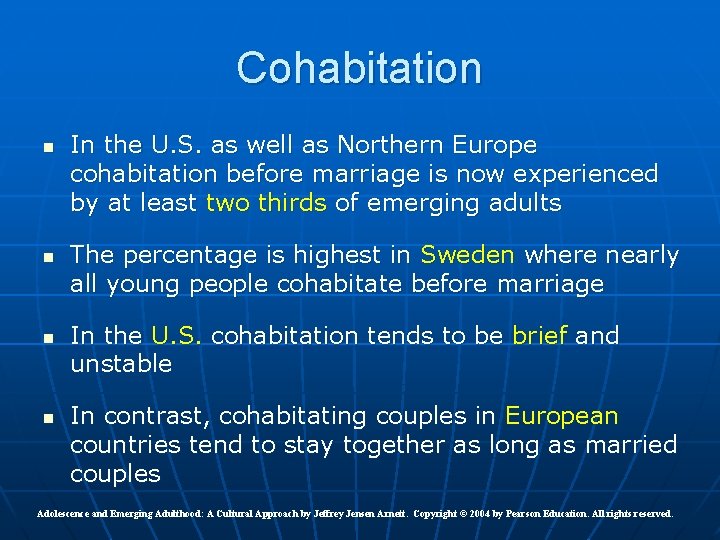
Cohabitation n n In the U. S. as well as Northern Europe cohabitation before marriage is now experienced by at least two thirds of emerging adults The percentage is highest in Sweden where nearly all young people cohabitate before marriage In the U. S. cohabitation tends to be brief and unstable In contrast, cohabitating couples in European countries tend to stay together as long as married couples Adolescence and Emerging Adulthood: A Cultural Approach by Jeffrey Jensen Arnett. Copyright © 2004 by Pearson Education. All rights reserved.
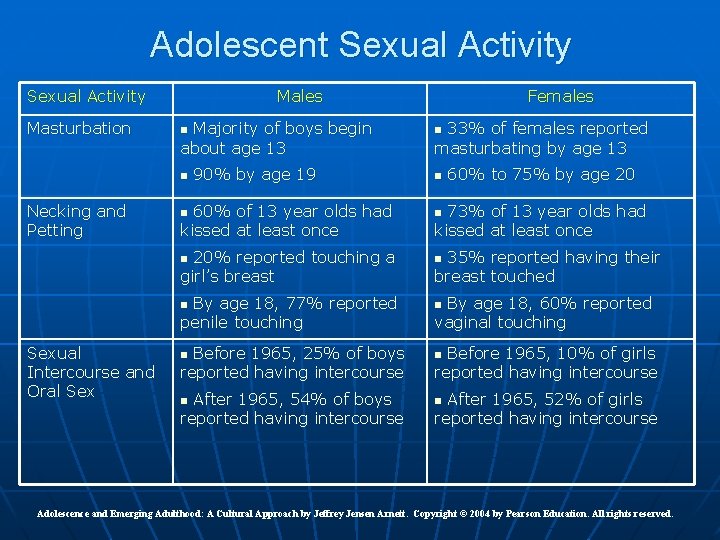
Adolescent Sexual Activity Masturbation Males Majority of boys begin about age 13 n n Necking and Petting 90% by age 19 60% of 13 year olds had kissed at least once n 20% reported touching a girl’s breast n By age 18, 77% reported penile touching n Sexual Intercourse and Oral Sex Before 1965, 25% of boys reported having intercourse n After 1965, 54% of boys reported having intercourse n Females 33% of females reported masturbating by age 13 n n 60% to 75% by age 20 73% of 13 year olds had kissed at least once n 35% reported having their breast touched n By age 18, 60% reported vaginal touching n Before 1965, 10% of girls reported having intercourse n After 1965, 52% of girls reported having intercourse n Adolescence and Emerging Adulthood: A Cultural Approach by Jeffrey Jensen Arnett. Copyright © 2004 by Pearson Education. All rights reserved.
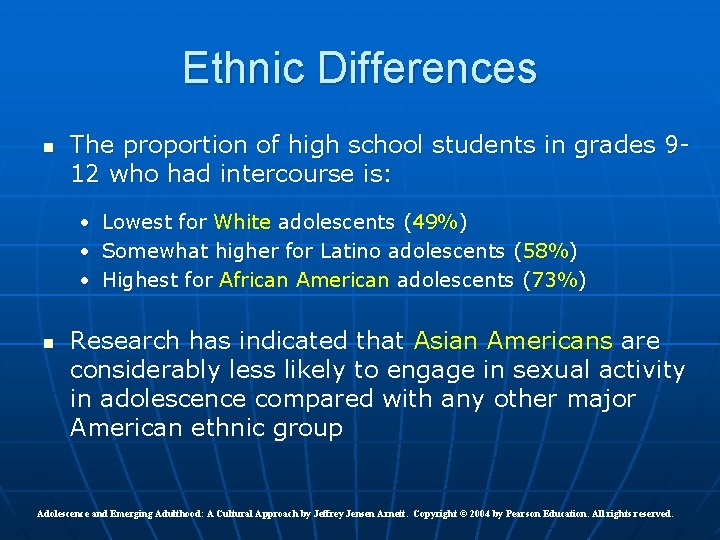
Ethnic Differences n The proportion of high school students in grades 912 who had intercourse is: • Lowest for White adolescents (49%) • Somewhat higher for Latino adolescents (58%) • Highest for African American adolescents (73%) n Research has indicated that Asian Americans are considerably less likely to engage in sexual activity in adolescence compared with any other major American ethnic group Adolescence and Emerging Adulthood: A Cultural Approach by Jeffrey Jensen Arnett. Copyright © 2004 by Pearson Education. All rights reserved.
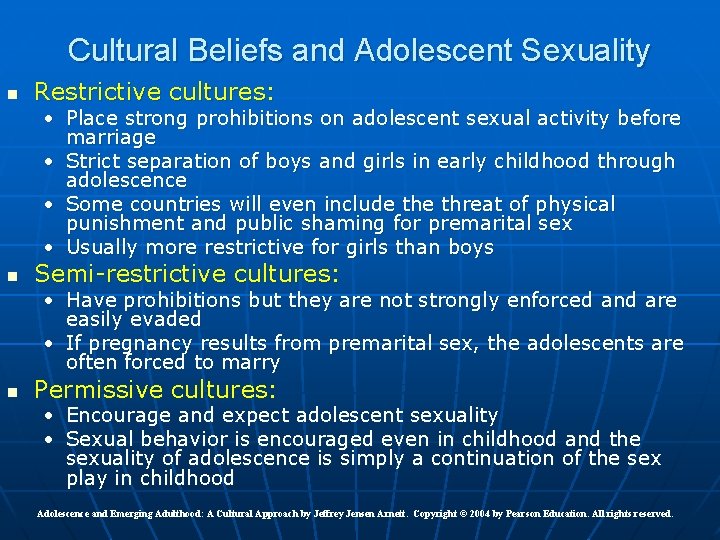
Cultural Beliefs and Adolescent Sexuality n Restrictive cultures: • Place strong prohibitions on adolescent sexual activity before marriage • Strict separation of boys and girls in early childhood through adolescence • Some countries will even include threat of physical punishment and public shaming for premarital sex • Usually more restrictive for girls than boys n Semi-restrictive cultures: • Have prohibitions but they are not strongly enforced and are easily evaded • If pregnancy results from premarital sex, the adolescents are often forced to marry n Permissive cultures: • Encourage and expect adolescent sexuality • Sexual behavior is encouraged even in childhood and the sexuality of adolescence is simply a continuation of the sex play in childhood Adolescence and Emerging Adulthood: A Cultural Approach by Jeffrey Jensen Arnett. Copyright © 2004 by Pearson Education. All rights reserved.
Sexual Scripts n n Different cognitive frameworks for understanding how a sexual experience is supposed to proceed and how sexual experiences are to be interpreted Examples: • Boys are expected to “make the moves” • Girls set the limits on how far the sexual episode is allowed to progress Adolescence and Emerging Adulthood: A Cultural Approach by Jeffrey Jensen Arnett. Copyright © 2004 by Pearson Education. All rights reserved.
Sexually Active Adolescents n Characteristics of non-virgins • • n Similar self-esteem as virgins Similar overall life satisfaction as virgins More likely to be early maturing Tend to have lower levels of academic performance and academic aspirations Adolescents who have sex early (15 years old or younger) • • • Early users of drugs and alcohol More likely to be from single parent households More likely to have grown up in poverty Adolescence and Emerging Adulthood: A Cultural Approach by Jeffrey Jensen Arnett. Copyright © 2004 by Pearson Education. All rights reserved.
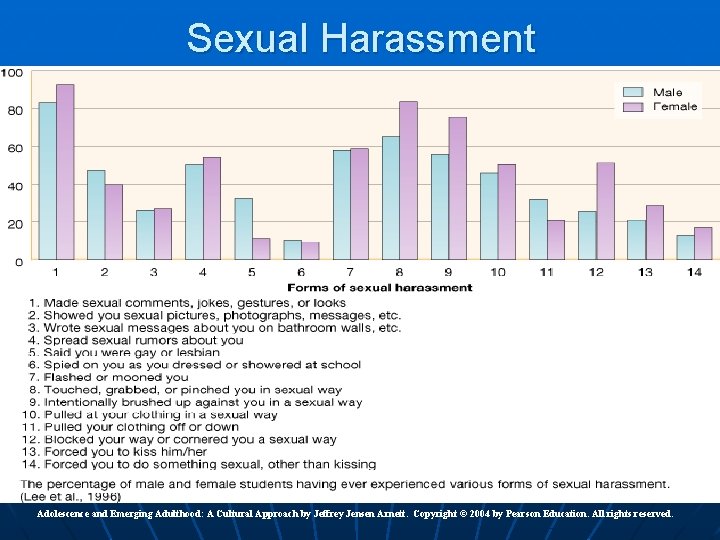
Sexual Harassment n n n Includes a wide range of behaviours from mild harassment such as name calling, joke and leering looks to severe harassment involving unwanted touching or sexual contact It is estimated that over half of American women will experience sexual harassment at some time during their professional live Date Rape is one form of sexual harassment that takes place when a persons, usually a woman, is forced by a romantic partner, date, or acquaintance to have sexual relations against her will • 15% of adolescent girls and 25% of emerging adult women have experienced date rape • Alcohol plays a big part in date rape on college campuses Adolescence and Emerging Adulthood: A Cultural Approach by Jeffrey Jensen Arnett. Copyright © 2004 by Pearson Education. All rights reserved.
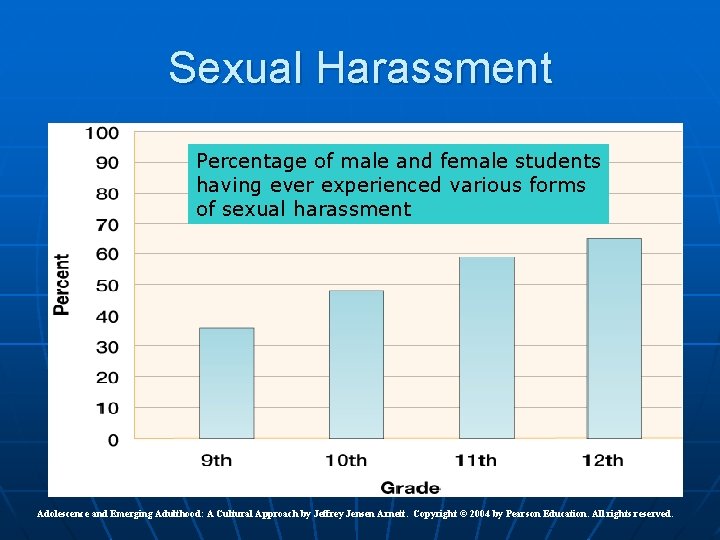
Sexual Harassment Percentage of male and female students having ever experienced various forms of sexual harassment Adolescence and Emerging Adulthood: A Cultural Approach by Jeffrey Jensen Arnett. Copyright © 2004 by Pearson Education. All rights reserved.
Sexual Harassment Adolescence and Emerging Adulthood: A Cultural Approach by Jeffrey Jensen Arnett. Copyright © 2004 by Pearson Education. All rights reserved.
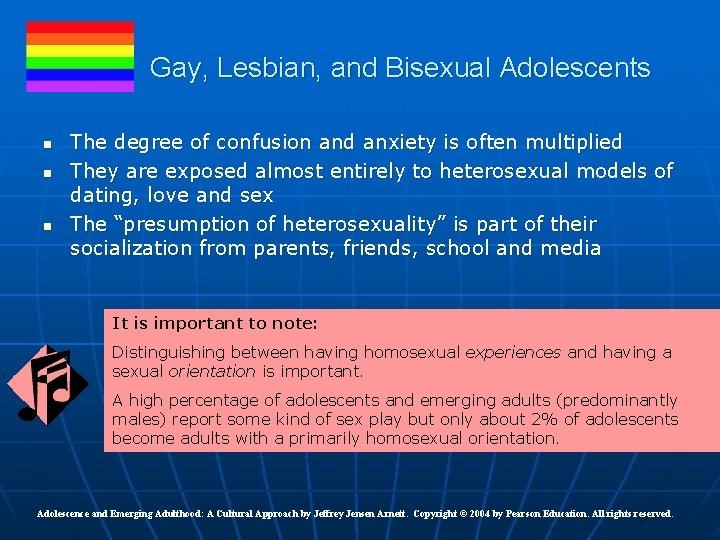
Gay, Lesbian, and Bisexual Adolescents n n n The degree of confusion and anxiety is often multiplied They are exposed almost entirely to heterosexual models of dating, love and sex The “presumption of heterosexuality” is part of their socialization from parents, friends, school and media It is important to note: Distinguishing between having homosexual experiences and having a sexual orientation is important. A high percentage of adolescents and emerging adults (predominantly males) report some kind of sex play but only about 2% of adolescents become adults with a primarily homosexual orientation. Adolescence and Emerging Adulthood: A Cultural Approach by Jeffrey Jensen Arnett. Copyright © 2004 by Pearson Education. All rights reserved.
Gay, Lesbian, and Bisexual Adolescents n n It is during adolescence that most gay, lesbian and bisexual (GLB) people become fully aware of their sexual orientation Coming out • beginning at an average of 14 for gay males and a year or two later for lesbians • Involves a person’s recognizing his or her own sexual identity and then disclosing the truth to friends, family and others n Homophobia • • Fear and hatred of homosexuals Because of this phenomenon, coming to the realization of a GLB identity can be traumatic for many adolescents Adolescence and Emerging Adulthood: A Cultural Approach by Jeffrey Jensen Arnett. Copyright © 2004 by Pearson Education. All rights reserved.
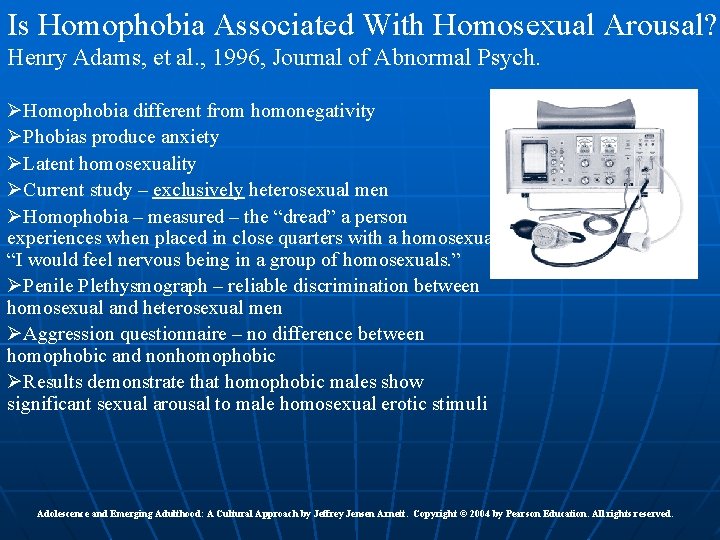
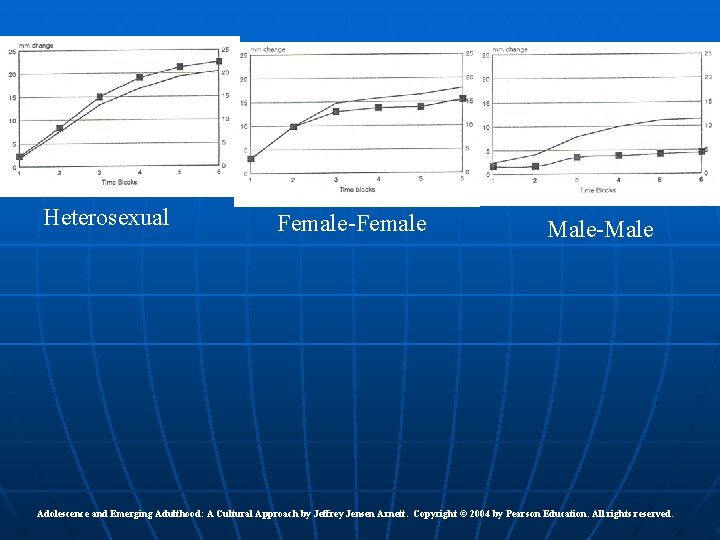
Is Homophobia Associated With Homosexual Arousal? Henry Adams, et al. , 1996, Journal of Abnormal Psych. ØHomophobia different from homonegativity ØPhobias produce anxiety ØLatent homosexuality ØCurrent study – exclusively heterosexual men ØHomophobia – measured – the “dread” a person experiences when placed in close quarters with a homosexual. “I would feel nervous being in a group of homosexuals. ” ØPenile Plethysmograph – reliable discrimination between homosexual and heterosexual men ØAggression questionnaire – no difference between homophobic and nonhomophobic ØResults demonstrate that homophobic males show significant sexual arousal to male homosexual erotic stimuli Adolescence and Emerging Adulthood: A Cultural Approach by Jeffrey Jensen Arnett. Copyright © 2004 by Pearson Education. All rights reserved.
Heterosexual Female-Female Male-Male Adolescence and Emerging Adulthood: A Cultural Approach by Jeffrey Jensen Arnett. Copyright © 2004 by Pearson Education. All rights reserved.
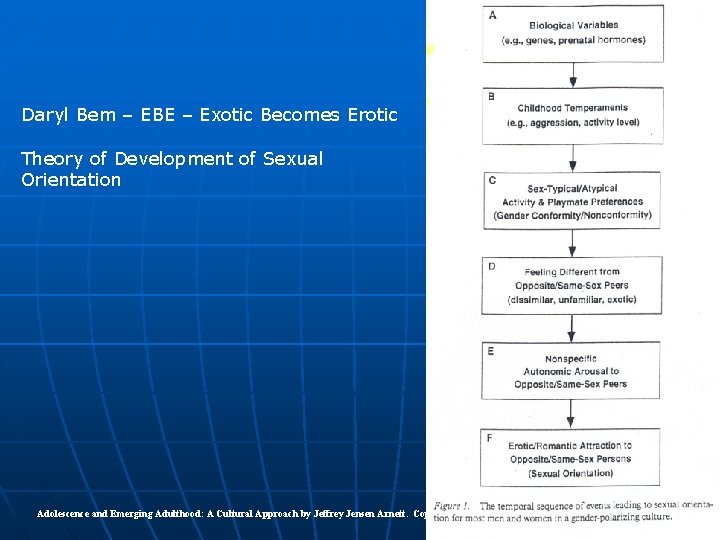
Daryl Bem – EBE – Exotic Becomes Erotic Theory of Development of Sexual Orientation Adolescence and Emerging Adulthood: A Cultural Approach by Jeffrey Jensen Arnett. Copyright © 2004 by Pearson Education. All rights reserved.
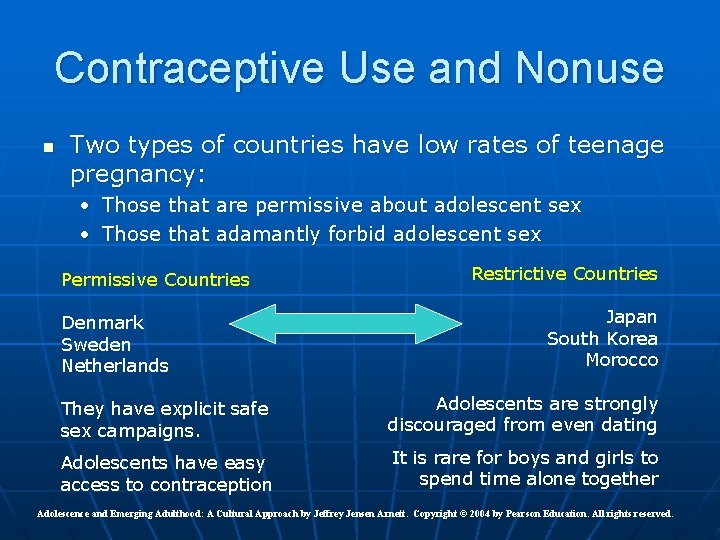
Contraceptive Use and Nonuse n Two types of countries have low rates of teenage pregnancy: • Those that are permissive about adolescent sex • Those that adamantly forbid adolescent sex Permissive Countries Denmark Sweden Netherlands Restrictive Countries Japan South Korea Morocco They have explicit safe sex campaigns. Adolescents are strongly discouraged from even dating Adolescents have easy access to contraception It is rare for boys and girls to spend time alone together Adolescence and Emerging Adulthood: A Cultural Approach by Jeffrey Jensen Arnett. Copyright © 2004 by Pearson Education. All rights reserved.
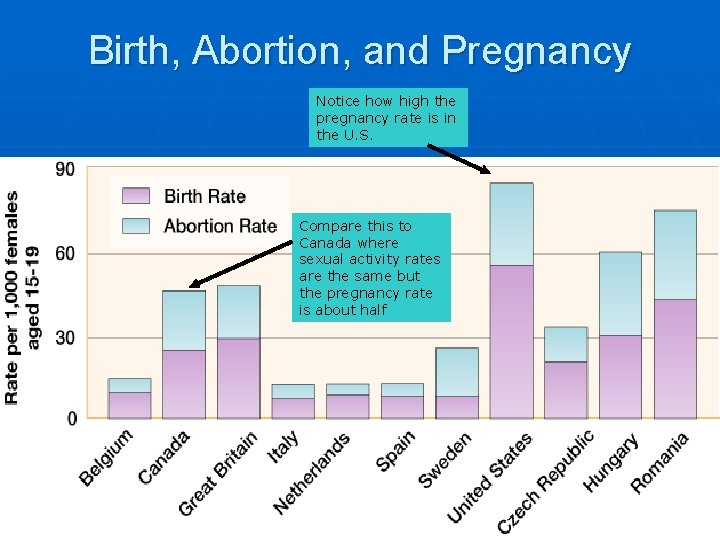
Birth, Abortion, and Pregnancy Notice how high the pregnancy rate is in the U. S. Compare this to Canada where sexual activity rates are the same but the pregnancy rate is about half Adolescence and Emerging Adulthood: A Cultural Approach by Jeffrey Jensen Arnett. Copyright © 2004 by Pearson Education. All rights reserved.
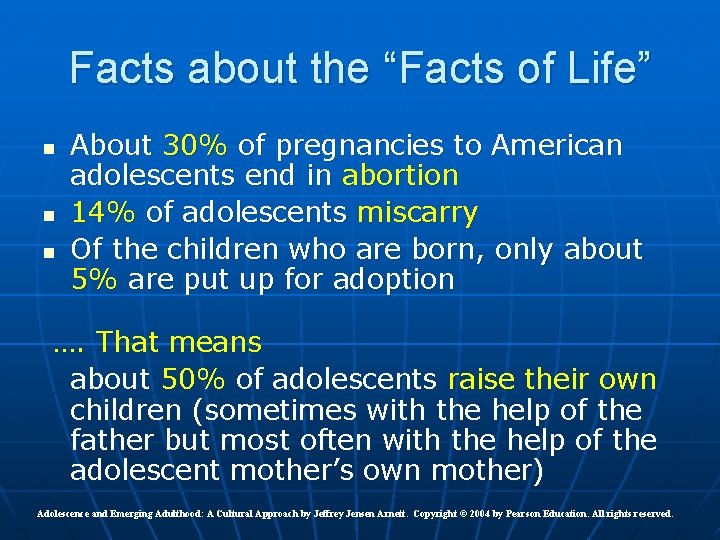
Facts about the “Facts of Life” n n n About 30% of pregnancies to American adolescents end in abortion 14% of adolescents miscarry Of the children who are born, only about 5% are put up for adoption …. That means about 50% of adolescents raise their own children (sometimes with the help of the father but most often with the help of the adolescent mother’s own mother) Adolescence and Emerging Adulthood: A Cultural Approach by Jeffrey Jensen Arnett. Copyright © 2004 by Pearson Education. All rights reserved.
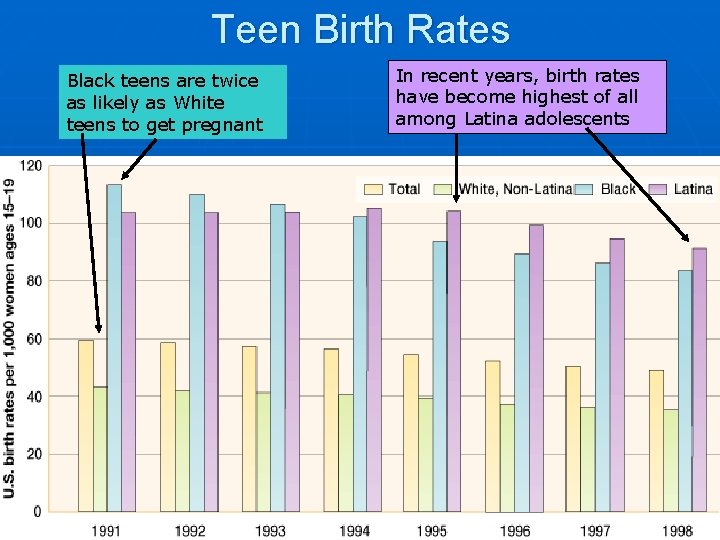
Teen Birth Rates Black teens are twice as likely as White teens to get pregnant In recent years, birth rates have become highest of all among Latina adolescents Adolescence and Emerging Adulthood: A Cultural Approach by Jeffrey Jensen Arnett. Copyright © 2004 by Pearson Education. All rights reserved.
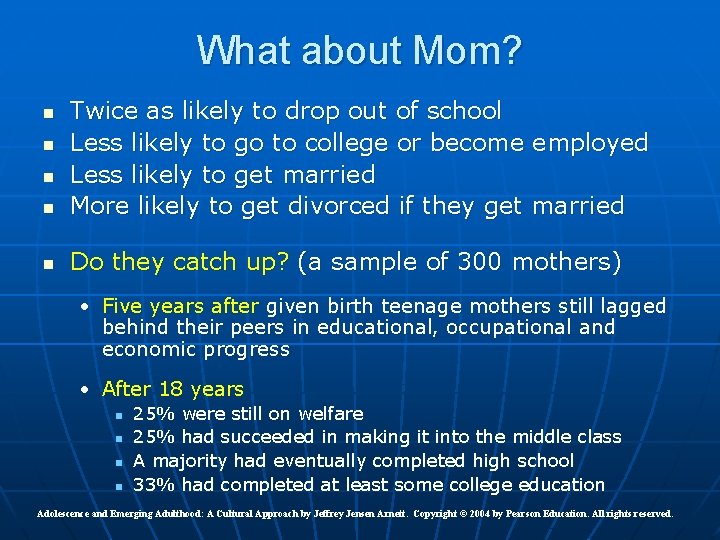
What about Mom? n Twice as likely to drop out of school Less likely to go to college or become employed Less likely to get married More likely to get divorced if they get married n Do they catch up? (a sample of 300 mothers) n n n • Five years after given birth teenage mothers still lagged behind their peers in educational, occupational and economic progress • After 18 years n n 25% were still on welfare 25% had succeeded in making it into the middle class A majority had eventually completed high school 33% had completed at least some college education Adolescence and Emerging Adulthood: A Cultural Approach by Jeffrey Jensen Arnett. Copyright © 2004 by Pearson Education. All rights reserved.
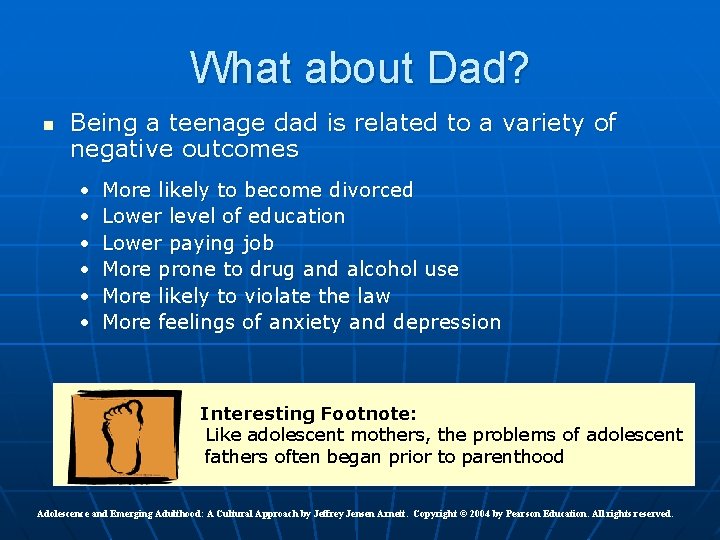
What about Dad? n Being a teenage dad is related to a variety of negative outcomes • • • More likely to become divorced Lower level of education Lower paying job More prone to drug and alcohol use More likely to violate the law More feelings of anxiety and depression Interesting Footnote: Like adolescent mothers, the problems of adolescent fathers often began prior to parenthood Adolescence and Emerging Adulthood: A Cultural Approach by Jeffrey Jensen Arnett. Copyright © 2004 by Pearson Education. All rights reserved.
What about Baby? n Children born to adolescent mothers face a higher likelihood of a variety of difficulties in life • • • Babies are more likely to be born premature Lower birth rate Premature and low birth rate are related to a variety of physical and intellectual problems • Greater likelihood of behavioral problems • School misbehaviour, delinquency and early sexual activity It is important to note: These problems are not just due to having an adolescent mother but also due to the fact that most adolescent mothers are not only young and unmarried but poor as well Adolescence and Emerging Adulthood: A Cultural Approach by Jeffrey Jensen Arnett. Copyright © 2004 by Pearson Education. All rights reserved.
Sexually Transmitted Diseases n n n By age 24, one in three sexually active Americans have contracted an STD Two thirds of all STDs occur in people who are under 25 years old Two important characteristics of STDs • Asymptomatic n n People show no symptoms of the disease They are especially likely to infect others because neither they nor others realize that they are infected • Latency Period n n There may be years between the time people are infected and the time they being to show symptoms During this time they may be infecting others without either themselves or their partners being aware of it Adolescence and Emerging Adulthood: A Cultural Approach by Jeffrey Jensen Arnett. Copyright © 2004 by Pearson Education. All rights reserved.
Sexually Transmitted Diseases n Chlamydia • Most common STD • Highest rates among 15 to 19 year olds • Leading cause of female infertility n Gonorrhea • Caused by bacteria that thrive in the moist mucous membranes of the body • Very easily passed along during sex • Females are at least twice as likely as males to become infected n Herpes Simplex • Caused by a virus • Has two variations: herpes simplex I and herpes simplex II • Highly infectious (75% of persons exposed to an infected partner will become infected) • There is no cure for herpes Adolescence and Emerging Adulthood: A Cultural Approach by Jeffrey Jensen Arnett. Copyright © 2004 by Pearson Education. All rights reserved.
Sexually transmitted diseases n HIV/AIDS • Strips the body of its ability to fend off infections • The body is highly vulnerable to a wide variety of illnesses and diseases • 90% of cases of HIV in the U. S. result from intercourse between homosexual or bisexual partners • Outside the U. S. HIV/AIDS is spread mainly between heterosexual partners • Has a long latency period (tend to by asymptomatic up to 5 years) • AIDS is the leading cause of death worldwide among persons 25 to 44 years old • 10 of every 11 new HIV infections worldwide come from Africa • The mortality rate for people who have AIDS remains extremely high Adolescence and Emerging Adulthood: A Cultural Approach by Jeffrey Jensen Arnett. Copyright © 2004 by Pearson Education. All rights reserved.
Sex Education n n Americans agree that rates of premarital pregnancy and STDs in adolescence are serious problems that must be reduced However there is vehement disagreement about what is the best solution • One side: comprehensive sexuality education • Other side: abstinence promotion Adolescence and Emerging Adulthood: A Cultural Approach by Jeffrey Jensen Arnett. Copyright © 2004 by Pearson Education. All rights reserved.
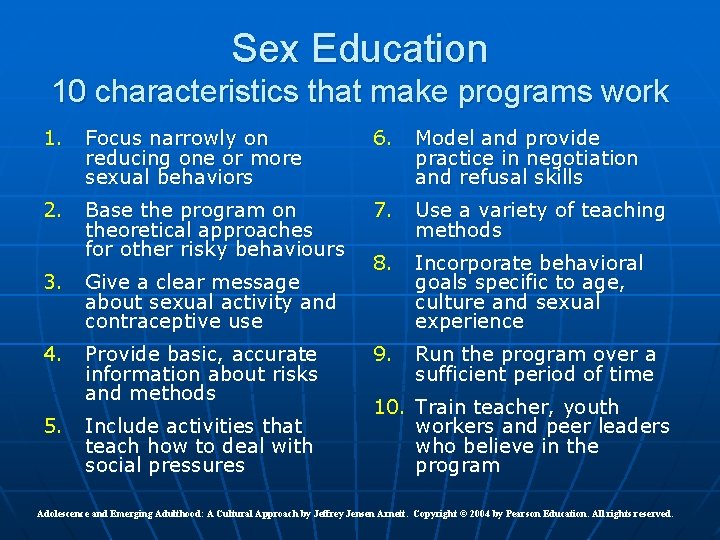
Sex Education 10 characteristics that make programs work 1. Focus narrowly on reducing one or more sexual behaviors 6. Model and provide practice in negotiation and refusal skills 2. Base the program on theoretical approaches for other risky behaviours 7. Use a variety of teaching methods 8. Incorporate behavioral goals specific to age, culture and sexual experience 9. Run the program over a sufficient period of time 3. Give a clear message about sexual activity and contraceptive use 4. Provide basic, accurate information about risks and methods 5. Include activities that teach how to deal with social pressures 10. Train teacher, youth workers and peer leaders who believe in the program Adolescence and Emerging Adulthood: A Cultural Approach by Jeffrey Jensen Arnett. Copyright © 2004 by Pearson Education. All rights reserved.