Date Day 13 EQ What is a solution
- Slides: 26
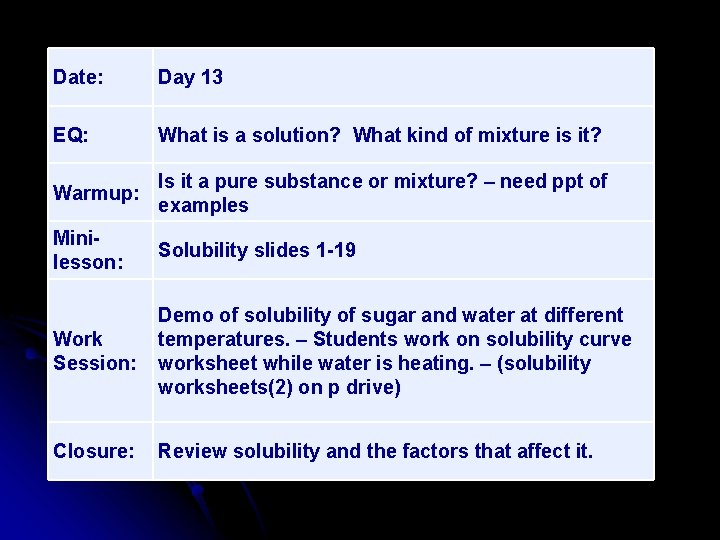
Date: Day 13 EQ: What is a solution? What kind of mixture is it? Warmup: Is it a pure substance or mixture? – need ppt of examples Minilesson: Solubility slides 1 -19 Work Session: Demo of solubility of sugar and water at different temperatures. – Students work on solubility curve worksheet while water is heating. – (solubility worksheets(2) on p drive) Closure: Review solubility and the factors that affect it.
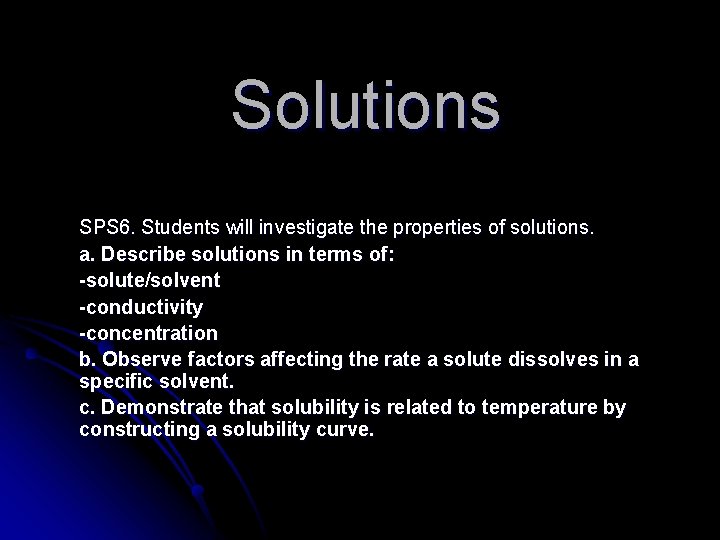
Solutions SPS 6. Students will investigate the properties of solutions. a. Describe solutions in terms of: -solute/solvent -conductivity -concentration b. Observe factors affecting the rate a solute dissolves in a specific solvent. c. Demonstrate that solubility is related to temperature by constructing a solubility curve.
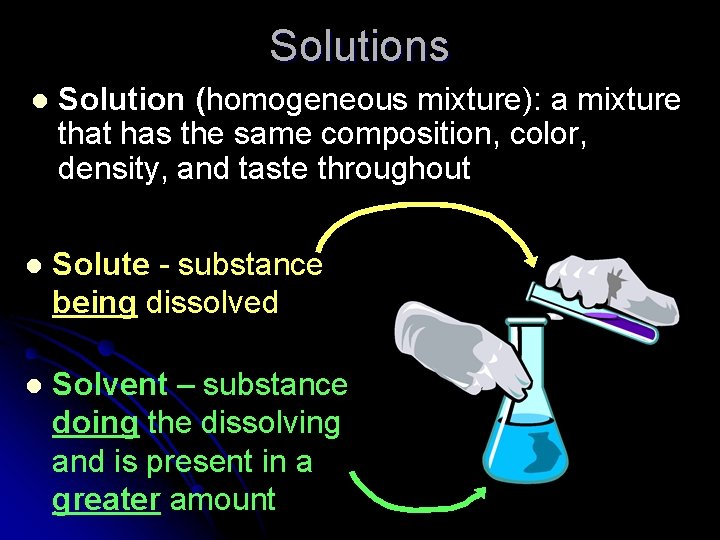
Solutions l Solution (homogeneous mixture): a mixture that has the same composition, color, density, and taste throughout l Solute - substance being dissolved l Solvent – substance doing the dissolving and is present in a greater amount
Nonliquid Solutions l Solutions can also be gaseous or even solid. l Air is a solution of 78 percent nitrogen, 20 percent oxygen, and small amounts of other gases such as argon, carbon dioxide, and hydrogen.
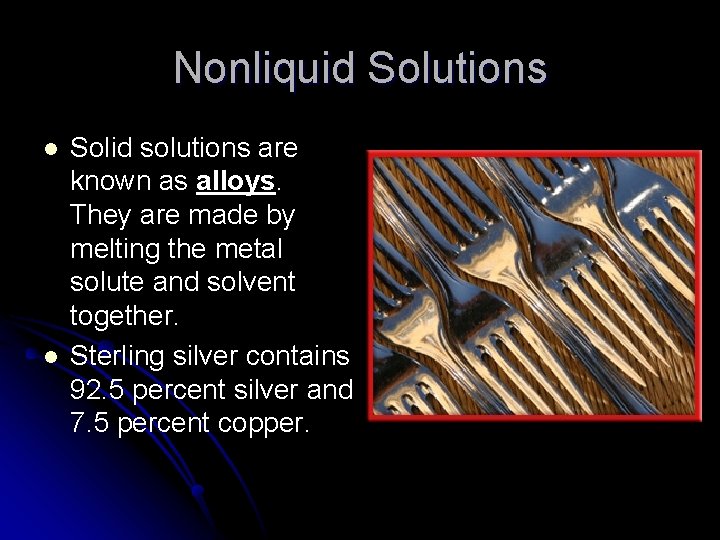
Nonliquid Solutions l l Solid solutions are known as alloys. They are made by melting the metal solute and solvent together. Sterling silver contains 92. 5 percent silver and 7. 5 percent copper.
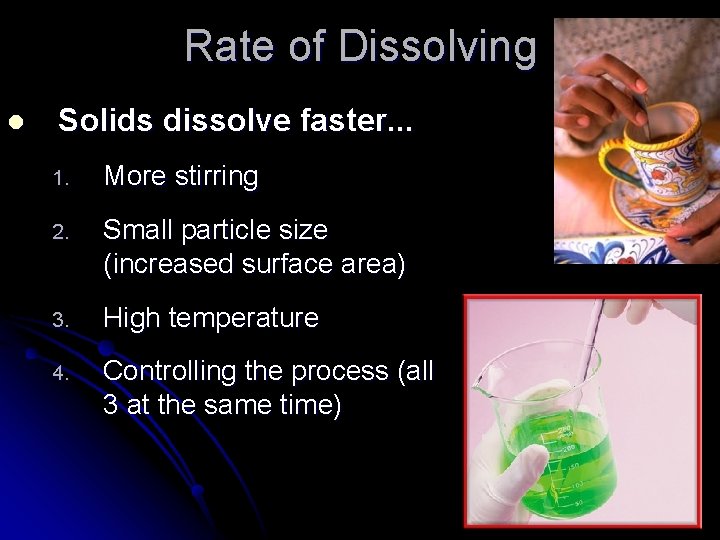
Rate of Dissolving l Solids dissolve faster. . . 1. More stirring 2. Small particle size (increased surface area) 3. High temperature 4. Controlling the process (all 3 at the same time)
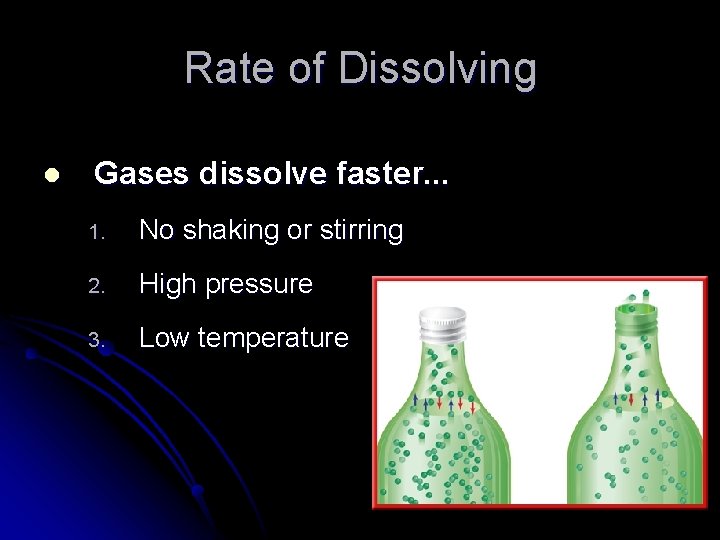
Rate of Dissolving l Gases dissolve faster. . . 1. No shaking or stirring 2. High pressure 3. Low temperature
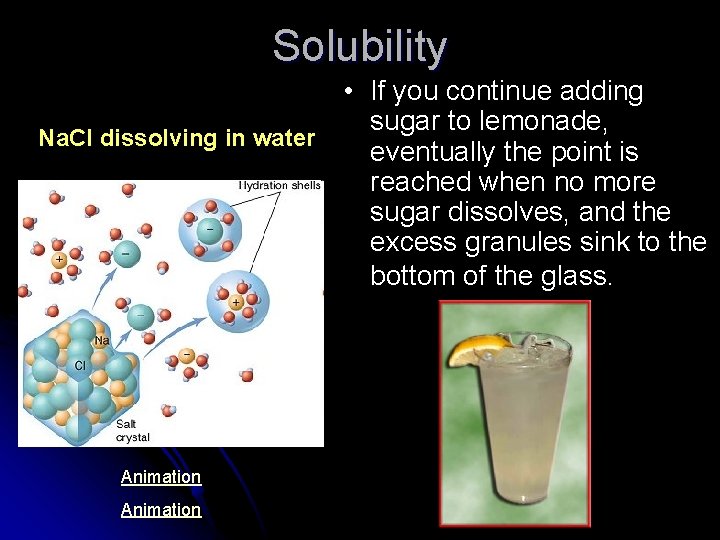
Solubility • If you continue adding sugar to lemonade, Na. Cl dissolving in water eventually the point is reached when no more sugar dissolves, and the excess granules sink to the bottom of the glass. Animation
Solubility l Solubility Maximum grams of solute that will dissolve in 100 g of solvent at a given temperature l Varies with temperature l Based on a saturated solution l
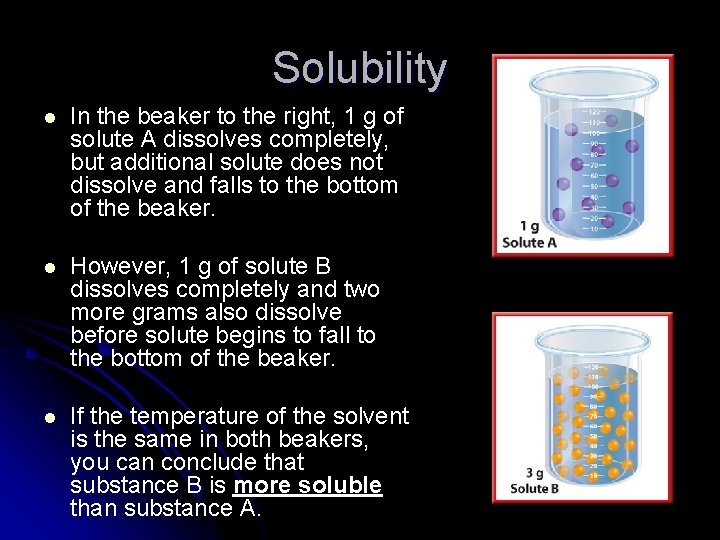
Solubility l In the beaker to the right, 1 g of solute A dissolves completely, but additional solute does not dissolve and falls to the bottom of the beaker. l However, 1 g of solute B dissolves completely and two more grams also dissolve before solute begins to fall to the bottom of the beaker. l If the temperature of the solvent is the same in both beakers, you can conclude that substance B is more soluble than substance A.
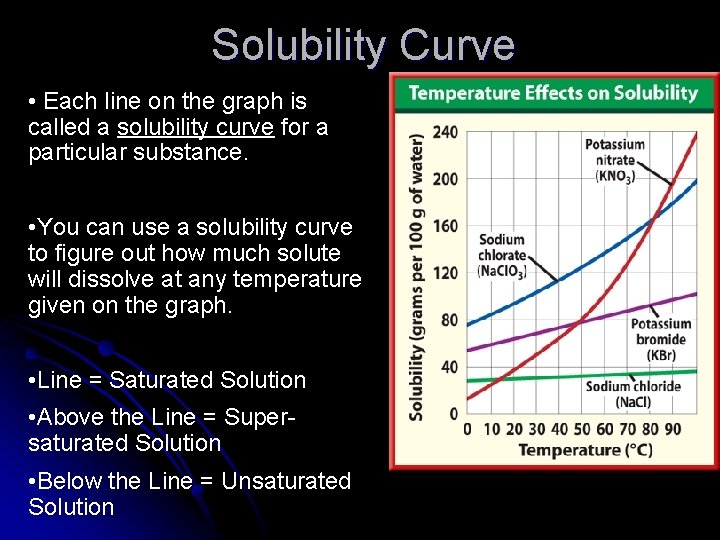
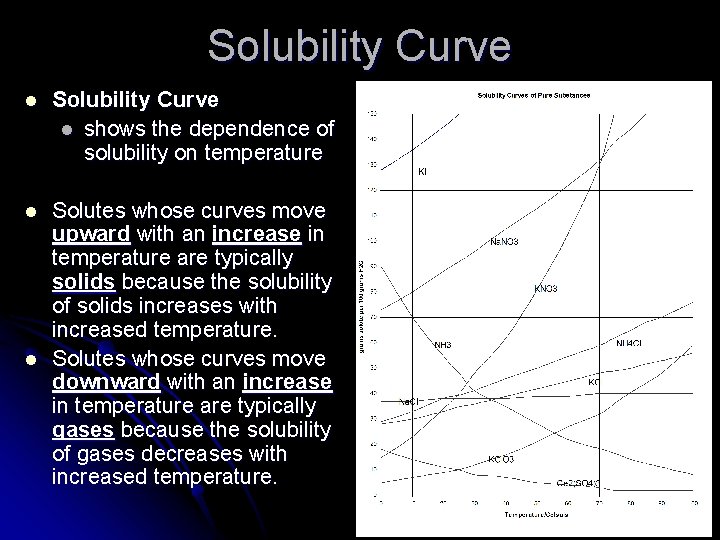
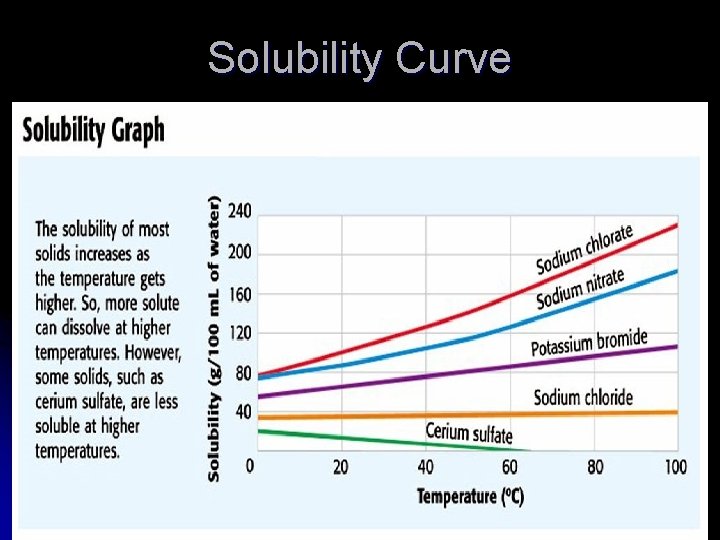
Solubility Curve • Each line on the graph is called a solubility curve for a particular substance. • You can use a solubility curve to figure out how much solute will dissolve at any temperature given on the graph. • Line = Saturated Solution • Above the Line = Supersaturated Solution • Below the Line = Unsaturated Solution
Solubility Curve l shows the dependence of solubility on temperature l Solutes whose curves move upward with an increase in temperature are typically solids because the solubility of solids increases with increased temperature. Solutes whose curves move downward with an increase in temperature are typically gases because the solubility of gases decreases with increased temperature. l
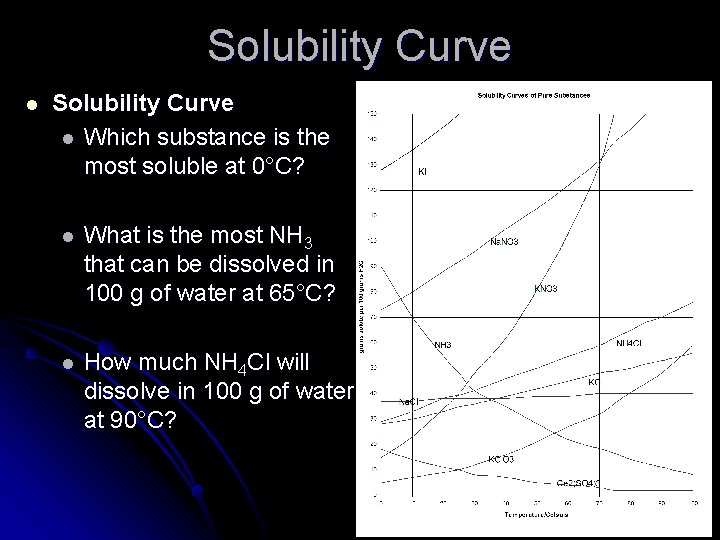
Solubility Curve l Which substance is the most soluble at 0°C? l What is the most NH 3 that can be dissolved in 100 g of water at 65°C? l How much NH 4 Cl will dissolve in 100 g of water at 90°C?
Solubility Curve
Stop l Conductivity will be taught after learning about ions.
Concentration l Concentrated solution l l Large amount of solute is dissolved in the solvent Dilute solution l Small amount of solute is dissolved in the solvent
Concentration l Percent (%) by Volume l Usually liquid in liquid l EX: 10% juice = 10 m. L juice + 90 m. L water l Percent (%) by Mass l Usually solid in liquid l EX: 20% Na. Cl = 20 g Na. Cl + 80 g water
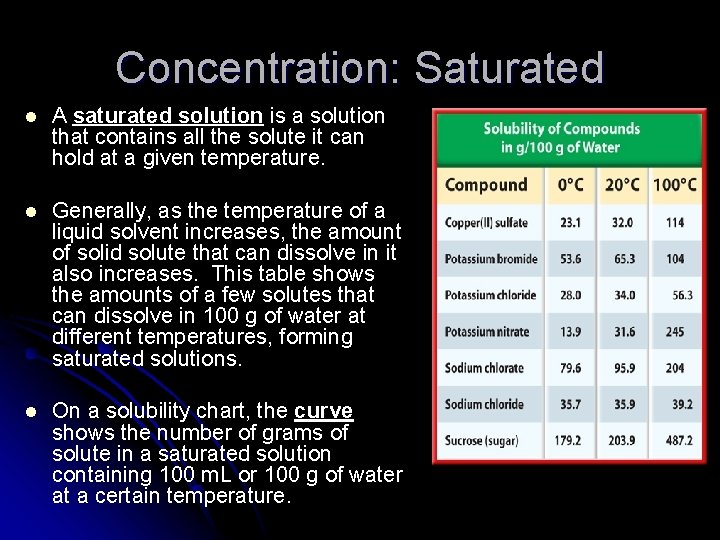
Concentration: Saturated l A saturated solution is a solution that contains all the solute it can hold at a given temperature. l Generally, as the temperature of a liquid solvent increases, the amount of solid solute that can dissolve in it also increases. This table shows the amounts of a few solutes that can dissolve in 100 g of water at different temperatures, forming saturated solutions. l On a solubility chart, the curve shows the number of grams of solute in a saturated solution containing 100 m. L or 100 g of water at a certain temperature.
Concentration: Unsaturated l An unsaturated solution is any solution that can dissolve more solute at a given temperature. l Each time a saturated solution is heated to a higher temperature, it becomes unsaturated. l On a solubility chart, any amount of solute below the line indicates the solution is unsaturated at that certain temperature.
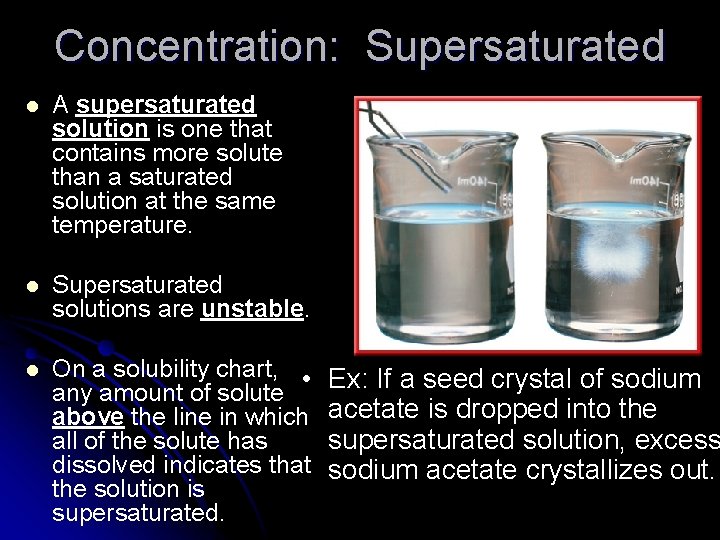
Concentration: Supersaturated l A supersaturated solution is one that contains more solute than a saturated solution at the same temperature. l Supersaturated solutions are unstable. l On a solubility chart, • any amount of solute above the line in which all of the solute has dissolved indicates that the solution is supersaturated. Ex: If a seed crystal of sodium acetate is dropped into the supersaturated solution, excess sodium acetate crystallizes out.
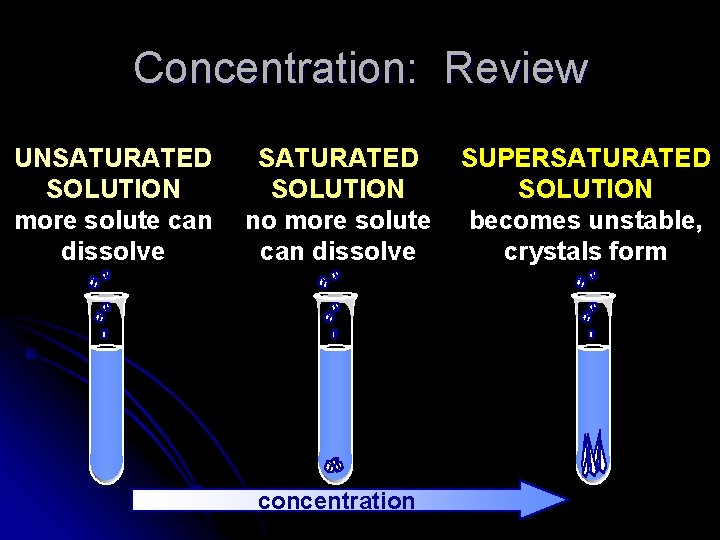
Concentration: Review UNSATURATED SOLUTION more solute can dissolve SATURATED SOLUTION no more solute can dissolve concentration SUPERSATURATED SOLUTION becomes unstable, crystals form
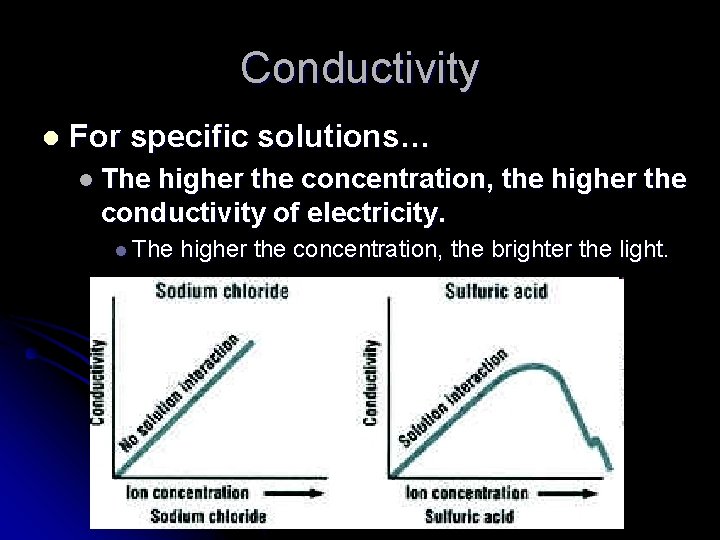
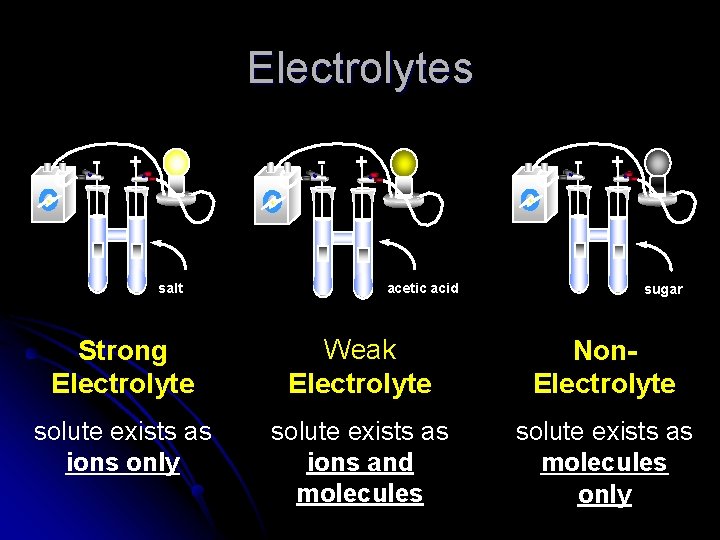
Conductivity l For specific solutions… l The higher the concentration, the higher the conductivity of electricity. l The higher the concentration, the brighter the light.
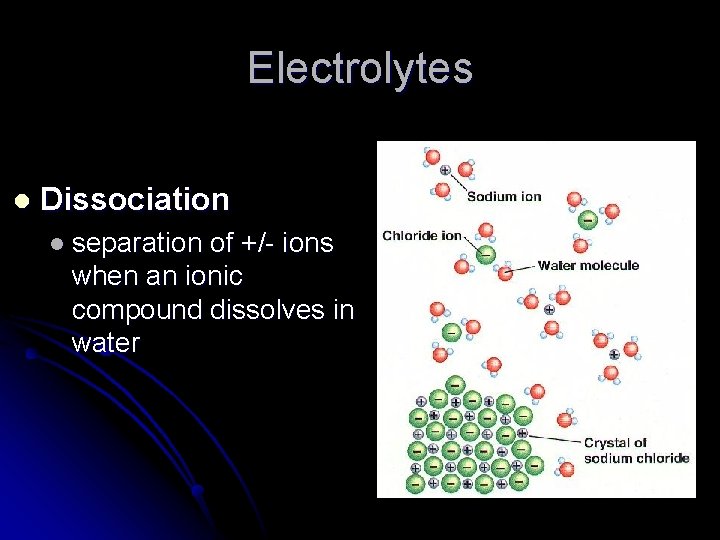
Electrolytes l Dissociation l separation of +/- ions when an ionic compound dissolves in water
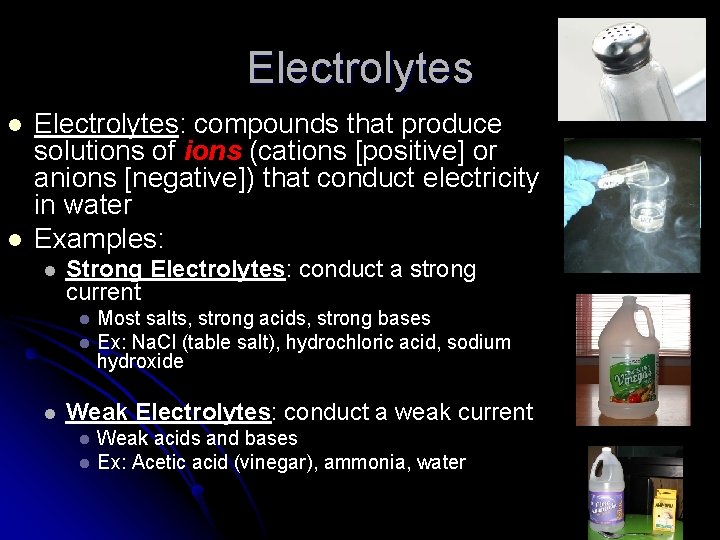
Electrolytes l l Electrolytes: compounds that produce solutions of ions (cations [positive] or anions [negative]) that conduct electricity in water Examples: l Strong Electrolytes: conduct a strong current l l l Most salts, strong acids, strong bases Ex: Na. Cl (table salt), hydrochloric acid, sodium hydroxide Weak Electrolytes: conduct a weak current l l Weak acids and bases Ex: Acetic acid (vinegar), ammonia, water
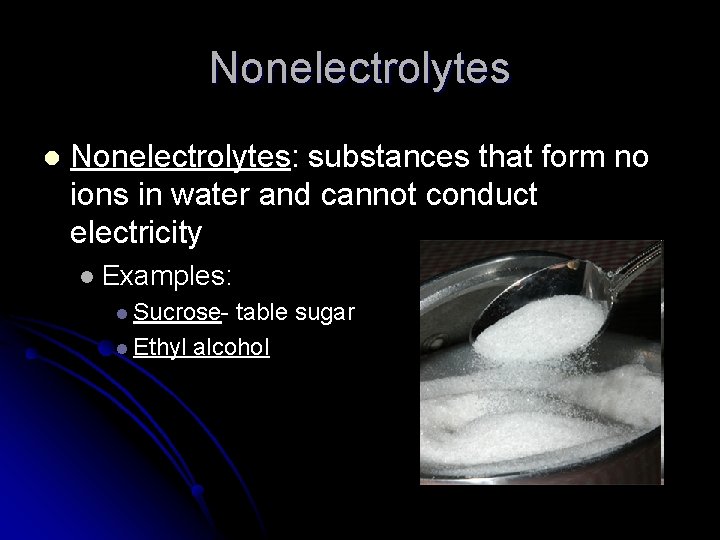
Nonelectrolytes l Nonelectrolytes: substances that form no ions in water and cannot conduct electricity l Examples: l Sucrose- table sugar l Ethyl alcohol
Electrolytes - - + salt - + acetic acid + sugar Strong Electrolyte Weak Electrolyte Non. Electrolyte solute exists as ions only solute exists as ions and molecules solute exists as molecules only