Data Mining Concepts and Techniques 3 rd ed



- Slides: 28
Data Mining: Concepts and Techniques (3 rd ed. ) — Chapter 6 — Jiawei Han, Micheline Kamber, and Jian Pei University of Illinois at Urbana-Champaign & Simon Fraser University © 2011 Han, Kamber & Pei. All rights reserved. 1
What Is Frequent Pattern Analysis? n Frequent pattern: a pattern (a set of items, subsequences, substructures, etc. ) that occurs frequently in a data set n First proposed by Agrawal, Imielinski, and Swami [AIS 93] in the context of frequent itemsets and association rule mining n n Motivation: Finding inherent regularities in data n What products were often purchased together? — Beer and diapers? ! n What are the subsequent purchases after buying a PC? n What kinds of DNA are sensitive to this new drug? n Can we automatically classify web documents? Applications n Basket data analysis, cross-marketing, catalog design, sale campaign analysis, Web log (click stream) analysis, and DNA sequence analysis. 2
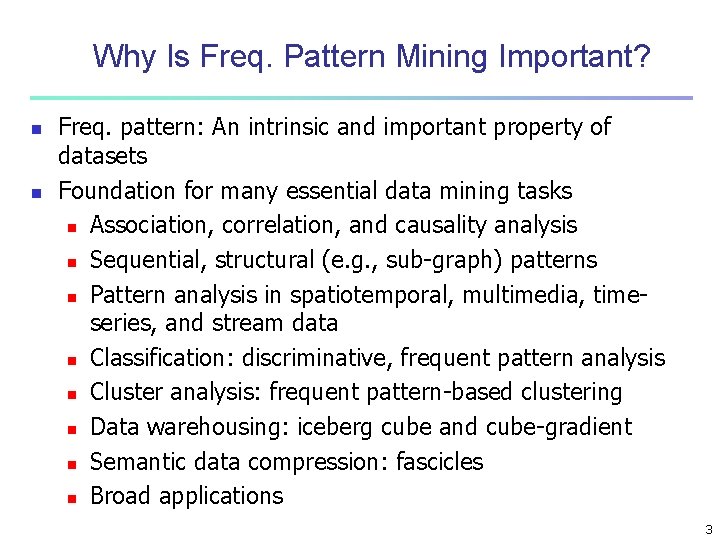
Why Is Freq. Pattern Mining Important? n n Freq. pattern: An intrinsic and important property of datasets Foundation for many essential data mining tasks n Association, correlation, and causality analysis n Sequential, structural (e. g. , sub-graph) patterns n Pattern analysis in spatiotemporal, multimedia, timeseries, and stream data n Classification: discriminative, frequent pattern analysis n Cluster analysis: frequent pattern-based clustering n Data warehousing: iceberg cube and cube-gradient n Semantic data compression: fascicles n Broad applications 3
Basic Concepts: Frequent Patterns Tid Items bought 10 Beer, Nuts, Diaper 20 Beer, Coffee, Diaper 30 Beer, Diaper, Eggs 40 Nuts, Eggs, Milk 50 Nuts, Coffee, Diaper, Eggs, Milk Customer buys both Customer buys diaper n n itemset: A set of one or more items k-itemset X = {x 1, …, xk} support, or, support count of X: Frequency or occurrence of an itemset X An itemset X is frequent if X’s support is no less than a minsup threshold Customer buys beer 4
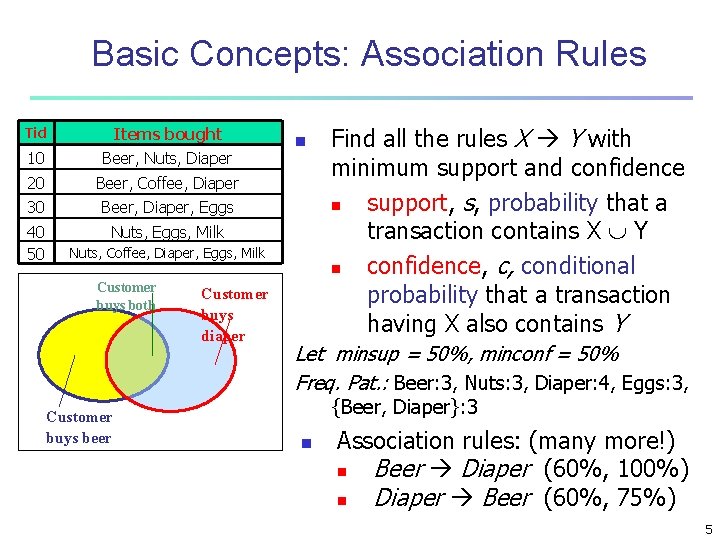
Basic Concepts: Association Rules Tid Items bought 10 Beer, Nuts, Diaper 20 Beer, Coffee, Diaper 30 Beer, Diaper, Eggs 40 50 Nuts, Eggs, Milk n Nuts, Coffee, Diaper, Eggs, Milk Customer buys both Customer buys beer Customer buys diaper Find all the rules X Y with minimum support and confidence n support, s, probability that a transaction contains X Y n confidence, c, conditional probability that a transaction having X also contains Y Let minsup = 50%, minconf = 50% Freq. Pat. : Beer: 3, Nuts: 3, Diaper: 4, Eggs: 3, {Beer, Diaper}: 3 n Association rules: (many more!) n Beer Diaper (60%, 100%) n Diaper Beer (60%, 75%) 5
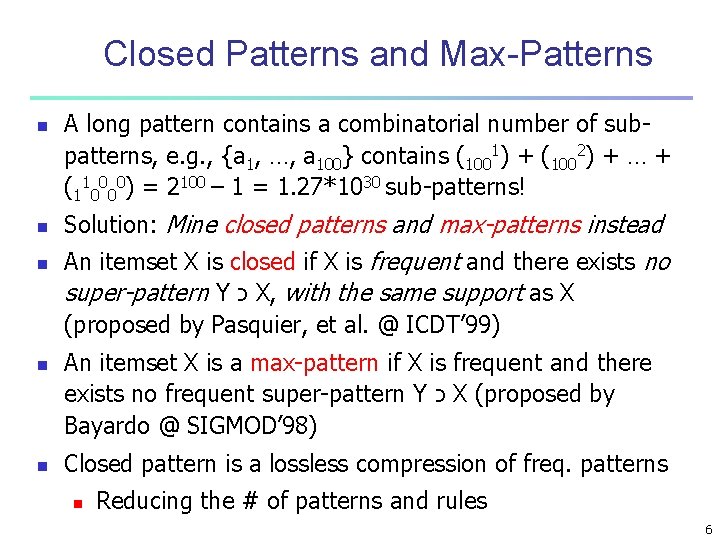
Closed Patterns and Max-Patterns n n n A long pattern contains a combinatorial number of subpatterns, e. g. , {a 1, …, a 100} contains (1001) + (1002) + … + (110000) = 2100 – 1 = 1. 27*1030 sub-patterns! Solution: Mine closed patterns and max-patterns instead An itemset X is closed if X is frequent and there exists no super-pattern Y כ X, with the same support as X (proposed by Pasquier, et al. @ ICDT’ 99) An itemset X is a max-pattern if X is frequent and there exists no frequent super-pattern Y כ X (proposed by Bayardo @ SIGMOD’ 98) Closed pattern is a lossless compression of freq. patterns n Reducing the # of patterns and rules 6
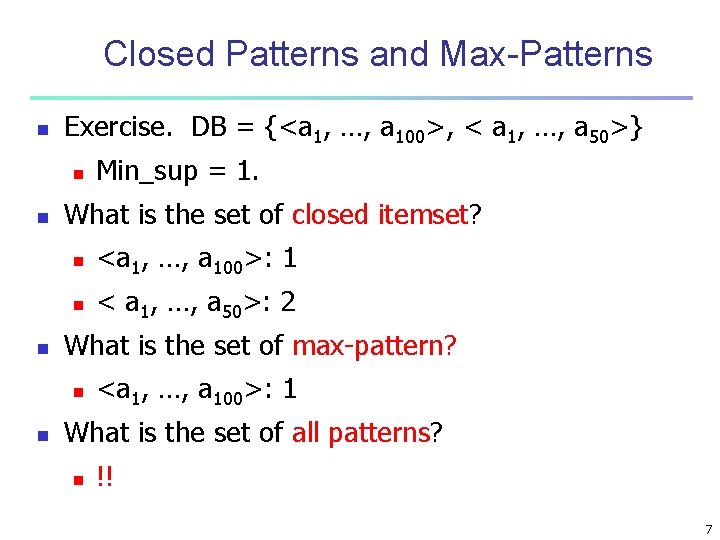
Closed Patterns and Max-Patterns n Exercise. DB = {<a 1, …, a 100>, < a 1, …, a 50>} n n n What is the set of closed itemset? n <a 1, …, a 100>: 1 n < a 1, …, a 50>: 2 What is the set of max-pattern? n n Min_sup = 1. <a 1, …, a 100>: 1 What is the set of all patterns? n !! 7
Computational Complexity of Frequent Itemset Mining n How many itemsets are potentially to be generated in the worst case? n n The number of frequent itemsets to be generated is senstive to the minsup threshold When minsup is low, there exist potentially an exponential number of frequent itemsets The worst case: MN where M: # distinct items, and N: max length of transactions The worst case complexty vs. the expected probability n Ex. Suppose Walmart has 104 kinds of products n The chance to pick up one product 10 -4 n The chance to pick up a particular set of 10 products: ~10 -40 n What is the chance this particular set of 10 products to be frequent 103 times in 109 transactions? 8
The Downward Closure Property and Scalable Mining Methods n n The downward closure property of frequent patterns n Any subset of a frequent itemset must be frequent n If {beer, diaper, nuts} is frequent, so is {beer, diaper} n i. e. , every transaction having {beer, diaper, nuts} also contains {beer, diaper} Scalable mining methods: Three major approaches n Apriori (Agrawal & Srikant@VLDB’ 94) n Freq. pattern growth (FPgrowth—Han, Pei & Yin @SIGMOD’ 00) n Vertical data format approach (Charm—Zaki & Hsiao @SDM’ 02) 9
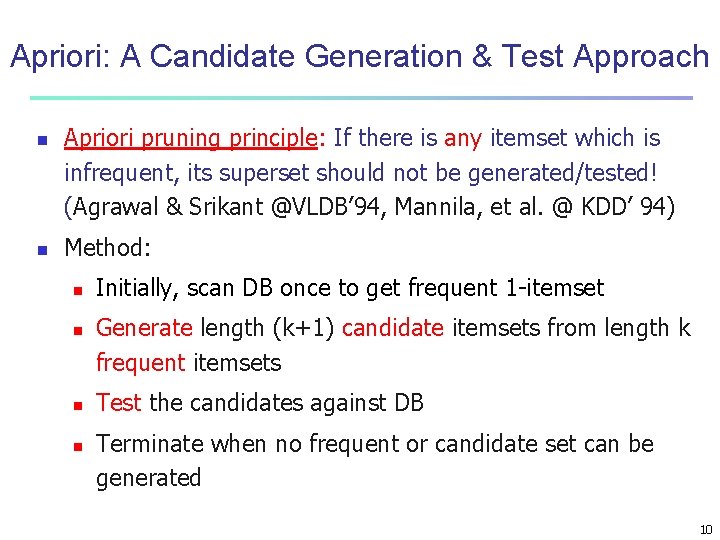
Apriori: A Candidate Generation & Test Approach n n Apriori pruning principle: If there is any itemset which is infrequent, its superset should not be generated/tested! (Agrawal & Srikant @VLDB’ 94, Mannila, et al. @ KDD’ 94) Method: n n Initially, scan DB once to get frequent 1 -itemset Generate length (k+1) candidate itemsets from length k frequent itemsets Test the candidates against DB Terminate when no frequent or candidate set can be generated 10
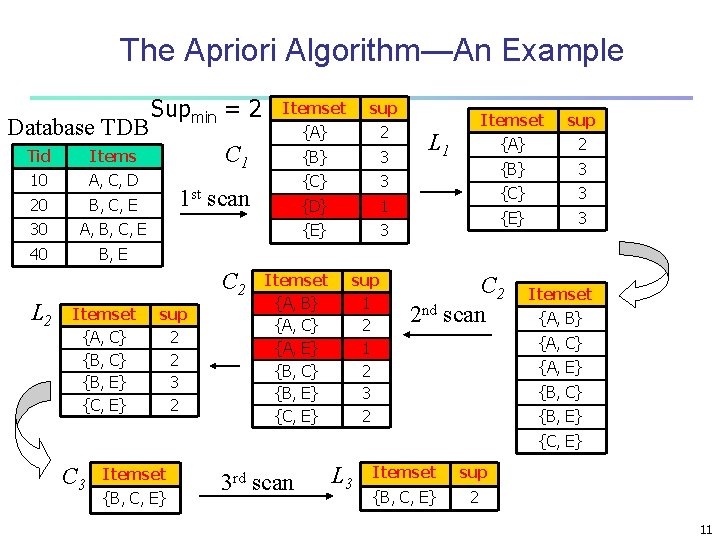
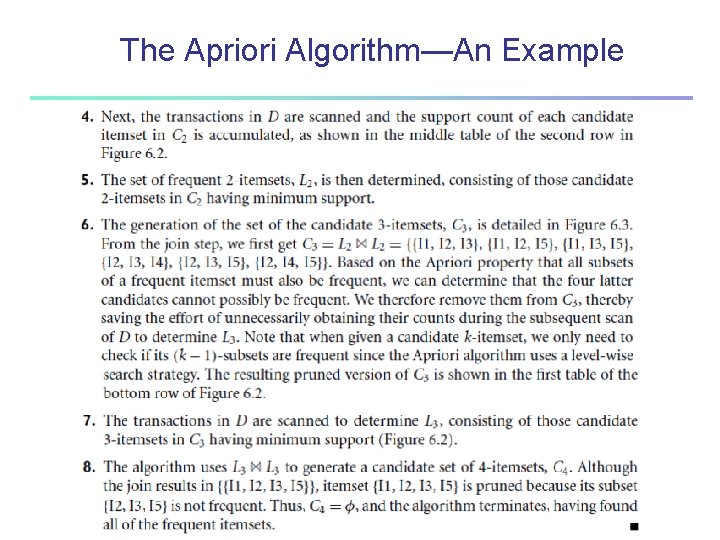
The Apriori Algorithm—An Example Database TDB Tid Items 10 A, C, D 20 B, C, E 30 A, B, C, E 40 B, E Supmin = 2 Itemset {A, C} {B, E} {C, E} sup {A} 2 {B} 3 {C} 3 {D} 1 {E} 3 C 1 1 st scan C 2 L 2 Itemset sup 2 2 3 2 Itemset {A, B} {A, C} {A, E} {B, C} {B, E} {C, E} sup 1 2 3 2 L 1 Itemset sup {A} 2 {B} 3 {C} 3 {E} 3 C 2 2 nd scan Itemset {A, B} {A, C} {A, E} {B, C} {B, E} {C, E} C 3 Itemset {B, C, E} 3 rd scan L 3 Itemset sup {B, C, E} 2 11
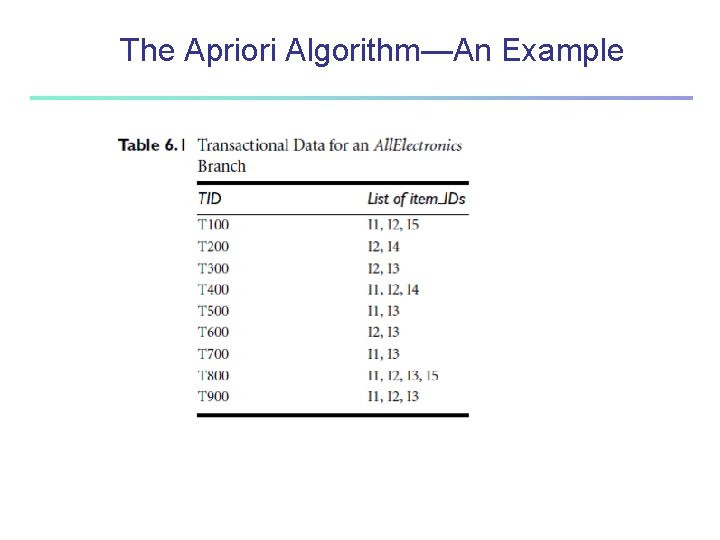
The Apriori Algorithm—An Example
The Apriori Algorithm—An Example
The Apriori Algorithm—An Example
The Apriori Algorithm—An Example
The Apriori Algorithm—An Example
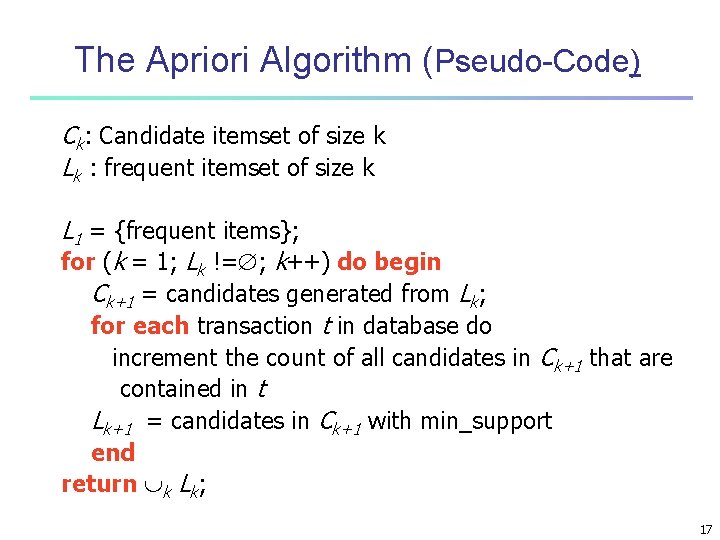
The Apriori Algorithm (Pseudo-Code) Ck: Candidate itemset of size k Lk : frequent itemset of size k L 1 = {frequent items}; for (k = 1; Lk != ; k++) do begin Ck+1 = candidates generated from Lk; for each transaction t in database do increment the count of all candidates in Ck+1 that are contained in t Lk+1 = candidates in Ck+1 with min_support end return k Lk; 17
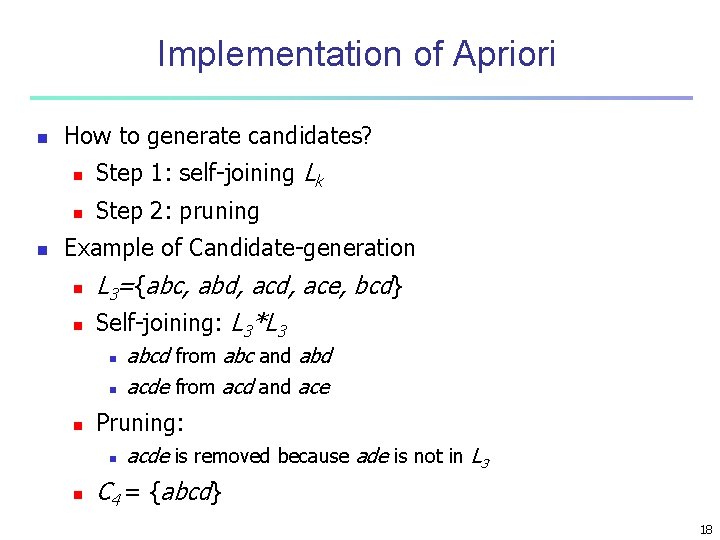
Implementation of Apriori n n How to generate candidates? n Step 1: self-joining Lk n Step 2: pruning Example of Candidate-generation n n L 3={abc, abd, ace, bcd} Self-joining: L 3*L 3 n n n Pruning: n n abcd from abc and abd acde from acd and ace acde is removed because ade is not in L 3 C 4 = {abcd} 18
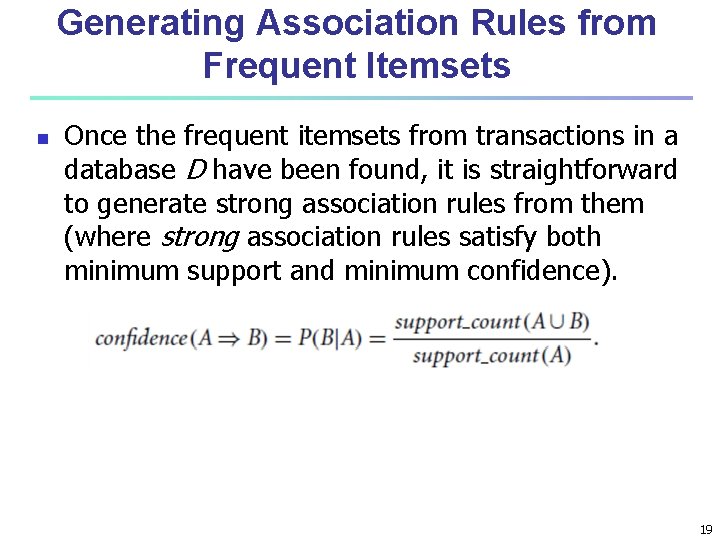
Generating Association Rules from Frequent Itemsets n Once the frequent itemsets from transactions in a database D have been found, it is straightforward to generate strong association rules from them (where strong association rules satisfy both minimum support and minimum confidence). 19
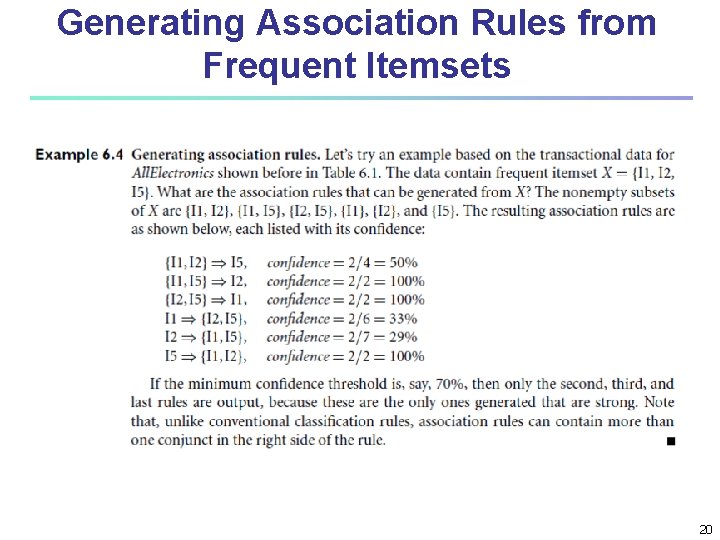
Generating Association Rules from Frequent Itemsets 20
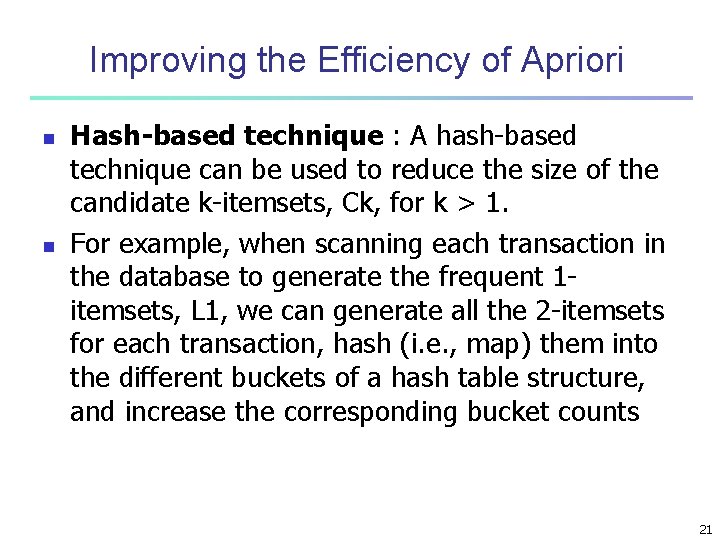
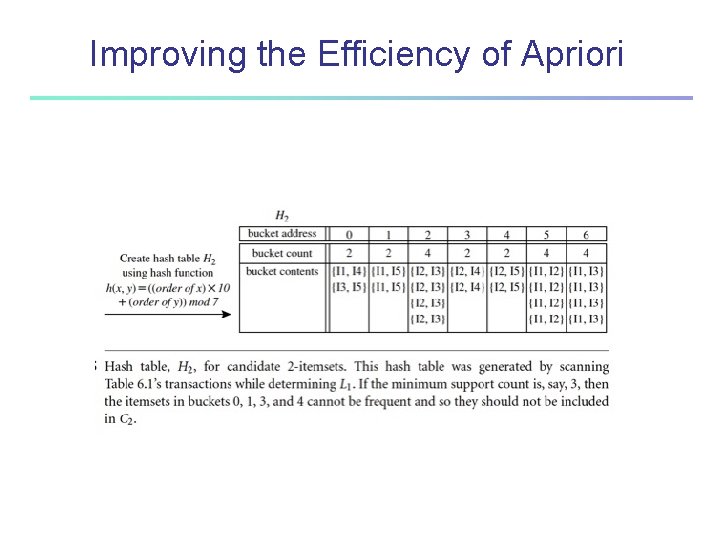
Improving the Efficiency of Apriori n n Hash-based technique : A hash-based technique can be used to reduce the size of the candidate k-itemsets, Ck, for k > 1. For example, when scanning each transaction in the database to generate the frequent 1 itemsets, L 1, we can generate all the 2 -itemsets for each transaction, hash (i. e. , map) them into the different buckets of a hash table structure, and increase the corresponding bucket counts 21
Improving the Efficiency of Apriori n A 2 -itemset with a corresponding bucket count in the hash table that is below the support threshold cannot be frequent and thus should be removed from the candidate set. Such a hashbased technique may substantially reduce the number of candidate k-itemsets examined (especially when k D 2). 22
Improving the Efficiency of Apriori
Improving the Efficiency of Apriori Transaction reduction (reducing the number of transactions scanned in future iterations): A transaction that does not contain any frequent kitemsets cannot contain any frequent (k C 1)itemsets. Therefore, such a transaction can be marked or removed from further consideration because subsequent database scans for j-itemsets, where j > k, will not need to consider such a transaction. n 24
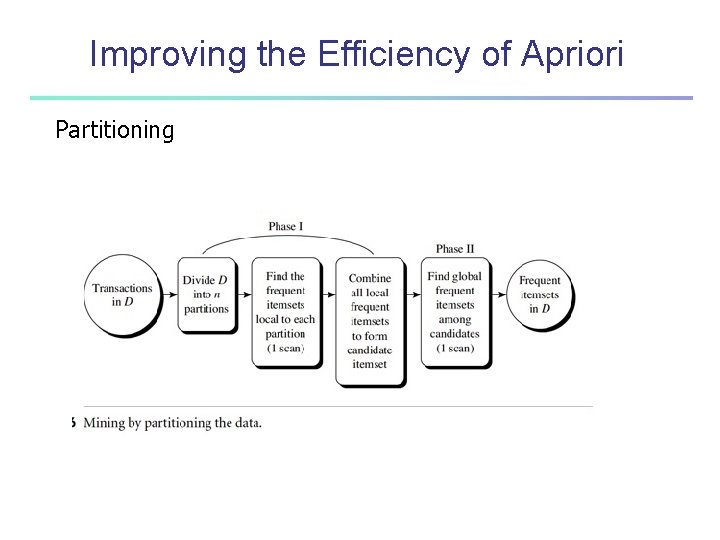
Improving the Efficiency of Apriori n Partitioning: Any itemset that is potentially frequent in DB must be frequent in at least one of the partitions of DB n Scan 1: partition database and find local frequent patterns n Scan 2: consolidate global frequent patterns
Improving the Efficiency of Apriori Partitioning
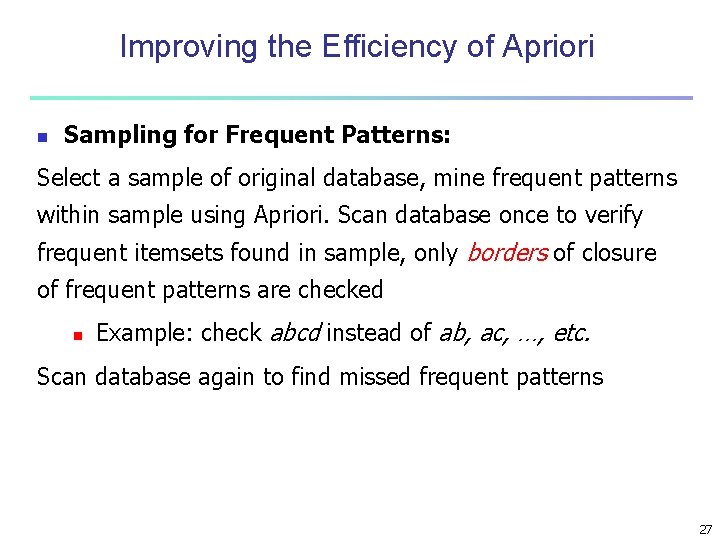
Improving the Efficiency of Apriori n Sampling for Frequent Patterns: Select a sample of original database, mine frequent patterns within sample using Apriori. Scan database once to verify frequent itemsets found in sample, only borders of closure of frequent patterns are checked n Example: check abcd instead of ab, ac, …, etc. Scan database again to find missed frequent patterns 27
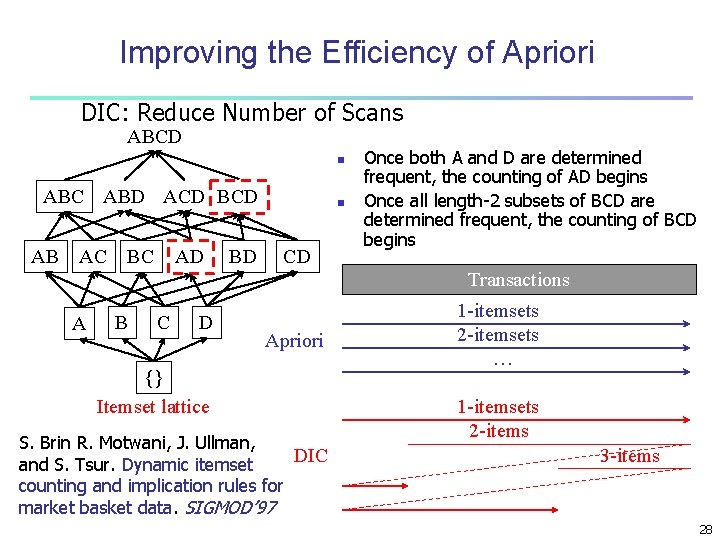
Improving the Efficiency of Apriori DIC: Reduce Number of Scans ABCD n ABC ABD ACD BCD AB AC BC AD BD n CD Once both A and D are determined frequent, the counting of AD begins Once all length-2 subsets of BCD are determined frequent, the counting of BCD begins Transactions A B C D Apriori {} Itemset lattice S. Brin R. Motwani, J. Ullman, DIC and S. Tsur. Dynamic itemset counting and implication rules for market basket data. SIGMOD’ 97 1 -itemsets 2 -itemsets … 1 -itemsets 2 -items 3 -items 28