CSC 427 Data Structures and Algorithm Analysis Fall
- Slides: 29
CSC 427: Data Structures and Algorithm Analysis Fall 2011 Brute force approach & efficiency § league standings example § KISS vs. generality § exhaustive search: string matching § generate & test: N-queens, TSP, Knapsack § inheritance & efficiency • Array. List Sorted. Array. List 1
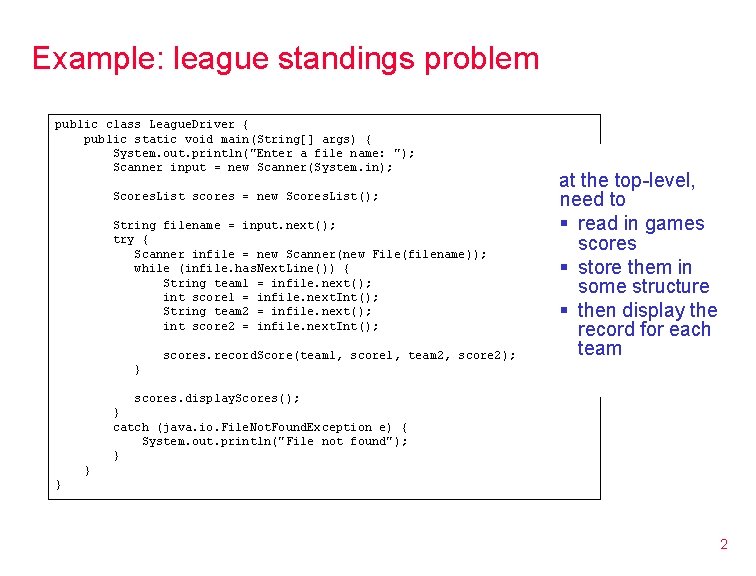
Example: league standings problem public class League. Driver { public static void main(String[] args) { System. out. println("Enter a file name: "); Scanner input = new Scanner(System. in); Scores. List scores = new Scores. List(); String filename = input. next(); try { Scanner infile = new Scanner(new File(filename)); while (infile. has. Next. Line()) { String team 1 = infile. next(); int score 1 = infile. next. Int(); String team 2 = infile. next(); int score 2 = infile. next. Int(); scores. record. Score(team 1, score 1, team 2, score 2); at the top-level, need to § read in games scores § store them in some structure § then display the record for each team } scores. display. Scores(); } catch (java. io. File. Not. Found. Exception e) { System. out. println("File not found"); } } } 2
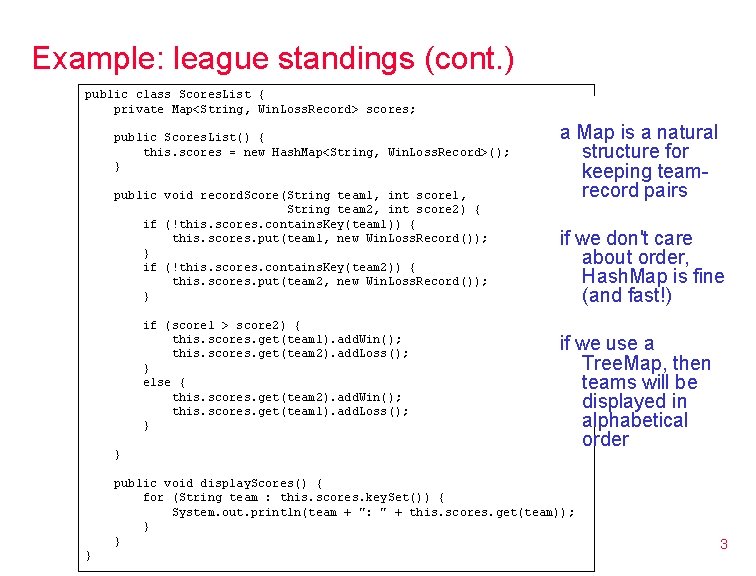
Example: league standings (cont. ) public class Scores. List { private Map<String, Win. Loss. Record> scores; public Scores. List() { this. scores = new Hash. Map<String, Win. Loss. Record>(); } public void record. Score(String team 1, int score 1, String team 2, int score 2) { if (!this. scores. contains. Key(team 1)) { this. scores. put(team 1, new Win. Loss. Record()); } if (!this. scores. contains. Key(team 2)) { this. scores. put(team 2, new Win. Loss. Record()); } if (score 1 > score 2) { this. scores. get(team 1). add. Win(); this. scores. get(team 2). add. Loss(); } else { this. scores. get(team 2). add. Win(); this. scores. get(team 1). add. Loss(); } } a Map is a natural structure for keeping teamrecord pairs if we don't care about order, Hash. Map is fine (and fast!) if we use a Tree. Map, then teams will be displayed in alphabetical order public void display. Scores() { for (String team : this. scores. key. Set()) { System. out. println(team + ": " + this. scores. get(team)); } } } 3
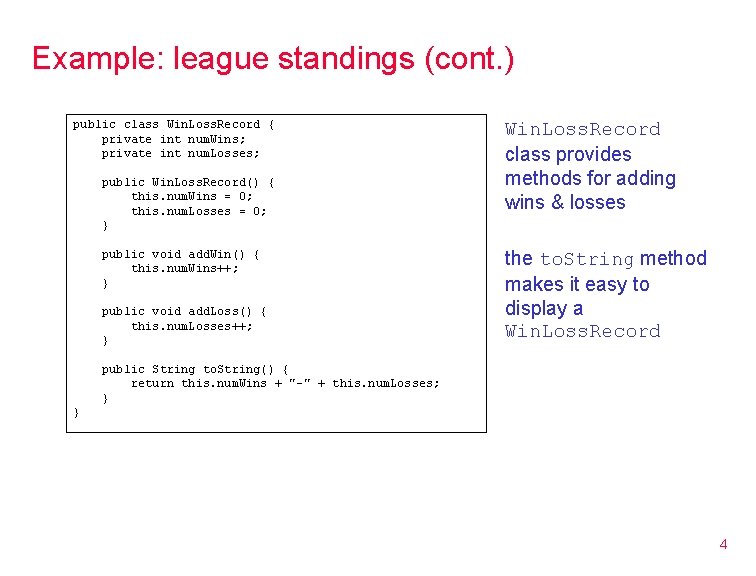
Example: league standings (cont. ) public class Win. Loss. Record { private int num. Wins; private int num. Losses; public Win. Loss. Record() { this. num. Wins = 0; this. num. Losses = 0; } public void add. Win() { this. num. Wins++; } public void add. Loss() { this. num. Losses++; } Win. Loss. Record class provides methods for adding wins & losses the to. String method makes it easy to display a Win. Loss. Record public String to. String() { return this. num. Wins + "-" + this. num. Losses; } } 4
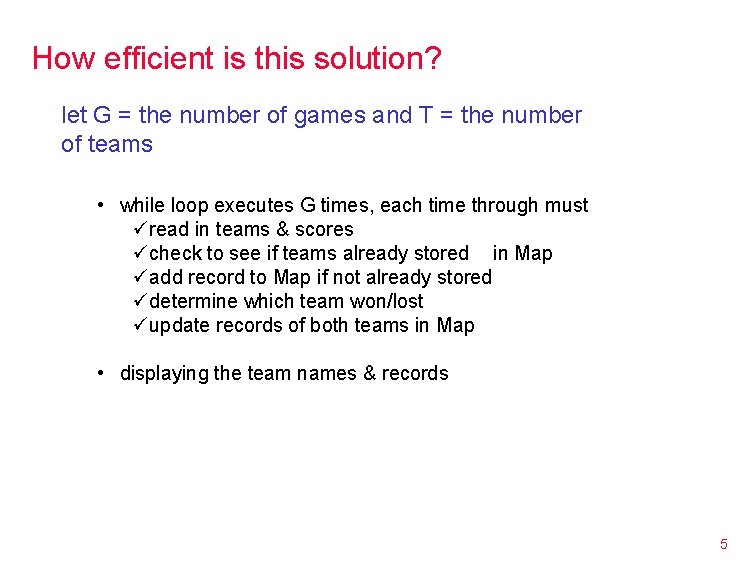
How efficient is this solution? let G = the number of games and T = the number of teams • while loop executes G times, each time through must üread in teams & scores ücheck to see if teams already stored in Map üadd record to Map if not already stored üdetermine which team won/lost üupdate records of both teams in Map • displaying the team names & records 5
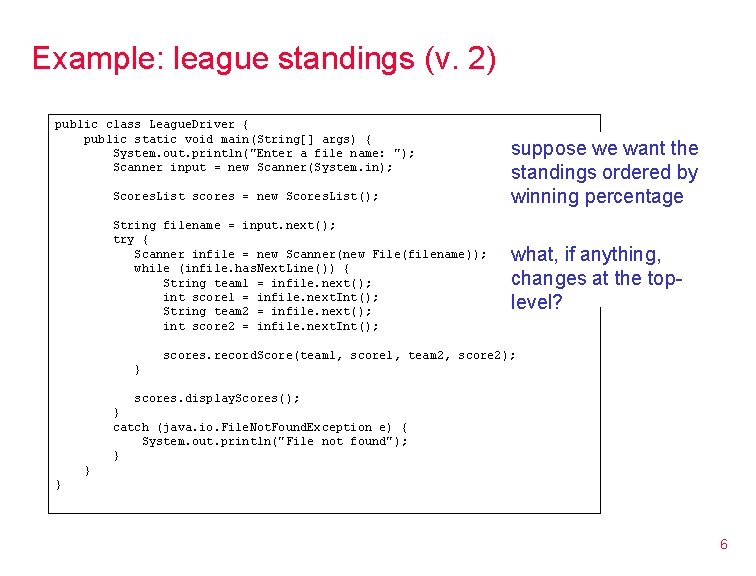
Example: league standings (v. 2) public class League. Driver { public static void main(String[] args) { System. out. println("Enter a file name: "); Scanner input = new Scanner(System. in); Scores. List scores = new Scores. List(); String filename = input. next(); try { Scanner infile = new Scanner(new File(filename)); while (infile. has. Next. Line()) { String team 1 = infile. next(); int score 1 = infile. next. Int(); String team 2 = infile. next(); int score 2 = infile. next. Int(); suppose we want the standings ordered by winning percentage what, if anything, changes at the toplevel? scores. record. Score(team 1, score 1, team 2, score 2); } scores. display. Scores(); } catch (java. io. File. Not. Found. Exception e) { System. out. println("File not found"); } } } 6
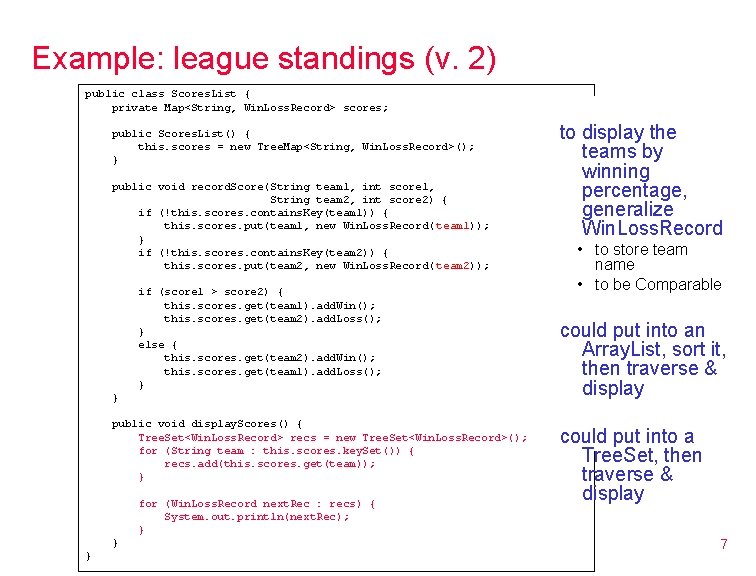
Example: league standings (v. 2) public class Scores. List { private Map<String, Win. Loss. Record> scores; public Scores. List() { this. scores = new Tree. Map<String, Win. Loss. Record>(); } public void record. Score(String team 1, int score 1, String team 2, int score 2) { if (!this. scores. contains. Key(team 1)) { this. scores. put(team 1, new Win. Loss. Record( team 1)); } if (!this. scores. contains. Key(team 2)) { this. scores. put(team 2, new Win. Loss. Record( team 2)); if (score 1 > score 2) { this. scores. get(team 1). add. Win(); this. scores. get(team 2). add. Loss(); } else { this. scores. get(team 2). add. Win(); this. scores. get(team 1). add. Loss(); } } public void display. Scores() { Tree. Set<Win. Loss. Record> recs = new Tree. Set<Win. Loss. Record>(); for (String team : this. scores. key. Set()) { recs. add(this. scores. get(team)); } for (Win. Loss. Record next. Rec : recs) { System. out. println(next. Rec); } } } to display the teams by winning percentage, generalize Win. Loss. Record • to store team name • to be Comparable could put into an Array. List, sort it, then traverse & display could put into a Tree. Set, then traverse & display 7
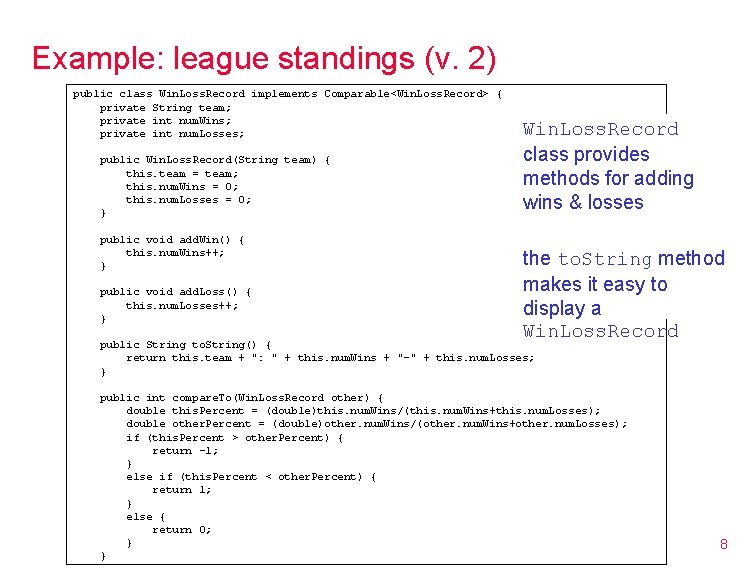
Example: league standings (v. 2) public class Win. Loss. Record implements Comparable<Win. Loss. Record> { private String team; private int num. Wins; private int num. Losses; public Win. Loss. Record(String team) { this. team = team; this. num. Wins = 0; this. num. Losses = 0; } public void add. Win() { this. num. Wins++; } public void add. Loss() { this. num. Losses++; } Win. Loss. Record class provides methods for adding wins & losses the to. String method makes it easy to display a Win. Loss. Record public String to. String() { return this. team + ": " + this. num. Wins + "-" + this. num. Losses; } public int compare. To(Win. Loss. Record other) { double this. Percent = (double)this. num. Wins/(this. num. Wins+this. num. Losses); double other. Percent = (double)other. num. Wins/(other. num. Wins+other. num. Losses); if (this. Percent > other. Percent) { return -1; } else if (this. Percent < other. Percent) { return 1; } else { return 0; } } 8
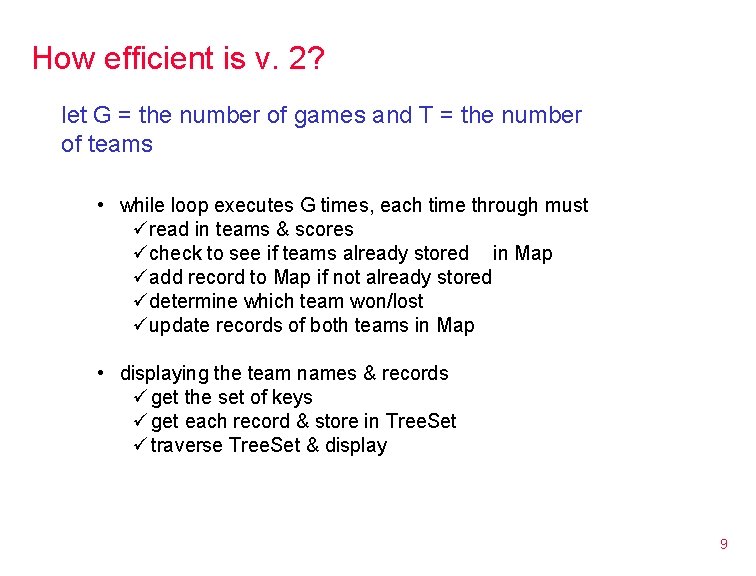
How efficient is v. 2? let G = the number of games and T = the number of teams • while loop executes G times, each time through must üread in teams & scores ücheck to see if teams already stored in Map üadd record to Map if not already stored üdetermine which team won/lost üupdate records of both teams in Map • displaying the team names & records ü get the set of keys ü get each record & store in Tree. Set ü traverse Tree. Set & display 9
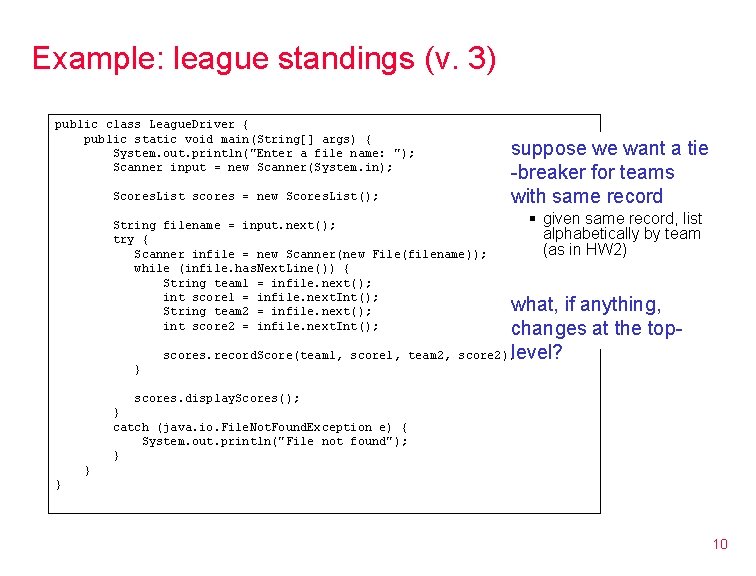
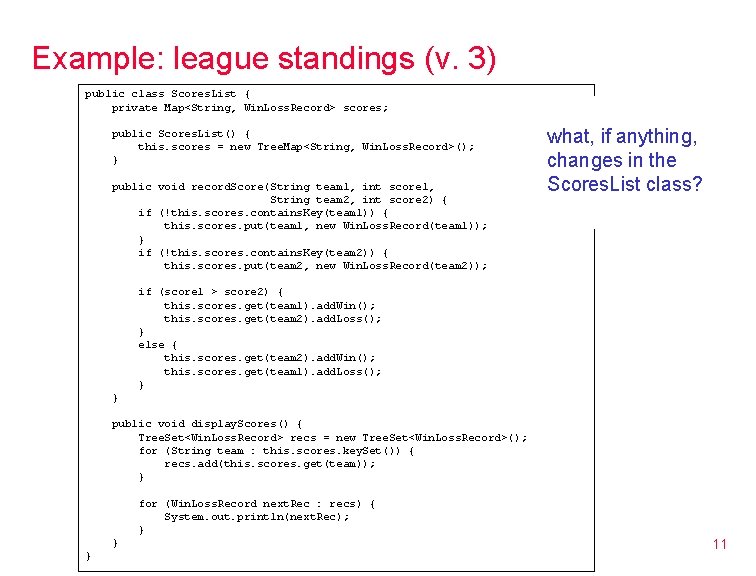
Example: league standings (v. 3) public class League. Driver { public static void main(String[] args) { System. out. println("Enter a file name: "); Scanner input = new Scanner(System. in); suppose we want a tie -breaker for teams with same record Scores. List scores = new Scores. List(); String filename = input. next(); try { Scanner infile = new Scanner(new File(filename)); while (infile. has. Next. Line()) { String team 1 = infile. next(); int score 1 = infile. next. Int(); String team 2 = infile. next(); int score 2 = infile. next. Int(); scores. record. Score(team 1, score 1, team 2, § given same record, list alphabetically by team (as in HW 2) what, if anything, changes at the topscore 2); level? } scores. display. Scores(); } catch (java. io. File. Not. Found. Exception e) { System. out. println("File not found"); } } } 10
Example: league standings (v. 3) public class Scores. List { private Map<String, Win. Loss. Record> scores; public Scores. List() { this. scores = new Tree. Map<String, Win. Loss. Record>(); } public void record. Score(String team 1, int score 1, String team 2, int score 2) { if (!this. scores. contains. Key(team 1)) { this. scores. put(team 1, new Win. Loss. Record(team 1)); } if (!this. scores. contains. Key(team 2)) { this. scores. put(team 2, new Win. Loss. Record(team 2)); what, if anything, changes in the Scores. List class? if (score 1 > score 2) { this. scores. get(team 1). add. Win(); this. scores. get(team 2). add. Loss(); } else { this. scores. get(team 2). add. Win(); this. scores. get(team 1). add. Loss(); } } public void display. Scores() { Tree. Set<Win. Loss. Record> recs = new Tree. Set<Win. Loss. Record>(); for (String team : this. scores. key. Set()) { recs. add(this. scores. get(team)); } for (Win. Loss. Record next. Rec : recs) { System. out. println(next. Rec); } } } 11
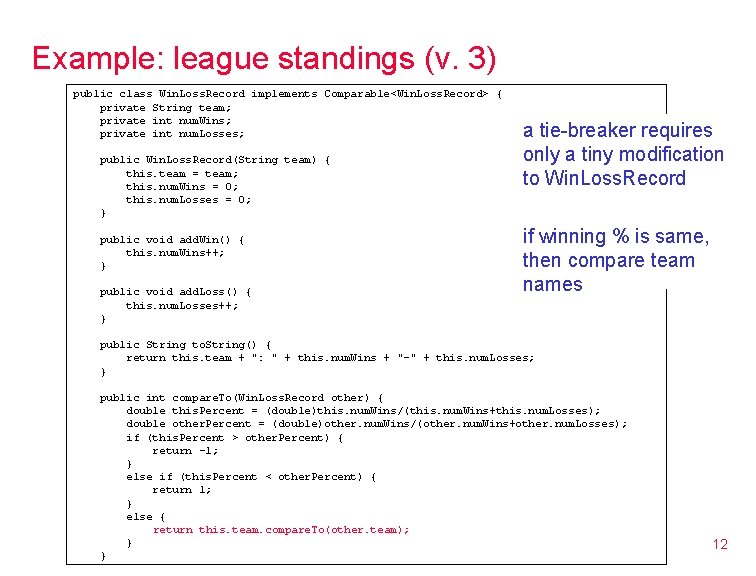
Example: league standings (v. 3) public class Win. Loss. Record implements Comparable<Win. Loss. Record> { private String team; private int num. Wins; private int num. Losses; public Win. Loss. Record(String team) { this. team = team; this. num. Wins = 0; this. num. Losses = 0; } public void add. Win() { this. num. Wins++; } public void add. Loss() { this. num. Losses++; } a tie-breaker requires only a tiny modification to Win. Loss. Record if winning % is same, then compare team names public String to. String() { return this. team + ": " + this. num. Wins + "-" + this. num. Losses; } public int compare. To(Win. Loss. Record other) { double this. Percent = (double)this. num. Wins/(this. num. Wins+this. num. Losses); double other. Percent = (double)other. num. Wins/(other. num. Wins+other. num. Losses); if (this. Percent > other. Percent) { return -1; } else if (this. Percent < other. Percent) { return 1; } else { return this. team. compare. To(other. team); } } 12
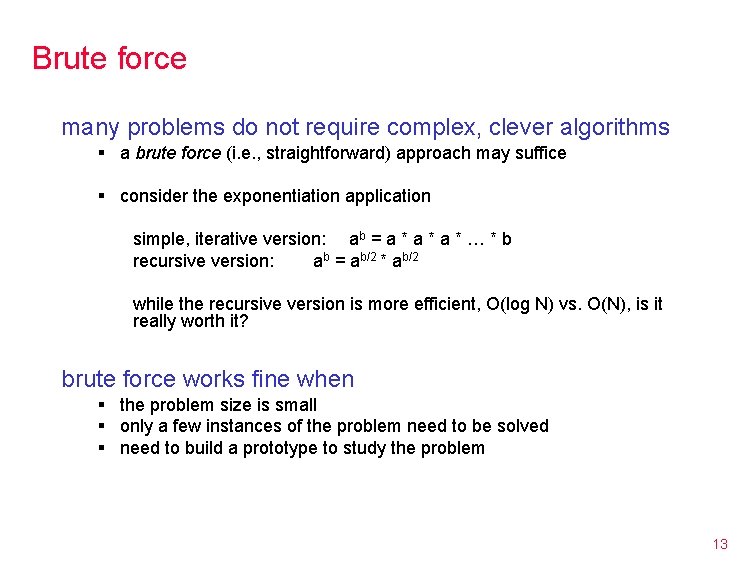
Brute force many problems do not require complex, clever algorithms § a brute force (i. e. , straightforward) approach may suffice § consider the exponentiation application simple, iterative version: ab = a * a * … * b recursive version: ab = ab/2 * ab/2 while the recursive version is more efficient, O(log N) vs. O(N), is it really worth it? brute force works fine when § the problem size is small § only a few instances of the problem need to be solved § need to build a prototype to study the problem 13
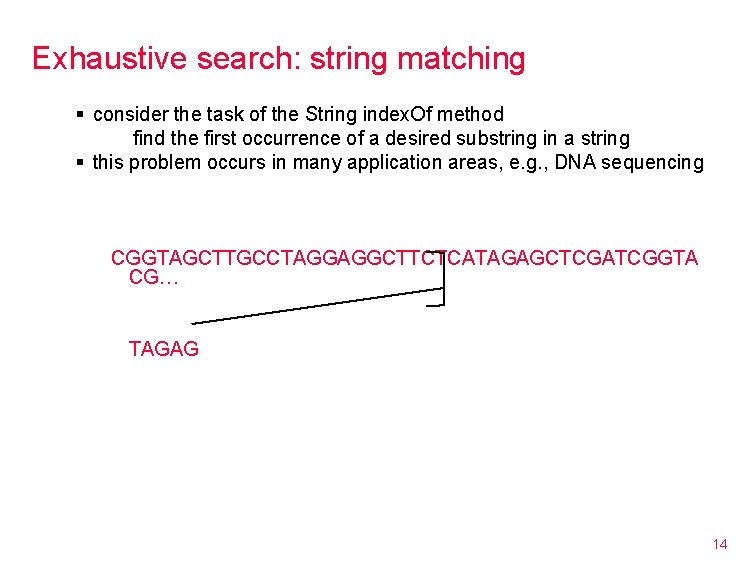
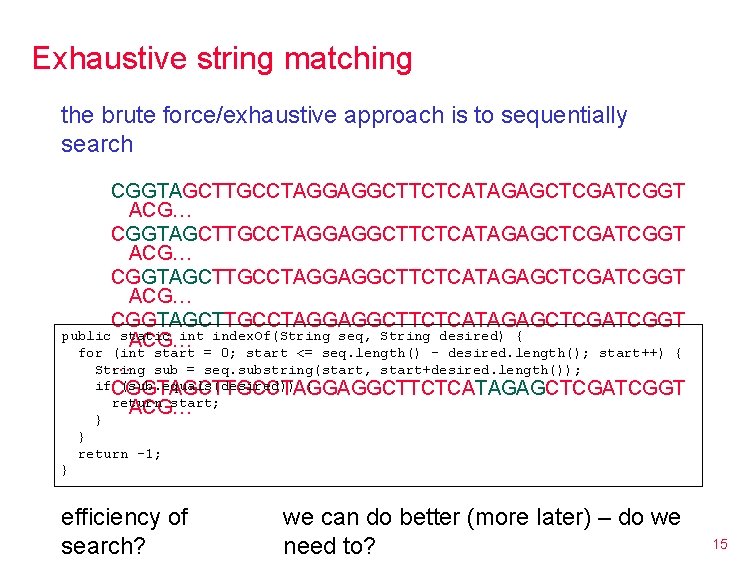
Exhaustive search: string matching § consider the task of the String index. Of method find the first occurrence of a desired substring in a string § this problem occurs in many application areas, e. g. , DNA sequencing CGGTAGCTTGCCTAGGAGGCTTCTCATAGAGCTCGATCGGTA CG… TAGAG 14
Exhaustive string matching the brute force/exhaustive approach is to sequentially search CGGTAGCTTGCCTAGGAGGCTTCTCATAGAGCTCGATCGGT ACG… CGGTAGCTTGCCTAGGAGGCTTCTCATAGAGCTCGATCGGT public static int index. Of(String seq, String desired) { ACG… for (int start = 0; start <= seq. length() – desired. length(); start++) { … sub = seq. substring(start, start+desired. length()); String if. CGGTAGCTTGCCTAGGAGGCTTCTCATAGAGCTCGATCGGT (sub. equals(desired)) { return start; ACG… } } return -1; } efficiency of search? we can do better (more later) – do we need to? 15
Generate & test sometimes exhaustive algorithms are referred to as "generate & test" § can express algorithm as generating each candidate solution systematically, testing each to see if the candidate is actually a solution string matching: try seq. substring(0, desired. length()) if no match, try seq. substring(1, desired. length()+1) if no match, try seq. substring(2, desired. length()+2) … extreme example – for league standings problem, suppose you knew there was a small, fixed number of games (e. g. , 20) DON'T DO THIS! § instead of sorting the records by winning percentage, store records in a Tree. Map (ordered by team name) traverse the teams, print each 20 -0 team traverse the teams again, print each 19 -1 team 16
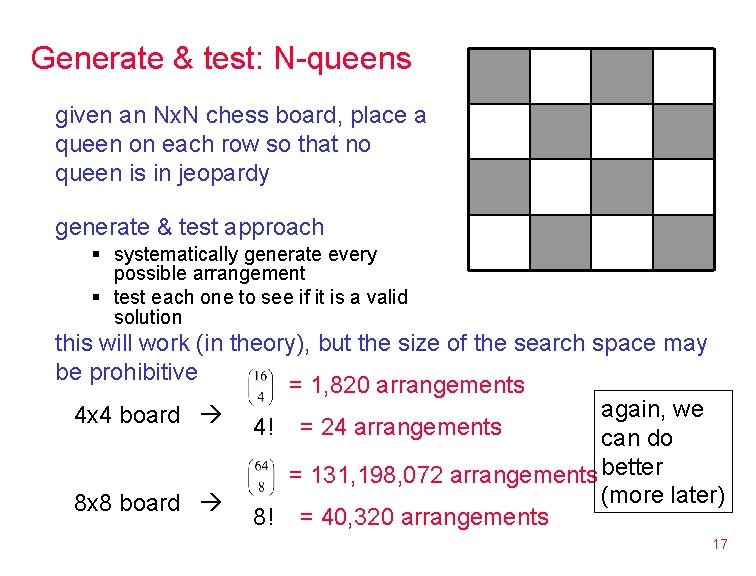
Generate & test: N-queens given an Nx. N chess board, place a queen on each row so that no queen is in jeopardy generate & test approach § systematically generate every possible arrangement § test each one to see if it is a valid solution this will work (in theory), but the size of the search space may be prohibitive = 1, 820 arrangements again, we 4 x 4 board 4! = 24 arrangements can do = 131, 198, 072 arrangements better (more later) 8 x 8 board 8! = 40, 320 arrangements 17
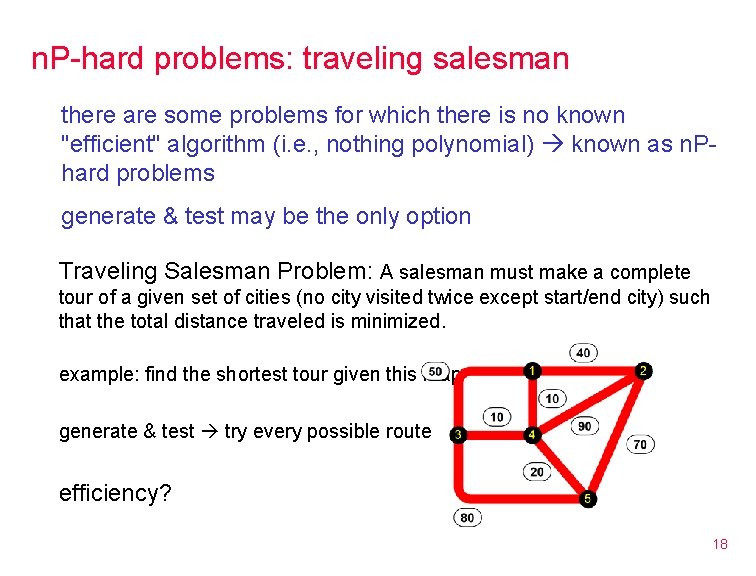
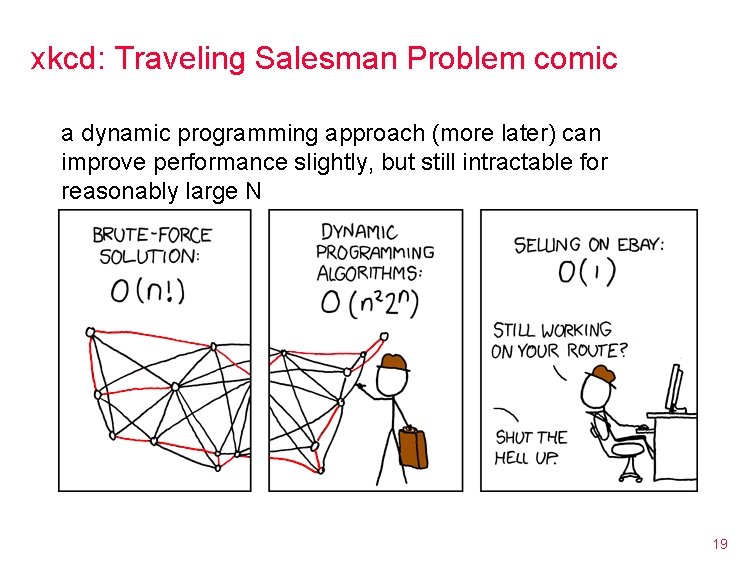
n. P-hard problems: traveling salesman there are some problems for which there is no known "efficient" algorithm (i. e. , nothing polynomial) known as n. Phard problems generate & test may be the only option Traveling Salesman Problem: A salesman must make a complete tour of a given set of cities (no city visited twice except start/end city) such that the total distance traveled is minimized. example: find the shortest tour given this map generate & test try every possible route efficiency? 18
xkcd: Traveling Salesman Problem comic a dynamic programming approach (more later) can improve performance slightly, but still intractable for reasonably large N 19
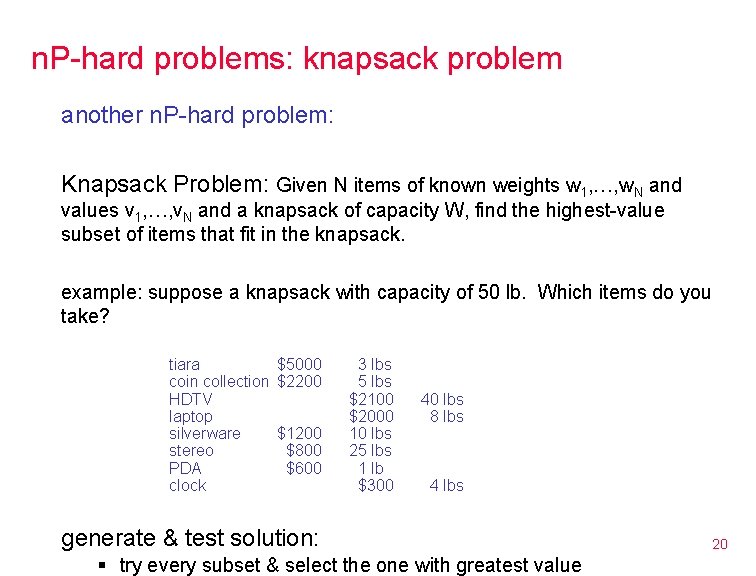
n. P-hard problems: knapsack problem another n. P-hard problem: Knapsack Problem: Given N items of known weights w 1, …, w. N and values v 1, …, v. N and a knapsack of capacity W, find the highest-value subset of items that fit in the knapsack. example: suppose a knapsack with capacity of 50 lb. Which items do you take? tiara $5000 coin collection $2200 HDTV laptop silverware $1200 stereo $800 PDA $600 clock 3 lbs 5 lbs $2100 $2000 10 lbs 25 lbs 1 lb $300 40 lbs 8 lbs 4 lbs generate & test solution: § try every subset & select the one with greatest value 20
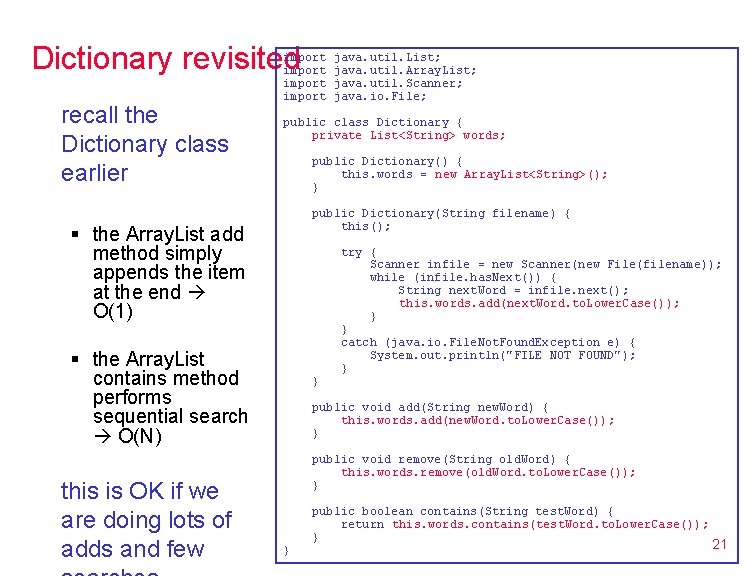
Dictionary revisited recall the Dictionary class earlier import public class Dictionary { private List<String> words; public Dictionary() { this. words = new Array. List<String>(); } public Dictionary(String filename) { this(); § the Array. List add method simply appends the item at the end O(1) § the Array. List contains method performs sequential search O(N) this is OK if we are doing lots of adds and few java. util. List; java. util. Array. List; java. util. Scanner; java. io. File; } try { Scanner infile = new Scanner(new File(filename)); while (infile. has. Next()) { String next. Word = infile. next(); this. words. add(next. Word. to. Lower. Case()); } } catch (java. io. File. Not. Found. Exception e) { System. out. println("FILE NOT FOUND"); } public void add(String new. Word) { this. words. add(new. Word. to. Lower. Case()); } public void remove(String old. Word) { this. words. remove(old. Word. to. Lower. Case()); } } public boolean contains(String test. Word) { return this. words. contains(test. Word. to. Lower. Case()); } 21
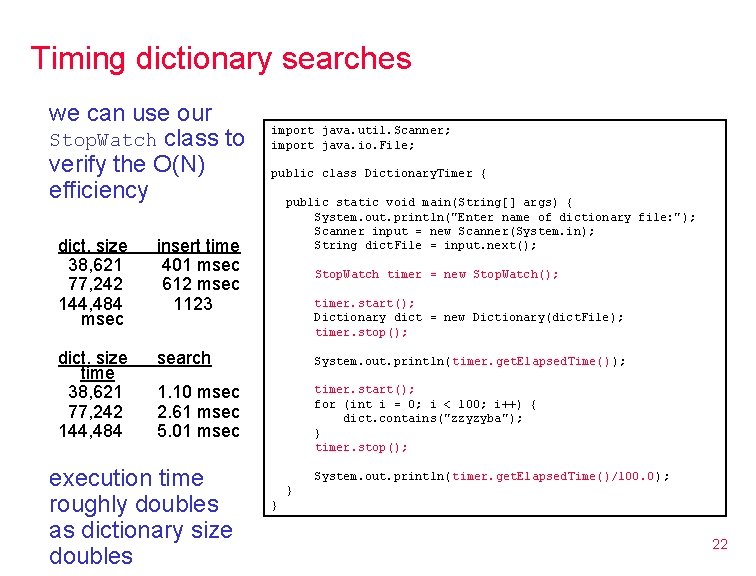
Timing dictionary searches we can use our Stop. Watch class to verify the O(N) efficiency dict. size 38, 621 77, 242 144, 484 msec insert time 401 msec 612 msec 1123 dict. size time 38, 621 77, 242 144, 484 search import java. util. Scanner; import java. io. File; public class Dictionary. Timer { public static void main(String[] args) { System. out. println("Enter name of dictionary file: "); Scanner input = new Scanner(System. in); String dict. File = input. next(); Stop. Watch timer = new Stop. Watch(); timer. start(); Dictionary dict = new Dictionary(dict. File); timer. stop(); System. out. println( timer. get. Elapsed. Time()); 1. 10 msec 2. 61 msec 5. 01 msec execution time roughly doubles as dictionary size doubles timer. start(); for (int i = 0; i < 100; i++) { dict. contains("zzyzyba"); } timer. stop(); System. out. println( timer. get. Elapsed. Time()/100. 0 ); } } 22
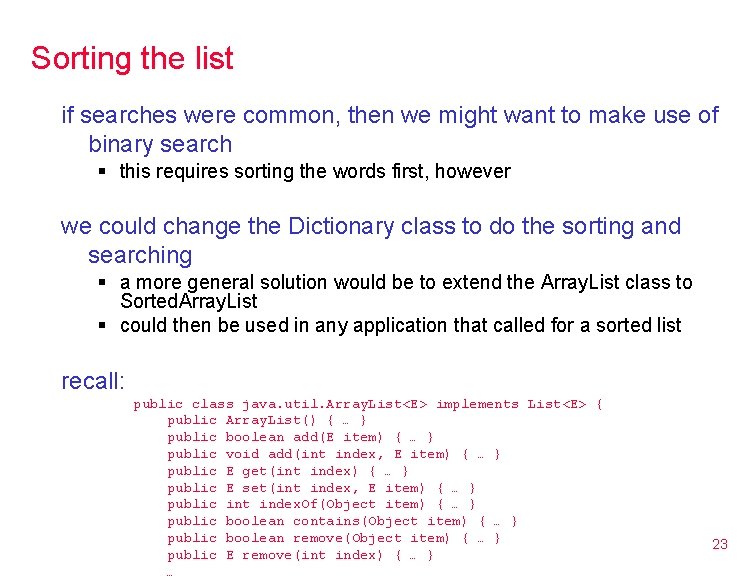
Sorting the list if searches were common, then we might want to make use of binary search § this requires sorting the words first, however we could change the Dictionary class to do the sorting and searching § a more general solution would be to extend the Array. List class to Sorted. Array. List § could then be used in any application that called for a sorted list recall: public class java. util. Array. List<E> implements List<E> { public Array. List() { … } public boolean add(E item) { … } public void add(int index, E item) { … } public E get(int index) { … } public E set(int index, E item) { … } public int index. Of(Object item) { … } public boolean contains(Object item) { … } public boolean remove(Object item) { … } public E remove(int index) { … } … 23
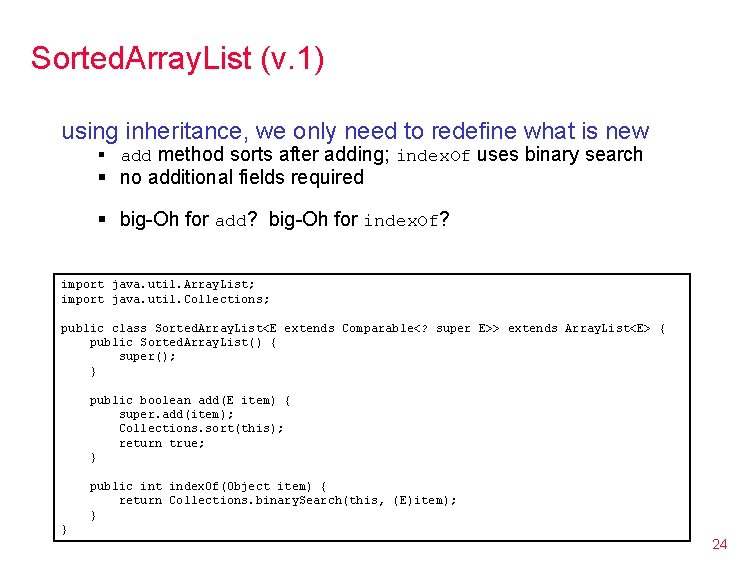
Sorted. Array. List (v. 1) using inheritance, we only need to redefine what is new § add method sorts after adding; index. Of uses binary search § no additional fields required § big-Oh for add? big-Oh for index. Of? import java. util. Array. List; import java. util. Collections; public class Sorted. Array. List<E extends Comparable<? super E>> extends Array. List<E> { public Sorted. Array. List() { super(); } public boolean add(E item) { super. add(item); Collections. sort(this); return true; } public int index. Of(Object item) { return Collections. binary. Search(this, (E)item); } } 24
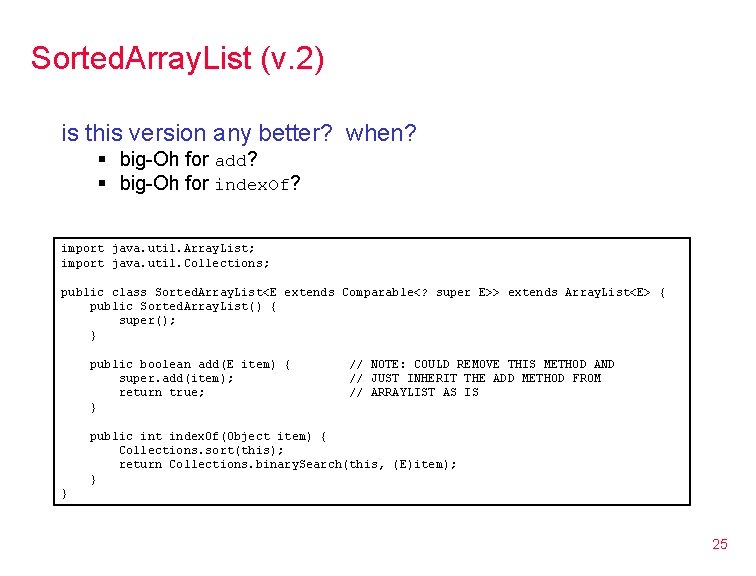
Sorted. Array. List (v. 2) is this version any better? when? § big-Oh for add? § big-Oh for index. Of? import java. util. Array. List; import java. util. Collections; public class Sorted. Array. List<E extends Comparable<? super E>> extends Array. List<E> { public Sorted. Array. List() { super(); } public boolean add(E item) { super. add(item); return true; } // NOTE: COULD REMOVE THIS METHOD AND // JUST INHERIT THE ADD METHOD FROM // ARRAYLIST AS IS public int index. Of(Object item) { Collections. sort(this); return Collections. binary. Search(this, (E)item); } } 25
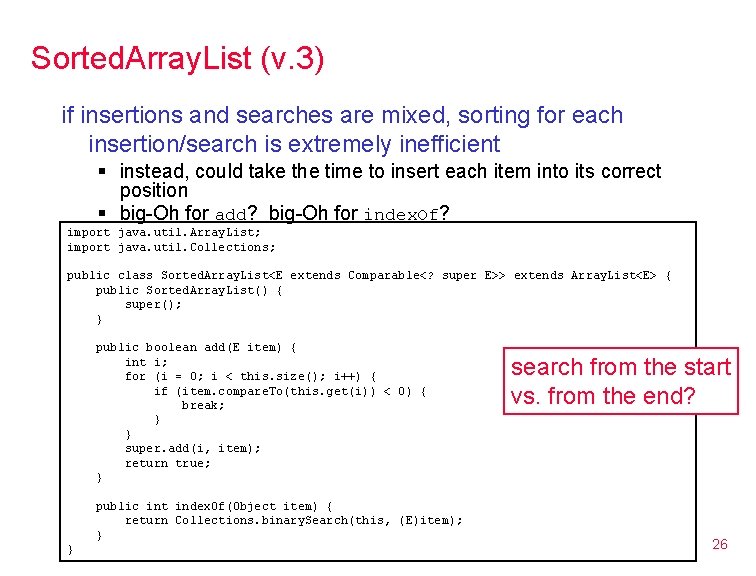
Sorted. Array. List (v. 3) if insertions and searches are mixed, sorting for each insertion/search is extremely inefficient § instead, could take the time to insert each item into its correct position § big-Oh for add? big-Oh for index. Of? import java. util. Array. List; import java. util. Collections; public class Sorted. Array. List<E extends Comparable<? super E>> extends Array. List<E> { public Sorted. Array. List() { super(); } public boolean add(E item) { int i; for (i = 0; i < this. size(); i++) { if (item. compare. To(this. get(i)) < 0) { break; } } super. add(i, item); return true; } public int index. Of(Object item) { return Collections. binary. Search(this, (E)item); } } search from the start vs. from the end? 26
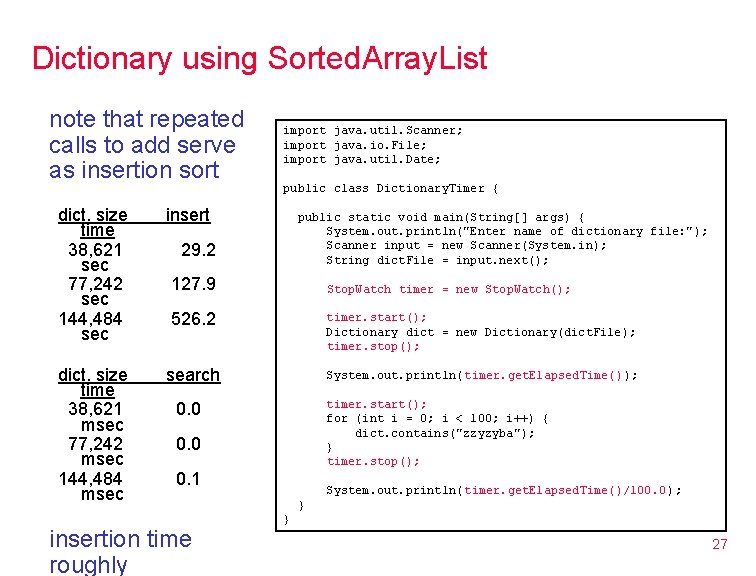
Dictionary using Sorted. Array. List note that repeated calls to add serve as insertion sort import java. util. Scanner; import java. io. File; import java. util. Date; public class Dictionary. Timer { dict. size time 38, 621 sec 77, 242 sec 144, 484 sec insert 526. 2 timer. start(); Dictionary dict = new Dictionary(dict. File); timer. stop(); dict. size time 38, 621 msec 77, 242 msec 144, 484 msec search System. out. println( timer. get. Elapsed. Time()); public static void main(String[] args) { System. out. println("Enter name of dictionary file: "); Scanner input = new Scanner(System. in); String dict. File = input. next(); 29. 2 127. 9 Stop. Watch timer = new Stop. Watch(); timer. start(); for (int i = 0; i < 100; i++) { dict. contains("zzyzyba"); } timer. stop(); 0. 0 0. 1 insertion time roughly System. out. println( timer. get. Elapsed. Time()/100. 0 ); } } 27
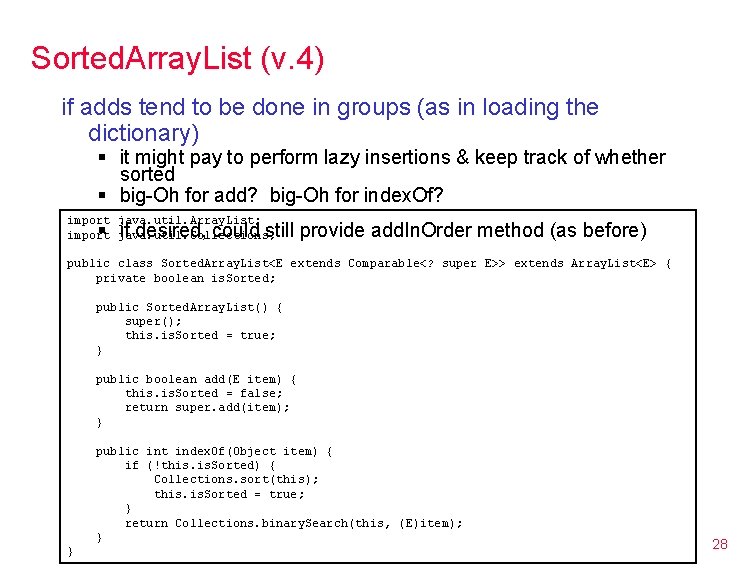
Sorted. Array. List (v. 4) if adds tend to be done in groups (as in loading the dictionary) § it might pay to perform lazy insertions & keep track of whether sorted § big-Oh for add? big-Oh for index. Of? import java. util. Array. List; import java. util. Collections; § if desired, could still provide add. In. Order method (as before) public class Sorted. Array. List<E extends Comparable<? super E>> extends Array. List<E> { private boolean is. Sorted; public Sorted. Array. List() { super(); this. Sorted = true; } public boolean add(E item) { this. Sorted = false; return super. add(item); } public int index. Of(Object item) { if (!this. Sorted) { Collections. sort(this); this. Sorted = true; } return Collections. binary. Search(this, (E)item); } } 28
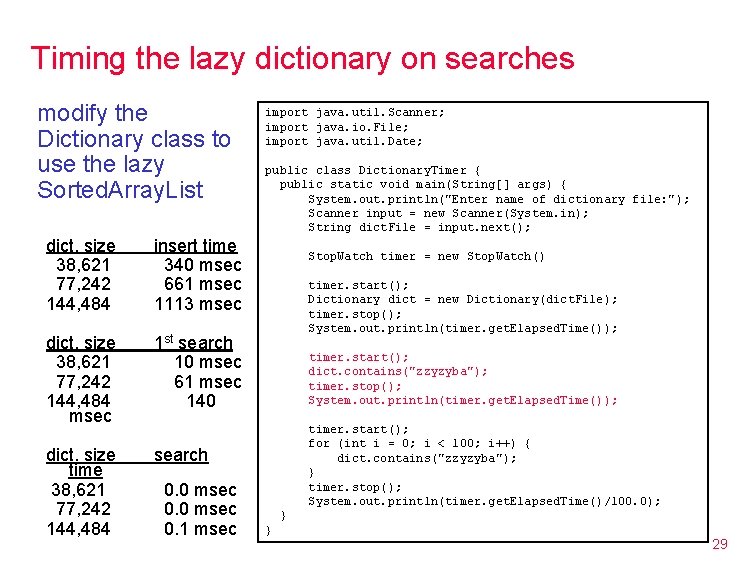
Timing the lazy dictionary on searches modify the Dictionary class to use the lazy Sorted. Array. List dict. size 38, 621 77, 242 144, 484 insert time 340 msec 661 msec 1113 msec dict. size 38, 621 77, 242 144, 484 msec 1 st search 10 msec 61 msec 140 dict. size time 38, 621 77, 242 144, 484 search 0. 0 msec 0. 1 msec import java. util. Scanner; import java. io. File; import java. util. Date; public class Dictionary. Timer { public static void main(String[] args) { System. out. println("Enter name of dictionary file: "); Scanner input = new Scanner(System. in); String dict. File = input. next(); Stop. Watch timer = new Stop. Watch() timer. start(); Dictionary dict = new Dictionary(dict. File); timer. stop(); System. out. println(timer. get. Elapsed. Time()); timer. start(); dict. contains("zzyzyba"); timer. stop(); System. out. println(timer. get. Elapsed. Time()); timer. start(); for (int i = 0; i < 100; i++) { dict. contains("zzyzyba"); } timer. stop(); System. out. println(timer. get. Elapsed. Time()/100. 0); } } 29