
Plato 427 347 B C Member of the
Plato • 427 - 347 B. C. • Member of the Athenian aristocracy (descendent of Codrus, the last king of Athens, and Solon). After Plato’s father died, his mother married a friend of Pericles. – Plato’s uncle Carmides and his cousin Critias (disciple of Socrates) take part in the (oligarchic) gvt. Of the Thirty. – The democratic reaction to that gvt. Leads to Socrates’ death. • Reaction: Plato resents practical politics (Seventh Letter) & democracy • 387 B. C. Foundation of the Academy (closed in 526 A. D. by emperor Justinian). • Dialogues (Socrates) • Other major works: Statesman, Laws, Apology
• Ebenstein & Ebenstein: – Plato’s Republic, first work of political science -Plato’s assumption: “the right kind of government and politics can be the legitimate object of rigorous, rational analysis. ” (E & E 20) • Application of Reason to the study of social relations • Eternal and unchangeable truth • Only a few can access truth – (ultimately…through Revelation) – Religion & myths are “medicinal lies” for the masses • Wisdom/craft (ontological hierarchy)
(Politeia) Republic (380 B. C. ) Politeia = Constitution • Everything comprising the state as it is (law, organization, government, community, culture, economy) • Constitution, as when we refer to a person’s bodily constitution. • Athenian laws were written on stones in public places across the city (ex: the Agora) • Isocrates: politeia is the "soul (psyche) of the polis" with power over it like that of the mind over the body
Republic: Ten Books • Book I: Introduction. Thrasymachus (elenchus) • Book II: Glauco requests Socrates for an analysis of justice and injustice • Books II-IV Definition of the just city and the just individual character • Books V-VII Problems of organization of the ideal city, in charge of the king-philosopher • Books VIII-IX Injustice (degenerate types of constitution: timocracy/honor, oligarchy/money, democracy/the people, tyranny or despotism/individual caprice) • Book X: Conclusions. Advantages of justice over injustice – need of rejecting poets as educators
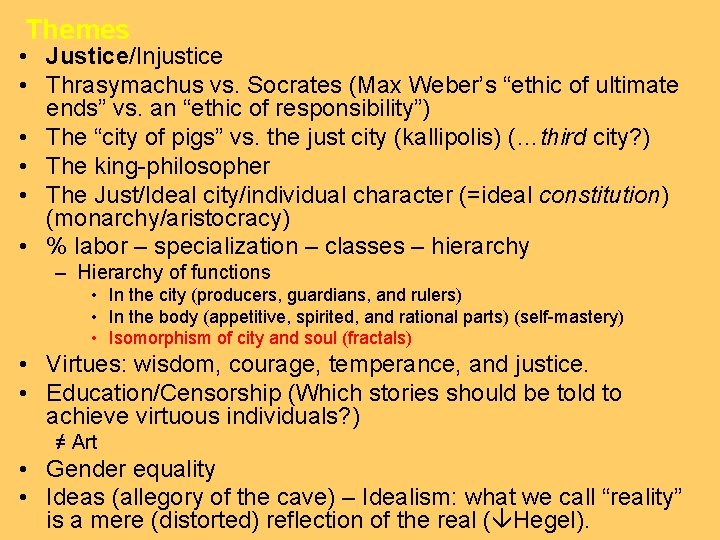
Themes • Justice/Injustice • Thrasymachus vs. Socrates (Max Weber’s “ethic of ultimate ends” vs. an “ethic of responsibility”) • The “city of pigs” vs. the just city (kallipolis) (…third city? ) • The king-philosopher • The Just/Ideal city/individual character (=ideal constitution) (monarchy/aristocracy) • % labor – specialization – classes – hierarchy – Hierarchy of functions • In the city (producers, guardians, and rulers) • In the body (appetitive, spirited, and rational parts) (self-mastery) • Isomorphism of city and soul (fractals) • Virtues: wisdom, courage, temperance, and justice. • Education/Censorship (Which stories should be told to achieve virtuous individuals? ) ≠ Art • Gender equality • Ideas (allegory of the cave) – Idealism: what we call “reality” is a mere (distorted) reflection of the real ( Hegel).
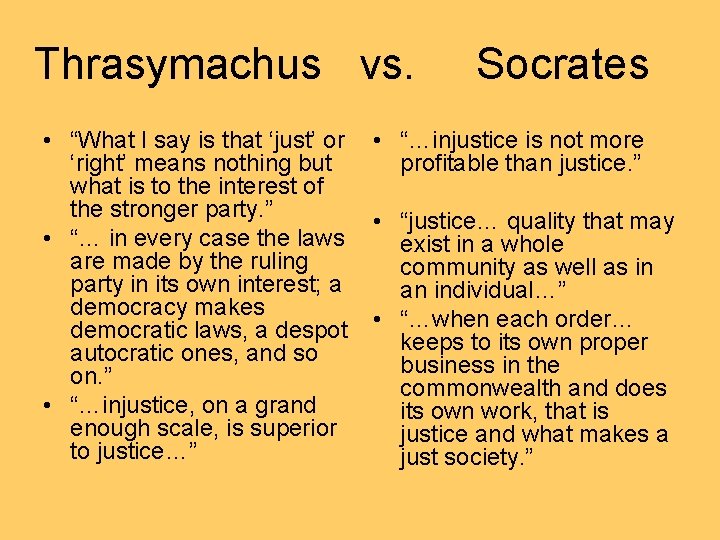
Thrasymachus vs. • “What I say is that ‘just’ or ‘right’ means nothing but what is to the interest of the stronger party. ” • “… in every case the laws are made by the ruling party in its own interest; a democracy makes democratic laws, a despot autocratic ones, and so on. ” • “…injustice, on a grand enough scale, is superior to justice…” Socrates • “…injustice is not more profitable than justice. ” • “justice… quality that may exist in a whole community as well as in an individual…” • “…when each order… keeps to its own proper business in the commonwealth and does its own work, that is justice and what makes a just society. ”
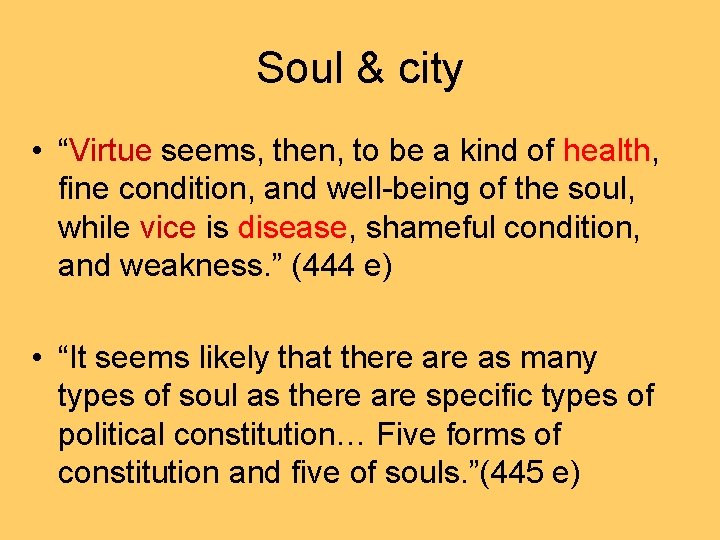
Soul & city • “Virtue seems, then, to be a kind of health, fine condition, and well-being of the soul, while vice is disease, shameful condition, and weakness. ” (444 e) • “It seems likely that there as many types of soul as there are specific types of political constitution… Five forms of constitution and five of souls. ”(445 e)
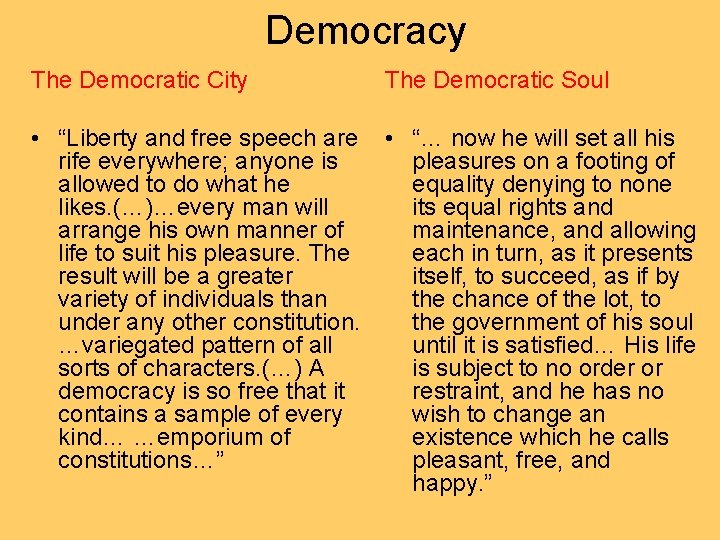
Democracy The Democratic City The Democratic Soul • “Liberty and free speech are • “… now he will set all his rife everywhere; anyone is pleasures on a footing of allowed to do what he equality denying to none likes. (…)…every man will its equal rights and arrange his own manner of maintenance, and allowing life to suit his pleasure. The each in turn, as it presents result will be a greater itself, to succeed, as if by variety of individuals than the chance of the lot, to under any other constitution. the government of his soul …variegated pattern of all until it is satisfied… His life sorts of characters. (…) A is subject to no order or democracy is so free that it restraint, and he has no contains a sample of every wish to change an kind… …emporium of existence which he calls constitutions…” pleasant, free, and happy. ”
Kallipolis’ Political Order Is based upon an ontological order Disorder = (political and personal) disease Discuss: Plato’s political theory supposes the annihilation of politics (Kallipolis)
• How useful/dangerous are stories to convey things? Discuss Plato’s perspective. • Is censorship necessary in education? • Are city and soul (really) similar? Do natural hierarchies organize them? • Can we distinguish between necessary and unnecessary appetites? • Why do many associate Plato’s Kallipolis with Totalitarianism? • Are democracy and self-mastery incompatible, as Plato suggests?
- Slides: 10