
Design of experiment ERT 427 2 kp fractional

- Slides: 26
+ Design of experiment ERT 427 2 k-p fractional factorial Miss Hanna Ilyani Zulhaimi
+ OUTLINE n Limitation of full factorial design n The concept of fractional factorial, 2 k-p n One-half fraction factorial design, 2 k-1 n One-quarter fraction factorial design, 2 k-2 n General 2 k-p fractional factorial design
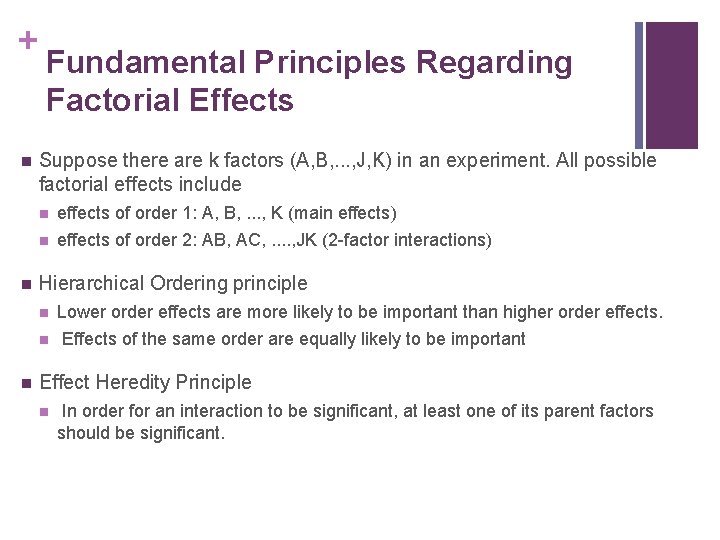
+ n n Fundamental Principles Regarding Factorial Effects Suppose there are k factors (A, B, . . . , J, K) in an experiment. All possible factorial effects include n effects of order 1: A, B, . . . , K (main effects) n effects of order 2: AB, AC, . . , JK (2 -factor interactions) Hierarchical Ordering principle n n n Lower order effects are more likely to be important than higher order effects. Effects of the same order are equally likely to be important Effect Heredity Principle n In order for an interaction to be significant, at least one of its parent factors should be significant.
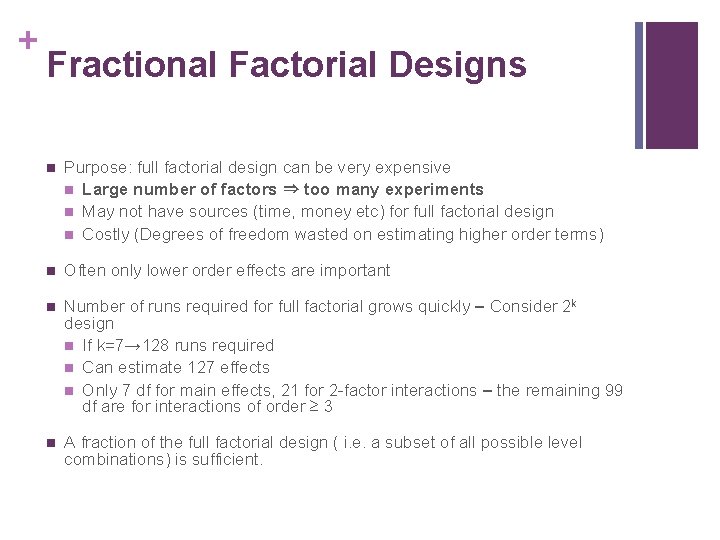
+ Fractional Factorial Designs n Purpose: full factorial design can be very expensive n Large number of factors ⇒ too many experiments n May not have sources (time, money etc) for full factorial design n Costly (Degrees of freedom wasted on estimating higher order terms) n Often only lower order effects are important n Number of runs required for full factorial grows quickly – Consider 2 k design n If k=7→ 128 runs required n Can estimate 127 effects n Only 7 df for main effects, 21 for 2 -factor interactions – the remaining 99 df are for interactions of order ≥ 3 n A fraction of the full factorial design ( i. e. a subset of all possible level combinations) is sufficient.
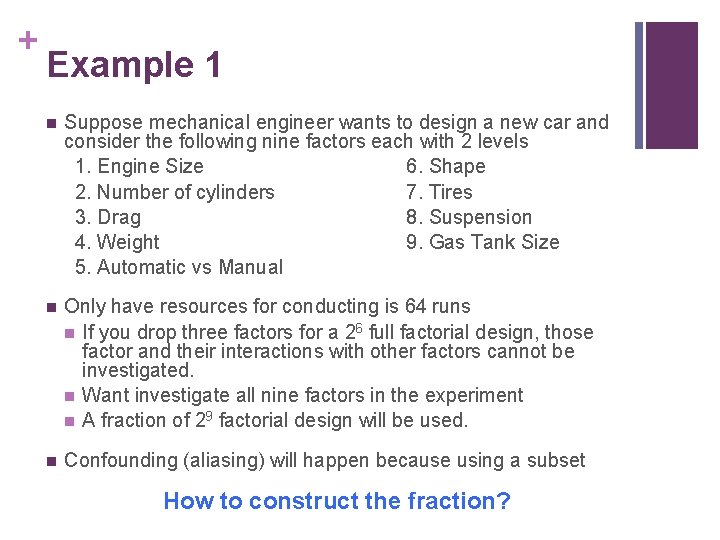
+ Example 1 n Suppose mechanical engineer wants to design a new car and consider the following nine factors each with 2 levels 1. Engine Size 6. Shape 2. Number of cylinders 7. Tires 3. Drag 8. Suspension 4. Weight 9. Gas Tank Size 5. Automatic vs Manual n Only have resources for conducting is 64 runs n If you drop three factors for a 26 full factorial design, those factor and their interactions with other factors cannot be investigated. n Want investigate all nine factors in the experiment n A fraction of 29 factorial design will be used. n Confounding (aliasing) will happen because using a subset How to construct the fraction?
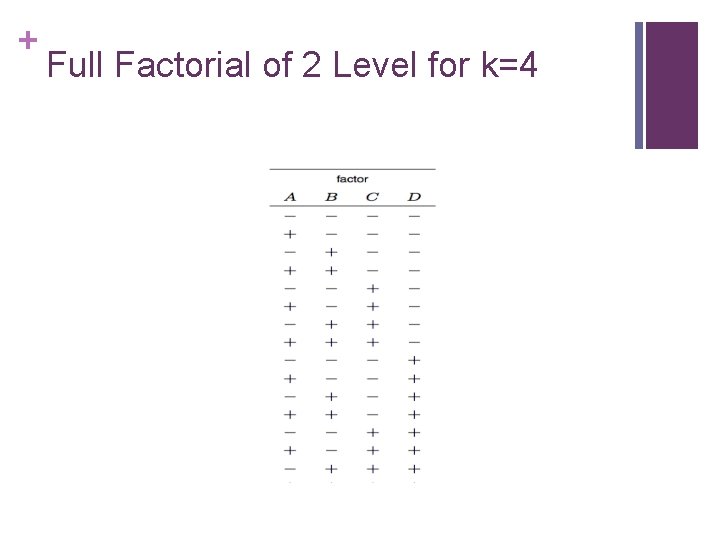
+ Example 2 Filtration rate experiment: Recall that there are four factors in the experiment (A, B, C and D), each of 2 levels. Suppose the available resource is enough for conducting 8 runs. 24 full factorial design consists of all the 16 level combinations of the four factors. We need to choose half of them. The chosen half is called 24− 1 fractional factorial design Which half we should select (construct)?
+ Full Factorial of 2 Level for k=4
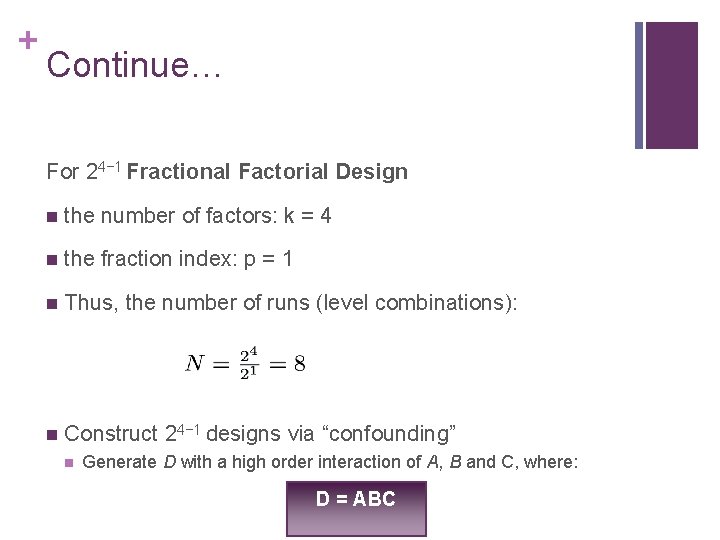
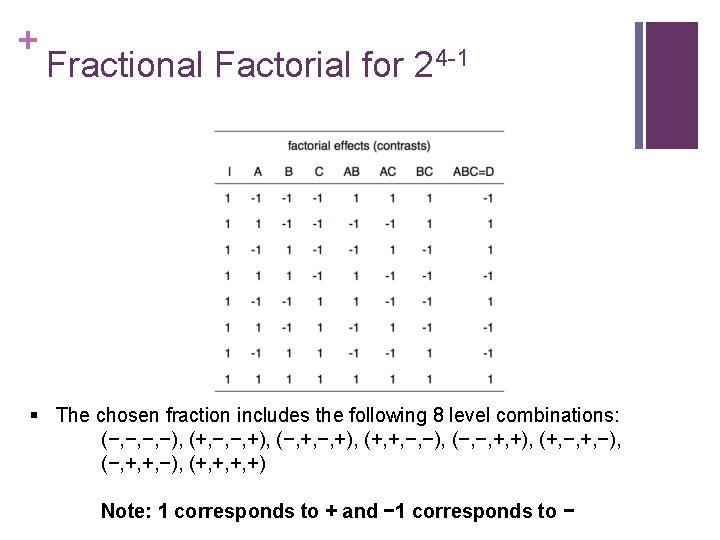
+ Continue… For 24− 1 Fractional Factorial Design n the number of factors: k = 4 n the fraction index: p = 1 n Thus, the number of runs (level combinations): n Construct 24− 1 designs via “confounding” n Generate D with a high order interaction of A, B and C, where: D = ABC
+ Fractional Factorial for 24 -1 § The chosen fraction includes the following 8 level combinations: (−, −, −, −), (+, −, −, +), (−, +, −, +), (+, +, −, −), (−, −, +, +), (+, −, +, −), (−, +, +, −), (+, +, +, +) Note: 1 corresponds to + and − 1 corresponds to −
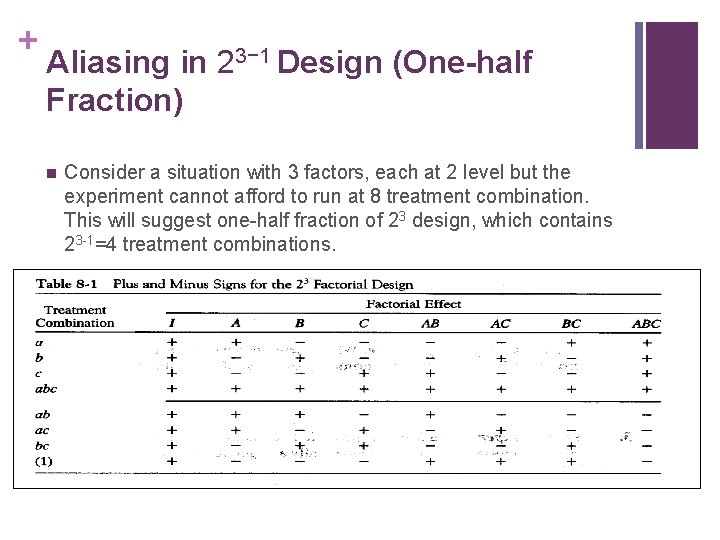
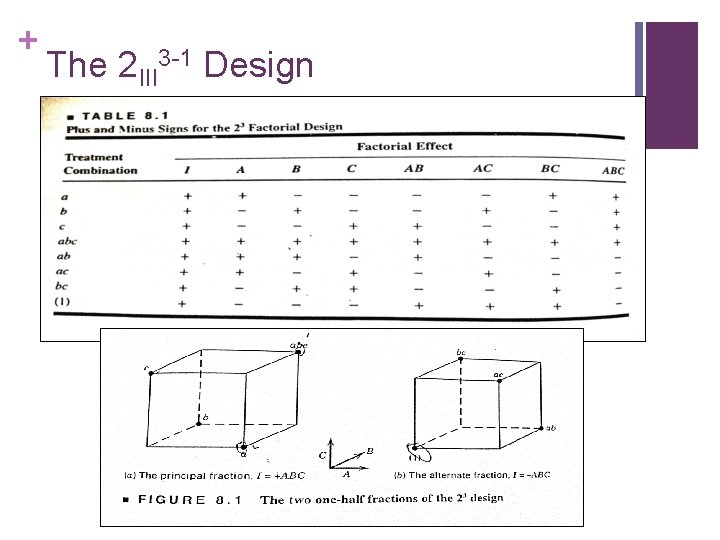
+ Aliasing in 23− 1 Design (One-half Fraction) n Consider a situation with 3 factors, each at 2 level but the experiment cannot afford to run at 8 treatment combination. This will suggest one-half fraction of 23 design, which contains 23 -1=4 treatment combinations. n Note that I=ABC
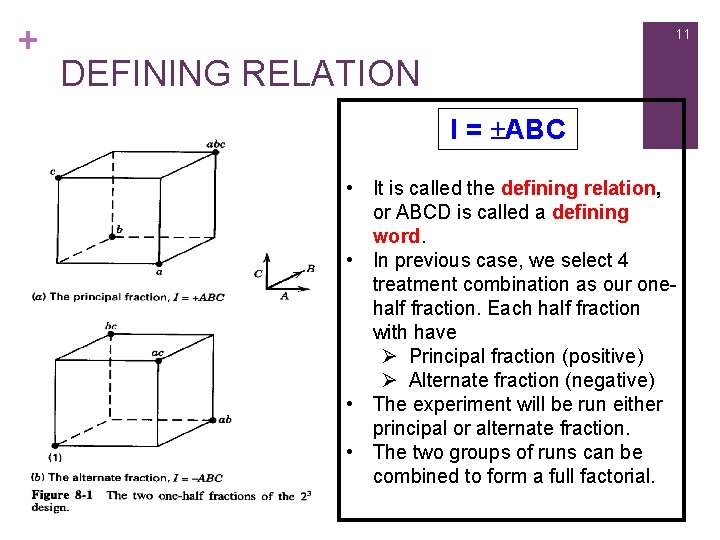
+ 11 DEFINING RELATION I = ±ABC • It is called the defining relation, or ABCD is called a defining word. • In previous case, we select 4 treatment combination as our onehalf fraction. Each half fraction with have Ø Principal fraction (positive) Ø Alternate fraction (negative) • The experiment will be run either principal or alternate fraction. • The two groups of runs can be combined to form a full factorial.
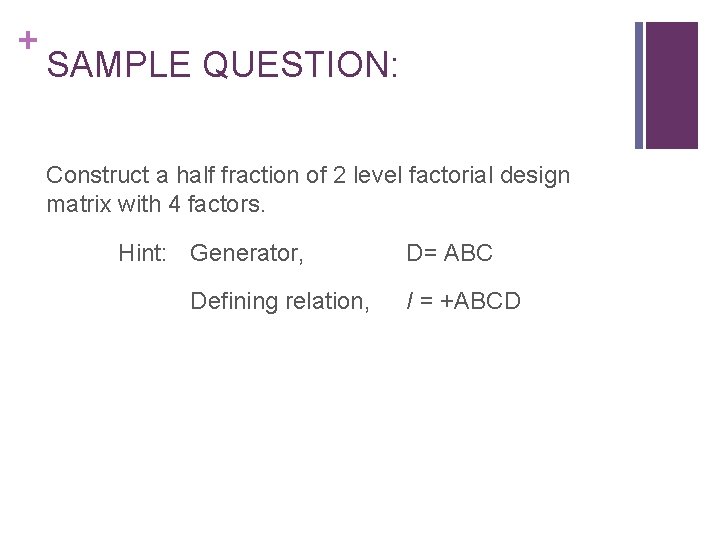
+ SAMPLE QUESTION: Construct a half fraction of 2 level factorial design matrix with 4 factors. Hint: Generator, Defining relation, D= ABC I = +ABCD
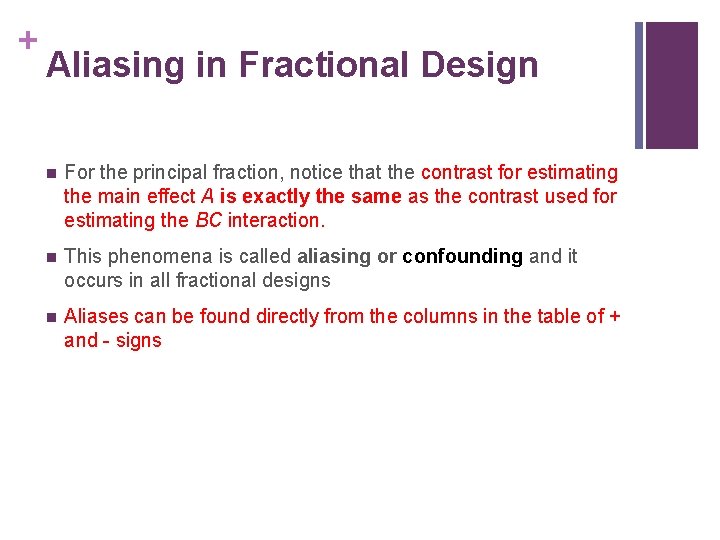
+ Aliasing in Fractional Design n For the principal fraction, notice that the contrast for estimating the main effect A is exactly the same as the contrast used for estimating the BC interaction. n This phenomena is called aliasing or confounding and it occurs in all fractional designs n Aliases can be found directly from the columns in the table of + and - signs
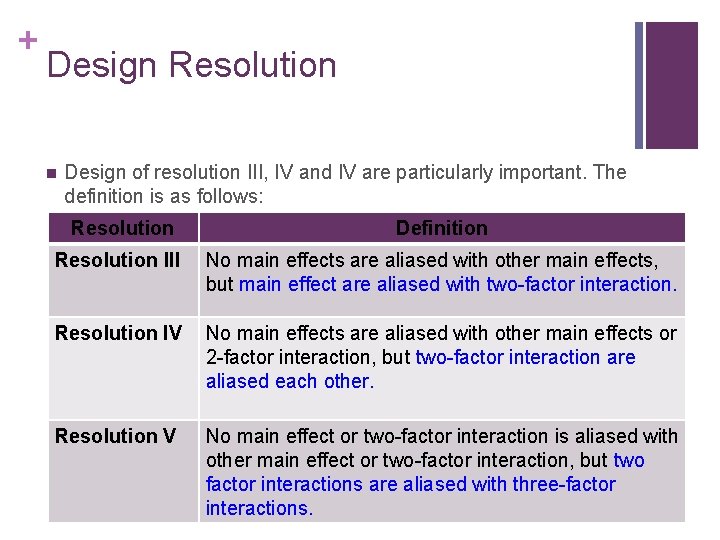
+ Design Resolution n Design of resolution III, IV and IV are particularly important. The definition is as follows: Resolution Definition Resolution III No main effects are aliased with other main effects, but main effect are aliased with two-factor interaction. Resolution IV No main effects are aliased with other main effects or 2 -factor interaction, but two-factor interaction are aliased each other. Resolution V No main effect or two-factor interaction is aliased with other main effect or two-factor interaction, but two factor interactions are aliased with three-factor interactions.
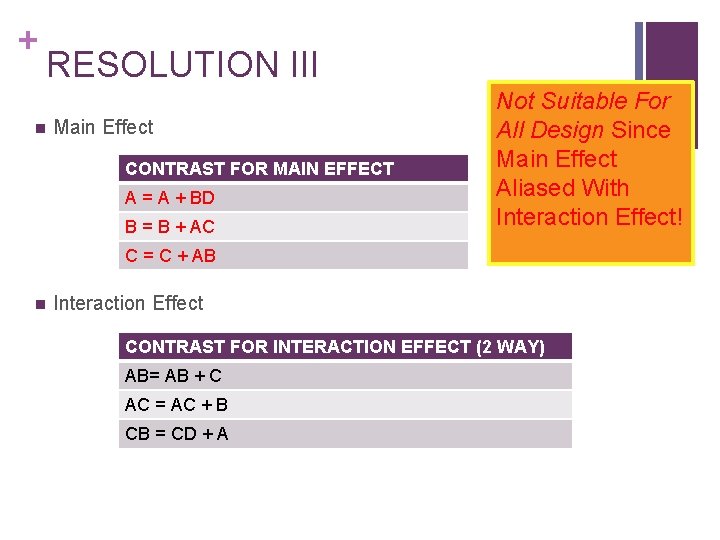
+ RESOLUTION III n Main Effect CONTRAST FOR MAIN EFFECT A = A + BD B = B + AC Not Suitable For All Design Since Main Effect Aliased With Interaction Effect! C = C + AB n Interaction Effect CONTRAST FOR INTERACTION EFFECT (2 WAY) AB= AB + C AC = AC + B CB = CD + A
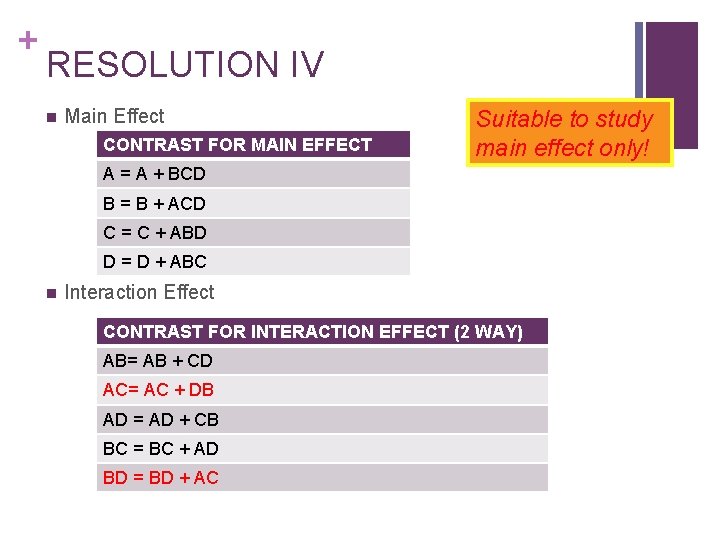
+ RESOLUTION IV n Main Effect CONTRAST FOR MAIN EFFECT Suitable to study main effect only! A = A + BCD B = B + ACD C = C + ABD D = D + ABC n Interaction Effect CONTRAST FOR INTERACTION EFFECT (2 WAY) AB= AB + CD AC= AC + DB AD = AD + CB BC = BC + AD BD = BD + AC
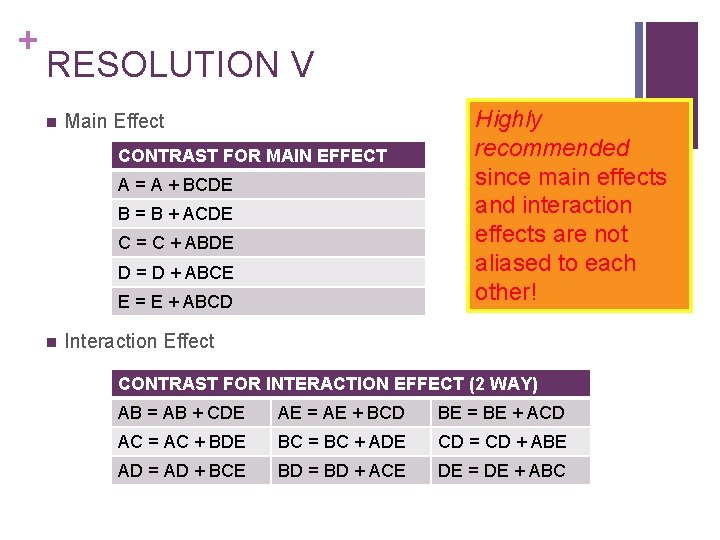
+ RESOLUTION V n Main Effect CONTRAST FOR MAIN EFFECT A = A + BCDE B = B + ACDE C = C + ABDE D = D + ABCE E = E + ABCD n Highly recommended since main effects and interaction effects are not aliased to each other! Interaction Effect CONTRAST FOR INTERACTION EFFECT (2 WAY) AB = AB + CDE AE = AE + BCD BE = BE + ACD AC = AC + BDE BC = BC + ADE CD = CD + ABE AD = AD + BCE BD = BD + ACE DE = DE + ABC
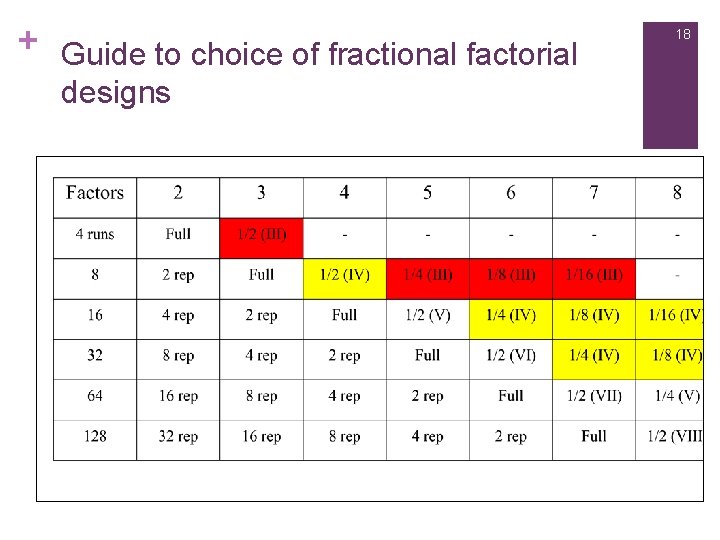
+ Guide to choice of fractional factorial designs 18
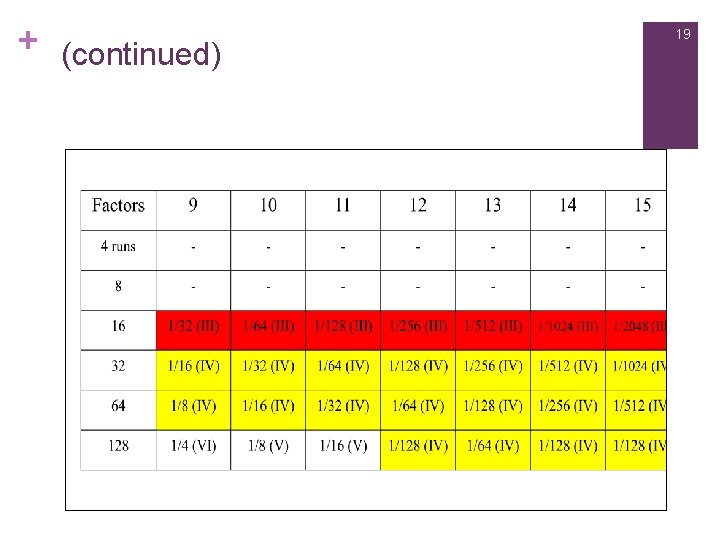
+ (continued) 19
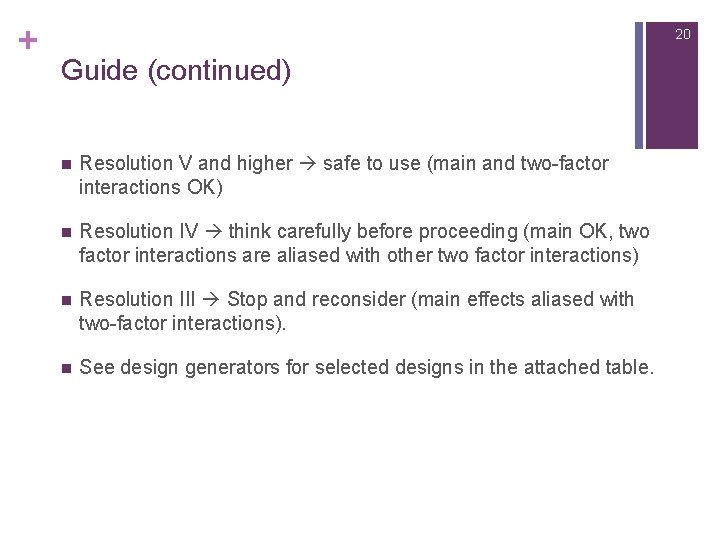
+ 20 Guide (continued) n Resolution V and higher safe to use (main and two-factor interactions OK) n Resolution IV think carefully before proceeding (main OK, two factor interactions are aliased with other two factor interactions) n Resolution III Stop and reconsider (main effects aliased with two-factor interactions). n See design generators for selected designs in the attached table.
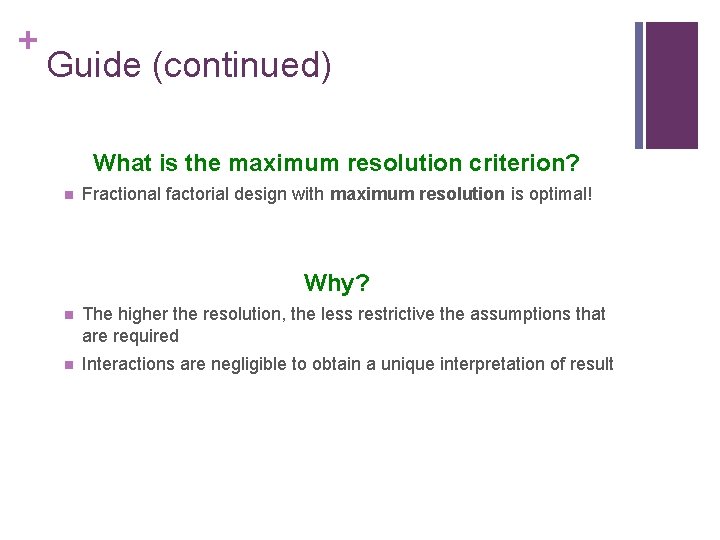
+ Guide (continued) What is the maximum resolution criterion? n Fractional factorial design with maximum resolution is optimal! Why? n The higher the resolution, the less restrictive the assumptions that are required n Interactions are negligible to obtain a unique interpretation of result
+ The 2 III 3 -1 Design
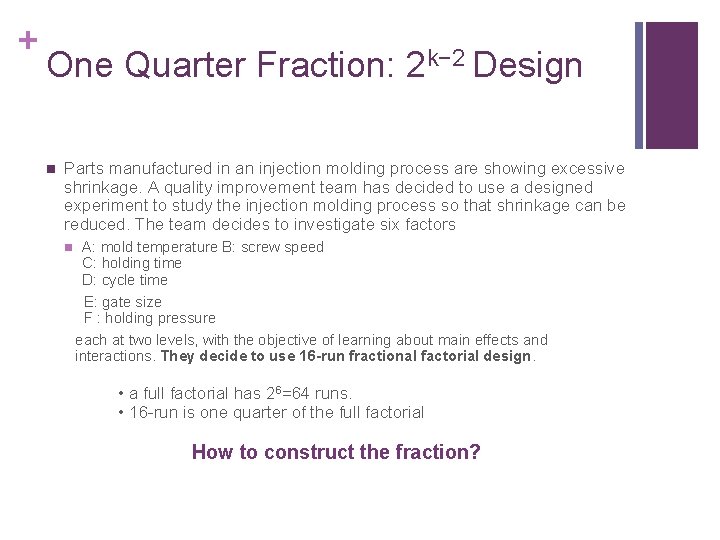
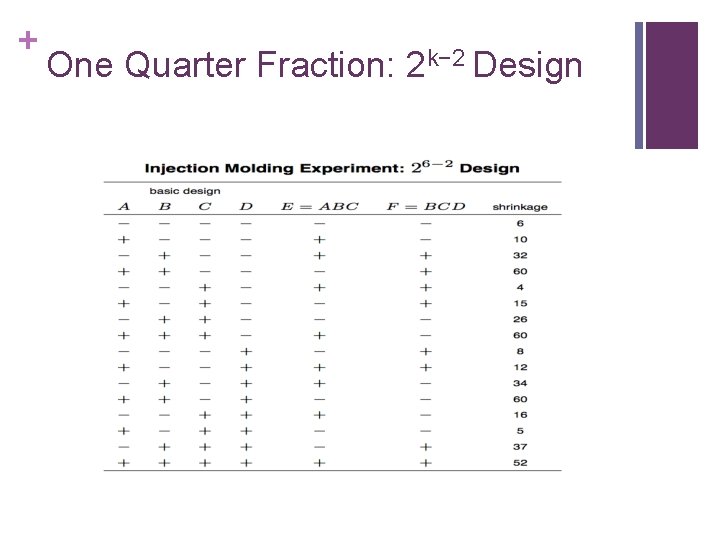
+ One Quarter Fraction: 2 k− 2 Design n Parts manufactured in an injection molding process are showing excessive shrinkage. A quality improvement team has decided to use a designed experiment to study the injection molding process so that shrinkage can be reduced. The team decides to investigate six factors n A: mold temperature B: screw speed C: holding time D: cycle time E: gate size F : holding pressure each at two levels, with the objective of learning about main effects and interactions. They decide to use 16 -run fractional factorial design. • a full factorial has 26=64 runs. • 16 -run is one quarter of the full factorial How to construct the fraction?
+ One Quarter Fraction: 2 k− 2 Design
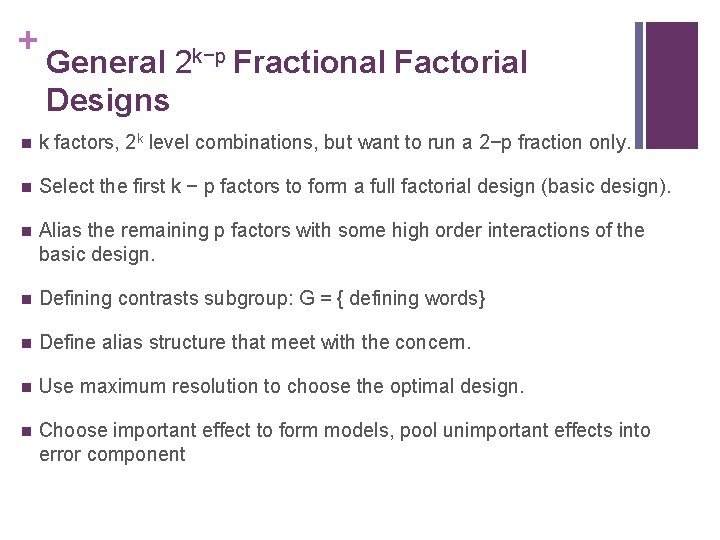
+ General 2 k−p Fractional Factorial Designs n k factors, 2 k level combinations, but want to run a 2−p fraction only. n Select the first k − p factors to form a full factorial design (basic design). n Alias the remaining p factors with some high order interactions of the basic design. n Defining contrasts subgroup: G = { defining words} n Define alias structure that meet with the concern. n Use maximum resolution to choose the optimal design. n Choose important effect to form models, pool unimportant effects into error component
+ Thank you