
Teacher Quality Partnership TQP Grant Competition U S


- Slides: 67
Teacher Quality Partnership (TQP) Grant Competition U. S. Department of Education Office of Innovation and Improvement June 2, 2016 Note: These slides are intended as guidance only. Please refer to the official documents published in the Federal Register.
Note About These Slides • The slides presented on this webinar will be available for download on the TQP website. • Applicants are strongly encouraged to download the TQP Application Package from the TQP website. • The TQP Application Package provides additional instructions needed to apply for this TQP grant. http: //innovation. ed. gov/what-we-do/teacher-quality-partnership/ Note: These slides are intended as guidance only. Please refer to the official documents published in the Federal Register. 2
Notes on General Q&A • We cannot answer questions that are specific to your state or region. • We cannot answer questions that are applicant-specific like: “Does this sound like a good idea? ”, or “Does this idea address the absolute priority? ” • The TQP Frequently Asked Questions (FAQ) document addresses many questions that applicants may ask. As necessary, the Department also plans to update the FAQ document throughout the competition. http: //www 2. ed. gov/programs/tqpartnership/tqpfinalfaq 52316. pdf/ We may not be able to answer all questions received during today’s webinar. If you have additional questions, please send them to the TQP inbox at: TQPartnership@ed. gov 3
Agenda for Today’s Webinar I. TQP Program Purpose and Overview II. Eligibility Requirements III. FY 16 Program Priorities IV. Selection Criteria & Scoring V. TQP Program Requirements VI. Submission Guidance VII. Competition Resources 4
TQP Program Purpose to improve student achievement by improving the quality of new teachers … http: //innovation. ed. gov/what-we-do/teacher-qualitypartnership/ 5
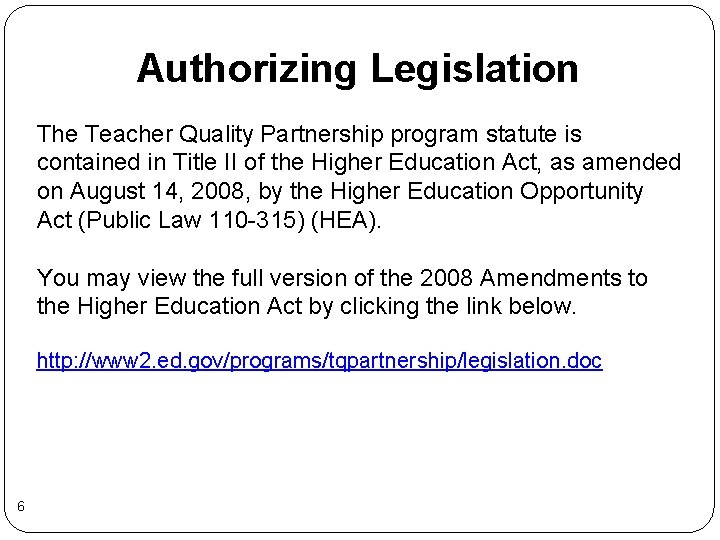
Authorizing Legislation The Teacher Quality Partnership program statute is contained in Title II of the Higher Education Act, as amended on August 14, 2008, by the Higher Education Opportunity Act (Public Law 110 -315) (HEA). You may view the full version of the 2008 Amendments to the Higher Education Act by clicking the link below. http: //www 2. ed. gov/programs/tqpartnership/legislation. doc 6
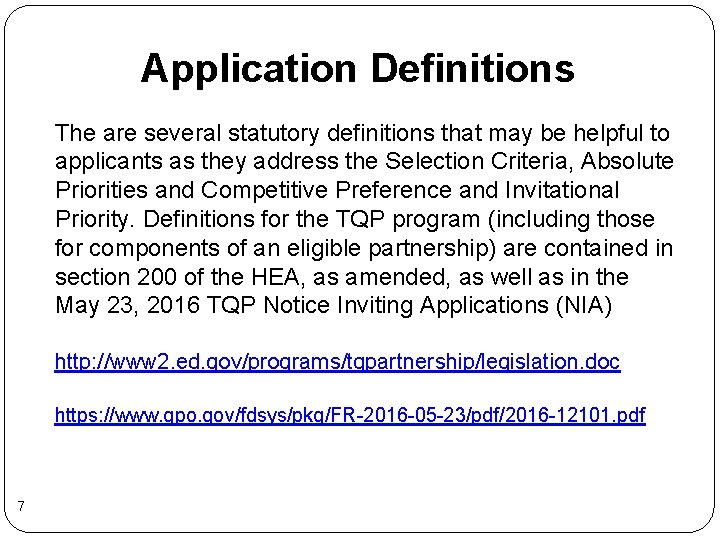
Application Definitions The are several statutory definitions that may be helpful to applicants as they address the Selection Criteria, Absolute Priorities and Competitive Preference and Invitational Priority. Definitions for the TQP program (including those for components of an eligible partnership) are contained in section 200 of the HEA, as amended, as well as in the May 23, 2016 TQP Notice Inviting Applications (NIA) http: //www 2. ed. gov/programs/tqpartnership/legislation. doc https: //www. gpo. gov/fdsys/pkg/FR-2016 -05 -23/pdf/2016 -12101. pdf 7
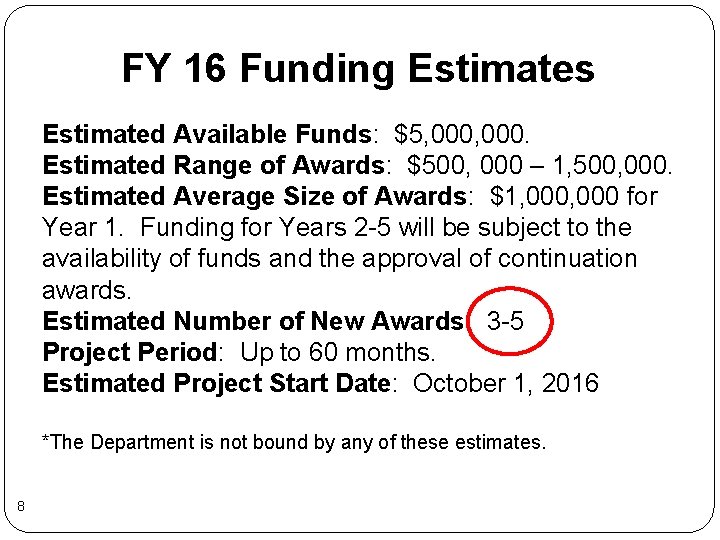
FY 16 Funding Estimates Estimated Available Funds: $5, 000. Estimated Range of Awards: $500, 000 – 1, 500, 000. Estimated Average Size of Awards: $1, 000 for Year 1. Funding for Years 2 -5 will be subject to the availability of funds and the approval of continuation awards. Estimated Number of New Awards: 3 -5 Project Period: Up to 60 months. Estimated Project Start Date: October 1, 2016 *The Department is not bound by any of these estimates. 8
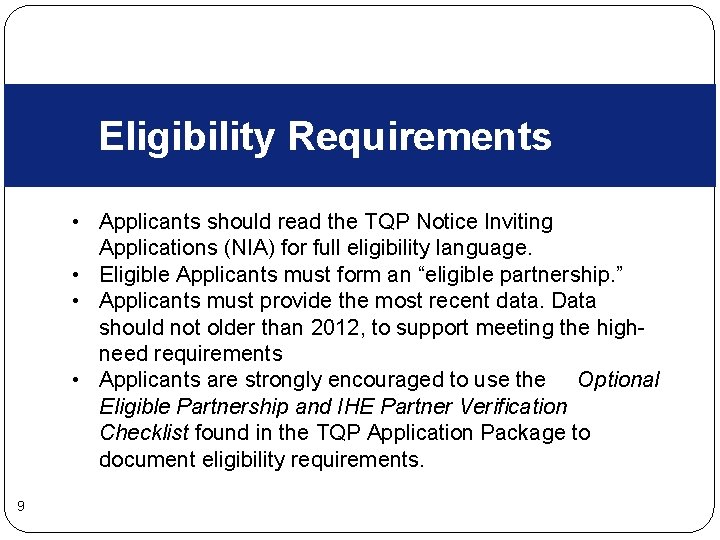
Eligibility Requirements • Applicants should read the TQP Notice Inviting Applications (NIA) for full eligibility language. • Eligible Applicants must form an “eligible partnership. ” • Applicants must provide the most recent data. Data should not older than 2012, to support meeting the highneed requirements • Applicants are strongly encouraged to use the Optional Eligible Partnership and IHE Partner Verification Checklist found in the TQP Application Package to document eligibility requirements. 9
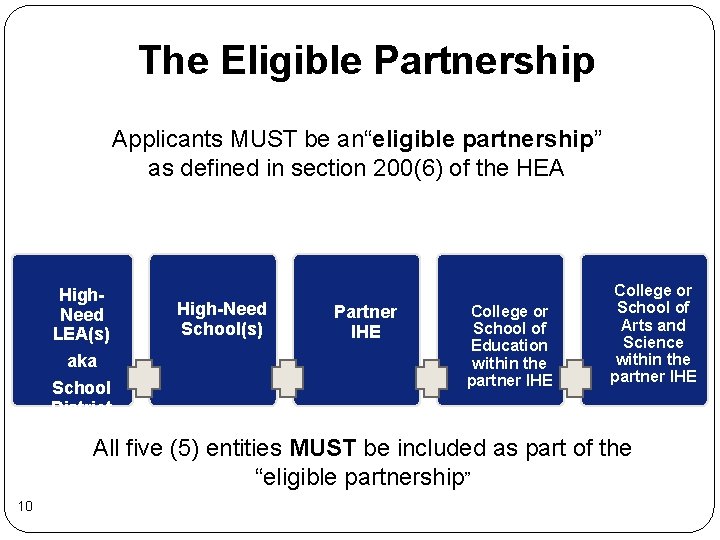
The Eligible Partnership High. Need LEA(s) aka School District Applicants MUST be an“eligible partnership” as defined in section 200(6) of the HEA High-Need School(s) Partner IHE College or School of Education within the partner IHE College or School of Arts and Science within the partner IHE All five (5) entities MUST be included as part of the “eligible partnership” 10
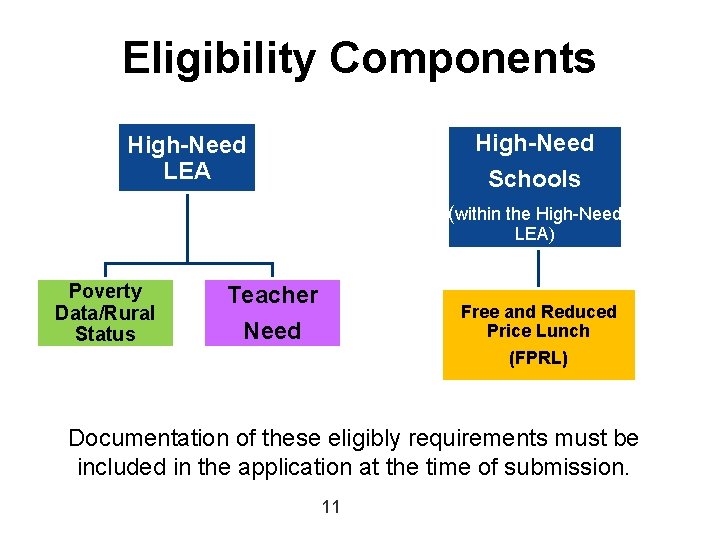
Eligibility Components High-Need LEA Schools (within the High-Need LEA) Poverty Data/Rural Status Teacher Free and Reduced Price Lunch Need (FPRL) Documentation of these eligibly requirements must be included in the application at the time of submission. 11
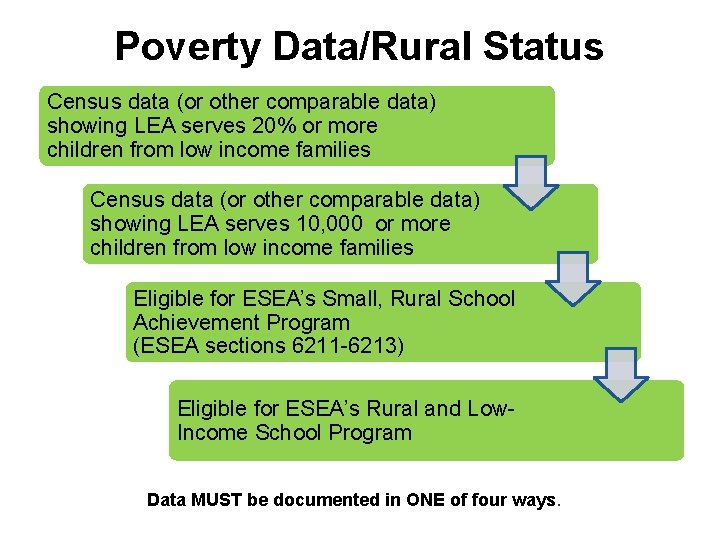
Poverty Data/Rural Status Census data (or other comparable data) showing LEA serves 20% or more children from low income families Census data (or other comparable data) showing LEA serves 10, 000 or more children from low income families Eligible for ESEA’s Small, Rural School Achievement Program (ESEA sections 6211 -6213) Eligible for ESEA’s Rural and Low. Income School Program Data MUST be documented in ONE of four ways.
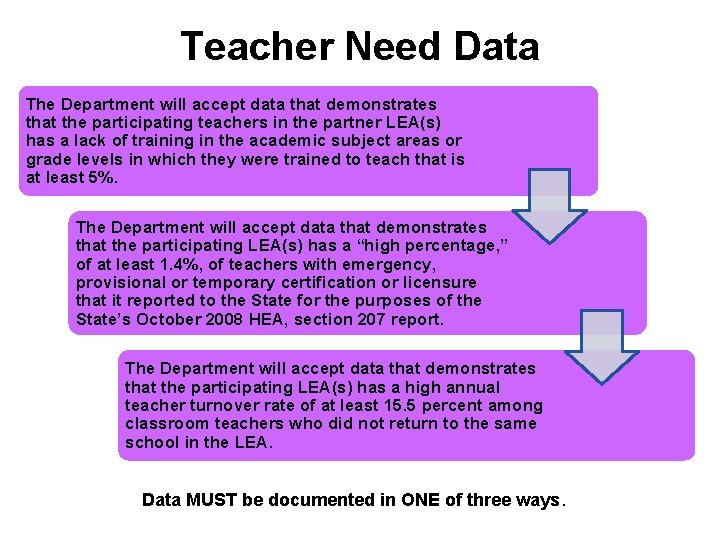
Teacher Need Data The Department will accept data that demonstrates that the participating teachers in the partner LEA(s) has a lack of training in the academic subject areas or grade levels in which they were trained to teach that is at least 5%. The Department will accept data that demonstrates that the participating LEA(s) has a “high percentage, ” of at least 1. 4%, of teachers with emergency, provisional or temporary certification or licensure that it reported to the State for the purposes of the State’s October 2008 HEA, section 207 report. The Department will accept data that demonstrates that the participating LEA(s) has a high annual teacher turnover rate of at least 15. 5 percent among classroom teachers who did not return to the same school in the LEA. Data MUST be documented in ONE of three ways.
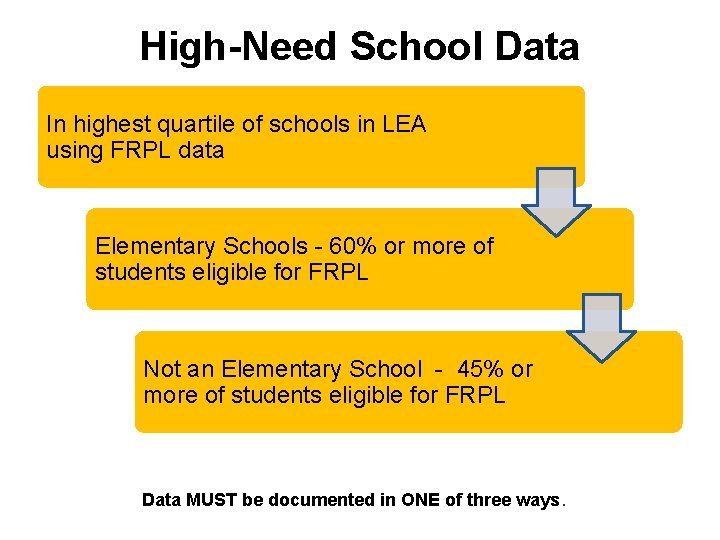
High-Need School Data In highest quartile of schools in LEA using FRPL data Elementary Schools - 60% or more of students eligible for FRPL Not an Elementary School - 45% or more of students eligible for FRPL Data MUST be documented in ONE of three ways.
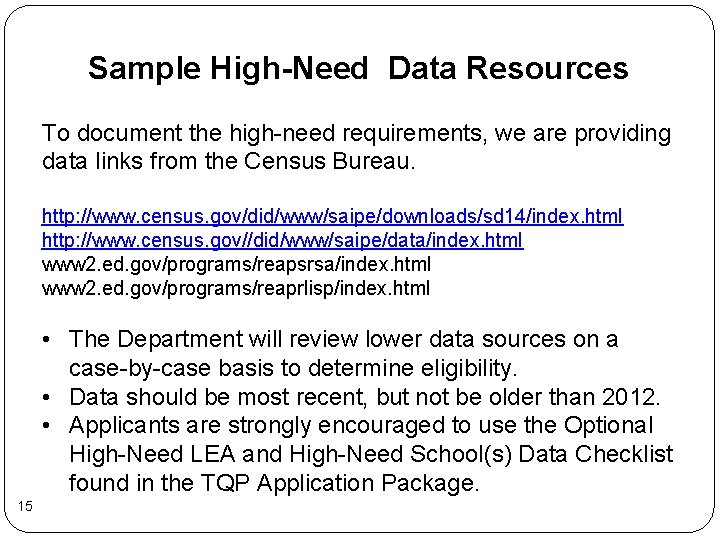
Sample High-Need Data Resources To document the high-need requirements, we are providing data links from the Census Bureau. http: //www. census. gov/did/www/saipe/downloads/sd 14/index. html http: //www. census. gov//did/www/saipe/data/index. html www 2. ed. gov/programs/reapsrsa/index. html www 2. ed. gov/programs/reaprlisp/index. html • The Department will review lower data sources on a case-by-case basis to determine eligibility. • Data should be most recent, but not be older than 2012. • Applicants are strongly encouraged to use the Optional High-Need LEA and High-Need School(s) Data Checklist found in the TQP Application Package. 15
Eligibility Questions Please enter your questions in the chat box to the right of your screen. We may not be able to answer all questions at this time, but we will answer as many questions as possible in the allotted Q&A time. 16
FY 16 TQP Priorities Note: These slides are intended as guidance only. Please refer to the official Notices in the Federal Register. 17
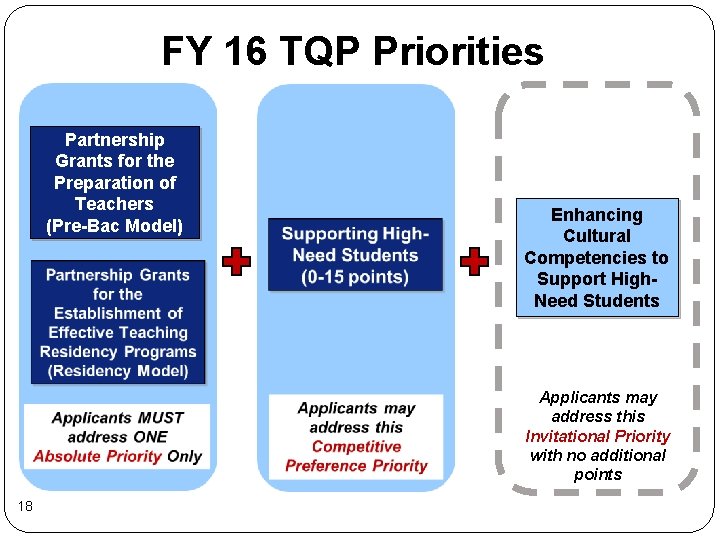
FY 16 TQP Priorities Partnership Grants for the Preparation of Teachers (Pre-Bac Model) Enhancing Cultural Competencies to Support High. Need Students Applicants may address this Invitational Priority with no additional points 18
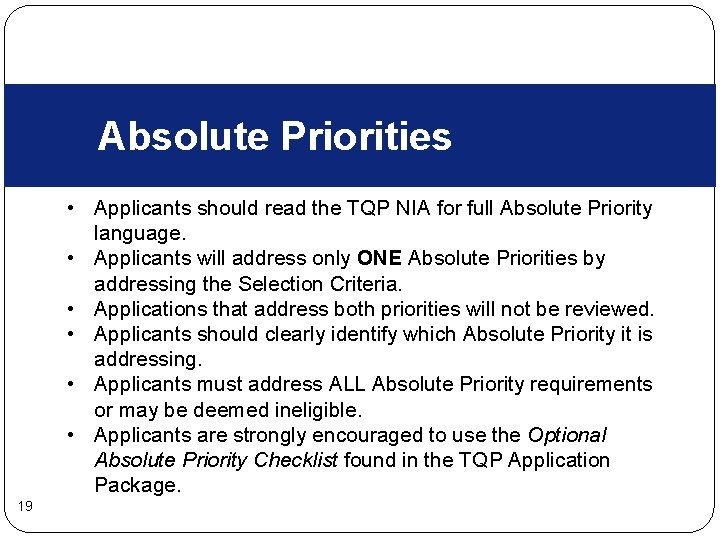
Absolute Priorities • Applicants should read the TQP NIA for full Absolute Priority language. • Applicants will address only ONE Absolute Priorities by addressing the Selection Criteria. • Applications that address both priorities will not be reviewed. • Applicants should clearly identify which Absolute Priority it is addressing. • Applicants must address ALL Absolute Priority requirements or may be deemed ineligible. • Applicants are strongly encouraged to use the Optional Absolute Priority Checklist found in the TQP Application Package. 19
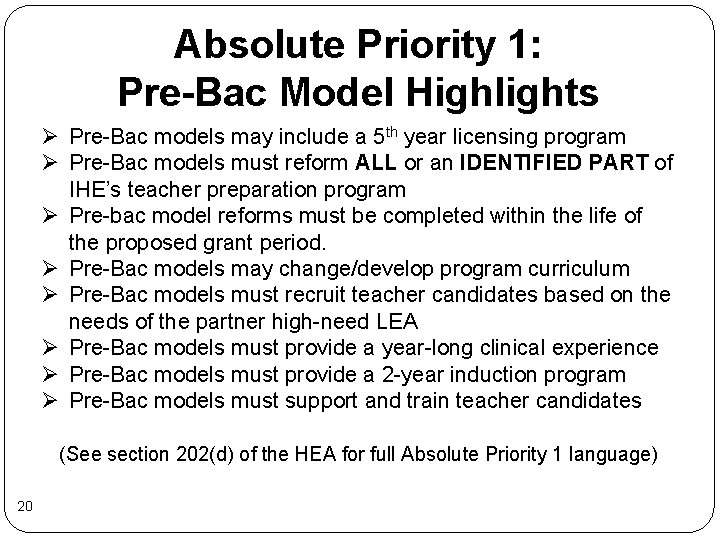
Absolute Priority 1: Pre-Bac Model Highlights Ø Pre-Bac models may include a 5 th year licensing program Ø Pre-Bac models must reform ALL or an IDENTIFIED PART of IHE’s teacher preparation program Ø Pre-bac model reforms must be completed within the life of the proposed grant period. Ø Pre-Bac models may change/develop program curriculum Ø Pre-Bac models must recruit teacher candidates based on the needs of the partner high-need LEA Ø Pre-Bac models must provide a year-long clinical experience Ø Pre-Bac models must provide a 2 -year induction program Ø Pre-Bac models must support and train teacher candidates (See section 202(d) of the HEA for full Absolute Priority 1 language) 20
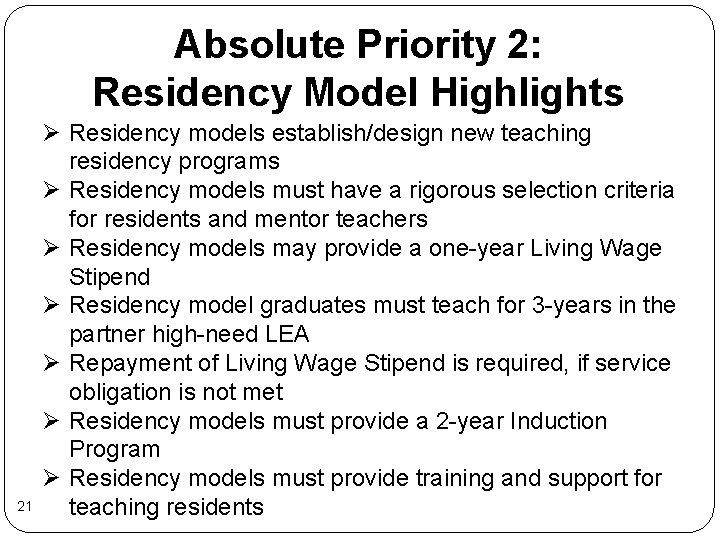
Absolute Priority 2: Residency Model Highlights 21 Ø Residency models establish/design new teaching residency programs Ø Residency models must have a rigorous selection criteria for residents and mentor teachers Ø Residency models may provide a one-year Living Wage Stipend Ø Residency model graduates must teach for 3 -years in the partner high-need LEA Ø Repayment of Living Wage Stipend is required, if service obligation is not met Ø Residency models must provide a 2 -year Induction Program Ø Residency models must provide training and support for teaching residents
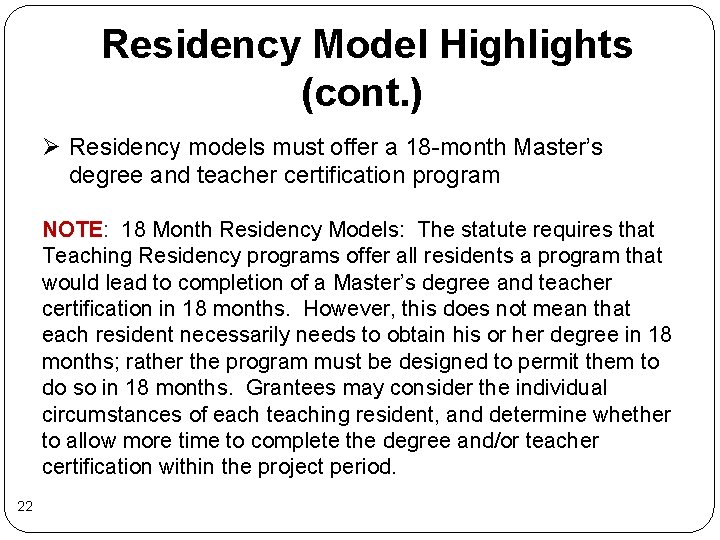
Residency Model Highlights (cont. ) Ø Residency models must offer a 18 -month Master’s degree and teacher certification program NOTE: 18 Month Residency Models: The statute requires that Teaching Residency programs offer all residents a program that would lead to completion of a Master’s degree and teacher certification in 18 months. However, this does not mean that each resident necessarily needs to obtain his or her degree in 18 months; rather the program must be designed to permit them to do so in 18 months. Grantees may consider the individual circumstances of each teaching resident, and determine whether to allow more time to complete the degree and/or teacher certification within the project period. 22
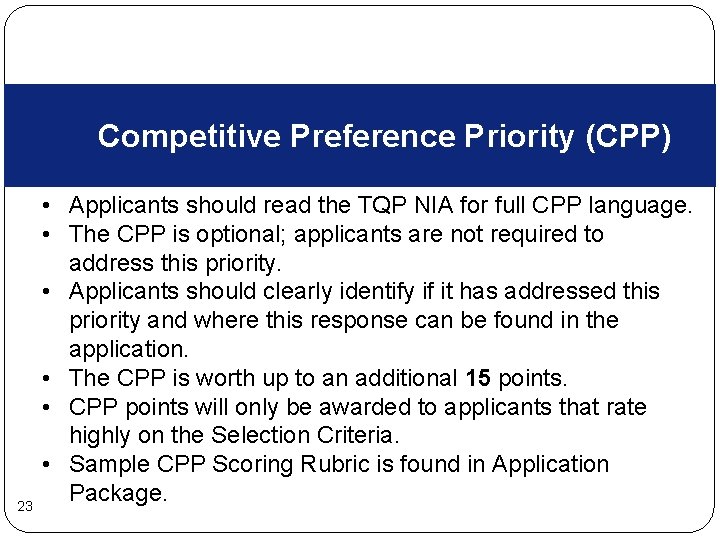
Competitive Preference Priority (CPP) 23 • Applicants should read the TQP NIA for full CPP language. • The CPP is optional; applicants are not required to address this priority. • Applicants should clearly identify if it has addressed this priority and where this response can be found in the application. • The CPP is worth up to an additional 15 points. • CPP points will only be awarded to applicants that rate highly on the Selection Criteria. • Sample CPP Scoring Rubric is found in Application Package.
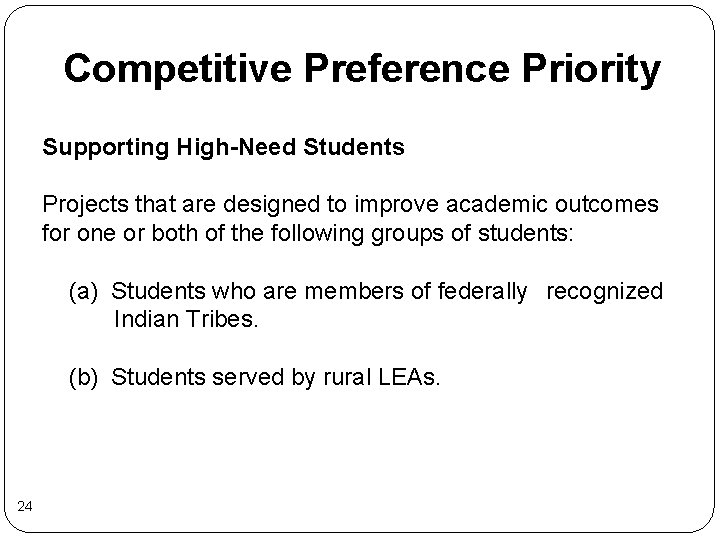
Competitive Preference Priority Supporting High-Need Students Projects that are designed to improve academic outcomes for one or both of the following groups of students: (a) Students who are members of federally recognized Indian Tribes. (b) Students served by rural LEAs. 24
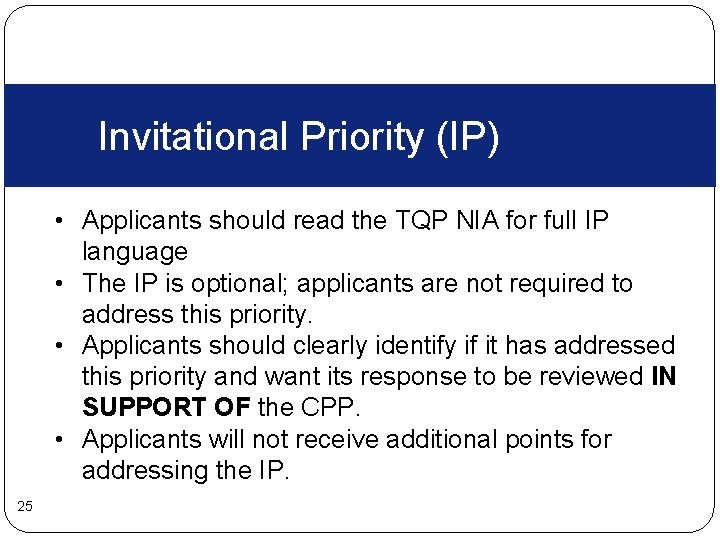
Invitational Priority (IP) • Applicants should read the TQP NIA for full IP language • The IP is optional; applicants are not required to address this priority. • Applicants should clearly identify if it has addressed this priority and want its response to be reviewed IN SUPPORT OF the CPP. • Applicants will not receive additional points for addressing the IP. 25
Invitational Priority Enhancing Cultural Competencies that Support High. Need Students The Department invites applicants to propose a TQP project that will provide project participants with specific coursework, experiences and professional development to enable them to gain academic content knowledge and cultural competencies, and related pedagogical skills. 26
Invitational Priority (cont. ) Things to Include: • Documentation to support a high number or high concentration of the identified population(s) you wish to serve. • Describe the collaboration across partner IHEs to ensure that TQP project participants who intend to teach in the identified population(s) are prepared to effectively teach these students. • Describe of how the proposed TQP project activities align with the appropriate State licensure standards and, how implemented strategies translate into classroom practice with the identified population(s). 27
Priority Questions Please enter your questions in the chat box to the right of your screen. We may not be able to answer all questions at this time, but we will answer as many questions as possible in the allotted Q&A time. 28
TQP Program Requirements TQP General Program Requirements • Applicants should review Section 202 of the HEA for full TQP General Requirements language. • Applicants MUST address ALL TQP General Program Requirements, if not, they may be deemed ineligible. • TQP General Program Requirements may be addressed as part of the selection criteria. • Applicants are strongly encouraged to use the Optional General Program Requirements Checklist found in the TQP Application Package. 29
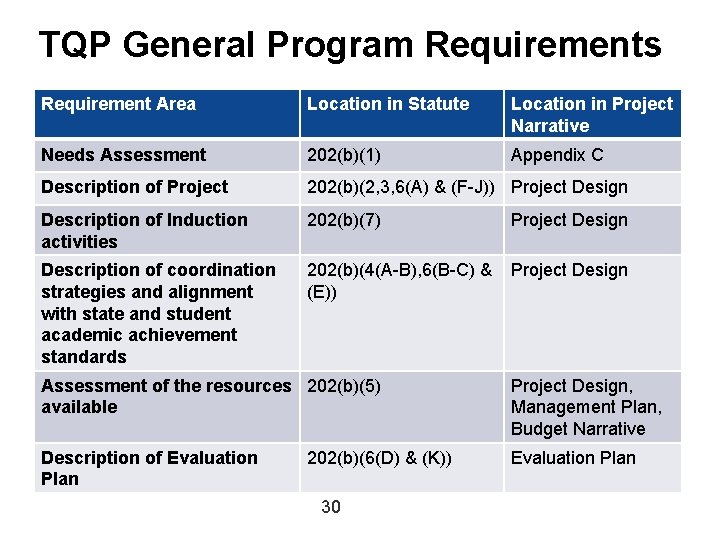
TQP General Program Requirements Requirement Area Location in Statute Location in Project Narrative Needs Assessment 202(b)(1) Appendix C Description of Project 202(b)(2, 3, 6(A) & (F-J)) Project Design Description of Induction activities 202(b)(7) Description of coordination strategies and alignment with state and student academic achievement standards 202(b)(4(A-B), 6(B-C) & Project Design (E)) Project Design Assessment of the resources 202(b)(5) available Project Design, Management Plan, Budget Narrative Description of Evaluation Plan 202(b)(6(D) & (K)) 30
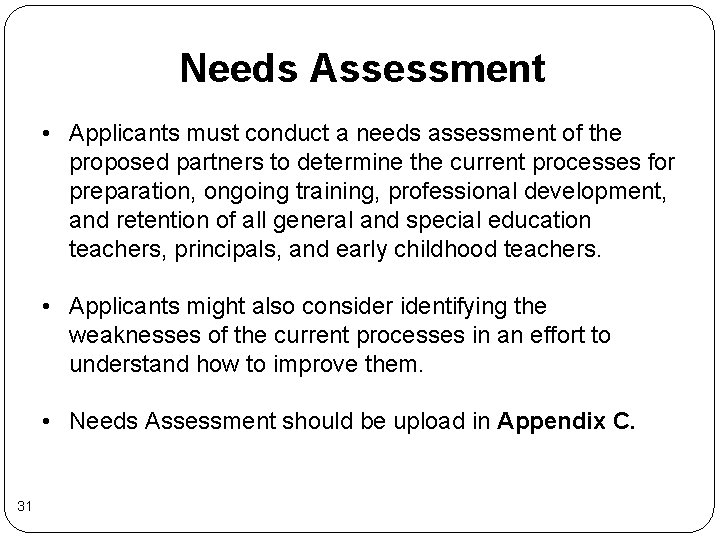
Needs Assessment • Applicants must conduct a needs assessment of the proposed partners to determine the current processes for preparation, ongoing training, professional development, and retention of all general and special education teachers, principals, and early childhood teachers. • Applicants might also consider identifying the weaknesses of the current processes in an effort to understand how to improve them. • Needs Assessment should be upload in Appendix C. 31
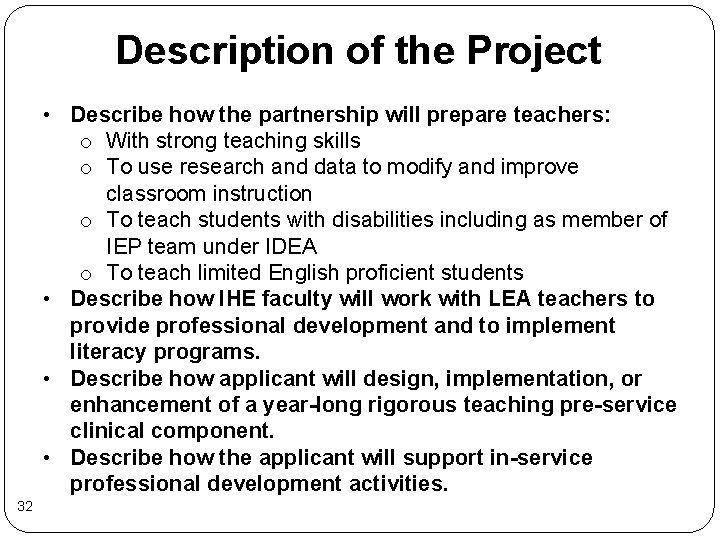
Description of the Project • Describe how the partnership will prepare teachers: o With strong teaching skills o To use research and data to modify and improve classroom instruction o To teach students with disabilities including as member of IEP team under IDEA o To teach limited English proficient students • Describe how IHE faculty will work with LEA teachers to provide professional development and to implement literacy programs. • Describe how applicant will design, implementation, or enhancement of a year-long rigorous teaching pre-service clinical component. • Describe how the applicant will support in-service professional development activities. 32
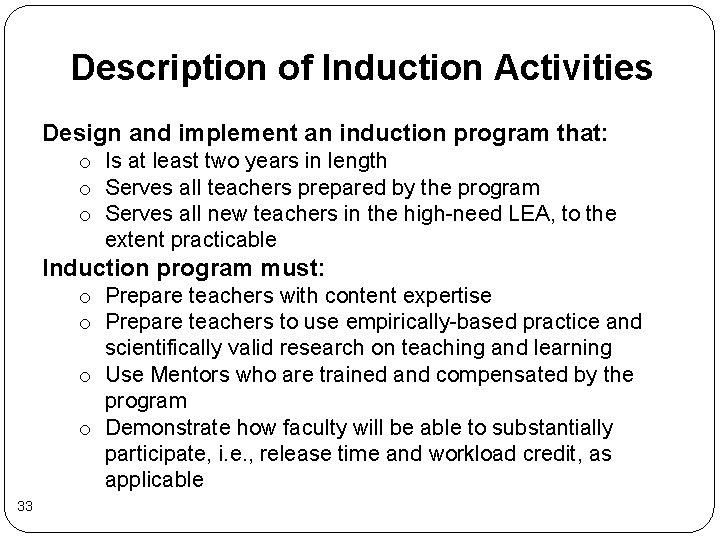
Description of Induction Activities Design and implement an induction program that: o Is at least two years in length o Serves all teachers prepared by the program o Serves all new teachers in the high-need LEA, to the extent practicable Induction program must: o Prepare teachers with content expertise o Prepare teachers to use empirically-based practice and scientifically valid research on teaching and learning o Use Mentors who are trained and compensated by the program o Demonstrate how faculty will be able to substantially participate, i. e. , release time and workload credit, as applicable 33
Description of coordination strategies and alignment with State and student academic achievement standards Description must include how the partnership plans to: • Coordinate strategies with other professional development programs, incl. those that funded under ESEA, IDEA, and other Federal sources • Have activities that are consistent with State ESEA academic content standards, State ECE standards and domains • Correspond with the goal of improving student academic achievement 34
Assessment of the Available Resources Application needs to describe resources available to the partnership: • Integration of funds from related sources • Intended use of grant funds • Commitment of the resources of the partnership to required project activities 35
Description of Evaluation Plan Application needs to describe: • The evaluation plan under section 204(a) of the HEA • How the partnership will collect, analyze, and use data on retention to evaluate the effectiveness of the partnership’s teacher support systems 36
100% Non-Federal Match Requirement 37
100% Non-Federal Match Requirement • Section 203(c) of the HEA, requires that each grantee provide matching funds equal to 100% of the total amount of the TQP grant award. • Matching funds must be from non-Federal sources. • Matching funds may be provided in cash or as in-kind donations. • The TQP Program follows the Supplement Not Supplant Rule from section 202(k) of the HEA. o Program funds must be used to create new or expand upon existing activities, not fund current activities. 38
100% Non-Federal Match Requirement • The Secretary may waive all or part of the matching requirement. • Applicants should use the TQP Waiver Request Form found in the Application Package if a waiver to the match requirement is needed. • If a waiver to the match requirement is requested, the request should reflect the Year 1 award amount only. • Successful applicants will receive information on waivers requests for Years 2 -5 at a later time. • Applicants may not count unrecovered Indirect Costs towards meeting the match requirement. 39
Program Requirement Questions Please enter your questions in the chat box to the right of your screen. We may not be able to answer all questions at this time, but we will answer as many questions as possible in the allotted Q&A time. 40
TQP Selection Criteria & Scoring Note: These slides are intended as guidance only. Please refer to the official Notices in the Federal Register. 41
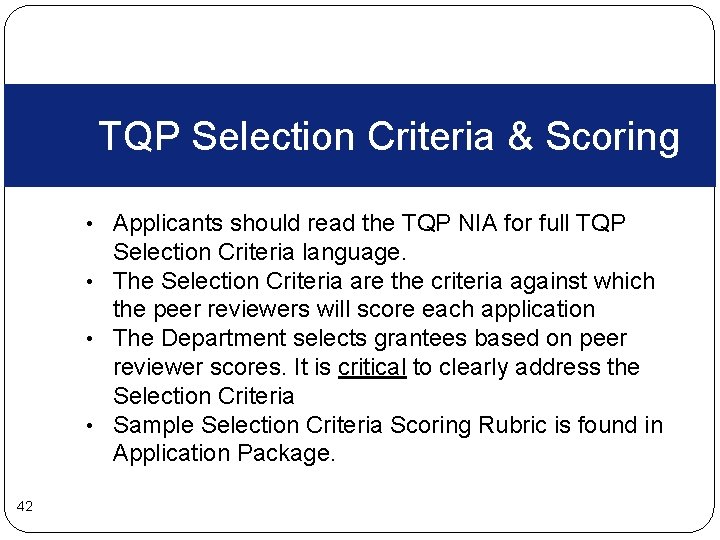
TQP Selection Criteria & Scoring • Applicants should read the TQP NIA for full TQP Selection Criteria language. • The Selection Criteria are the criteria against which the peer reviewers will score each application • The Department selects grantees based on peer reviewer scores. It is critical to clearly address the Selection Criteria • Sample Selection Criteria Scoring Rubric is found in Application Package. 42
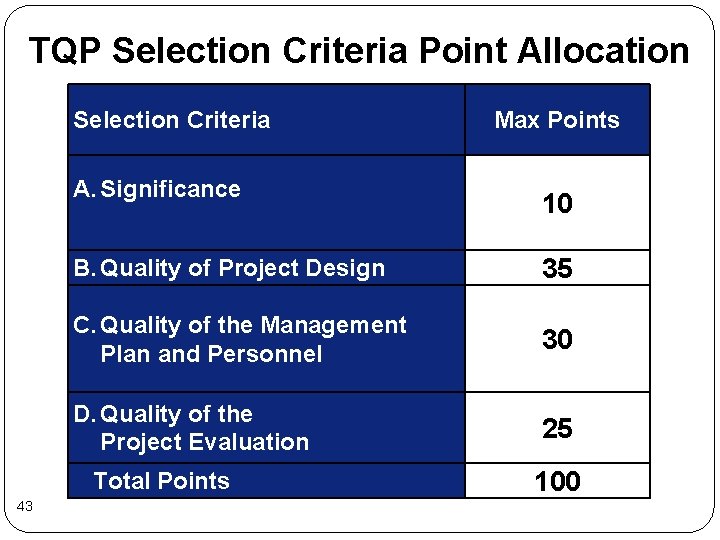
TQP Selection Criteria Point Allocation Selection Criteria A. Significance 10 B. Quality of Project Design 35 C. Quality of the Management Plan and Personnel 30 D. Quality of the Project Evaluation 25 Total Points 43 Max Points 100
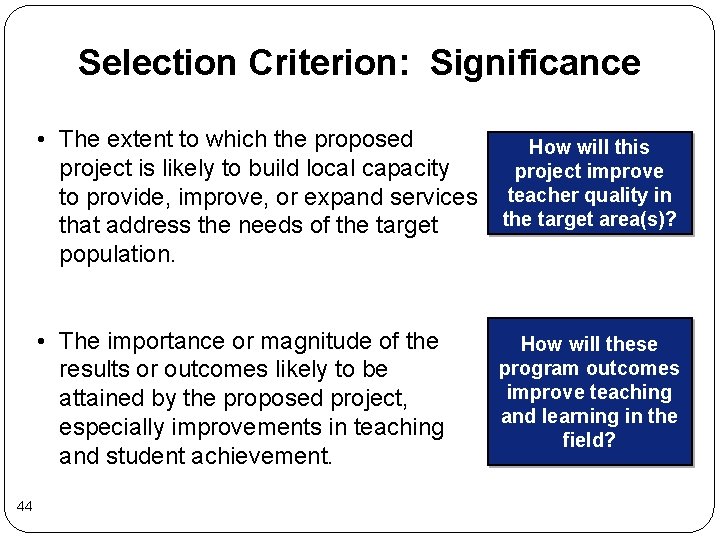
Selection Criterion: Significance • The extent to which the proposed How will this project is likely to build local capacity project improve to provide, improve, or expand services teacher quality in the target area(s)? that address the needs of the target population. • The importance or magnitude of the results or outcomes likely to be attained by the proposed project, especially improvements in teaching and student achievement. 44 How will these program outcomes improve teaching and learning in the field?
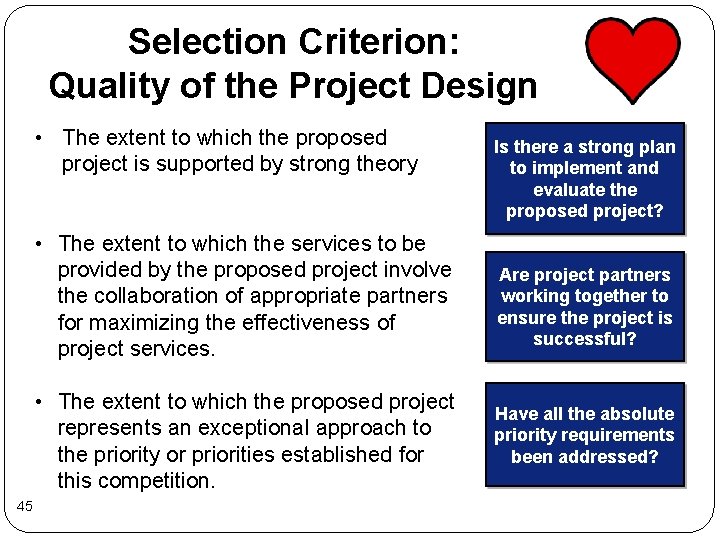
Selection Criterion: Quality of the Project Design • The extent to which the proposed project is supported by strong theory • The extent to which the services to be provided by the proposed project involve the collaboration of appropriate partners for maximizing the effectiveness of project services. • The extent to which the proposed project Balance of Costs represents an exceptional approach to with Outcomes of the priority or priorities established for Project this competition. 45 Is there a strong plan to implement and evaluate the proposed project? Are project partners working together to ensure the project is successful? Have all the absolute priority requirements been addressed?
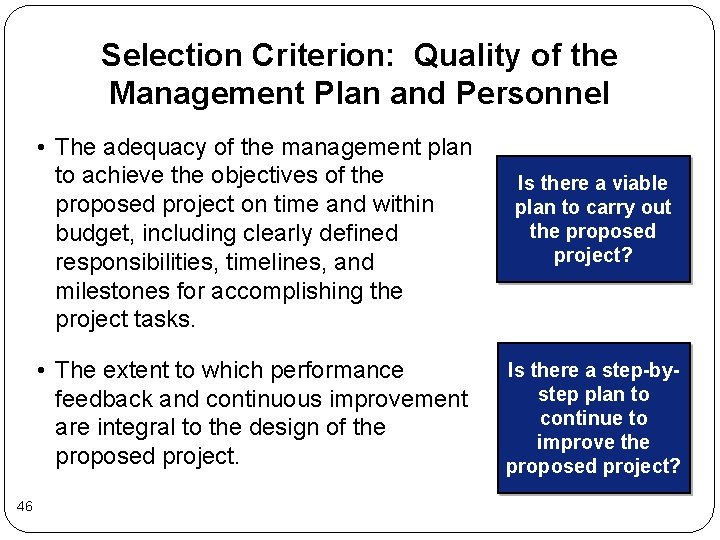
Selection Criterion: Quality of the Management Plan and Personnel • The adequacy of the management plan to achieve the objectives of the proposed project on time and within budget, including clearly defined responsibilities, timelines, and milestones for accomplishing the project tasks. • The extent to which performance feedback and continuous improvement are integral to the design of the proposed project. 46 Is there a viable plan to carry out the proposed project? Is there a step-bystep plan to continue to improve the proposed project?
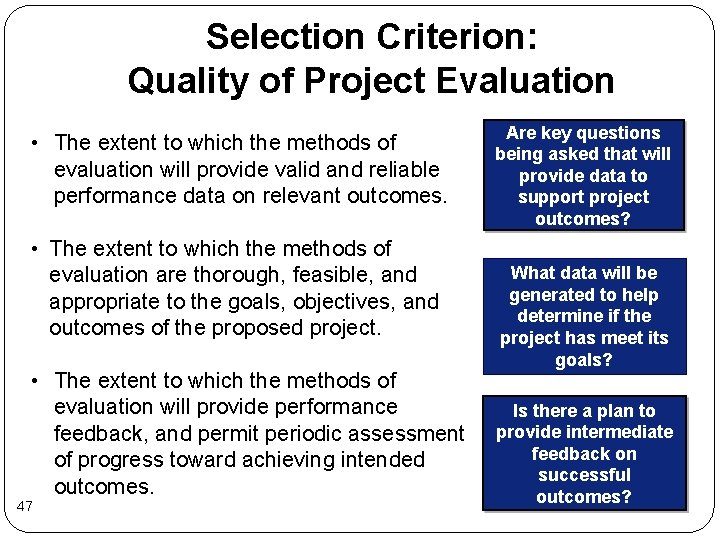
Selection Criterion: Quality of Project Evaluation • The extent to which the methods of evaluation will provide valid and reliable performance data on relevant outcomes. • The extent to which the methods of evaluation are thorough, feasible, and appropriate to the goals, objectives, and outcomes of the proposed project. • The extent to which the methods of evaluation will provide performance feedback, and permit periodic assessment of progress toward achieving intended outcomes. 47 Are key questions being asked that will provide data to support project outcomes? What data will be generated to help determine if the project has meet its goals? Is there a plan to provide intermediate feedback on successful outcomes?
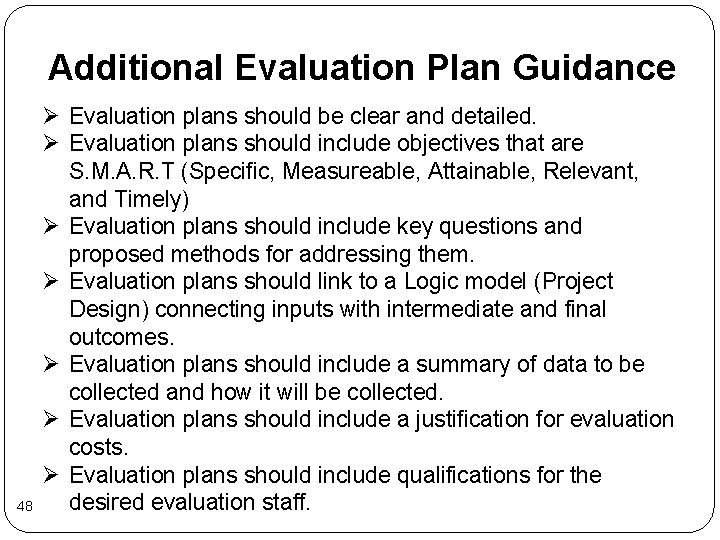
Additional Evaluation Plan Guidance 48 Ø Evaluation plans should be clear and detailed. Ø Evaluation plans should include objectives that are S. M. A. R. T (Specific, Measureable, Attainable, Relevant, and Timely) Ø Evaluation plans should include key questions and proposed methods for addressing them. Ø Evaluation plans should link to a Logic model (Project Design) connecting inputs with intermediate and final outcomes. Ø Evaluation plans should include a summary of data to be collected and how it will be collected. Ø Evaluation plans should include a justification for evaluation costs. Ø Evaluation plans should include qualifications for the desired evaluation staff.
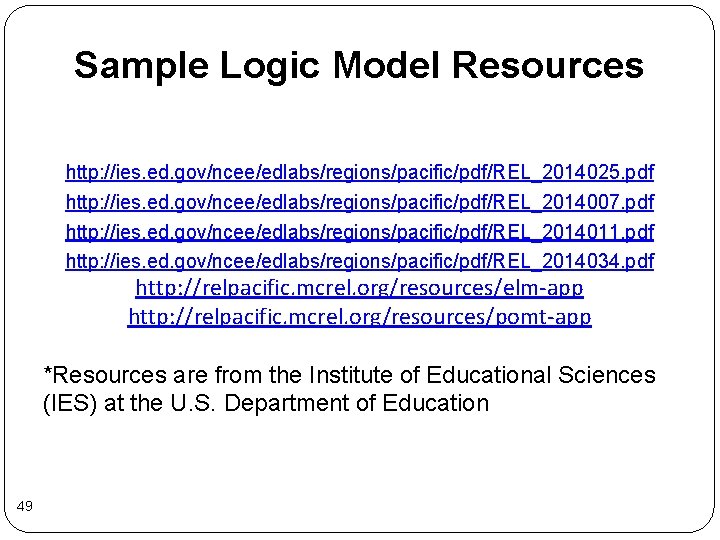
Sample Logic Model Resources http: //ies. ed. gov/ncee/edlabs/regions/pacific/pdf/REL_2014025. pdf http: //ies. ed. gov/ncee/edlabs/regions/pacific/pdf/REL_2014007. pdf http: //ies. ed. gov/ncee/edlabs/regions/pacific/pdf/REL_2014011. pdf http: //ies. ed. gov/ncee/edlabs/regions/pacific/pdf/REL_2014034. pdf http: //relpacific. mcrel. org/resources/elm-app http: //relpacific. mcrel. org/resources/pomt-app *Resources are from the Institute of Educational Sciences (IES) at the U. S. Department of Education 49
Selection Criteria Questions Please enter your questions in the chat box to the right of your screen. We may not be able to answer all questions at this time, but we will answer as many questions as possible in the allotted Q&A time. 50
Application Submission Guidance Note: These slides are intended as guidance only. Please refer to the official Notices in the Federal Register. 51
Grants. gov 52
Registering for Grants. gov • • 53 All TQP grant applications MUST be submitted electronically using Grants. gov (www. grants. gov) Applicants MUST register with Grants. gov and System Award Management (SAM) system in order to submit applications using Grants. gov Registration instructions are found in the TQP Application Package. (Register TODAY!) Current registrants should confirm that your Grants. gov and SAM accounts are active and up to date
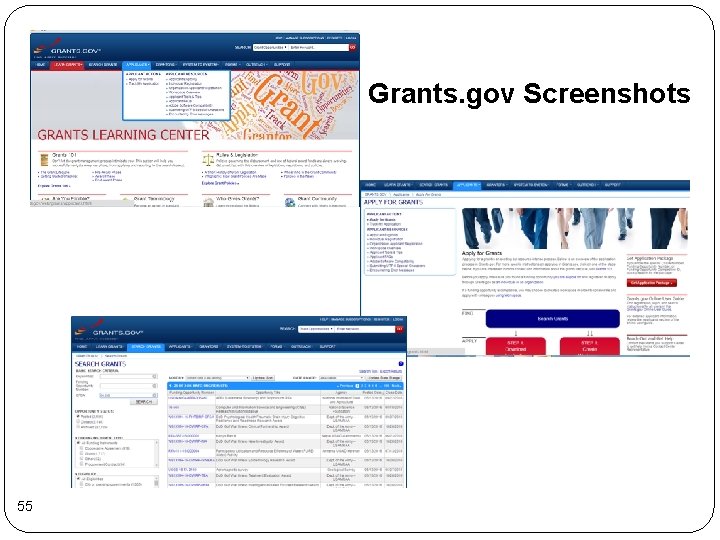
Applying Through Grants. gov • Click the Applicant tab in the top center of the home page • Click Apply for Grants in the drop down menu • Click the Search Grants button in the middle of the screen • Enter CFDA Number: 84. 336 to the left of the screen. • Problems With Submission: Contact the Grants. gov Help Desk at 1 -800 -518 -4726 or at support@grants. gov. • You must obtain a Grants. gov Help Desk Case Number and keep track of your progress to resolve the issue • Additional submission instructions are found in the TQP Application Package. 54
Grants. gov Screenshots 55
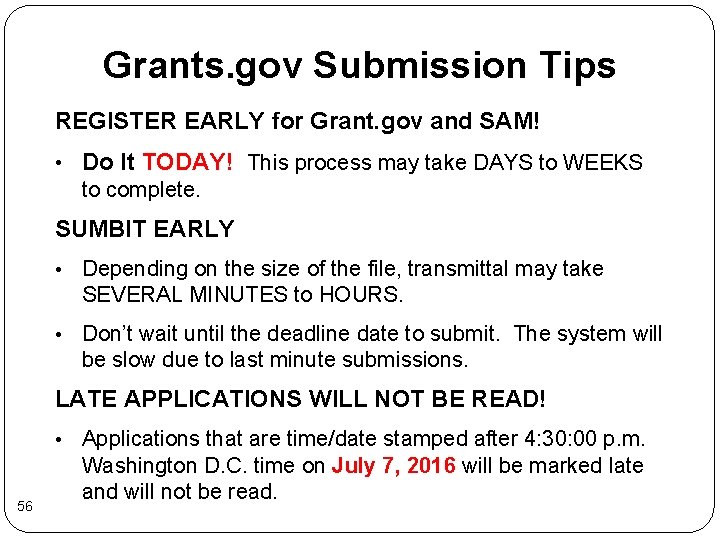
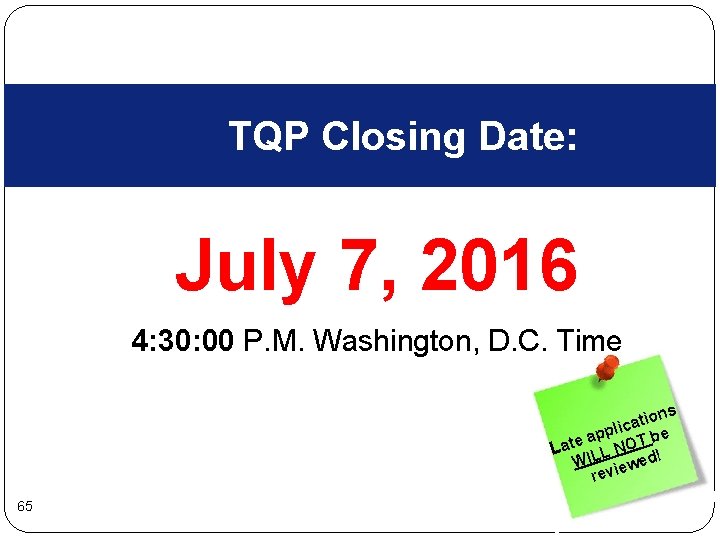
Grants. gov Submission Tips REGISTER EARLY for Grant. gov and SAM! • Do It TODAY! This process may take DAYS to WEEKS to complete. SUMBIT EARLY • Depending on the size of the file, transmittal may take SEVERAL MINUTES to HOURS. • Don’t wait until the deadline date to submit. The system will be slow due to last minute submissions. LATE APPLICATIONS WILL NOT BE READ! • 56 Applications that are time/date stamped after 4: 30: 00 p. m. Washington D. C. time on July 7, 2016 will be marked late and will not be read.
Grants. gov Submission Tips When in Doubt: CALL THE GRANTS. GOV HELP DESK (1 -800 -518 -4726) 57
Application Submission Questions Please enter your questions in the chat box to the right of your screen. We may not be able to answer all questions at this time, but we will answer as many questions as possible in the allotted Q&A time. 58
Competition Resources 59
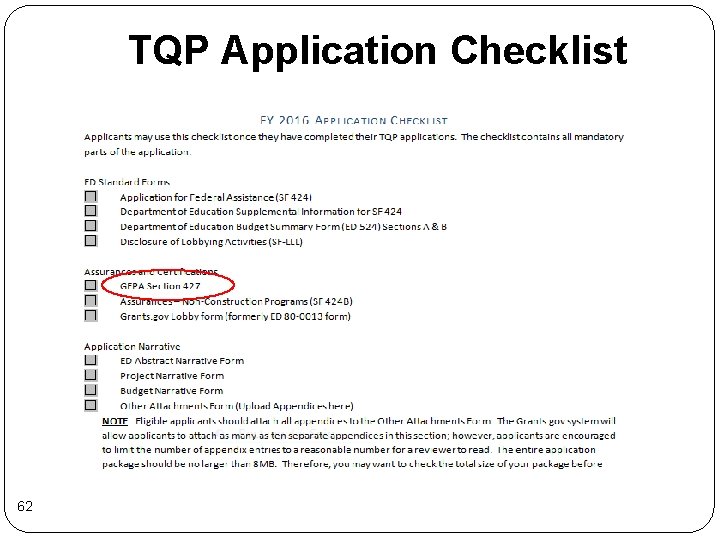
TQP Competition Resources TQP Program Website http: //innovation. ed. gov/what-we-do/teacher-qualitypartnership/ • FY 16 TQP Notice Inviting Applications (NIA) • FY 16 TQP Application Package • TQP Waiver Request Form • TQP Application Checklist • TQP Optional Program Checklists (4) • Optional Eligible Partnership AND IHE Verification Checklist • Optional TQP General Application and Program Requirements Checklist • Optional High-Need LEA AND High-Need School Checklist 60 • Option Absolute Priority Checklists
TQP Competition Resources FY 16 Intent to Apply: (June 22, 2016) https: //www. surveymonkey. com/r/tqpfy 16 FY 14 Funded TQP Applications FY 16 TQP FAQ Document Review the TQP FAQ document before sending questions. http: //www 2. ed. gov/programs/tqpartnership/tqpfinalfaq 52316. pdf Additional TQP questions may be sent to: ed. gov Do not wait unit the last minute to send questions about your application. 61
TQP Application Checklist 62
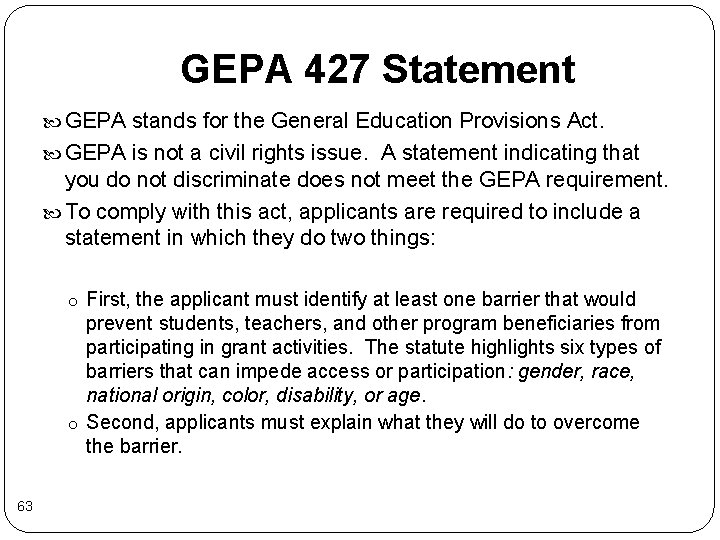
GEPA 427 Statement GEPA stands for the General Education Provisions Act. GEPA is not a civil rights issue. A statement indicating that you do not discriminate does not meet the GEPA requirement. To comply with this act, applicants are required to include a statement in which they do two things: o First, the applicant must identify at least one barrier that would prevent students, teachers, and other program beneficiaries from participating in grant activities. The statute highlights six types of barriers that can impede access or participation: gender, race, national origin, color, disability, or age. o Second, applicants must explain what they will do to overcome the barrier. 63
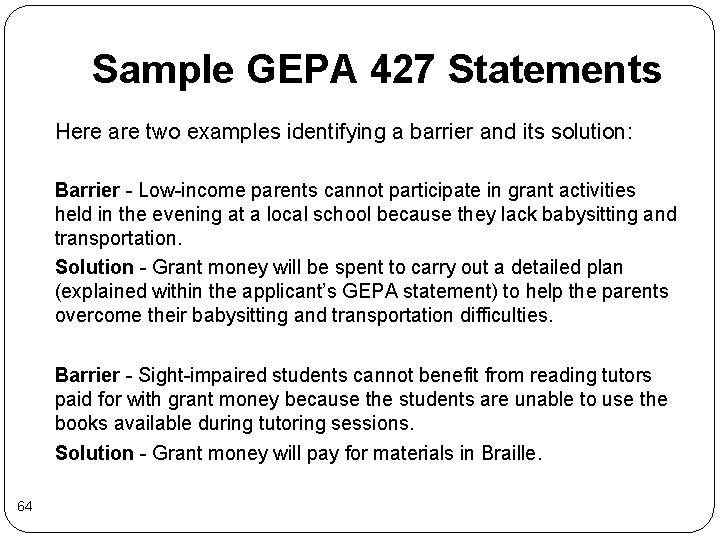
Sample GEPA 427 Statements Here are two examples identifying a barrier and its solution: Barrier - Low-income parents cannot participate in grant activities held in the evening at a local school because they lack babysitting and transportation. Solution - Grant money will be spent to carry out a detailed plan (explained within the applicant’s GEPA statement) to help the parents overcome their babysitting and transportation difficulties. Barrier - Sight-impaired students cannot benefit from reading tutors paid for with grant money because the students are unable to use the books available during tutoring sessions. Solution - Grant money will pay for materials in Braille. 64
TQP Closing Date: July 7, 2016 4: 30: 00 P. M. Washington, D. C. Time ions t a c ppli T be a e Lat ILL NO ! W wed e i v re 65
Final Questions & Answers Please enter your final questions in the chat box to the right of your screen. We may not be able to answer all questions at this time, but we will answer as many questions as possible in the allotted Q&A time. 66
Thank you for your interest in the TQP Grant Program. Best Wishes on a successful TQP application submission. Note: These slides are intended as guidance only. Please refer to the official documents published in the Federal Register.