CS 188 Artificial Intelligence Spring 2007 Lecture 10

- Slides: 39
CS 188: Artificial Intelligence Spring 2007 Lecture 10: Logical agents and knowledge representation 2/15/2007 Srini Narayanan – ICSI and UC Berkeley Many slides over the course adapted from Dan Klein, Stuart Russell or Andrew Moore
Announcements § Assignment 3 up this morning § Due 2/21, 11: 59 PM, written no coding § Covers logical agents
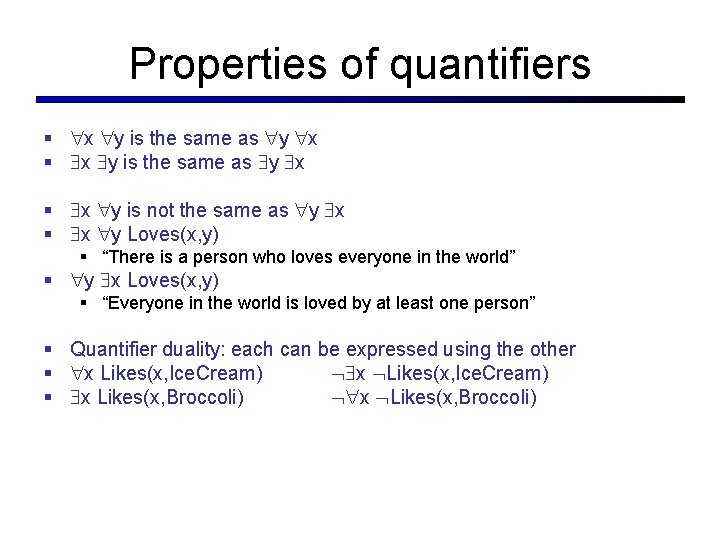
Properties of quantifiers § x y is the same as y x § x y is not the same as y x § x y Loves(x, y) § “There is a person who loves everyone in the world” § y x Loves(x, y) § “Everyone in the world is loved by at least one person” § Quantifier duality: each can be expressed using the other § x Likes(x, Ice. Cream) § x Likes(x, Broccoli)
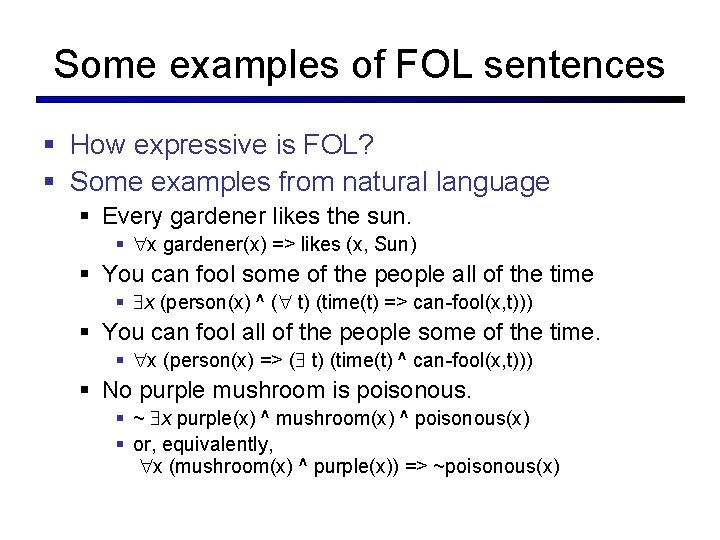
Some examples of FOL sentences § How expressive is FOL? § Some examples from natural language § Every gardener likes the sun. § x gardener(x) => likes (x, Sun) § You can fool some of the people all of the time § x (person(x) ^ ( t) (time(t) => can-fool(x, t))) § You can fool all of the people some of the time. § x (person(x) => ( t) (time(t) ^ can-fool(x, t))) § No purple mushroom is poisonous. § ~ x purple(x) ^ mushroom(x) ^ poisonous(x) § or, equivalently, x (mushroom(x) ^ purple(x)) => ~poisonous(x)
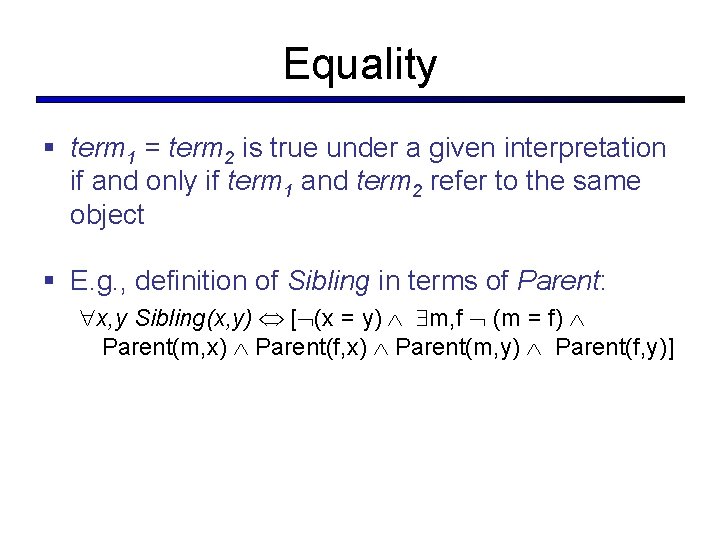
Equality § term 1 = term 2 is true under a given interpretation if and only if term 1 and term 2 refer to the same object § E. g. , definition of Sibling in terms of Parent: x, y Sibling(x, y) [ (x = y) m, f (m = f) Parent(m, x) Parent(f, x) Parent(m, y) Parent(f, y)]
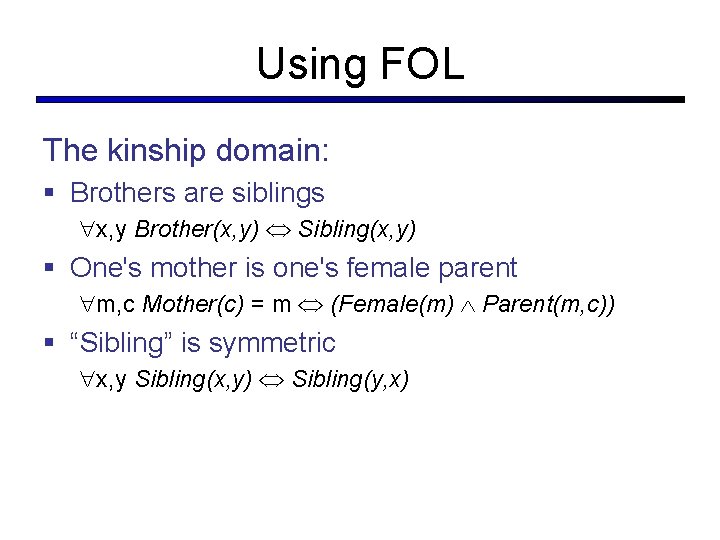
Using FOL The kinship domain: § Brothers are siblings x, y Brother(x, y) Sibling(x, y) § One's mother is one's female parent m, c Mother(c) = m (Female(m) Parent(m, c)) § “Sibling” is symmetric x, y Sibling(x, y) Sibling(y, x)
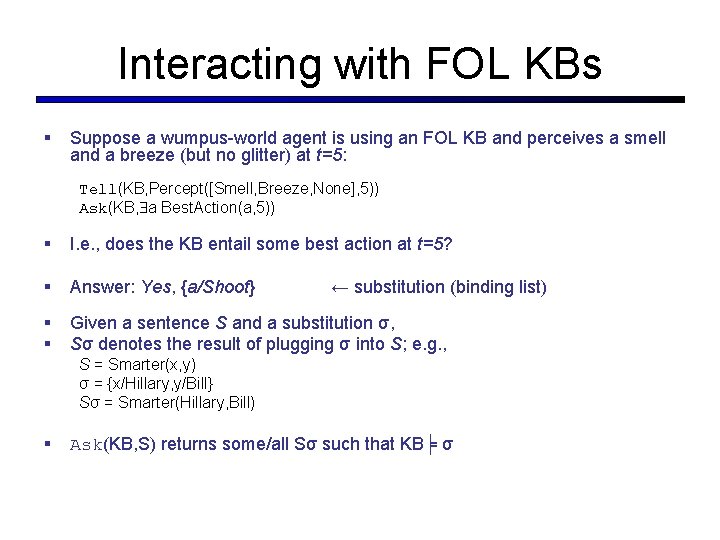
Interacting with FOL KBs § Suppose a wumpus-world agent is using an FOL KB and perceives a smell and a breeze (but no glitter) at t=5: Tell(KB, Percept([Smell, Breeze, None], 5)) Ask(KB, a Best. Action(a, 5)) § I. e. , does the KB entail some best action at t=5? § Answer: Yes, {a/Shoot} § § Given a sentence S and a substitution σ, Sσ denotes the result of plugging σ into S; e. g. , ← substitution (binding list) S = Smarter(x, y) σ = {x/Hillary, y/Bill} Sσ = Smarter(Hillary, Bill) § Ask(KB, S) returns some/all Sσ such that KB╞ σ
Inference in FOL
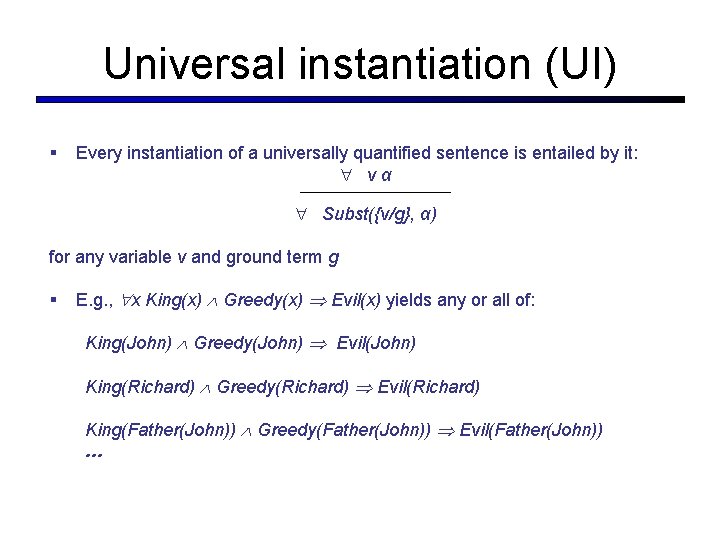
Universal instantiation (UI) § Every instantiation of a universally quantified sentence is entailed by it: vα Subst({v/g}, α) for any variable v and ground term g § E. g. , x King(x) Greedy(x) Evil(x) yields any or all of: King(John) Greedy(John) Evil(John) King(Richard) Greedy(Richard) Evil(Richard) King(Father(John)) Greedy(Father(John)) Evil(Father(John)) …
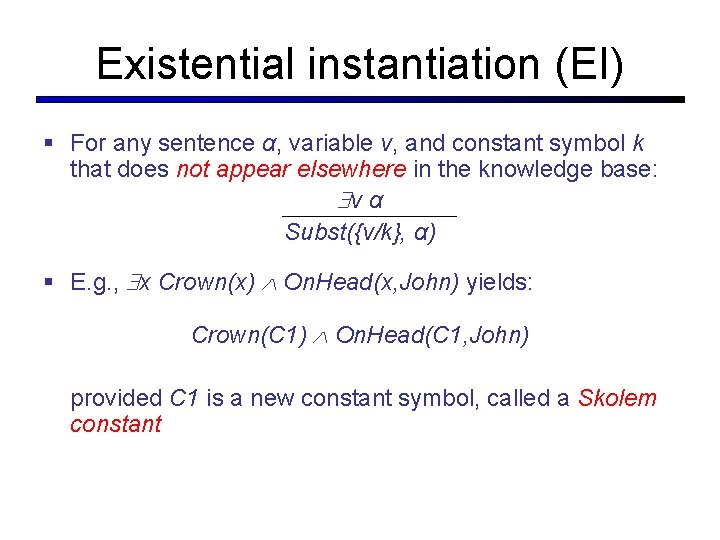
Existential instantiation (EI) § For any sentence α, variable v, and constant symbol k that does not appear elsewhere in the knowledge base: v α Subst({v/k}, α) § E. g. , x Crown(x) On. Head(x, John) yields: Crown(C 1) On. Head(C 1, John) provided C 1 is a new constant symbol, called a Skolem constant
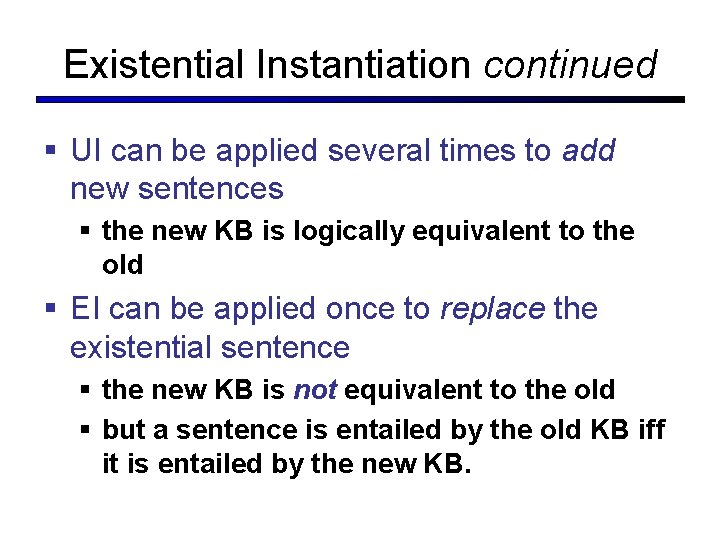
Existential Instantiation continued § UI can be applied several times to add new sentences § the new KB is logically equivalent to the old § EI can be applied once to replace the existential sentence § the new KB is not equivalent to the old § but a sentence is entailed by the old KB iff it is entailed by the new KB.
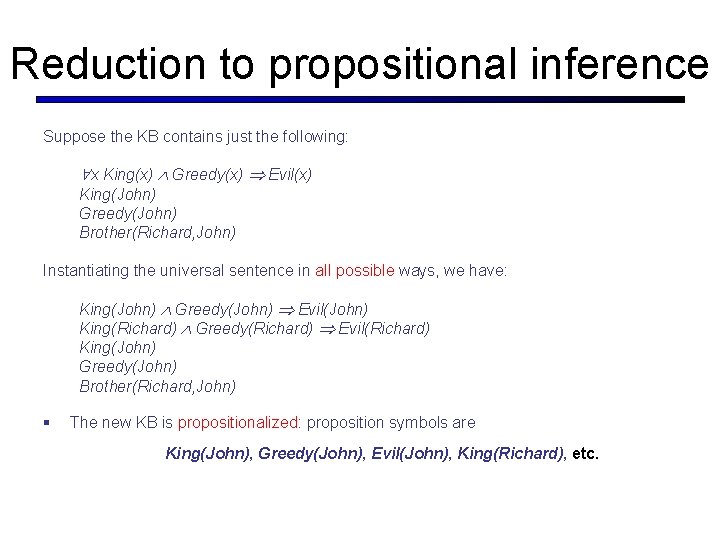
Reduction to propositional inference Suppose the KB contains just the following: x King(x) Greedy(x) Evil(x) King(John) Greedy(John) Brother(Richard, John) Instantiating the universal sentence in all possible ways, we have: King(John) Greedy(John) Evil(John) King(Richard) Greedy(Richard) Evil(Richard) King(John) Greedy(John) Brother(Richard, John) § The new KB is propositionalized: proposition symbols are King(John), Greedy(John), Evil(John), King(Richard), etc.
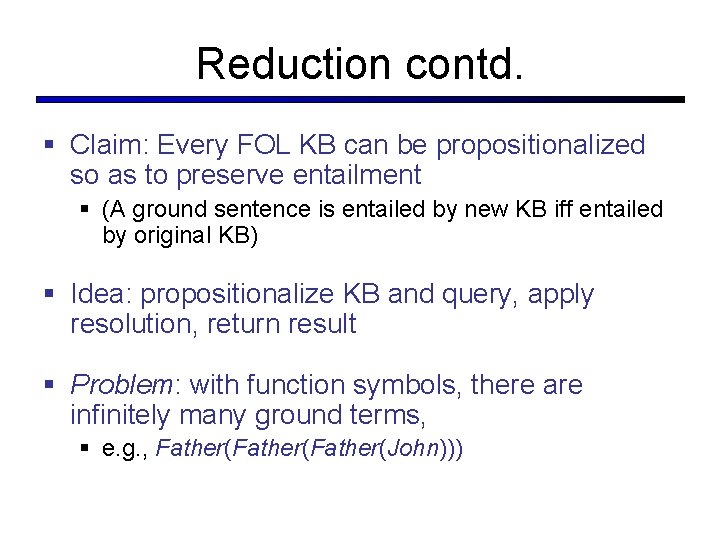
Reduction contd. § Claim: Every FOL KB can be propositionalized so as to preserve entailment § (A ground sentence is entailed by new KB iff entailed by original KB) § Idea: propositionalize KB and query, apply resolution, return result § Problem: with function symbols, there are infinitely many ground terms, § e. g. , Father(Father(John)))
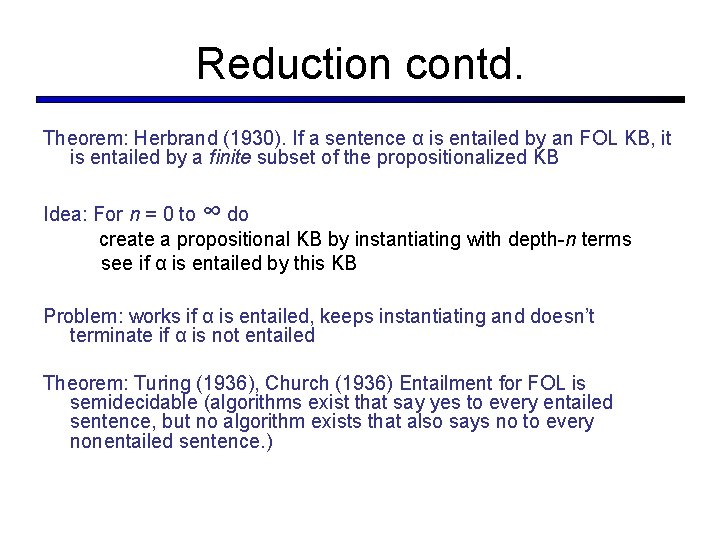
Reduction contd. Theorem: Herbrand (1930). If a sentence α is entailed by an FOL KB, it is entailed by a finite subset of the propositionalized KB Idea: For n = 0 to ∞ do create a propositional KB by instantiating with depth-n terms see if α is entailed by this KB Problem: works if α is entailed, keeps instantiating and doesn’t terminate if α is not entailed Theorem: Turing (1936), Church (1936) Entailment for FOL is semidecidable (algorithms exist that say yes to every entailed sentence, but no algorithm exists that also says no to every nonentailed sentence. )
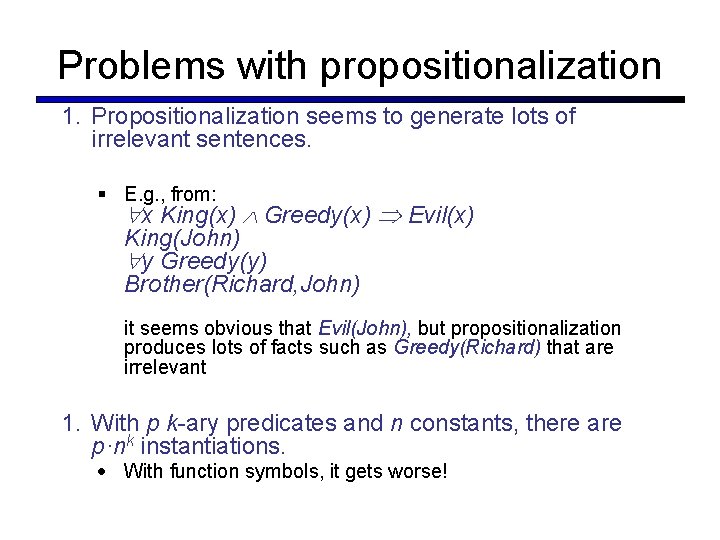
Problems with propositionalization 1. Propositionalization seems to generate lots of irrelevant sentences. § E. g. , from: x King(x) Greedy(x) Evil(x) King(John) y Greedy(y) Brother(Richard, John) it seems obvious that Evil(John), but propositionalization produces lots of facts such as Greedy(Richard) that are irrelevant 1. With p k-ary predicates and n constants, there are p·nk instantiations. · With function symbols, it gets worse!
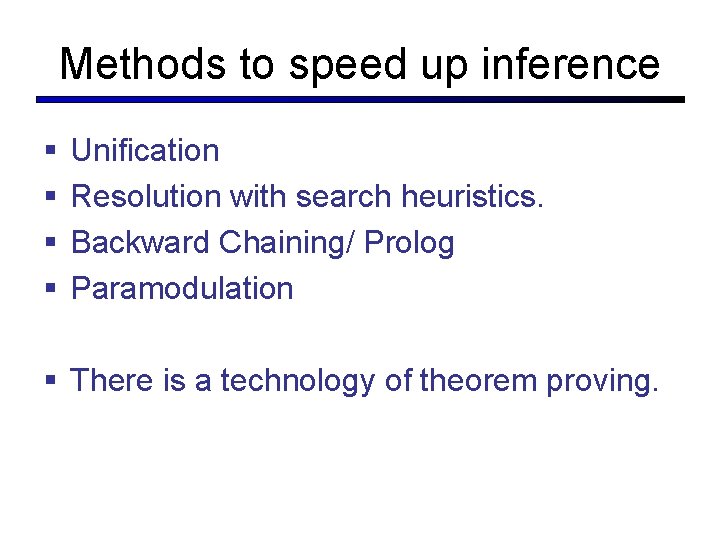
Methods to speed up inference § § Unification Resolution with search heuristics. Backward Chaining/ Prolog Paramodulation § There is a technology of theorem proving.
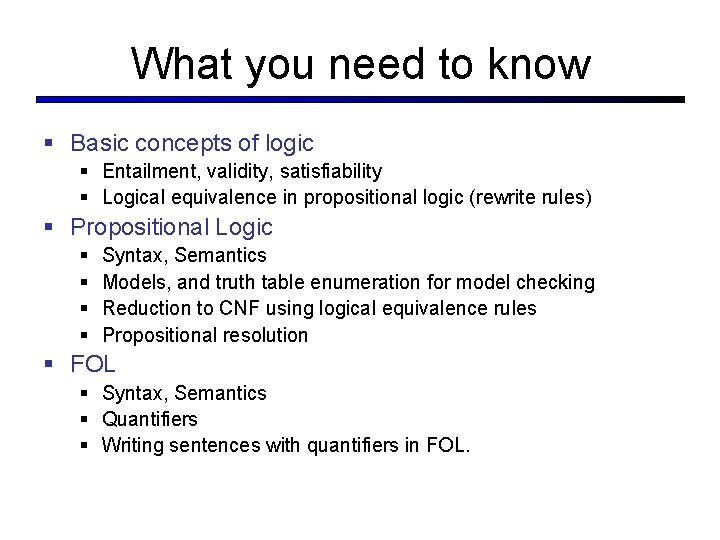
What you need to know § Basic concepts of logic § Entailment, validity, satisfiability § Logical equivalence in propositional logic (rewrite rules) § Propositional Logic § § Syntax, Semantics Models, and truth table enumeration for model checking Reduction to CNF using logical equivalence rules Propositional resolution § FOL § Syntax, Semantics § Quantifiers § Writing sentences with quantifiers in FOL.
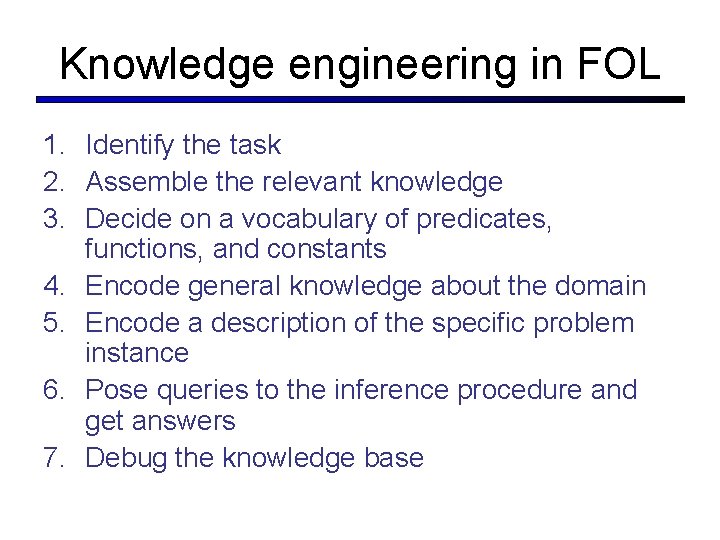
Knowledge engineering in FOL 1. Identify the task 2. Assemble the relevant knowledge 3. Decide on a vocabulary of predicates, functions, and constants 4. Encode general knowledge about the domain 5. Encode a description of the specific problem instance 6. Pose queries to the inference procedure and get answers 7. Debug the knowledge base
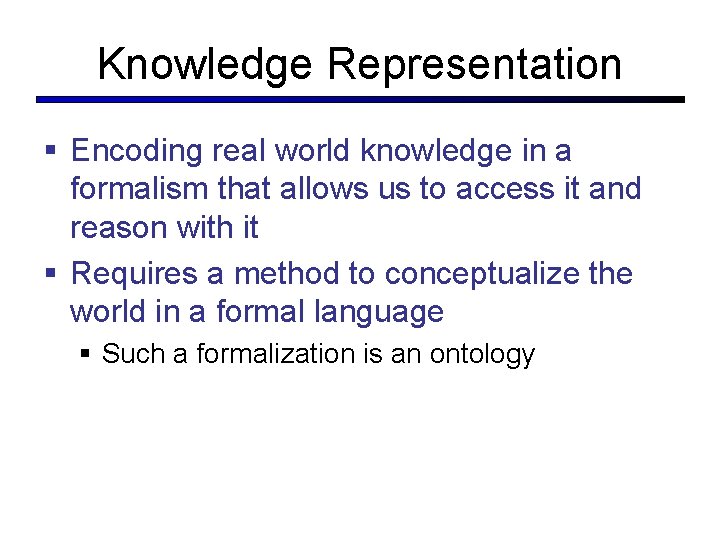
Knowledge Representation § Encoding real world knowledge in a formalism that allows us to access it and reason with it § Requires a method to conceptualize the world in a formal language § Such a formalization is an ontology
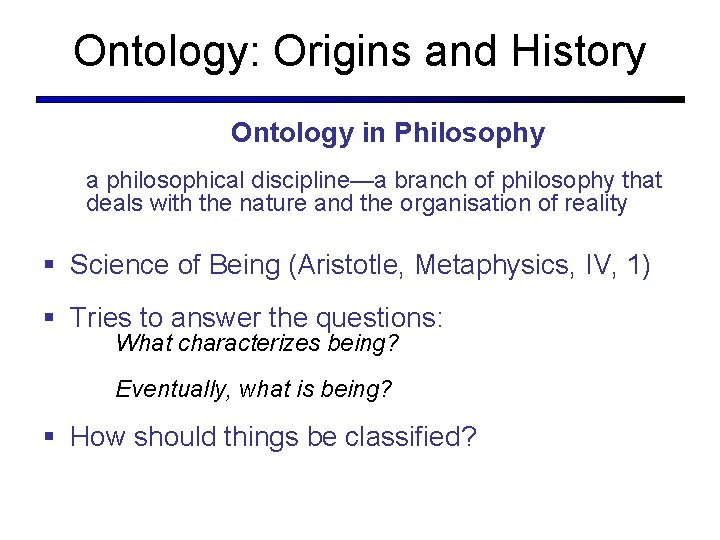
Ontology: Origins and History Ontology in Philosophy a philosophical discipline—a branch of philosophy that deals with the nature and the organisation of reality § Science of Being (Aristotle, Metaphysics, IV, 1) § Tries to answer the questions: What characterizes being? Eventually, what is being? § How should things be classified?
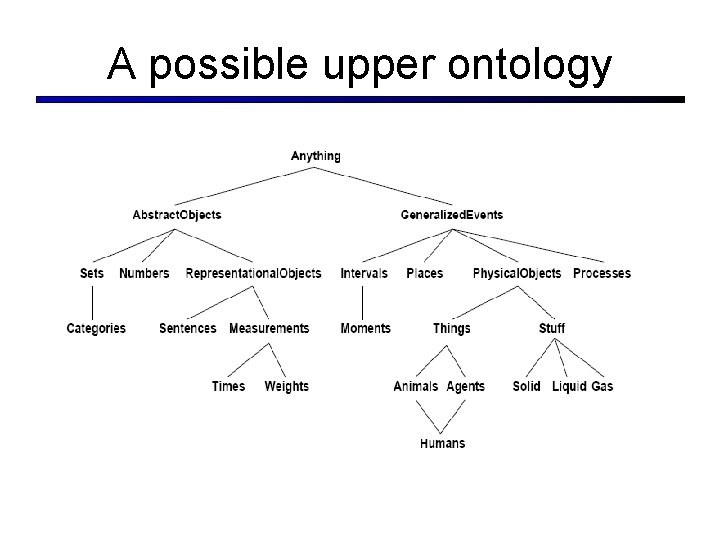
A possible upper ontology
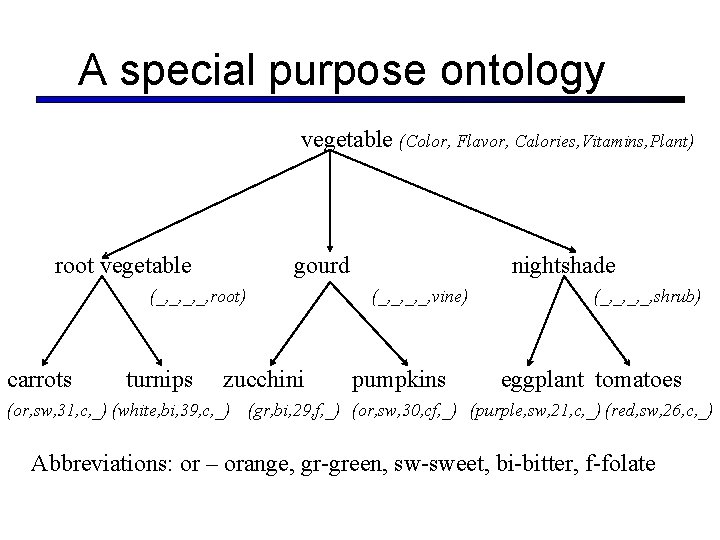
A special purpose ontology vegetable (Color, Flavor, Calories, Vitamins, Plant) root vegetable gourd (_, _, root) carrots turnips (_, _, vine) zucchini (or, sw, 31, c, _) (white, bi, 39, c, _) nightshade pumpkins (_, _, shrub) eggplant tomatoes (gr, bi, 29, f, _) (or, sw, 30, cf, _) (purple, sw, 21, c, _) (red, sw, 26, c, _) Abbreviations: or – orange, gr-green, sw-sweet, bi-bitter, f-folate
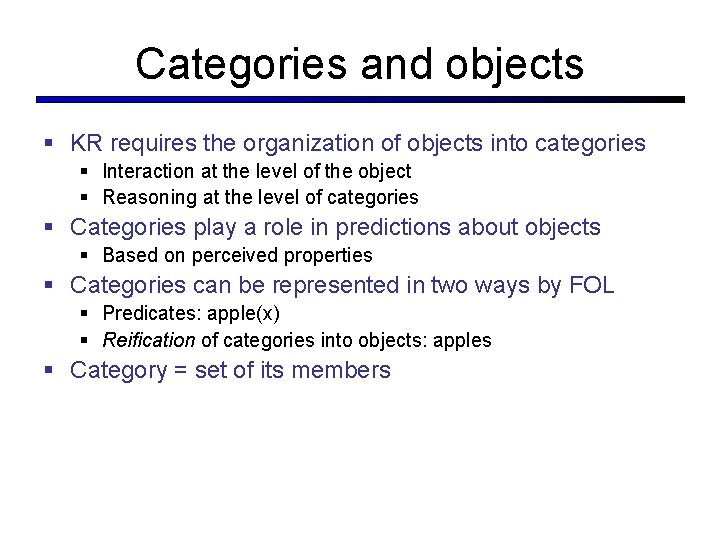
Categories and objects § KR requires the organization of objects into categories § Interaction at the level of the object § Reasoning at the level of categories § Categories play a role in predictions about objects § Based on perceived properties § Categories can be represented in two ways by FOL § Predicates: apple(x) § Reification of categories into objects: apples § Category = set of its members
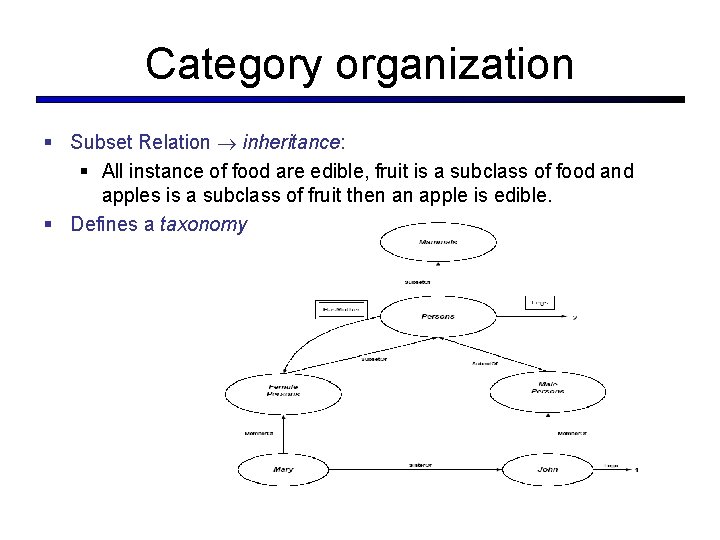
Category organization § Subset Relation inheritance: § All instance of food are edible, fruit is a subclass of food and apples is a subclass of fruit then an apple is edible. § Defines a taxonomy
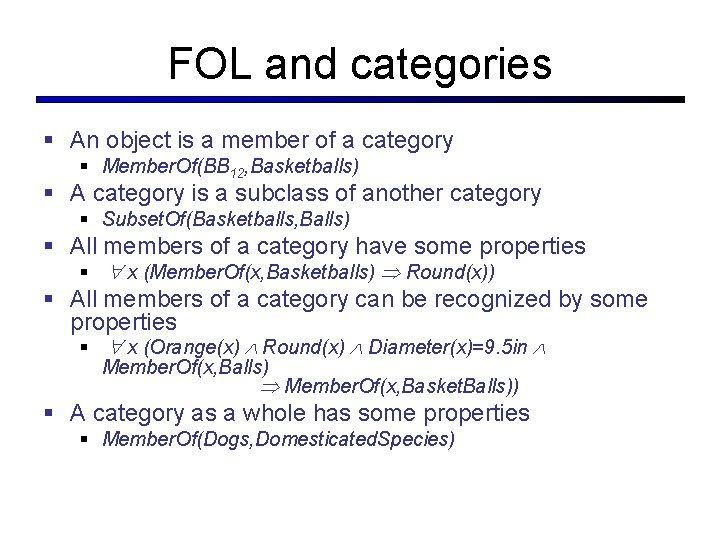
FOL and categories § An object is a member of a category § Member. Of(BB 12, Basketballs) § A category is a subclass of another category § Subset. Of(Basketballs, Balls) § All members of a category have some properties § x (Member. Of(x, Basketballs) Round(x)) § All members of a category can be recognized by some properties § x (Orange(x) Round(x) Diameter(x)=9. 5 in Member. Of(x, Balls) Member. Of(x, Basket. Balls)) § A category as a whole has some properties § Member. Of(Dogs, Domesticated. Species)
So what § Can we use formal categories in real world applications?
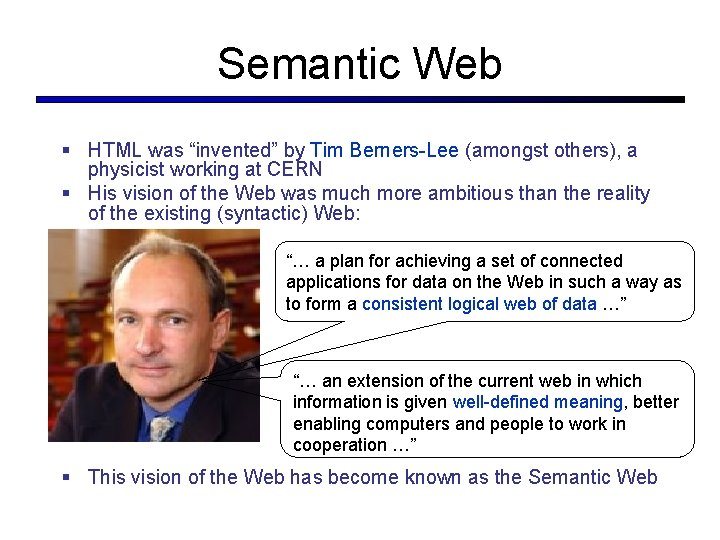
Semantic Web § HTML was “invented” by Tim Berners-Lee (amongst others), a physicist working at CERN § His vision of the Web was much more ambitious than the reality of the existing (syntactic) Web: “… a plan for achieving a set of connected applications for data on the Web in such a way as to form a consistent logical web of data …” “… an extension of the current web in which information is given well-defined meaning, better enabling computers and people to work in cooperation …” § This vision of the Web has become known as the Semantic Web
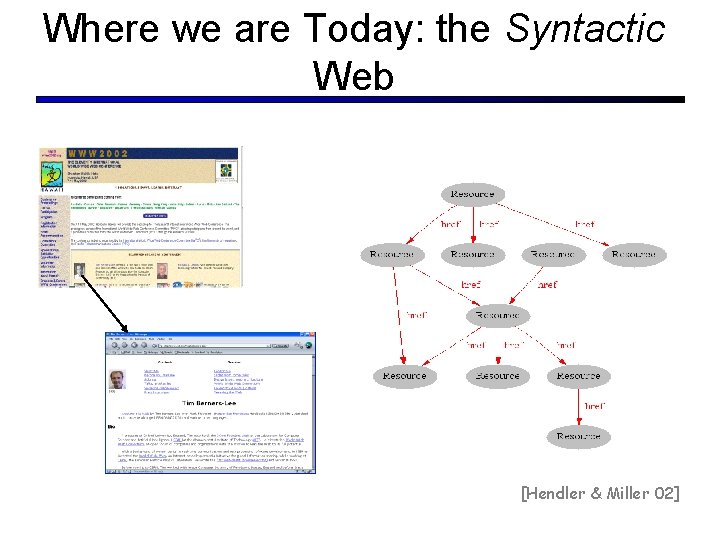
Where we are Today: the Syntactic Web [Hendler & Miller 02]
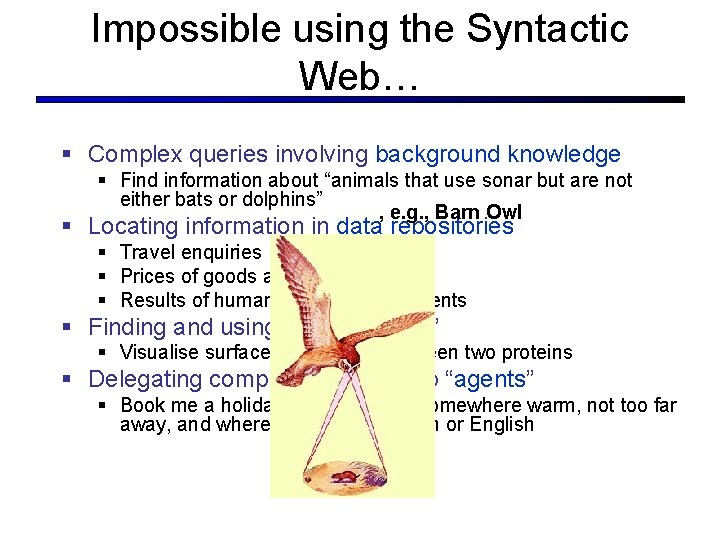
Impossible using the Syntactic Web… § Complex queries involving background knowledge § Find information about “animals that use sonar but are not either bats or dolphins” , e. g. , Barn Owl § Locating information in data repositories § Travel enquiries § Prices of goods and services § Results of human genome experiments § Finding and using “web services” § Visualise surface interactions between two proteins § Delegating complex tasks to web “agents” § Book me a holiday next weekend somewhere warm, not too far away, and where they speak French or English
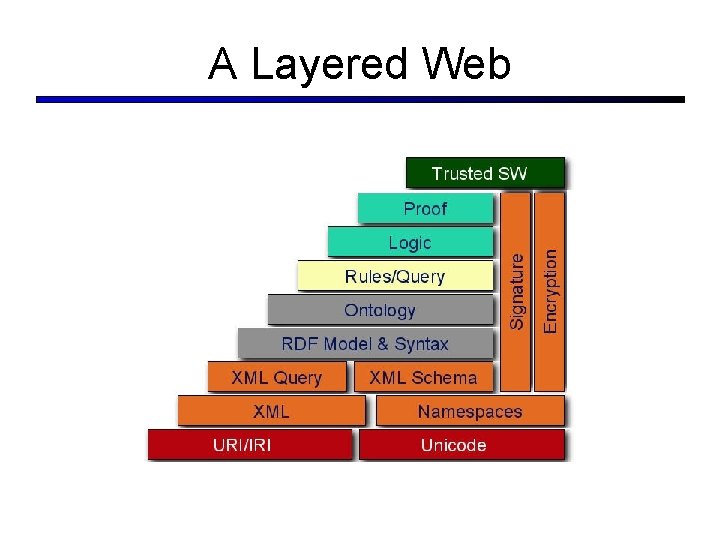
A Layered Web
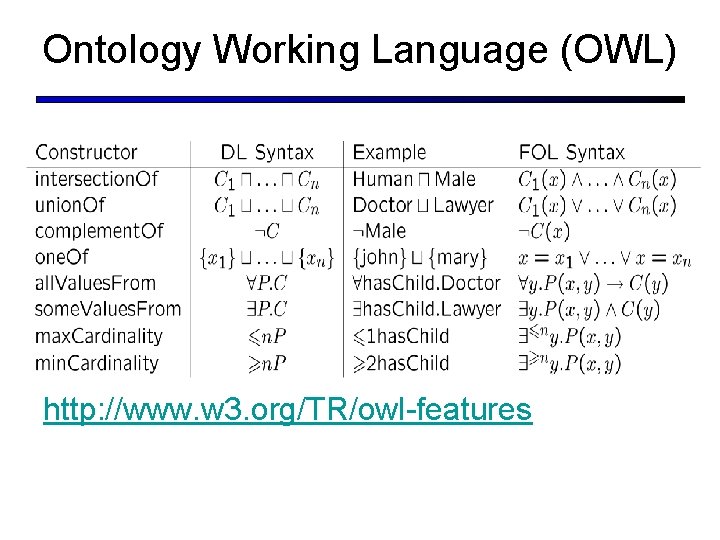
Ontology Working Language (OWL) http: //www. w 3. org/TR/owl-features
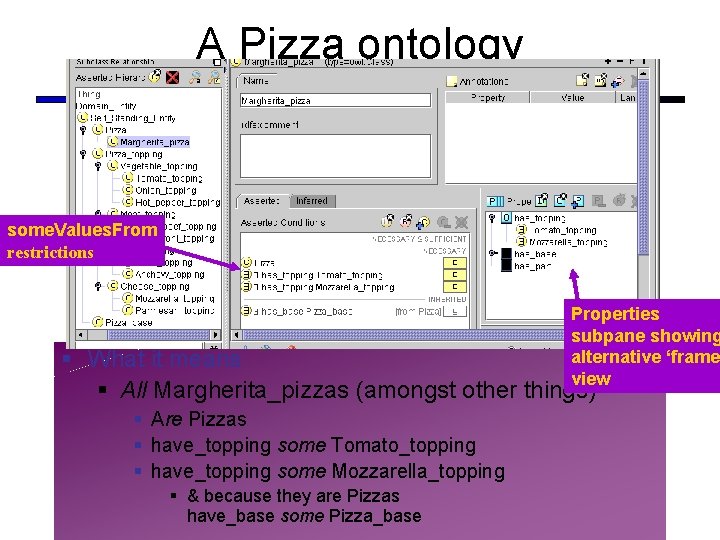
A Pizza ontology some. Values. From restrictions Properties subpane showing alternative ‘frame view § What it means § All Margherita_pizzas (amongst other things) § Are Pizzas § have_topping some Tomato_topping § have_topping some Mozzarella_topping § & because they are Pizzas have_base some Pizza_base
Current Status § Many general purpose logical ontologies in owl on the machine readable web § CYC § SUMO § Special purpose logical systems in routine use § UMLS medical ontology § Eco. CYC metabolic pathway database § Just type “semantic web” on Google. § Check the Wikipedia entry for starters.
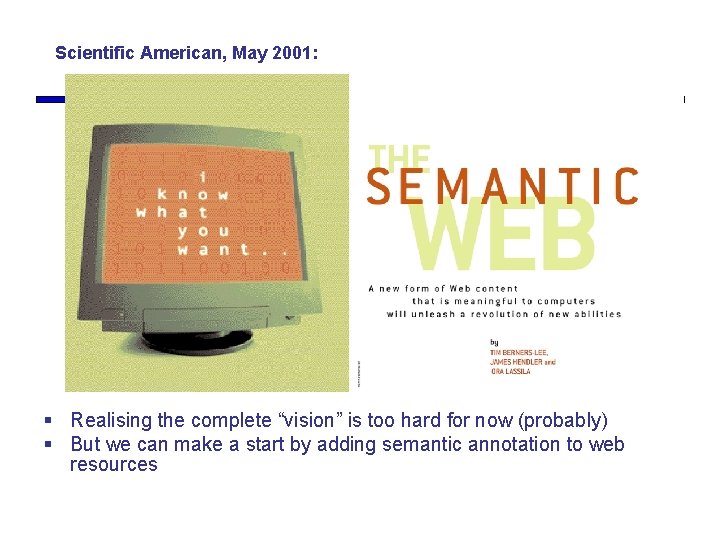
Scientific American, May 2001: § Realising the complete “vision” is too hard for now (probably) § But we can make a start by adding semantic annotation to web resources
Buying a book : Actions in FOL § Actions change the state of the world. § Not easy to capture this in FOL (why? ) § Action Buy (x, book, amazon) § Precondition: have (x, credit) / has_in_stock(amazon, book)… § Effect: charge(card) / ship(amazon, book, address(x)) § Frame Problem § Specifying things that don’t change (need Action x Fluents axioms) § Ramification problem § Capturing indirect effects § Qualification problem § Completeness of preconditions
Necessary and Sufficient conditions § Many categories have no clear-cut definitions § E. G. (chair, bush, book) § Tomatoes: sometimes green, red, yellow, black. Mostly round. § One solution: category Typical(Tomatoes) § x Typical(Tomatoes) Red(x) Spherical(x) § We can write down useful facts about categories without providing exact definitions. § What about “bachelor”? Philosophers (Quine, Fodor) and linguists (Fillmore) challenge the utility or possibility of the notion of strict definition. We might question a statement such as “the Pope is a bachelor”.
Structure of concepts § Instead complex concepts exhibit a radial structure often with a prototypical member and a number of mappings and extensions. § Prototypes of categories could arise from various considerations including § a) being a central category (others relate to it; amble and swagger relate to the prototype walk), § b) being an essential feature that meets a folk theory (birds have feathers, lay eggs), § c) being a typical case (sparrow is a typical bird), § d) being an ideal positive social standard (“parent) or an anti-ideal negative social standard (“terrorist”), § e) a stereotype (set of assumed attributes as in dumb blonde) or § f) a salient exemplar (second world war as a just war)
Summary § First-order logic: § objects and relations are semantic primitives § syntax: constants, functions, predicates, equality, quantifiers § Increased expressive power: sufficient to express real-world problems § Problems: § Handling human conceptual categories, uncertainty and dynamics § Next week: Modern AI: Probability § READ Chapter 13!!
A (Short) History of AI § 1940 -1950: Early days § 1943: Mc. Culloch & Pitts: Boolean circuit model of brain § 1950: Turing's ``Computing Machinery and Intelligence'‘ § 1950— 70: Excitement: Look, Ma, no hands! § 1950 s: Early AI programs, including Samuel's checkers program, Newell & Simon's Logic Theorist, Gelernter's Geometry Engine § 1956: Dartmouth meeting: ``Artificial Intelligence'' adopted § 1965: Robinson's complete algorithm for logical reasoning § 1970— 88: Knowledge-based approaches § 1969— 79: Early development of knowledge-based systems § 1980— 88: Expert systems industry booms § 1988— 93: Expert systems industry busts: “AI Winter” § 1988—: Statistical approaches § Resurgence of probability, focus on uncertainty § General increase in technical depth § Agents, agents, everywhere… “AI Spring”? § 2000—: Where are we now?