Crossdisciplinary axion chameleon detection ID Equipment people DM
- Slides: 35
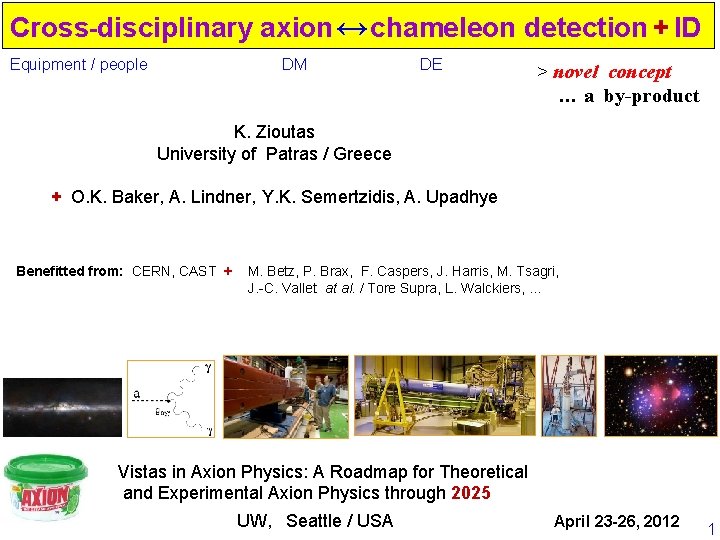
Cross-disciplinary axion ↔ chameleon detection + ID Equipment / people DM DE > novel concept … a by-product K. Zioutas University of Patras / Greece + O. K. Baker, A. Lindner, Y. K. Semertzidis, A. Upadhye Benefitted from: CERN, CAST + M. Betz, P. Brax, F. Caspers, J. Harris, M. Tsagri, J. -C. Vallet at al. / Tore Supra, L. Walckiers, … Vistas in Axion Physics: A Roadmap for Theoretical and Experimental Axion Physics through 2025 UW, Seattle / USA April 23 -26, 2012 1
Related work … • CAST search for sub-e. V mass solar axions with 3 He buffer gas. The CAST Collaboration, S. Aune et al, Phys. Rev. Lett. 107 (2011) 261302 “Results from CAST … searches”, T. Papaevangelou, Moriond (March 2012): http: //indico. in 2 p 3. fr/get. File. py/access? contrib. Id=70&session. Id=11&res. Id=0&material. Id=slides&conf. Id=6001 • Prospects for Searching Axion-like Particle Dark Matter with Dipole, Toroidal and Wiggler Magnets O. K. Baker, M. Betz, F. Caspers, J. Jaeckel, A. Lindner, A. Ringwald, Y. Semertzidis, P. Sikivie, K. Zioutas, Phys. Rev. D 85 (2012) 035018 • Detection prospects for solar and terrestrial chameleons P. Brax, A. Lindner, K. Zioutas, Phys. Rev. D 85 (2012) 043014. • A chameleon helioscope O. K. Baker, A. Lindner, A. Upadhye, K. Zioutas, ar. Xiv: 1201. 0079 v 1 • Detection of radiation pressure from solar chameleons O. K. Baker, A. Lindner, Y. K. Semertzidis, A. Upadhye, K. Zioutas, ar. Xiv: 1201. 6508 v 1 … and ref’s therein 2
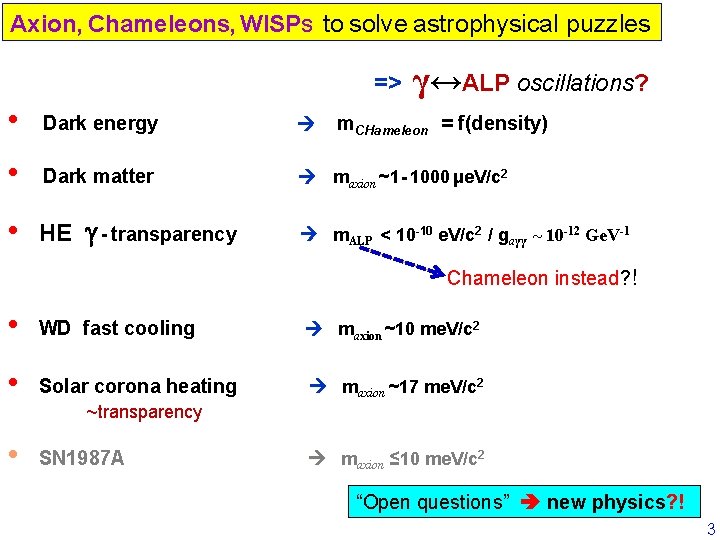
Axion, Chameleons, WISPs to solve astrophysical puzzles => γ↔ALP oscillations? • Dark energy m. CHameleon • Dark matter m • HE - transparency = f(density) axion ~1 - 1000 μe. V/c 2 m. ALP < 10 -10 e. V/c 2 / gaγγ ~ 10 -12 Ge. V-1 Chameleon instead? ! • WD fast cooling maxion ~10 me. V/c 2 • Solar corona heating m axion ~17 me. V/c 2 ~transparency • SN 1987 A maxion ≤ 10 me. V/c 2 “Open questions” new physics? ! 3
>> Motivation – encouragement for: >> • Telescopes: solar / relics + Natural T. @ work => direct signatures! => copy their workings • RECYCLING gain: time, $$, R&D, people (collaborators) accelerating science cost efficiently, e. g. , CAST 4
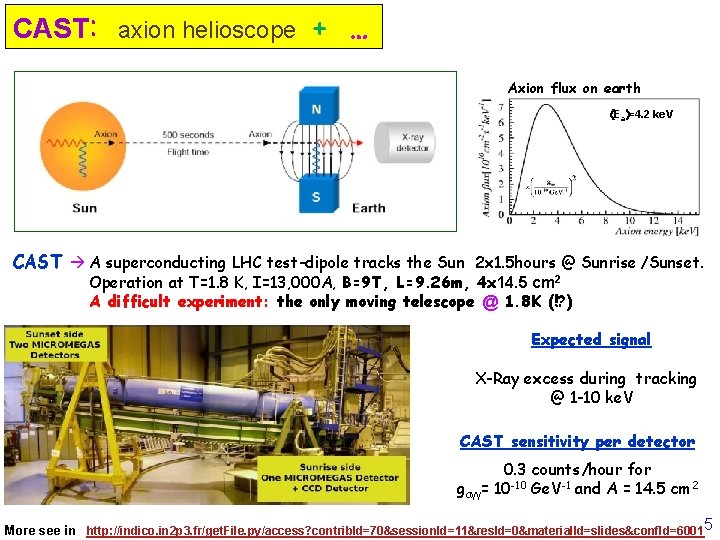
CAST: axion helioscope + … Axion flux on earth Ea =4. 2 ke. V CAST A superconducting LHC test-dipole tracks the Sun 2 x 1. 5 hours @ Sunrise /Sunset. Operation at T=1. 8 K, I=13, 000 A, B=9 T, L=9. 26 m, 4 x 14. 5 cm 2 A difficult experiment: the only moving telescope @ 1. 8 K (!? ) Expected signal X-Ray excess during tracking @ 1 -10 ke. V CAST sensitivity per detector 0. 3 counts/hour for gaγγ= 10 -10 Ge. V-1 and A = 14. 5 cm 2 More see in http: //indico. in 2 p 3. fr/get. File. py/access? contrib. Id=70&session. Id=11&res. Id=0&material. Id=slides&conf. Id=6001 5
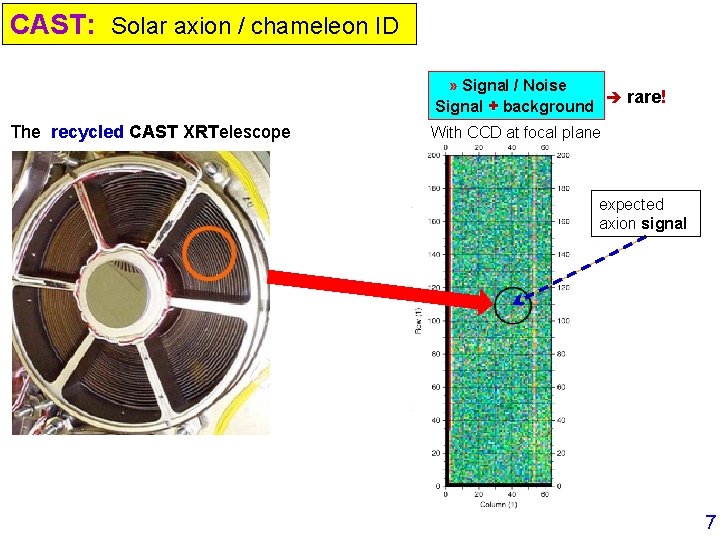
CAST: Solar axion / chameleon ID » Signal / Noise rare! Signal + background The recycled CAST XRTelescope With CCD at focal plane expected axion signal 7
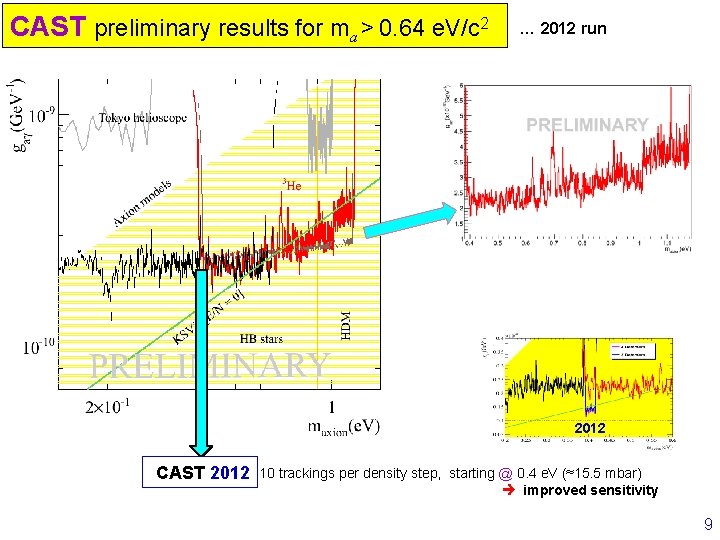
CAST preliminary results for ma > 0. 64 e. V/c 2 … 2012 run 2012 CAST 2012 10 trackings per density step, starting @ 0. 4 e. V (≈15. 5 mbar) improved sensitivity 9
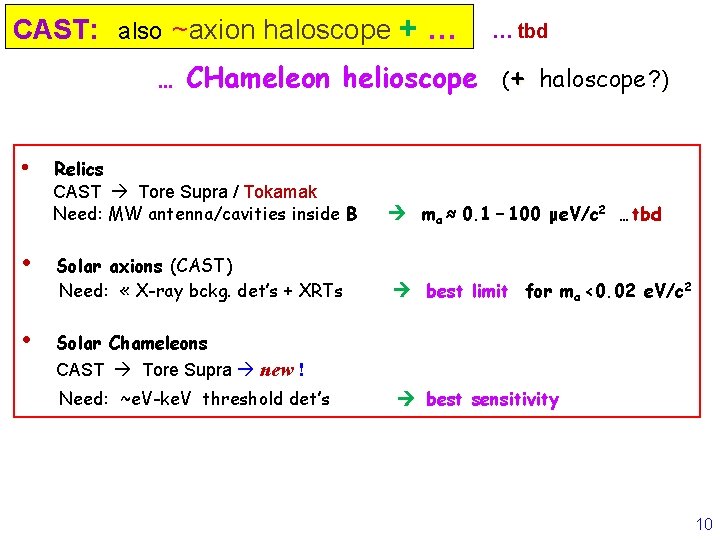
CAST: also ~axion haloscope + … … CHameleon helioscope • • … tbd (+ haloscope ? ) Relics CAST Tore Supra / Tokamak Need: MW antenna/cavities inside B ma ≈ 0. 1 – 100 μe. V/c 2 …tbd Solar axions (CAST) Need: « X-ray bckg. det’s + XRTs best limit for ma <0. 02 e. V/c 2 • Solar Chameleons CAST Tore Supra new ! Need: ~e. V-ke. V threshold det’s best sensitivity 10
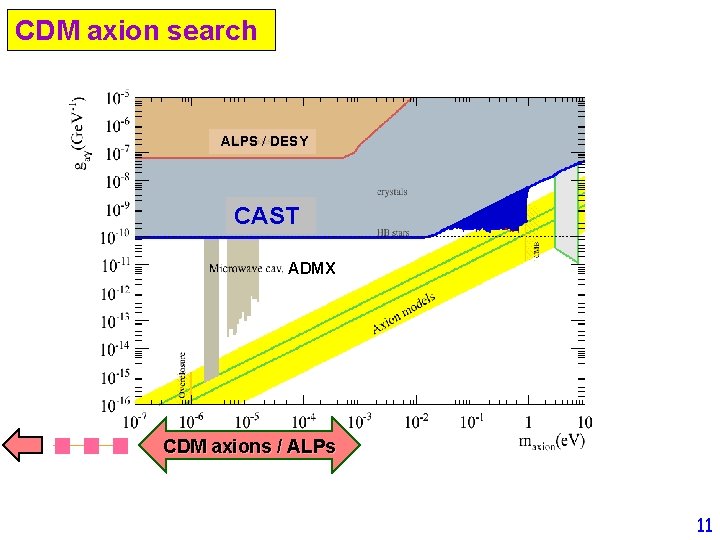
CDM axion search ALPS / DESY CAST ADMX CDM axions / ALPs 11
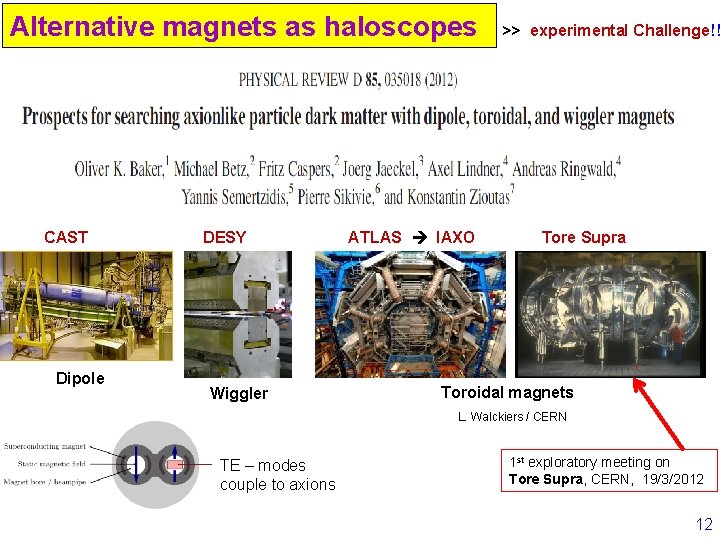
Alternative magnets as haloscopes >> experimental Challenge!! CAST DESY ATLAS IAXO Tore Supra Dipole Wiggler TE – modes couple to axions Toroidal magnets L. Walckiers / CERN 1 st exploratory meeting on Tore Supra, CERN, 19/3/2012 12
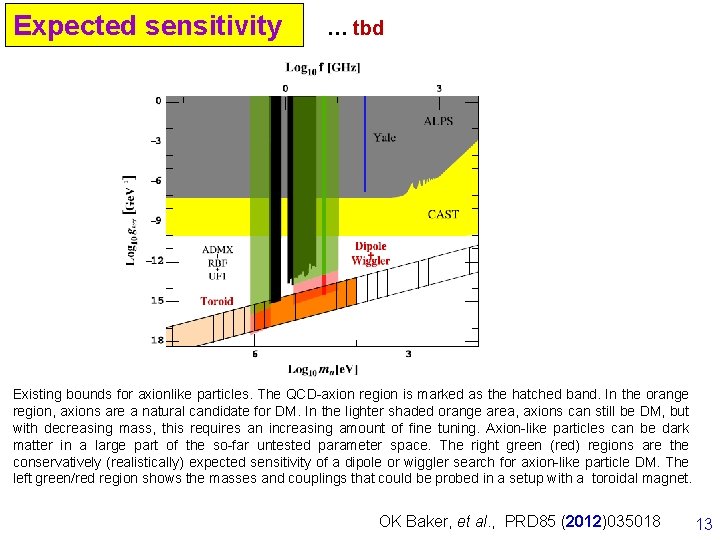
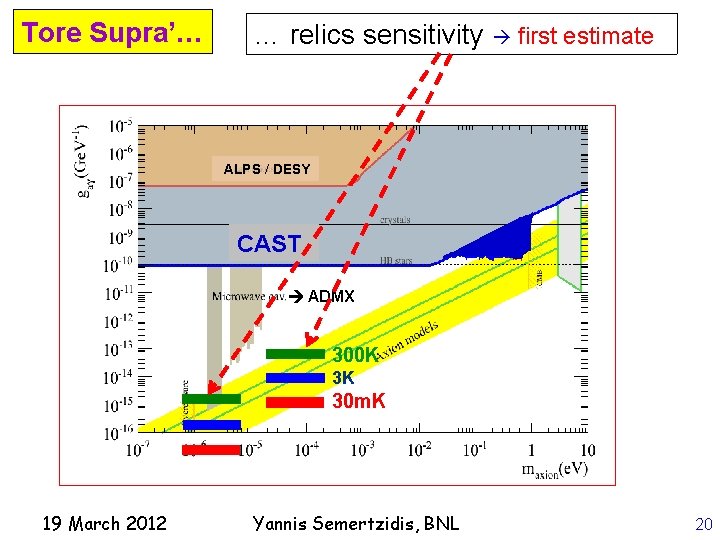
Expected sensitivity … tbd Existing bounds for axionlike particles. The QCD-axion region is marked as the hatched band. In the orange region, axions are a natural candidate for DM. In the lighter shaded orange area, axions can still be DM, but with decreasing mass, this requires an increasing amount of fine tuning. Axion-like particles can be dark matter in a large part of the so-far untested parameter space. The right green (red) regions are the conservatively (realistically) expected sensitivity of a dipole or wiggler search for axion-like particle DM. The left green/red region shows the masses and couplings that could be probed in a setup with a toroidal magnet. OK Baker, et al. , PRD 85 (2012)035018 13
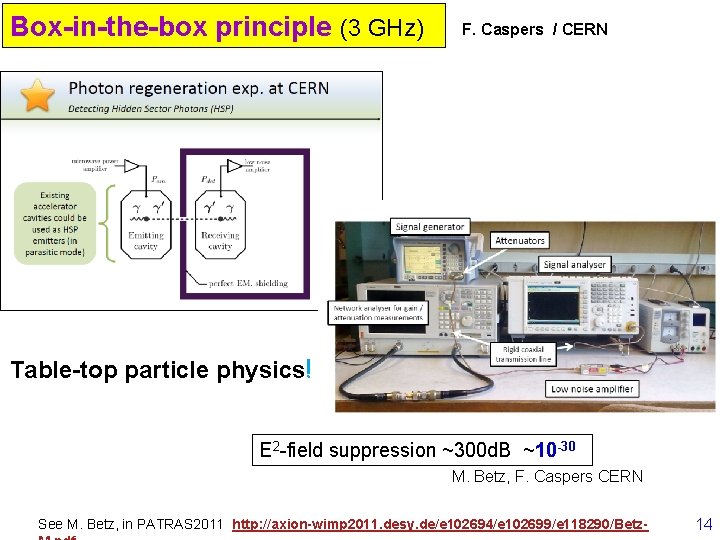
Box-in-the-box principle (3 GHz) F. Caspers / CERN Table-top particle physics! E 2 -field suppression ~300 d. B ~10 -30 M. Betz, F. Caspers CERN See M. Betz, in PATRAS 2011 http: //axion-wimp 2011. desy. de/e 102694/e 102699/e 118290/Betz- 14
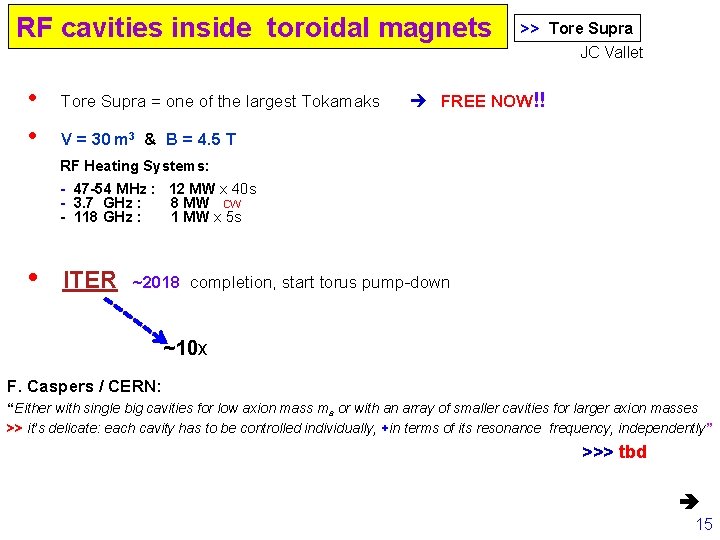
RF cavities inside toroidal magnets >> Tore Supra >> JC Vallet • Tore Supra = one of the largest Tokamaks FREE NOW!! • V = 30 m 3 & B = 4. 5 T RF Heating Systems: - 47 -54 MHz : 12 MW x 40 s - 3. 7 GHz : 8 MW cw - 118 GHz : 1 MW x 5 s • ITER ~2018 completion, start torus pump-down ~10 x F. Caspers / CERN: “Either with single big cavities for low axion mass ma or with an array of smaller cavities for larger axion masses >> it’s delicate: each cavity has to be controlled individually, +in terms of its resonance frequency, independently” >>> tbd 15
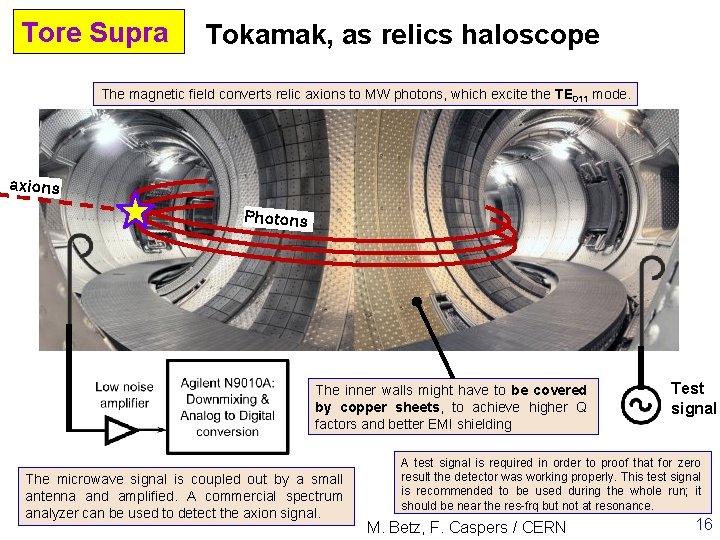
Tore Supra Tokamak, as relics haloscope The magnetic field converts relic axions to MW photons, which excite the TE 011 mode. axions Photons The inner walls might have to be covered by copper sheets, to achieve higher Q factors and better EMI shielding The microwave signal is coupled out by a small antenna and amplified. A commercial spectrum analyzer can be used to detect the axion signal. Test signal A test signal is required in order to proof that for zero result the detector was working properly. This test signal is recommended to be used during the whole run; it should be near the res-frq but not at resonance. M. Betz, F. Caspers / CERN 16
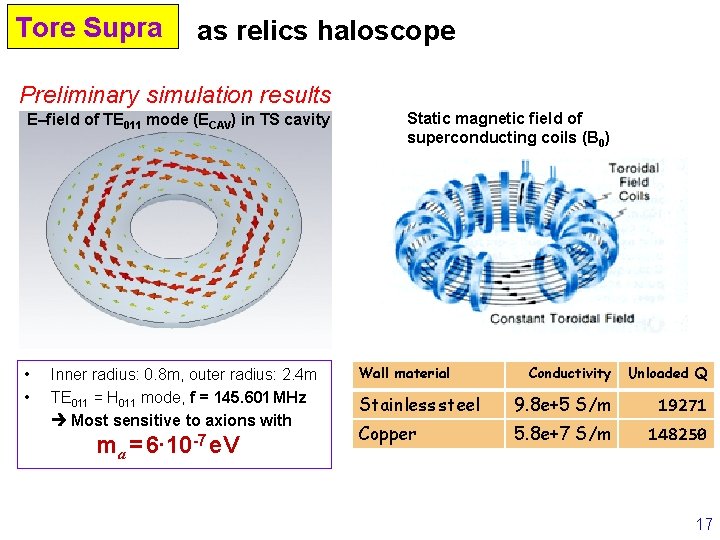
Tore Supra as relics haloscope Preliminary simulation results E–field of TE 011 mode (ECAV) in TS cavity • Inner radius: 0. 8 m, outer radius: 2. 4 m • TE 011 = H 011 mode, f = 145. 601 MHz Most sensitive to axions with ma = 6∙ 10 -7 e. V Static magnetic field of superconducting coils (B 0) Wall material Conductivity Unloaded Q Stainless steel 9. 8 e+5 S/m 19271 Copper 5. 8 e+7 S/m 148250 17
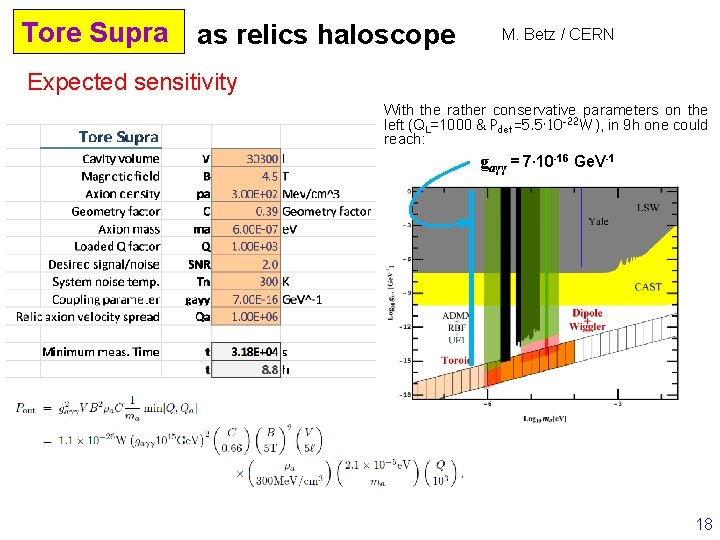
Tore Supra as relics haloscope M. Betz / CERN Expected sensitivity With the rather conservative parameters on the left (QL=1000 & Pdet=5. 5∙ 10 -22 W), in 9 h one could reach: gaγγ = 7∙ 10 -16 Ge. V-1 18
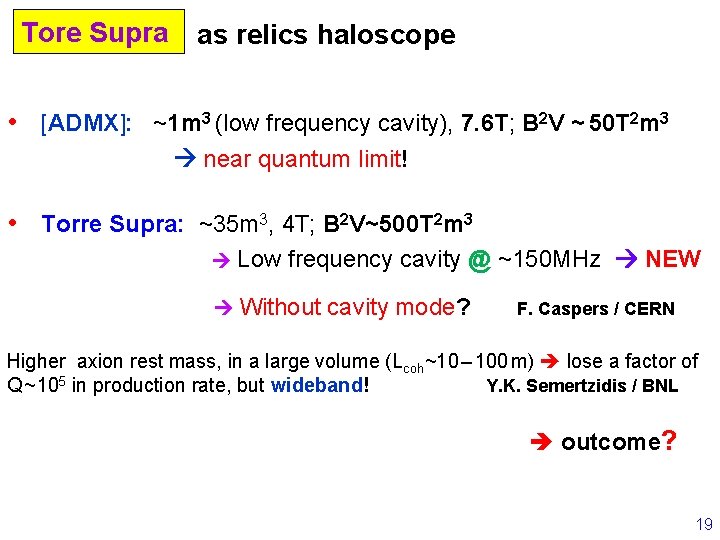
Tore Supra as relics haloscope • [ADMX]: ~1 m 3 (low frequency cavity), 7. 6 T; B 2 V ~ 50 T 2 m 3 near quantum limit! • Torre Supra: ~35 m 3, 4 T; B 2 V~500 T 2 m 3 Low frequency cavity @ ~150 MHz NEW Without cavity mode? F. Caspers / CERN Higher axion rest mass, in a large volume (Lcoh~10 – 100 m) lose a factor of Q ~ 105 in production rate, but wideband! Y. K. Semertzidis / BNL outcome? 19
Tore Supra’… … relics sensitivity first estimate ALPS / DESY CAST ADMX 300 K 3 K 30 m. K 19 March 2012 Yannis Semertzidis, BNL 20
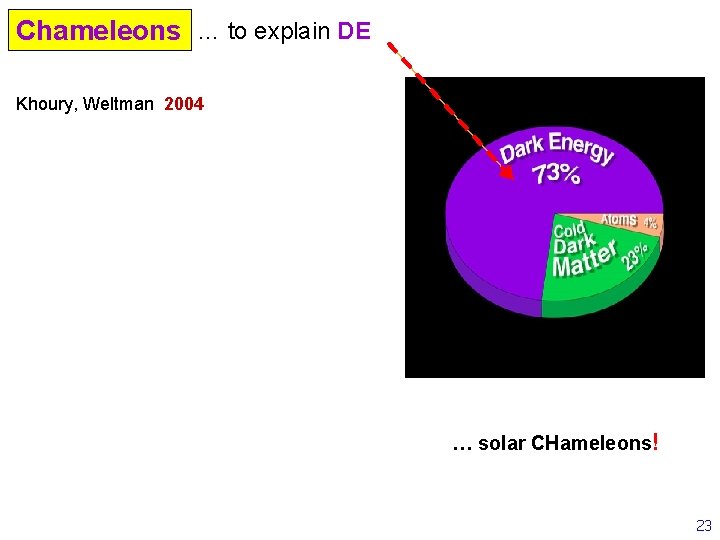
Chameleons … to explain DE Khoury, Weltman 2004 … solar CHameleons! 23
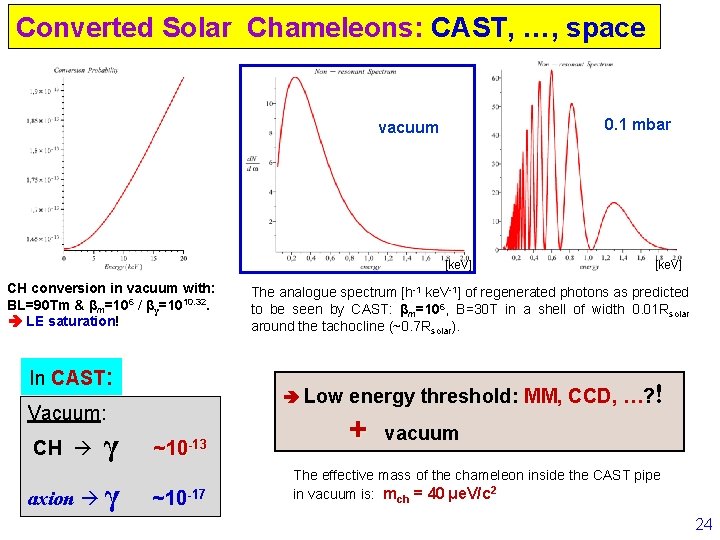
Converted Solar Chameleons: CAST, …, space 0. 1 mbar vacuum [ke. V] CH conversion in vacuum with: BL=90 Tm & βm=106 / βγ=1010. 32. LE saturation! In CAST: CH γ γ The analogue spectrum [h-1 ke. V-1] of regenerated photons as predicted to be seen by CAST: βm=106, B=30 T in a shell of width 0. 01 Rsolar around the tachocline (~0. 7 Rsolar). Low energy threshold: MM, CCD, …? Vacuum: -13 ~10 -13 axion ~10 -17 [ke. V] ! + vacuum The effective mass of the chameleon inside the CAST pipe in vacuum is: mch = 40 μe. V/c 2 24
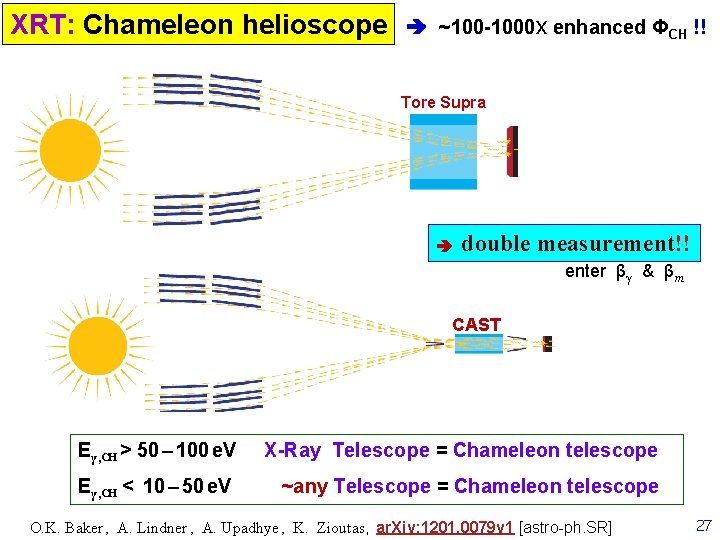
XRT: Chameleon helioscope ~100 -1000 x enhanced ΦCH !! Tore Supra double measurement!! enter βγ & βm CAST Eγ, CH > 50 – 100 e. V X-Ray Telescope = Chameleon telescope Eγ, CH < 10 – 50 e. V ~any Telescope = Chameleon telescope O. K. Baker , A. Lindner , A. Upadhye , K. Zioutas, ar. Xiv: 1201. 0079 v 1 [astro-ph. SR] 27
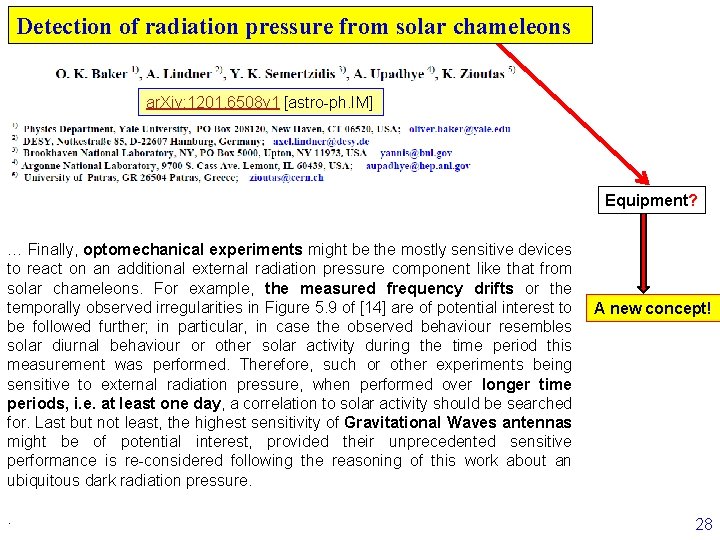
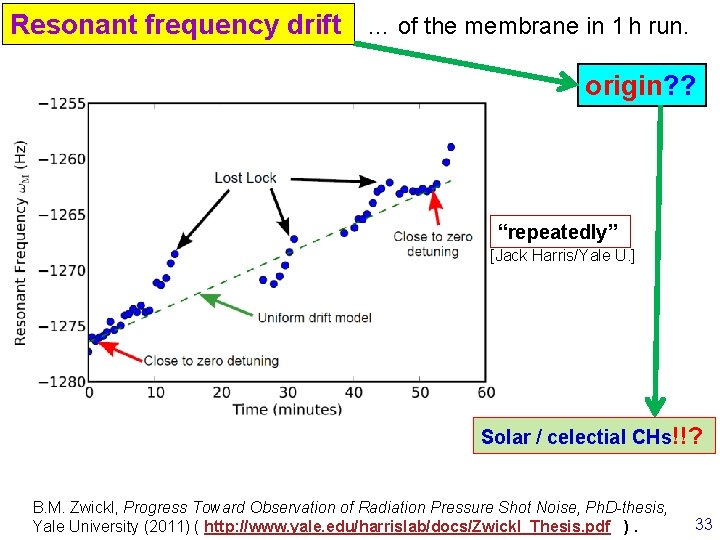
Detection of radiation pressure from solar chameleons. . on a foil ar. Xiv: 1201. 6508 v 1 [astro-ph. IM] Equipment? … Finally, optomechanical experiments might be the mostly sensitive devices to react on an additional external radiation pressure component like that from solar chameleons. For example, the measured frequency drifts or the temporally observed irregularities in Figure 5. 9 of [14] are of potential interest to be followed further; in particular, in case the observed behaviour resembles solar diurnal behaviour or other solar activity during the time period this measurement was performed. Therefore, such or other experiments being sensitive to external radiation pressure, when performed over longer time periods, i. e. at least one day, a correlation to solar activity should be searched for. Last but not least, the highest sensitivity of Gravitational Waves antennas might be of potential interest, provided their unprecedented sensitive performance is re-considered following the reasoning of this work about an ubiquitous dark radiation pressure. . A new concept! 28
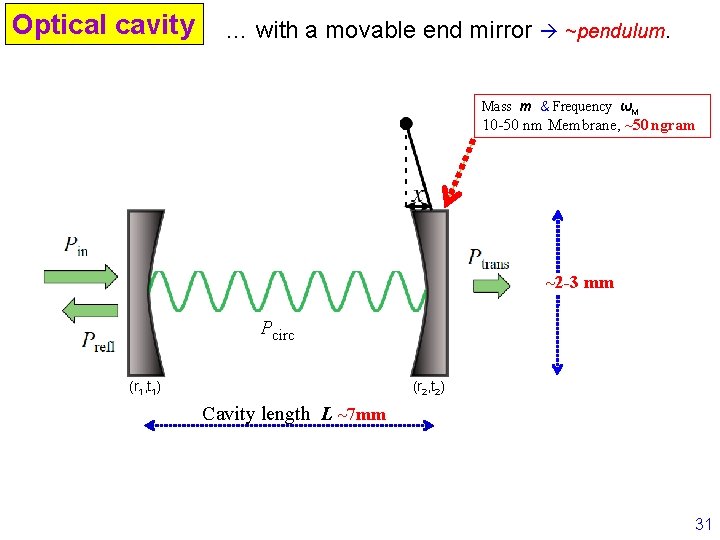
Optical cavity … with a movable end mirror ~pendulum. Mass m & Frequency ωΜ 10 -50 nm Membrane, ~50 ngram ~2 -3 mm Pcirc (r 1, t 1) (r 2, t 2) Cavity length L ~7 mm 31
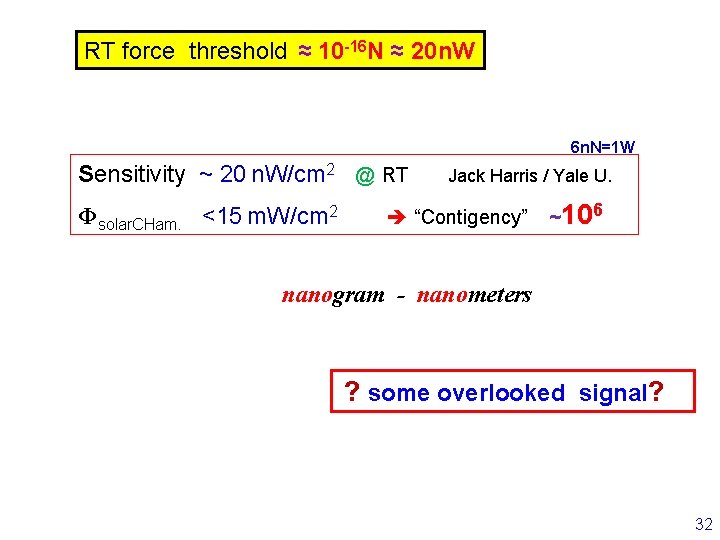
RT force threshold ≈ 10 -16 N ≈ 20 n. W 6 n. N=1 W Sensitivity ~ 20 n. W/cm 2 @ RT Jack Harris / Yale U. Φsolar. CHam. <15 m. W/cm 2 “Contigency” ~106 nanogram - nanometers ? some overlooked signal? 32
Resonant frequency drift … of the membrane in 1 h run. origin? ? “repeatedly” [Jack Harris/Yale U. ] Solar / celectial CHs!!? B. M. Zwickl, Progress Toward Observation of Radiation Pressure Shot Noise, Ph. D-thesis, Yale University (2011) ( http: //www. yale. edu/harrislab/docs/Zwickl_Thesis. pdf ). 33
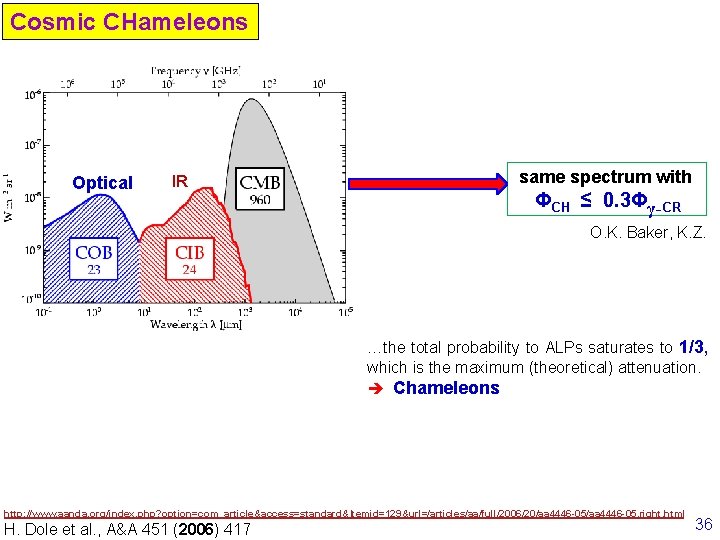
Cosmic CHameleons Optical IR same spectrum with ΦCH ≤ 0. 3Φγ-CR O. K. Baker, K. Z. …the total probability to ALPs saturates to 1/3, which is the maximum (theoretical) attenuation. Chameleons http: //www. aanda. org/index. php? option=com_article&access=standard&Itemid=129&url=/articles/aa/full/2006/20/aa 4446 -05. right. html H. Dole et al. , A&A 451 (2006) 417 36
Thanks Sun!! 37
Back-up slides 31
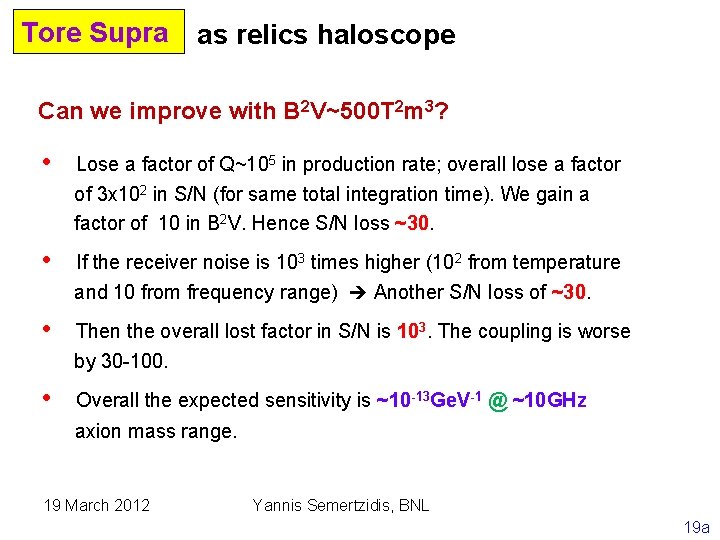
Tore Supra as relics haloscope Can we improve with B 2 V~500 T 2 m 3? • Lose a factor of Q~105 in production rate; overall lose a factor of 3 x 10² in S/N (for same total integration time). We gain a factor of 10 in B 2 V. Hence S/N loss ~30. • If the receiver noise is 103 times higher (102 from temperature and 10 from frequency range) Another S/N loss of ~30. • Then the overall lost factor in S/N is 103. The coupling is worse by 30 -100. • Overall the expected sensitivity is ~10 -13 Ge. V-1 @ ~10 GHz axion mass range. 19 March 2012 Yannis Semertzidis, BNL 19 a
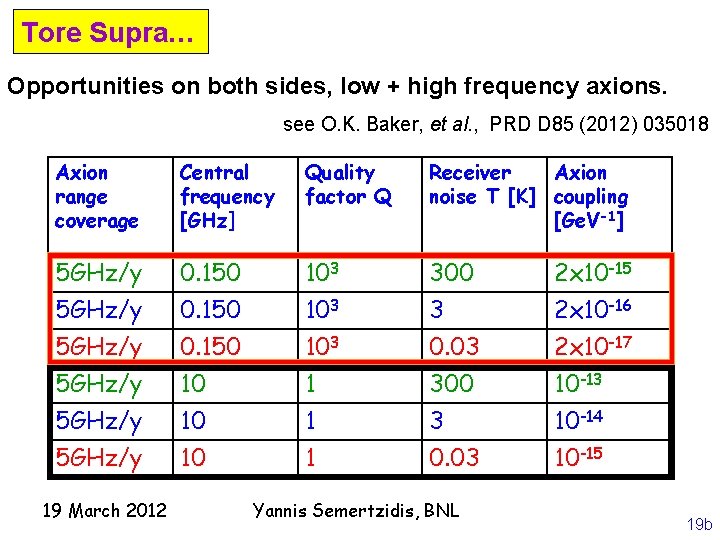
Tore Supra… Opportunities on both sides, low + high frequency axions. see O. K. Baker, et al. , PRD D 85 (2012) 035018 Axion range coverage Central frequency [GHz] Quality factor Q Receiver Axion noise T [K] coupling [Ge. V-1] 5 GHz/y 0. 150 103 300 2 x 10 -15 5 GHz/y 0. 150 103 3 2 x 10 -16 5 GHz/y 0. 150 103 0. 03 2 x 10 -17 5 GHz/y 10 1 300 10 -13 5 GHz/y 10 1 3 10 -14 5 GHz/y 10 1 0. 03 10 -15 19 March 2012 Yannis Semertzidis, BNL 19 b
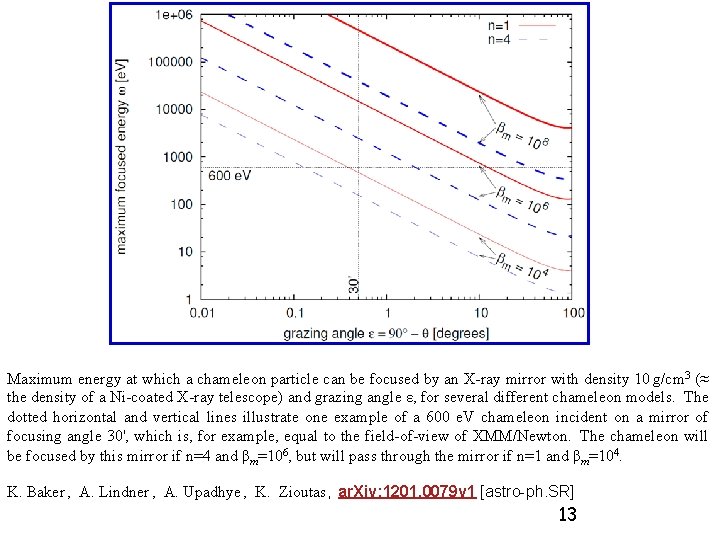
Maximum energy at which a chameleon particle can be focused by an X-ray mirror with density 10 g/cm 3 (≈ the density of a Ni-coated X-ray telescope) and grazing angle ε, for several different chameleon models. The dotted horizontal and vertical lines illustrate one example of a 600 e. V chameleon incident on a mirror of focusing angle 30', which is, for example, equal to the field-of-view of XMM/Newton. The chameleon will be focused by this mirror if n=4 and βm=106, but will pass through the mirror if n=1 and βm=104. K. Baker , A. Lindner , A. Upadhye , K. Zioutas, ar. Xiv: 1201. 0079 v 1 [astro-ph. SR] 13
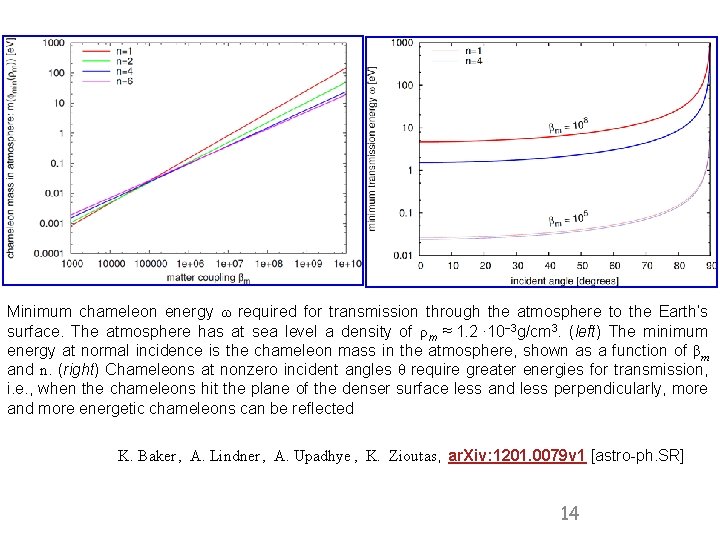
Minimum chameleon energy ω required for transmission through the atmosphere to the Earth’s surface. The atmosphere has at sea level a density of ρm ≈ 1. 2 · 10− 3 g/cm 3. (left) The minimum energy at normal incidence is the chameleon mass in the atmosphere, shown as a function of βm and n. (right) Chameleons at nonzero incident angles θ require greater energies for transmission, i. e. , when the chameleons hit the plane of the denser surface less and less perpendicularly, more and more energetic chameleons can be reflected K. Baker , A. Lindner , A. Upadhye , K. Zioutas, ar. Xiv: 1201. 0079 v 1 [astro-ph. SR] 14
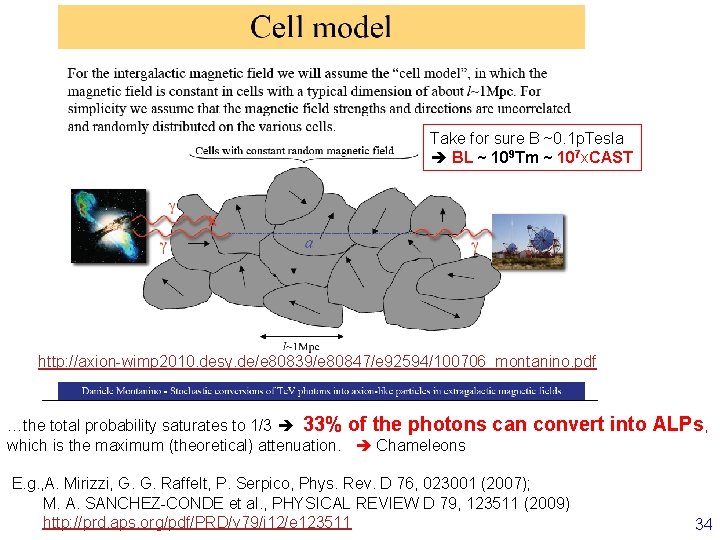
Take for sure B ~0. 1 p. Tesla BL ~ 109 Tm ~ 107 x. CAST http: //axion-wimp 2010. desy. de/e 80839/e 80847/e 92594/100706_montanino. pdf …the total probability saturates to 1/3 33% of the photons can convert into ALPs, which is the maximum (theoretical) attenuation. Chameleons E. g. , A. Mirizzi, G. G. Raffelt, P. Serpico, Phys. Rev. D 76, 023001 (2007); M. A. SANCHEZ-CONDE et al. , PHYSICAL REVIEW D 79, 123511 (2009) http: //prd. aps. org/pdf/PRD/v 79/i 12/e 123511 34
although it is well established that the ultimate energy source is the coronal magnetic field, the question of how the magnetic energy is transformed to heat the coronal plasma is still to be solved. . one important issue is whether the heating is released gradually + continuously or in the form of discrete, rapid and intense pulses. http: //xxx. lanl. gov/pdf/1204. 0041. pdf April 2012