
Possible indirect evidence for axionlike particles from far
Possible indirect evidence for axion-like particles from far away AGN? Alessandro De Angelis INFN, INAF and Udine University • • Photon propagation Observation of distant AGN Axion-Like Particles & the DARMa scenario Conclusions The work on axions has been done in collaboration with M. Roncadelli, O. Mansutti and M. Persic 1
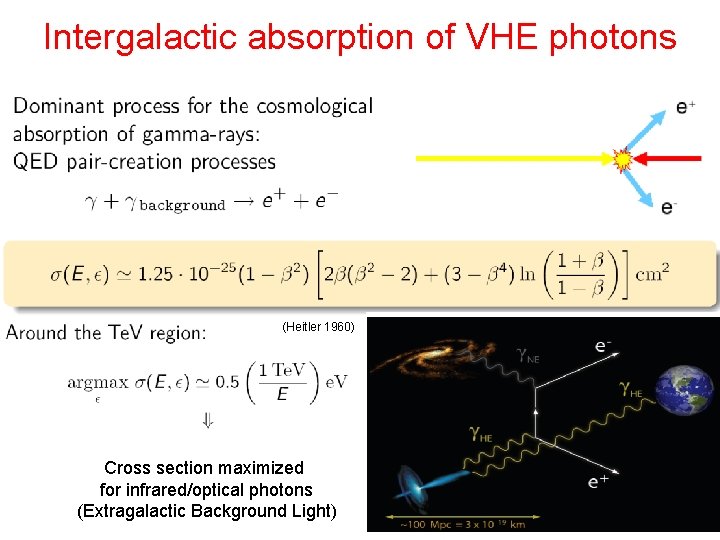
Intergalactic absorption of VHE photons (Heitler 1960) Cross section maximized for infrared/optical photons (Extragalactic Background Light) 2
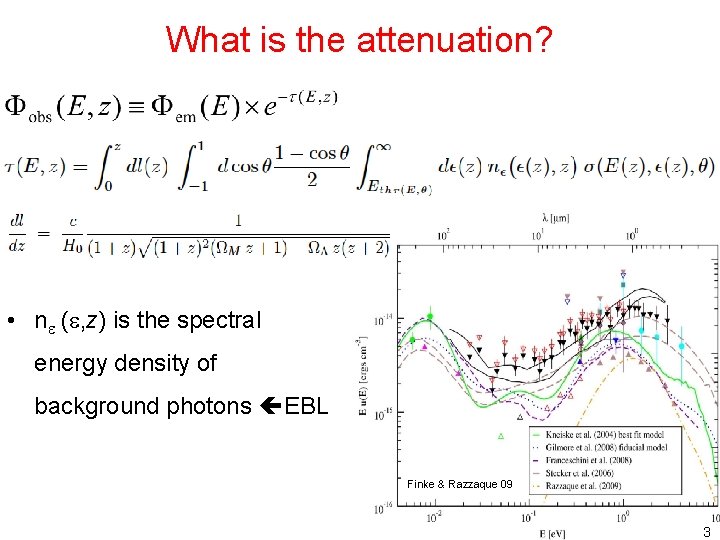
What is the attenuation? • ne (e, z) is the spectral energy density of background photons EBL Finke & Razzaque 09 3
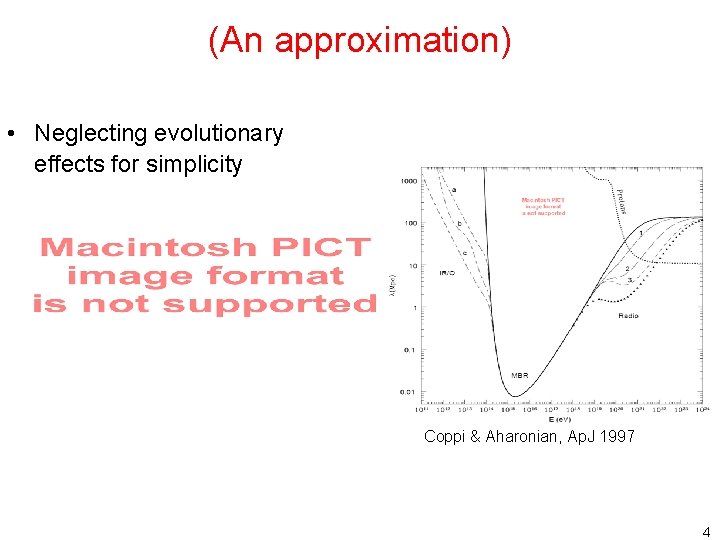
(An approximation) • Neglecting evolutionary effects for simplicity Coppi & Aharonian, Ap. J 1997 4
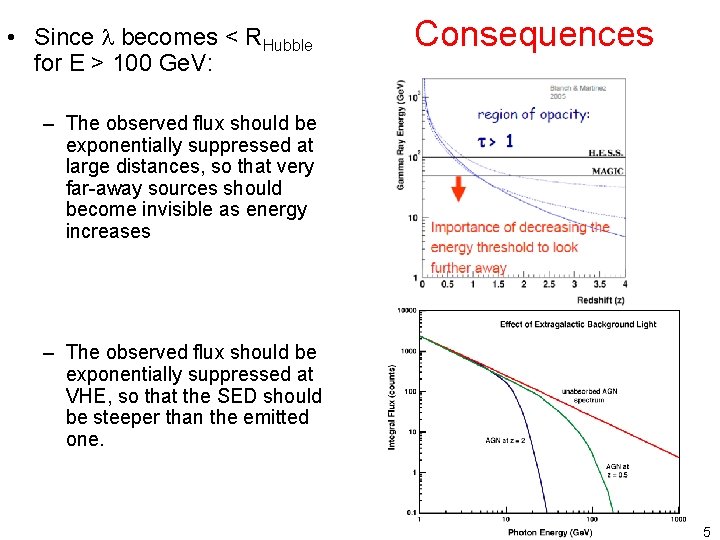
• Since l becomes < RHubble for E > 100 Ge. V: Consequences – The observed flux should be exponentially suppressed at large distances, so that very far-away sources should become invisible as energy increases – The observed flux should be exponentially suppressed at VHE, so that the SED should be steeper than the emitted one. 5
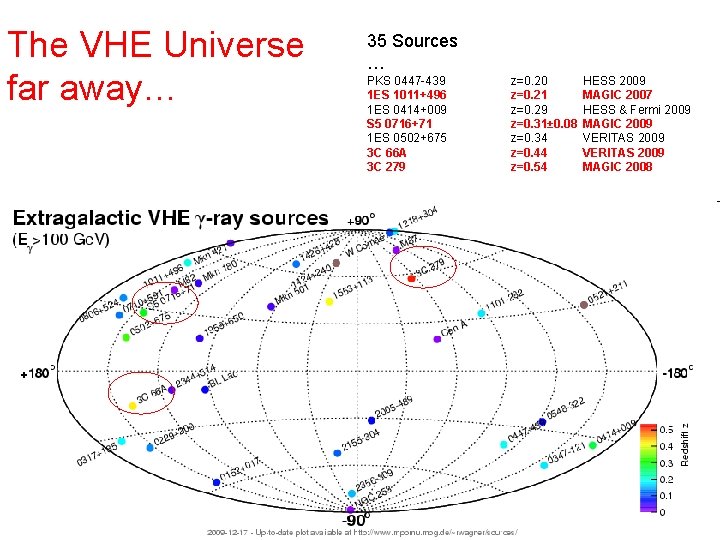
The VHE Universe far away… 35 Sources … PKS 0447 -439 1 ES 1011+496 1 ES 0414+009 S 5 0716+71 1 ES 0502+675 3 C 66 A 3 C 279 z=0. 20 z=0. 21 z=0. 29 z=0. 31± 0. 08 z=0. 34 z=0. 44 z=0. 54 HESS 2009 MAGIC 2007 HESS & Fermi 2009 MAGIC 2009 VERITAS 2009 MAGIC 2008 6
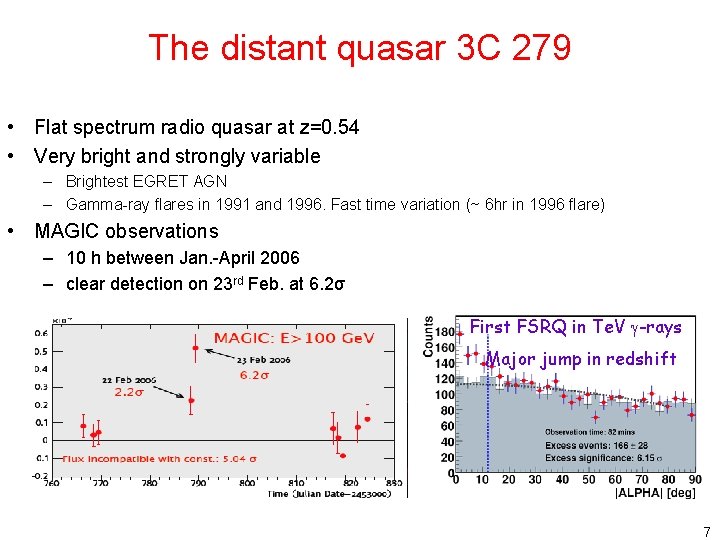
The distant quasar 3 C 279 • Flat spectrum radio quasar at z=0. 54 • Very bright and strongly variable – Brightest EGRET AGN – Gamma-ray flares in 1991 and 1996. Fast time variation (~ 6 hr in 1996 flare) • MAGIC observations – 10 h between Jan. -April 2006 – clear detection on 23 rd Feb. at 6. 2σ First FSRQ in Te. V -rays Major jump in redshift 7
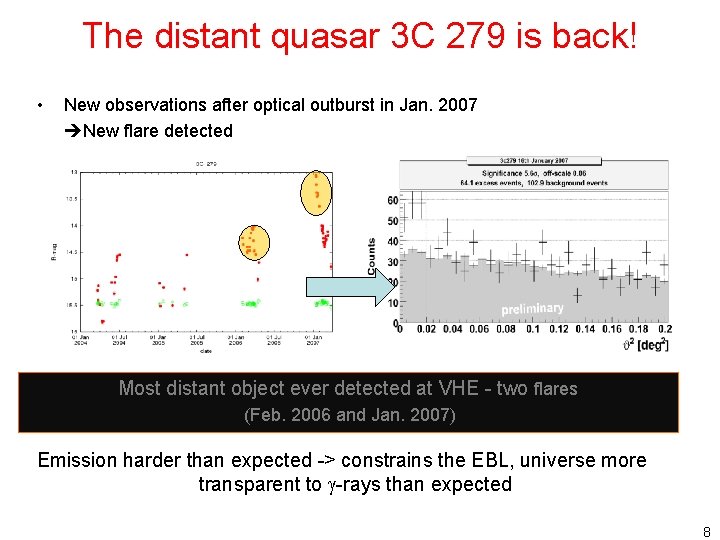
The distant quasar 3 C 279 is back! • New observations after optical outburst in Jan. 2007 New flare detected Most distant object ever detected at VHE - two flares (Feb. 2006 and Jan. 2007) Emission harder than expected -> constrains the EBL, universe more transparent to -rays than expected 8

Implications on Extragalactic Background Light blazar IACT VHE EBL e+ e- At ~0. 5 Te. V, flux attenuated by 2 orders of magnitude! 9
Could it be seen? At ~0. 5 Te. V, flux attenuated by 2 orders of magnitude! • The measurement of spectral features permits to constrain EBL models: – Power law Γ = 4. 1 ± 0. 7, measured up to 0. 5 Te. V • Spectrum sensitive to 0. 2 to 2 μm – Assume minimum reasonable index Γem = 1. 5: • Upper limit close to lower limit from galaxy count • Explanations go – from standard ones • very hard emission mechanisms with intrinsic slope < 1. 5 (Stecker 2008) • Very low EBL – to possible evidence for new physics • Oscillation to a particle traveling unimpeded? →X→ 10
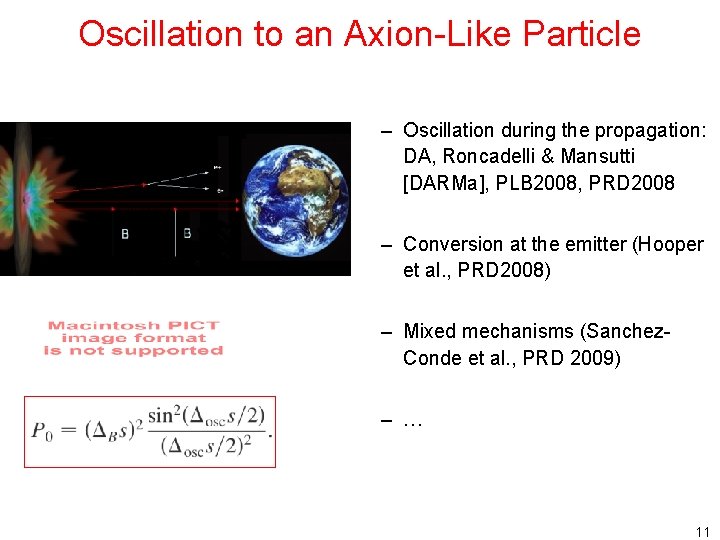
Oscillation to an Axion-Like Particle – Oscillation during the propagation: DA, Roncadelli & Mansutti [DARMa], PLB 2008, PRD 2008 – Conversion at the emitter (Hooper et al. , PRD 2008) – Mixed mechanisms (Sanchez. Conde et al. , PRD 2009) – … 11
Phenomenology of the oscillations • Photon-ALP oscillations are similar to neutrino oscillations but external B is needed • Bounds on the parameters M and m: – CAST & astrophysical arguments: M > 1010 Ge. V ; m < 0. 01 e. V (PDG 08) For the standard axion, m ~ (1010 Ge. V / M) e. V 12
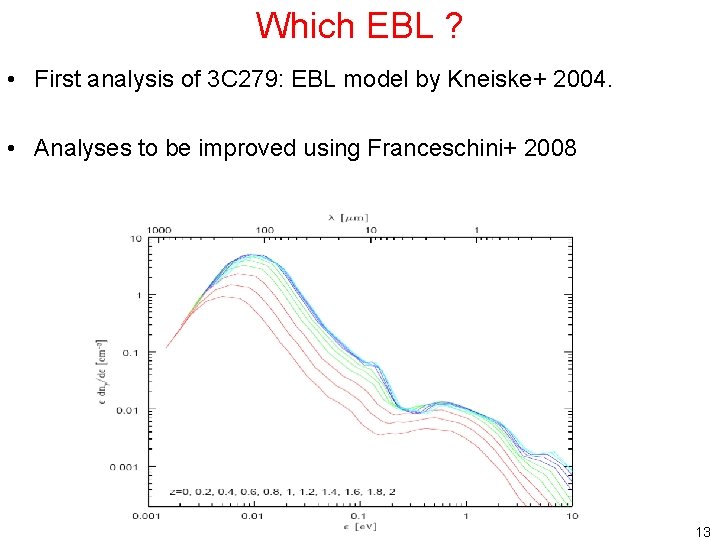
Which EBL ? • First analysis of 3 C 279: EBL model by Kneiske+ 2004. • Analyses to be improved using Franceschini+ 2008 13
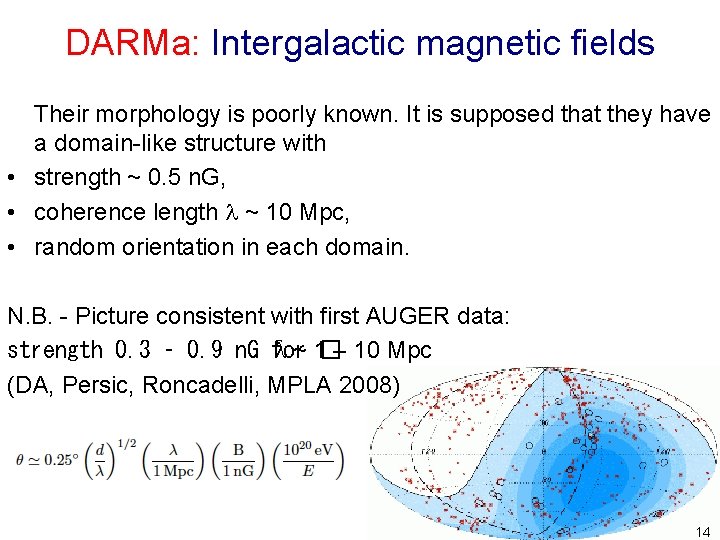
DARMa: Intergalactic magnetic fields Their morphology is poorly known. It is supposed that they have a domain-like structure with • strength ~ 0. 5 n. G, • coherence length l ~ 10 Mpc, • random orientation in each domain. N. B. - Picture consistent with first AUGER data: strength 0. 3 – 0. 9 n. G for l ~ 1�– 10 Mpc (DA, Persic, Roncadelli, MPLA 2008) 14
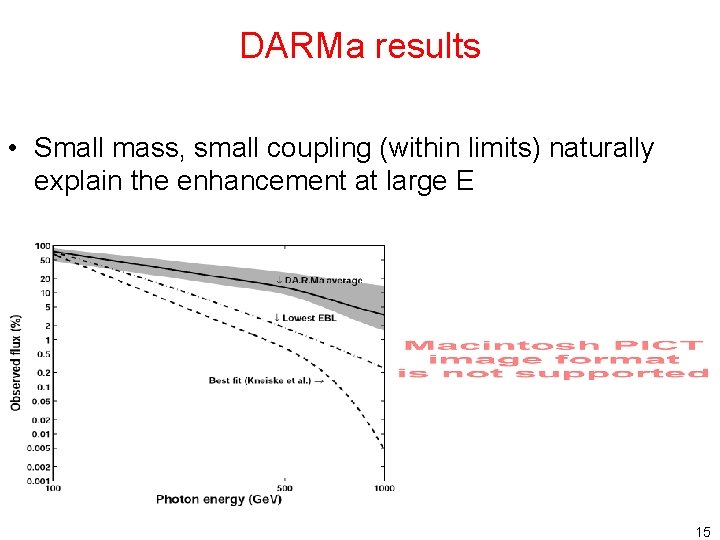
DARMa results • Small mass, small coupling (within limits) naturally explain the enhancement at large E 15
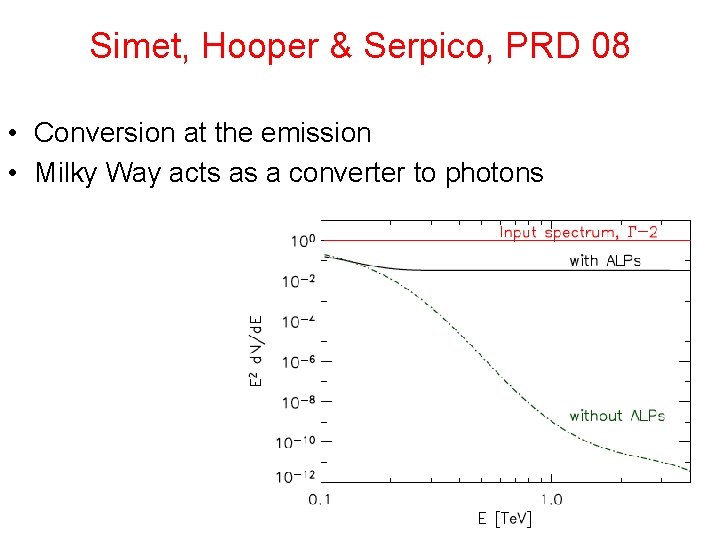
Simet, Hooper & Serpico, PRD 08 • Conversion at the emission • Milky Way acts as a converter to photons 16
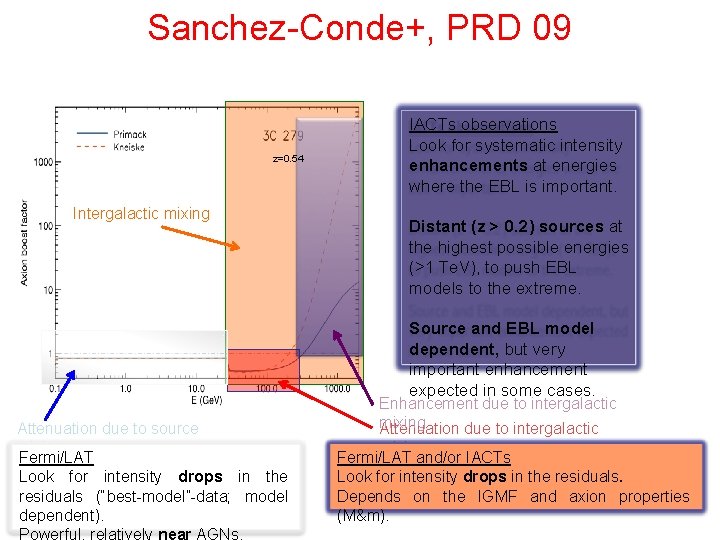
Sanchez-Conde+, PRD 09 z=0. 54 Intergalactic mixing IACTs observations Look for systematic intensity enhancements at energies where the EBL is important. Distant (z > 0. 2) sources at the highest possible energies (>1 Te. V), to push EBL models to the extreme. Source and EBL model dependent, but very important enhancement expected in some cases. Attenuation due to source mixing Fermi/LAT Look for intensity drops in the residuals (“best-model”-data; model dependent). Powerful, relatively near AGNs. Enhancement due to intergalactic mixing Attenuation due to intergalactic mixing Fermi/LAT and/or IACTs Look for intensity drops in the residuals. Depends on the IGMF and axion properties (M&m).
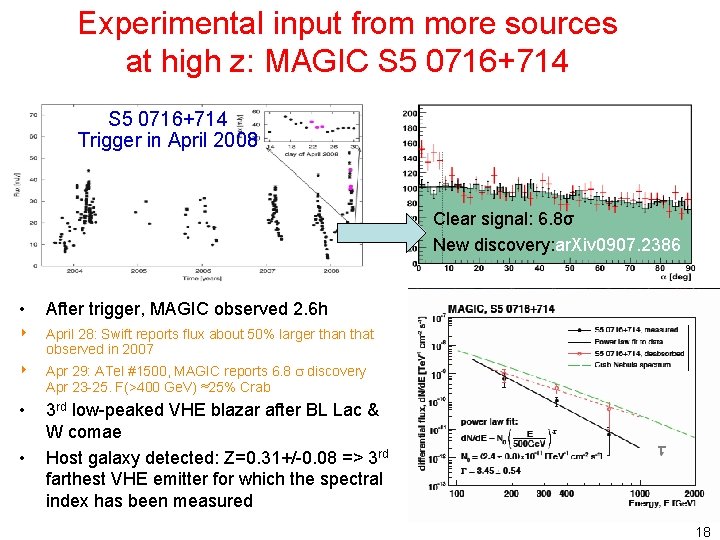
Experimental input from more sources at high z: MAGIC S 5 0716+714 Trigger in April 2008 Clear signal: 6. 8σ New discovery: ar. Xiv 0907. 2386 • After trigger, MAGIC observed 2. 6 h ‣ April 28: Swift reports flux about 50% larger than that observed in 2007 ‣ Apr 29: ATel #1500, MAGIC reports 6. 8 s discovery Apr 23 -25. F(>400 Ge. V) ≈25% Crab • 3 rd low-peaked VHE blazar after BL Lac & W comae Host galaxy detected: Z=0. 31+/-0. 08 => 3 rd farthest VHE emitter for which the spectral index has been measured • 18
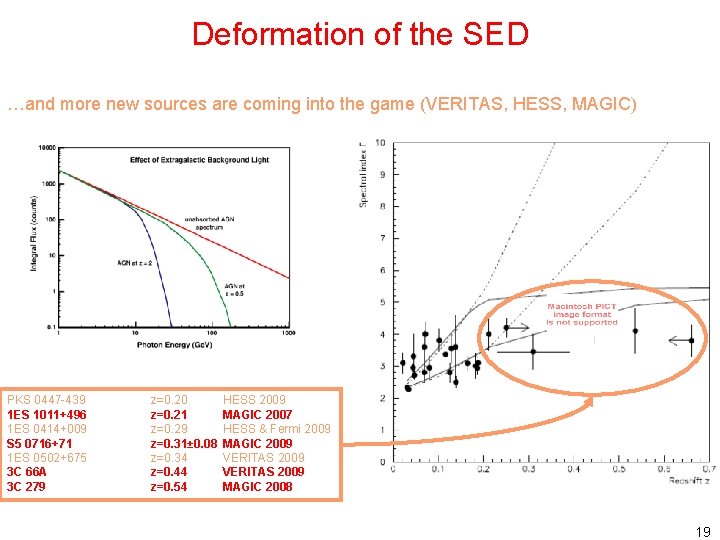
Deformation of the SED …and more new sources are coming into the game (VERITAS, HESS, MAGIC) PKS 0447 -439 1 ES 1011+496 1 ES 0414+009 S 5 0716+71 1 ES 0502+675 3 C 66 A 3 C 279 z=0. 20 z=0. 21 z=0. 29 z=0. 31± 0. 08 z=0. 34 z=0. 44 z=0. 54 HESS 2009 MAGIC 2007 HESS & Fermi 2009 MAGIC 2009 VERITAS 2009 MAGIC 2008 19
Did we already see axions? • Recent gamma observations might already pose substantial challenges to the conventional models to explain the observed source spectra and/or EBL density. – MAGIC 3 C 279 at z=0. 54; VERITAS recent detection above 0. 1 Te. V from 3 C 66 A (z=0. 44). EBL-corrected spectrum harder than 1. 5 (Acciari+09); … • Te. V photons coming from 3 C 66 A? (Neshpor+98; Stepanyan+02). Difficult to explain with conventional EBL and physics. – The lower limit on the EBL at 3. 6 mm was recently revised upwards by a factor ∼ 2, suggesting a more opaque universe (Levenson+08). – Some sources at z = 0. 1 − 0. 2 seem to have harder intrinsic energy spectra than previously anticipated (Krennrich+08). – Spectral indices don’t grow with increasing distance. • While it is still possible, although difficult, to explain the above points with conventional physics, the axion/photon oscillation would naturally explain these puzzles: – More high energy photons than expected – Softer unfolded intrinsic spectrum when including axions Extraordinary claims require extraordinary evidence 20
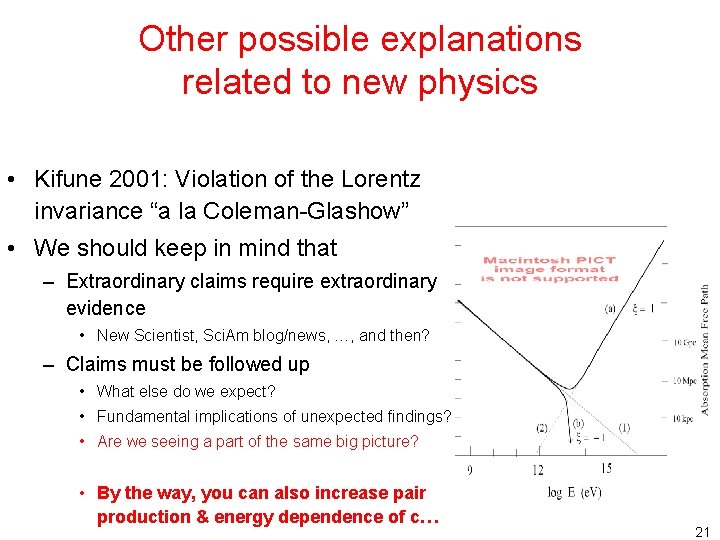
Other possible explanations related to new physics • Kifune 2001: Violation of the Lorentz invariance “a la Coleman-Glashow” • We should keep in mind that – Extraordinary claims require extraordinary evidence • New Scientist, Sci. Am blog/news, …, and then? – Claims must be followed up • What else do we expect? • Fundamental implications of unexpected findings? • Are we seeing a part of the same big picture? • By the way, you can also increase pair production & energy dependence of c… 21
Conclusions • The existence of a very light ALP, predicted by many extensions of the SM, naturally explains the observed transparency of the VHE gamma-ray sky – As a bonus, it explains why only the most distant AGN seem to demand an unconventional emission spectrum • The DARMa prediction, in particular, concerns the spectral change of observed AGN flux at VHE • The constraints impose a very light mass (m << 10 -10 e. V) and a small coupling (~1011 Ge. V). Incompatible w/ the standard axion. – Required magnetic fields for the conversion: OK • More data on distant AGN will tell 22
Appendix: some recent MAGIC results on DM annihilations into photons • d. SPHs – Draco Ap. J 08: 8 h of observation, no signal – Willman I Apj 09: 16 h of observation, no signal Boost factors ~ 103 – 105 needed • Segue I globular cluster: 30 h observation, results soon • Clusters – Perseus Ap. J 10: 24 h of observation, no signal, boost ~104 • Substantial improvement (sensitivity, E resolution, angular resolution) expected for MAGIC in phase II 23
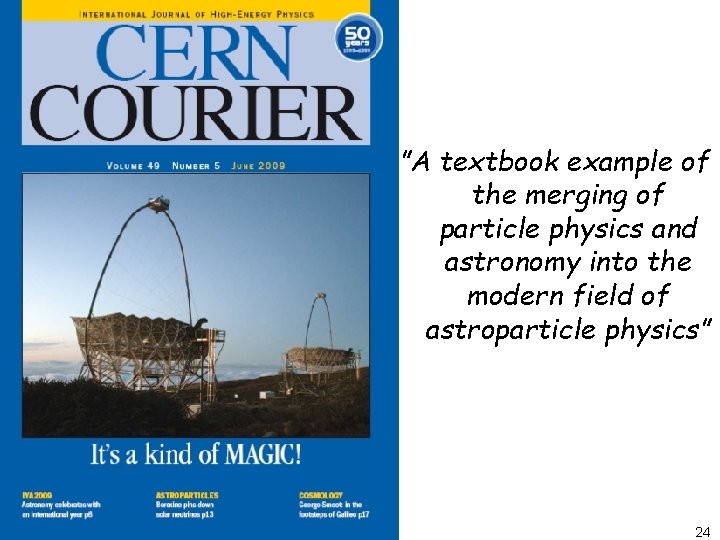
”A textbook example of the merging of particle physics and astronomy into the modern field of astroparticle physics” 24

BACKUP 25
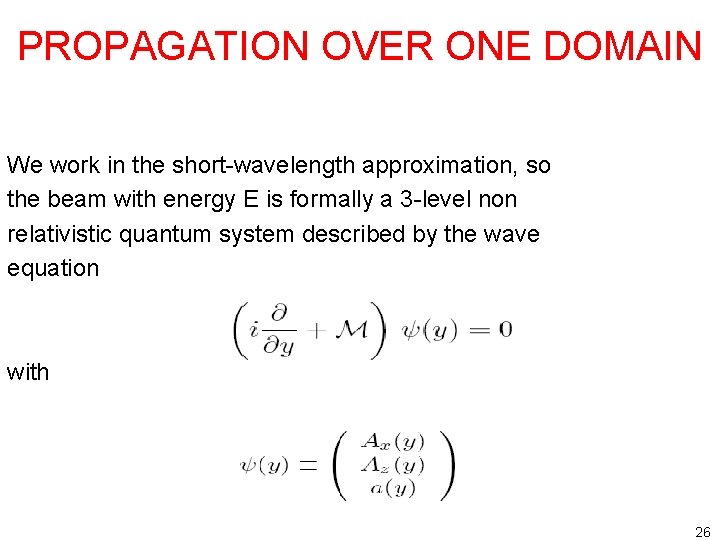
PROPAGATION OVER ONE DOMAIN We work in the short-wavelength approximation, so the beam with energy E is formally a 3 -level non relativistic quantum system described by the wave equation with 26
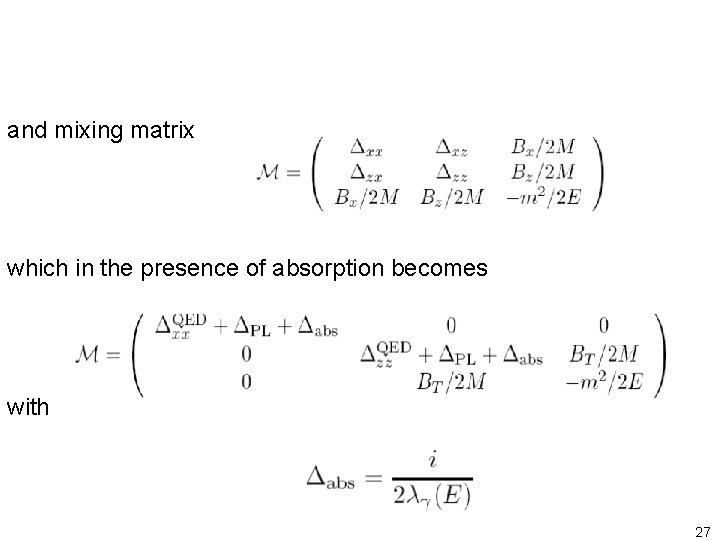
and mixing matrix which in the presence of absorption becomes with 27
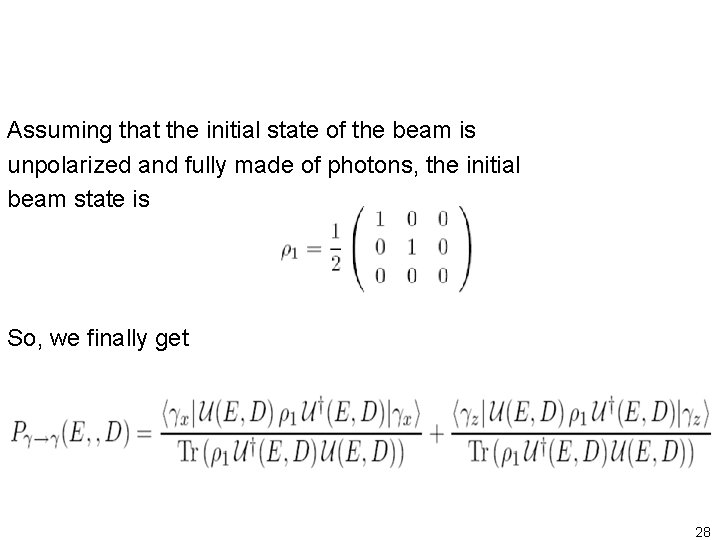
Assuming that the initial state of the beam is unpolarized and fully made of photons, the initial beam state is So, we finally get 28
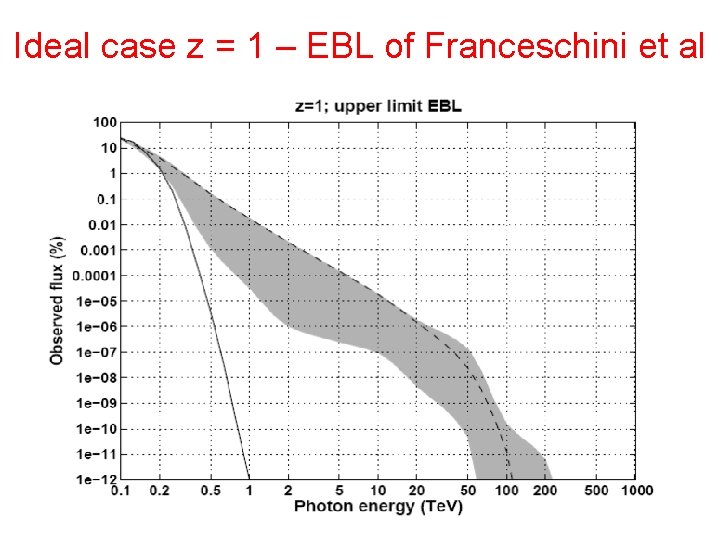
Ideal case z = 1 – EBL of Franceschini et al 29
- Slides: 29