
Experimental Axion Review Igor G Irastorza Universidad de

- Slides: 42
Experimental Axion Review Igor G. Irastorza Universidad de Zaragoza EPS Conference of High Energy Physics, Venice, Italy 7 July 2017
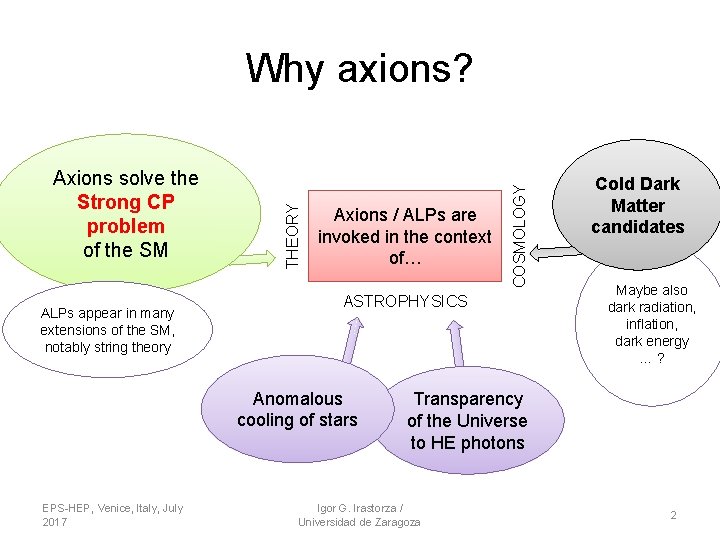
ALPs appear in many extensions of the SM, notably string theory Axions / ALPs are invoked in the context of… ASTROPHYSICS Anomalous cooling of stars EPS-HEP, Venice, Italy, July 2017 COSMOLOGY Axions solve the Strong CP problem of the SM THEORY Why axions? Cold Dark Matter candidates Maybe also dark radiation, inflation, dark energy …? Transparency of the Universe to HE photons Igor G. Irastorza / Universidad de Zaragoza 2
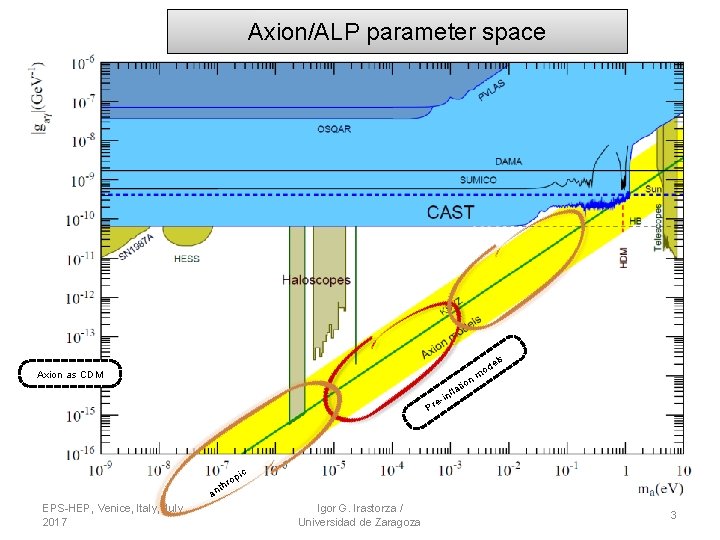
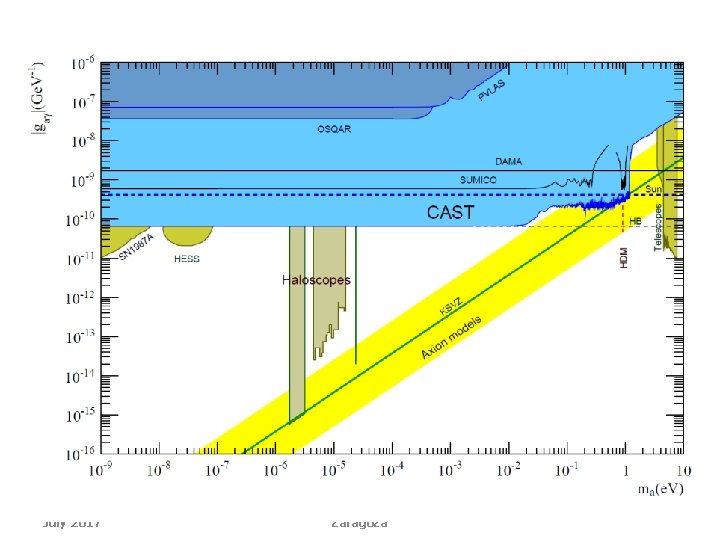
Axion/ALP parameter space els Axion as CDM ion lat inf d mo e- Pr ic op thr an EPS-HEP, Venice, Italy, July 2017 Igor G. Irastorza / Universidad de Zaragoza 3
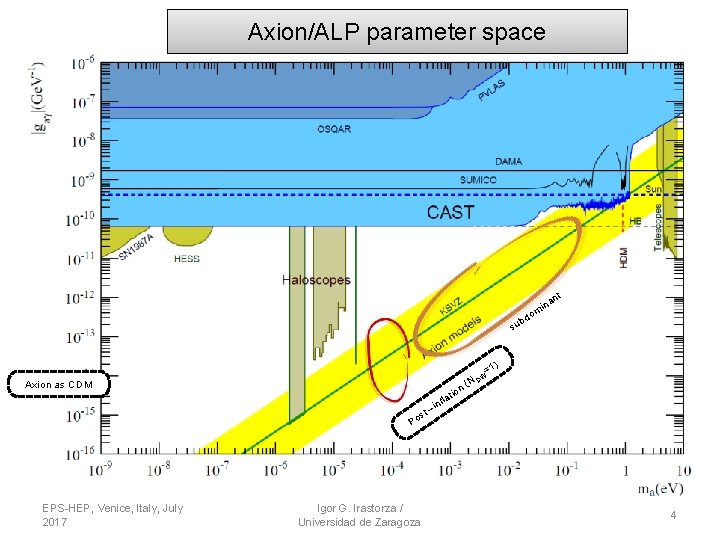
Axion/ALP parameter space nt o bd su na mi ) W Axion as CDM s Po EPS-HEP, Venice, Italy, July 2017 =1 Igor G. Irastorza / Universidad de Zaragoza in t– n tio (N D fla 4
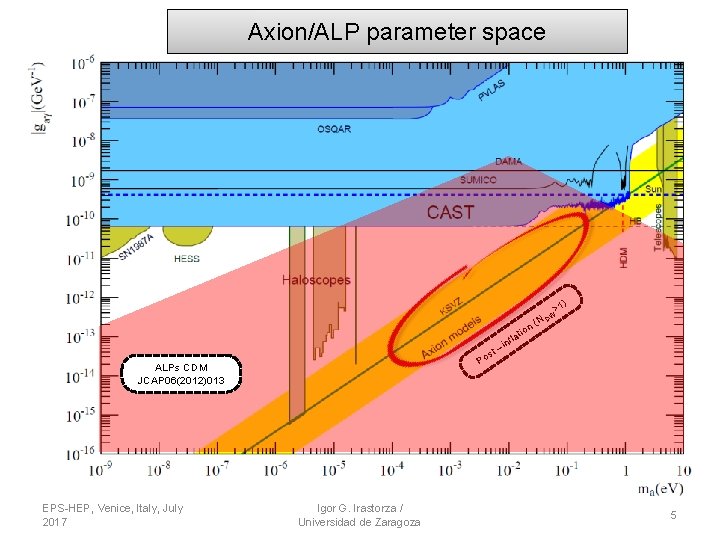
Axion/ALP parameter space N n( Po ALPs CDM JCAP 06(2012)013 EPS-HEP, Venice, Italy, July 2017 Igor G. Irastorza / Universidad de Zaragoza – st ) >1 DW io lat inf 5
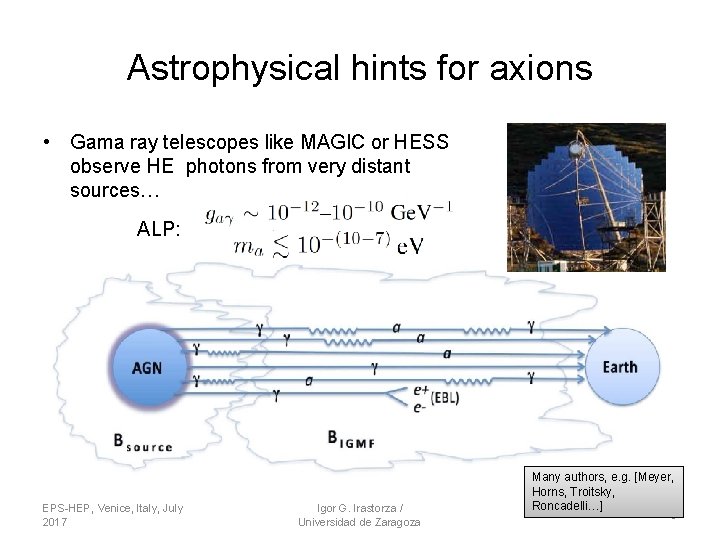
Astrophysical hints for axions • Gama ray telescopes like MAGIC or HESS observe HE photons from very distant sources… ALP: EPS-HEP, Venice, Italy, July 2017 Igor G. Irastorza / Universidad de Zaragoza Many authors, e. g. [Meyer, Horns, Troitsky, Roncadelli…] 6
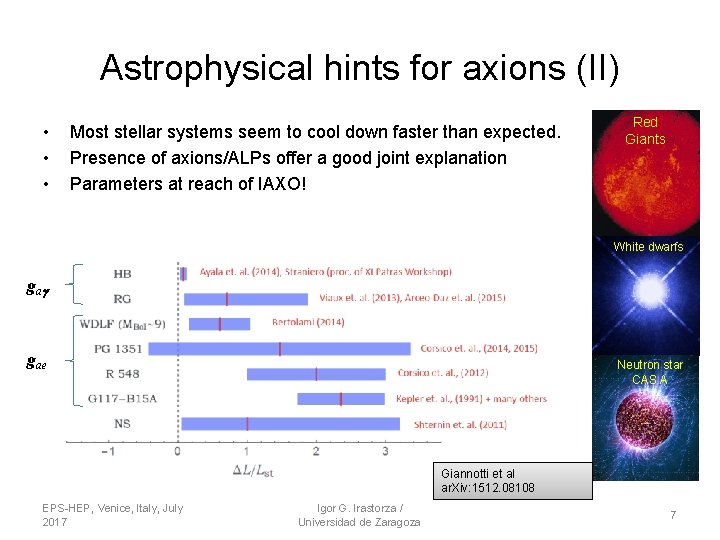
Astrophysical hints for axions (II) • • • Most stellar systems seem to cool down faster than expected. Presence of axions/ALPs offer a good joint explanation Parameters at reach of IAXO! Red Giants White dwarfs gag gae Neutron star CAS A Giannotti et al ar. Xiv: 1512. 08108 EPS-HEP, Venice, Italy, July 2017 Igor G. Irastorza / Universidad de Zaragoza 7
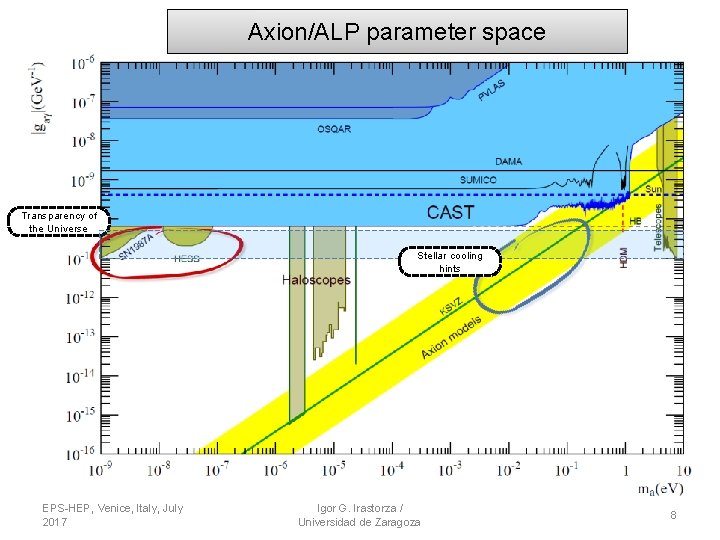
Axion/ALP parameter space Transparency of the Universe Stellar cooling hints EPS-HEP, Venice, Italy, July 2017 Igor G. Irastorza / Universidad de Zaragoza 8
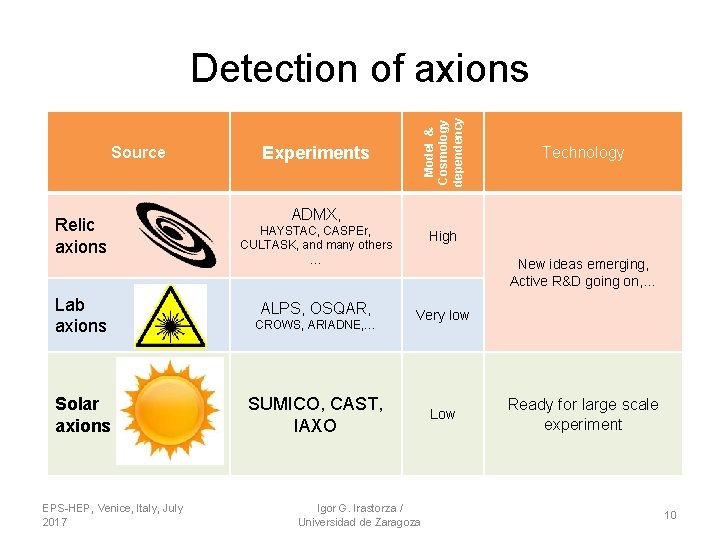
Detection of axions n Axion – photon coupling generically present in every axion model. Axion-photon conversion in the presence of an electromagnetic field (Primakoff effect) n Most detection techniques based on the axion-to-photon conversion inside magnets n Other couplings possible, but less generic (model dependent) axion-electron coupling axion-nucleon coupling EPS-HEP, Venice, Italy, July 2017 Igor G. Irastorza / Universidad de Zaragoza 9
Source Relic axions Experiments Technology ADMX, HAYSTAC, CASPEr, CULTASK, and many others … Lab axions CROWS, ARIADNE, … Solar axions SUMICO, CAST, IAXO EPS-HEP, Venice, Italy, July 2017 Model & Cosmology dependency Detection of axions ALPS, OSQAR, High New ideas emerging, Active R&D going on, … Very low Igor G. Irastorza / Universidad de Zaragoza Low Ready for large scale experiment 10
EPS-HEP, Venice, Italy, July 2017 Igor G. Irastorza / Universidad de Zaragoza 11
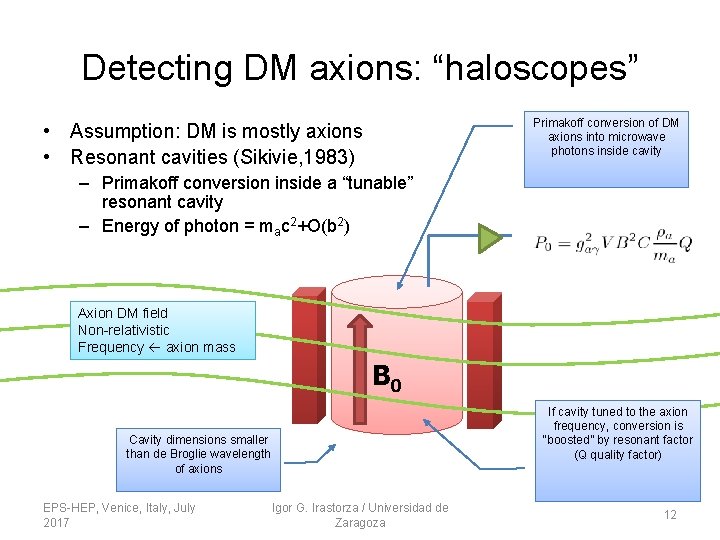
Detecting DM axions: “haloscopes” Primakoff conversion of DM axions into microwave photons inside cavity • Assumption: DM is mostly axions • Resonant cavities (Sikivie, 1983) – Primakoff conversion inside a “tunable” resonant cavity – Energy of photon = mac 2+O(b 2) Axion DM field Non-relativistic Frequency axion mass B 0 If cavity tuned to the axion frequency, conversion is “boosted” by resonant factor (Q quality factor) Cavity dimensions smaller than de Broglie wavelength of axions EPS-HEP, Venice, Italy, July 2017 Igor G. Irastorza / Universidad de Zaragoza 12
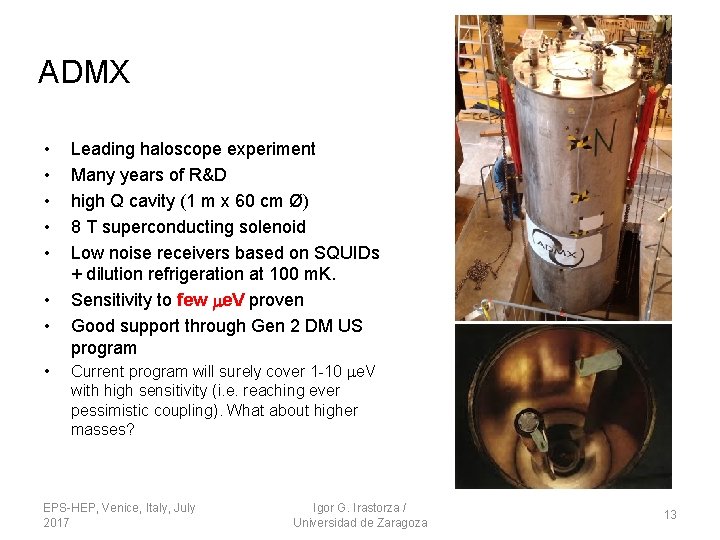
ADMX • • Leading haloscope experiment Many years of R&D high Q cavity (1 m x 60 cm Ø) 8 T superconducting solenoid Low noise receivers based on SQUIDs + dilution refrigeration at 100 m. K. Sensitivity to few me. V proven Good support through Gen 2 DM US program Current program will surely cover 1 -10 me. V with high sensitivity (i. e. reaching ever pessimistic coupling). What about higher masses? EPS-HEP, Venice, Italy, July 2017 Igor G. Irastorza / Universidad de Zaragoza 13
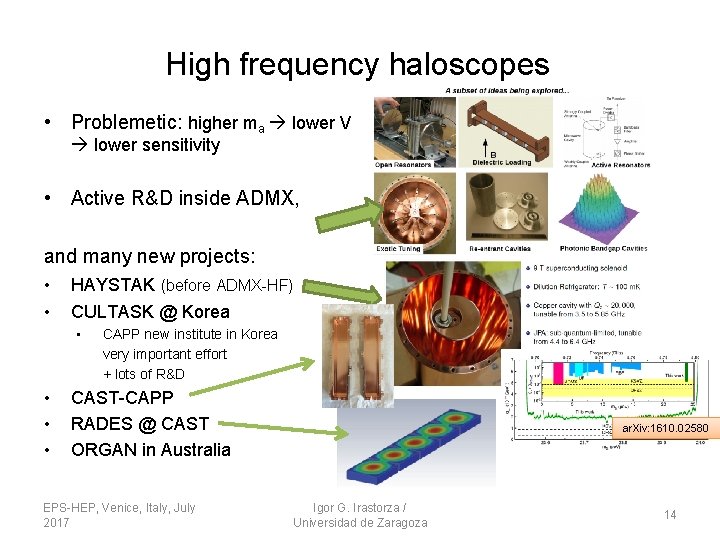
High frequency haloscopes • Problemetic: higher ma lower V lower sensitivity • Active R&D inside ADMX, and many new projects: • • HAYSTAK (before ADMX-HF) CULTASK @ Korea • • CAPP new institute in Korea very important effort + lots of R&D CAST-CAPP RADES @ CAST ORGAN in Australia EPS-HEP, Venice, Italy, July 2017 ar. Xiv: 1610. 02580 Igor G. Irastorza / Universidad de Zaragoza 14
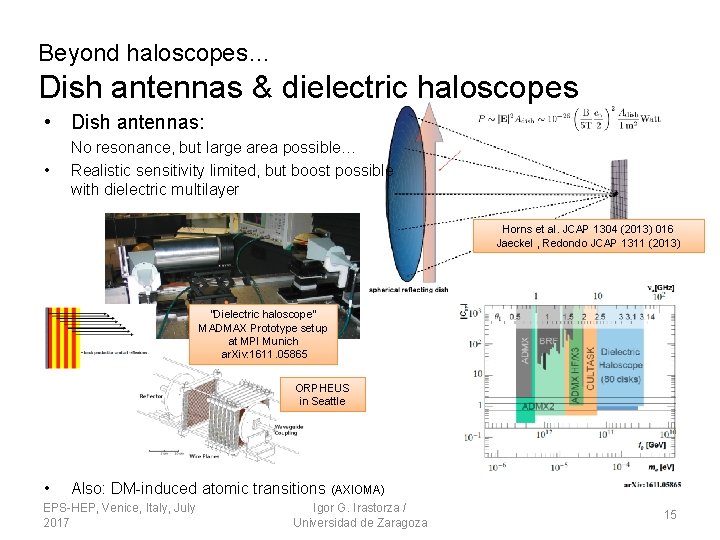
Beyond haloscopes… Dish antennas & dielectric haloscopes • Dish antennas: • No resonance, but large area possible… Realistic sensitivity limited, but boost possible with dielectric multilayer Horns et al. JCAP 1304 (2013) 016 Jaeckel , Redondo JCAP 1311 (2013) “Dielectric haloscope” MADMAX Prototype setup at MPI Munich ar. Xiv: 1611. 05865 ORPHEUS in Seattle • Also: DM-induced atomic transitions (AXIOMA) EPS-HEP, Venice, Italy, July 2017 Igor G. Irastorza / Universidad de Zaragoza 15
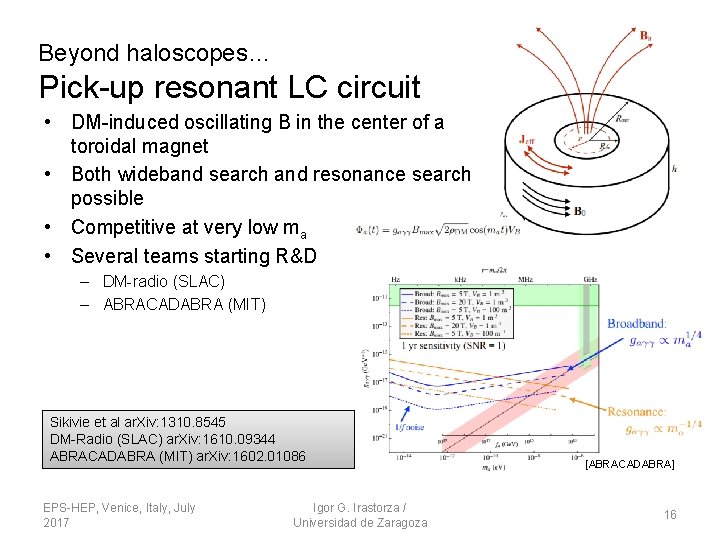
Beyond haloscopes… Pick-up resonant LC circuit • DM-induced oscillating B in the center of a toroidal magnet • Both wideband search and resonance search possible • Competitive at very low ma • Several teams starting R&D – DM-radio (SLAC) – ABRACADABRA (MIT) Sikivie et al ar. Xiv: 1310. 8545 DM-Radio (SLAC) ar. Xiv: 1610. 09344 ABRACADABRA (MIT) ar. Xiv: 1602. 01086 EPS-HEP, Venice, Italy, July 2017 Igor G. Irastorza / Universidad de Zaragoza [ABRACADABRA] 16
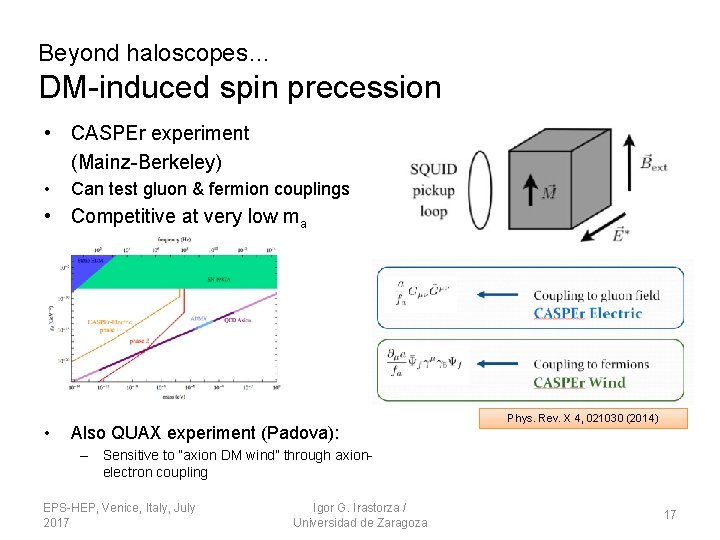
Beyond haloscopes… DM-induced spin precession • CASPEr experiment (Mainz-Berkeley) • Can test gluon & fermion couplings • Competitive at very low ma • Also QUAX experiment (Padova): Phys. Rev. X 4, 021030 (2014) – Sensitive to “axion DM wind” through axionelectron coupling EPS-HEP, Venice, Italy, July 2017 Igor G. Irastorza / Universidad de Zaragoza 17
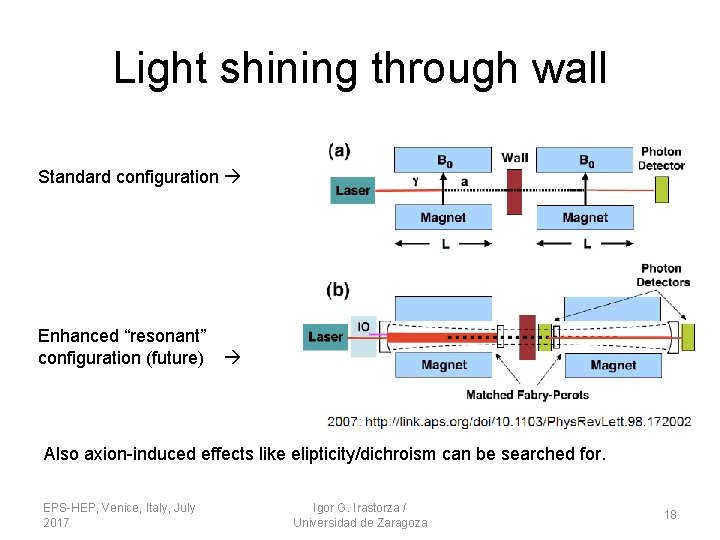
Light shining through wall Standard configuration Enhanced “resonant” configuration (future) Also axion-induced effects like elipticity/dichroism can be searched for. EPS-HEP, Venice, Italy, July 2017 Igor G. Irastorza / Universidad de Zaragoza 18
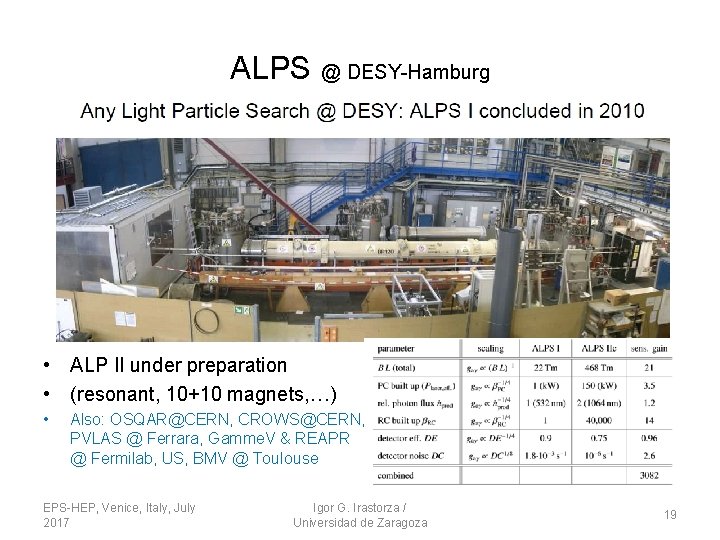
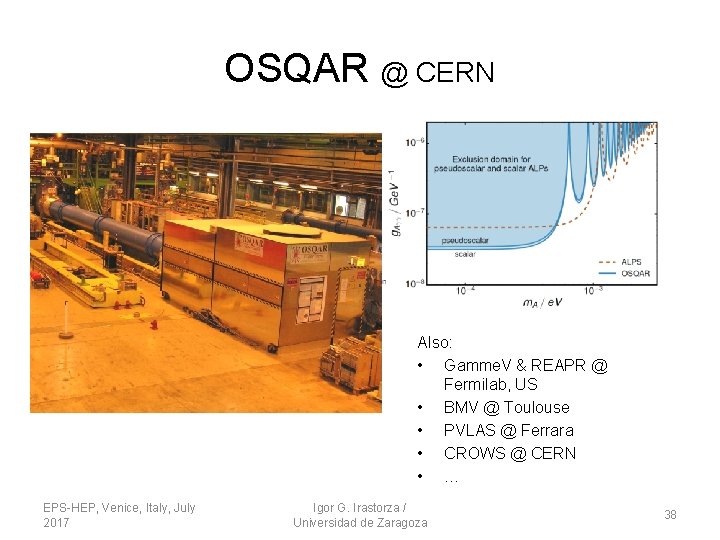
ALPS @ DESY-Hamburg • ALP II under preparation • (resonant, 10+10 magnets, …) • Also: OSQAR@CERN, CROWS@CERN, PVLAS @ Ferrara, Gamme. V & REAPR @ Fermilab, US, BMV @ Toulouse EPS-HEP, Venice, Italy, July 2017 Igor G. Irastorza / Universidad de Zaragoza 19
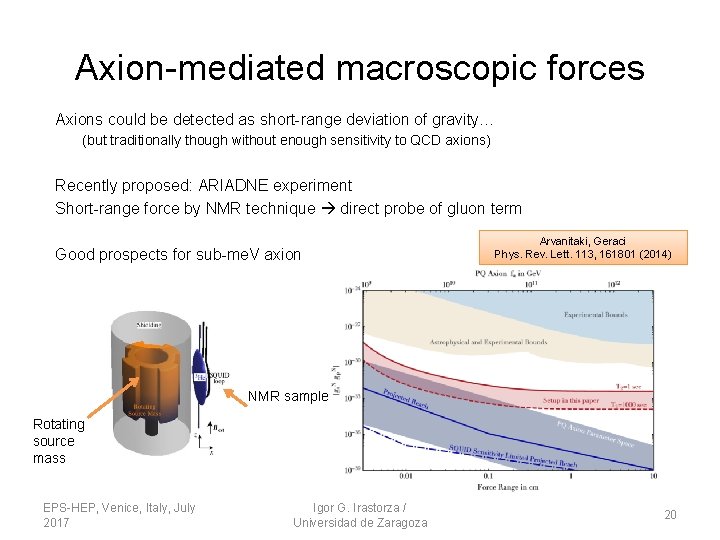
Axion-mediated macroscopic forces Axions could be detected as short-range deviation of gravity… (but traditionally though without enough sensitivity to QCD axions) Recently proposed: ARIADNE experiment Short-range force by NMR technique direct probe of gluon term Good prospects for sub-me. V axion Arvanitaki, Geraci Phys. Rev. Lett. 113, 161801 (2014) NMR sample Rotating source mass EPS-HEP, Venice, Italy, July 2017 Igor G. Irastorza / Universidad de Zaragoza 20
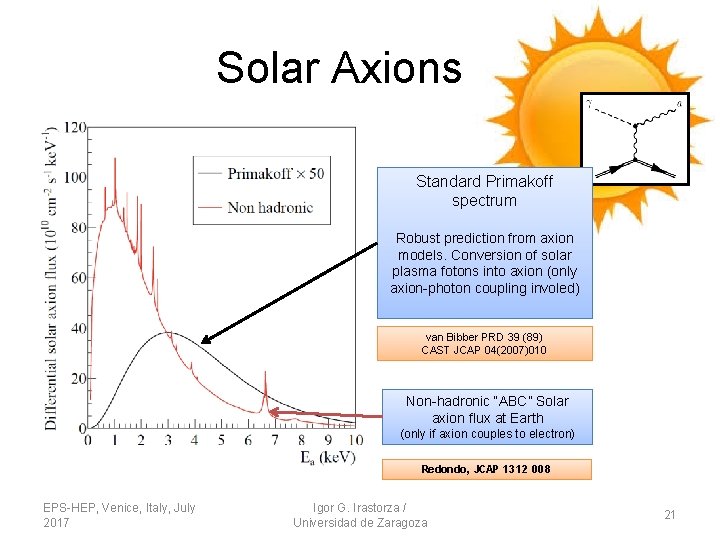
Solar Axions Standard Primakoff spectrum Robust prediction from axion models. Conversion of solar plasma fotons into axion (only axion-photon coupling involed) van Bibber PRD 39 (89) CAST JCAP 04(2007)010 Non-hadronic “ABC” Solar axion flux at Earth (only if axion couples to electron) Redondo, JCAP 1312 008 EPS-HEP, Venice, Italy, July 2017 Igor G. Irastorza / Universidad de Zaragoza 21
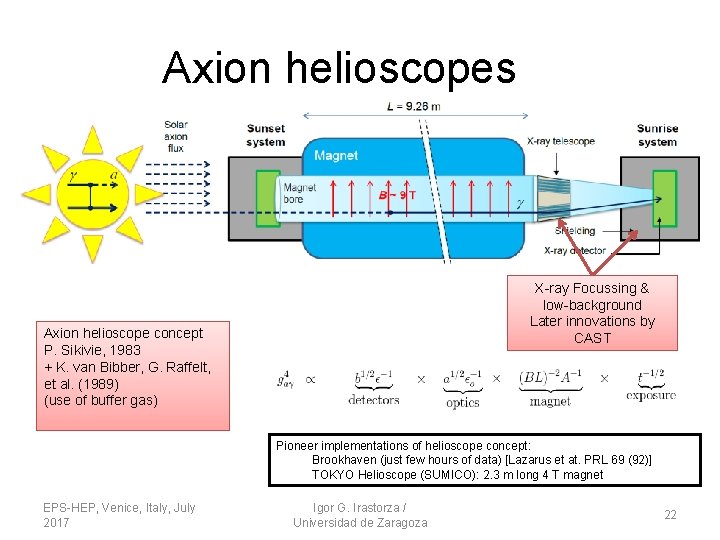
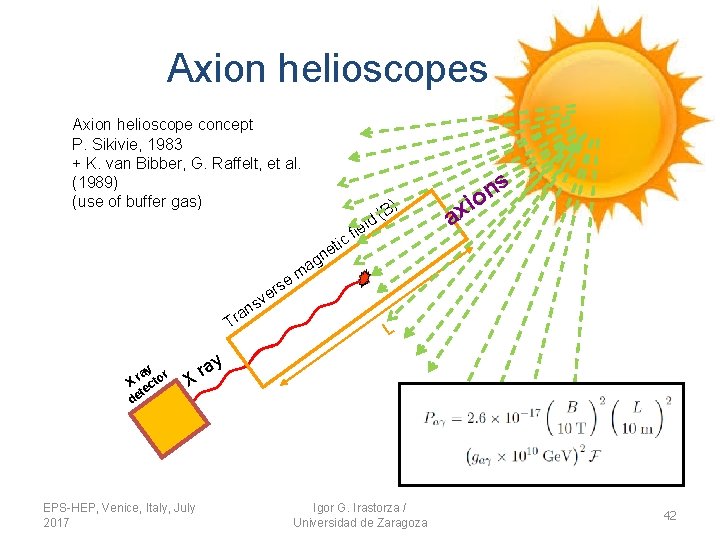
Axion helioscopes X-ray Focussing & low-background Later innovations by CAST Axion helioscope concept P. Sikivie, 1983 + K. van Bibber, G. Raffelt, et al. (1989) (use of buffer gas) Pioneer implementations of helioscope concept: Brookhaven (just few hours of data) [Lazarus et at. PRL 69 (92)] TOKYO Helioscope (SUMICO): 2. 3 m long 4 T magnet EPS-HEP, Venice, Italy, July 2017 Igor G. Irastorza / Universidad de Zaragoza 22
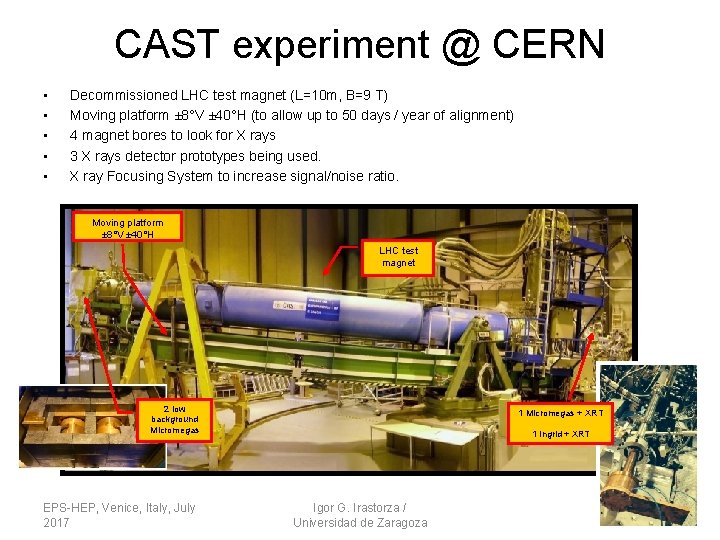
CAST experiment @ CERN • • • Decommissioned LHC test magnet (L=10 m, B=9 T) Moving platform ± 8°V ± 40°H (to allow up to 50 days / year of alignment) 4 magnet bores to look for X rays 3 X rays detector prototypes being used. X ray Focusing System to increase signal/noise ratio. Moving platform ± 8°V ± 40°H LHC test magnet 2 low background Micromegas EPS-HEP, Venice, Italy, July 2017 1 Micromegas + XRT 1 Ingrid + XRT Igor G. Irastorza / Universidad de Zaragoza 23
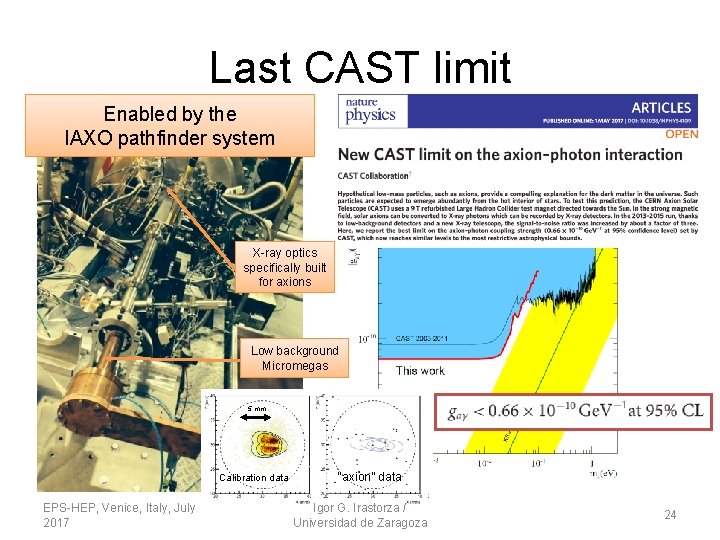
Last CAST limit Enabled by the IAXO pathfinder system X-ray optics specifically built for axions Low background Micromegas 5 mm Calibration data EPS-HEP, Venice, Italy, July 2017 “axion” data Igor G. Irastorza / Universidad de Zaragoza 24
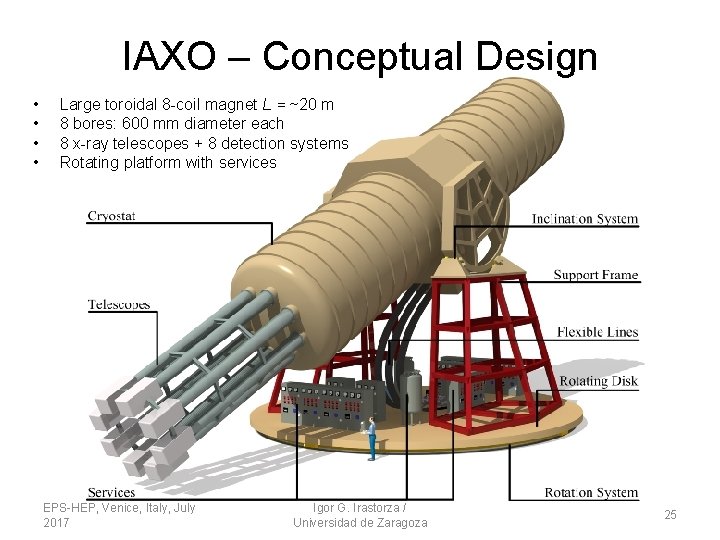
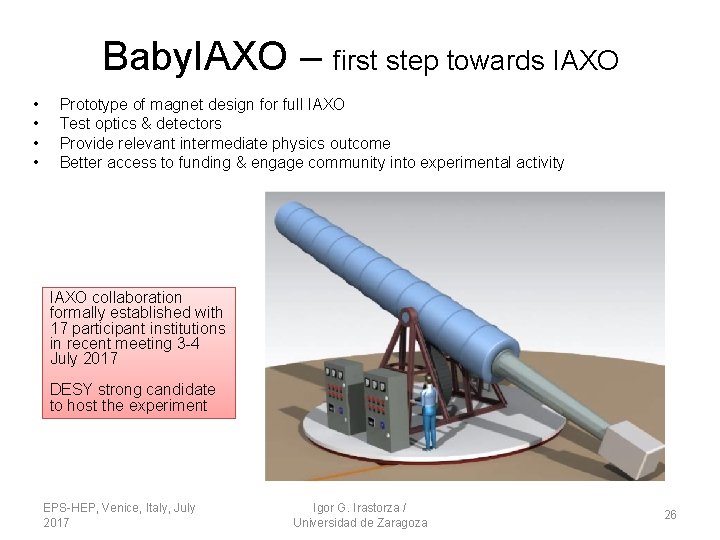
IAXO – Conceptual Design • • Large toroidal 8 -coil magnet L = ~20 m 8 bores: 600 mm diameter each 8 x-ray telescopes + 8 detection systems Rotating platform with services EPS-HEP, Venice, Italy, July 2017 Igor G. Irastorza / Universidad de Zaragoza 25
Baby. IAXO – first step towards IAXO • • Prototype of magnet design for full IAXO Test optics & detectors Provide relevant intermediate physics outcome Better access to funding & engage community into experimental activity IAXO collaboration formally established with 17 participant institutions in recent meeting 3 -4 July 2017 DESY strong candidate to host the experiment EPS-HEP, Venice, Italy, July 2017 Igor G. Irastorza / Universidad de Zaragoza 26
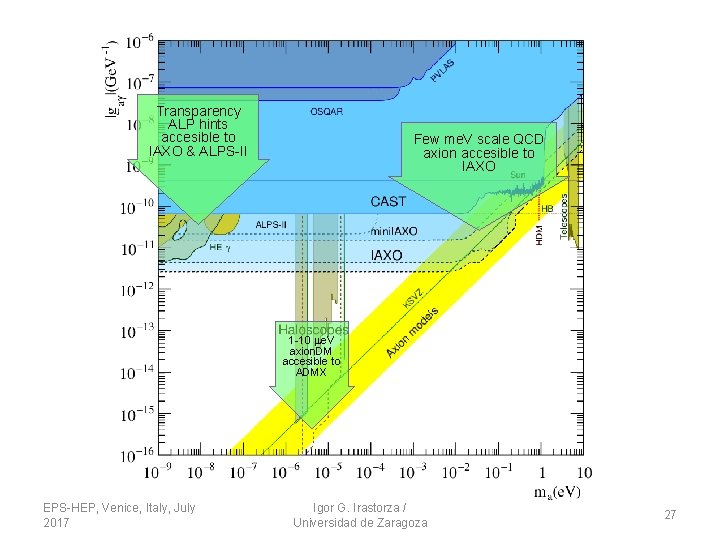
Transparency ALP hints accesible to IAXO & ALPS-II Few me. V scale QCD axion accesible to IAXO 1 -10 me. V axion. DM accesible to ADMX EPS-HEP, Venice, Italy, July 2017 Igor G. Irastorza / Universidad de Zaragoza 27
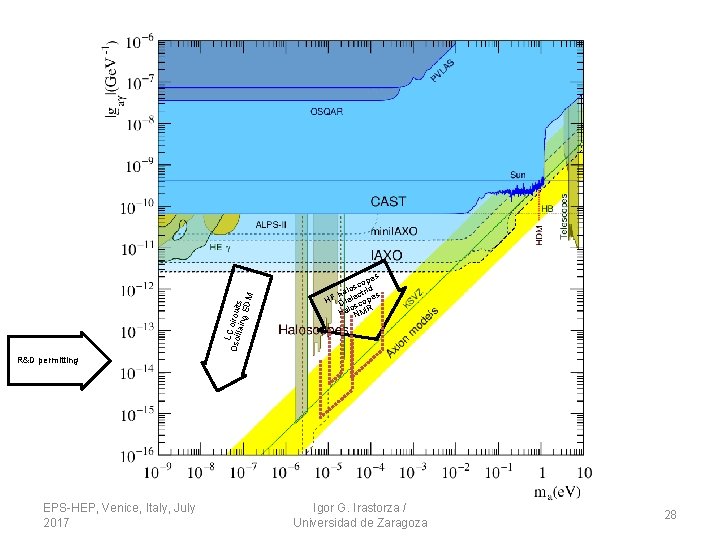
L Osc C circuit illain s g ED M s ope c s o d hal ctri s HF Diele cope os hal NMR R&D permitting EPS-HEP, Venice, Italy, July 2017 Igor G. Irastorza / Universidad de Zaragoza 28
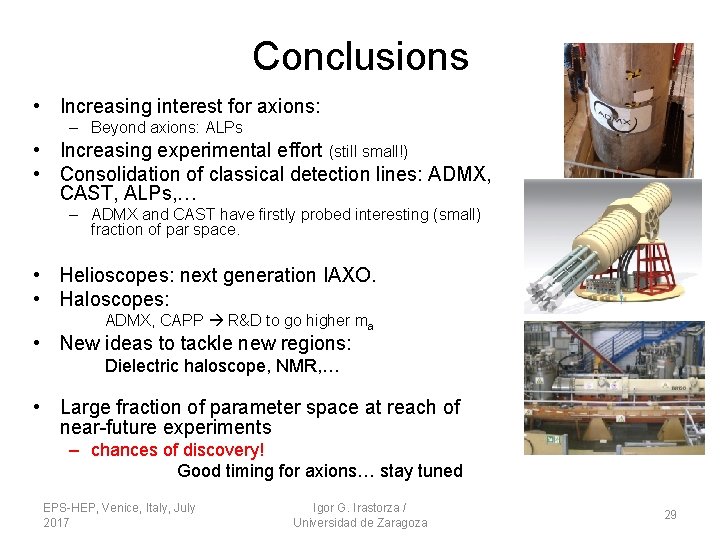
Conclusions • Increasing interest for axions: – Beyond axions: ALPs • Increasing experimental effort (still small!) • Consolidation of classical detection lines: ADMX, CAST, ALPs, … – ADMX and CAST have firstly probed interesting (small) fraction of par space. • Helioscopes: next generation IAXO. • Haloscopes: ADMX, CAPP R&D to go higher ma • New ideas to tackle new regions: Dielectric haloscope, NMR, … • Large fraction of parameter space at reach of near-future experiments – chances of discovery! Good timing for axions… stay tuned EPS-HEP, Venice, Italy, July 2017 Igor G. Irastorza / Universidad de Zaragoza 29
Backup slides… EPS-HEP, Venice, Italy, July 2017 Igor G. Irastorza / Universidad de Zaragoza 30
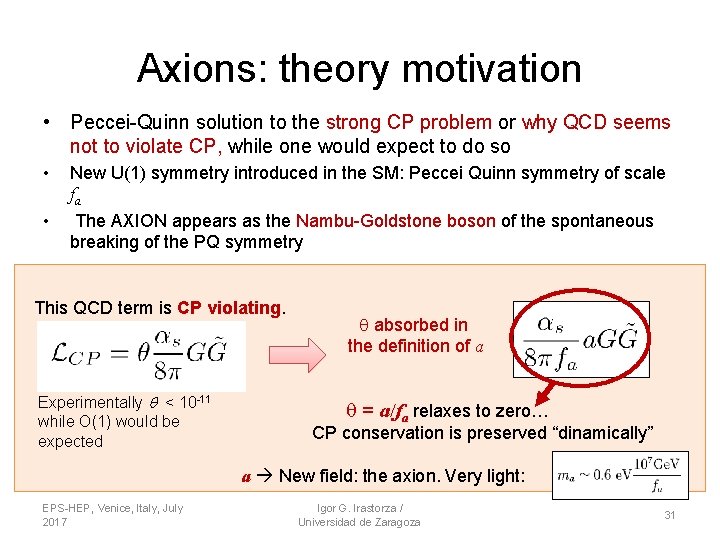
Axions: theory motivation • Peccei-Quinn solution to the strong CP problem or why QCD seems not to violate CP, while one would expect to do so • • New U(1) symmetry introduced in the SM: Peccei Quinn symmetry of scale fa The AXION appears as the Nambu-Goldstone boson of the spontaneous breaking of the PQ symmetry This QCD term is CP violating. Experimentally q < 10 -11 while O(1) would be expected q absorbed in the definition of a q = a/fa relaxes to zero… CP conservation is preserved “dinamically” a New field: the axion. Very light: EPS-HEP, Venice, Italy, July 2017 Igor G. Irastorza / Universidad de Zaragoza 31
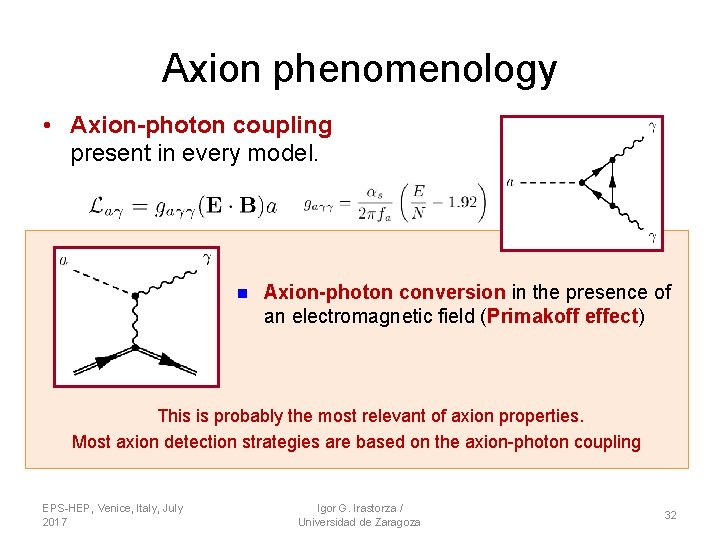
Axion phenomenology • Axion-photon coupling present in every model. n Axion-photon conversion in the presence of an electromagnetic field (Primakoff effect) This is probably the most relevant of axion properties. Most axion detection strategies are based on the axion-photon coupling EPS-HEP, Venice, Italy, July 2017 Igor G. Irastorza / Universidad de Zaragoza 32
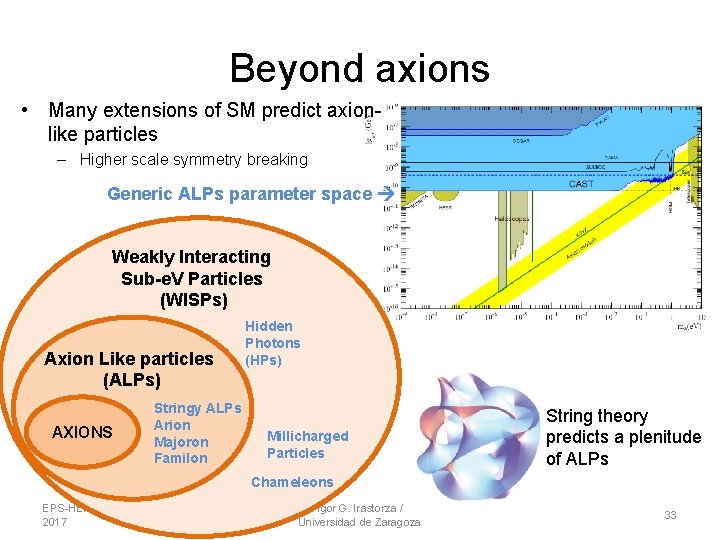
Beyond axions • Many extensions of SM predict axionlike particles – Higher scale symmetry breaking Generic ALPs parameter space Weakly Interacting Sub-e. V Particles (WISPs) Axion Like particles (ALPs) AXIONS Stringy ALPs Arion Majoron Familon Hidden Photons (HPs) Millicharged Particles String theory predicts a plenitude of ALPs Chameleons EPS-HEP, Venice, Italy, July 2017 Igor G. Irastorza / Universidad de Zaragoza 33
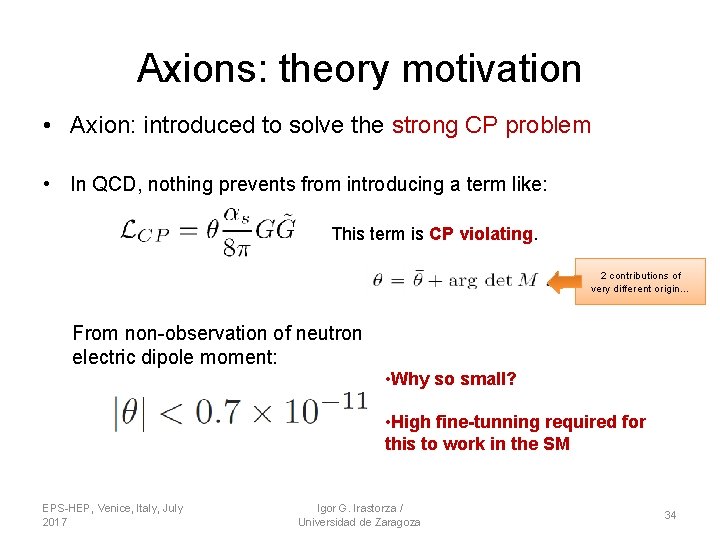
Axions: theory motivation • Axion: introduced to solve the strong CP problem • In QCD, nothing prevents from introducing a term like: This term is CP violating. 2 contributions of very different origin… From non-observation of neutron electric dipole moment: • Why so small? • High fine-tunning required for this to work in the SM EPS-HEP, Venice, Italy, July 2017 Igor G. Irastorza / Universidad de Zaragoza 34
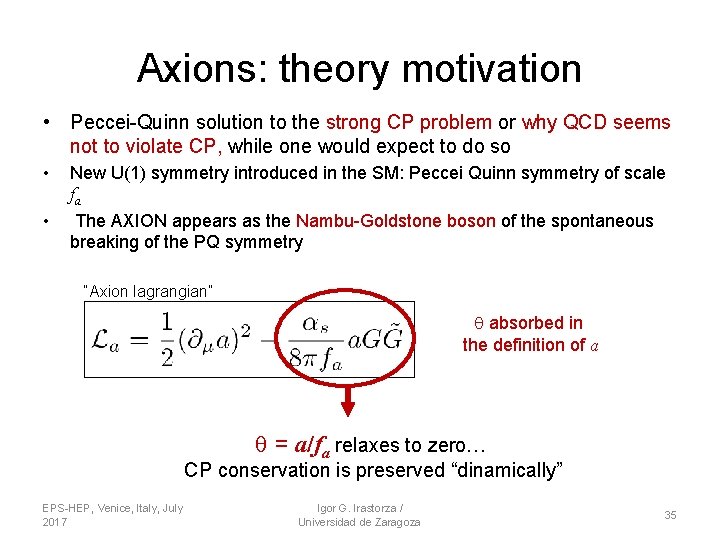
Axions: theory motivation • Peccei-Quinn solution to the strong CP problem or why QCD seems not to violate CP, while one would expect to do so • • New U(1) symmetry introduced in the SM: Peccei Quinn symmetry of scale fa The AXION appears as the Nambu-Goldstone boson of the spontaneous breaking of the PQ symmetry “Axion lagrangian” q absorbed in the definition of a q = a/fa relaxes to zero… CP conservation is preserved “dinamically” EPS-HEP, Venice, Italy, July 2017 Igor G. Irastorza / Universidad de Zaragoza 35
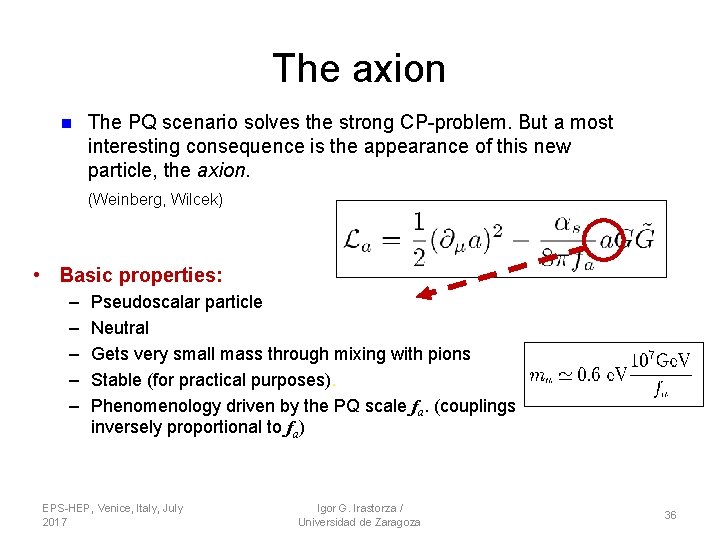
The axion n The PQ scenario solves the strong CP-problem. But a most interesting consequence is the appearance of this new particle, the axion. (Weinberg, Wilcek) • Basic properties: – – – Pseudoscalar particle Neutral Gets very small mass through mixing with pions Stable (for practical purposes). Phenomenology driven by the PQ scale fa. (couplings inversely proportional to fa) EPS-HEP, Venice, Italy, July 2017 Igor G. Irastorza / Universidad de Zaragoza 36
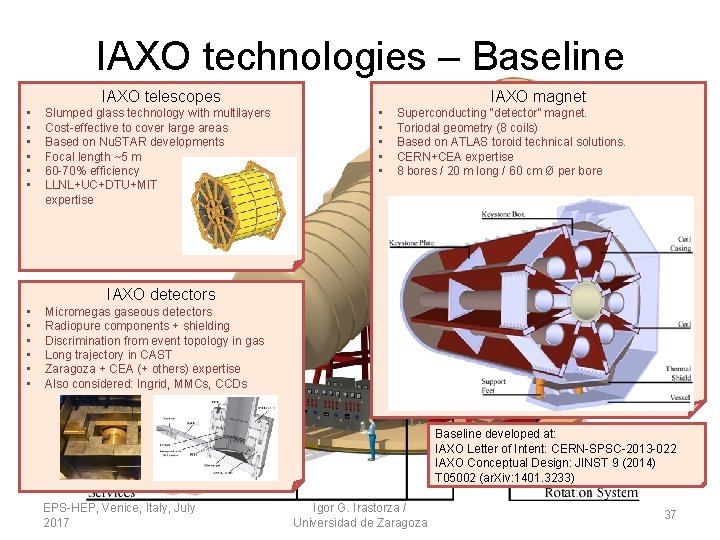
IAXO technologies – Baseline IAXO telescopes • • • Slumped glass technology with multilayers Cost-effective to cover large areas Based on Nu. STAR developments Focal length ~5 m 60 -70% efficiency LLNL+UC+DTU+MIT expertise • • • Micromegas gaseous detectors Radiopure components + shielding Discrimination from event topology in gas Long trajectory in CAST Zaragoza + CEA (+ others) expertise Also considered: Ingrid, MMCs, CCDs IAXO magnet • • • Superconducting “detector” magnet. Toriodal geometry (8 coils) Based on ATLAS toroid technical solutions. CERN+CEA expertise 8 bores / 20 m long / 60 cm Ø per bore IAXO detectors Baseline developed at: IAXO Letter of Intent: CERN-SPSC-2013 -022 IAXO Conceptual Design: JINST 9 (2014) T 05002 (ar. Xiv: 1401. 3233) EPS-HEP, Venice, Italy, July 2017 Igor G. Irastorza / Universidad de Zaragoza 37
OSQAR @ CERN Also: • Gamme. V & REAPR @ Fermilab, US • BMV @ Toulouse • PVLAS @ Ferrara • CROWS @ CERN • … EPS-HEP, Venice, Italy, July 2017 Igor G. Irastorza / Universidad de Zaragoza 38
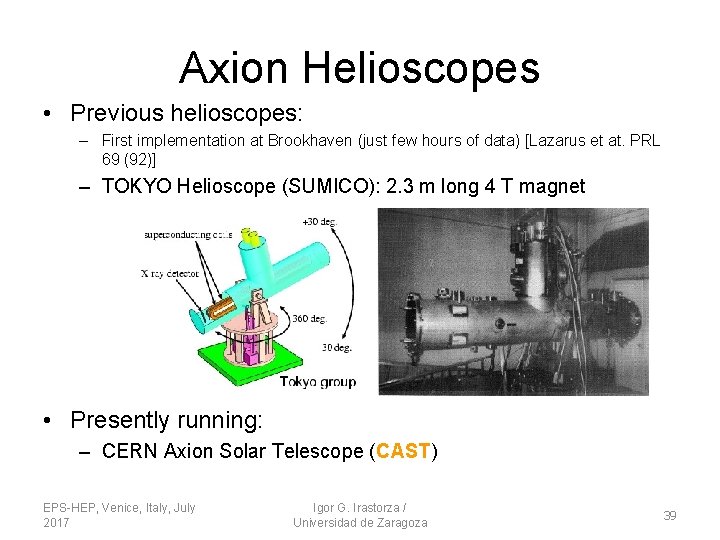
Axion Helioscopes • Previous helioscopes: – First implementation at Brookhaven (just few hours of data) [Lazarus et at. PRL 69 (92)] – TOKYO Helioscope (SUMICO): 2. 3 m long 4 T magnet • Presently running: – CERN Axion Solar Telescope (CAST) EPS-HEP, Venice, Italy, July 2017 Igor G. Irastorza / Universidad de Zaragoza 39
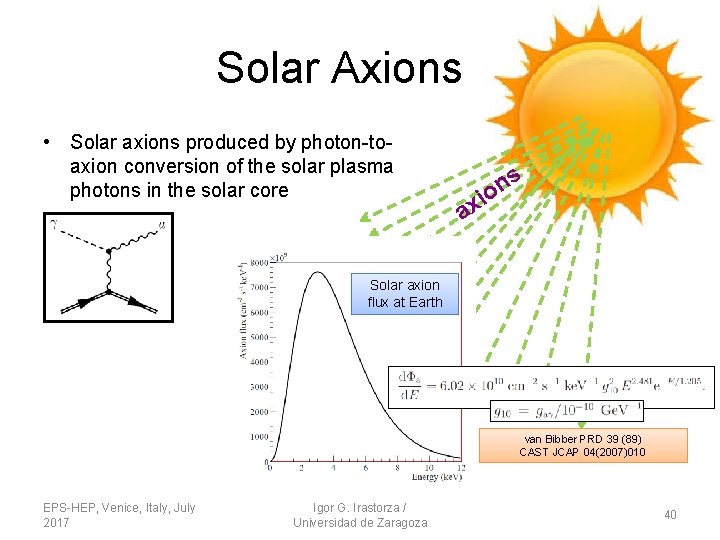
Solar Axions • Solar axions produced by photon-toaxion conversion of the solar plasma photons in the solar core a s n xio Solar axion flux at Earth van Bibber PRD 39 (89) CAST JCAP 04(2007)010 EPS-HEP, Venice, Italy, July 2017 Igor G. Irastorza / Universidad de Zaragoza 40
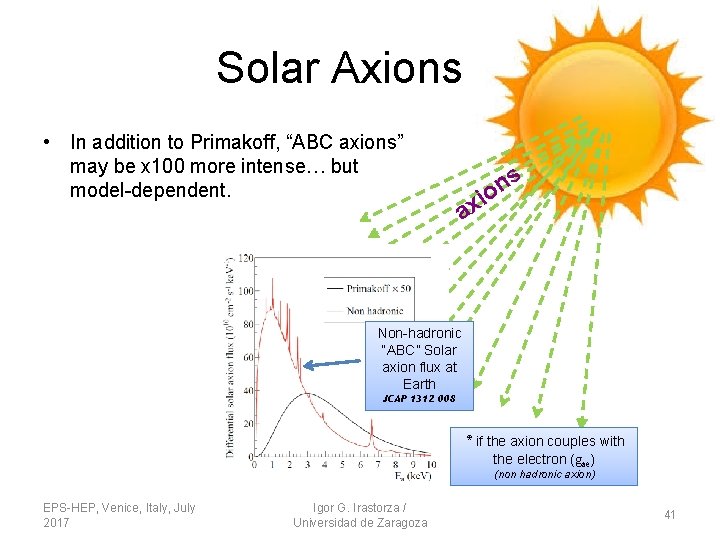
Solar Axions • In addition to Primakoff, “ABC axions” may be x 100 more intense… but model-dependent. a s n xio Non-hadronic “ABC” Solar axion flux at Earth JCAP 1312 008 * if the axion couples with the electron (gae) (non hadronic axion) EPS-HEP, Venice, Italy, July 2017 Igor G. Irastorza / Universidad de Zaragoza 41
Axion helioscopes Axion helioscope concept P. Sikivie, 1983 + K. van Bibber, G. Raffelt, et al. (1989) (use of buffer gas) B) ( d iel f c a s n xio ti y ra r X ecto t de X EPS-HEP, Venice, Italy, July 2017 s r ve ns a Tr a m e e gn L y ra Igor G. Irastorza / Universidad de Zaragoza 42