CPSC 503 Computational Linguistics Lecture 6 Giuseppe Carenini
- Slides: 43
CPSC 503 Computational Linguistics Lecture 6 Giuseppe Carenini 3/7/2021 CPSC 503 Winter 2012 1
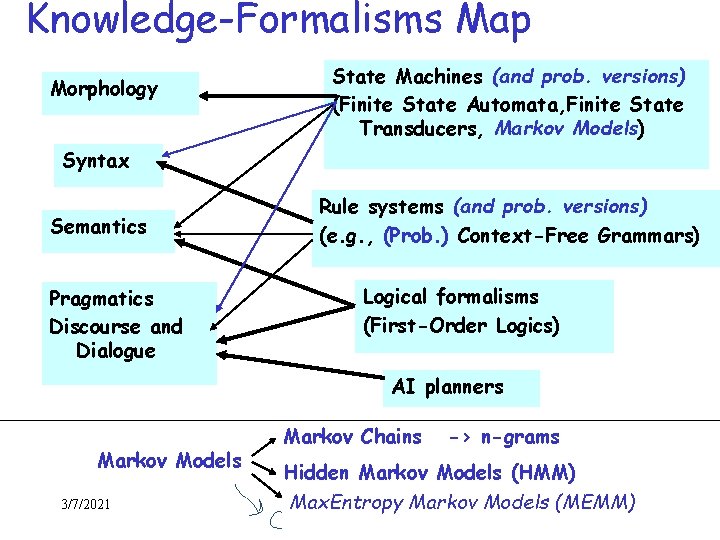
Knowledge-Formalisms Map Morphology State Machines (and prob. versions) (Finite State Automata, Finite State Transducers, Markov Models) Syntax Semantics Pragmatics Discourse and Dialogue Rule systems (and prob. versions) (e. g. , (Prob. ) Context-Free Grammars) Logical formalisms (First-Order Logics) AI planners Markov Models 3/7/2021 Markov Chains -> n-grams Hidden Markov Models (HMM) Max. Entropy Markov Models (MEMM) CPSC 503 Winter 2012 2
Today Jan 24 • Part-of-speech tagging • Start Syntax… 3/7/2021 CPSC 503 Winter 2012 3
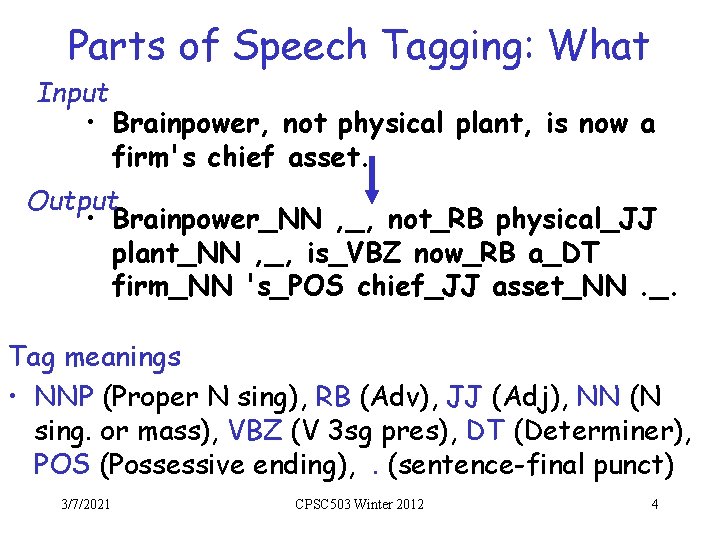
Parts of Speech Tagging: What Input • Brainpower, not physical plant, is now a firm's chief asset. Output • Brainpower_NN , _, not_RB physical_JJ plant_NN , _, is_VBZ now_RB a_DT firm_NN 's_POS chief_JJ asset_NN. _. Tag meanings • NNP (Proper N sing), RB (Adv), JJ (Adj), NN (N sing. or mass), VBZ (V 3 sg pres), DT (Determiner), POS (Possessive ending), . (sentence-final punct) 3/7/2021 CPSC 503 Winter 2012 4
Parts of Speech Summary • Eight basic categories… • Closed vs. Open class • POS distribution • Tagsets …. . 3/7/2021 CPSC 503 Winter 2012 5
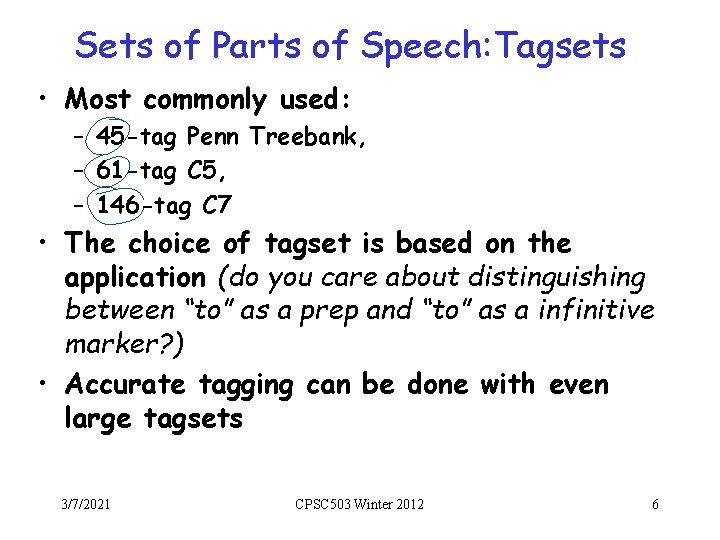
Sets of Parts of Speech: Tagsets • Most commonly used: – 45 -tag Penn Treebank, – 61 -tag C 5, – 146 -tag C 7 • The choice of tagset is based on the application (do you care about distinguishing between “to” as a prep and “to” as a infinitive marker? ) • Accurate tagging can be done with even large tagsets 3/7/2021 CPSC 503 Winter 2012 6
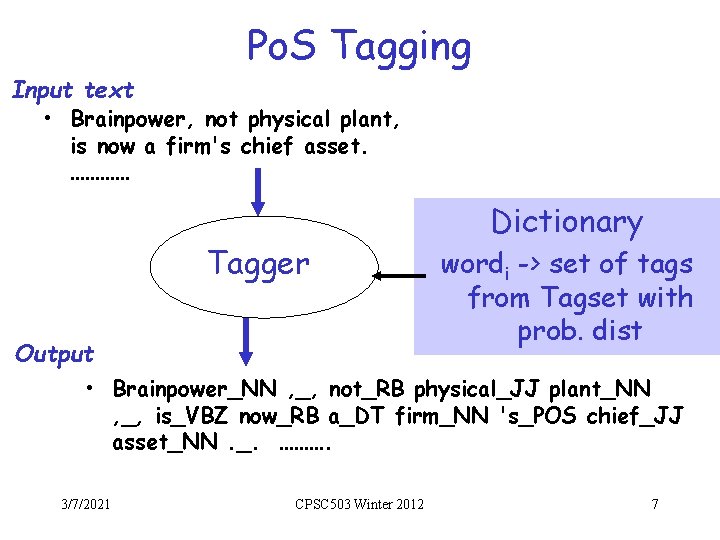
Po. S Tagging Input text • Brainpower, not physical plant, is now a firm's chief asset. ………… Tagger Output Dictionary wordi -> set of tags from Tagset with prob. dist • Brainpower_NN , _, not_RB physical_JJ plant_NN , _, is_VBZ now_RB a_DT firm_NN 's_POS chief_JJ asset_NN. _. ………. 3/7/2021 CPSC 503 Winter 2012 7
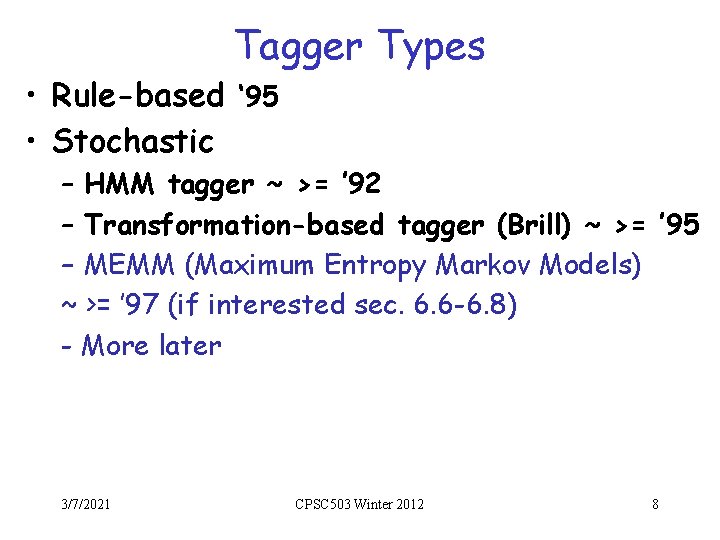
Tagger Types • Rule-based ‘ 95 • Stochastic – HMM tagger ~ >= ’ 92 – Transformation-based tagger (Brill) ~ >= ’ 95 – MEMM (Maximum Entropy Markov Models) ~ >= ’ 97 (if interested sec. 6. 6 -6. 8) - More later 3/7/2021 CPSC 503 Winter 2012 8
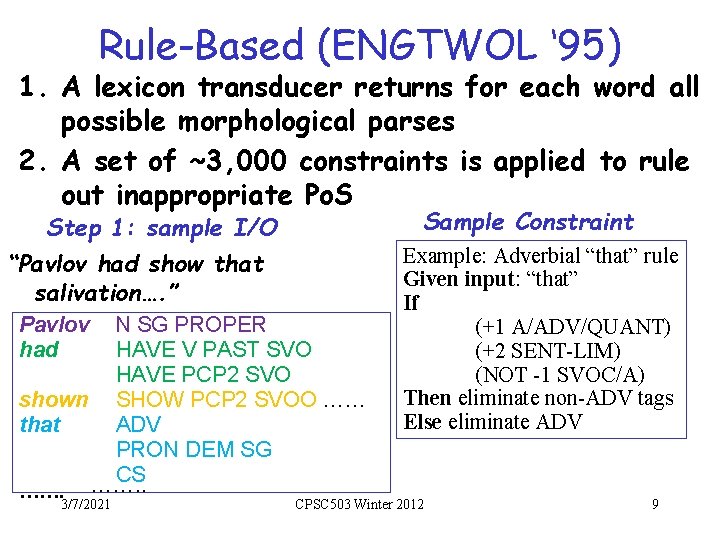
Rule-Based (ENGTWOL ‘ 95) 1. A lexicon transducer returns for each word all possible morphological parses 2. A set of ~3, 000 constraints is applied to rule out inappropriate Po. S Sample Constraint Step 1: sample I/O “Pavlov had show that salivation…. ” Pavlov had N SG PROPER HAVE V PAST SVO HAVE PCP 2 SVO shown SHOW PCP 2 SVOO …… that ADV PRON DEM SG CS ……. 3/7/2021 Example: Adverbial “that” rule Given input: “that” If (+1 A/ADV/QUANT) (+2 SENT-LIM) (NOT -1 SVOC/A) Then eliminate non-ADV tags Else eliminate ADV CPSC 503 Winter 2012 9
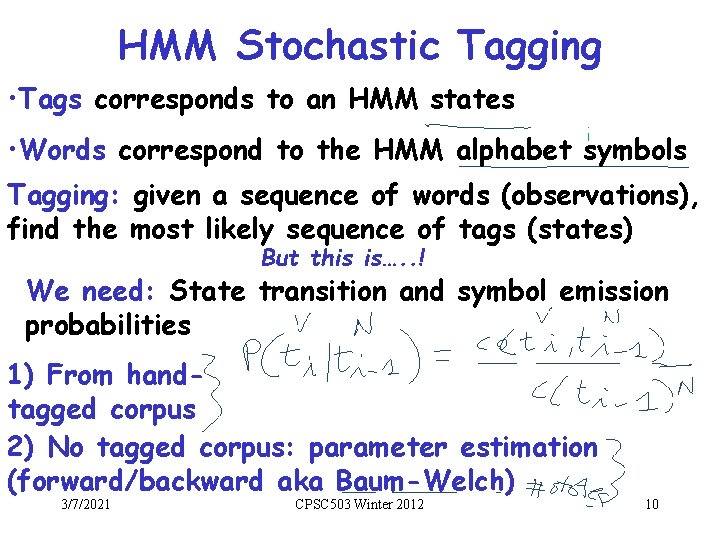
HMM Stochastic Tagging • Tags corresponds to an HMM states • Words correspond to the HMM alphabet symbols Tagging: given a sequence of words (observations), find the most likely sequence of tags (states) But this is…. . ! We need: State transition and symbol emission probabilities 1) From handtagged corpus 2) No tagged corpus: parameter estimation (forward/backward aka Baum-Welch) 3/7/2021 CPSC 503 Winter 2012 10
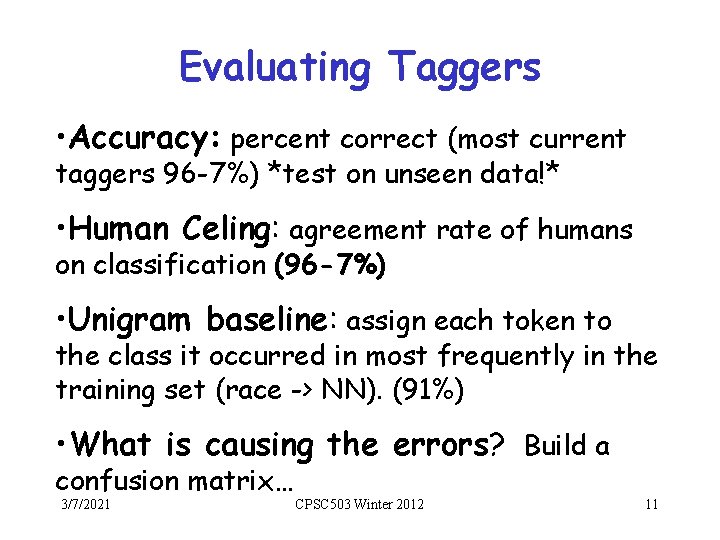
Evaluating Taggers • Accuracy: percent correct (most current taggers 96 -7%) *test on unseen data!* • Human Celing: agreement rate of humans on classification (96 -7%) • Unigram baseline: assign each token to the class it occurred in most frequently in the training set (race -> NN). (91%) • What is causing the errors? Build a confusion matrix… 3/7/2021 CPSC 503 Winter 2012 11
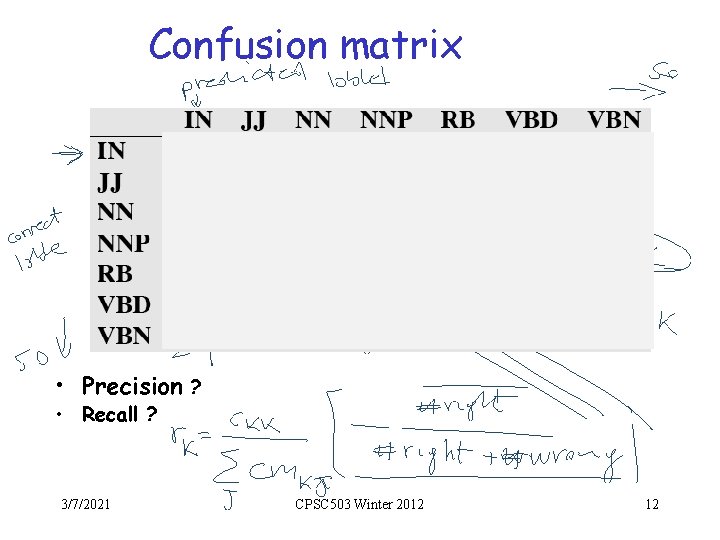
Confusion matrix • Precision ? • Recall ? 3/7/2021 CPSC 503 Winter 2012 12
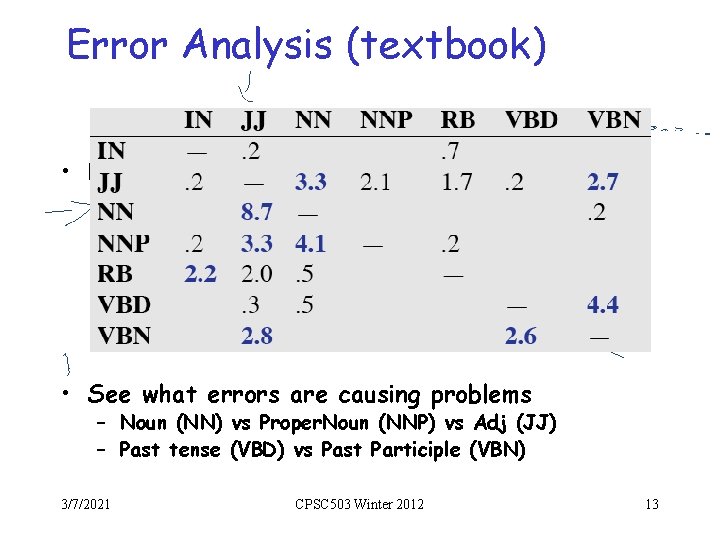
Error Analysis (textbook) • Look at a confusion matrix • See what errors are causing problems – Noun (NN) vs Proper. Noun (NNP) vs Adj (JJ) – Past tense (VBD) vs Past Participle (VBN) 3/7/2021 CPSC 503 Winter 2012 13
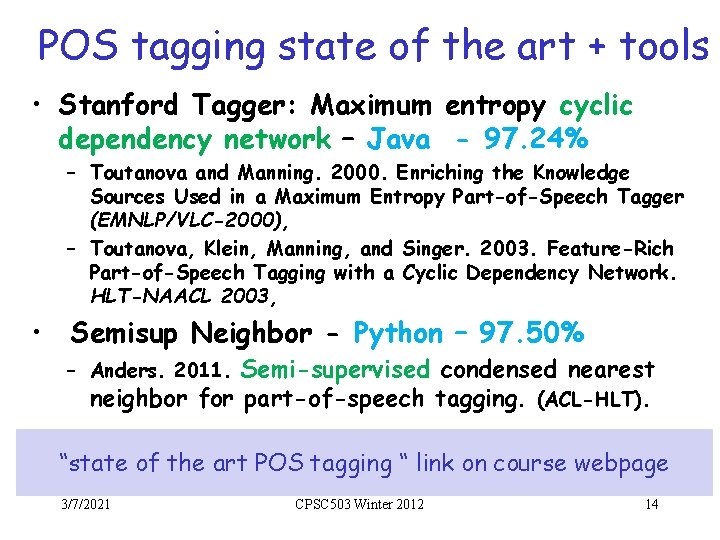
POS tagging state of the art + tools • Stanford Tagger: Maximum entropy cyclic dependency network – Java - 97. 24% – Toutanova and Manning. 2000. Enriching the Knowledge Sources Used in a Maximum Entropy Part-of-Speech Tagger (EMNLP/VLC-2000), – Toutanova, Klein, Manning, and Singer. 2003. Feature-Rich Part-of-Speech Tagging with a Cyclic Dependency Network. HLT-NAACL 2003, • Semisup Neighbor - Python – 97. 50% – Anders. 2011. Semi-supervised condensed nearest neighbor for part-of-speech tagging. (ACL-HLT). “state of the art POS tagging “ link on course webpage 3/7/2021 CPSC 503 Winter 2012 14
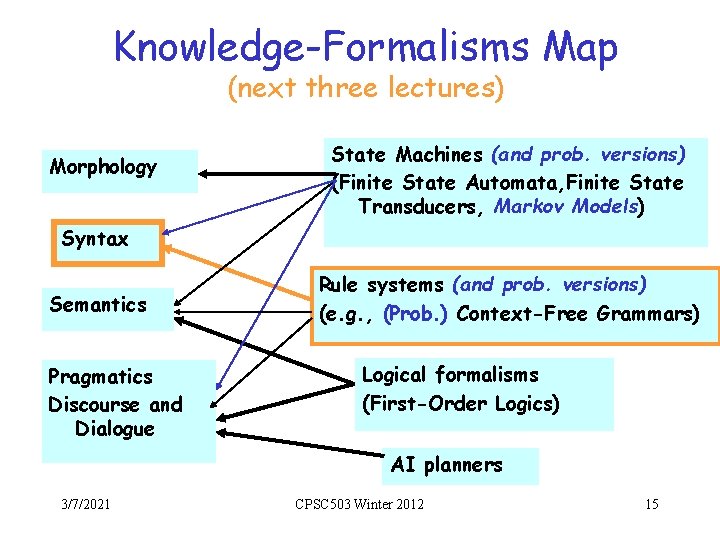
Knowledge-Formalisms Map (next three lectures) Morphology State Machines (and prob. versions) (Finite State Automata, Finite State Transducers, Markov Models) Syntax Semantics Pragmatics Discourse and Dialogue Rule systems (and prob. versions) (e. g. , (Prob. ) Context-Free Grammars) Logical formalisms (First-Order Logics) AI planners 3/7/2021 CPSC 503 Winter 2012 15
Today Jan 24 • POS tagging • Start Syntax – English Syntax – Context-Free Grammar for English • • 3/7/2021 Rules Trees Recursion Problems CPSC 503 Winter 2012 16
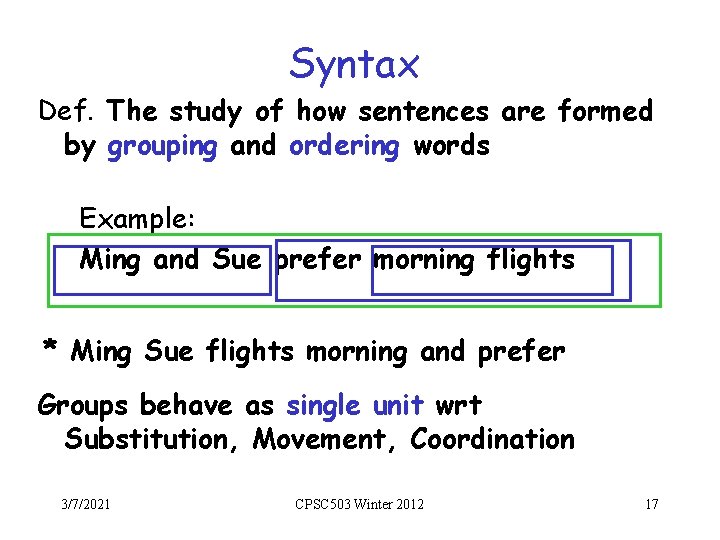
Syntax Def. The study of how sentences are formed by grouping and ordering words Example: Ming and Sue prefer morning flights * Ming Sue flights morning and prefer Groups behave as single unit wrt Substitution, Movement, Coordination 3/7/2021 CPSC 503 Winter 2012 17
Syntax: Useful tasks • Why should you care? – Grammar checkers – Basis for semantic interpretation • Question answering • Information extraction • Summarization – Machine translation – …… 3/7/2021 CPSC 503 Winter 2012 18
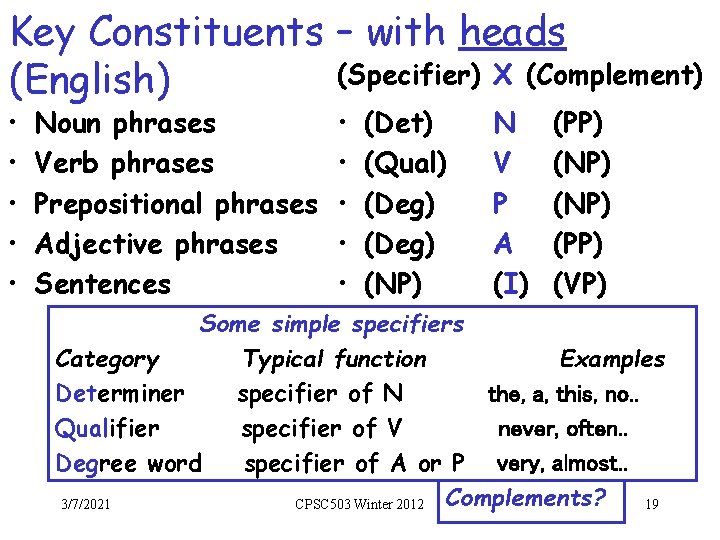
Key Constituents – with heads (Specifier) X (Complement) (English) • • • Noun phrases Verb phrases Prepositional phrases Adjective phrases Sentences • • • (Det) (Qual) (Deg) (NP) N V P A (I) (PP) (NP) (PP) (VP) Some simple specifiers Category Typical function Examples Determiner specifier of N the, a, this, no. . Qualifier specifier of V never, often. . Degree word specifier of A or P very, almost. . 3/7/2021 CPSC 503 Winter 2012 Complements? 19
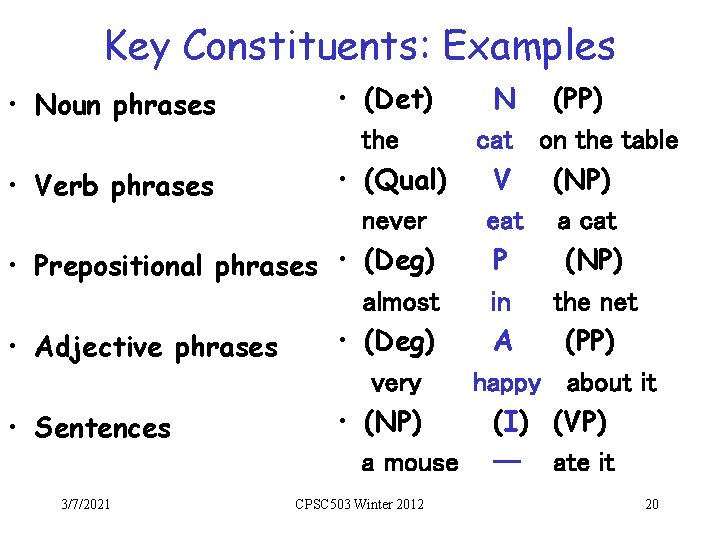
Key Constituents: Examples • (Det) N (PP) the cat on the table • (Qual) V (NP) Verb phrases never eat a cat P (NP) Prepositional phrases • (Deg) almost in the net • (Deg) A (PP) Adjective phrases very happy about it • (NP) (I) (VP) Sentences a mouse -- ate it • Noun phrases • • 3/7/2021 CPSC 503 Winter 2012 20
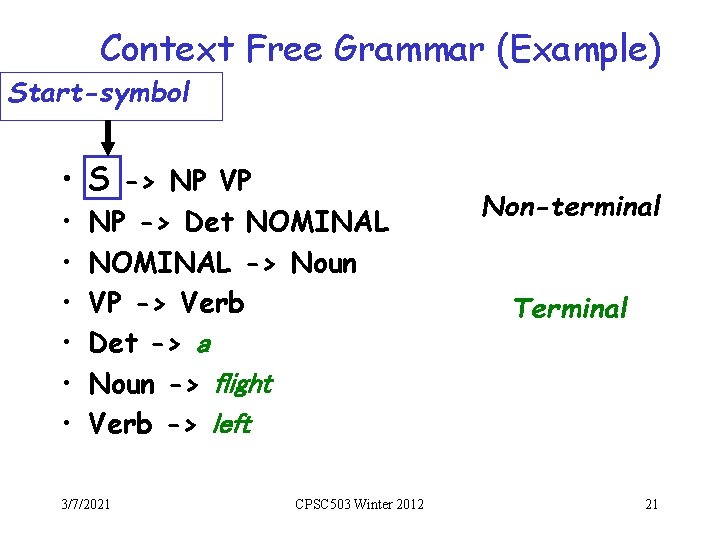
Context Free Grammar (Example) Start-symbol • S -> NP VP • • • NP -> Det NOMINAL -> Noun VP -> Verb Det -> a Noun -> flight Verb -> left 3/7/2021 CPSC 503 Winter 2012 Non-terminal Terminal 21
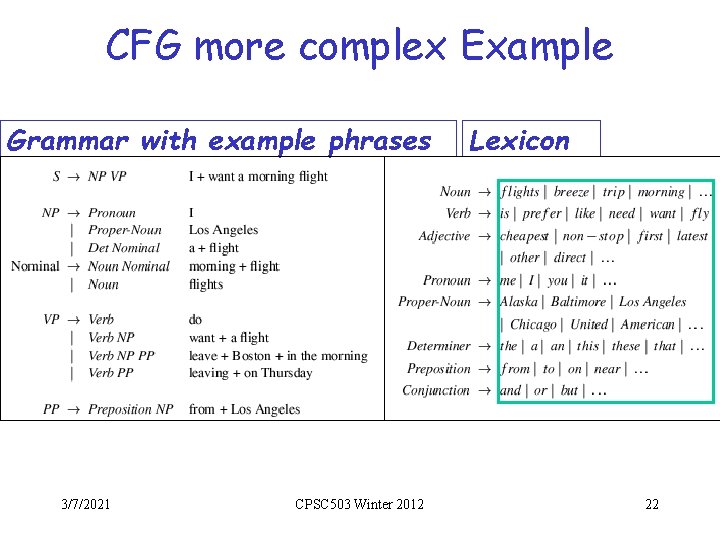
CFG more complex Example Grammar with example phrases 3/7/2021 CPSC 503 Winter 2012 Lexicon 22
CFGs • Define a Formal Language (un/grammatical sentences) • Generative Formalism – Generate strings in the language – Reject strings not in the language – Impose structures (trees) on strings in the language 3/7/2021 CPSC 503 Winter 2012 23
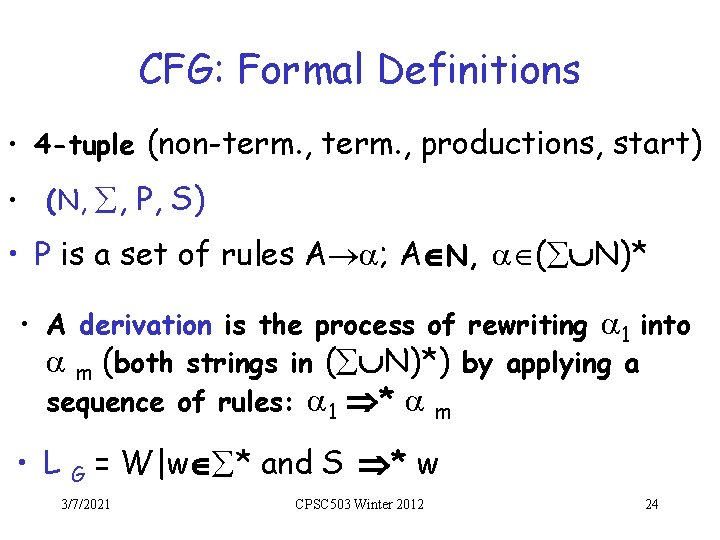
CFG: Formal Definitions • 4 -tuple (non-term. , productions, start) • (N, , P, S) • P is a set of rules A ; A N, ( N)* • A derivation is the process of rewriting 1 into m (both strings in ( N)*) by applying a sequence of rules: 1 * m • L G = W|w * and S * w 3/7/2021 CPSC 503 Winter 2012 24
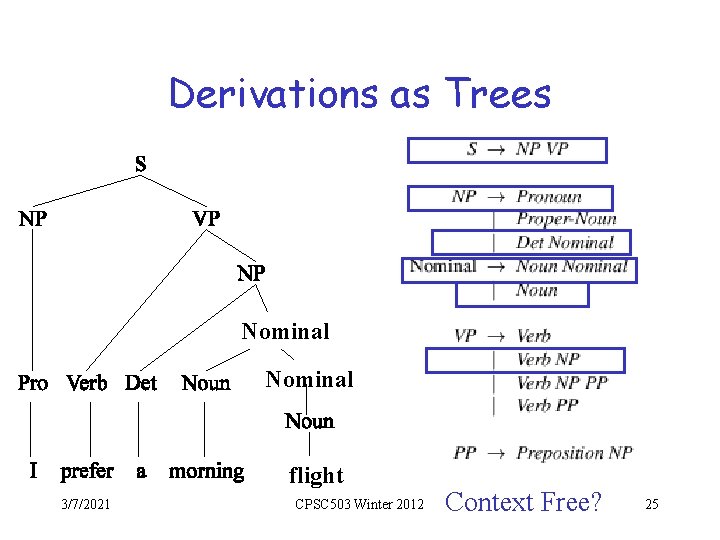
Derivations as Trees Nominal flight 3/7/2021 CPSC 503 Winter 2012 Context Free? 25
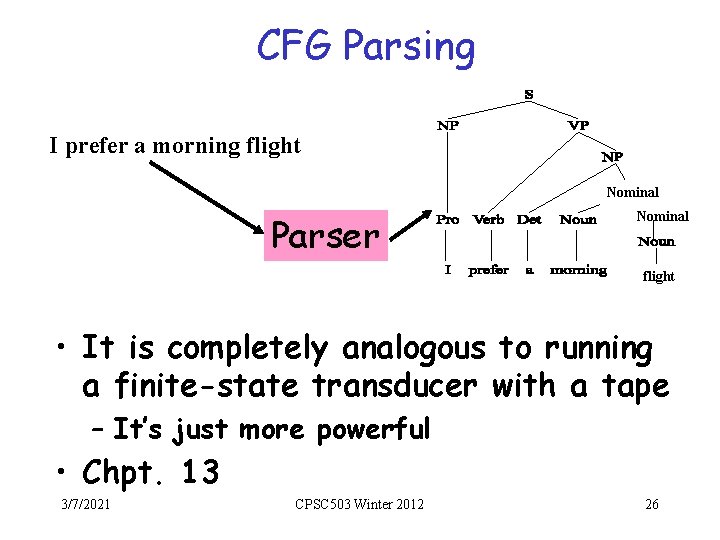
CFG Parsing I prefer a morning flight Nominal Parser Nominal flight • It is completely analogous to running a finite-state transducer with a tape – It’s just more powerful • Chpt. 13 3/7/2021 CPSC 503 Winter 2012 26
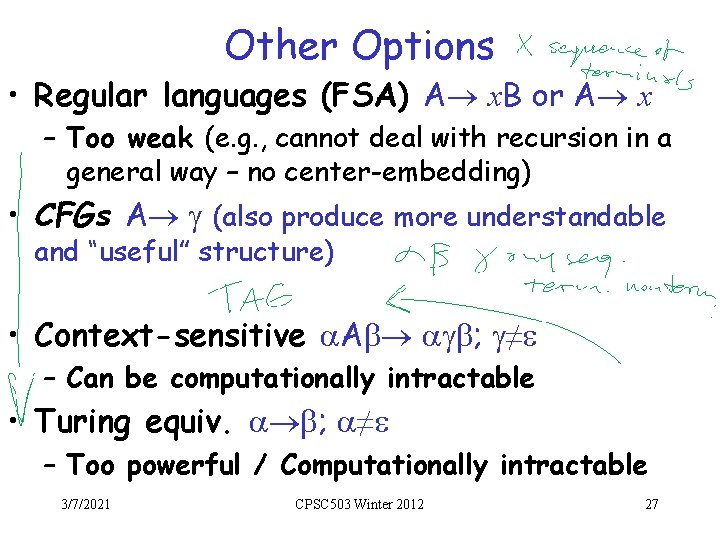
Other Options • Regular languages (FSA) A x. B or A x – Too weak (e. g. , cannot deal with recursion in a general way – no center-embedding) • CFGs A (also produce more understandable and “useful” structure) • Context-sensitive A ; ≠ – Can be computationally intractable • Turing equiv. ; ≠ – Too powerful / Computationally intractable 3/7/2021 CPSC 503 Winter 2012 27
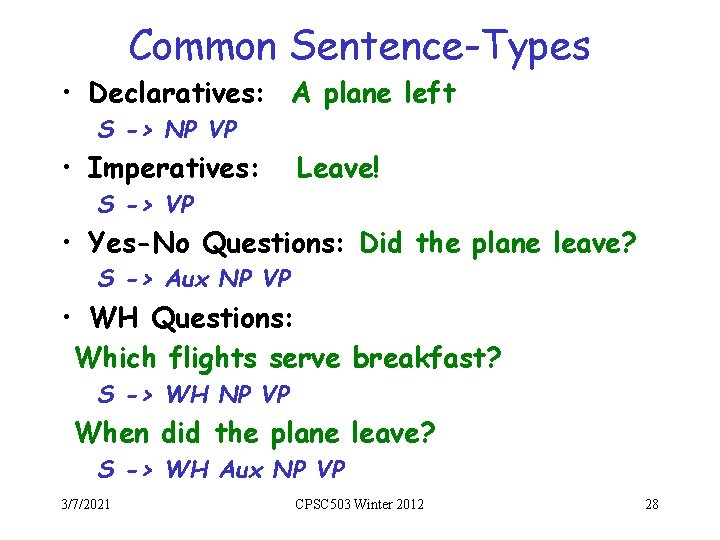
Common Sentence-Types • Declaratives: A plane left S -> NP VP • Imperatives: Leave! S -> VP • Yes-No Questions: Did the plane leave? S -> Aux NP VP • WH Questions: Which flights serve breakfast? S -> WH NP VP When did the plane leave? S -> WH Aux NP VP 3/7/2021 CPSC 503 Winter 2012 28
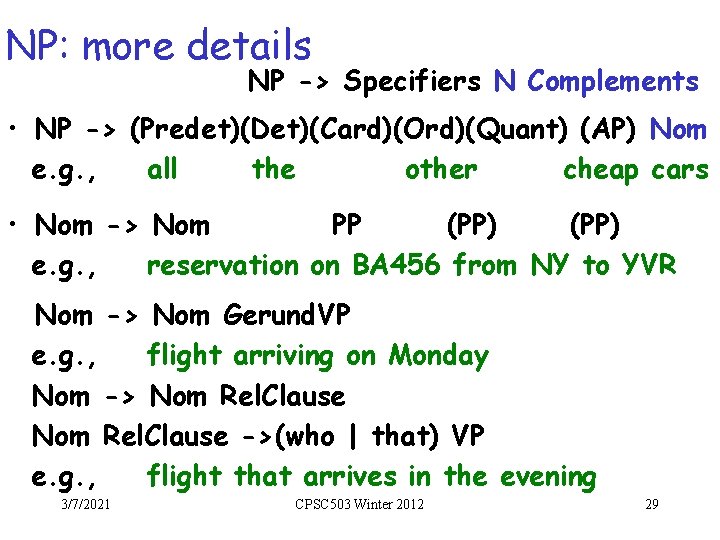
NP: more details NP -> Specifiers N Complements • NP -> (Predet)(Det)(Card)(Ord)(Quant) (AP) Nom e. g. , all the other cheap cars • Nom -> Nom PP (PP) e. g. , reservation on BA 456 from NY to YVR Nom -> Nom Gerund. VP e. g. , flight arriving on Monday Nom -> Nom Rel. Clause ->(who | that) VP e. g. , flight that arrives in the evening 3/7/2021 CPSC 503 Winter 2012 29
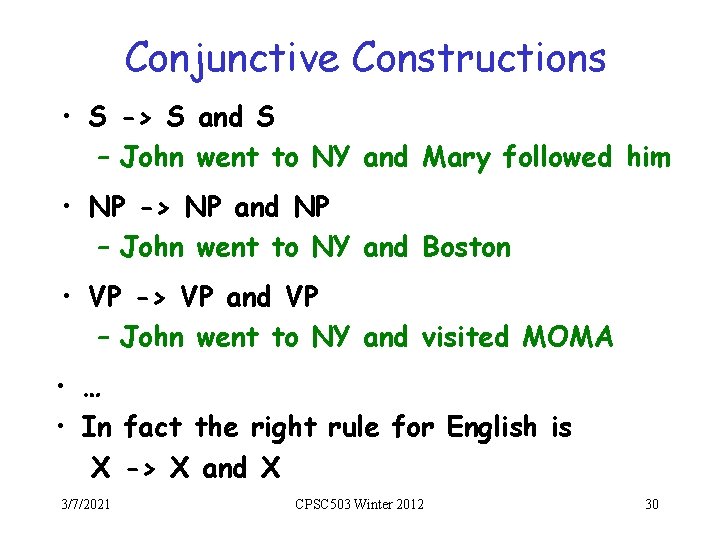
Conjunctive Constructions • S -> S and S – John went to NY and Mary followed him • NP -> NP and NP – John went to NY and Boston • VP -> VP and VP – John went to NY and visited MOMA • … • In fact the right rule for English is X -> X and X 3/7/2021 CPSC 503 Winter 2012 30
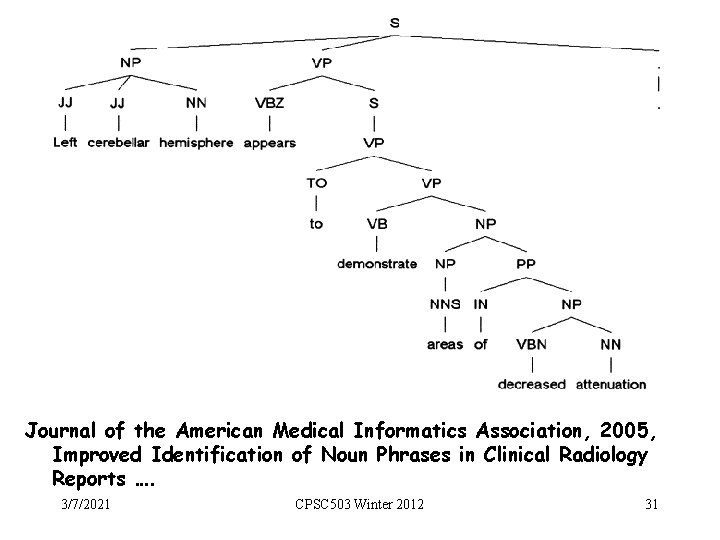
Journal of the American Medical Informatics Association, 2005, Improved Identification of Noun Phrases in Clinical Radiology Reports …. 3/7/2021 CPSC 503 Winter 2012 31
Problems with CFGs • Agreement • Subcategorization 3/7/2021 CPSC 503 Winter 2012 32
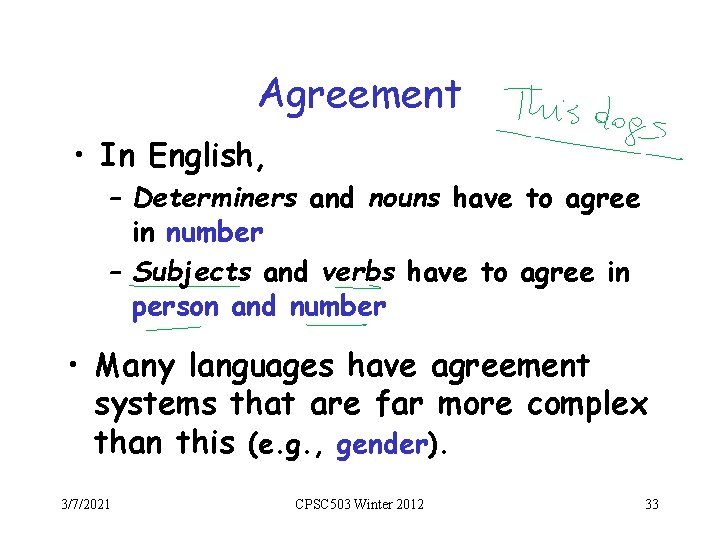
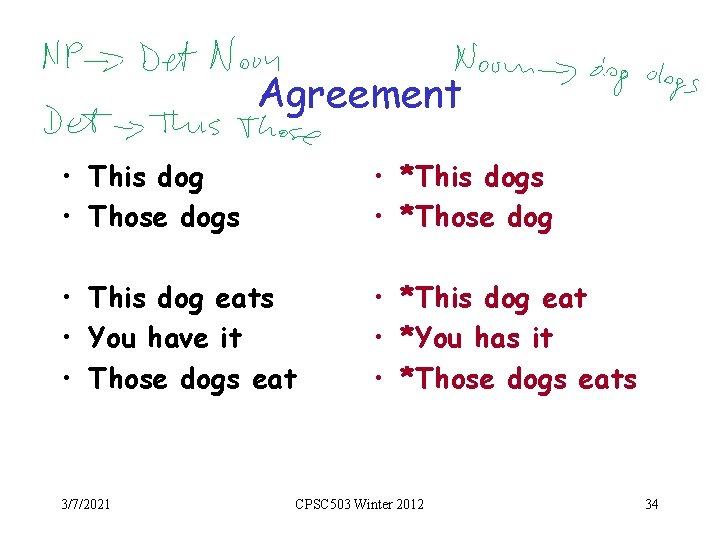
Agreement • In English, – Determiners and nouns have to agree in number – Subjects and verbs have to agree in person and number • Many languages have agreement systems that are far more complex than this (e. g. , gender). 3/7/2021 CPSC 503 Winter 2012 33
Agreement • This dog • Those dogs • *This dogs • *Those dog • This dog eats • You have it • Those dogs eat • *This dog eat • *You has it • *Those dogs eats 3/7/2021 CPSC 503 Winter 2012 34
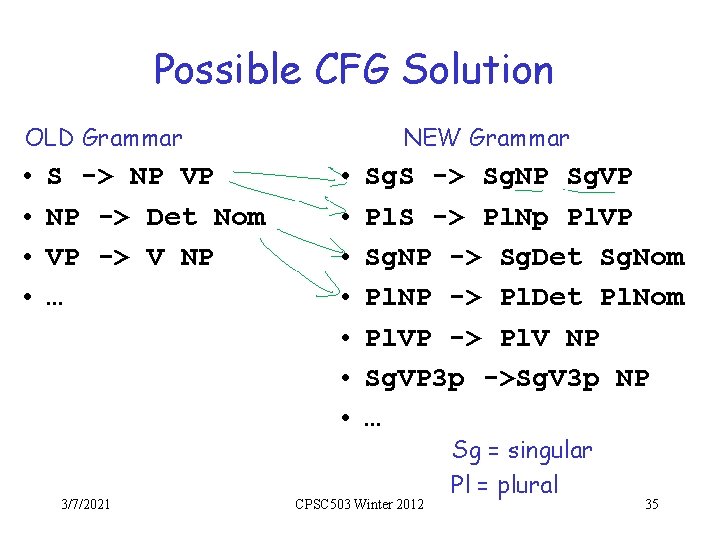
Possible CFG Solution OLD Grammar • • S -> NP VP NP -> Det Nom VP -> V NP … 3/7/2021 NEW Grammar • • Sg. S -> Sg. NP Sg. VP Pl. S -> Pl. Np Pl. VP Sg. NP -> Sg. Det Sg. Nom Pl. NP -> Pl. Det Pl. Nom Pl. VP -> Pl. V NP Sg. VP 3 p ->Sg. V 3 p NP … CPSC 503 Winter 2012 Sg = singular Pl = plural 35
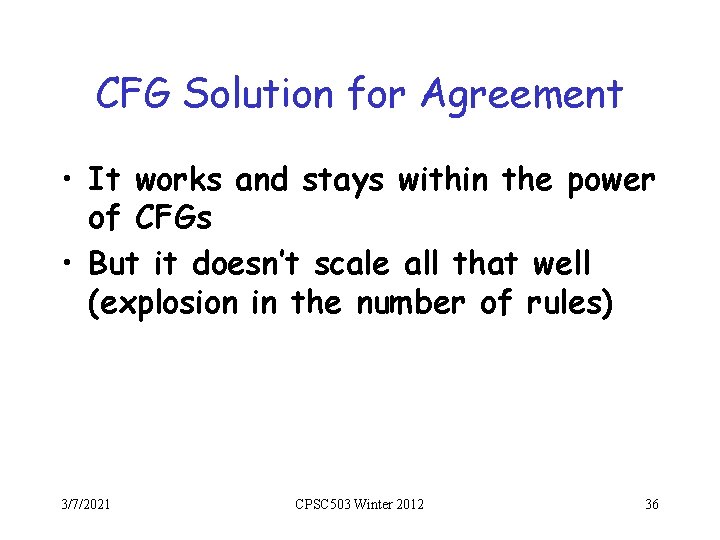
CFG Solution for Agreement • It works and stays within the power of CFGs • But it doesn’t scale all that well (explosion in the number of rules) 3/7/2021 CPSC 503 Winter 2012 36
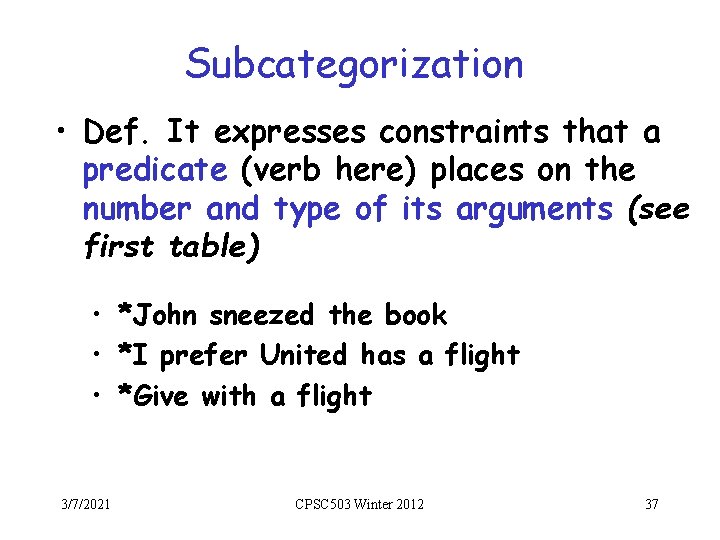
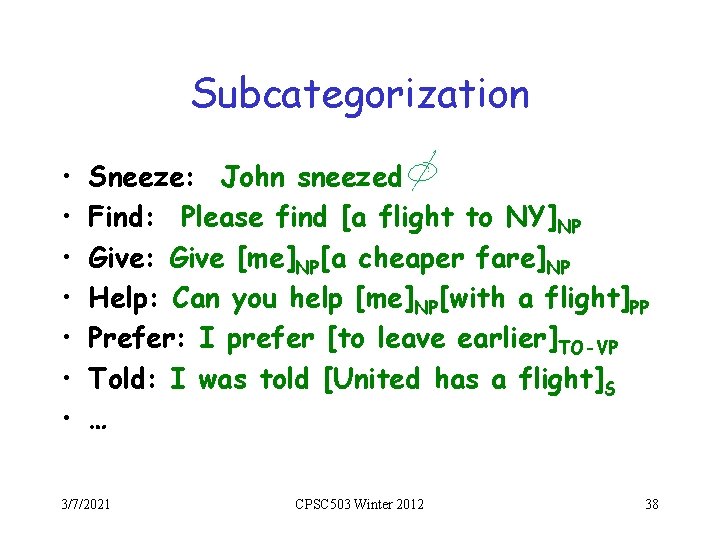
Subcategorization • Def. It expresses constraints that a predicate (verb here) places on the number and type of its arguments (see first table) • *John sneezed the book • *I prefer United has a flight • *Give with a flight 3/7/2021 CPSC 503 Winter 2012 37
Subcategorization • • Sneeze: John sneezed Find: Please find [a flight to NY]NP Give: Give [me]NP[a cheaper fare]NP Help: Can you help [me]NP[with a flight]PP Prefer: I prefer [to leave earlier]TO-VP Told: I was told [United has a flight]S … 3/7/2021 CPSC 503 Winter 2012 38
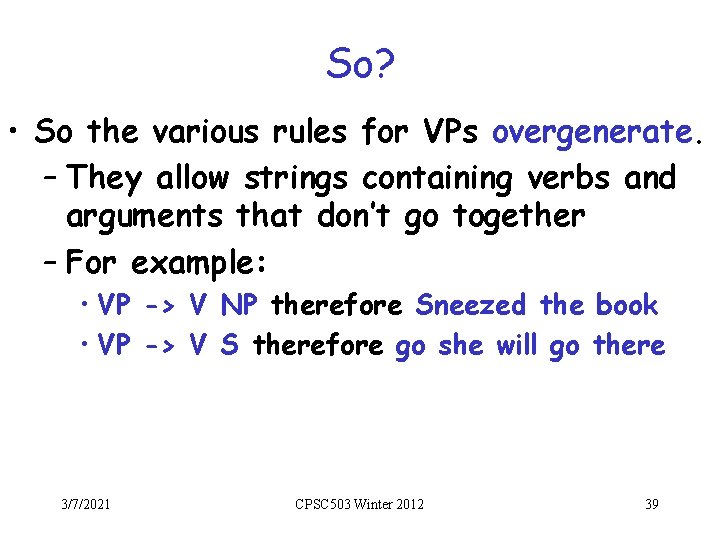
So? • So the various rules for VPs overgenerate. – They allow strings containing verbs and arguments that don’t go together – For example: • VP -> V NP therefore Sneezed the book • VP -> V S therefore go she will go there 3/7/2021 CPSC 503 Winter 2012 39
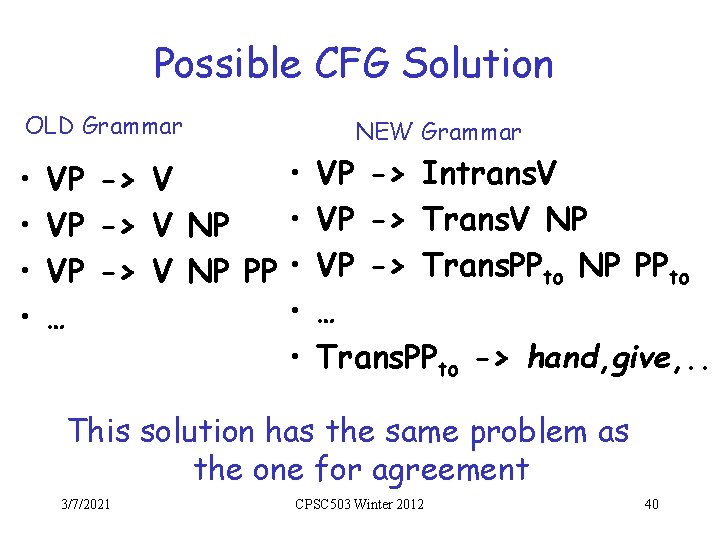
Possible CFG Solution OLD Grammar • • NEW Grammar • VP -> V NP PP • • … • VP -> Intrans. V VP -> Trans. V NP VP -> Trans. PPto NP PPto … Trans. PPto -> hand, give, . . This solution has the same problem as the one for agreement 3/7/2021 CPSC 503 Winter 2012 40
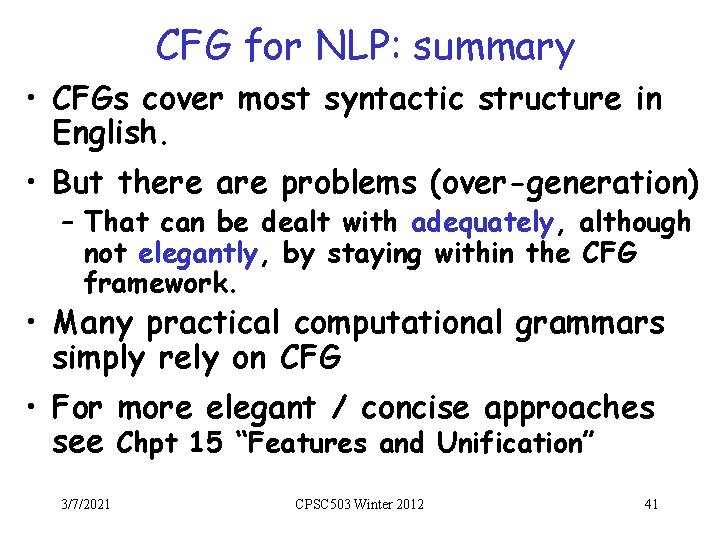
CFG for NLP: summary • CFGs cover most syntactic structure in English. • But there are problems (over-generation) – That can be dealt with adequately, although not elegantly, by staying within the CFG framework. • Many practical computational grammars simply rely on CFG • For more elegant / concise approaches see Chpt 15 “Features and Unification” 3/7/2021 CPSC 503 Winter 2012 41
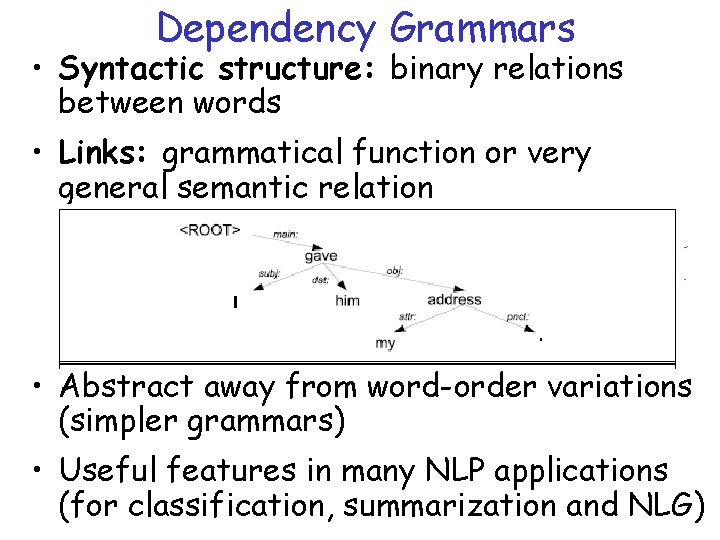
Dependency Grammars • Syntactic structure: binary relations between words • Links: grammatical function or very general semantic relation • Abstract away from word-order variations (simpler grammars) • Useful features in many NLP applications 3/7/2021 classification, CPSC 503 Winter 2012 42 (for summarization and NLG)
Next Time • Read Chapter 12 (syntax & Context Free Grammars) • Start Parsing (Chp. 13) 3/7/2021 CPSC 503 Winter 2012 43