
CPSC 503 Computational Linguistics Natural Language Processing Human

- Slides: 36
CPSC 503 Computational Linguistics Natural Language Processing Human Language Technology …… Course Overview- Lecture 1 – 2012 -13 Giuseppe Carenini 3/9/2021 CPSC 503 – Winter 2012 1
Today Jan 8 • Overview of the field • Overview of course – – Background knowledge Topics Activities and Grading Administrative Stuff • Introductions (if time left) 3/9/2021 CPSC 503 – Winter 2012 2
Natural Language Processing • What is it? – We’re going to study formalisms, models and algorithms to allow computers to perform useful tasks involving knowledge about human languages. 3/9/2021 CPSC 503 – Winter 2012 3
Sample Useful Tasks • Any ideas? 3/9/2021 CPSC 503 – Winter 2012 4
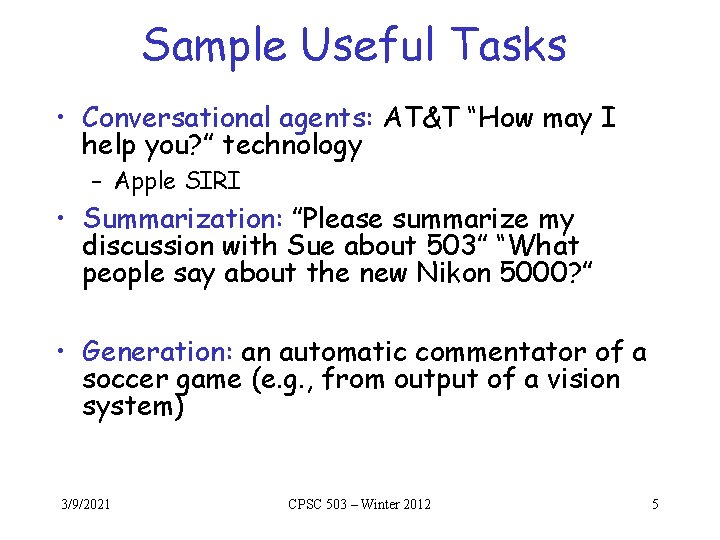
Sample Useful Tasks • Conversational agents: AT&T “How may I help you? ” technology – Apple SIRI • Summarization: ”Please summarize my discussion with Sue about 503” “What people say about the new Nikon 5000? ” • Generation: an automatic commentator of a soccer game (e. g. , from output of a vision system) 3/9/2021 CPSC 503 – Winter 2012 5
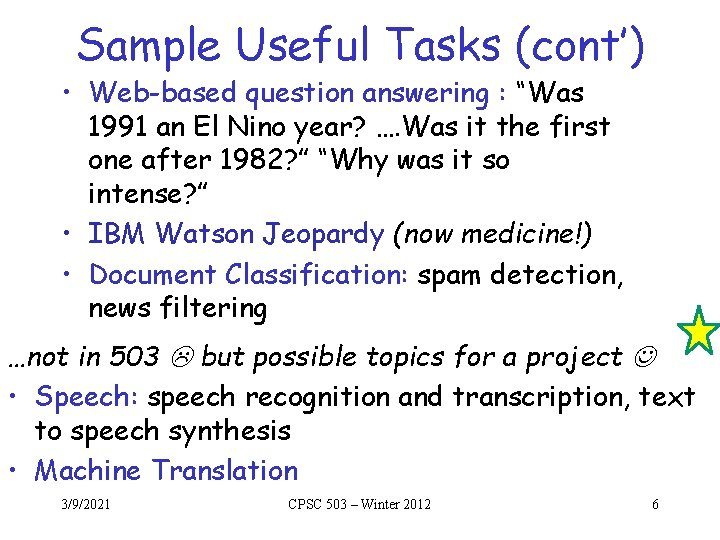
Sample Useful Tasks (cont’) • Web-based question answering : “Was 1991 an El Nino year? …. Was it the first one after 1982? ” “Why was it so intense? ” • IBM Watson Jeopardy (now medicine!) • Document Classification: spam detection, news filtering …not in 503 but possible topics for a project • Speech: speech recognition and transcription, text to speech synthesis • Machine Translation 3/9/2021 CPSC 503 – Winter 2012 6
Natural Language Processing • What is it? – We’re going to study formalisms, models and algorithms to allow computers to perform useful tasks involving knowledge about human languages. 3/9/2021 CPSC 503 – Winter 2012 7
Knowledge about Language • Any ideas? 3/9/2021 CPSC 503 – Winter 2012 8
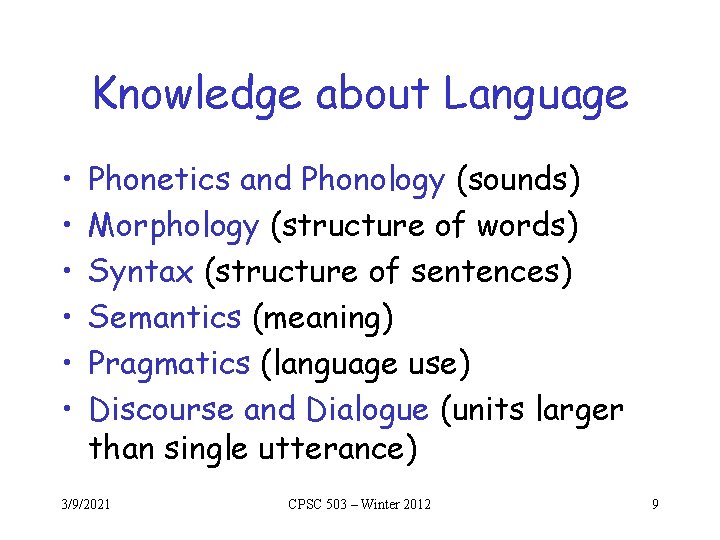
Knowledge about Language • • • Phonetics and Phonology (sounds) Morphology (structure of words) Syntax (structure of sentences) Semantics (meaning) Pragmatics (language use) Discourse and Dialogue (units larger than single utterance) 3/9/2021 CPSC 503 – Winter 2012 9
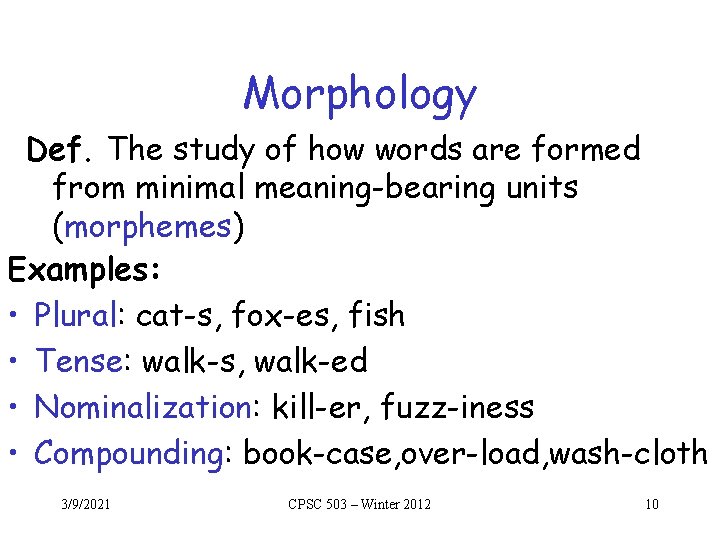
Morphology Def. The study of how words are formed from minimal meaning-bearing units (morphemes) Examples: • Plural: cat-s, fox-es, fish • Tense: walk-s, walk-ed • Nominalization: kill-er, fuzz-iness • Compounding: book-case, over-load, wash-cloth 3/9/2021 CPSC 503 – Winter 2012 10
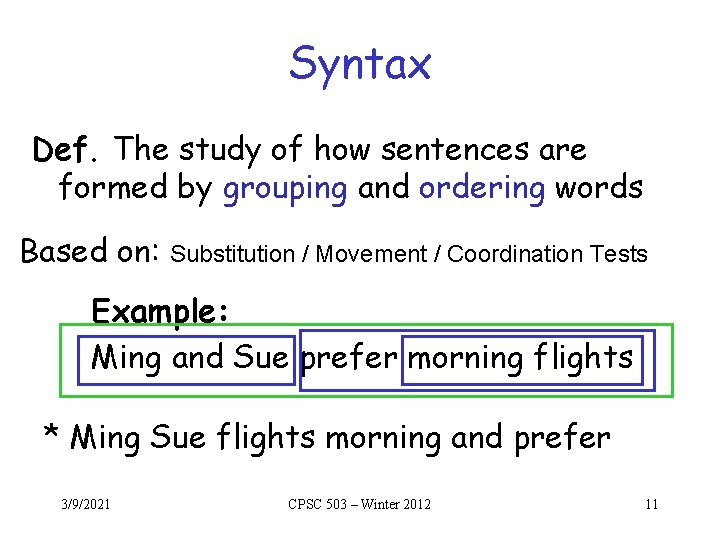
Syntax Def. The study of how sentences are formed by grouping and ordering words Based on: Substitution / Movement / Coordination Tests Example: Ming and Sue prefer morning flights * Ming Sue flights morning and prefer 3/9/2021 CPSC 503 – Winter 2012 11
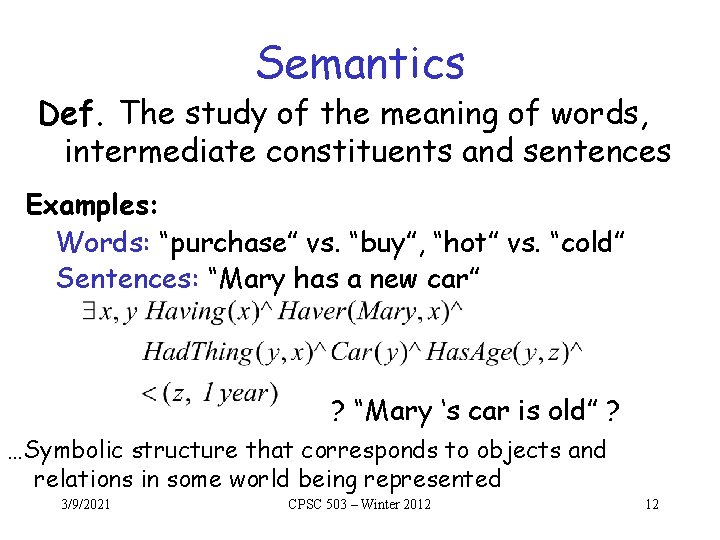
Semantics Def. The study of the meaning of words, intermediate constituents and sentences Examples: Words: “purchase” vs. “buy”, “hot” vs. “cold” Sentences: “Mary has a new car” ? “Mary ‘s car is old” ? …Symbolic structure that corresponds to objects and relations in some world being represented 3/9/2021 CPSC 503 – Winter 2012 12
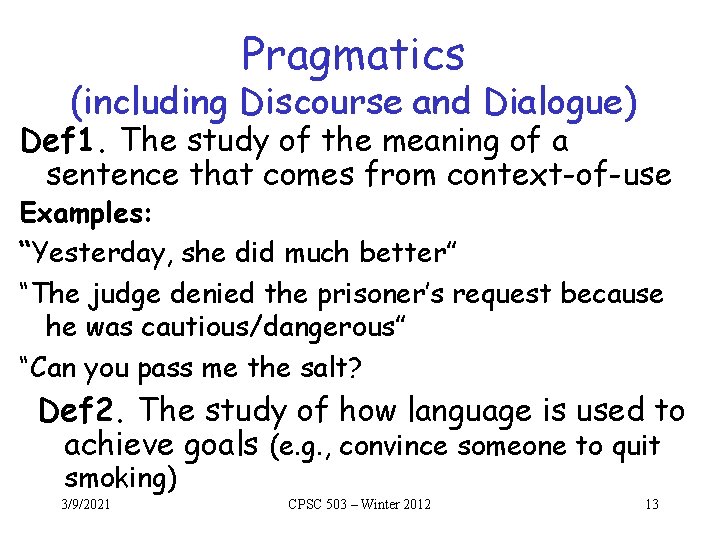
Pragmatics (including Discourse and Dialogue) Def 1. The study of the meaning of a sentence that comes from context-of-use Examples: “Yesterday, she did much better” “The judge denied the prisoner’s request because he was cautious/dangerous” “Can you pass me the salt? Def 2. The study of how language is used to achieve goals (e. g. , convince someone to quit smoking) 3/9/2021 CPSC 503 – Winter 2012 13
Natural Language Processing • What is it? – We’re going to study formalisms, models and algorithms to allow computers to perform useful tasks involving knowledge about human languages. 3/9/2021 CPSC 503 – Winter 2012 14
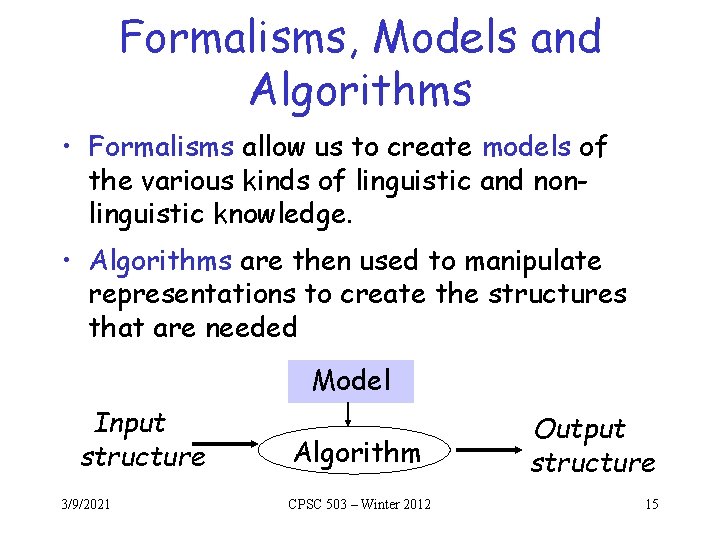
Formalisms, Models and Algorithms • Formalisms allow us to create models of the various kinds of linguistic and nonlinguistic knowledge. • Algorithms are then used to manipulate representations to create the structures that are needed Model Input structure 3/9/2021 Algorithm CPSC 503 – Winter 2012 Output structure 15
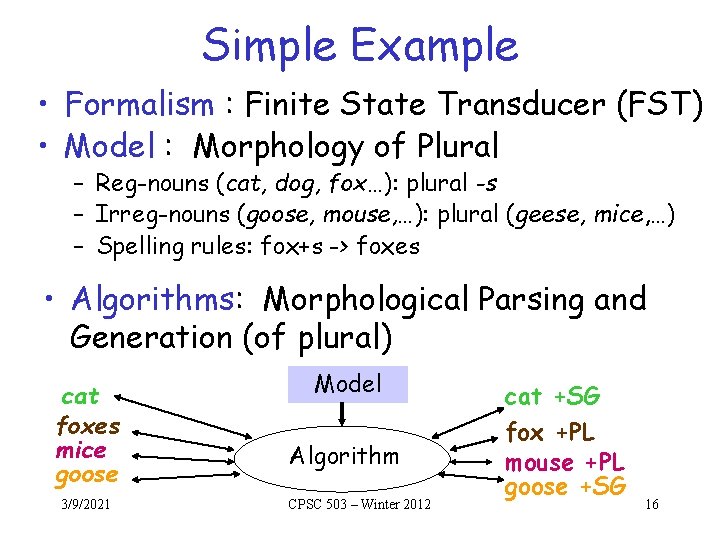
Simple Example • Formalism : Finite State Transducer (FST) • Model : Morphology of Plural – Reg-nouns (cat, dog, fox…): plural -s – Irreg-nouns (goose, mouse, …): plural (geese, mice, …) – Spelling rules: fox+s -> foxes • Algorithms: Morphological Parsing and Generation (of plural) cat foxes mice goose 3/9/2021 Model Algorithm CPSC 503 – Winter 2012 cat +SG fox +PL mouse +PL goose +SG 16
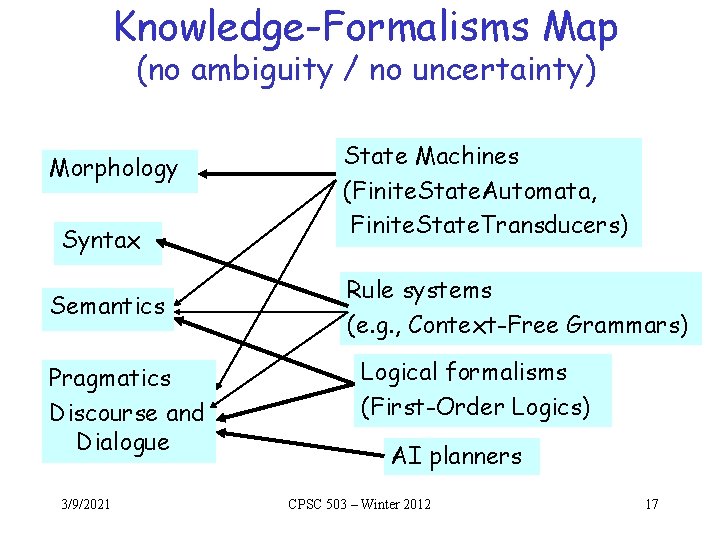
Knowledge-Formalisms Map (no ambiguity / no uncertainty) Morphology Syntax Semantics Pragmatics Discourse and Dialogue 3/9/2021 State Machines (Finite. State. Automata, Finite. State. Transducers) Rule systems (e. g. , Context-Free Grammars) Logical formalisms (First-Order Logics) AI planners CPSC 503 – Winter 2012 17
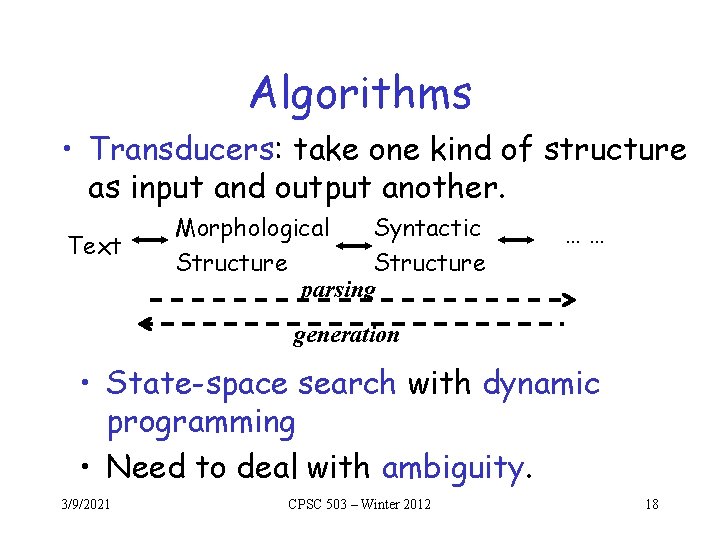
Algorithms • Transducers: take one kind of structure as input and output another. Text Morphological Syntactic Structure parsing …… generation • State-space search with dynamic programming • Need to deal with ambiguity. 3/9/2021 CPSC 503 – Winter 2012 18
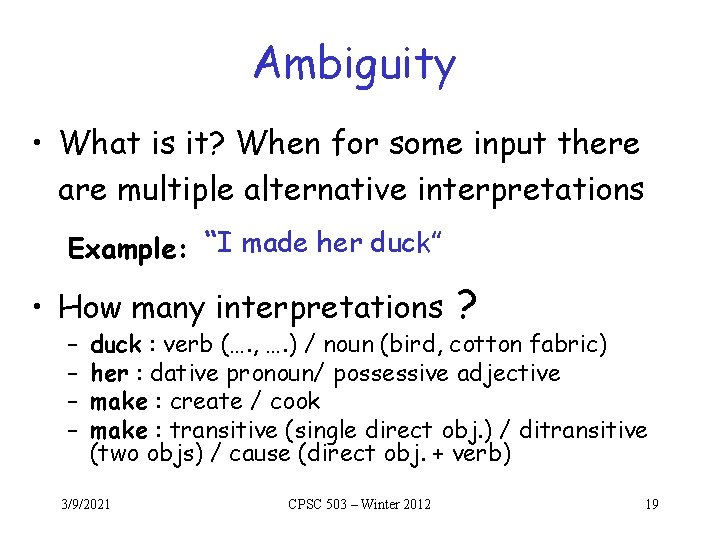
Ambiguity • What is it? When for some input there are multiple alternative interpretations Example: “I made her duck” • How many interpretations – – ? duck : verb (…. , …. ) / noun (bird, cotton fabric) her : dative pronoun/ possessive adjective make : create / cook make : transitive (single direct obj. ) / ditransitive (two objs) / cause (direct obj. + verb) 3/9/2021 CPSC 503 – Winter 2012 19
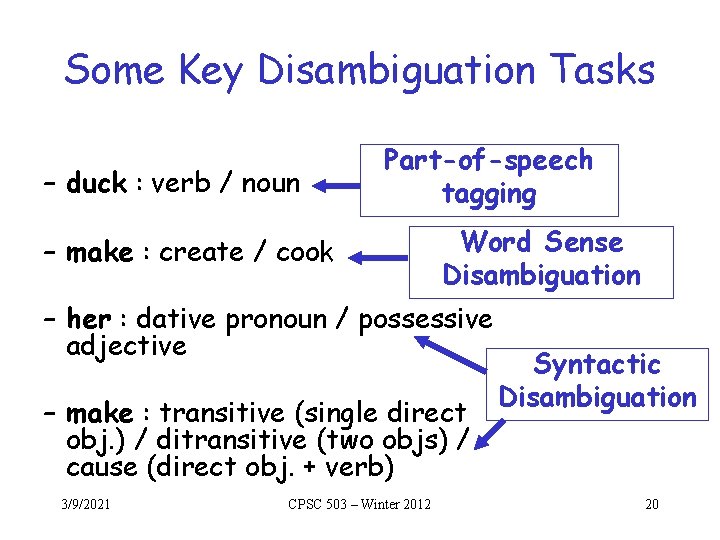
Some Key Disambiguation Tasks – duck : verb / noun Part-of-speech tagging – make : create / cook Word Sense Disambiguation – her : dative pronoun / possessive adjective – make : transitive (single direct obj. ) / ditransitive (two objs) / cause (direct obj. + verb) 3/9/2021 CPSC 503 – Winter 2012 Syntactic Disambiguation 20
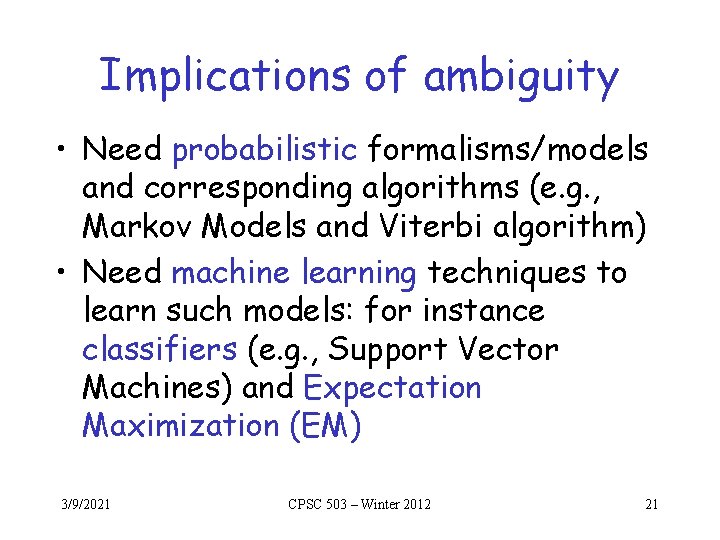
Implications of ambiguity • Need probabilistic formalisms/models and corresponding algorithms (e. g. , Markov Models and Viterbi algorithm) • Need machine learning techniques to learn such models: for instance classifiers (e. g. , Support Vector Machines) and Expectation Maximization (EM) 3/9/2021 CPSC 503 – Winter 2012 21
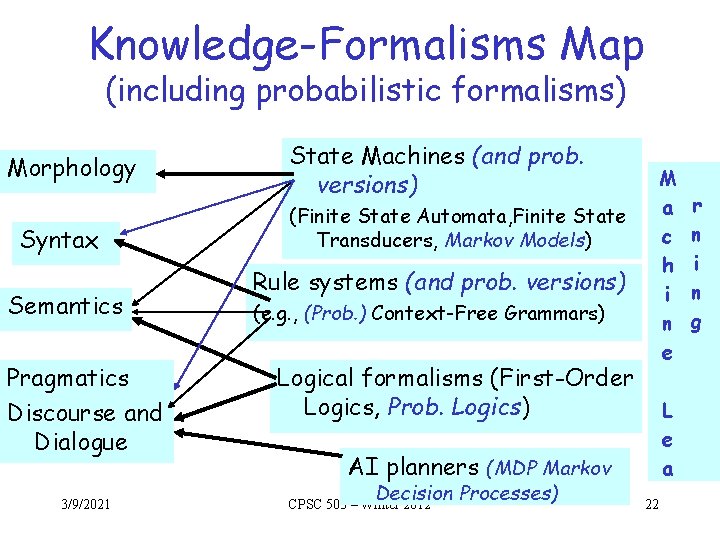
Knowledge-Formalisms Map (including probabilistic formalisms) Morphology Syntax Semantics Pragmatics Discourse and Dialogue 3/9/2021 State Machines (and prob. versions) (Finite State Automata, Finite State Transducers, Markov Models) Rule systems (and prob. versions) (e. g. , (Prob. ) Context-Free Grammars) Logical formalisms (First-Order Logics, Prob. Logics) M a c h i n e L e a AI planners (MDP Markov Decision Processes) CPSC 503 – Winter 2012 22 r n i n g
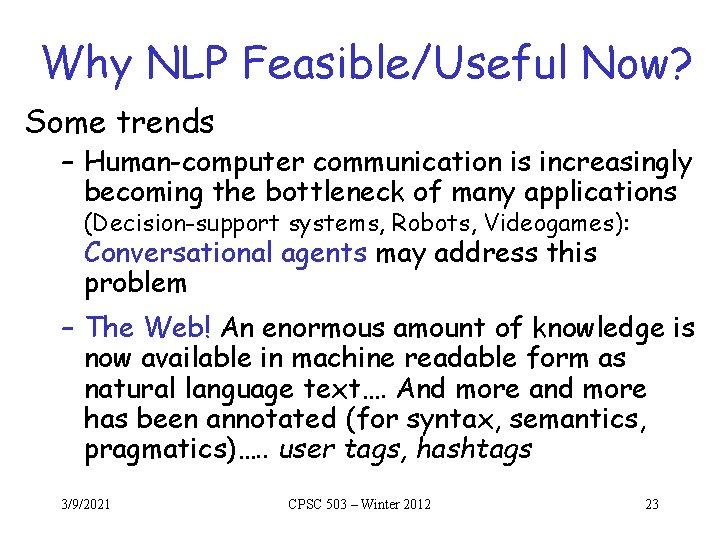
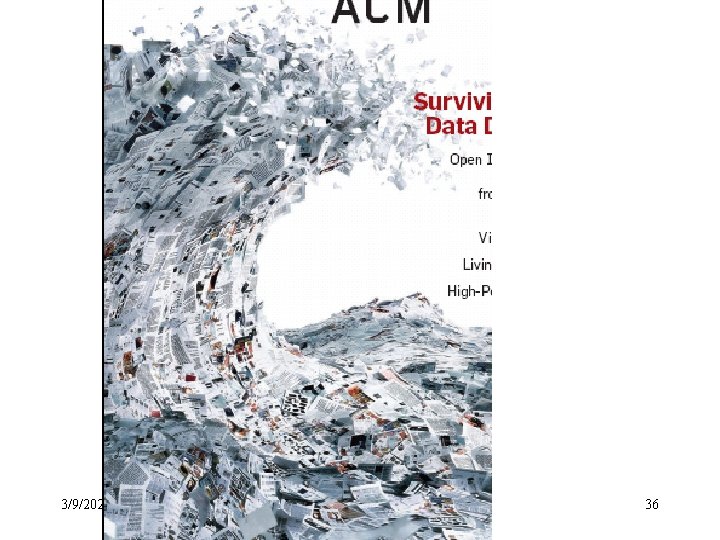
Why NLP Feasible/Useful Now? Some trends – Human-computer communication is increasingly becoming the bottleneck of many applications (Decision-support systems, Robots, Videogames): Conversational agents may address this problem – The Web! An enormous amount of knowledge is now available in machine readable form as natural language text…. And more and more has been annotated (for syntax, semantics, pragmatics)…. . user tags, hashtags 3/9/2021 CPSC 503 – Winter 2012 23
Today Jan 8 • Overview of the field • Overview of course – – Background knowledge Topics Activities and Grading Administrative Stuff • Introductions 3/9/2021 CPSC 503 – Winter 2012 24
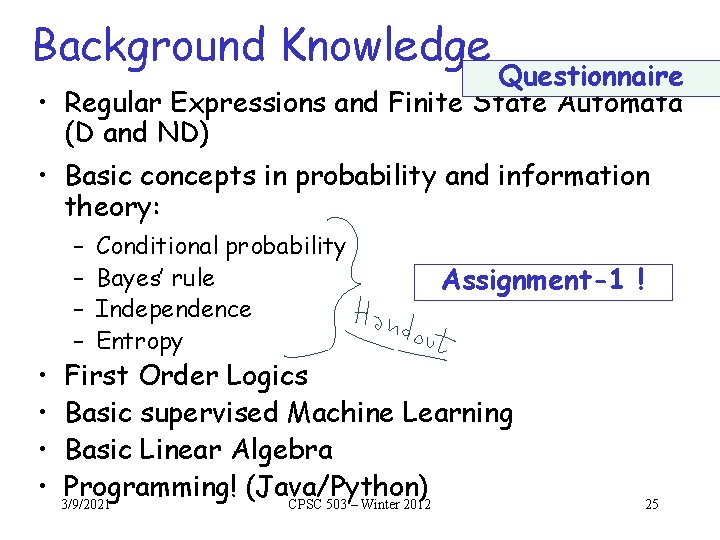
Background Knowledge Questionnaire • Regular Expressions and Finite State Automata (D and ND) • Basic concepts in probability and information theory: • • – – Conditional probability Bayes’ rule Independence Entropy Assignment-1 ! First Order Logics Basic supervised Machine Learning Basic Linear Algebra Programming! (Java/Python) 3/9/2021 CPSC 503 – Winter 2012 25
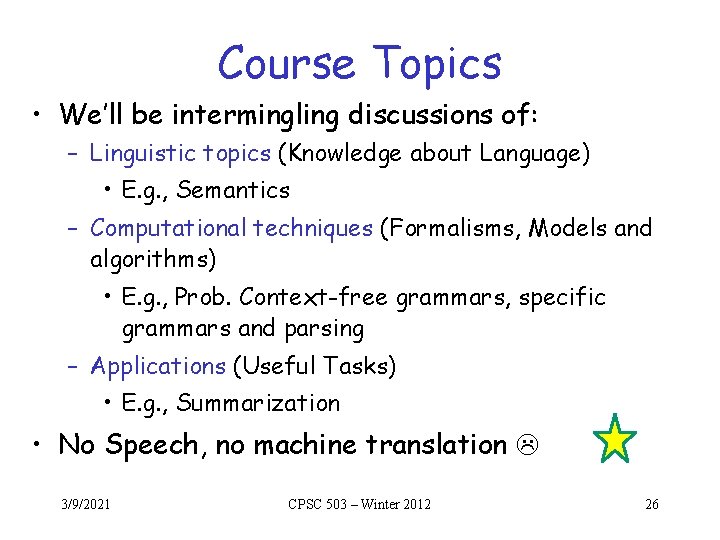
Course Topics • We’ll be intermingling discussions of: – Linguistic topics (Knowledge about Language) • E. g. , Semantics – Computational techniques (Formalisms, Models and algorithms) • E. g. , Prob. Context-free grammars, specific grammars and parsing – Applications (Useful Tasks) • E. g. , Summarization • No Speech, no machine translation 3/9/2021 CPSC 503 – Winter 2012 26
Just English? • The examples in this class are for the most part all English. – Only because it happens to be what we share. • Projects on other languages are welcome. 3/9/2021 CPSC 503 – Winter 2012 27
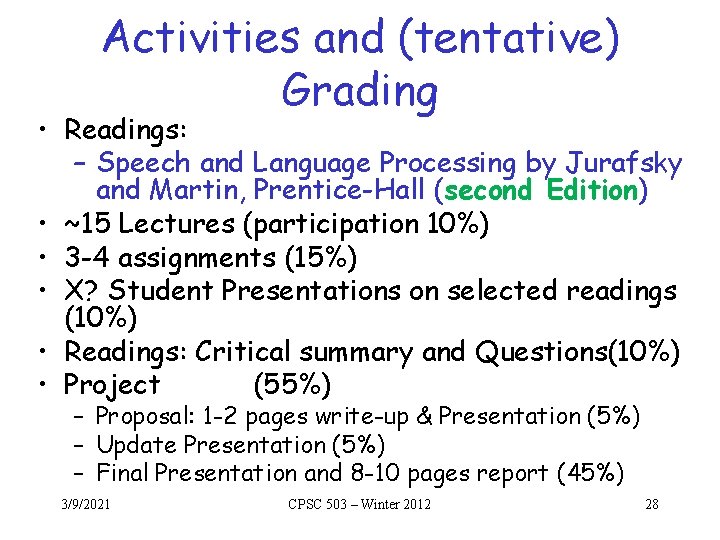
Activities and (tentative) Grading • Readings: – Speech and Language Processing by Jurafsky and Martin, Prentice-Hall (second Edition) • ~15 Lectures (participation 10%) • 3 -4 assignments (15%) • X? Student Presentations on selected readings (10%) • Readings: Critical summary and Questions(10%) • Project (55%) – Proposal: 1 -2 pages write-up & Presentation (5%) – Update Presentation (5%) – Final Presentation and 8 -10 pages report (45%) 3/9/2021 CPSC 503 – Winter 2012 28
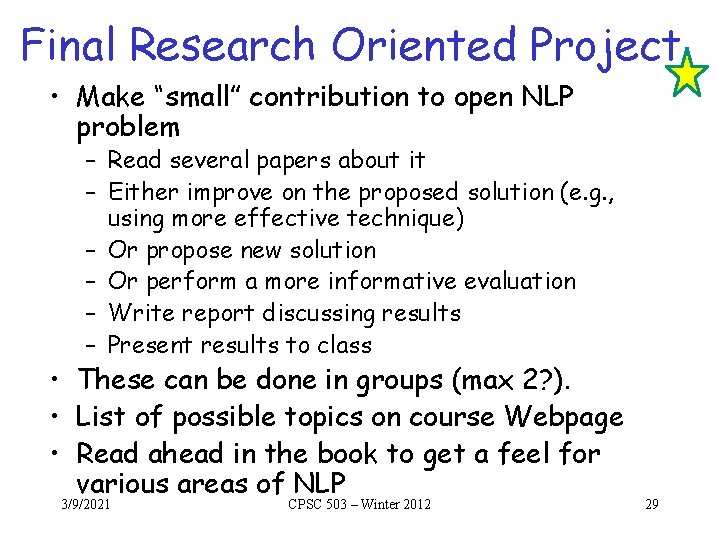
Final Research Oriented Project • Make “small” contribution to open NLP problem – Read several papers about it – Either improve on the proposed solution (e. g. , using more effective technique) – Or propose new solution – Or perform a more informative evaluation – Write report discussing results – Present results to class • These can be done in groups (max 2? ). • List of possible topics on course Webpage • Read ahead in the book to get a feel for various areas of NLP 3/9/2021 CPSC 503 – Winter 2012 29
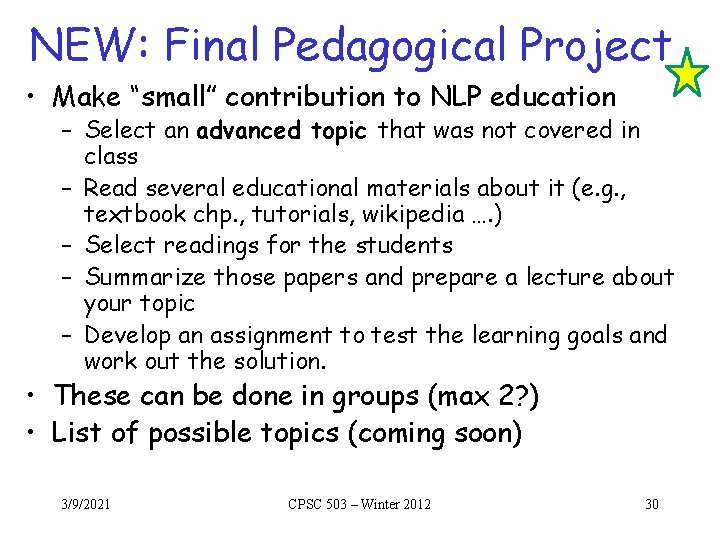
NEW: Final Pedagogical Project • Make “small” contribution to NLP education – Select an advanced topic that was not covered in class – Read several educational materials about it (e. g. , textbook chp. , tutorials, wikipedia …. ) – Select readings for the students – Summarize those papers and prepare a lecture about your topic – Develop an assignment to test the learning goals and work out the solution. • These can be done in groups (max 2? ) • List of possible topics (coming soon) 3/9/2021 CPSC 503 – Winter 2012 30
Communication: UBC Connect Link on course Web page • Assignments posted there • Questions about assignments • Questions about readings • …. 3/9/2021 CPSC 503 – Winter 2012 31
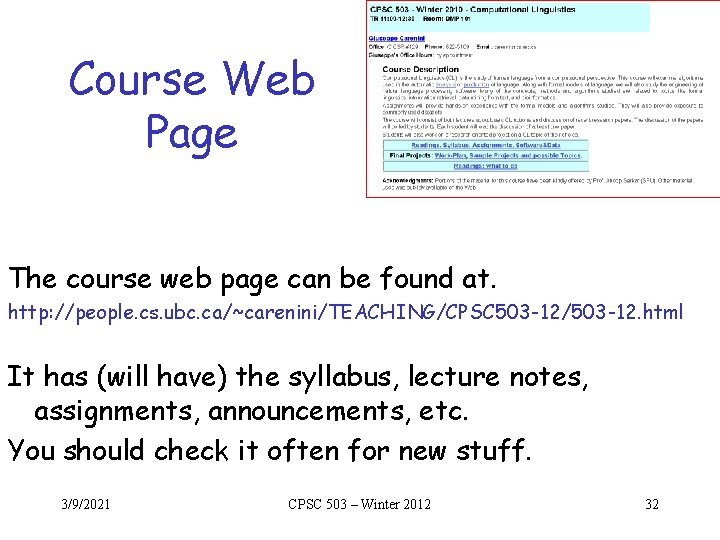
Course Web Page The course web page can be found at. http: //people. cs. ubc. ca/~carenini/TEACHING/CPSC 503 -12/503 -12. html It has (will have) the syllabus, lecture notes, assignments, announcements, etc. You should check it often for new stuff. 3/9/2021 CPSC 503 – Winter 2012 32
Today Jan 8 • Overview of the field • Overview of course – – Background knowledge Topics Activities and Grading Administrative Stuff • Introductions (if time left) 3/9/2021 CPSC 503 – Winter 2012 33
Introductions • • Your Name Previous experience in NLP? Why are you interested in NLP? Are you thinking of NLP as your main research area? If not, what else do you want to specialize in…. • Anything else………… 3/9/2021 CPSC 503 – Winter 2012 34
Next Time • Read Chapter 1 (including 1. 6 brief history ) and 2 of textbook • Chapter 2 is background knowledge. • We will start Chapter 3 • Assignment 1 will be out by this Tue 15 – due Tue 22 3/9/2021 CPSC 503 – Winter 2012 35
3/9/2021 CPSC 503 – Winter 2012 36