Connecting Healthcare Stakeholders Through HIT and Health Information




- Slides: 50
Connecting Healthcare Stakeholders Through HIT and Health Information Exchange The Inland Northwest Health Services Story Thomas Fritz, CEO Frederick Galusha, CIO Jac Davies, Director
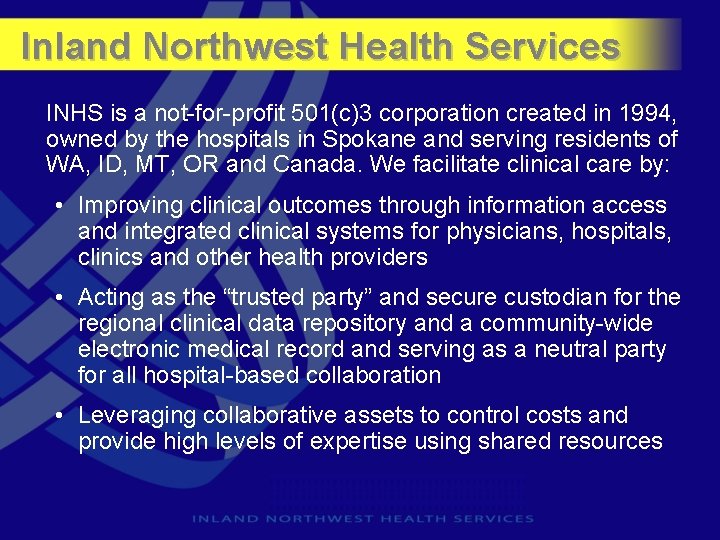
Inland Northwest Health Services INHS is a not-for-profit 501(c)3 corporation created in 1994, owned by the hospitals in Spokane and serving residents of WA, ID, MT, OR and Canada. We facilitate clinical care by: • Improving clinical outcomes through information access and integrated clinical systems for physicians, hospitals, clinics and other health providers • Acting as the “trusted party” and secure custodian for the regional clinical data repository and a community-wide electronic medical record and serving as a neutral party for all hospital-based collaboration • Leveraging collaborative assets to control costs and provide high levels of expertise using shared resources
Drivers of Collaboration • Financial savings • Community pressure (physicians) • Focused expertise • Most of the same forces exist in other communities today
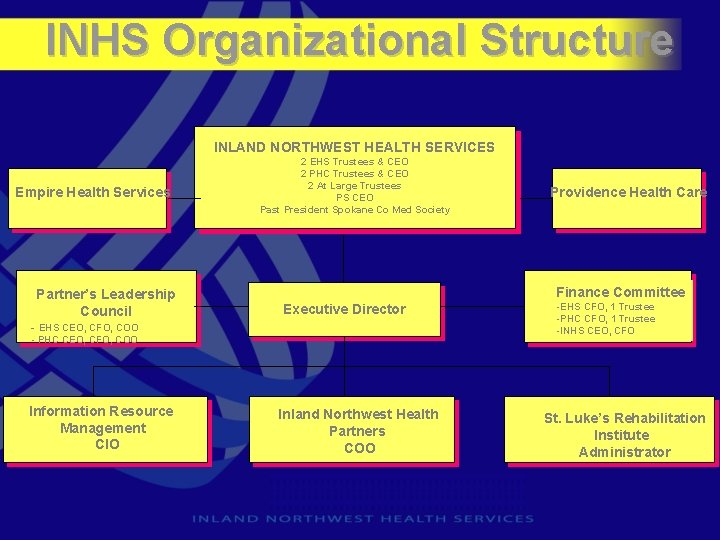
INHS Organizational Structure INLAND NORTHWEST HEALTH SERVICES Empire Health Services Partner’s Leadership Council 2 EHS Trustees & CEO 2 PHC Trustees & CEO 2 At Large Trustees PS CEO Past President Spokane Co Med Society Finance Committee Executive Director - EHS CEO, CFO, COO - PHC CEO, CFO, COO Information Resource Management CIO Providence Health Care Inland Northwest Health Partners COO -EHS CFO, 1 Trustee -PHC CFO, 1 Trustee -INHS CEO, CFO St. Luke’s Rehabilitation Institute Administrator
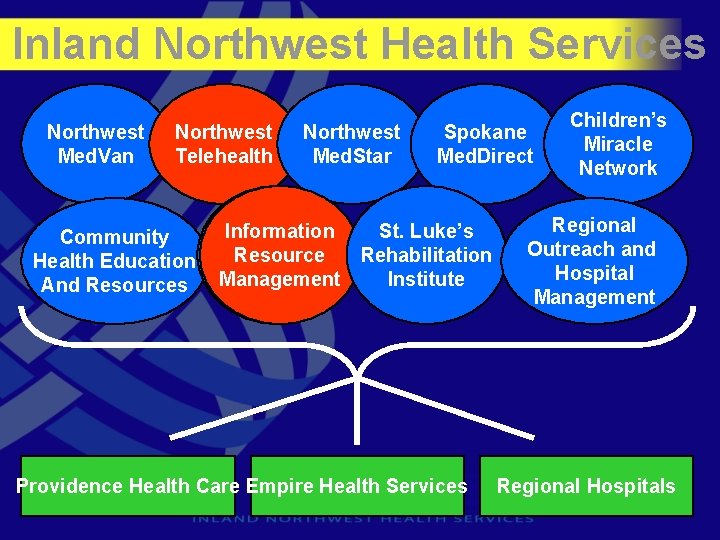
Inland Northwest Health Services Northwest Med. Van Northwest Telehealth Community Health Education And Resources Northwest Med. Star Spokane Med. Direct Information St. Luke’s Resource Rehabilitation Management Institute Providence Health Care Empire Health Services Children’s Miracle Network Regional Outreach and Hospital Management Regional Hospitals
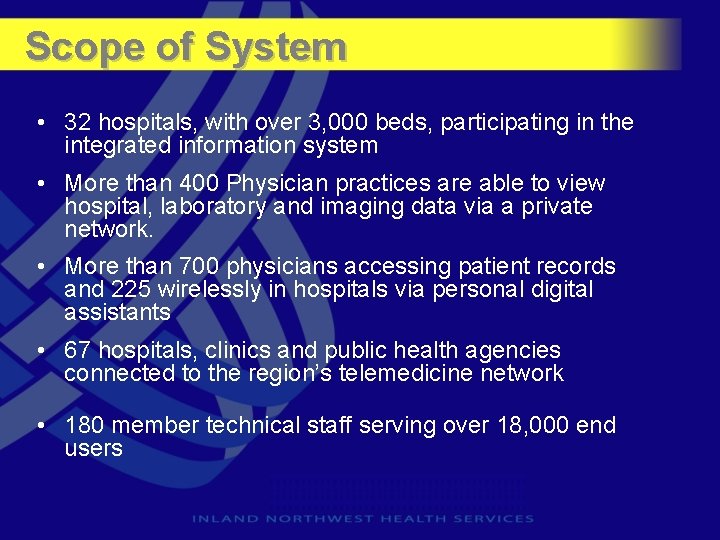
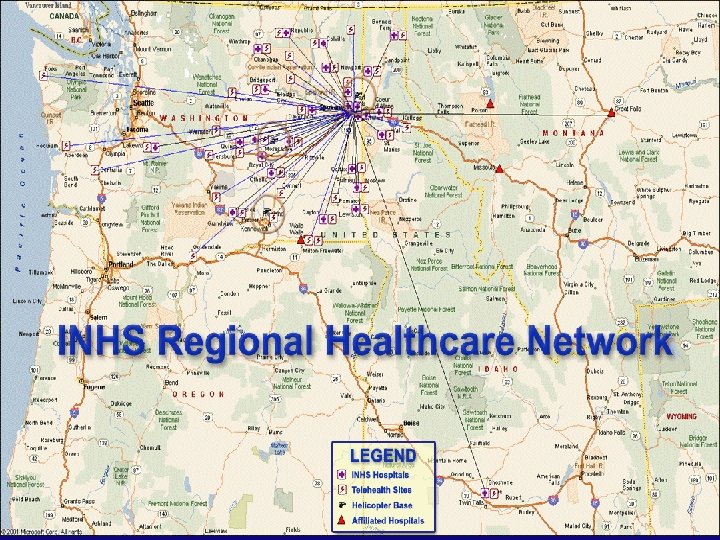
Scope of System • 32 hospitals, with over 3, 000 beds, participating in the integrated information system • More than 400 Physician practices are able to view hospital, laboratory and imaging data via a private network. • More than 700 physicians accessing patient records and 225 wirelessly in hospitals via personal digital assistants • 67 hospitals, clinics and public health agencies connected to the region’s telemedicine network • 180 member technical staff serving over 18, 000 end users
Decade of Health Information Technology "America needs to move much faster to adopt information technology in our health care system. Electronic health information will provide a quantum leap in patient power, doctor power, and effective health care. We can't wait any longer. " Tommy Thompson, Secretary, DHHS July 21, 2004
National Strategic Framework • Goal 1. Inform Clinical Practice • Goal 2 – Interconnect Clinicians • Goal 3 – Personalize Care • Goal 4 – Improve population health
Community RHIO Governance • Inland Northwest Community Health Information Project (INCHIP) – Advisory and decision-making body on community-wide health information standards and processes – Voluntary coalition, with members meeting regularly to discuss and make recommendations and decisions – Governed by Board of Directors with physician, non-physician, and community representatives – Obtain agreement on key issues, I. e. data exchange processes and standards
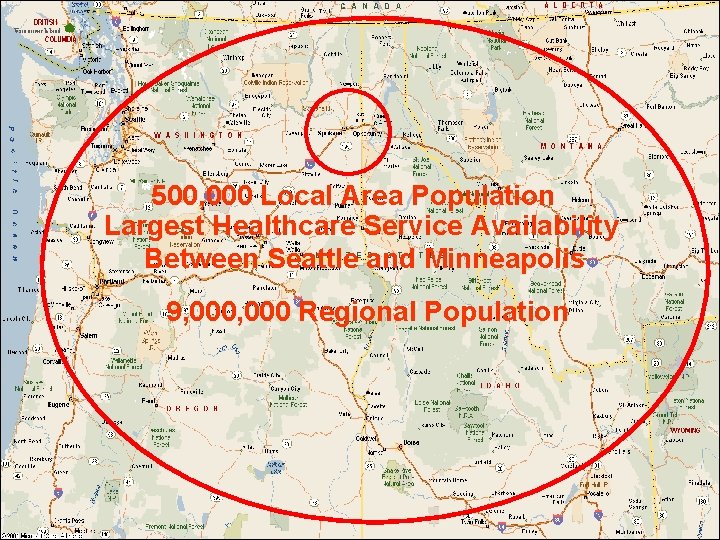
500, 000 Local Area Population Largest Healthcare Service Availability Between Seattle and Minneapolis 9, 000 Regional Population
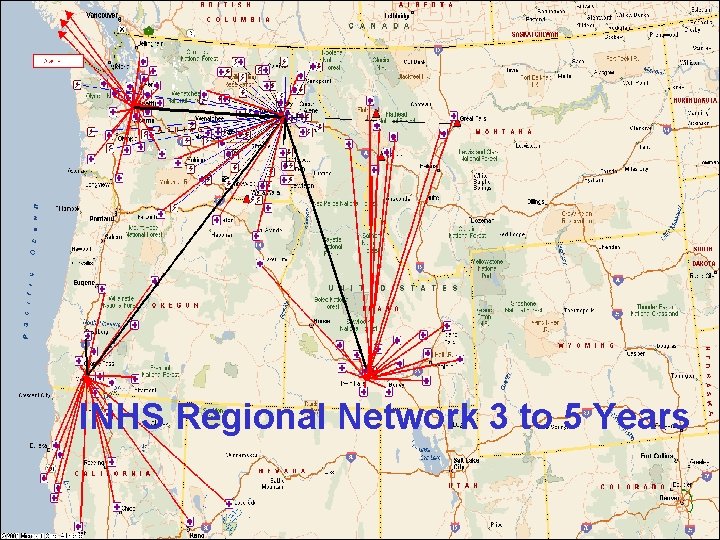
INHS Regional Network 3 to 5 Years
Regional Collaboration Source: INHS/IRM – What if? INHS Collaboration
Feedback From Recent Site Visit I might still be seeing patients. . . Your institution has what I would consider one of the most sophisticated informatics infrastructures in the entire US. That's saying something. . . I've worked at Brigham and Women's, Mass General, University of Pittsburgh and the Pittsburgh VA as well as several other hospitals on the east coast - from my perspective, your program can stand on equal footing to any of these places – surpassing. . . Pfizer Pharmaceuticals, Steve Labkoff, MD -- 27 October 2004
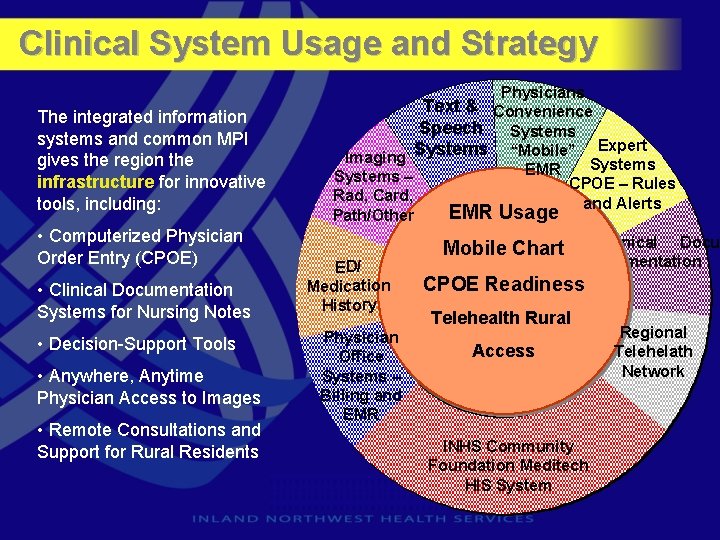
Clinical System Usage and Strategy The integrated information systems and common MPI gives the region the infrastructure for innovative tools, including: • Computerized Physician Order Entry (CPOE) • Clinical Documentation Systems for Nursing Notes • Decision-Support Tools • Anywhere, Anytime Physician Access to Images • Remote Consultations and Support for Rural Residents Physicians Text & Convenience Speech Systems Expert Imaging Systems “Mobile” Systems EMR Systems – CPOE – Rules Rad, Card, and Alerts EMR Usage Path/Other ED/ Medication History Physician Office Systems – Billing and EMR Mobile Chart Clinical Docu -mentation CPOE Readiness Telehealth Rural Access INHS Community Foundation Meditech HIS System Regional Telehelath Network
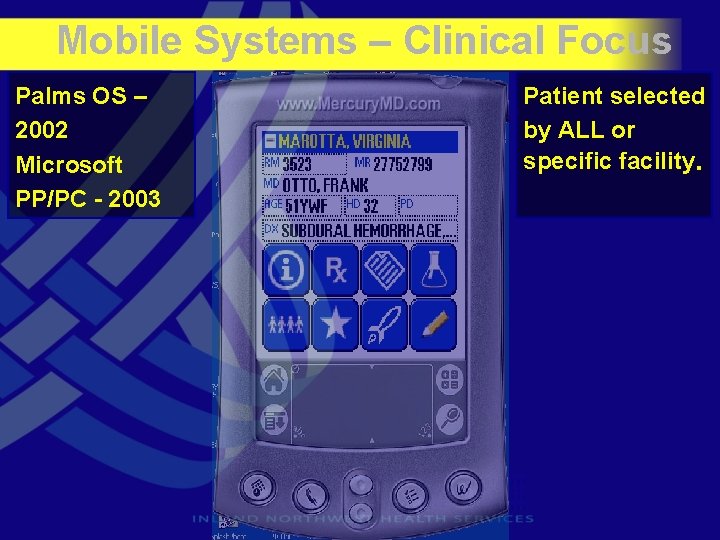
Mobile Systems – Clinical Focus Palms OS – 2002 Microsoft PP/PC - 2003 Patient selected by ALL or specific facility.
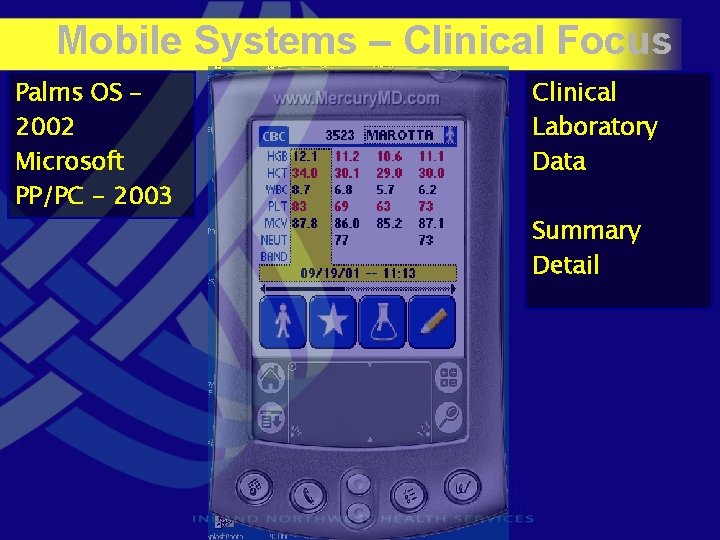
Mobile Systems – Clinical Focus Palms OS – 2002 Microsoft PP/PC - 2003 Clinical Laboratory Data Summary Detail
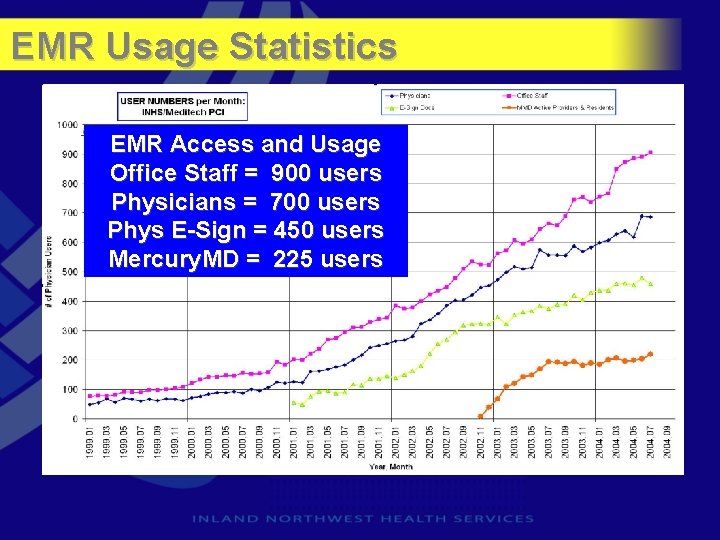
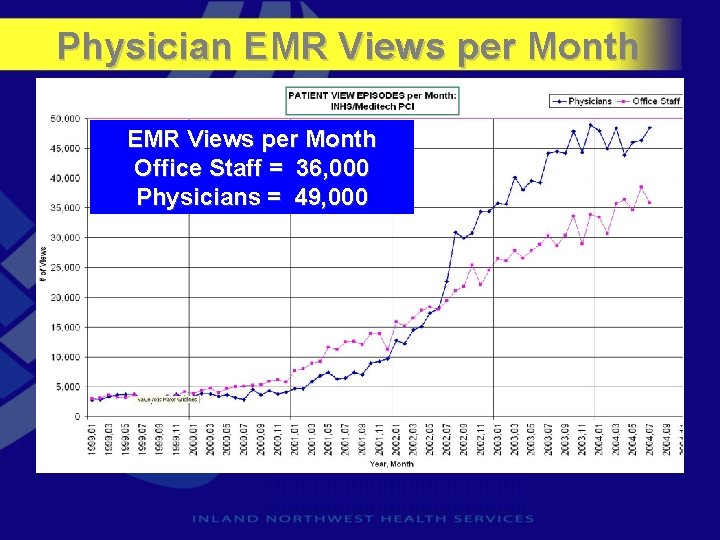
EMR Usage Statistics EMR Access and Usage Office Staff = 900 users Physicians = 700 users Phys E-Sign = 450 users Mercury. MD = 225 users
Physician EMR Views per Month Office Staff = 36, 000 Physicians = 49, 000
Physician/Clinical Connectivity Source: INHS/IRM – Dr. John Lee, SHMC Childrens Hospital
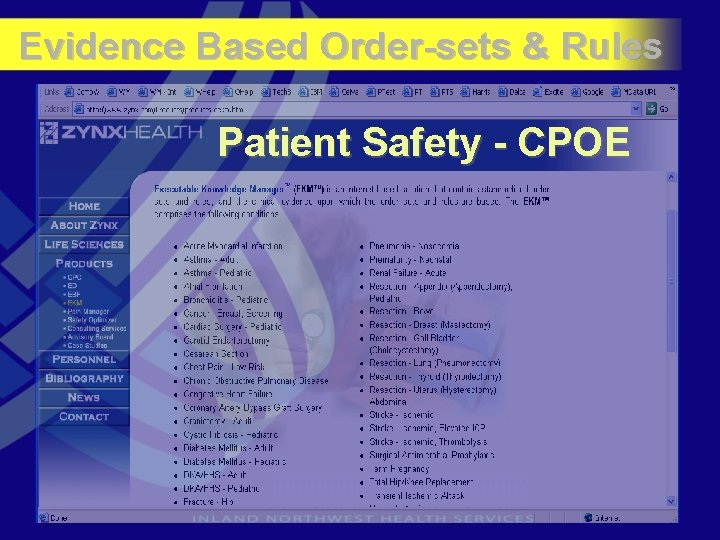
Systems Driving Patient Safety • Patient Safety – Bar-Coded Medication Verification (BMV) Systems in two hospitals to assure appropriate medication administration – Computerized Physician Order Entry (CPOE) using Evidence Based Medicine (EBM) to establish standard orders-sets – Mobil Chart on PDA (handheld) providing physicians and clinicians with the latest clinical results (Labs, Rad, Medications, Vitals and I/O) using decision support tools
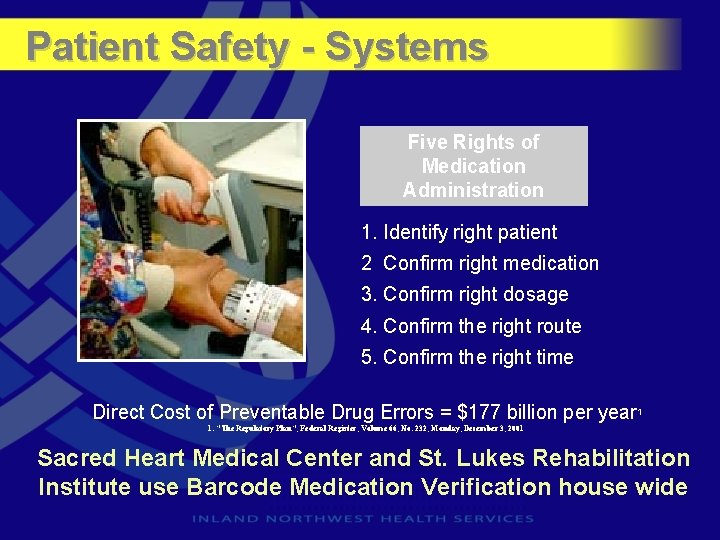
Patient Safety - Systems Five Rights of Medication Administration 1. Identify right patient 2 Confirm right medication 3. Confirm right dosage 4. Confirm the right route 5. Confirm the right time Direct Cost of Preventable Drug Errors = $177 billion per year 1 1. "The Regulatory Plan", Federal Register, Volume 66, No. 232, Monday, December 3, 2001 Sacred Heart Medical Center and St. Lukes Rehabilitation Institute use Barcode Medication Verification house wide
Evidence Based Order-sets & Rules Patient Safety - CPOE
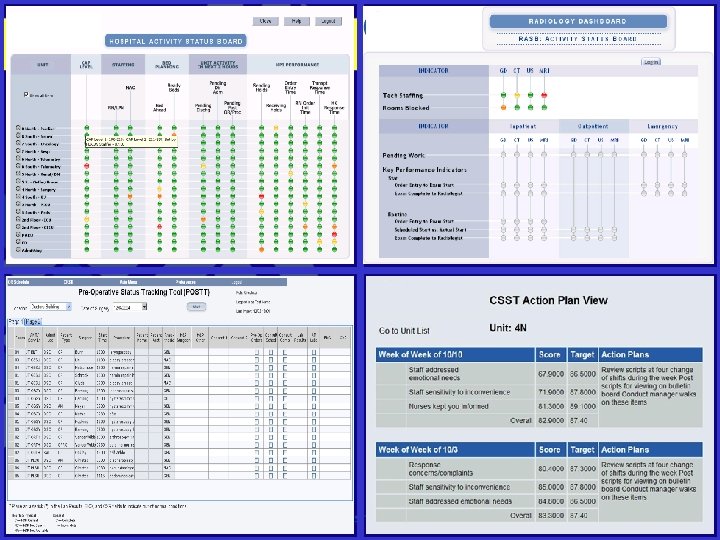
Quality and Efficiency Measures • Quality Performance and Real-time Monitoring Dashboards – Reduced ER wait time 1. 5 hours – Improved resource allocations – Increase in customer satisfaction to 90 th percentile – Transparent accountability – everyone sees what is working and what is not – JACHO accredited “core measures” vendor – Developer of Critical Access Hospital quality benchmark system
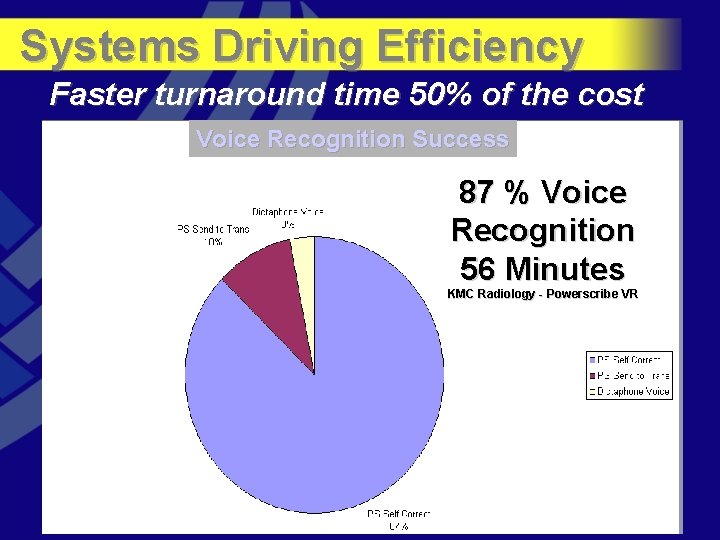
Systems Driving Efficiency Faster turnaround time 50% of the cost Voice Recognition Success 87 % Voice Recognition 56 Minutes KMC Radiology - Powerscribe VR
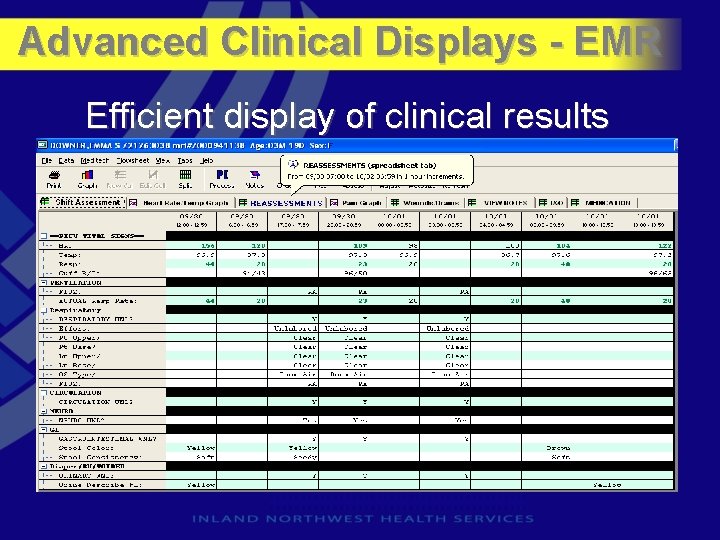
Community-wide EMR • Electronic Clinical Data – Longitudinal inpatient record for 32 hospitals – 2. 6 million unique patient records – Community digital image store – Reduced test duplication – Inpatient and outpatient lab results available – Electronic data availability (Hospital, Office, Home…) – More complete clinical data improves clinical results
Advanced Clinical Displays - EMR Efficient display of clinical results
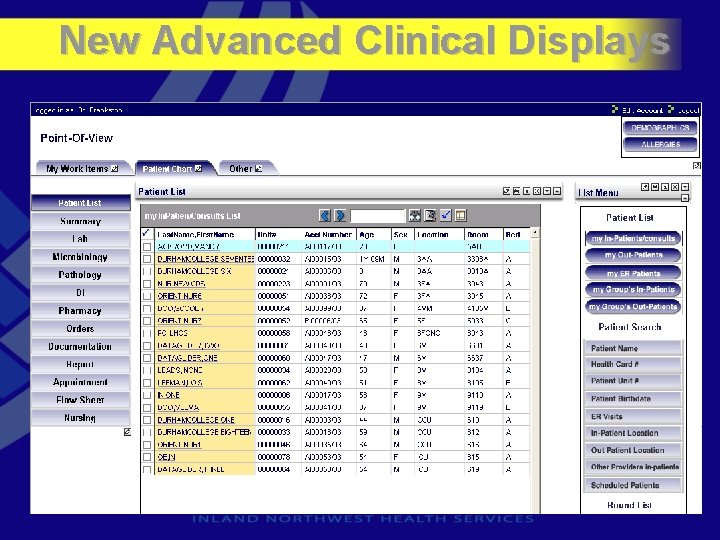
New Advanced Clinical Displays
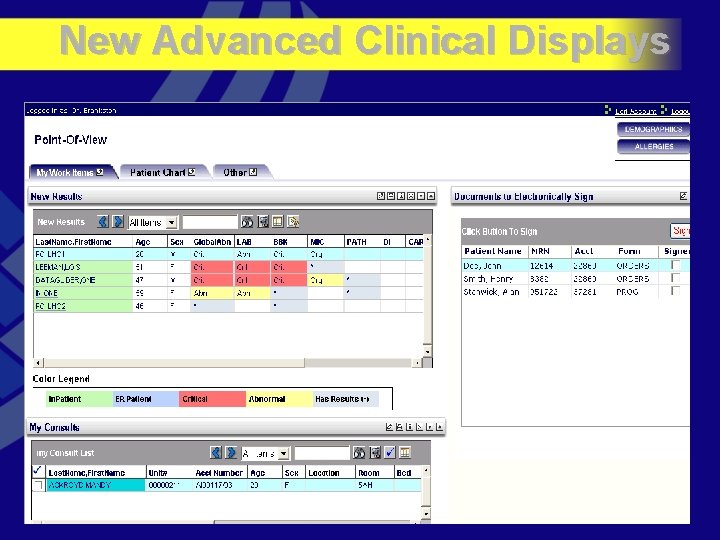
New Advanced Clinical Displays
Physician/Clinical Connectivity Source: INHS/IRM – Tom Carli Mgr, Spokane Internal Medicine
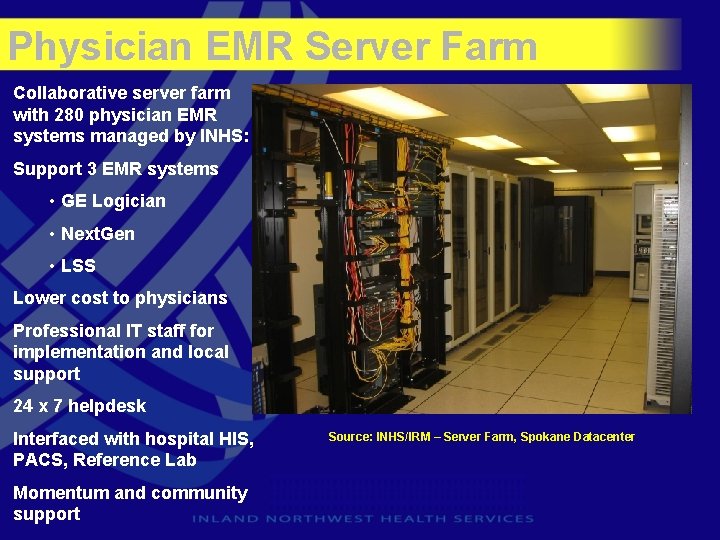
Physician EMR Server Farm Collaborative server farm with 280 physician EMR systems managed by INHS: Support 3 EMR systems • GE Logician • Next. Gen • LSS Lower cost to physicians Professional IT staff for implementation and local support 24 x 7 helpdesk Interfaced with hospital HIS, PACS, Reference Lab Momentum and community support Source: INHS/IRM – Server Farm, Spokane Datacenter
INHS Telemedicine System • Nursing courses and education with universities and community colleges addressing Nursing Shortages • Rural hospital Tele. Pharmacy program providing remote Pharmacist services • Tele. ER program assisting rural trauma doctors with ER cases remotely • Physicians provide remote Clinical Consults in Neurology, Pathology, Psychiatric services, and many other areas • Prison Based Health Services receive specialist care • Statewide Diabetes Education Program Including Native American Tribes
Telepharmacy in our Region Source: INHS/IRM – Kristy Nielsen, and Othello Hospital
Tele. ER Live Today Source: INHS/IRM – Dr. Jim Nania EHS Emergency Room
Accomplishments • We have improved clinical outcomes through information access and integrated clinical systems for physicians, hospitals, clinics and other health providers • We have become the “trusted party” and secure custodian for a regional clinical data repository. • We have leveraged collaborative assets to control costs and provide high levels of expertise using shared resources
Accomplishments • We established a regional Master Patient Index standard that has allowed us to gather and distribute patient data to the caregivers in our region • We established standard data sets, allowing comparison of clinical data and enhancing the longitudinal patient record • We created a regional integrated information system that connects hospitals, clinics and physician offices, providing a community Electronic Medical Record
Accomplishments • We connected Physicians throughout the region, directly in their offices and wirelessly within our hospitals, providing relevant clinical data when and where they need it • We enhanced care in rural areas by connecting residents and clinicians to specialists through an extensive regional telemedicine network • We increased patient safety by utilizing advanced systems
Outcomes • One hospital projected cost savings of $1. 3 million over four years by implementing a new hospital IS within the INHS shared services model • Participating hospitals spend 2. 0% on HIT versus national average of 3. 1% • Pre-INHS, one hospital needed 98 FTEs for IS. INHS uses 57 FTEs to support that account, which now includes Meditech, approximately 200 other IT systems, and around 2500 desktop devices
Outcomes • One hospital implemented bar-coded medication verification and found that 1% of its medication administrations would have resulted in errors without the intervention of the new system • The Tele. Pharmacy program intervened in 3% of the medication administrations in a rural hospital to avoid medication errors
Outcomes • Air ambulance service – went from annual loss of more than $4 million to revenue of $1 million each year in net income • Rehabilitation services went from more than $6 million in debt to $1 million in revenue • In 2003, rural hospitals in Washington saved over $500, 000 in travel costs by using the telemedicine network for training and meetings.
Obstacles and Challenges • Limited funds from rural hospitals slows their adoption of key clinical systems • Each new hospital brings new challenges – wanting everything for nothing • Minimal physician office automation has slowed the longitudinal electronic medical record • Poor IT investment decisions – hospitals and physicians are buying IT without knowing enough
What we have learned • Creating a sustainable business model: – Leverage assets – Provide an efficient cost plus model – Create standardization – Assure value-added services – Assure quality of services – Get lowest cost from vendors • If you do these things, customers will stay and the business will be sustainable
What we have learned • Does the vendor matter? – No, doesn’t matter which vendor is used – Savings arise from standardization – Value is in having a core business function, and leveraging that core to provide other services
What we have learned • Drivers are what affect joint ventures – Are the drivers financial? Probably should look at standardization of information systems – Are the drivers clinical (data exchange)? Can focus on data standards for information sharing – Identify the real business needs of the participants and their communities
What we have learned • How do you create sharing among competitors? – Let competitors run on the same network – Governance needs to be neutral, not favoring any competitor – Neutral governance organization can promote agreements on common issues (MPI, network standards, etc)
What we have learned • Joint ventures are hard – Every time there is a board or CEO change in a participating organization, have to rejustify the venture. – A joint venture does not institutionalize itself
What we have learned • Community governance organizations take work – Members continuously jockey for position – Members have to be willing to set aside selfinterest – Everyone has to keep working at it – Organization must have structure. expectations for conduct, and ground rules for communication and problem-solving
Physician/Clinical Connectivity Source: INHS/IRM – Dr. Terri Lewis, SHMC Radiology Department
Thank You Tom Fritz fritzt@inhs. org Fred Galusha galushf@inhs. org Jac Davies daviesjc@inhs. org www. inhs. org