Conference of the Parties to CETS 198 Training

- Slides: 20
Conference of the Parties to CETS 198 Training for Rapporteurs International Cooperation B. Verhelst Moneyval LE expert
Section 2: Investigative Assistance �Art. 16: Obligation to assist �Art. 17: Requests for information on bank accounts �Art. 18: Requests for information on banking transactions �Art. 19: Requests for the monitoring of banking transactions �Art. 20: Spontaneous information
Article 17 – Information on bank accounts
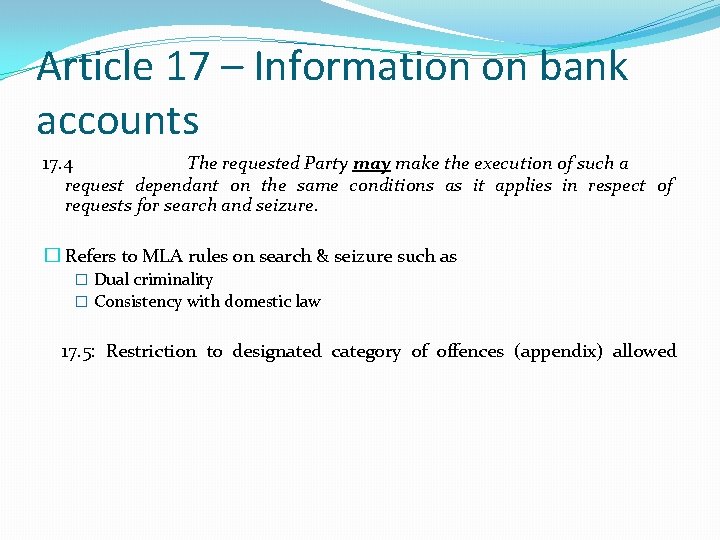
Article 17 – Information on bank accounts 17. 4 The requested Party make the execution of such a request dependant on the same conditions as it applies in respect of requests for search and seizure. � Refers to MLA rules on search & seizure such as � Dual criminality � Consistency with domestic law 17. 5: Restriction to designated category of offences (appendix) allowed
Article 18 – information on banking transactions
Article 19 – Monitoring banking transactions
Article 17 – Information on bank accounts Article 18 – information on banking transactions Article 19 – Monitoring banking transactions �Level of compliance/effective implementation Requests received and fully executed? �Incomplete requests refused or sent back? �Subject to search & seizure conditions? Which? Prevents effective implementation? �Art. 17 : Limited list of relevant offences? Conformity with appendix? �Extension to NBFIs (discretionary)? If not, legal obstacles?
Section 4: Confiscation �Art. 23: Obligation to confiscate �Art. 24: Execution of confiscation �Art. 25: Confiscated property �Art. 26: Right of enforcement and maximim amount of confiscation �Art. 27: Imprisonment in default
Article 23 – Obligation to confiscate 23. 1 A party, which has received a request by another Party for confiscation concerning instrumentalities or proceeds, situated in its territory, shall: a enforce a confiscation order made by a court of a requesting Party in relation to such instrumentalities or proceeds; or b submit the request to its competent authorities for the purpose of obtaining. an order of confiscation and, if such order is granted, enforce it � Identical to 1990 Convention � See art. 3 (domestic) � Quid object of the offence (autonomous ML)? � a) Exequatur , and/or b) Initiate own procedure (Art. 23. 2)
Article 23 – Obligation to confiscate 23. 3 : Enforcement equivalent value confiscation � See 1990 Convention � Property (any nature) located in requested Party � If no payment: claim to be executed on any available property 23. 4: Confiscation request related specific item � See 1990 Convention � Possibility to enforce in the form of equivalent value � Discretionary : if both Parties agree
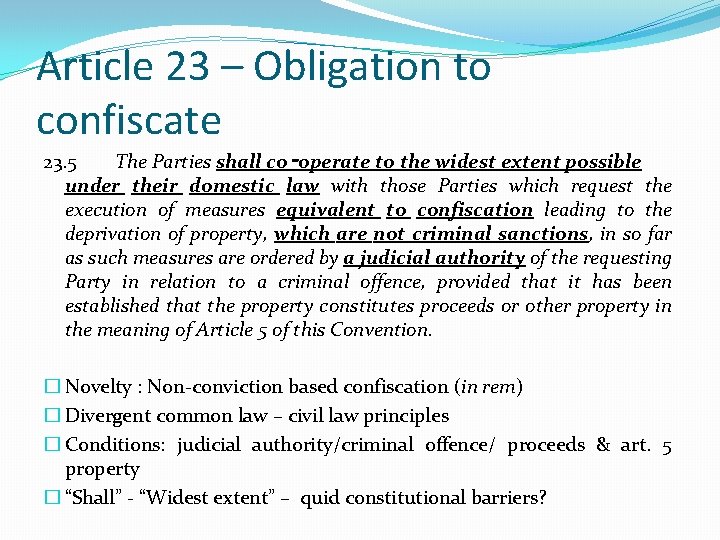
Article 23 – Obligation to confiscate 23. 5 The Parties shall co‑operate to the widest extent possible under their domestic law with those Parties which request the execution of measures equivalent to confiscation leading to the deprivation of property, which are not criminal sanctions, in so far as such measures are ordered by a judicial authority of the requesting Party in relation to a criminal offence, provided that it has been established that the property constitutes proceeds or other property in the meaning of Article 5 of this Convention. � Novelty : Non-conviction based confiscation (in rem) � Divergent common law – civil law principles � Conditions: judicial authority/criminal offence/ proceeds & art. 5 property � “Shall” - “Widest extent” – quid constitutional barriers?
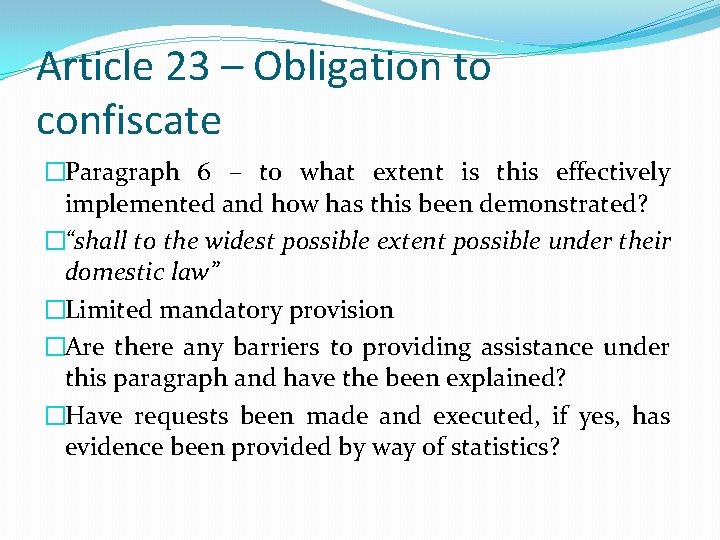
Article 23 – Obligation to confiscate �Paragraph 6 – to what extent is this effectively implemented and how has this been demonstrated? �“shall to the widest possible extent possible under their domestic law” �Limited mandatory provision �Are there any barriers to providing assistance under this paragraph and have the been explained? �Have requests been made and executed, if yes, has evidence been provided by way of statistics?
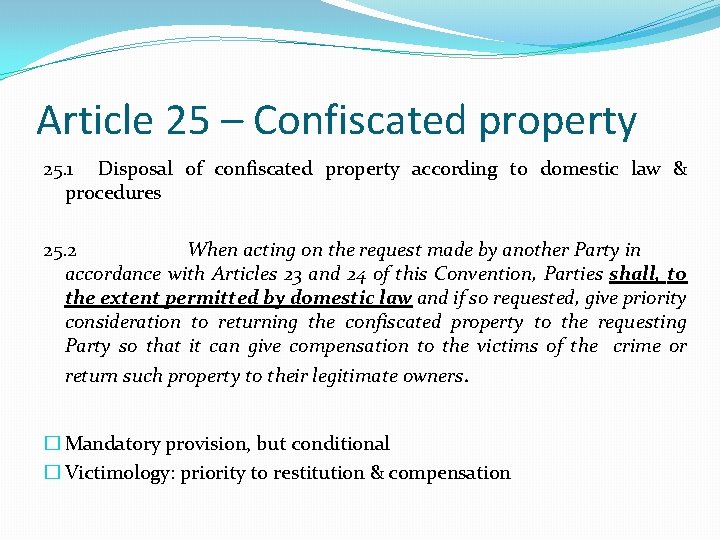
Article 25 – Confiscated property 25. 1 Disposal of confiscated property according to domestic law & procedures 25. 2 When acting on the request made by another Party in accordance with Articles 23 and 24 of this Convention, Parties shall, to the extent permitted by domestic law and if so requested, give priority consideration to returning the confiscated property to the requesting Party so that it can give compensation to the victims of the crime or return such property to their legitimate owners. � Mandatory provision, but conditional � Victimology: priority to restitution & compensation
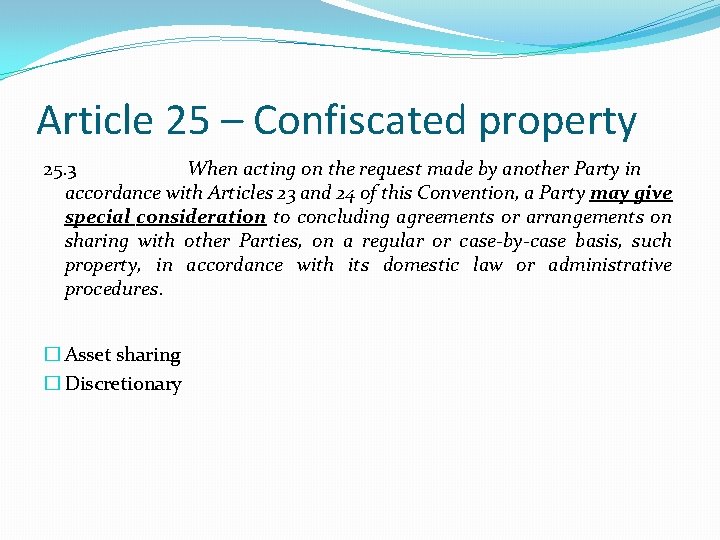
Article 25 – Confiscated property 25. 3 When acting on the request made by another Party in accordance with Articles 23 and 24 of this Convention, a Party may give special consideration to concluding agreements or arrangements on sharing with other Parties, on a regular or case-by-case basis, such property, in accordance with its domestic law or administrative procedures. � Asset sharing � Discretionary
Article 25 – Confiscated property �Paragraph 2 – can property be returned? �If yes, what evidence has been provided to demonstrate this? If no, why not? �Paragraph 3 – have any asset sharing agreements been entered into? What countries? �Statistics on assets shared. Examples?
Section 5: Refusal and postponement of cooperation �Art. 28: Grounds for refusal �Art. 29: Postponement �Art. 30: Partial or conditional granting of a request
Article 28 – Discretionary rounds for refusal (general) 28. 1 Co‑operation under this chapter may be refused if: 28. 1. a. Against the fundamental principles of the legal system 28. 1. b. Prejudice to sovereignty. . . other essential interest 28. 1. c. Request disproportionate to importance of the case 28. 1. d. Fiscal exception, save financing of terrorism 28. 1. e Political offence, except for financing of terrorism 28. 1. f. Ne bis in idem (double jeopardy) 28. 1. g. Dual criminality - S. 2 (invest. ass. ): only if coercive action - conduct underlying the offence � Cfr. 1990 Convention (except bold) � Discretionary � Exclusive (no other grounds accepted)
Article 28 – Discretionary Grounds for refusal (other) 28. 2. & 3. : Ch. IV - Sect. 2 (coercive investigative assistance) & Sect. 3 (provisional measures) - not provided or permitted in domestic law - request not emanating from judicial authority 28. 4. a. to e. Miscellaneous & procedural grounds 28. 4. f+28. 5. & 6. In absentia – rights of defence 28. 7 Bank secrecy cannot be invoked - request emanating from judicial authority 28. 8. : no refusal grounds a. Legal persons b. Death or dissolution of legal person c. Author of predicate offence
Article 28 – Grounds for refusal �Par. 1 d and 1 e – have these exceptions been exercised? If yes, how many times has it been invoked? �Compare with number of requests for assistance �Par. 8 c – has this been invoked? Statistics. � Compare with number of requests for assistance �If refused, fundamental principle argument acceptable?
Section 7: Procedural and other general Rules Article 34 – Direct communication Art. 34. 1. Between Central Authorities (CA) Art. 34. 2. Urgency: between judicial authorities (uncluding PP) with copy to CA Art. 34. 3. Use of Interpol communication line Art. 34. 4. Reference to competent authority in case of mistake Art. 34. 5. Non-coercive Sect. 2 requests (investigative assistance): direct communication between competent authorities Art. 34. 6. Possibility to send draft requests/communications between judicial authorities prior to formal request � Practical arrangements to enhance efficiency � Check average execution time (urgent/ not urgent)