Computer Security CS 426 Lecture 34 DNS Security
- Slides: 34
Computer Security CS 426 Lecture 34 DNS Security CS 426 Fall 2010/Lecture 34 1
Domain Name System • Translate host names to IP addresses – E. g. , www. google. com 74. 125. 91. 103 – Hostnames are human-friendly – IP addresses keep changing • And back – From IP addresses to DNS name • Analogy: Phone book for the Internet – Where they differ? CS 426 Fall 2010/Lecture 34 2
DNS is a Distributed Database • Information is stored in a distributed way • Highly dynamic • Decentralized authority CS 426 Fall 2010/Lecture 34 3
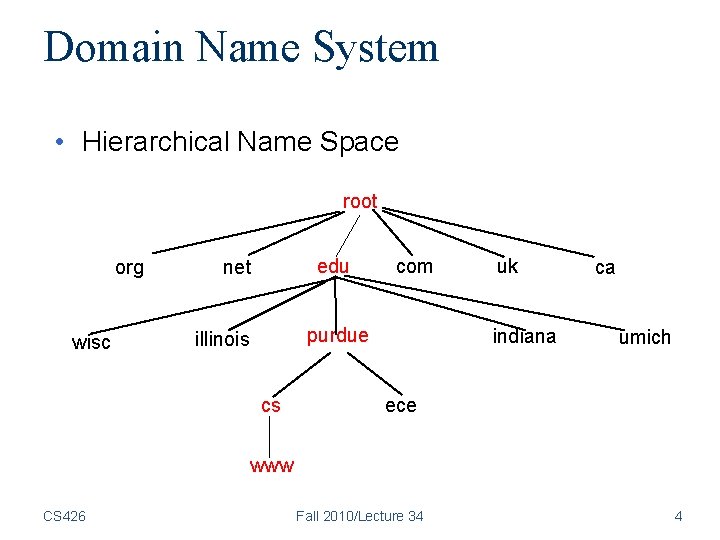
Domain Name System • Hierarchical Name Space root org wisc edu net com purdue illinois cs uk indiana ca umich ece www CS 426 Fall 2010/Lecture 34 4
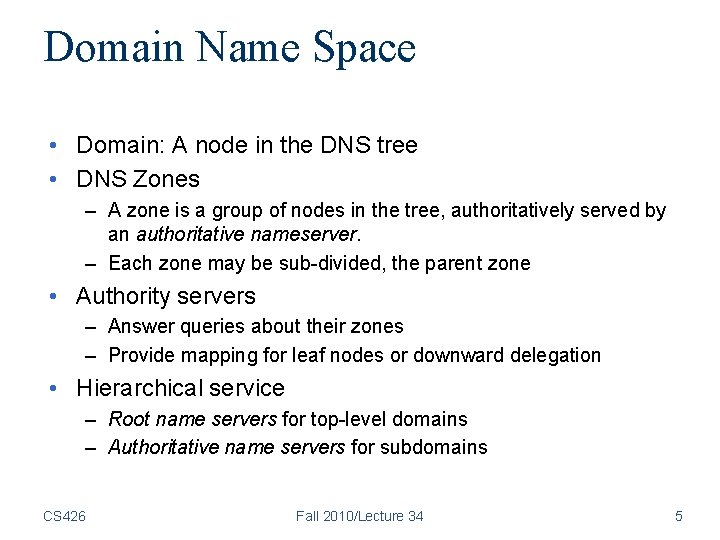
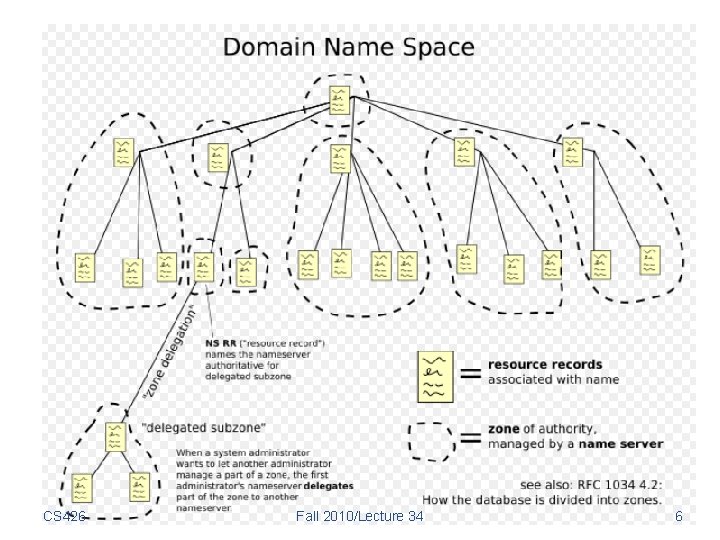
Domain Name Space • Domain: A node in the DNS tree • DNS Zones – A zone is a group of nodes in the tree, authoritatively served by an authoritative nameserver. – Each zone may be sub-divided, the parent zone • Authority servers – Answer queries about their zones – Provide mapping for leaf nodes or downward delegation • Hierarchical service – Root name servers for top-level domains – Authoritative name servers for subdomains CS 426 Fall 2010/Lecture 34 5
Domain Name Space (cont’) CS 426 Fall 2010/Lecture 34 6
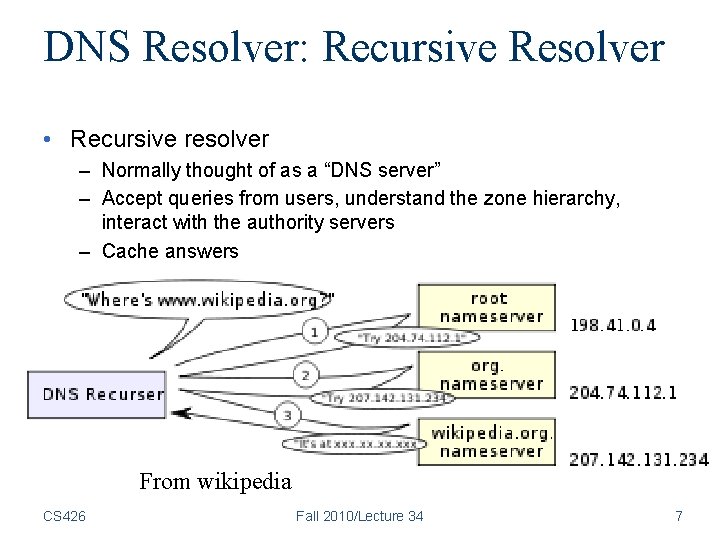
DNS Resolver: Recursive Resolver • Recursive resolver – Normally thought of as a “DNS server” – Accept queries from users, understand the zone hierarchy, interact with the authority servers – Cache answers From wikipedia CS 426 Fall 2010/Lecture 34 7
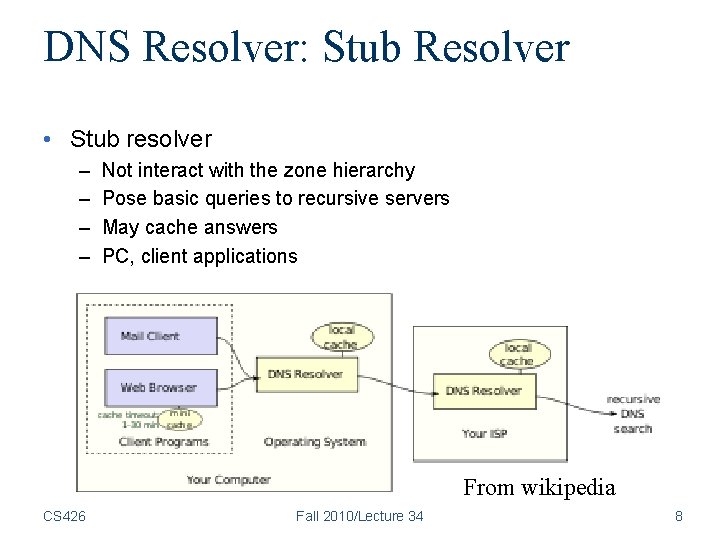
DNS Resolver: Stub Resolver • Stub resolver – – Not interact with the zone hierarchy Pose basic queries to recursive servers May cache answers PC, client applications From wikipedia CS 426 Fall 2010/Lecture 34 8
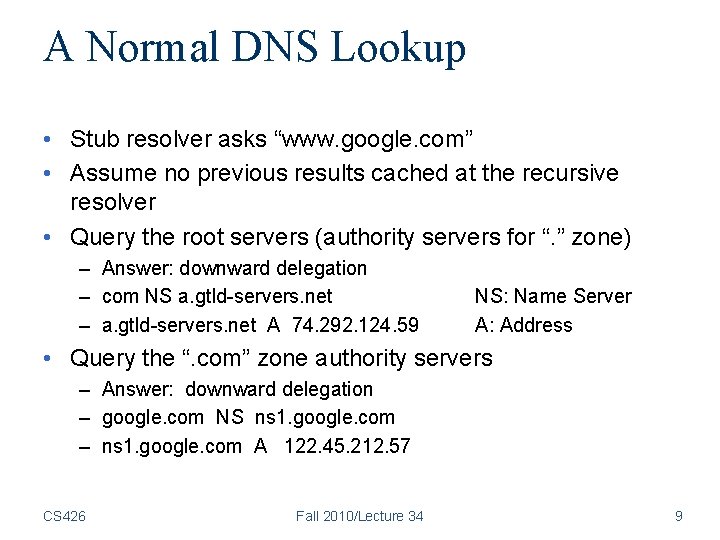
A Normal DNS Lookup • Stub resolver asks “www. google. com” • Assume no previous results cached at the recursive resolver • Query the root servers (authority servers for “. ” zone) – Answer: downward delegation – com NS a. gtld-servers. net – a. gtld-servers. net A 74. 292. 124. 59 NS: Name Server A: Address • Query the “. com” zone authority servers – Answer: downward delegation – google. com NS ns 1. google. com – ns 1. google. com A 122. 45. 212. 57 CS 426 Fall 2010/Lecture 34 9
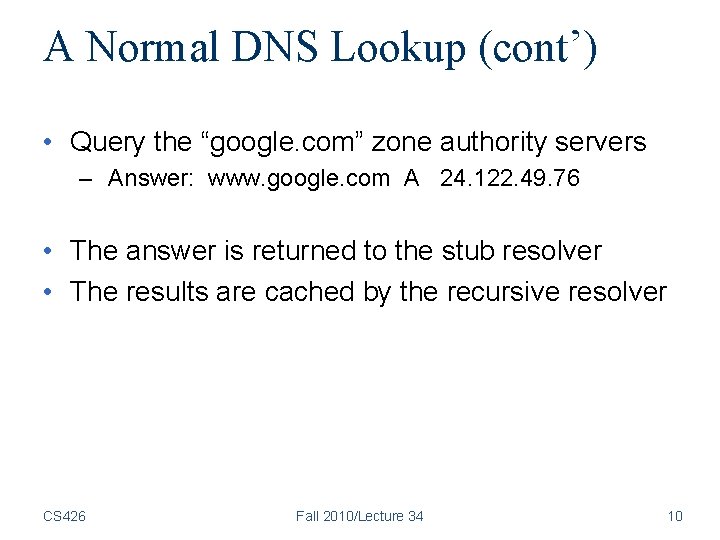
A Normal DNS Lookup (cont’) • Query the “google. com” zone authority servers – Answer: www. google. com A 24. 122. 49. 76 • The answer is returned to the stub resolver • The results are cached by the recursive resolver CS 426 Fall 2010/Lecture 34 10
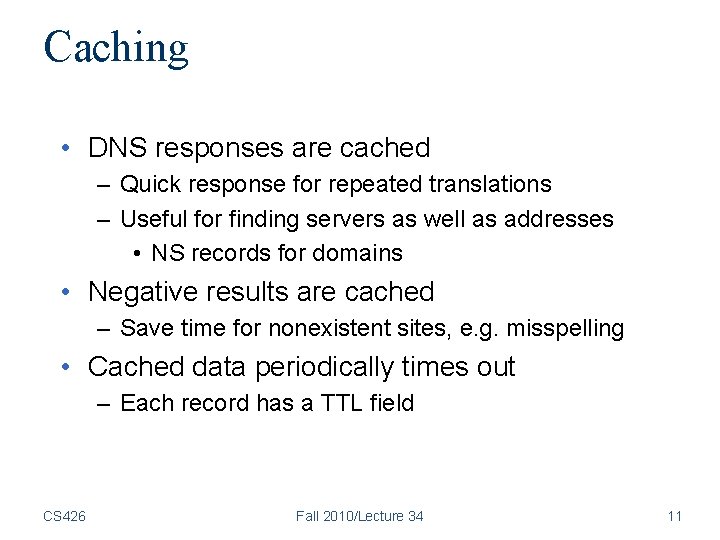
Caching • DNS responses are cached – Quick response for repeated translations – Useful for finding servers as well as addresses • NS records for domains • Negative results are cached – Save time for nonexistent sites, e. g. misspelling • Cached data periodically times out – Each record has a TTL field CS 426 Fall 2010/Lecture 34 11
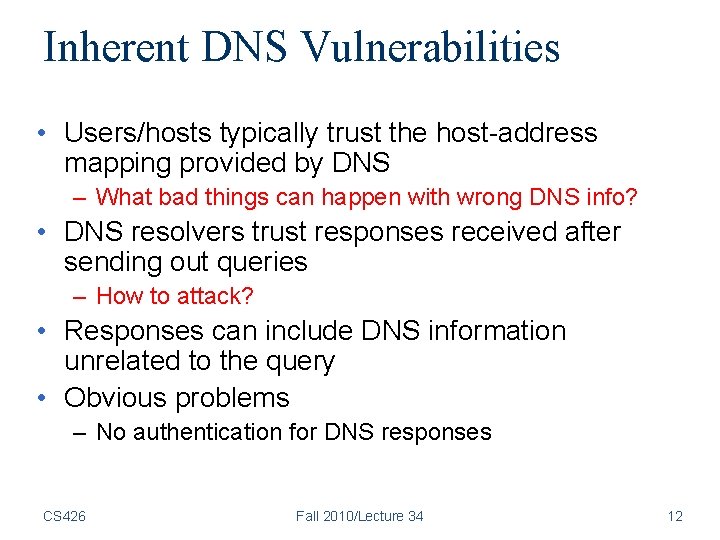
Inherent DNS Vulnerabilities • Users/hosts typically trust the host-address mapping provided by DNS – What bad things can happen with wrong DNS info? • DNS resolvers trust responses received after sending out queries – How to attack? • Responses can include DNS information unrelated to the query • Obvious problems – No authentication for DNS responses CS 426 Fall 2010/Lecture 34 12
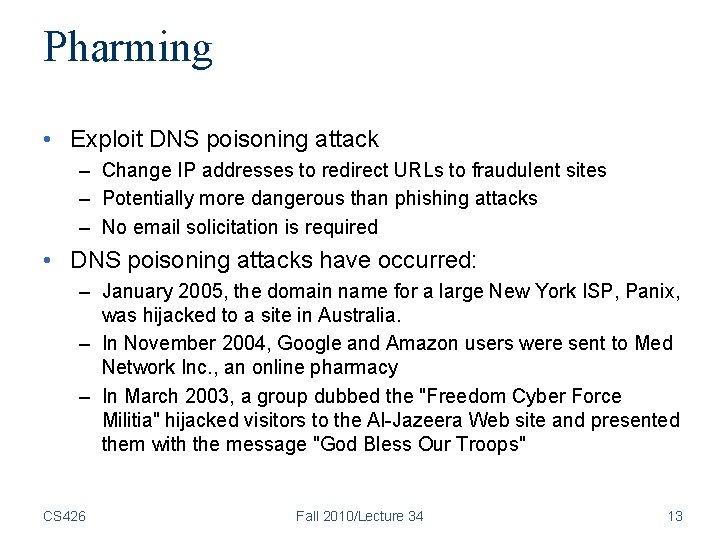
Pharming • Exploit DNS poisoning attack – Change IP addresses to redirect URLs to fraudulent sites – Potentially more dangerous than phishing attacks – No email solicitation is required • DNS poisoning attacks have occurred: – January 2005, the domain name for a large New York ISP, Panix, was hijacked to a site in Australia. – In November 2004, Google and Amazon users were sent to Med Network Inc. , an online pharmacy – In March 2003, a group dubbed the "Freedom Cyber Force Militia" hijacked visitors to the Al-Jazeera Web site and presented them with the message "God Bless Our Troops" CS 426 Fall 2010/Lecture 34 13
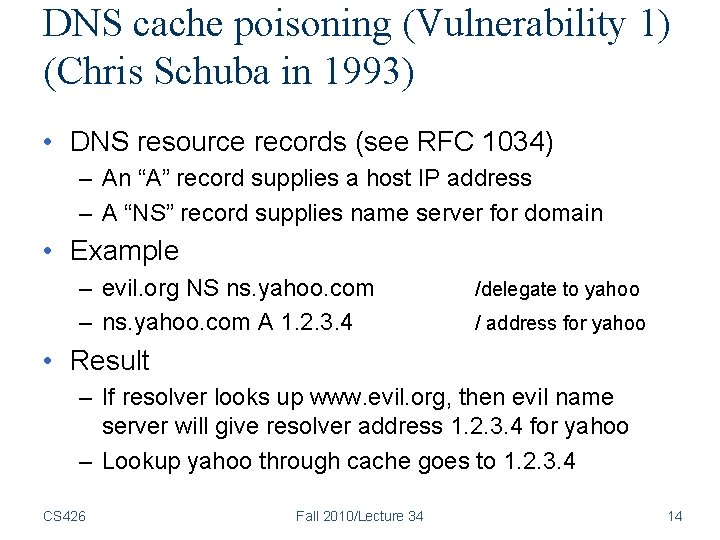
DNS cache poisoning (Vulnerability 1) (Chris Schuba in 1993) • DNS resource records (see RFC 1034) – An “A” record supplies a host IP address – A “NS” record supplies name server for domain • Example – evil. org NS ns. yahoo. com – ns. yahoo. com A 1. 2. 3. 4 /delegate to yahoo / address for yahoo • Result – If resolver looks up www. evil. org, then evil name server will give resolver address 1. 2. 3. 4 for yahoo – Lookup yahoo through cache goes to 1. 2. 3. 4 CS 426 Fall 2010/Lecture 34 14
Defense Using The Bailiwicks Rules • The bailiwick system prevents foo. com from declaring anything about com, or some other new TLD, or www. google. com • Using the bailiwicks rules – The root servers can return any record – The com servers can return any record for com – The google. com servers can return any record for google. com CS 426 Fall 2010/Lecture 34 15
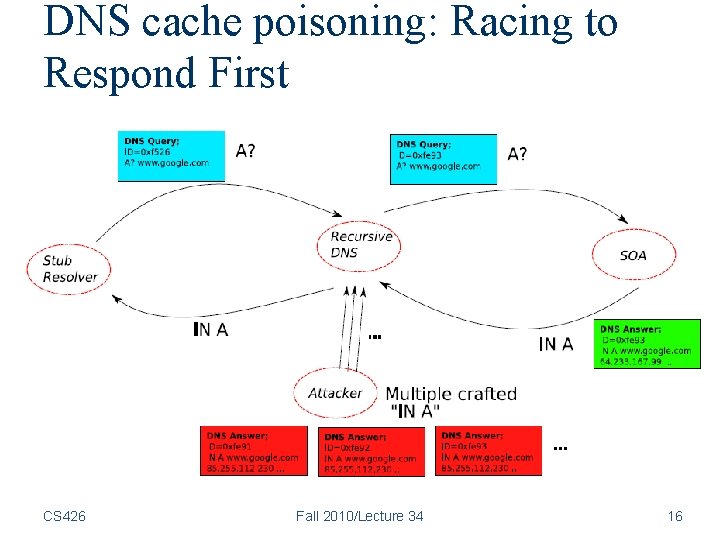
DNS cache poisoning: Racing to Respond First CS 426 Fall 2010/Lecture 34 16
DNS Cache Poisoning • Attacker wants his IP address returned for a DNS query • When the resolver asks ns 1. google. com for www. google. com, the attacker could reply first, with his own IP • What is supposed to prevent this? • Transaction ID – 16 -bit random number – The real server knows the number, because it was contained in the query – The attacker has to guess CS 426 Fall 2010/Lecture 34 17
DNS cache poisoning (Vulnerability 2) • Responding before the real nameserver – An attacker can guess when a DNS cache entry times out and a query has been sent, and provide a fake response. – The fake response will be accepted only when its 16 bit transaction ID matches the query – CERT reported in 1997 that BIND uses sequential transaction ID and is easily predicted • fixed by using random transaction IDs CS 426 Fall 2010/Lecture 34 18
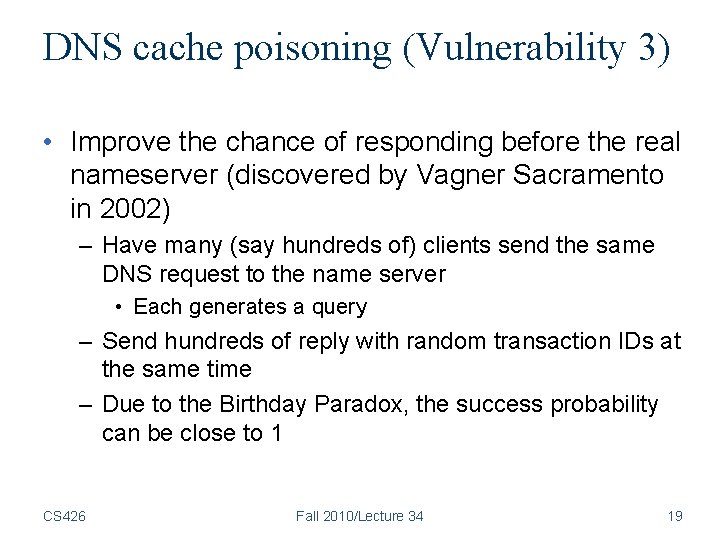
DNS cache poisoning (Vulnerability 3) • Improve the chance of responding before the real nameserver (discovered by Vagner Sacramento in 2002) – Have many (say hundreds of) clients send the same DNS request to the name server • Each generates a query – Send hundreds of reply with random transaction IDs at the same time – Due to the Birthday Paradox, the success probability can be close to 1 CS 426 Fall 2010/Lecture 34 19
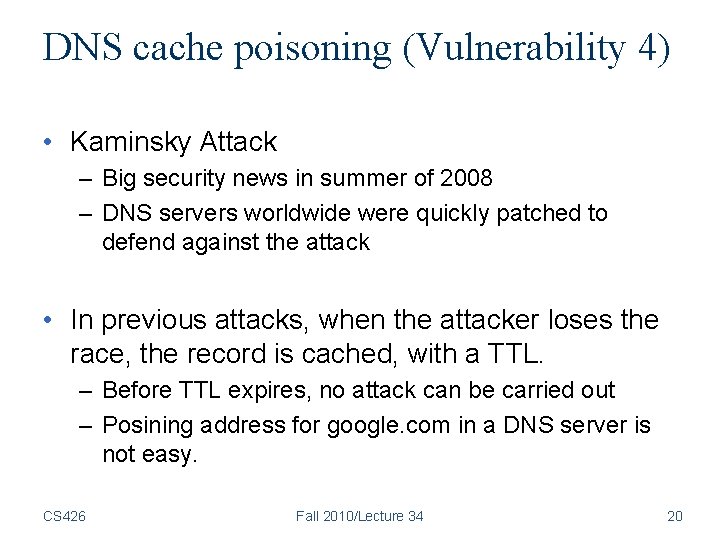
DNS cache poisoning (Vulnerability 4) • Kaminsky Attack – Big security news in summer of 2008 – DNS servers worldwide were quickly patched to defend against the attack • In previous attacks, when the attacker loses the race, the record is cached, with a TTL. – Before TTL expires, no attack can be carried out – Posining address for google. com in a DNS server is not easy. CS 426 Fall 2010/Lecture 34 20
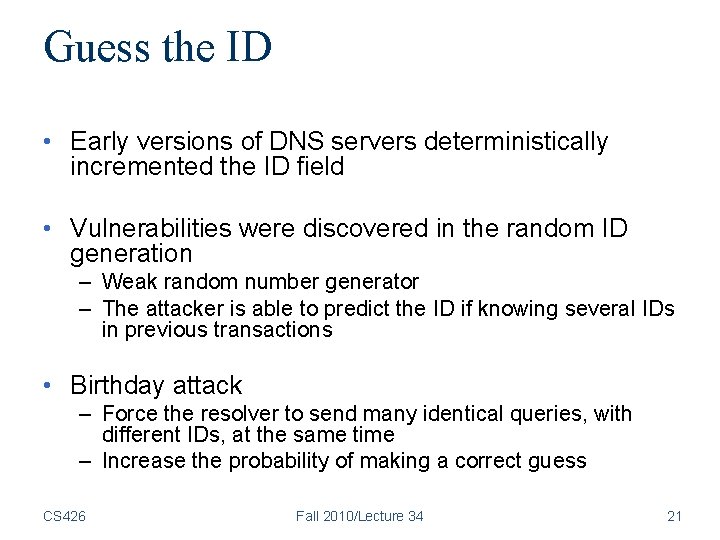
Guess the ID • Early versions of DNS servers deterministically incremented the ID field • Vulnerabilities were discovered in the random ID generation – Weak random number generator – The attacker is able to predict the ID if knowing several IDs in previous transactions • Birthday attack – Force the resolver to send many identical queries, with different IDs, at the same time – Increase the probability of making a correct guess CS 426 Fall 2010/Lecture 34 21
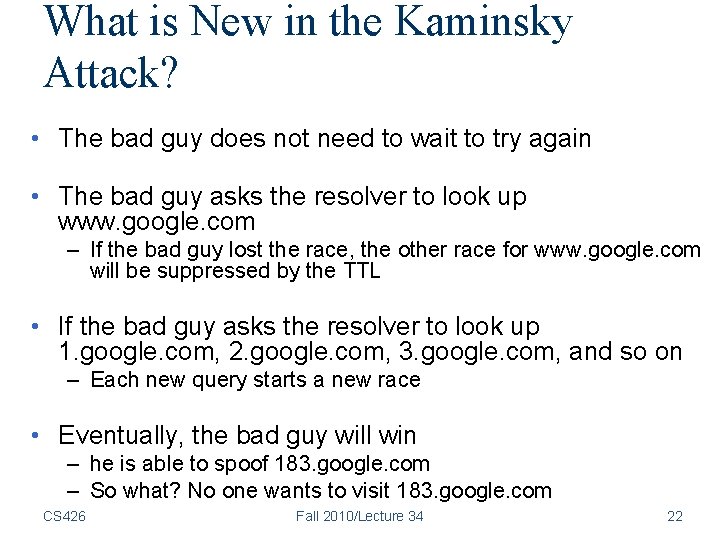
What is New in the Kaminsky Attack? • The bad guy does not need to wait to try again • The bad guy asks the resolver to look up www. google. com – If the bad guy lost the race, the other race for www. google. com will be suppressed by the TTL • If the bad guy asks the resolver to look up 1. google. com, 2. google. com, 3. google. com, and so on – Each new query starts a new race • Eventually, the bad guy will win – he is able to spoof 183. google. com – So what? No one wants to visit 183. google. com CS 426 Fall 2010/Lecture 34 22
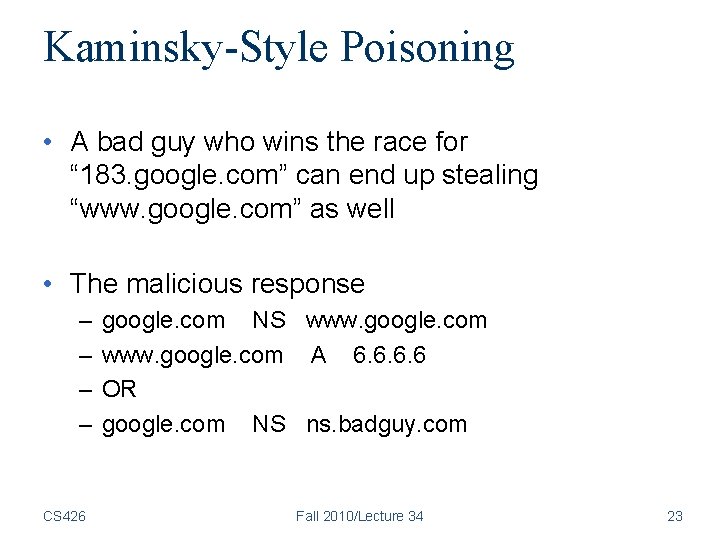
Kaminsky-Style Poisoning • A bad guy who wins the race for “ 183. google. com” can end up stealing “www. google. com” as well • The malicious response – – CS 426 google. com NS www. google. com A 6. 6 OR google. com NS ns. badguy. com Fall 2010/Lecture 34 23
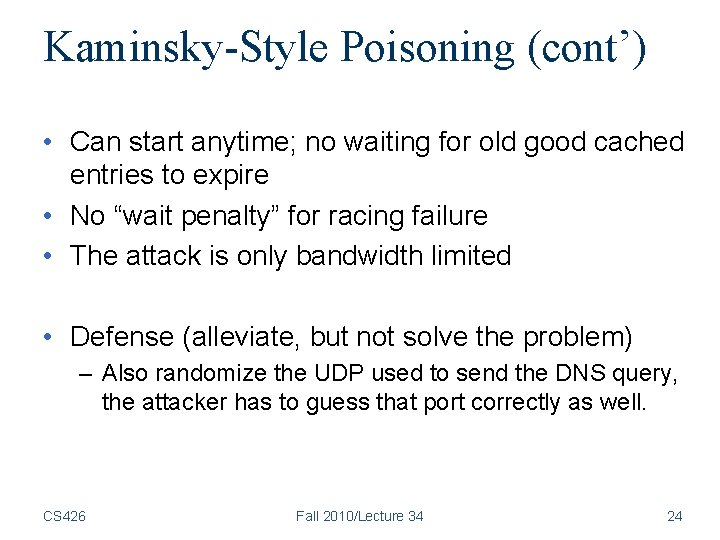
Kaminsky-Style Poisoning (cont’) • Can start anytime; no waiting for old good cached entries to expire • No “wait penalty” for racing failure • The attack is only bandwidth limited • Defense (alleviate, but not solve the problem) – Also randomize the UDP used to send the DNS query, the attacker has to guess that port correctly as well. CS 426 Fall 2010/Lecture 34 24
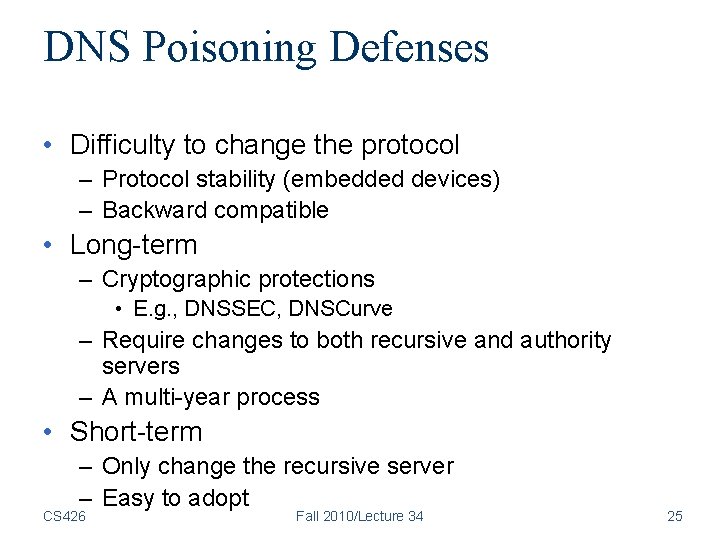
DNS Poisoning Defenses • Difficulty to change the protocol – Protocol stability (embedded devices) – Backward compatible • Long-term – Cryptographic protections • E. g. , DNSSEC, DNSCurve – Require changes to both recursive and authority servers – A multi-year process • Short-term – Only change the recursive server – Easy to adopt CS 426 Fall 2010/Lecture 34 25
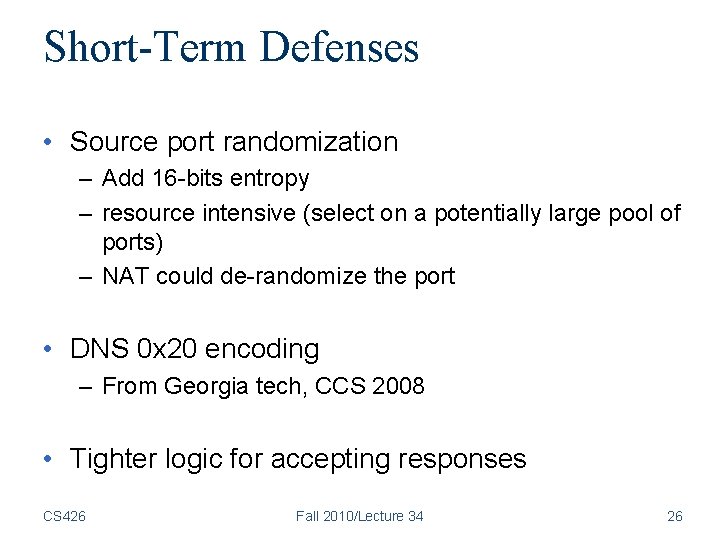
Short-Term Defenses • Source port randomization – Add 16 -bits entropy – resource intensive (select on a potentially large pool of ports) – NAT could de-randomize the port • DNS 0 x 20 encoding – From Georgia tech, CCS 2008 • Tighter logic for accepting responses CS 426 Fall 2010/Lecture 34 26
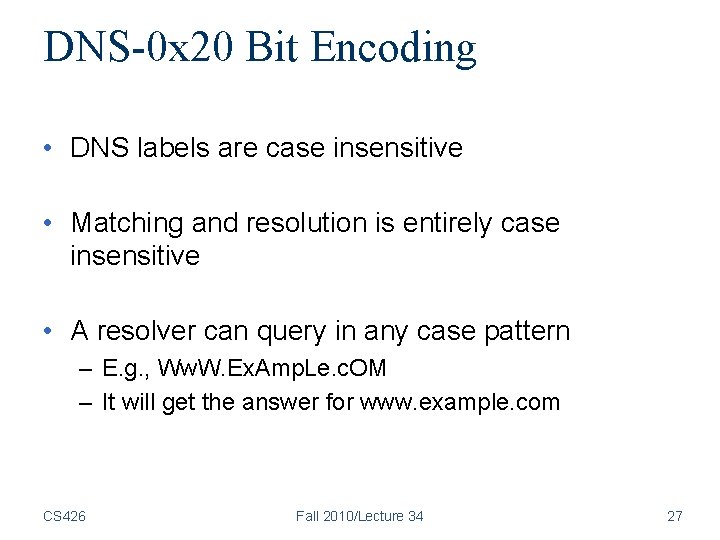
DNS-0 x 20 Bit Encoding • DNS labels are case insensitive • Matching and resolution is entirely case insensitive • A resolver can query in any case pattern – E. g. , Ww. W. Ex. Amp. Le. c. OM – It will get the answer for www. example. com CS 426 Fall 2010/Lecture 34 27
DNS-0 x 20 DNS Encoding (cont’) • A DNS response contains the query being asked • When generating the response, the query is copied from the request exactly into the response – The case pattern of the query is preserved in the response • Open source implementations exhibit this behavior – The DNS request is rewritten in place • The mixed pattern of upper and lower case letters constitutes a channel, which can be used to improve DNS security – Only the real server knows the correct pattern CS 426 Fall 2010/Lecture 34 28
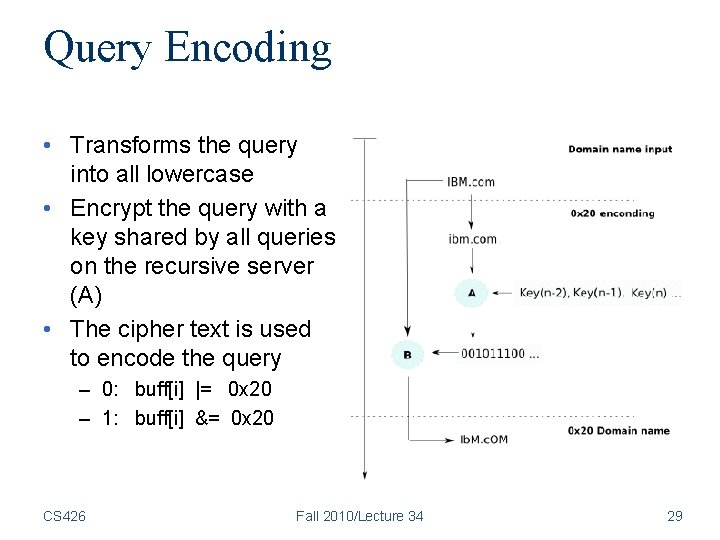
Query Encoding • Transforms the query into all lowercase • Encrypt the query with a key shared by all queries on the recursive server (A) • The cipher text is used to encode the query – 0: buff[i] |= 0 x 20 – 1: buff[i] &= 0 x 20 CS 426 Fall 2010/Lecture 34 29
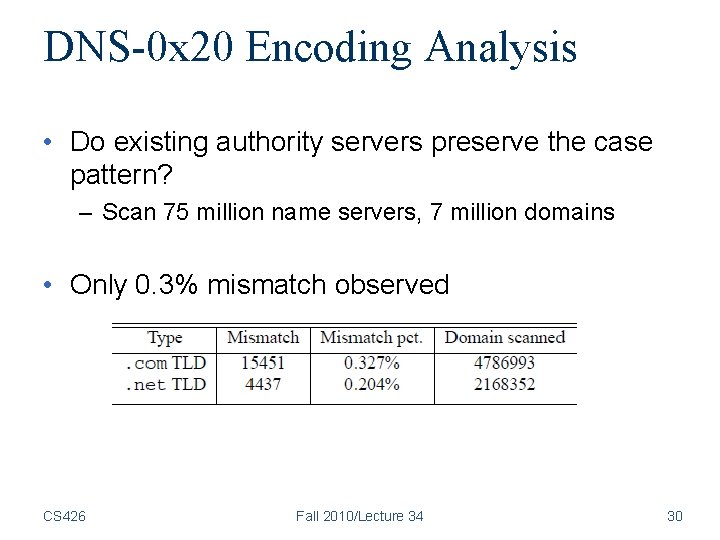
DNS-0 x 20 Encoding Analysis • Do existing authority servers preserve the case pattern? – Scan 75 million name servers, 7 million domains • Only 0. 3% mismatch observed CS 426 Fall 2010/Lecture 34 30
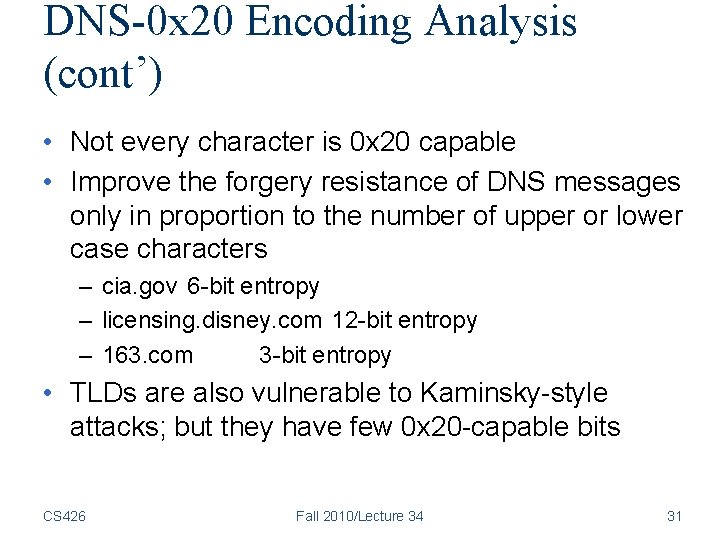
DNS-0 x 20 Encoding Analysis (cont’) • Not every character is 0 x 20 capable • Improve the forgery resistance of DNS messages only in proportion to the number of upper or lower case characters – cia. gov 6 -bit entropy – licensing. disney. com 12 -bit entropy – 163. com 3 -bit entropy • TLDs are also vulnerable to Kaminsky-style attacks; but they have few 0 x 20 -capable bits CS 426 Fall 2010/Lecture 34 31
Other DNS attacks • Attacking home routers/gateways • Incidence in Mexica in 2008 – an email sent to users – email include URL (HTTP requests) to the HTTPbased interface of wireless routers – using the default password to reconfigure the router/gateway CS 426 Fall 2010/Lecture 34 32
Readings for This Lecture • Optional: • An Illustrated Guide to the Kaminsky DNS Vulnerability • Dan Kaminsky's Black Hat presentation (Power. Point) CS 426 Fall 2010/Lecture 34 33
Coming Attractions … • Network Security Defenses CS 426 Fall 2010/Lecture 34 34