
CMSC 426 Principles of Computer Security Standards Requirements

- Slides: 25
CMSC 426 Principles of Computer Security Standards, Requirements, and Principles All materials copyright UMBC and Dr. Katherine Gibson unless otherwise noted
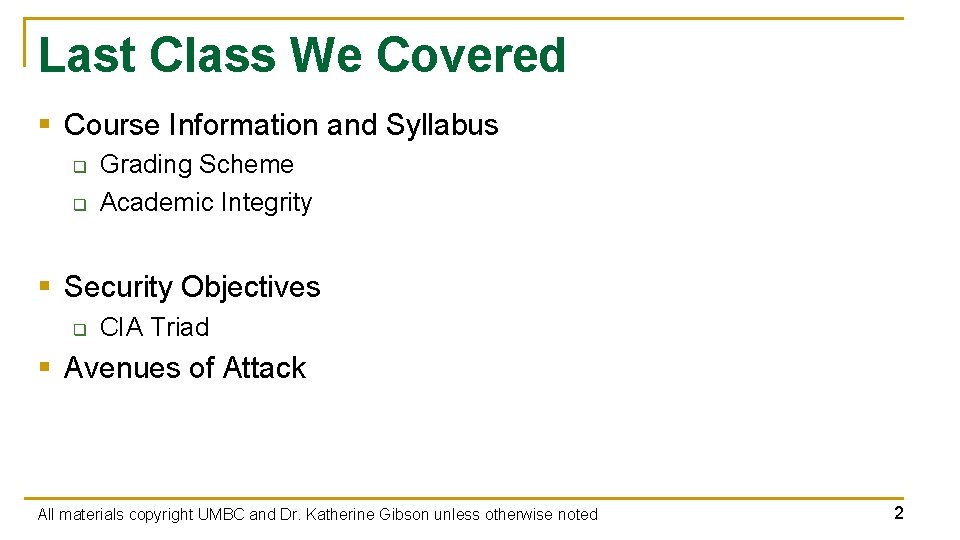
Last Class We Covered § Course Information and Syllabus q q Grading Scheme Academic Integrity § Security Objectives q CIA Triad § Avenues of Attack All materials copyright UMBC and Dr. Katherine Gibson unless otherwise noted 2
Any Questions from Last Time? All materials copyright UMBC and Dr. Katherine Gibson unless otherwise noted 3
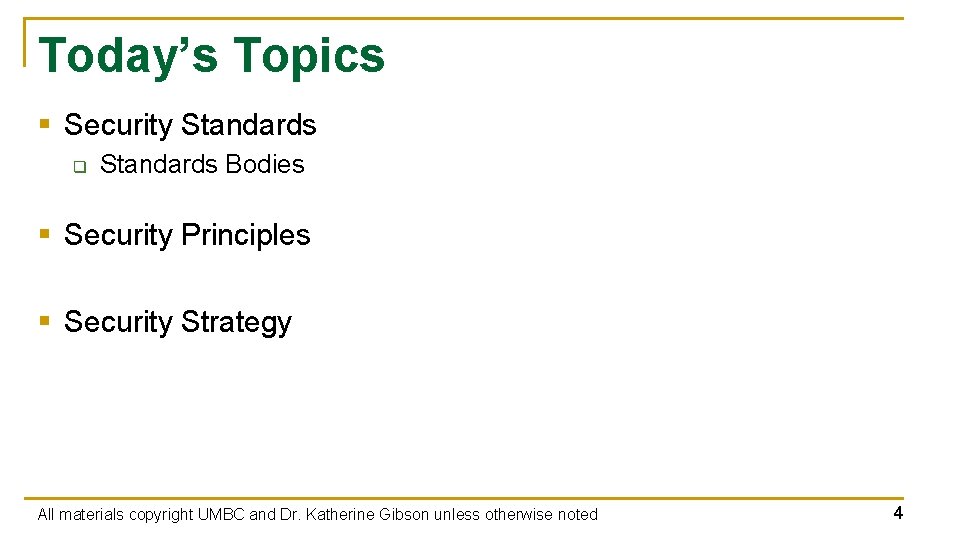
Today’s Topics § Security Standards q Standards Bodies § Security Principles § Security Strategy All materials copyright UMBC and Dr. Katherine Gibson unless otherwise noted 4
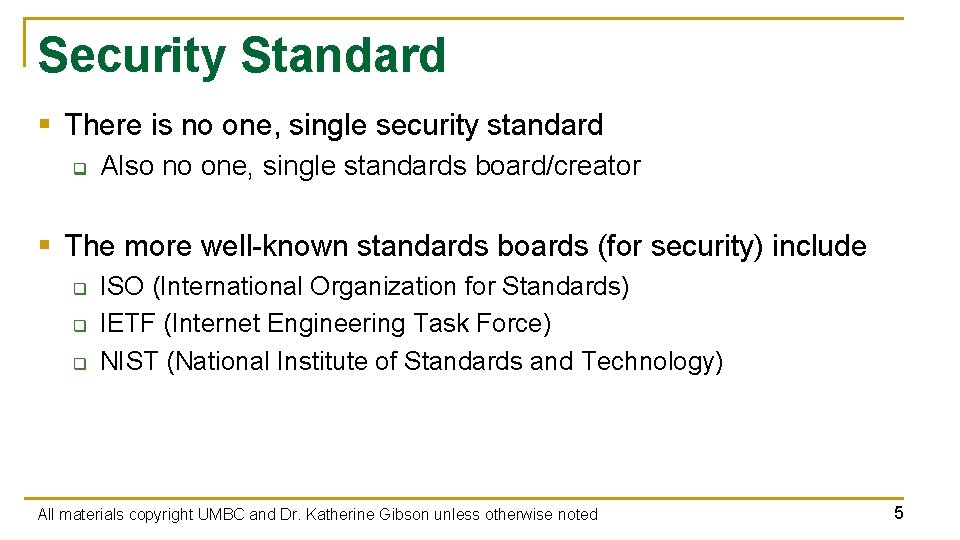
Security Standard § There is no one, single security standard q Also no one, single standards board/creator § The more well-known standards boards (for security) include q q q ISO (International Organization for Standards) IETF (Internet Engineering Task Force) NIST (National Institute of Standards and Technology) All materials copyright UMBC and Dr. Katherine Gibson unless otherwise noted 5
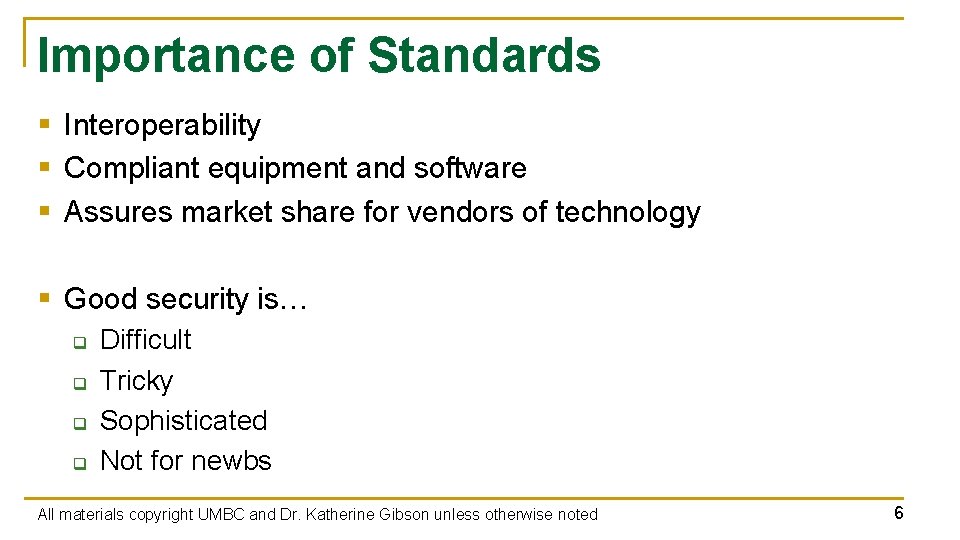
Importance of Standards § Interoperability § Compliant equipment and software § Assures market share for vendors of technology § Good security is… q q Difficult Tricky Sophisticated Not for newbs All materials copyright UMBC and Dr. Katherine Gibson unless otherwise noted 6
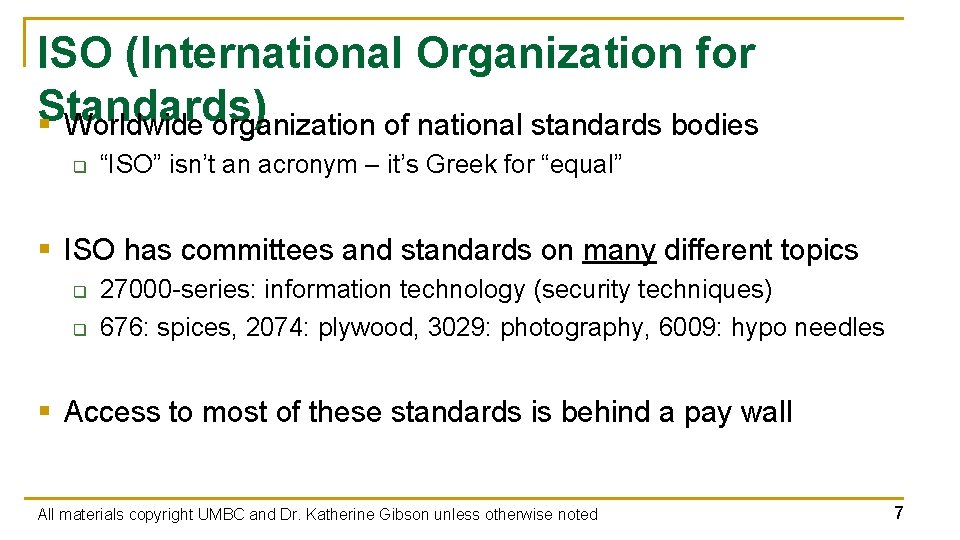
ISO (International Organization for Standards) § Worldwide organization of national standards bodies q “ISO” isn’t an acronym – it’s Greek for “equal” § ISO has committees and standards on many different topics q q 27000 -series: information technology (security techniques) 676: spices, 2074: plywood, 3029: photography, 6009: hypo needles § Access to most of these standards is behind a pay wall All materials copyright UMBC and Dr. Katherine Gibson unless otherwise noted 7
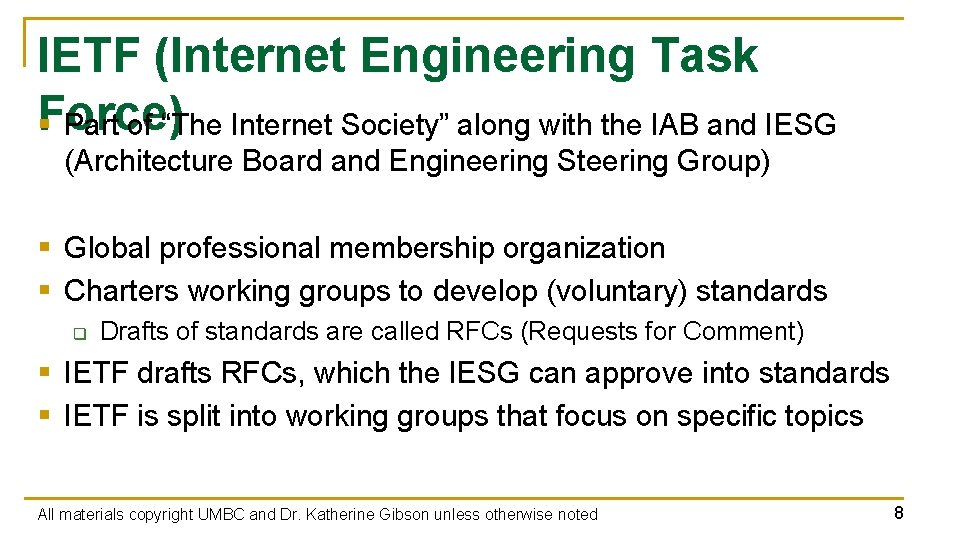
IETF (Internet Engineering Task Force) § Part of “The Internet Society” along with the IAB and IESG (Architecture Board and Engineering Steering Group) § Global professional membership organization § Charters working groups to develop (voluntary) standards q Drafts of standards are called RFCs (Requests for Comment) § IETF drafts RFCs, which the IESG can approve into standards § IETF is split into working groups that focus on specific topics All materials copyright UMBC and Dr. Katherine Gibson unless otherwise noted 8
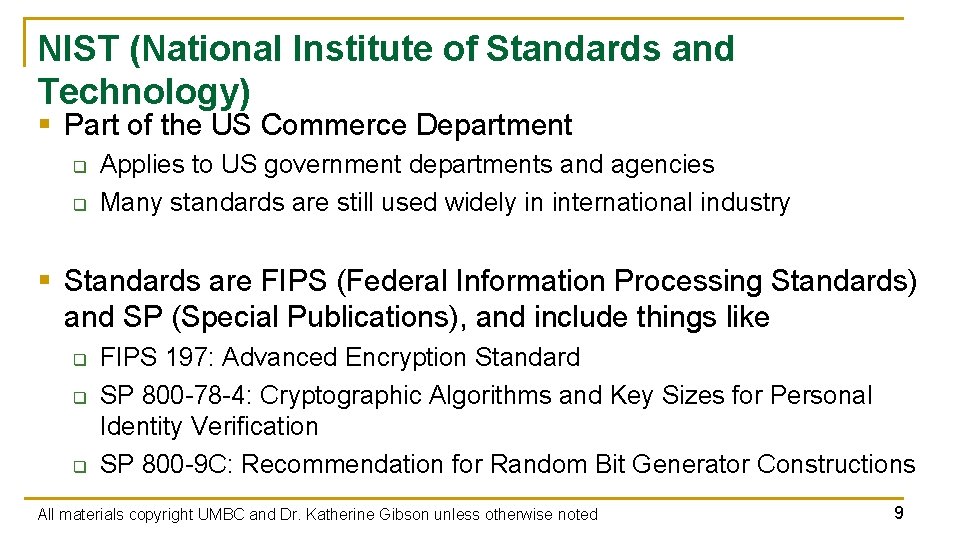
NIST (National Institute of Standards and Technology) § Part of the US Commerce Department q q Applies to US government departments and agencies Many standards are still used widely in international industry § Standards are FIPS (Federal Information Processing Standards) and SP (Special Publications), and include things like q q q FIPS 197: Advanced Encryption Standard SP 800 -78 -4: Cryptographic Algorithms and Key Sizes for Personal Identity Verification SP 800 -9 C: Recommendation for Random Bit Generator Constructions All materials copyright UMBC and Dr. Katherine Gibson unless otherwise noted 9
Security Principles All materials copyright UMBC and Dr. Katherine Gibson unless otherwise noted 10
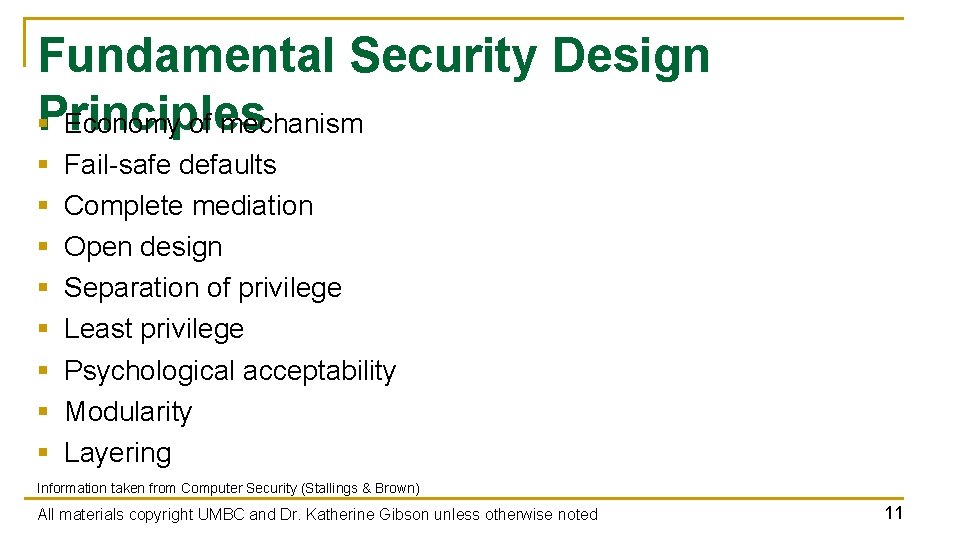
Fundamental Security Design Principles § Economy of mechanism § § § § Fail-safe defaults Complete mediation Open design Separation of privilege Least privilege Psychological acceptability Modularity Layering Information taken from Computer Security (Stallings & Brown) All materials copyright UMBC and Dr. Katherine Gibson unless otherwise noted 11
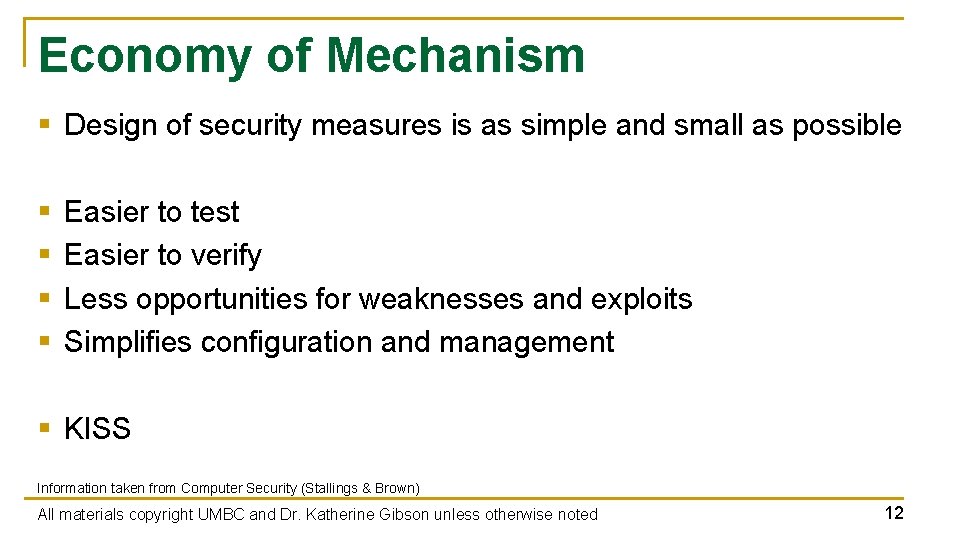
Economy of Mechanism § Design of security measures is as simple and small as possible § § Easier to test Easier to verify Less opportunities for weaknesses and exploits Simplifies configuration and management § KISS Information taken from Computer Security (Stallings & Brown) All materials copyright UMBC and Dr. Katherine Gibson unless otherwise noted 12
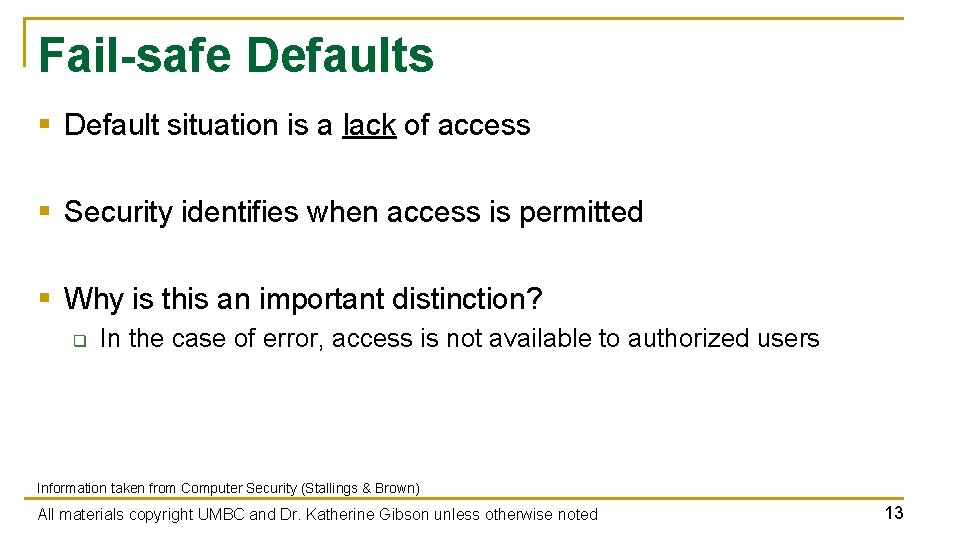
Fail-safe Defaults § Default situation is a lack of access § Security identifies when access is permitted § Why is this an important distinction? q In the case of error, access is not available to authorized users Information taken from Computer Security (Stallings & Brown) All materials copyright UMBC and Dr. Katherine Gibson unless otherwise noted 13
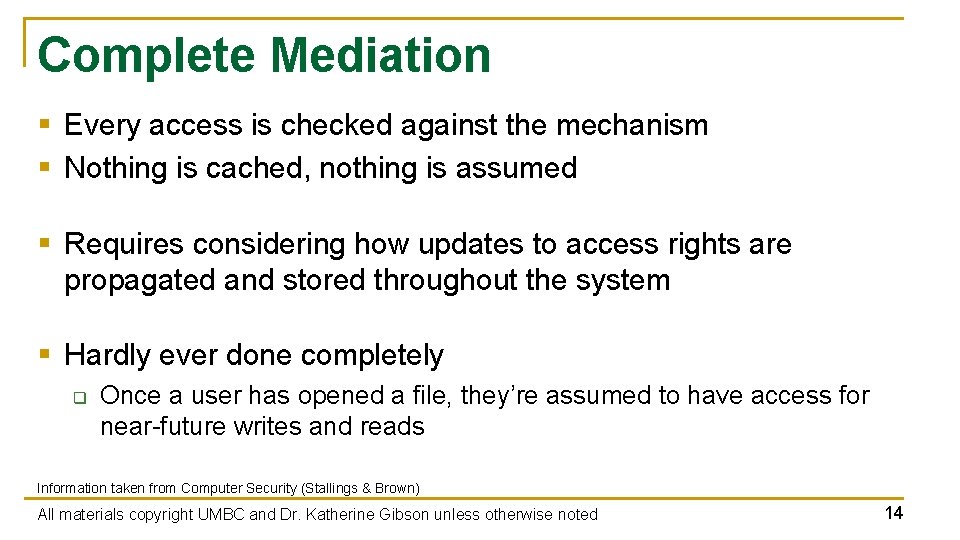
Complete Mediation § Every access is checked against the mechanism § Nothing is cached, nothing is assumed § Requires considering how updates to access rights are propagated and stored throughout the system § Hardly ever done completely q Once a user has opened a file, they’re assumed to have access for near-future writes and reads Information taken from Computer Security (Stallings & Brown) All materials copyright UMBC and Dr. Katherine Gibson unless otherwise noted 14
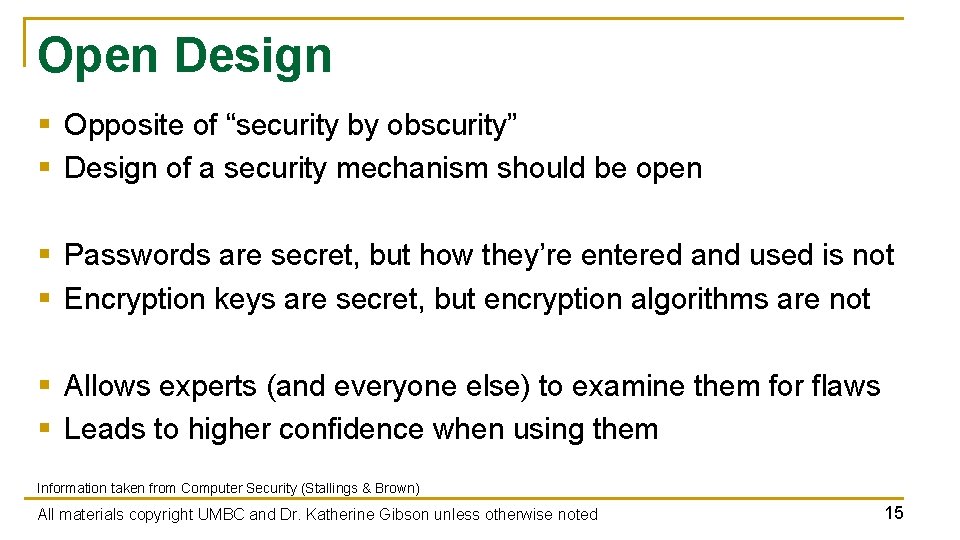
Open Design § Opposite of “security by obscurity” § Design of a security mechanism should be open § Passwords are secret, but how they’re entered and used is not § Encryption keys are secret, but encryption algorithms are not § Allows experts (and everyone else) to examine them for flaws § Leads to higher confidence when using them Information taken from Computer Security (Stallings & Brown) All materials copyright UMBC and Dr. Katherine Gibson unless otherwise noted 15
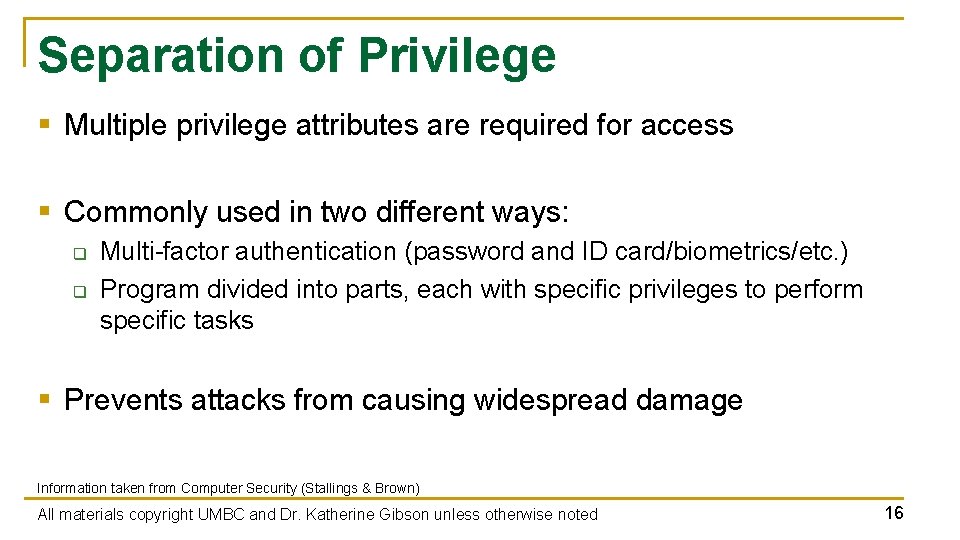
Separation of Privilege § Multiple privilege attributes are required for access § Commonly used in two different ways: q q Multi-factor authentication (password and ID card/biometrics/etc. ) Program divided into parts, each with specific privileges to perform specific tasks § Prevents attacks from causing widespread damage Information taken from Computer Security (Stallings & Brown) All materials copyright UMBC and Dr. Katherine Gibson unless otherwise noted 16
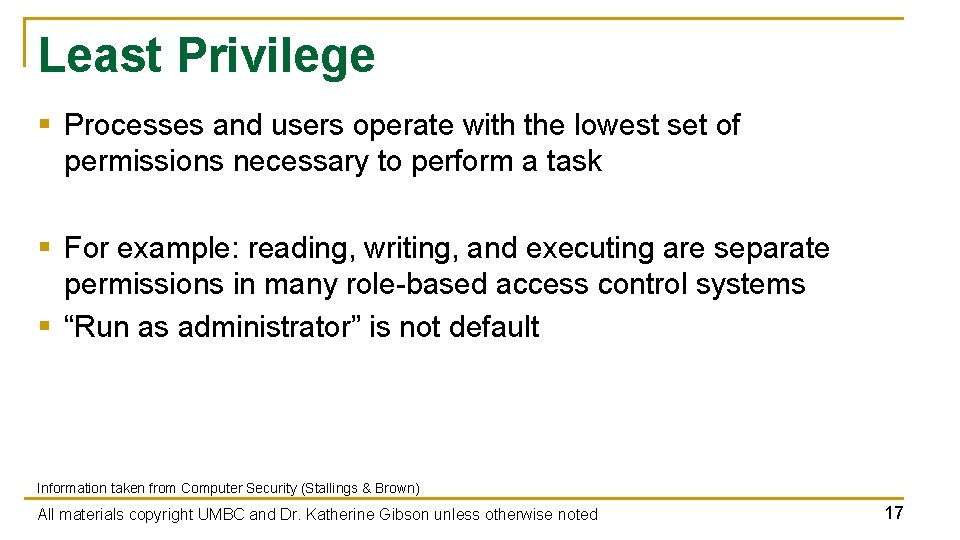
Least Privilege § Processes and users operate with the lowest set of permissions necessary to perform a task § For example: reading, writing, and executing are separate permissions in many role-based access control systems § “Run as administrator” is not default Information taken from Computer Security (Stallings & Brown) All materials copyright UMBC and Dr. Katherine Gibson unless otherwise noted 17
Psychological Acceptability § Security mechanisms should: q NOT interfere with users q Meet the needs of authorizers q “Make sense” § Mechanisms should be transparent and minimally obstructive Information taken from Computer Security (Stallings & Brown) All materials copyright UMBC and Dr. Katherine Gibson unless otherwise noted 18
Modularity § Security functions are developed separately from other modules § Security functions can be “plugged in” to other applications q Including replacing one security function with another in future § No need to have hundreds of people individually re-invent the wheel q Especially when the “wheel” is complex and finely-tuned Information taken from Computer Security (Stallings & Brown) All materials copyright UMBC and Dr. Katherine Gibson unless otherwise noted 19
Layering § Use multiple, overlapping approaches to ensure security § If one layer is breached or circumvented, another can pick up the slack § Multiple layers means requiring multiple means of attack to gain access to protected information and systems Information taken from Computer Security (Stallings & Brown) All materials copyright UMBC and Dr. Katherine Gibson unless otherwise noted 20
Security Strategy All materials copyright UMBC and Dr. Katherine Gibson unless otherwise noted 21
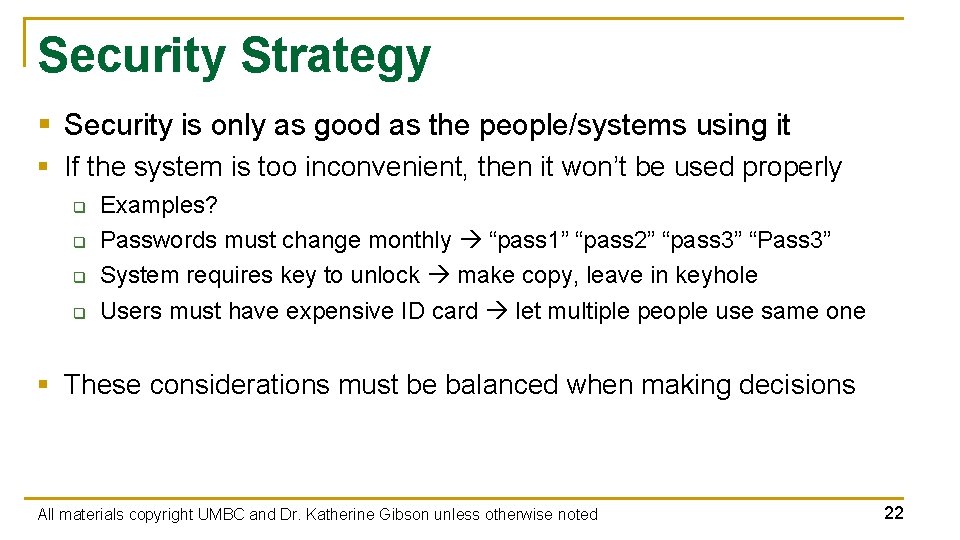
Security Strategy § Security is only as good as the people/systems using it § If the system is too inconvenient, then it won’t be used properly q q Examples? Passwords must change monthly “pass 1” “pass 2” “pass 3” “Pass 3” System requires key to unlock make copy, leave in keyhole Users must have expensive ID card let multiple people use same one § These considerations must be balanced when making decisions All materials copyright UMBC and Dr. Katherine Gibson unless otherwise noted 22
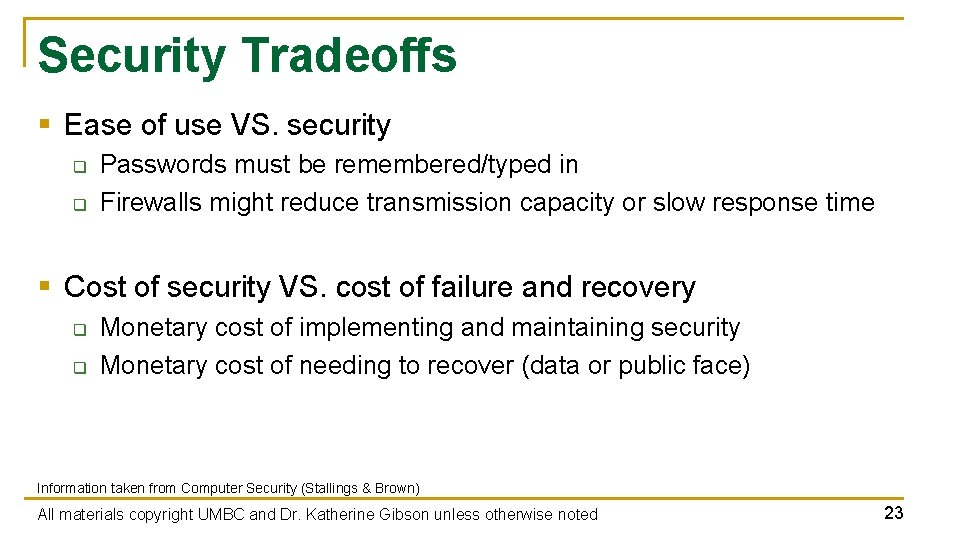
Security Tradeoffs § Ease of use VS. security q q Passwords must be remembered/typed in Firewalls might reduce transmission capacity or slow response time § Cost of security VS. cost of failure and recovery q q Monetary cost of implementing and maintaining security Monetary cost of needing to recover (data or public face) Information taken from Computer Security (Stallings & Brown) All materials copyright UMBC and Dr. Katherine Gibson unless otherwise noted 23
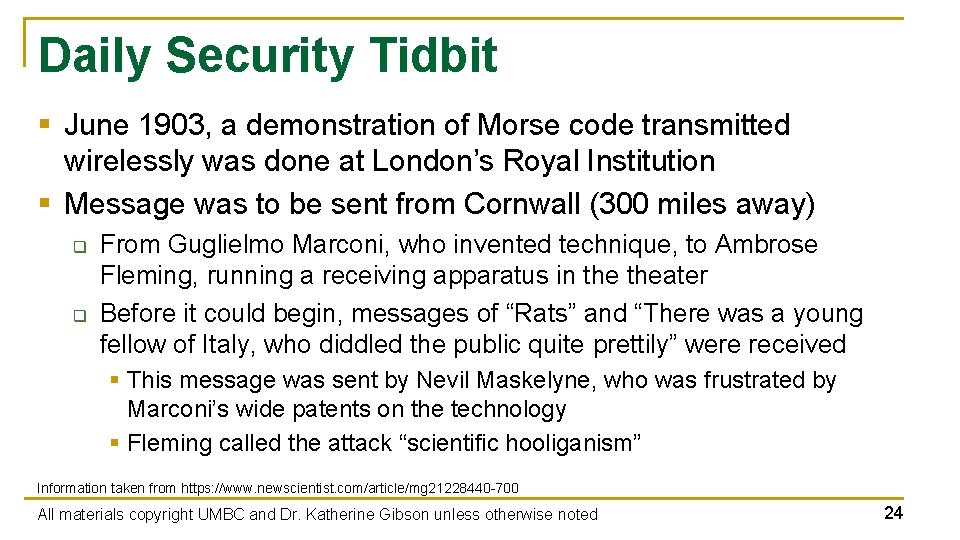
Daily Security Tidbit § June 1903, a demonstration of Morse code transmitted wirelessly was done at London’s Royal Institution § Message was to be sent from Cornwall (300 miles away) q q From Guglielmo Marconi, who invented technique, to Ambrose Fleming, running a receiving apparatus in theater Before it could begin, messages of “Rats” and “There was a young fellow of Italy, who diddled the public quite prettily” were received § This message was sent by Nevil Maskelyne, who was frustrated by Marconi’s wide patents on the technology § Fleming called the attack “scientific hooliganism” Information taken from https: //www. newscientist. com/article/mg 21228440 -700 All materials copyright UMBC and Dr. Katherine Gibson unless otherwise noted 24
Announcements § None today! All materials copyright UMBC and Dr. Katherine Gibson unless otherwise noted 25