Community Health Assessment at a Family Medicine Clerkship

- Slides: 36
Community Health Assessment at a Family Medicine Clerkship Site Kristen Kelly MPH, MS-IV
Topics of Presentation 1. 2. 3. 4. Why am I involved in clerkship education? Background: Need for a Community Health Learning Experience Development of Learning Experience Recommendations
How did a student become involved in community health education in medical school?
Community Health n Accepted part of FM residency education n n Community Oriented Primary Care (COPC) projects Needs assessments Other community involvement Increasingly part of medical student education
Challenges n n n Few examples of community health in clinical practice for students to see Little consensus on content and format Difficult to measure outcomes and quantify importance
Student Interest n n n 3 rd year FCM clerkship community health requirement Pursued interest during Masters in Public Health between 3 rd and 4 th years Clerkship site required a community health component
Background: Need for a Community Health Learning Experience
FCM Core Clerkship at UCSF n n n 6 week block during third year 6 physical locations, 3 outside San Francisco Different formats n n COPC Student-designed and led Placements with community organizations Community health component at all sites but one
Goal Propose a model for a feasible community health experience at out-of-town site
Guiding Questions 1. Is community health exposure a vital aspect of the clerkship that should be required of all students? 2. What are the goals of the community health experience ? 3. What curricular models offer the best potential to meet these goals and are logistically feasible?
Development of Community Health Learning Experience
Project Methods n n n Background research: community health Review of student evaluations of existing community health requirements Focus groups with students Open-format interviews with preceptors and faculty Participant observation student presentations of community health projects
Interviews n Open-format Interviews: n n n 6 faculty members 7 community health preceptors Administrator of community health projects 5 additional individuals with community health expertise Experiences working with community health projects
Focus Groups n n n 3 focus groups of medical students who had completed the FCM clerkships Variety of FCM sites Structured format with pre-determined questions
Evaluation of Data n n n Coding of interviews and focus groups using N -Vivo® program for qualitative analysis Evaluated for themes Used this data to develop proposal for project structure at out-of-town clerkship site
Themes n Valuable to have community component n n n Context, advocacy, exposure Community groups have links to university Time period is very short (6 half-days – or three days total) Different interpretations of community health Goals often vague or too ambitious
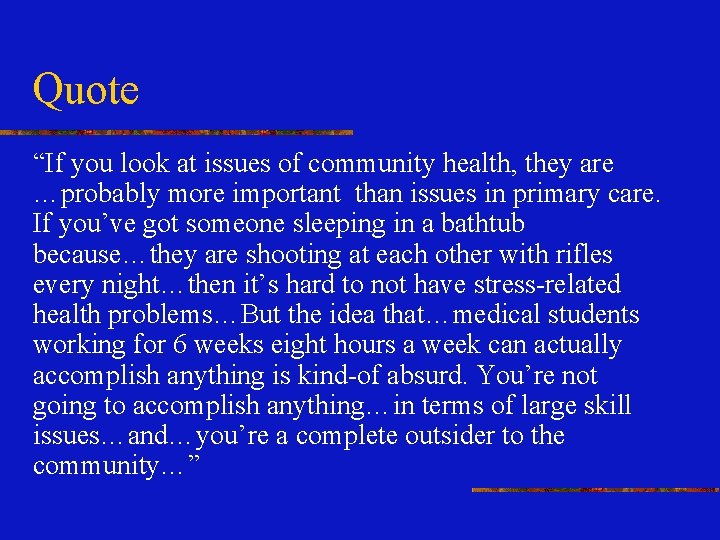
Quote “If you look at issues of community health, they are …probably more important than issues in primary care. If you’ve got someone sleeping in a bathtub because…they are shooting at each other with rifles every night…then it’s hard to not have stress-related health problems…But the idea that…medical students working for 6 weeks eight hours a week can actually accomplish anything is kind-of absurd. You’re not going to accomplish anything…in terms of large skill issues…and…you’re a complete outsider to the community…”
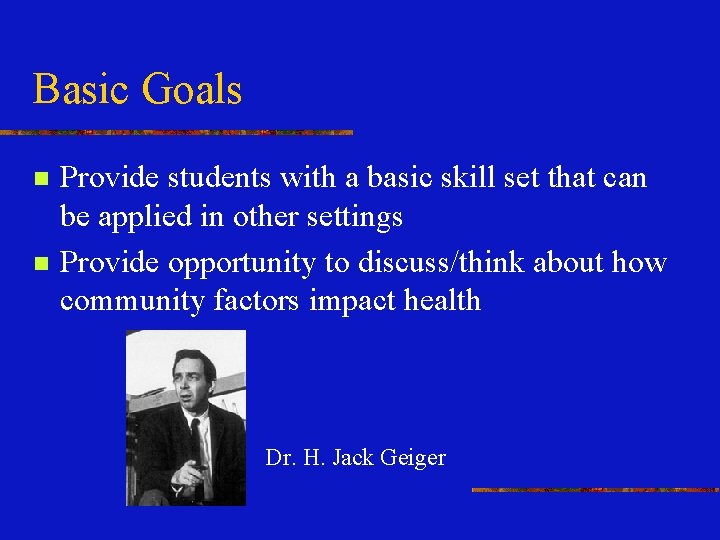
Basic Goals n n Provide students with a basic skill set that can be applied in other settings Provide opportunity to discuss/think about how community factors impact health Dr. H. Jack Geiger
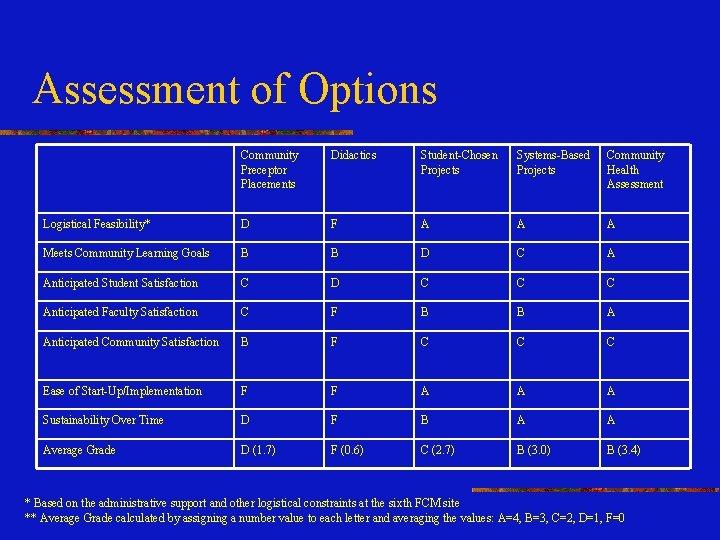
Assessment of Options Community Preceptor Placements Didactics Student-Chosen Projects Systems-Based Projects Community Health Assessment Logistical Feasibility* D F A A A Meets Community Learning Goals B B D C A Anticipated Student Satisfaction C D C C C Anticipated Faculty Satisfaction C F B B A Anticipated Community Satisfaction B F C C C Ease of Start-Up/Implementation F F A A A Sustainability Over Time D F B A A Average Grade D (1. 7) F (0. 6) C (2. 7) B (3. 0) B (3. 4) * Based on the administrative support and other logistical constraints at the sixth FCM site ** Average Grade calculated by assigning a number value to each letter and averaging the values: A=4, B=3, C=2, D=1, F=0
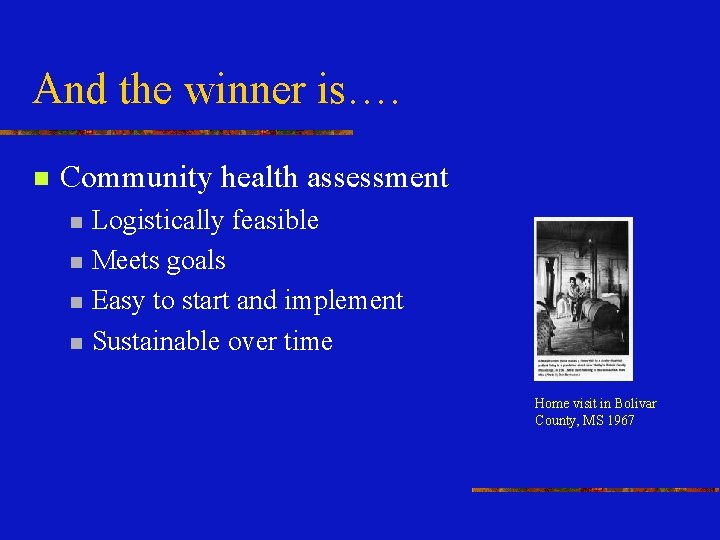
And the winner is…. n Community health assessment n n Logistically feasible Meets goals Easy to start and implement Sustainable over time Home visit in Bolivar County, MS 1967
Recommendations for Community Health Experience
Healthy Community Assessment 1. Based on recommendations from Community Organizing and Community Building for Health, 2 nd Edition. Ed. Meredith Minkler. 2005. 2. Chapter 8: “Community Health Assessment or Healthy Community Assessment: Whose Community? Whose Health? Whose Assessment? ” (Trevor Hancock and Meredith Minkler)
Central Question Posed Pretend that you are done with residency and have just started a new job at this clinic. You are new to the area and do not know anything about one of the communities that many of your patients are from. What features of the community either promote or detract from health and well-being?
Guidelines n n Students work together in groups Students identify a community represented by patients in the FCM clinic Students read relevant chapters from Community Organizing and Community Building for Health Focus on assets as well as deficits
Nitty-Gritty n n Students should use at least one of each of the following methods: no-contact, minimalcontact/observational, and interactive contact No-contact: e. g. , internet Minimal contact: walks, visits to local churches Interactive: talking to people From Hancock, T and M. Minkler. 2005. “Community Health Assessment or Healthy Community Assessment. ” Community Organizing and Community Building for Health. Chapter 8.
End-Product n n Informal presentation to faculty member about what the students learned about the community Students will be asked to find a way to share the information with a community member who assisted with assessment Encourage discussion Should be fun, low-stress!
Elements of a Healthy Community n n Do people in the community have access to basic prerequisites for health (e. g. , food, shelter, education, clean water, clean and safe environments)? How strong is civic or associational life? How rich is the cultural life of the community? What are community members’ perceptions of strengths of the community as well as areas of need? From Hancock, T and M. Minkler. 2005. “Community Health Assessment or Healthy Community Assessment. ” Community Organizing and Community Building for Health. Chapter 8: 144 -146.
Positives to Structure n n n Skills and defined approach Limited faculty/administrative support Take away focus on physician as point person Focus on community strengths as well as needs Opportunity to discuss relevance and future work with communities
Drawbacks to Structure n n n Communities “assessed” many times Feeling of wanting to build on the information gathered Some students may find it too abstract
Final Notes n n n Presentation made to FCM faculty members and site director Currently student project-based structured being implemented Individual hired to oversee projects
Future Directions n n n Learned about community-oriented processes: e. g. , COPC, community-based participatory research Idea of community control and involvement in health Hope to build on these ideas in future practice
Thank you! n n Dr. William Shore MD, UCSF Department of Family and Community Medicine Nap Hosang MD, MPH, MBA, UC Berkeley School of Public Health Community medicine preceptors UCSF Department of Family and Community Medicine faculty members and students
Why Community Health? n Issues difficult to address in purely clinical environment: n n Health disparities by race, class, neighborhood/ community Chronic “lifestyle” illnesses Social determinants of health Movement to involve communities in own health
Health Beyond the Clinic n 1978 International Conference on Primary Health Care in Alma Ata, USSR (WHO). Primary health care: n Involves community development (education, housing, public works, and many other sectors) n Strives towards maximal community participation and control over primary health care and fosters the ability of communities to participate
A Little History • Sidney and Emily Kark in rural South Africa in the 1940 s, Community-Oriented Primary Care • 1950 s-70 s: Growth of Community Health Center movement in the US • Dr. H. Jack Geiger in the impoverished Mississippi Delta in the 1960 s, Community. Oriented Primary Care