College and Career Ready IEPs CCRIEPs Improving Outcomes
- Slides: 39
College and Career Ready IEPs (CCRIEPs) Improving Outcomes for Students Ages 3 through 21 The Five Step Process Step 3: Develop IEP Goals April 2018
What is a CCR-IEP? CCR-IEP = College and Career Ready IEP • An Individualized Education Program (IEP) developed to: - meet the unique disability-related needs of the student and - help ensure the student graduated ready for further education and the work place
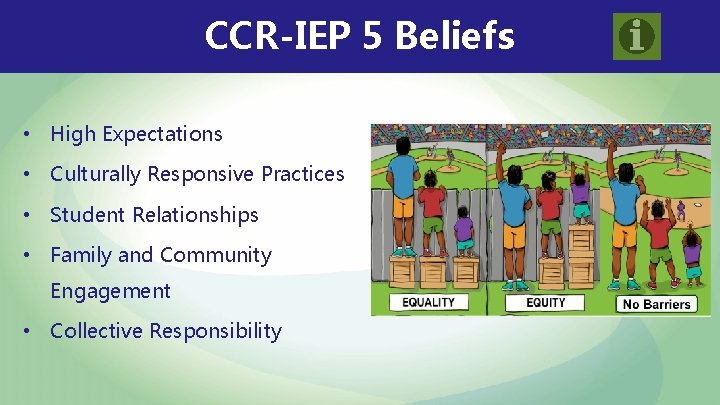
CCR-IEP 5 Beliefs • High Expectations • Culturally Responsive Practices • Student Relationships • Family and Community Engagement • Collective Responsibility
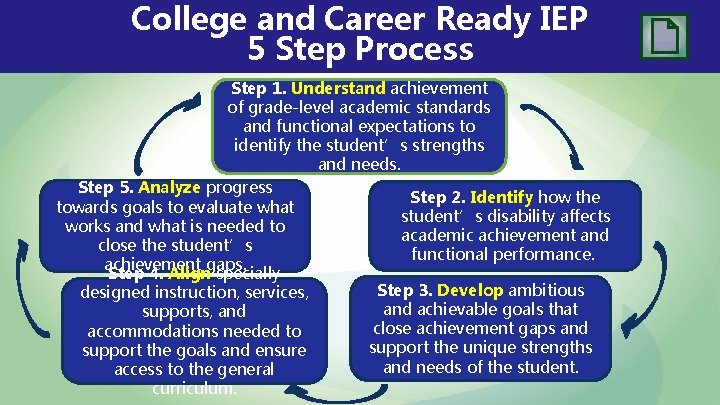
College and Career Ready IEP 5 Step Process Step 1. Understand achievement of grade-level academic standards and functional expectations to identify the student’s strengths and needs. Step 5. Analyze progress Step 2. Identify how the towards goals to evaluate what student’s disability affects works and what is needed to academic achievement and close the student’s functional performance. achievement gaps. Step 4. Align specially Step 3. Develop ambitious designed instruction, services, and achievable goals that supports, and close achievement gaps and accommodations needed to support the unique strengths support the goals and ensure and needs of the student. access to the general curriculum.
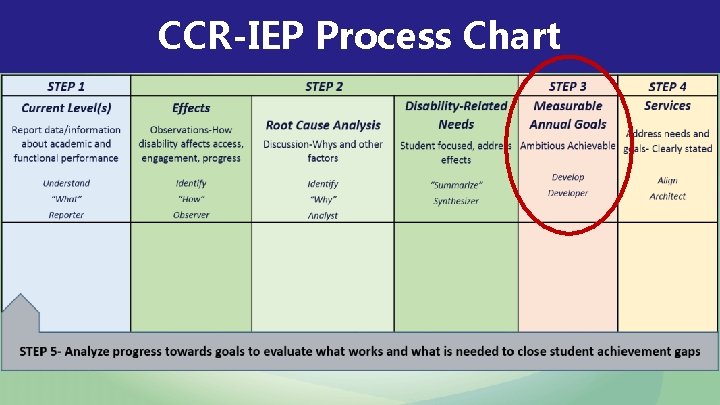
CCR-IEP Process Chart
Step 3: Develop Ambitious and Achievable Goals Develop ambitious and achievable goals that close achievement gaps and support the unique strengths and needs of the student.
Step 3 Key Ideas • IEP goals are directed at “why” (i. e. , root causes) the student is not meeting early childhood/grade-level standards or expectations • IEP goals address student-specific disability-related need(s) that will improve access, engagement and progress toward standards and expectations (i. e. , address effects) • IEP goals are measurable, ambitious and achievable • One goal may address more than one disability-related need
Step 3 Key Ideas • IEP goals specify what a student will learn (target skill(s)/behavior) • In rare circumstances a goal may not be required to address a disability related need • The need is still addressed with support(s) or accommodation(s) (supplementary aids/services, supports for staff) • How do we know when a goal is needed to address a disability related need? • Ask, “Does the student needs to develop a skill or just use a skill already mastered”?
Guidance from U. S. Department of Education IEP goals must be. . . • Aligned with the academic content standards for the grade in which a student is enrolled • An IEP that focuses on ensuring a student is involved in general education curriculum will be aligned with the academic content standards • Ambitious and achievable • For students with the most significant cognitive disabilities, goals are aligned with alternate academic achievement standards aligned with grade-level content standards Adapted from U. S. Department of Education Dear Colleague Letter, November 16, 2015: OSERS Policy Guidance on Free Appropriate Public Education (FAPE)
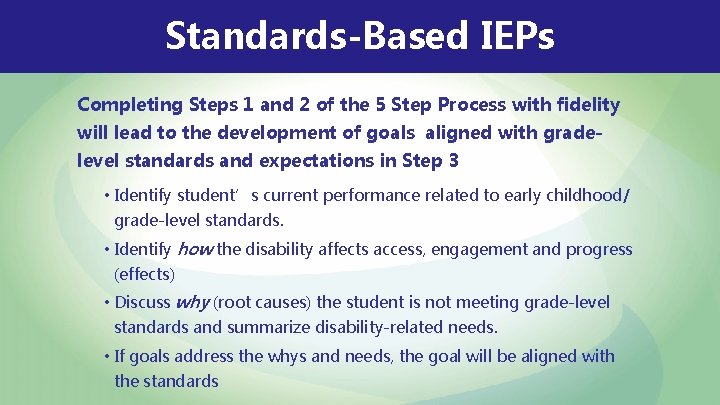
Standards-Based IEPs Completing Steps 1 and 2 of the 5 Step Process with fidelity will lead to the development of goals aligned with gradelevel standards and expectations in Step 3 • Identify student’s current performance related to early childhood/ grade-level standards. • Identify how the disability affects access, engagement and progress (effects) • Discuss why (root causes) the student is not meeting grade-level standards and summarize disability-related needs. • If goals address the whys and needs, the goal will be aligned with the standards
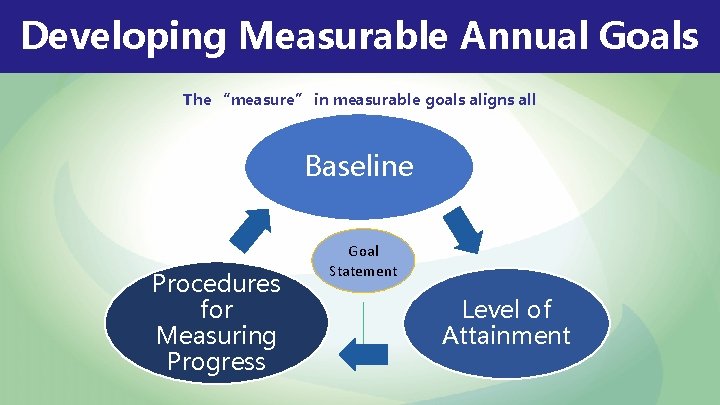
Developing Measurable Annual Goals The “measure” in measurable goals aligns all components Baseline Procedures for Measuring Progress Goal Statement Level of Attainment
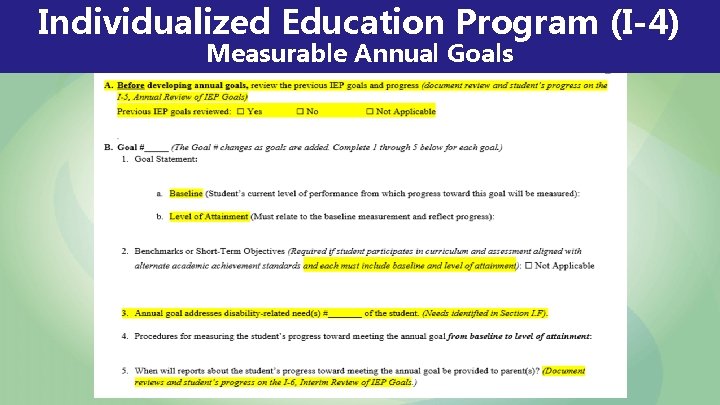
Individualized Education Program (I-4) Measurable Annual Goals
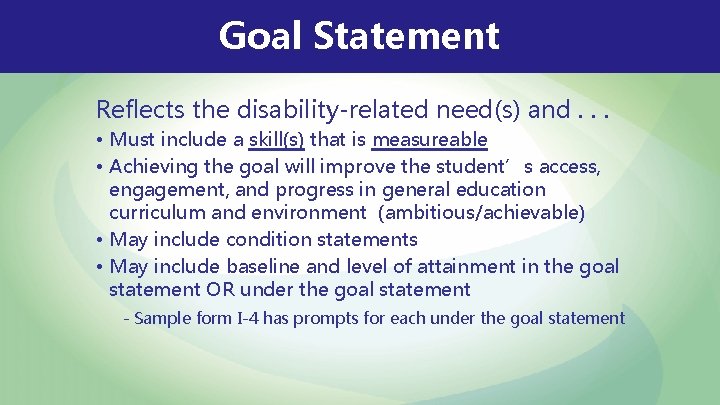
Goal Statement Reflects the disability-related need(s) and. . . • Must include a skill(s) that is measureable • Achieving the goal will improve the student’s access, engagement, and progress in general education curriculum and environment (ambitious/achievable) • May include condition statements • May include baseline and level of attainment in the goal statement OR under the goal statement - Sample form I-4 has prompts for each under the goal statement
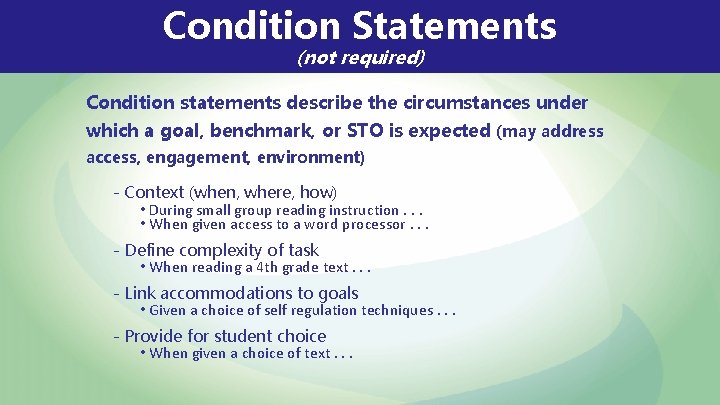
Condition Statements (not required) Condition statements describe the circumstances under which a goal, benchmark, or STO is expected (may address access, engagement, environment) - Context (when, where, how) • During small group reading instruction. . . • When given access to a word processor. . . - Define complexity of task • When reading a 4 th grade text. . . - Link accommodations to goals • Given a choice of self regulation techniques. . . - Provide for student choice • When given a choice of text. . .
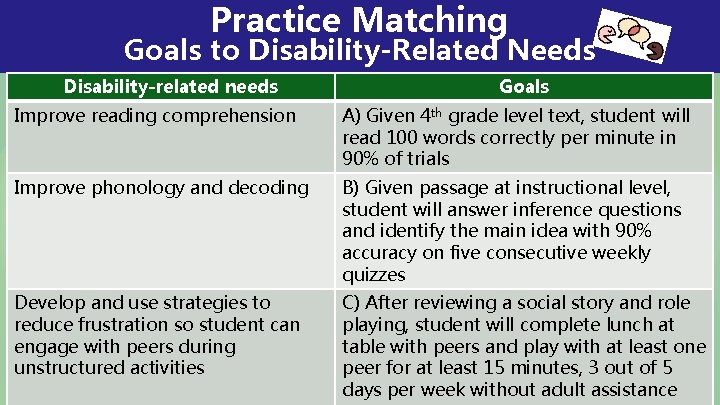
Practice Matching Goals to Disability-Related Needs Disability-related needs Goals Improve reading comprehension A) Given 4 th grade level text, student will read 100 words correctly per minute in 90% of trials Improve phonology and decoding B) Given passage at instructional level, student will answer inference questions and identify the main idea with 90% accuracy on five consecutive weekly quizzes Develop and use strategies to reduce frustration so student can engage with peers during unstructured activities C) After reviewing a social story and role playing, student will complete lunch at table with peers and play with at least one peer for at least 15 minutes, 3 out of 5 days per week without adult assistance
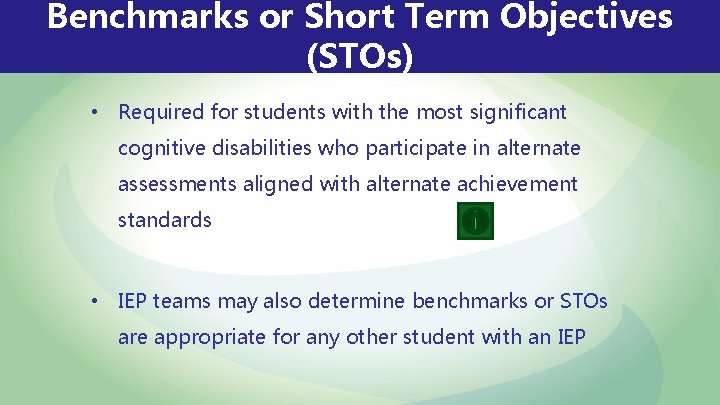
Benchmarks or Short Term Objectives (STOs) • Required for students with the most significant cognitive disabilities who participate in alternate assessments aligned with alternate achievement standards • IEP teams may also determine benchmarks or STOs are appropriate for any other student with an IEP
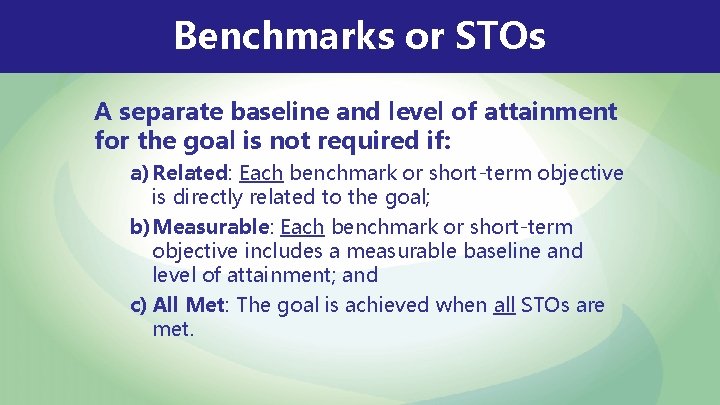
Benchmarks or STOs A separate baseline and level of attainment for the goal is not required if: a) Related: Each benchmark or short-term objective is directly related to the goal; b) Measurable: Each benchmark or short-term objective includes a measurable baseline and level of attainment; and c) All Met: The goal is achieved when all STOs are met.
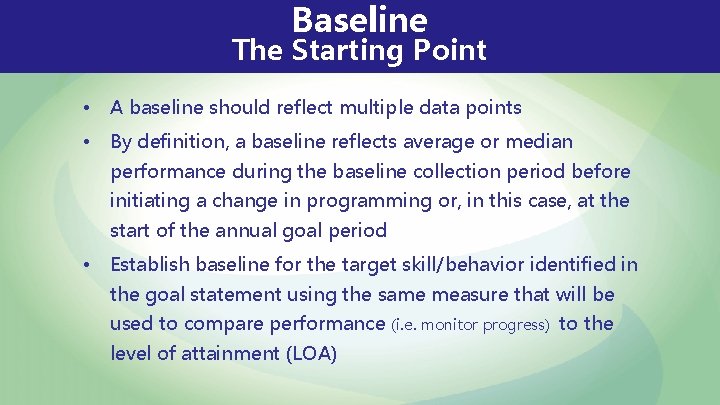
Baseline The Starting Point • A baseline should reflect multiple data points • By definition, a baseline reflects average or median performance during the baseline collection period before initiating a change in programming or, in this case, at the start of the annual goal period • Establish baseline for the target skill/behavior identified in the goal statement using the same measure that will be used to compare performance (i. e. monitor progress) to the level of attainment (LOA)
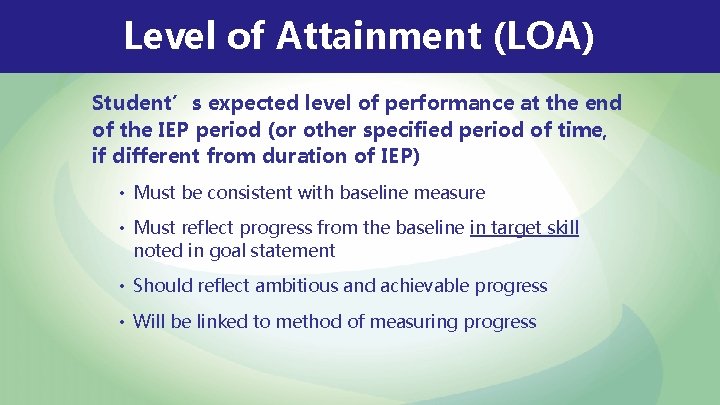
Level of Attainment (LOA) Student’s expected level of performance at the end of the IEP period (or other specified period of time, if different from duration of IEP) • Must be consistent with baseline measure • Must reflect progress from the baseline in target skill noted in goal statement • Should reflect ambitious and achievable progress • Will be linked to method of measuring progress
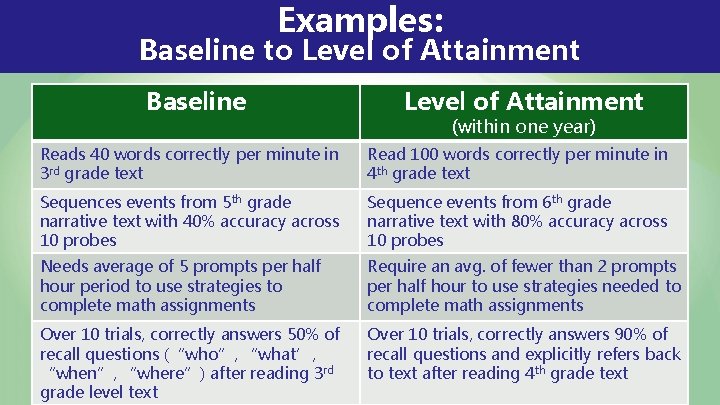
Examples: Baseline to Level of Attainment Baseline Level of Attainment Reads 40 words correctly per minute in 3 rd grade text Read 100 words correctly per minute in 4 th grade text Sequences events from 5 th grade narrative text with 40% accuracy across 10 probes Sequence events from 6 th grade narrative text with 80% accuracy across 10 probes Needs average of 5 prompts per half hour period to use strategies to complete math assignments Require an avg. of fewer than 2 prompts per half hour to use strategies needed to complete math assignments Over 10 trials, correctly answers 50% of recall questions (“who”, “what’, “when”, “where”) after reading 3 rd grade level text Over 10 trials, correctly answers 90% of recall questions and explicitly refers back to text after reading 4 th grade text (within one year)
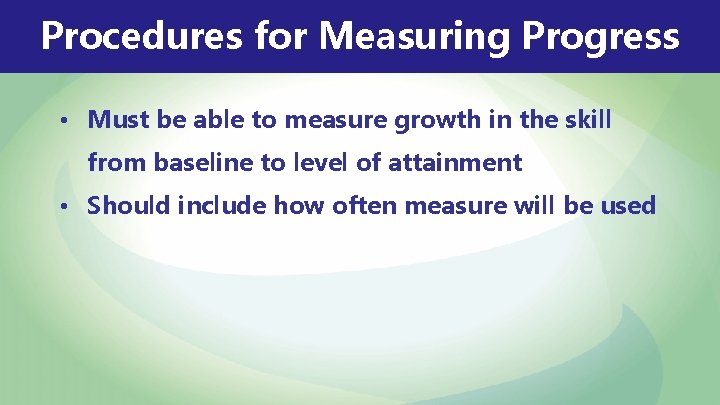
Procedures for Measuring Progress • Must be able to measure growth in the skill from baseline to level of attainment • Should include how often measure will be used
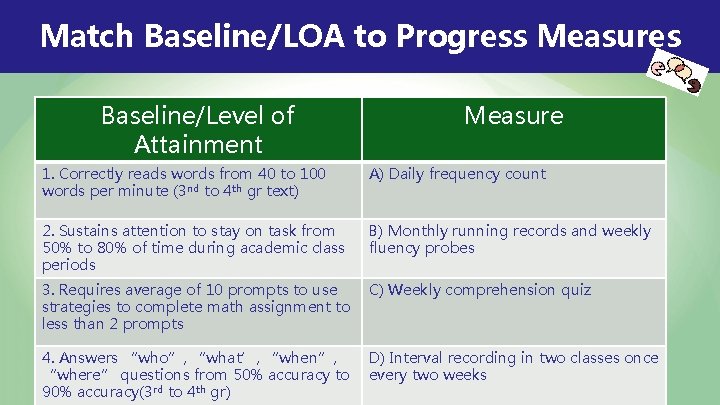
Match Baseline/LOA to Progress Measures Baseline/Level of Attainment Measure 1. Correctly reads words from 40 to 100 words per minute (3 nd to 4 th gr text) A) Daily frequency count 2. Sustains attention to stay on task from 50% to 80% of time during academic class periods B) Monthly running records and weekly fluency probes 3. Requires average of 10 prompts to use C) Weekly comprehension quiz strategies to complete math assignment to less than 2 prompts 4. Answers “who”, “what’, “when”, D) Interval recording in two classes once “where” questions from 50% accuracy to every two weeks 90% accuracy(3 rd to 4 th gr)
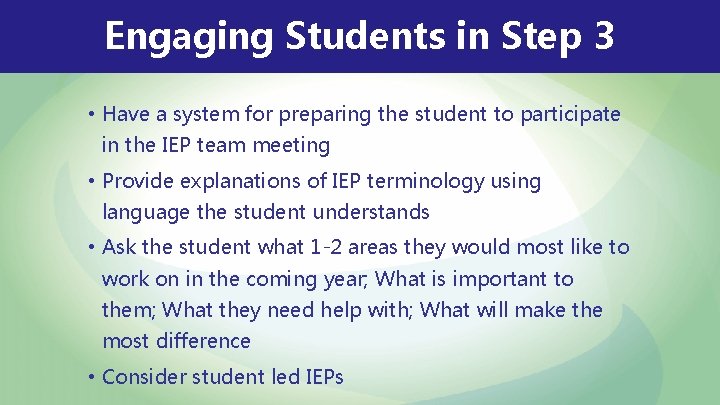
Engaging Students in Step 3 • Have a system for preparing the student to participate in the IEP team meeting • Provide explanations of IEP terminology using language the student understands • Ask the student what 1 -2 areas they would most like to work on in the coming year; What is important to them; What they need help with; What will make the most difference • Consider student led IEPs
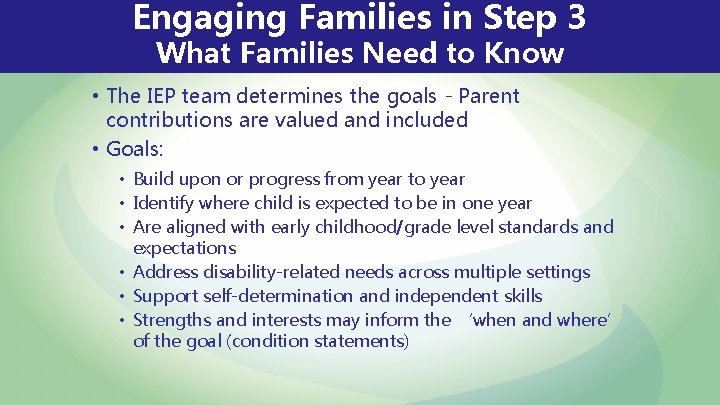
Engaging Families in Step 3 What Families Need to Know • The IEP team determines the goals - Parent contributions are valued and included • Goals: • Build upon or progress from year to year • Identify where child is expected to be in one year • Are aligned with early childhood/grade level standards and expectations • Address disability-related needs across multiple settings • Support self-determination and independent skills • Strengths and interests may inform the ‘when and where’ of the goal (condition statements)
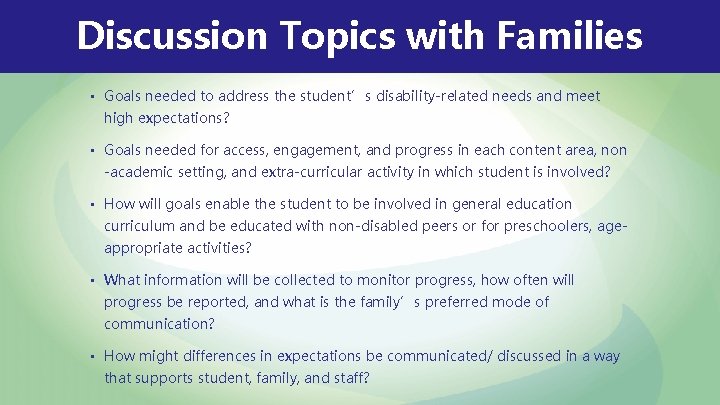
Discussion Topics with Families • Goals needed to address the student’s disability-related needs and meet high expectations? • Goals needed for access, engagement, and progress in each content area, non -academic setting, and extra-curricular activity in which student is involved? • How will goals enable the student to be involved in general education curriculum and be educated with non-disabled peers or for preschoolers, ageappropriate activities? • What information will be collected to monitor progress, how often will progress be reported, and what is the family’s preferred mode of communication? • How might differences in expectations be communicated/ discussed in a way that supports student, family, and staff?
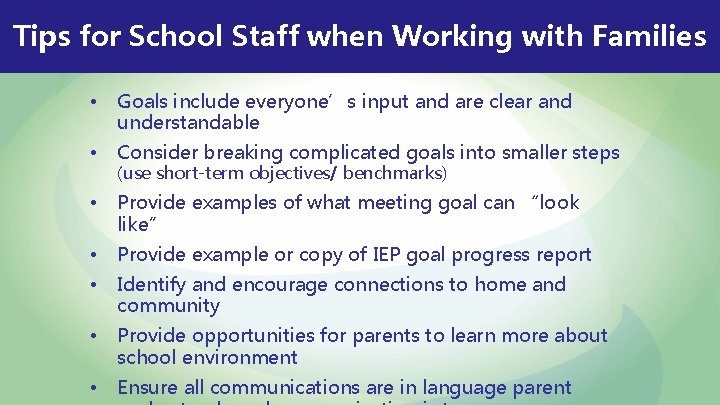
Tips for School Staff when Working with Families • Goals include everyone’s input and are clear and understandable • Consider breaking complicated goals into smaller steps • Provide examples of what meeting goal can “look like” • Provide example or copy of IEP goal progress report • Identify and encourage connections to home and community • Provide opportunities for parents to learn more about school environment • Ensure all communications are in language parent (use short-term objectives/ benchmarks)
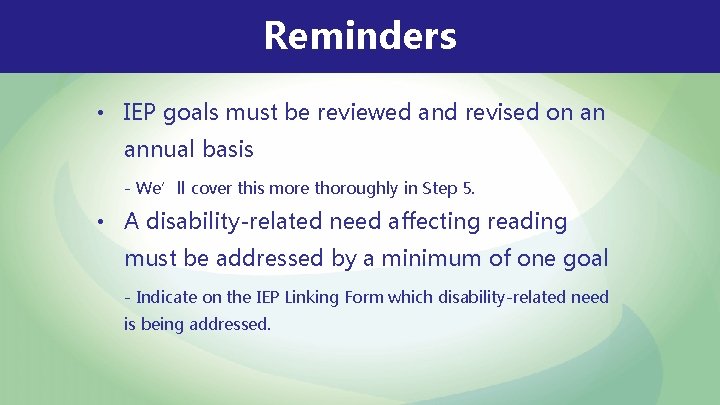
Reminders • IEP goals must be reviewed and revised on an annual basis - We’ll cover this more thoroughly in Step 5. • A disability-related need affecting reading must be addressed by a minimum of one goal - Indicate on the IEP Linking Form which disability-related need is being addressed.
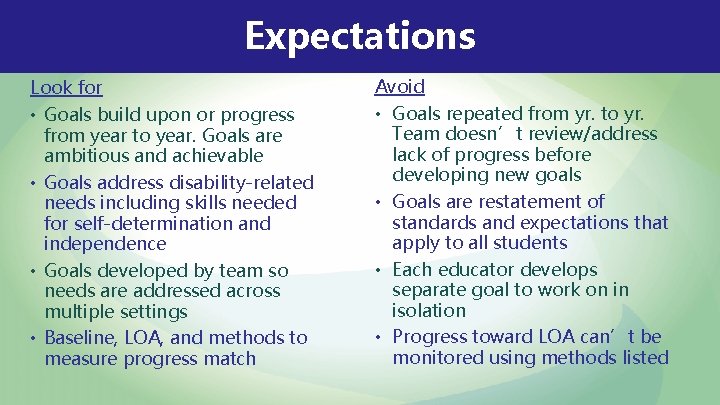
Expectations Look for • Goals build upon or progress from year to year. Goals are ambitious and achievable • Goals address disability-related needs including skills needed for self-determination and independence • Goals developed by team so needs are addressed across multiple settings • Baseline, LOA, and methods to measure progress match Avoid • Goals repeated from yr. to yr. Team doesn’t review/address lack of progress before developing new goals • Goals are restatement of standards and expectations that apply to all students • Each educator develops separate goal to work on in isolation • Progress toward LOA can’t be monitored using methods listed
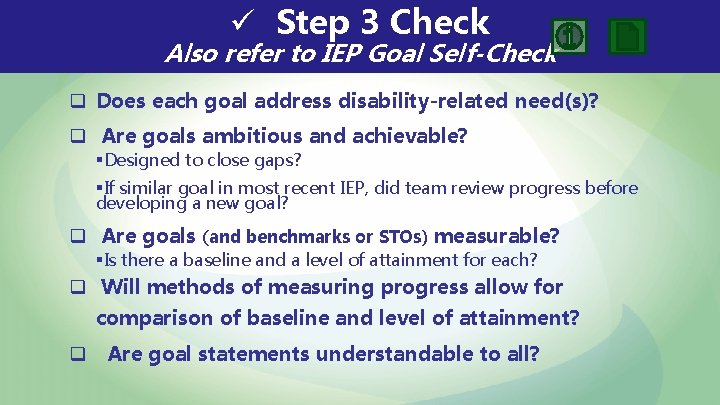
ü Step 3 Check Also refer to IEP Goal Self-Check q Does each goal address disability-related need(s)? q Are goals ambitious and achievable? §Designed to close gaps? §If similar goal in most recent IEP, did team review progress before developing a new goal? q Are goals (and benchmarks or STOs) measurable? §Is there a baseline and a level of attainment for each? q Will methods of measuring progress allow for comparison of baseline and level of attainment? q Are goal statements understandable to all?
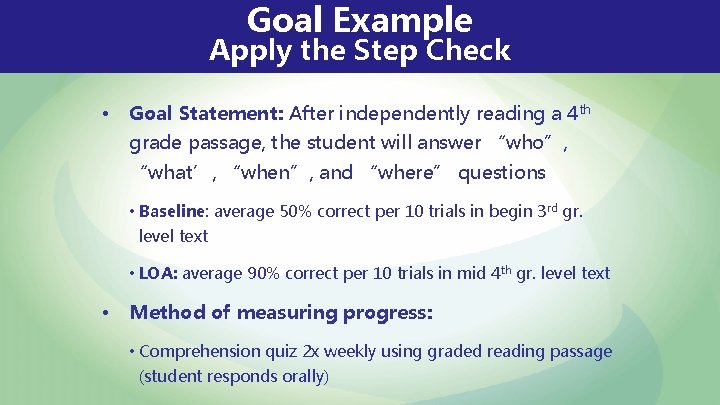
Goal Example Apply the Step Check • Goal Statement: After independently reading a 4 th grade passage, the student will answer “who”, “what’, “when”, and “where” questions • Baseline: average 50% correct per 10 trials in begin 3 rd gr. level text • LOA: average 90% correct per 10 trials in mid 4 th gr. level text • Method of measuring progress: • Comprehension quiz 2 x weekly using graded reading passage (student responds orally)
Step 3 Debrief Questions? Comments
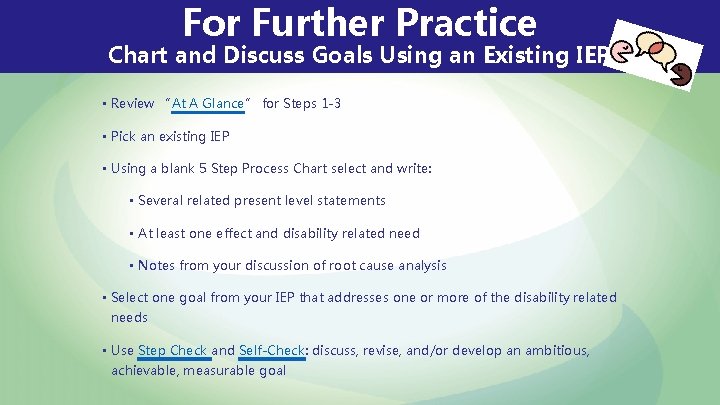
For Further Practice Chart and Discuss Goals Using an Existing IEP • Review “At A Glance” for Steps 1 -3 • Pick an existing IEP • Using a blank 5 Step Process Chart select and write: • Several related present level statements • At least one effect and disability related need • Notes from your discussion of root cause analysis • Select one goal from your IEP that addresses one or more of the disability related needs • Use Step Check and Self-Check: discuss, revise, and/or develop an ambitious, achievable, measurable goal
CCR IEP Learning Resources April 2018 33
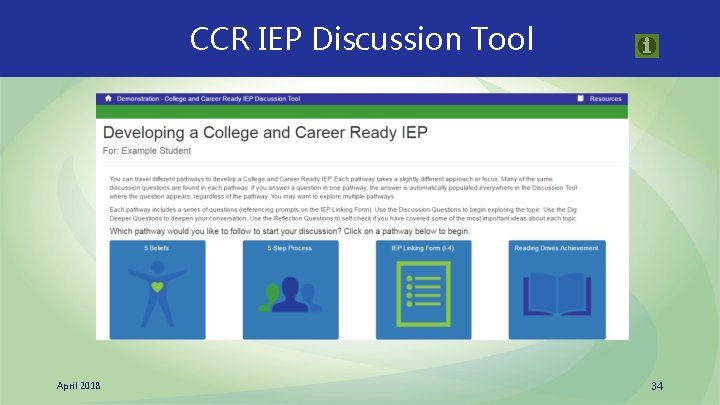
CCR IEP Discussion Tool April 2018 34
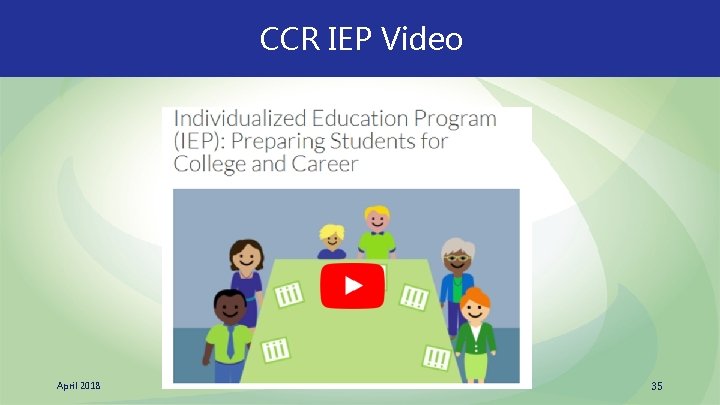
CCR IEP Video April 2018 35
Additional Step 3 Resources • Step 3: At A Glance • Measurable Annual IEP Goals: Self-Check • UDL Tips for Writing Goals • DPI Resources Behavior and IEPs • I’m Determined: Student led IEP meetings • OSERS Policy Letter- FAPE and IEPs • OSERS Policy Letter- IEPs and Behavior Supports • Wisconsin Rt. I Center
Step 3 Resources for Families http: //www. livebinders. com/play? id=2191148 • DPI Step 3 Resources • PTA Guide to Success • CDC Milestone Moments (Birth to age 5) – • UDL- Parent Brief from National Learning Disability Center • Measurable Annual IEP Goals - Self Check • Annual Goals- Center for Parent Information & Resources • Annual IEP Goals: What You Need to Know • Smart IEPs- Emotions to Advocacy
Step 3 Debrief Questions? Comments
Thank you!