Chapter19 Factor Analysis Naresh K Malhotra Marketing Researchan

- Slides: 14
Chapter_19 Factor Analysis Naresh K. Malhotra Marketing Research-an applied orientation, 4 th ed.
Factor Analysis is a general name denoting a class of procedures primarily used for data reduction and summarization. It is an interdependence technique in that an entire set of interdependent relationships is examined. Area of Factor Analysis: 1. 2. 3. To identify underlying dimensions or factors. To identify a new, smaller set of uncorrelated variables. To identify a smaller set of salient variables from a larger set.
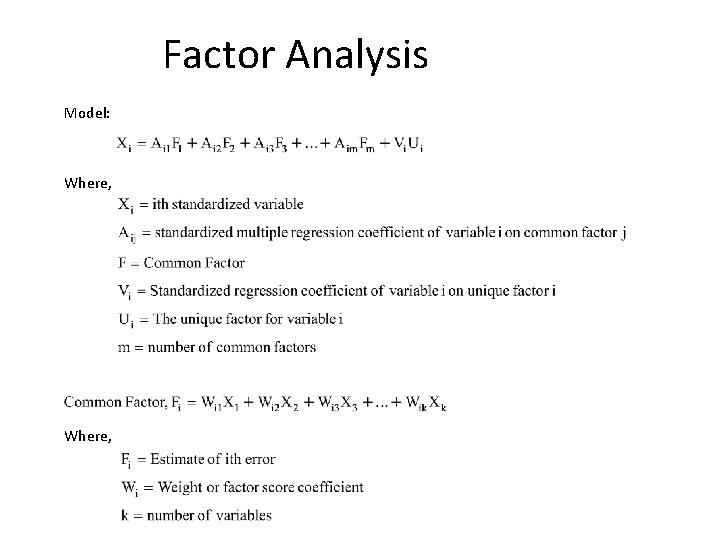
Factor Analysis Model: Where,
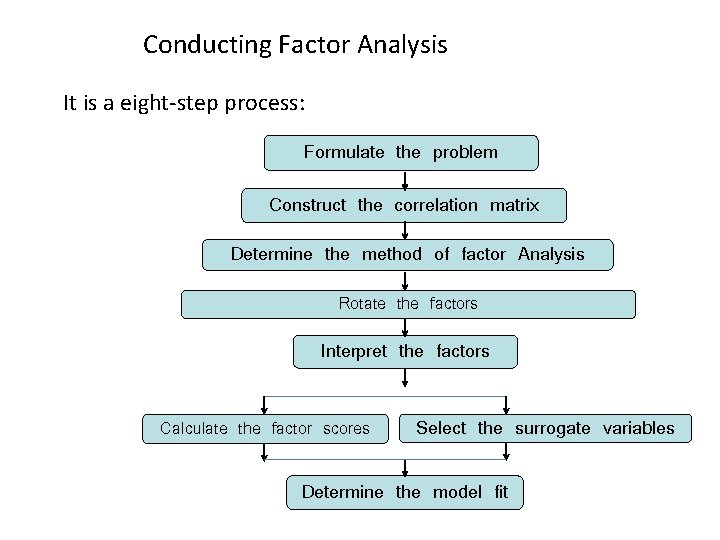
Conducting Factor Analysis It is a eight-step process: Formulate the problem Construct the correlation matrix Determine the method of factor Analysis Rotate the factors Interpret the factors Calculate the factor scores Select the surrogate variables Determine the model fit
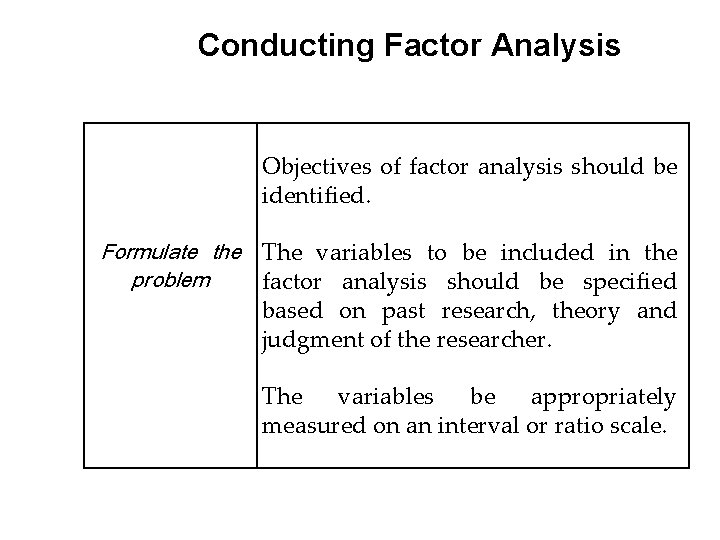
Conducting Factor Analysis Objectives of factor analysis should be identified. Formulate the The variables to be included in the problem factor analysis should be specified based on past research, theory and judgment of the researcher. The variables be appropriately measured on an interval or ratio scale.
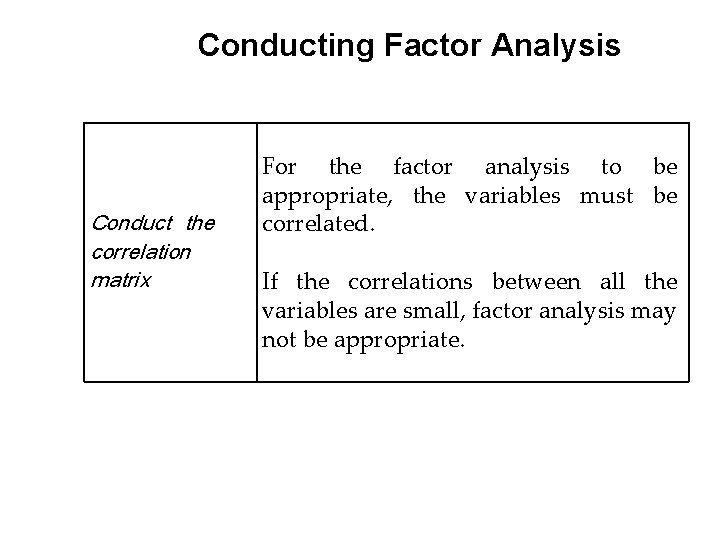
Conducting Factor Analysis Conduct the correlation matrix For the factor analysis to be appropriate, the variables must be correlated. If the correlations between all the variables are small, factor analysis may not be appropriate.
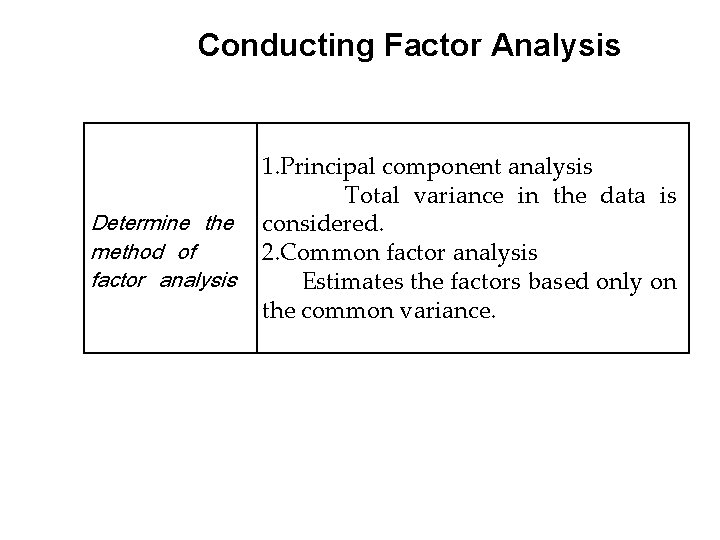
Conducting Factor Analysis Determine the method of factor analysis 1. Principal component analysis Total variance in the data is considered. 2. Common factor analysis Estimates the factors based only on the common variance.
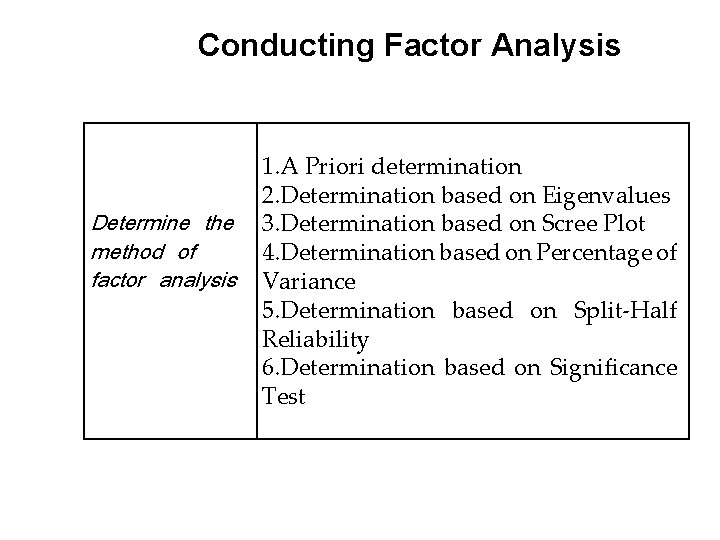
Conducting Factor Analysis Determine the method of factor analysis 1. A Priori determination 2. Determination based on Eigenvalues 3. Determination based on Scree Plot 4. Determination based on Percentage of Variance 5. Determination based on Split-Half Reliability 6. Determination based on Significance Test
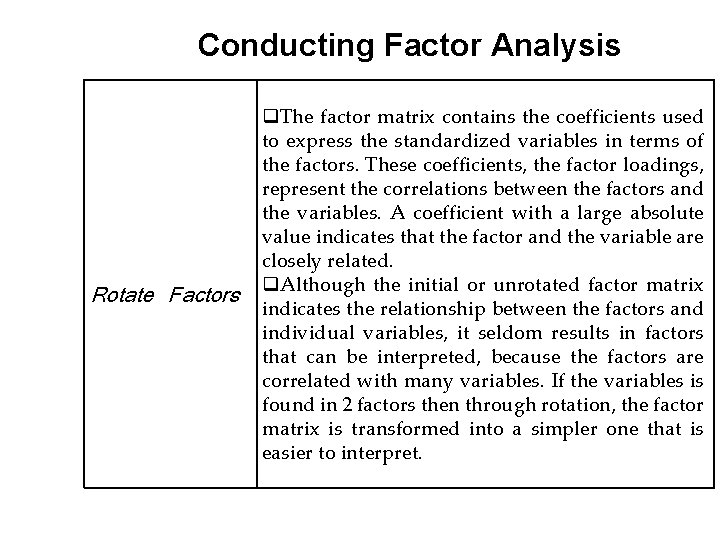
Conducting Factor Analysis Rotate Factors q. The factor matrix contains the coefficients used to express the standardized variables in terms of the factors. These coefficients, the factor loadings, represent the correlations between the factors and the variables. A coefficient with a large absolute value indicates that the factor and the variable are closely related. q. Although the initial or unrotated factor matrix indicates the relationship between the factors and individual variables, it seldom results in factors that can be interpreted, because the factors are correlated with many variables. If the variables is found in 2 factors then through rotation, the factor matrix is transformed into a simpler one that is easier to interpret.
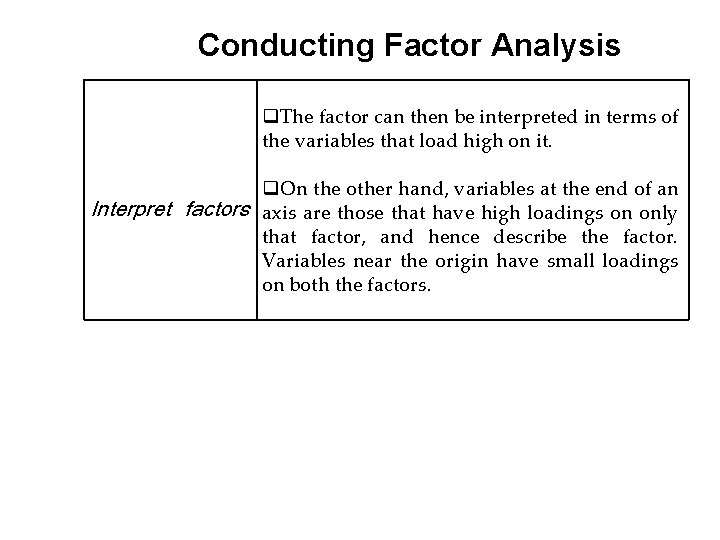
Conducting Factor Analysis q. The factor can then be interpreted in terms of the variables that load high on it. Interpret factors q. On the other hand, variables at the end of an axis are those that have high loadings on only that factor, and hence describe the factor. Variables near the origin have small loadings on both the factors.
Conducting Factor Analysis Calculate factor scores q. If the goal of factor analysis is to reduce the original set of variables to a smaller set of composite variables (factors) for use in subsequent multivariate analysis, it is useful to compute factor scores for each respondent. q. A factor is simply a linear combination of the original variables. q. The weights, or factor score coefficients, used to combine the standardized variables are obtained from the factor score coefficient matrix.
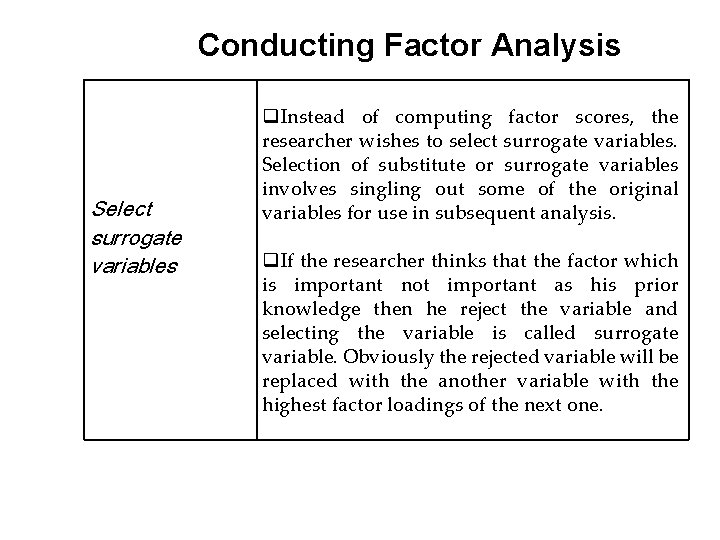
Conducting Factor Analysis Select surrogate variables q. Instead of computing factor scores, the researcher wishes to select surrogate variables. Selection of substitute or surrogate variables involves singling out some of the original variables for use in subsequent analysis. q. If the researcher thinks that the factor which is important not important as his prior knowledge then he reject the variable and selecting the variable is called surrogate variable. Obviously the rejected variable will be replaced with the another variable with the highest factor loadings of the next one.
Conducting Factor Analysis Determine the model fit q. The difference between the observed correlations (correlation matrix) and the reproduced correlations can be examined to determine the model fit. q. These differences are called residuals. If there are many large residuals (value more than 0. 05), the factor model does not provide a good fit to the data and the model should be reconsidered.
Conducting Factor Analysis: SPSS Windows Result of Principal component analysis q. Analyze > Data Reduction > Factor q. Descriptive > Coefficients, KMO and Bartlett’s test of spericity, and Reproduced q. Extraction > Method > Principal Components, Correlation Matrix and Eigenvalues over 1 q. Rotation > check on varimax