Chapter 8 MOTIVATION Learning outcomes to keep in



- Slides: 18
Chapter 8 MOTIVATION
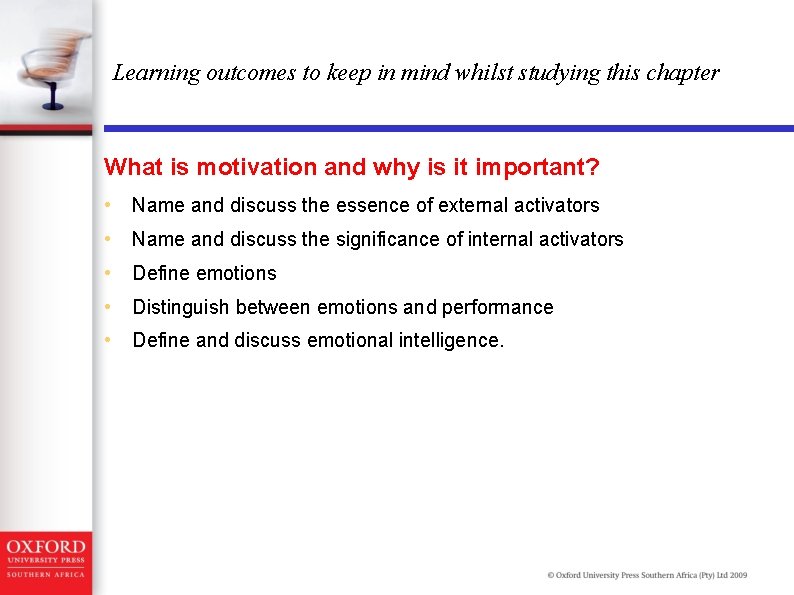
Learning outcomes to keep in mind whilst studying this chapter What is motivation and why is it important? • Name and discuss the essence of external activators • Name and discuss the significance of internal activators • Define emotions • Distinguish between emotions and performance • Define and discuss emotional intelligence.
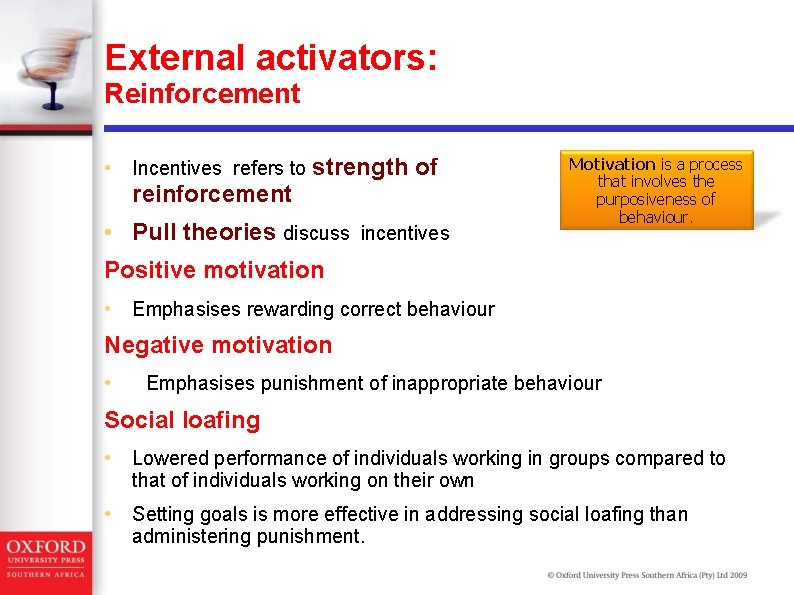
External activators: Reinforcement • Incentives refers to strength of reinforcement • Pull theories discuss incentives Motivation is a process that involves the purposiveness of behaviour. Positive motivation • Emphasises rewarding correct behaviour Negative motivation • Emphasises punishment of inappropriate behaviour Social loafing • Lowered performance of individuals working in groups compared to that of individuals working on their own • Setting goals is more effective in addressing social loafing than administering punishment.
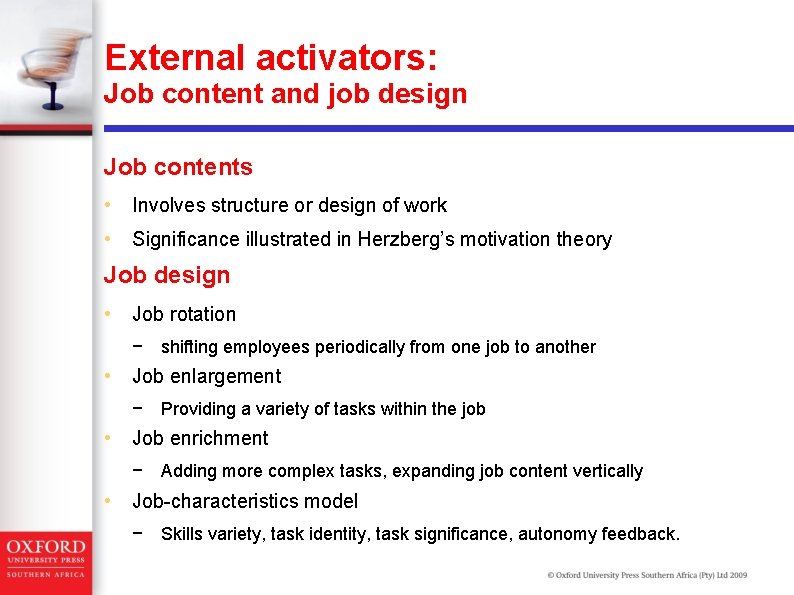
External activators: Job content and job design Job contents • Involves structure or design of work • Significance illustrated in Herzberg’s motivation theory Job design • Job rotation − shifting employees periodically from one job to another • Job enlargement − Providing a variety of tasks within the job • Job enrichment − Adding more complex tasks, expanding job content vertically • Job-characteristics model − Skills variety, task identity, task significance, autonomy feedback.
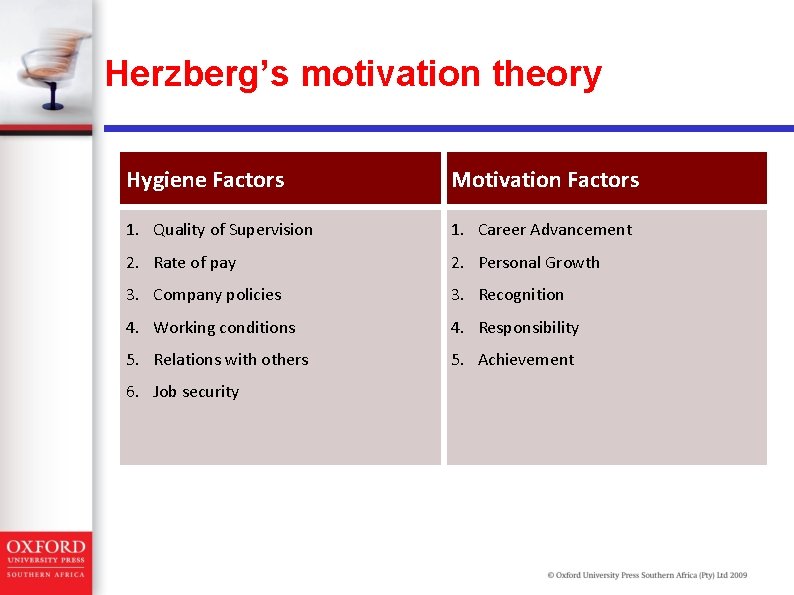
Herzberg’s motivation theory Hygiene Factors Motivation Factors 1. Quality of Supervision 1. Career Advancement 2. Rate of pay 2. Personal Growth 3. Company policies 3. Recognition 4. Working conditions 4. Responsibility 5. Relations with others 5. Achievement 6. Job security
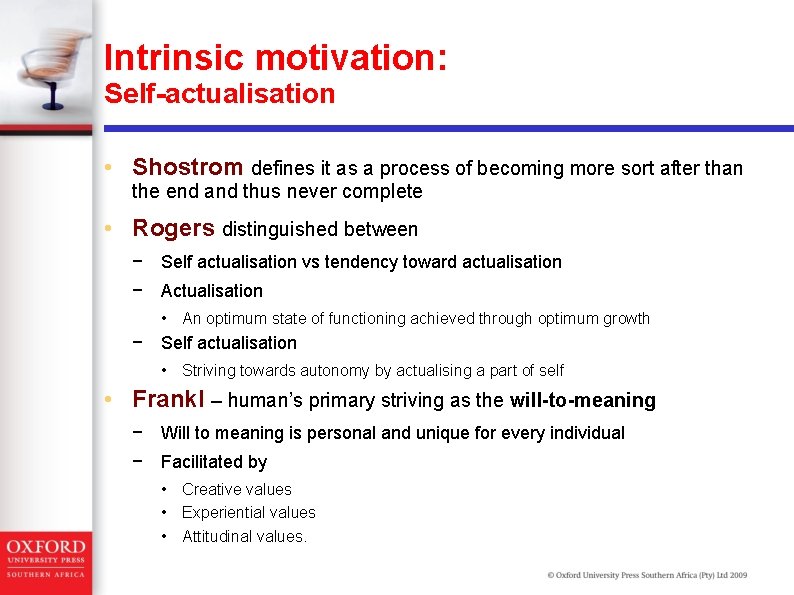
Intrinsic motivation: Self-actualisation • Shostrom defines it as a process of becoming more sort after than the end and thus never complete • Rogers distinguished between − Self actualisation vs tendency toward actualisation − Actualisation • An optimum state of functioning achieved through optimum growth − Self actualisation • Striving towards autonomy by actualising a part of self • Frankl – human’s primary striving as the will-to-meaning − Will to meaning is personal and unique for every individual − Facilitated by • Creative values • Experiential values • Attitudinal values.
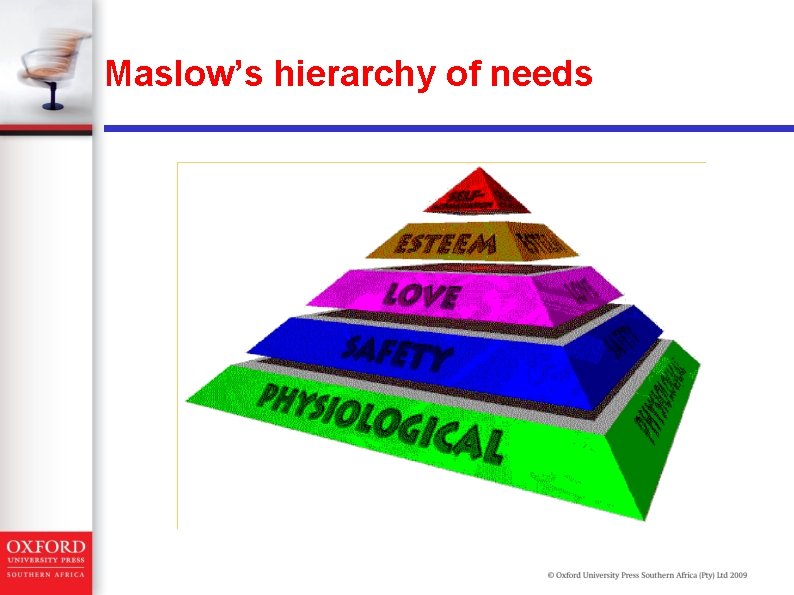
Maslow’s hierarchy of needs
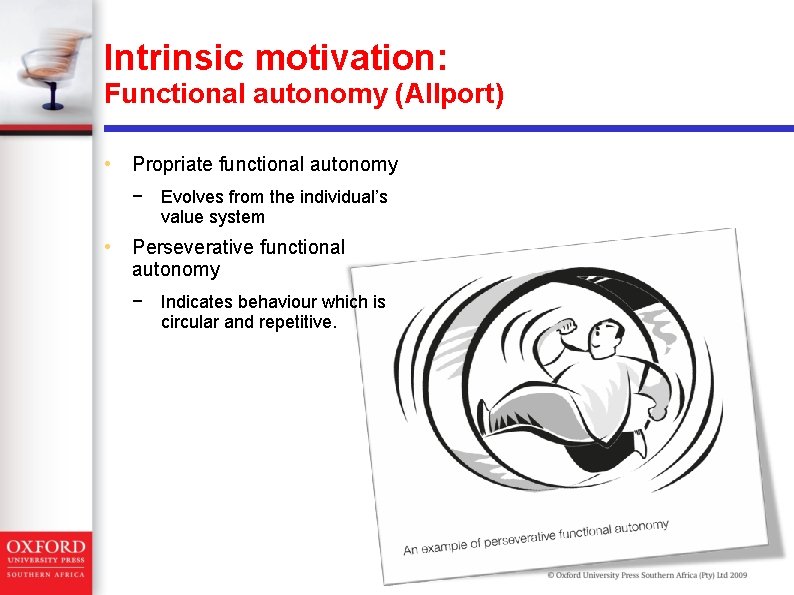
Intrinsic motivation: Functional autonomy (Allport) • Propriate functional autonomy − Evolves from the individual’s value system • Perseverative functional autonomy − Indicates behaviour which is circular and repetitive.
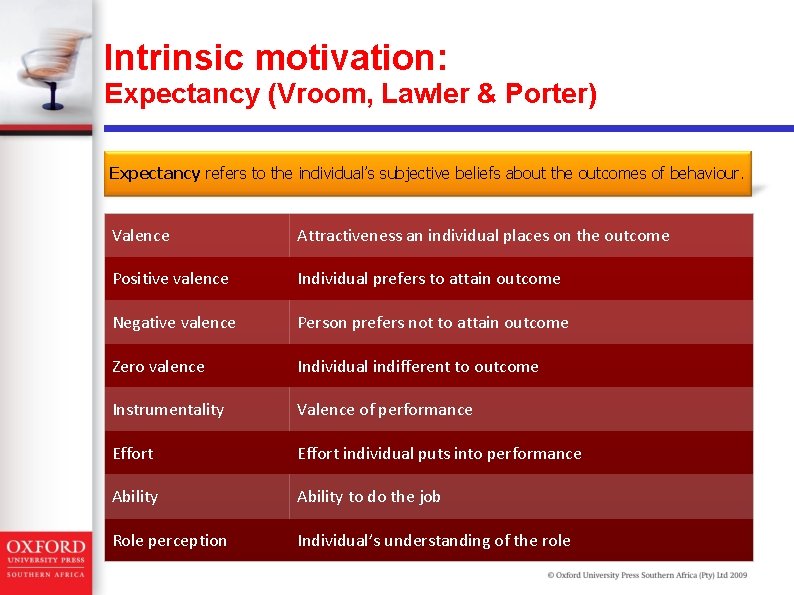
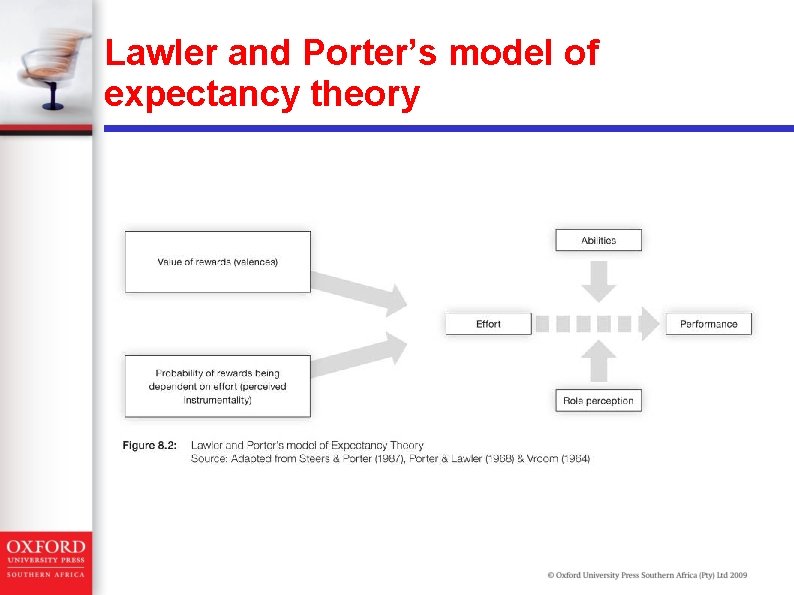
Intrinsic motivation: Expectancy (Vroom, Lawler & Porter) Expectancy refers to the individual’s subjective beliefs about the outcomes of behaviour. Valence Attractiveness an individual places on the outcome Positive valence Individual prefers to attain outcome Negative valence Person prefers not to attain outcome Zero valence Individual indifferent to outcome Instrumentality Valence of performance Effort individual puts into performance Ability to do the job Role perception Individual’s understanding of the role
Lawler and Porter’s model of expectancy theory
Intrinsic motivation: Achievement and self efficacy Achievement (Mc. Clelland) • Need to achieve derives from growing expectation in childhood • Achievement needs manifest in different forms in different cultural orientations Self efficacy (Bandura) • Sense of having more or less control over events affecting one’s life • Self efficacy beliefs are acquired by: − Reflecting on own past behaviour − Vicarious experiences − Verbal persuasion − Emotional cues.
Intrinsic motivation: Attribution (Bandura) Locus of causality • Internal or and external locus of control Stability • Consistency of causes over time Internal locus of control • Ability (stable factor) • Effort (unstable factor) External locus of control • Task difficulty (stable factor) • Luck (unstable factor). Attribution involves trying to understand, by localising the causes, why event’s and one’s behaviour have certain outcomes.
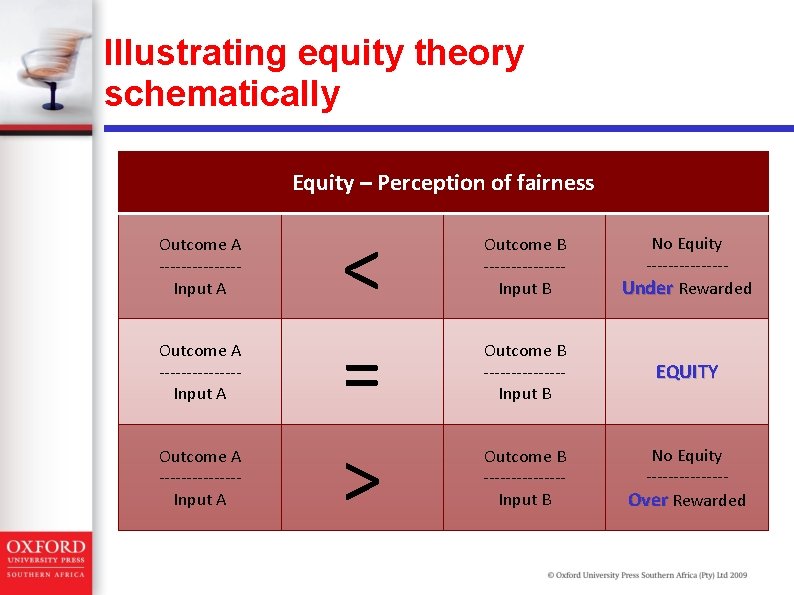
Illustrating equity theory schematically Equity – Perception of fairness Outcome A --------------Input A Outcome A -------Input A < = > Outcome B -------Input B No Equity -------Under Rewarded Outcome B -------Input B EQUITY Outcome B -------Input B No Equity -------Over Rewarded
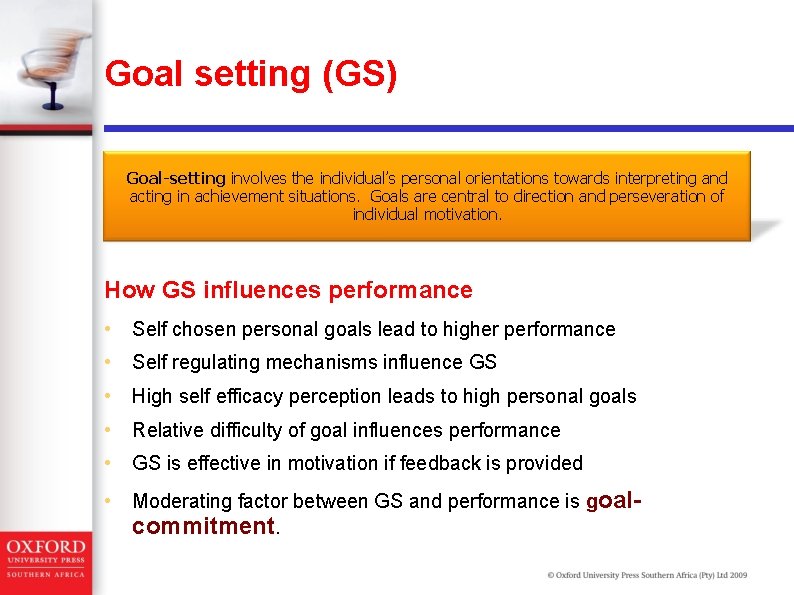
Goal setting (GS) Goal-setting involves the individual’s personal orientations towards interpreting and acting in achievement situations. Goals are central to direction and perseveration of individual motivation. How GS influences performance • Self chosen personal goals lead to higher performance • Self regulating mechanisms influence GS • High self efficacy perception leads to high personal goals • Relative difficulty of goal influences performance • GS is effective in motivation if feedback is provided • Moderating factor between GS and performance is goalcommitment.
The emotional process
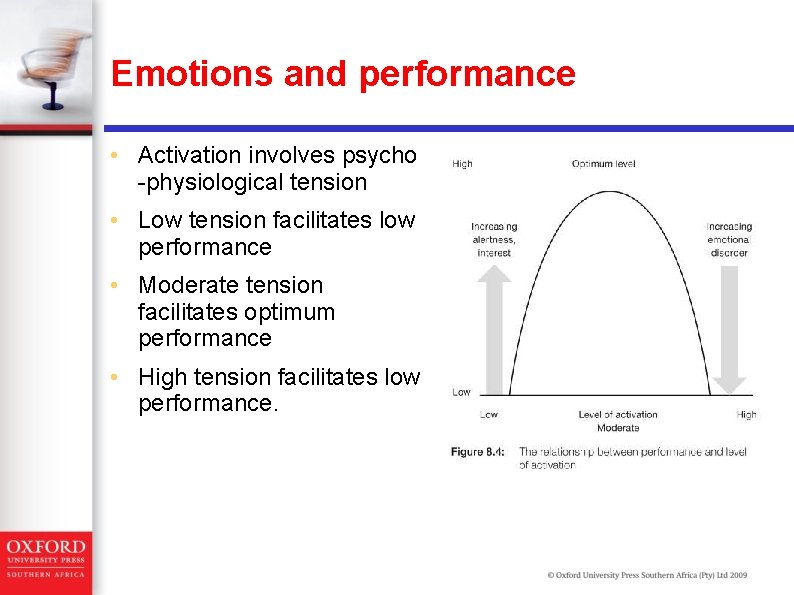
Emotions and performance • Activation involves psycho -physiological tension • Low tension facilitates low performance • Moderate tension facilitates optimum performance • High tension facilitates low performance.
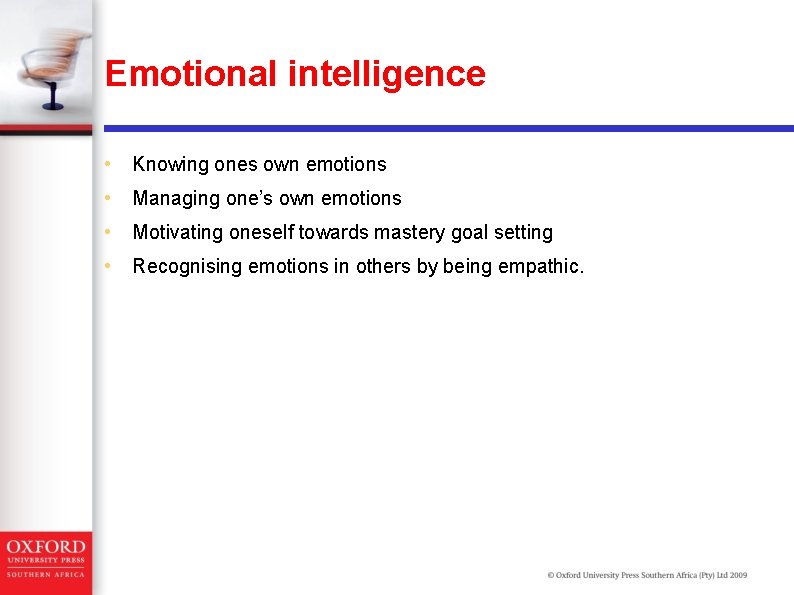
Emotional intelligence • Knowing ones own emotions • Managing one’s own emotions • Motivating oneself towards mastery goal setting • Recognising emotions in others by being empathic.
Thank you.