Chapter 6 Physical Fitness Lesson 6 1 The
- Slides: 29
Chapter 6 Physical Fitness Lesson 6. 1 The Benefits of Improved Physical Fitness Lesson 6. 2 The Components of Physical Fitness Lesson 6. 3 Fitness Safety
Lesson 6. 1 The Benefits of Improved Physical Fitness
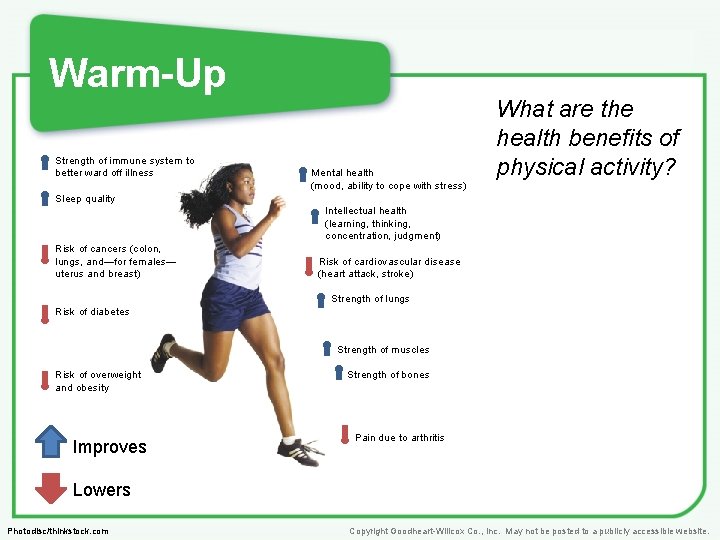
Warm-Up Strength of immune system to better ward off illness Mental health (mood, ability to cope with stress) What are the health benefits of physical activity? Sleep quality Intellectual health (learning, thinking, concentration, judgment) Risk of cancers (colon, lungs, and—for females— uterus and breast) Risk of cardiovascular disease (heart attack, stroke) Strength of lungs Risk of diabetes Strength of muscles Risk of overweight and obesity Improves Strength of bones Pain due to arthritis Lowers Photodisc/thinkstock. com Copyright Goodheart-Willcox Co. , Inc. May not be posted to a publicly accessible website.
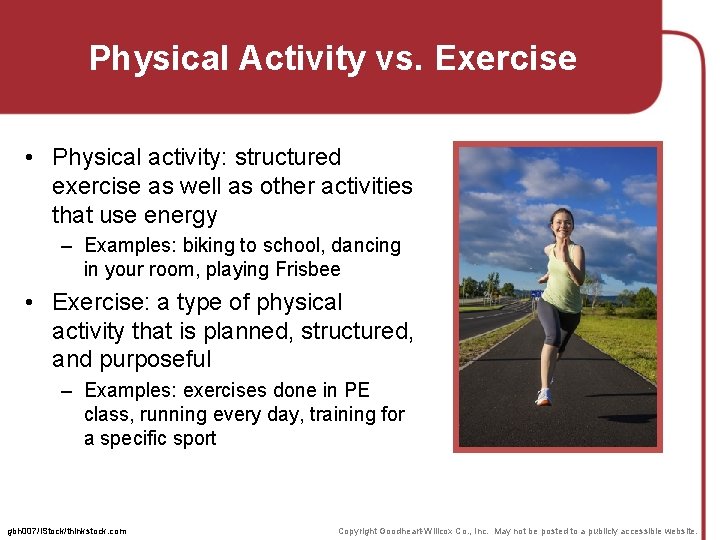
Physical Activity vs. Exercise • Physical activity: structured exercise as well as other activities that use energy – Examples: biking to school, dancing in your room, playing Frisbee • Exercise: a type of physical activity that is planned, structured, and purposeful – Examples: exercises done in PE class, running every day, training for a specific sport gbh 007/i. Stock/thinkstock. com Copyright Goodheart-Willcox Co. , Inc. May not be posted to a publicly accessible website.
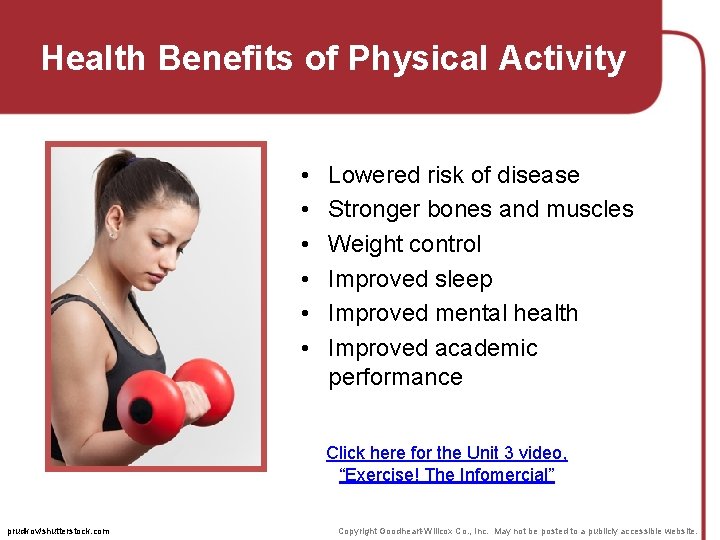
Health Benefits of Physical Activity • • • Lowered risk of disease Stronger bones and muscles Weight control Improved sleep Improved mental health Improved academic performance Click here for the Unit 3 video, “Exercise! The Infomercial” prudkov/shutterstock. com Copyright Goodheart-Willcox Co. , Inc. May not be posted to a publicly accessible website.
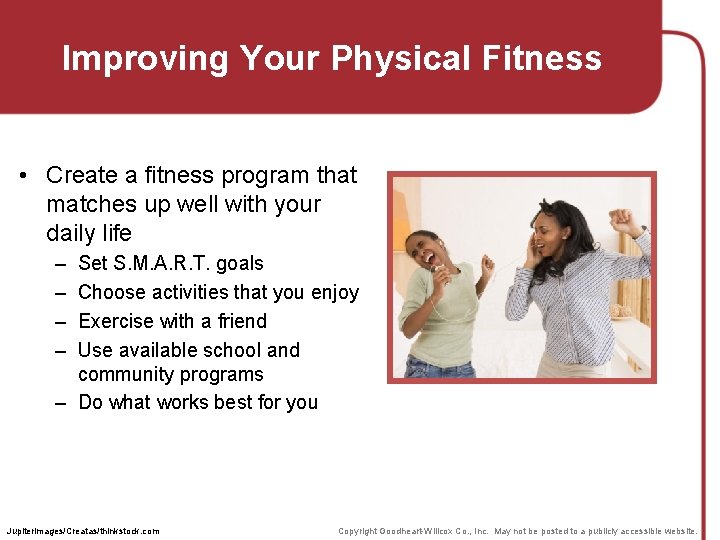
Improving Your Physical Fitness • Create a fitness program that matches up well with your daily life – – Set S. M. A. R. T. goals Choose activities that you enjoy Exercise with a friend Use available school and community programs – Do what works best for you Jupiterimages/Creatas/thinkstock. com Copyright Goodheart-Willcox Co. , Inc. May not be posted to a publicly accessible website.
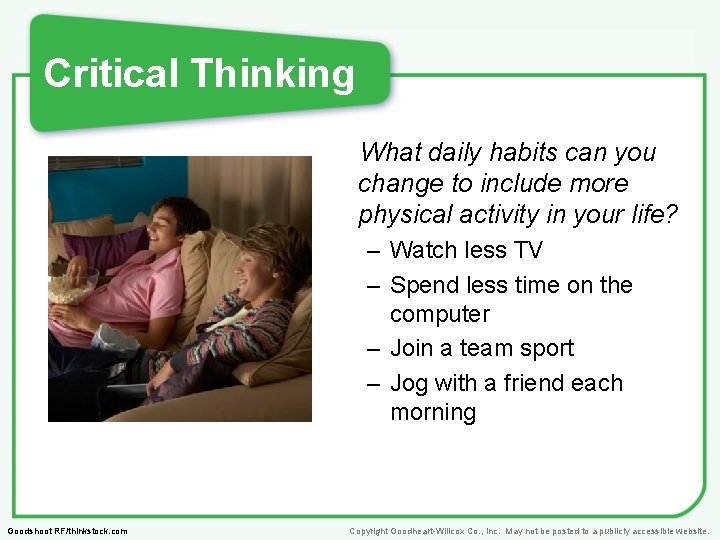
Critical Thinking What daily habits can you change to include more physical activity in your life? – Watch less TV – Spend less time on the computer – Join a team sport – Jog with a friend each morning Goodshoot RF/thinkstock. com Copyright Goodheart-Willcox Co. , Inc. May not be posted to a publicly accessible website.
Lesson 6. 2 The Components of Physical Fitness
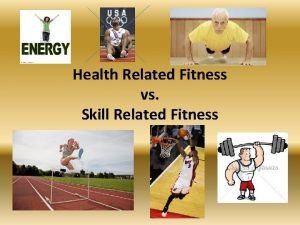
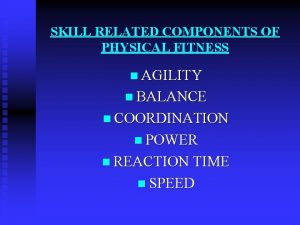
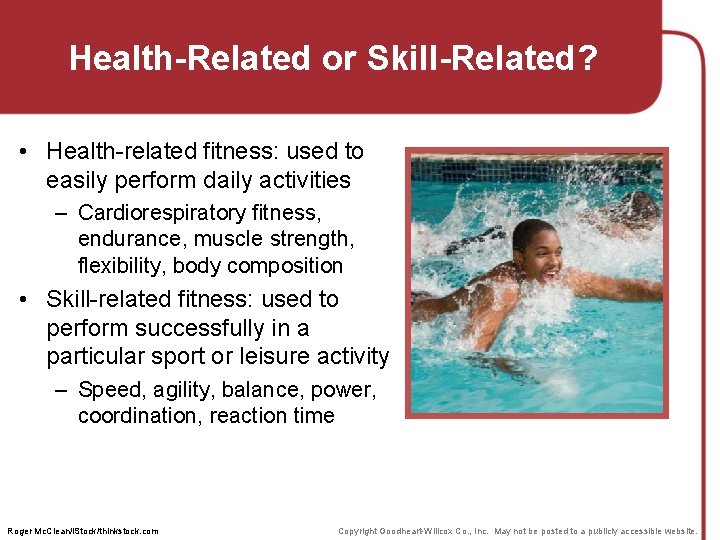
Health-Related or Skill-Related? • Health-related fitness: used to easily perform daily activities – Cardiorespiratory fitness, endurance, muscle strength, flexibility, body composition • Skill-related fitness: used to perform successfully in a particular sport or leisure activity – Speed, agility, balance, power, coordination, reaction time Roger Mc. Clean/i. Stock/thinkstock. com Copyright Goodheart-Willcox Co. , Inc. May not be posted to a publicly accessible website.
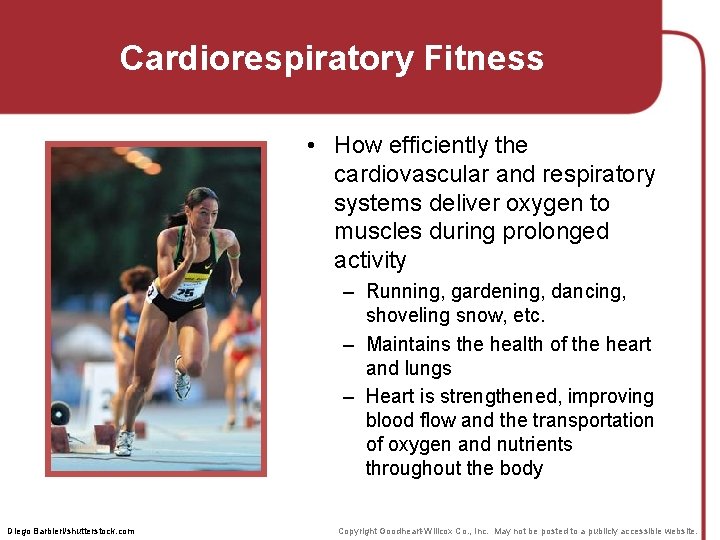
Cardiorespiratory Fitness • How efficiently the cardiovascular and respiratory systems deliver oxygen to muscles during prolonged activity – Running, gardening, dancing, shoveling snow, etc. – Maintains the health of the heart and lungs – Heart is strengthened, improving blood flow and the transportation of oxygen and nutrients throughout the body Diego Barbieri/shutterstock. com Copyright Goodheart-Willcox Co. , Inc. May not be posted to a publicly accessible website.
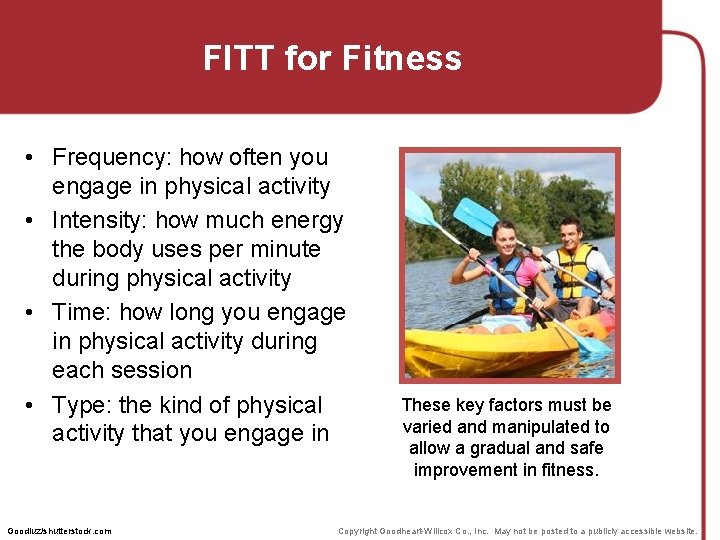
FITT for Fitness • Frequency: how often you engage in physical activity • Intensity: how much energy the body uses per minute during physical activity • Time: how long you engage in physical activity during each session • Type: the kind of physical activity that you engage in Goodluz/shutterstock. com These key factors must be varied and manipulated to allow a gradual and safe improvement in fitness. Copyright Goodheart-Willcox Co. , Inc. May not be posted to a publicly accessible website.
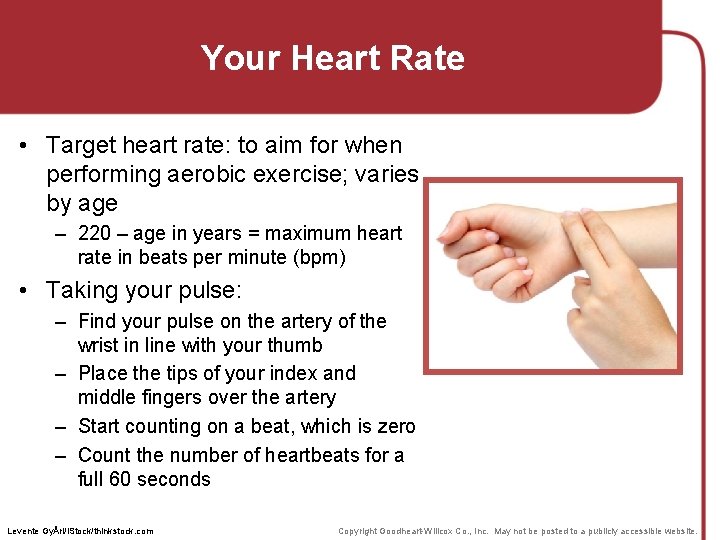
Your Heart Rate • Target heart rate: to aim for when performing aerobic exercise; varies by age – 220 – age in years = maximum heart rate in beats per minute (bpm) • Taking your pulse: – Find your pulse on the artery of the wrist in line with your thumb – Place the tips of your index and middle fingers over the artery – Start counting on a beat, which is zero – Count the number of heartbeats for a full 60 seconds Levente GyÅri/i. Stock/thinkstock. com Copyright Goodheart-Willcox Co. , Inc. May not be posted to a publicly accessible website.
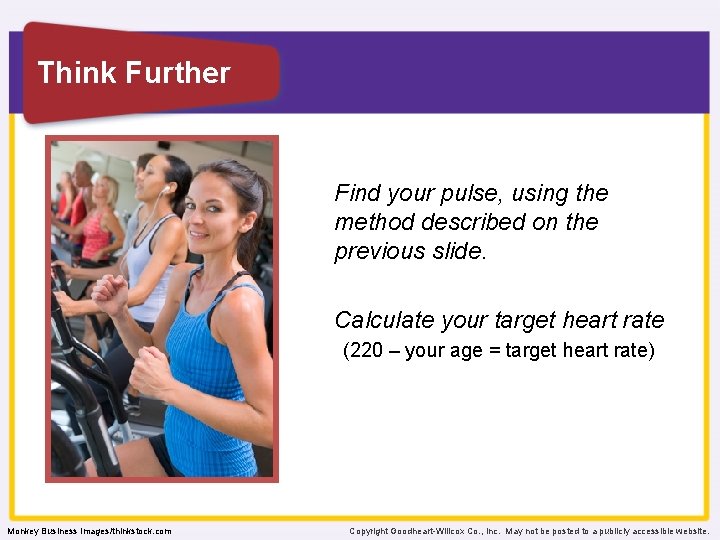
Think Further Find your pulse, using the method described on the previous slide. Calculate your target heart rate (220 – your age = target heart rate) Monkey Business Images/thinkstock. com Copyright Goodheart-Willcox Co. , Inc. May not be posted to a publicly accessible website.
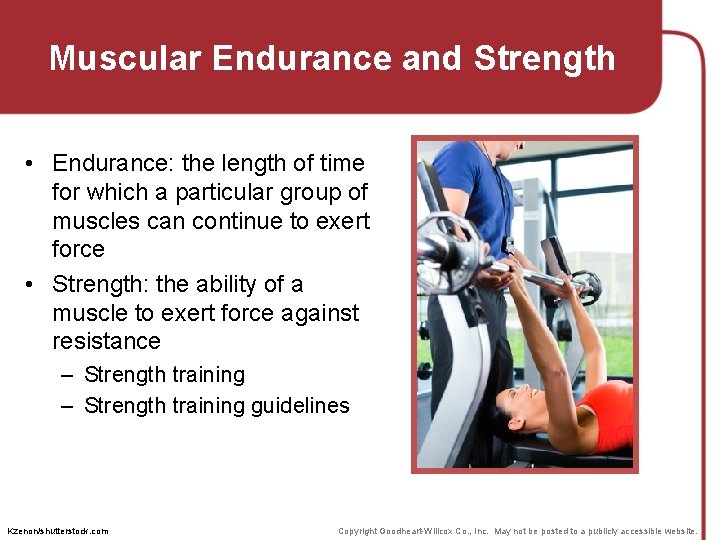
Muscular Endurance and Strength • Endurance: the length of time for which a particular group of muscles can continue to exert force • Strength: the ability of a muscle to exert force against resistance – Strength training guidelines Kzenon/shutterstock. com Copyright Goodheart-Willcox Co. , Inc. May not be posted to a publicly accessible website.
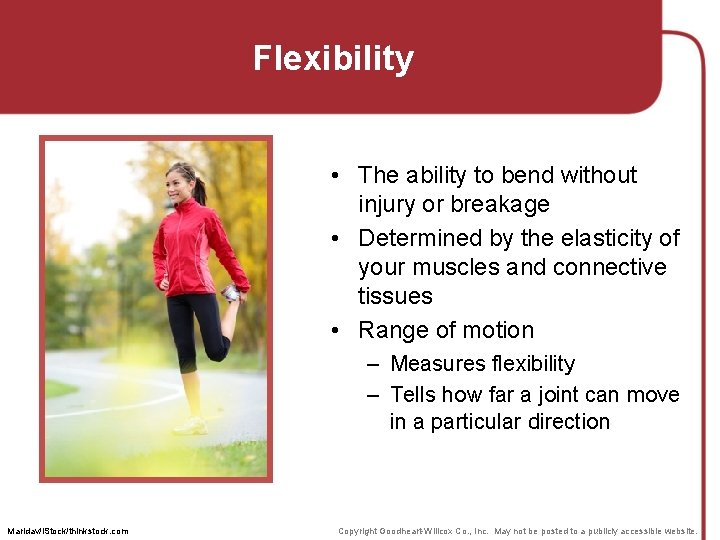
Flexibility • The ability to bend without injury or breakage • Determined by the elasticity of your muscles and connective tissues • Range of motion – Measures flexibility – Tells how far a joint can move in a particular direction Maridav/i. Stock/thinkstock. com Copyright Goodheart-Willcox Co. , Inc. May not be posted to a publicly accessible website.
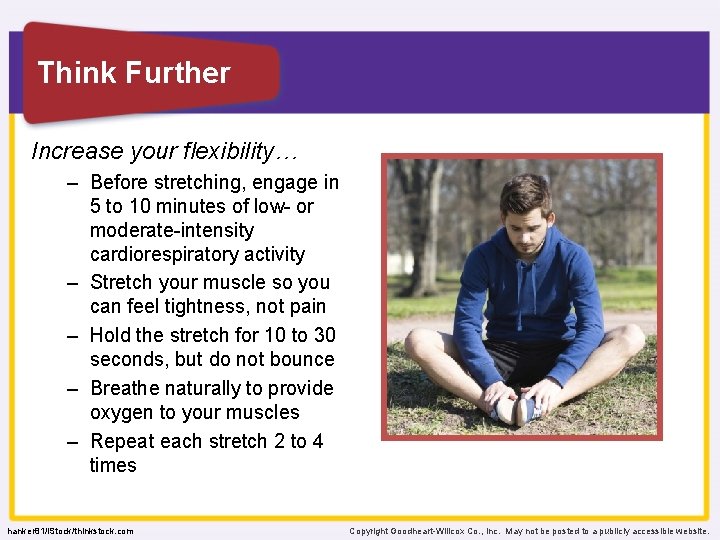
Think Further Increase your flexibility… – Before stretching, engage in 5 to 10 minutes of low- or moderate-intensity cardiorespiratory activity – Stretch your muscle so you can feel tightness, not pain – Hold the stretch for 10 to 30 seconds, but do not bounce – Breathe naturally to provide oxygen to your muscles – Repeat each stretch 2 to 4 times hanker 81/i. Stock/thinkstock. com Copyright Goodheart-Willcox Co. , Inc. May not be posted to a publicly accessible website.
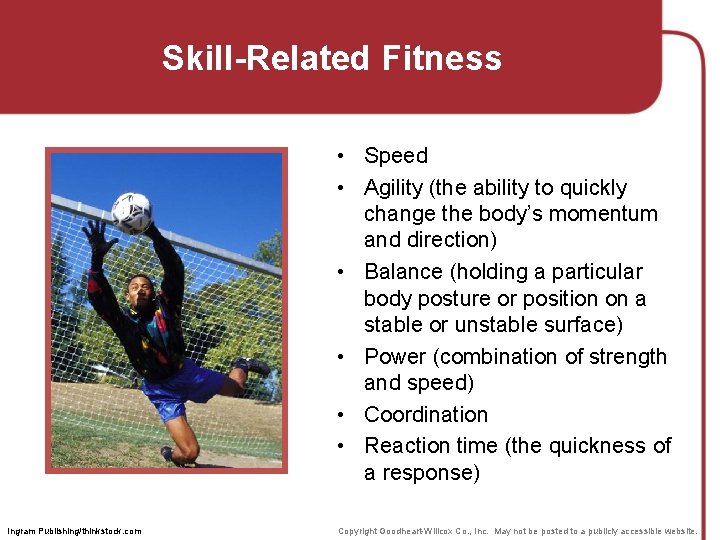
Skill-Related Fitness • Speed • Agility (the ability to quickly change the body’s momentum and direction) • Balance (holding a particular body posture or position on a stable or unstable surface) • Power (combination of strength and speed) • Coordination • Reaction time (the quickness of a response) Ingram Publishing/thinkstock. com Copyright Goodheart-Willcox Co. , Inc. May not be posted to a publicly accessible website.
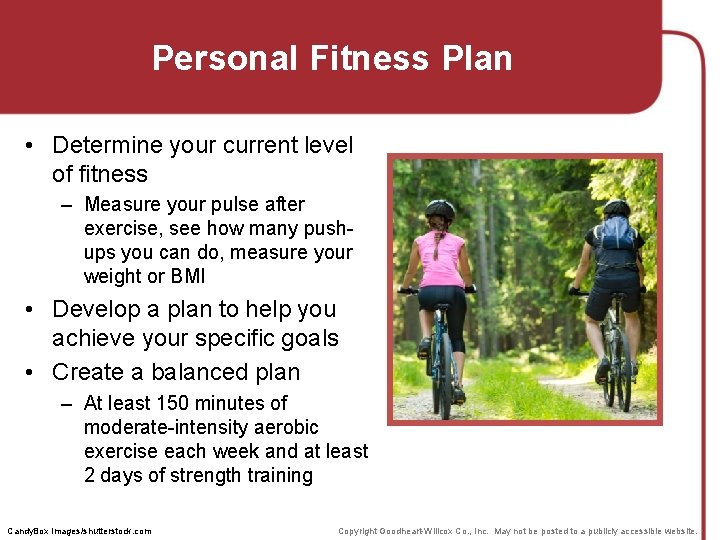
Personal Fitness Plan • Determine your current level of fitness – Measure your pulse after exercise, see how many pushups you can do, measure your weight or BMI • Develop a plan to help you achieve your specific goals • Create a balanced plan – At least 150 minutes of moderate-intensity aerobic exercise each week and at least 2 days of strength training Candy. Box Images/shutterstock. com Copyright Goodheart-Willcox Co. , Inc. May not be posted to a publicly accessible website.
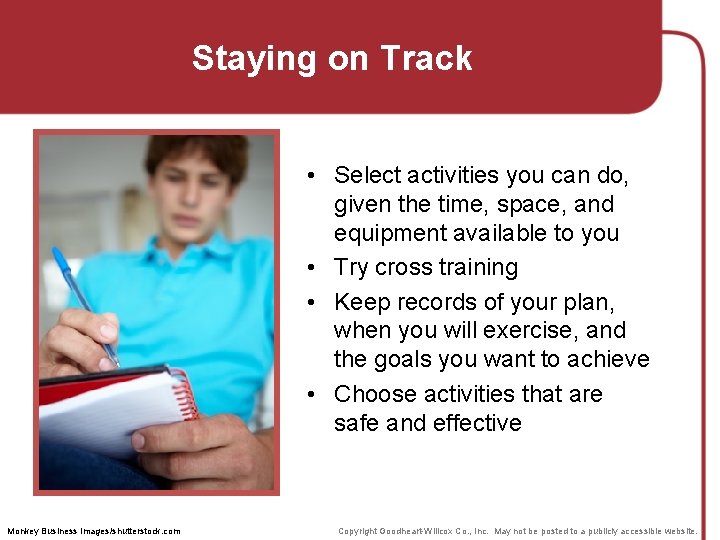
Staying on Track • Select activities you can do, given the time, space, and equipment available to you • Try cross training • Keep records of your plan, when you will exercise, and the goals you want to achieve • Choose activities that are safe and effective Monkey Business Images/shutterstock. com Copyright Goodheart-Willcox Co. , Inc. May not be posted to a publicly accessible website.
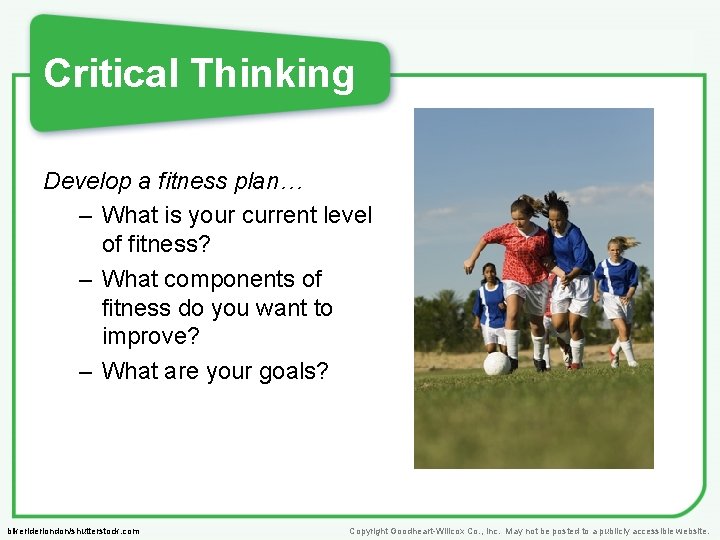
Critical Thinking Develop a fitness plan… – What is your current level of fitness? – What components of fitness do you want to improve? – What are your goals? bikeriderlondon/shutterstock. com Copyright Goodheart-Willcox Co. , Inc. May not be posted to a publicly accessible website.
Lesson 6. 3 Fitness Safety
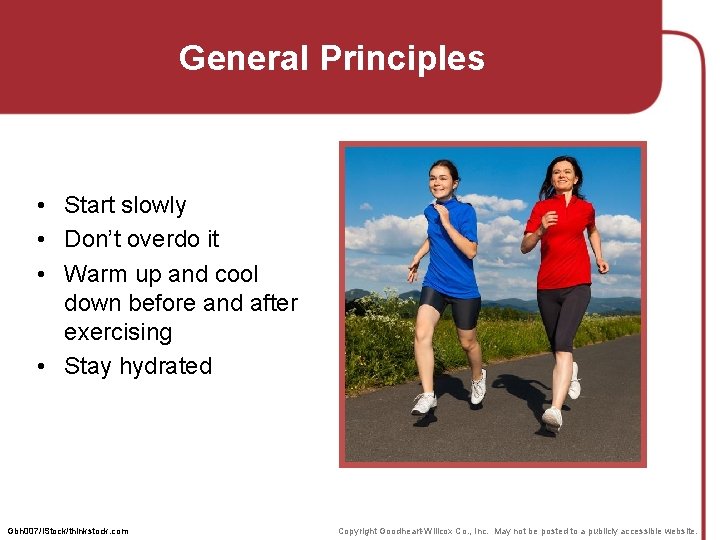
General Principles • Start slowly • Don’t overdo it • Warm up and cool down before and after exercising • Stay hydrated Gbh 007/i. Stock/thinkstock. com Copyright Goodheart-Willcox Co. , Inc. May not be posted to a publicly accessible website.
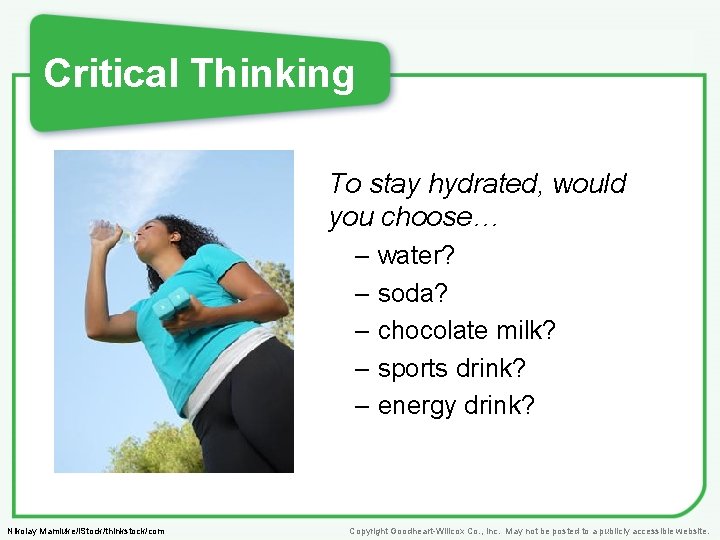
Critical Thinking To stay hydrated, would you choose… – water? – soda? – chocolate milk? – sports drink? – energy drink? Nikolay Mamluke/i. Stock/thinkstock/com Copyright Goodheart-Willcox Co. , Inc. May not be posted to a publicly accessible website.
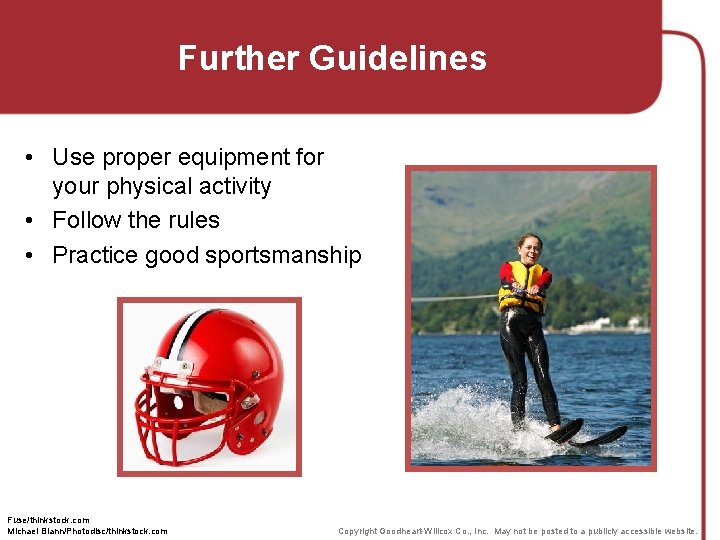
Further Guidelines • Use proper equipment for your physical activity • Follow the rules • Practice good sportsmanship Fuse/thinkstock. com Michael Blann/Photodisc/thinkstock. com Copyright Goodheart-Willcox Co. , Inc. May not be posted to a publicly accessible website.
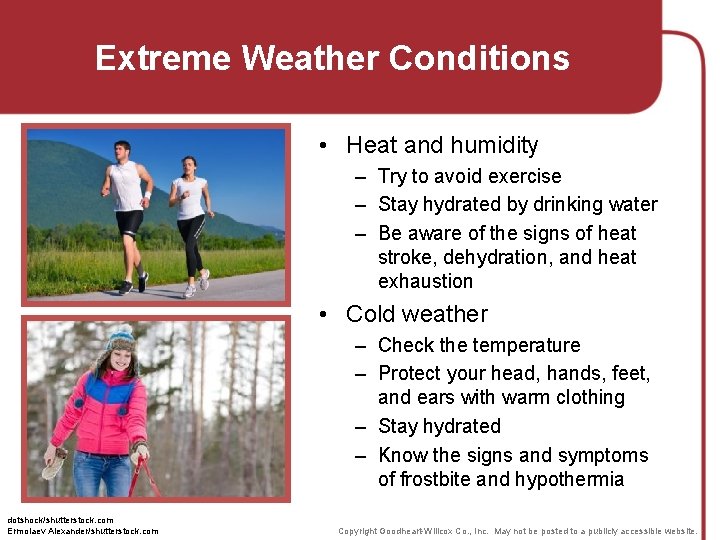
Extreme Weather Conditions • Heat and humidity – Try to avoid exercise – Stay hydrated by drinking water – Be aware of the signs of heat stroke, dehydration, and heat exhaustion • Cold weather – Check the temperature – Protect your head, hands, feet, and ears with warm clothing – Stay hydrated – Know the signs and symptoms of frostbite and hypothermia dotshock/shutterstock. com Ermolaev Alexander/shutterstock. com Copyright Goodheart-Willcox Co. , Inc. May not be posted to a publicly accessible website.
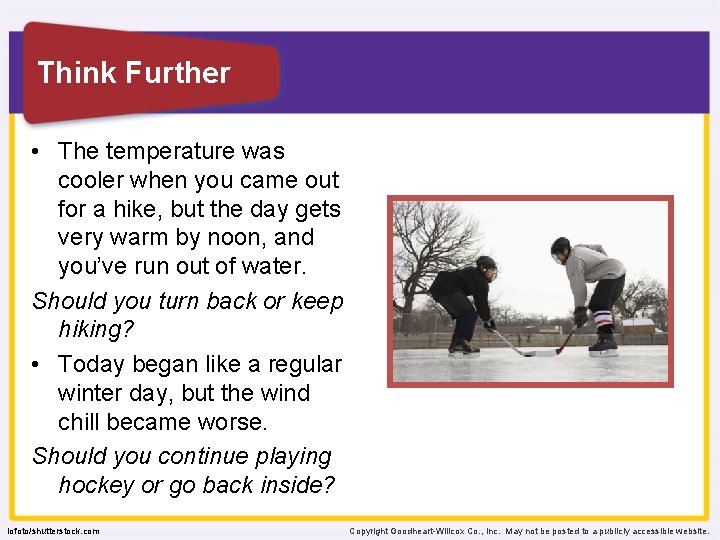
Think Further • The temperature was cooler when you came out for a hike, but the day gets very warm by noon, and you’ve run out of water. Should you turn back or keep hiking? • Today began like a regular winter day, but the wind chill became worse. Should you continue playing hockey or go back inside? iofoto/shutterstock. com Copyright Goodheart-Willcox Co. , Inc. May not be posted to a publicly accessible website.
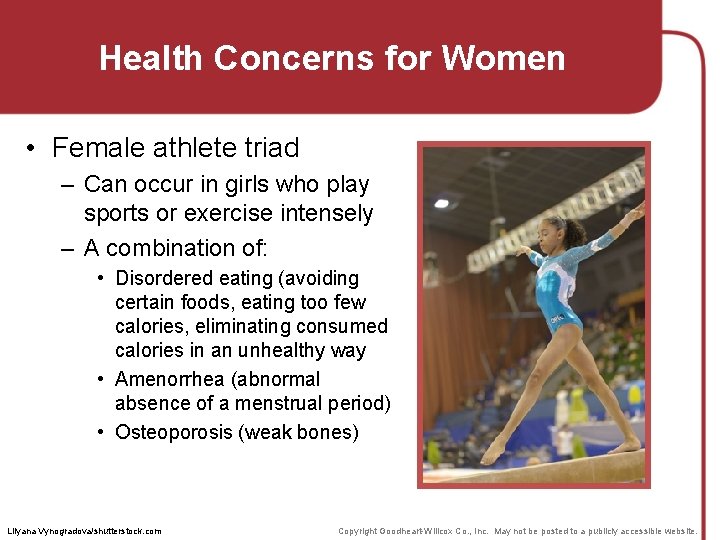
Health Concerns for Women • Female athlete triad – Can occur in girls who play sports or exercise intensely – A combination of: • Disordered eating (avoiding certain foods, eating too few calories, eliminating consumed calories in an unhealthy way • Amenorrhea (abnormal absence of a menstrual period) • Osteoporosis (weak bones) Lilyana Vynogradova/shutterstock. com Copyright Goodheart-Willcox Co. , Inc. May not be posted to a publicly accessible website.
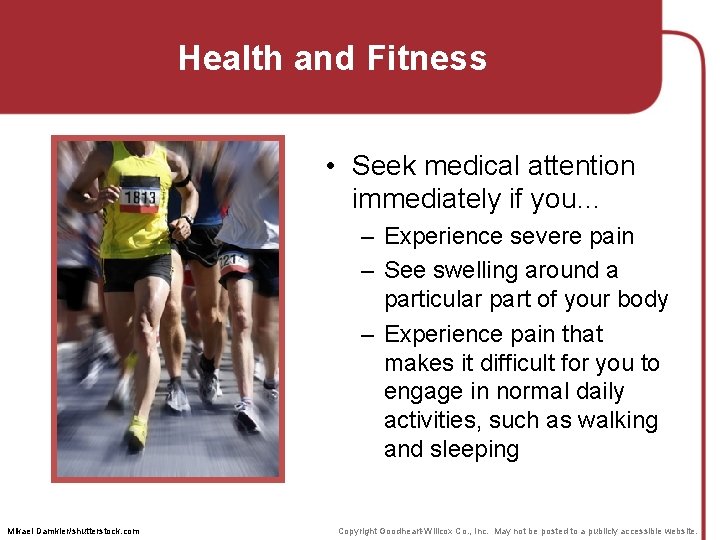
Health and Fitness • Seek medical attention immediately if you… – Experience severe pain – See swelling around a particular part of your body – Experience pain that makes it difficult for you to engage in normal daily activities, such as walking and sleeping Mikael Damkier/shutterstock. com Copyright Goodheart-Willcox Co. , Inc. May not be posted to a publicly accessible website.