Chapter 31 Schizophrenia and Other Psychoses Copyright 2013
- Slides: 25
Chapter 31 Schizophrenia and Other Psychoses Copyright © 2013 by Elsevier Inc. All rights reserved.
Learning Objectives 1) 2) 3) 4) 5) Compare the differences between a psychosis and other mental health disorders. Describe the continuum of neurobiological responses. Outline the signs and symptoms of psychosis in childhood, adolescence, and adulthood. Discuss three theories relating to the causes of schizophrenia and other psychoses. Compare and contrast four subtypes of schizophrenia. Copyright © 2013 by Elsevier Inc. All rights reserved. Slide 2
Learning Objectives 6) 7) 8) 9) Describe the signs, symptoms, and behaviors exhibited by an individual with schizophrenia. Outline the main pharmacological treatments and mental health therapies for clients with schizophrenia. Apply therapeutic process to clients suffering from schizophrenia or another psychosis. Plan three nursing responsibilities related to antipsychotic medications. Copyright © 2013 by Elsevier Inc. All rights reserved. Slide 3
Schizophrenia and Other Psychoses (p. 358) Psychosis The inability to recognize reality, relate to others, or cope with life’s demands Ø The most common psychosis is schizophrenia. Ø Other psychotic disorders include the following: • Brief psychotic disorder • Delusional disorder • Psychoses related to medical conditions or drug use Ø Copyright © 2013 by Elsevier Inc. All rights reserved. Slide 4
Continuum of Neurobiological Responses (p. 358) Neurobiological functions Can be viewed as existing along a continuum of behavioral responses • Highly adaptive, effective responses • Maladaptive, even destructive behaviors Ø Individuals who do not adapt as well are placed at the middle of the spectrum. Ø Copyright © 2013 by Elsevier Inc. All rights reserved. Slide 5
Psychoses Throughout the Life Cycle (p. 359) Psychoses in childhood Ø Failure to thrive syndrome • Slowed physical growth caused by an inability to integrate the physical, emotional, and sensorimotor realms of functioning • Related to neglect, environmental problems, and severe family stress Ø Risk factors for childhood schizophrenia • Genetic influences • Complications during pregnancy or birth • Biochemical imbalances Copyright © 2013 by Elsevier Inc. All rights reserved. Slide 6
Psychoses Throughout the Life Cycle cont’d. (p. 360) Psychoses in adolescence The average teen is in contact with reality; the adolescent with schizophrenia is not. Ø Changes in behavior are noted: • Poor hygiene • Strange, vague speech • Social withdrawal • Odd behaviors • Bizarre thoughts and beliefs • Unusual superstitions Ø Copyright © 2013 by Elsevier Inc. All rights reserved. Slide 7
Psychoses Throughout the Life Cycle cont’d. (p. 360) Psychoses in adulthood The onset of acute symptoms most often occurs in men during their middle twenties, while women usually present with symptoms in their late twenties. Ø The prognosis for individuals with schizophrenia is better if adaptive interpersonal relationships and acceptable school performance and work histories were in place before the onset of symptoms. Ø Copyright © 2013 by Elsevier Inc. All rights reserved. Slide 8
Psychoses Throughout the Life Cycle cont’d. (p. 360) Psychoses in older adulthood Schizophrenia is seldom diagnosed in older adults. Ø Older adults with schizophrenia may spend the remainder of their days in long-term care facilities. Ø Remember that the acute onset of psychotic behavior in any elderly client must be investigated. Ø Copyright © 2013 by Elsevier Inc. All rights reserved. Slide 9
Theories Related to Psychoses (p. 361) Schizophrenia exists in all cultures and socioeconomic groups. Biological theories Ø Stress/disease/trauma model • Addresses the effects of stress on the individual, especially during the prenatal period Ø Neurochemical models • Neurotransmitters such as serotonin, norepinephrine, and dopamine have been implicated as possible causes of schizophrenia. Copyright © 2013 by Elsevier Inc. All rights reserved. Slide 10
Theories Related to Psychoses cont’d. (p. 362) Other theories Ø Psychological models • Schizophrenia is caused by a basic character flaw combined with poor family relationships. Ø Sociocultural theories • Effects of the environment may lead to the development of psychoses. Copyright © 2013 by Elsevier Inc. All rights reserved. Slide 11
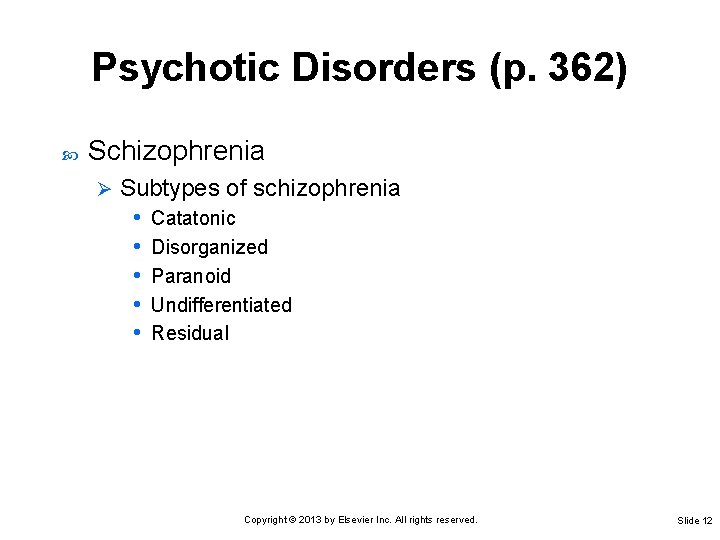
Psychotic Disorders (p. 362) Schizophrenia Ø Subtypes of schizophrenia • Catatonic • Disorganized • Paranoid • Undifferentiated • Residual Copyright © 2013 by Elsevier Inc. All rights reserved. Slide 12
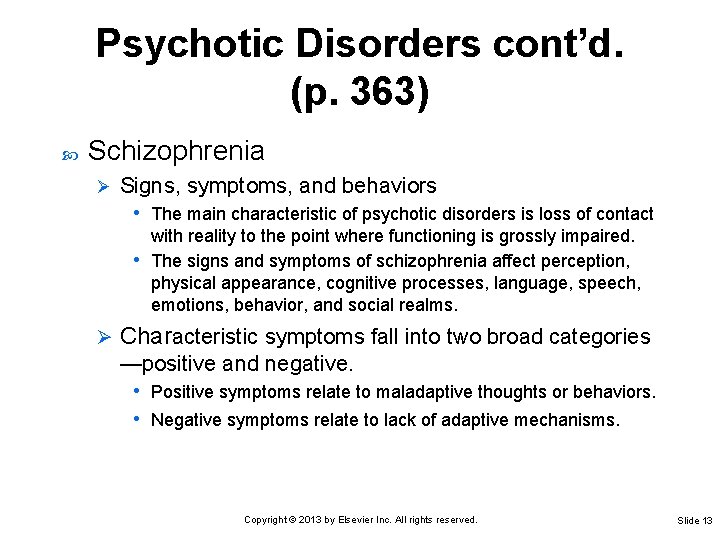
Psychotic Disorders cont’d. (p. 363) Schizophrenia Ø Signs, symptoms, and behaviors • The main characteristic of psychotic disorders is loss of contact with reality to the point where functioning is grossly impaired. • The signs and symptoms of schizophrenia affect perception, physical appearance, cognitive processes, language, speech, emotions, behavior, and social realms. Ø Characteristic symptoms fall into two broad categories —positive and negative. • Positive symptoms relate to maladaptive thoughts or behaviors. • Negative symptoms relate to lack of adaptive mechanisms. Copyright © 2013 by Elsevier Inc. All rights reserved. Slide 13
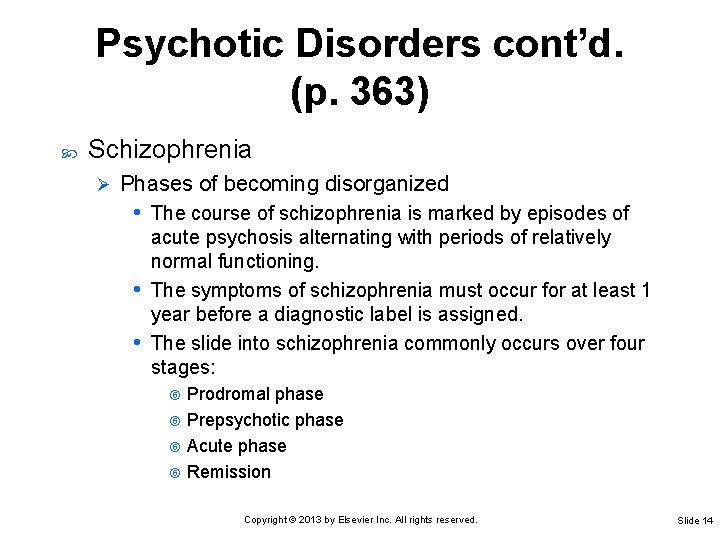
Psychotic Disorders cont’d. (p. 363) Schizophrenia Ø Phases of becoming disorganized • The course of schizophrenia is marked by episodes of acute psychosis alternating with periods of relatively normal functioning. • The symptoms of schizophrenia must occur for at least 1 year before a diagnostic label is assigned. • The slide into schizophrenia commonly occurs over four stages: Prodromal phase Prepsychotic phase Acute phase Remission Copyright © 2013 by Elsevier Inc. All rights reserved. Slide 14
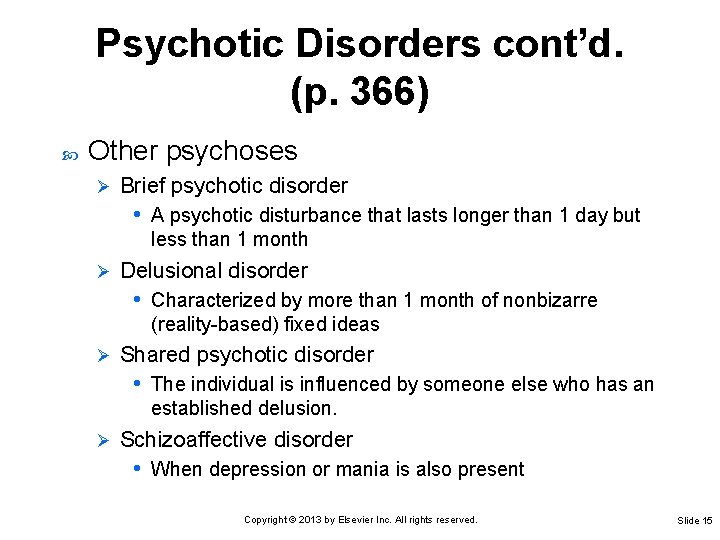
Psychotic Disorders cont’d. (p. 366) Other psychoses Ø Brief psychotic disorder • A psychotic disturbance that lasts longer than 1 day but less than 1 month Ø Delusional disorder • Characterized by more than 1 month of nonbizarre (reality-based) fixed ideas Ø Shared psychotic disorder • The individual is influenced by someone else who has an established delusion. Ø Schizoaffective disorder • When depression or mania is also present Copyright © 2013 by Elsevier Inc. All rights reserved. Slide 15
Therapeutic Interventions (p. 366) Goals of inpatient, short-term care include the following: Stabilize the client. Ø Prevent further decline in functioning. Ø Assist the client in coping with his or her disorder. Ø Long-term goals include psychosocial and vocational rehabilitation. Copyright © 2013 by Elsevier Inc. All rights reserved. Slide 16
Therapeutic Interventions cont’d. (p. 366) Pharmacological therapy Ø Antipsychotic or neuroleptic • Slow the central nervous system (CNS) • After an antipsychotic drug is taken, hallucinations and delusions decrease, thought processes change, and hyperactivity subsides. Copyright © 2013 by Elsevier Inc. All rights reserved. Slide 17
Therapeutic Interventions cont’d. (p. 367) Nursing process Primary nursing diagnoses: • Disturbed thought processes • Disturbed sensory perceptions • Social isolation • Impaired communications • Ineffective management of therapeutic regimen Ø The basic goals of care to assist clients in controlling their symptoms and achieving the highest possible level of functioning. Ø Copyright © 2013 by Elsevier Inc. All rights reserved. Slide 18
Therapeutic Interventions cont’d. (p. 367) Special considerations Ø The most common side effects of antipsychotic medications reflect alterations in CNS and peripheral nervous system functions: • Extrapyramidal side effects (EPSEs) • Sedation • Anticholinergic effects • Akathisia • Akinesia • Bradykinesia • Dystonia • Neuroleptic malignant syndrome Copyright © 2013 by Elsevier Inc. All rights reserved. Slide 19
Therapeutic Interventions cont’d. (p. 370) Nursing responsibilities Nurses should review desired actions, side effects, and incompatibilities for each medication prescribed. Ø Monitor client response to each medication. Ø Client and family education has a direct impact on the client’s level of functioning. Ø Copyright © 2013 by Elsevier Inc. All rights reserved. Slide 20
Question 1 The nurse is caring for a client who states that she has never been able to experience pleasure in life. The client’s condition is known as what? 1) Perseveration 2) Alexithymia 3) Apathy 4) Anhedonia Copyright © 2013 by Elsevier Inc. All rights reserved. Slide 21
Question 2 The nurse is caring for a client who has an inability to sit still. The client feels nervous and jittery. What is this client experiencing? 1) Akathisia 2) Akinesia 3) Bradykinesia 4) Dyskinesia Copyright © 2013 by Elsevier Inc. All rights reserved. Slide 22
Question 3 The nurse is caring for a client with schizophrenia. Her client has had at least one acute episode of schizophrenia and is currently free of acute psychosis but is having negative symptoms of withdrawal, emotional changes, disorganized thinking, and odd behaviors. What type of schizophrenia does the client have? 1) Catatonic 2) Disorganized 3) Undifferentiated 4) Residual Copyright © 2013 by Elsevier Inc. All rights reserved. Slide 23
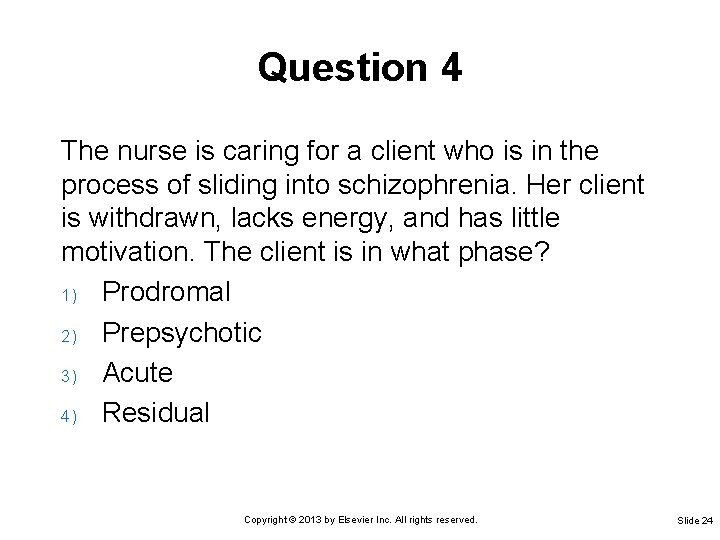
Question 4 The nurse is caring for a client who is in the process of sliding into schizophrenia. Her client is withdrawn, lacks energy, and has little motivation. The client is in what phase? 1) Prodromal 2) Prepsychotic 3) Acute 4) Residual Copyright © 2013 by Elsevier Inc. All rights reserved. Slide 24
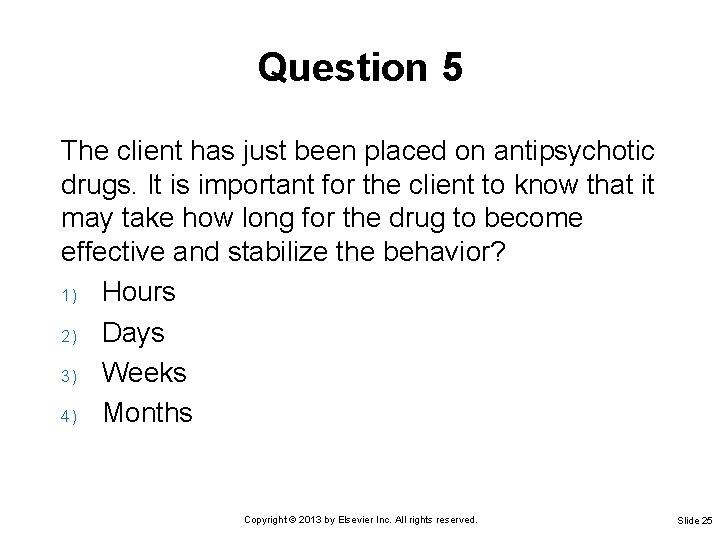
Question 5 The client has just been placed on antipsychotic drugs. It is important for the client to know that it may take how long for the drug to become effective and stabilize the behavior? 1) Hours 2) Days 3) Weeks 4) Months Copyright © 2013 by Elsevier Inc. All rights reserved. Slide 25