
Survey of Modern Psychology Schizophrenia and Psychotic Disorders


- Slides: 64
Survey of Modern Psychology Schizophrenia and Psychotic Disorders
What is Schizophrenia? SCHIZOPHRENIA IS NOT MULTIPLE PERSONALITIES!
Definitions • “Positive” symptoms refer to presence of abnormal behavior, thoughts, beliefs, etc. • “Negative” symptoms refer to absence of normal behavior (e. g. , responsiveness to environment)
Definitions • Hallucination – A distortion in perception that can occur through any of the senses • Auditory, visual, olfactory, gustatory, and tactile • Auditory hallucinations are the most common • Delusion – Erroneous beliefs that usually involve a misinterpretation of perceptions or experiences – It can be difficult at times to differentiate a strongly held belief from a delusion. The determination depends largely on the degree of conviction with which the belief is held despite clear evidence to the contrary
Psychotic Disorders • • • Schizophrenia Schizophreniform Disorder Schizoaffective Disorder Delusional Disorder Brief Psychotic Disorder Shared Psychotic Disorder (Folie à Deux)
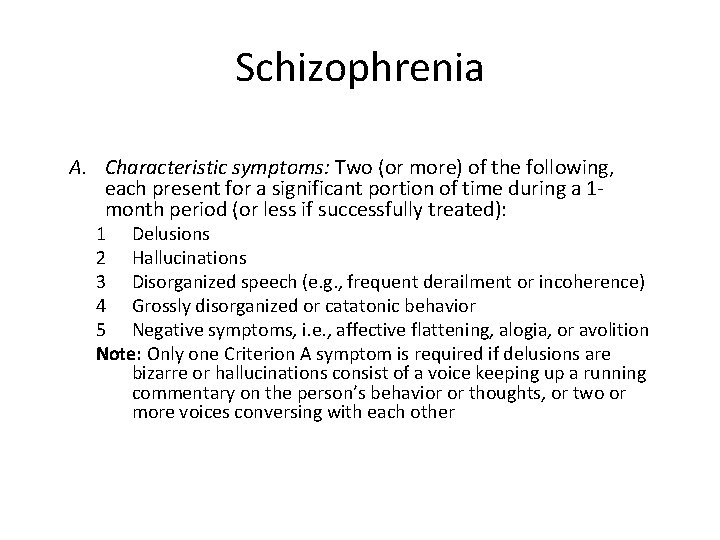
Schizophrenia A. Characteristic symptoms: Two (or more) of the following, each present for a significant portion of time during a 1 month period (or less if successfully treated): 1 Delusions 2 Hallucinations 3 Disorganized speech (e. g. , frequent derailment or incoherence) 4 Grossly disorganized or catatonic behavior 5 Negative symptoms, i. e. , affective flattening, alogia, or avolition Note: Only one Criterion A symptom is required if delusions are bizarre or hallucinations consist of a voice keeping up a running commentary on the person’s behavior or thoughts, or two or more voices conversing with each other
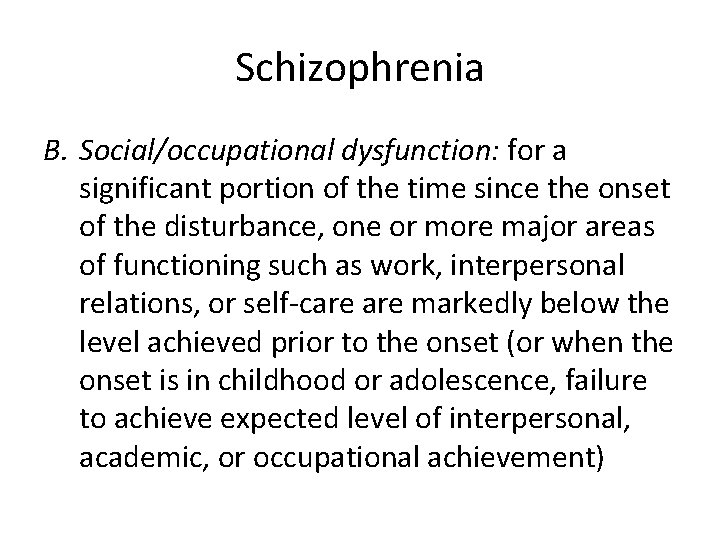
Schizophrenia B. Social/occupational dysfunction: for a significant portion of the time since the onset of the disturbance, one or more major areas of functioning such as work, interpersonal relations, or self-care markedly below the level achieved prior to the onset (or when the onset is in childhood or adolescence, failure to achieve expected level of interpersonal, academic, or occupational achievement)
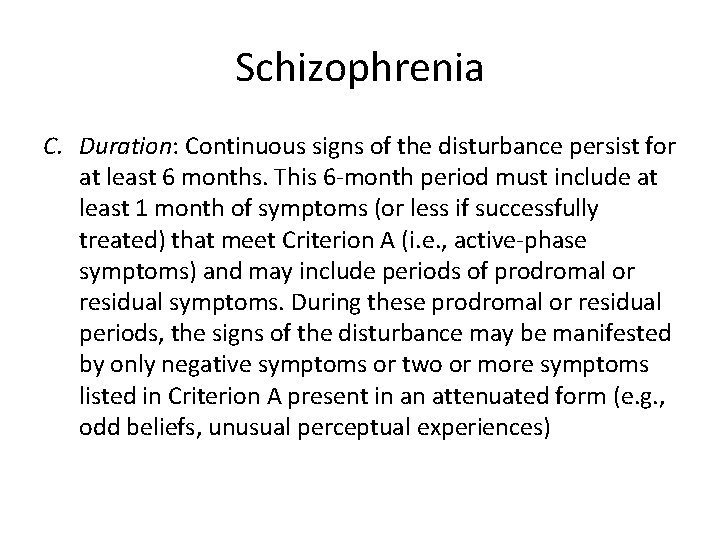
Schizophrenia C. Duration: Continuous signs of the disturbance persist for at least 6 months. This 6 -month period must include at least 1 month of symptoms (or less if successfully treated) that meet Criterion A (i. e. , active-phase symptoms) and may include periods of prodromal or residual symptoms. During these prodromal or residual periods, the signs of the disturbance may be manifested by only negative symptoms or two or more symptoms listed in Criterion A present in an attenuated form (e. g. , odd beliefs, unusual perceptual experiences)
Schizophrenia D. Schizoaffective and Mood Disorder exclusion: Schizoaffective Disorder and Mood Disorder With Psychotic Features have been ruled out because either (1) no Major Depressive, Manic, or Mixed Episodes have occurred concurrently with the active-phase symptoms; or (2) if mood episodes have occurred during activephase symptoms, their total duration has been brief relative to the duration of the active and residual periods
Schizophrenia E. Substance/general medical condition exclusion: The disturbance is not due to the direct physiological effects of a substance (e. g. , a drug of abuse, a medication) or a general medical condition
Schizophrenia F. Relationship to a Pervasive Developmental Disorder: If there is a history of Autistic Disorder or another Pervasive Developmental Disorder, the additional diagnosis of Schizophrenia is made only if prominent delusions or hallucinations are also present for at least a month (or less if successfully treated)
Schizophreniform Disorder A. Criteria A, D, and E of Schizophrenia are met* B. An episode of the disorder (including prodromal, active, and residual phases) lasts at least 1 month but less than 6 months. (When the diagnosis must be made without waiting for recovery, it should be qualified as “Provisional”) *This refers to symptoms and the exclusion of other mental disorders, medical conditions, or substance use
Schizophreniform Disorder Specify if: Without Good Prognostic Features With Good Prognostic Features: as evidenced by two (or more) of the following: 1. Onset of prominent psychotic symptoms within 4 weeks of the first noticeable change in usual behavior or functioning 2. Confusion or perplexity at the height of the psychotic episode 3. Good premorbid social and occupational functioning 4. Absence of blunted or flat affect
Schizophreniform Disorder: Notes • Much less prevalent than Schizophrenia • Does not require impairment in functioning (though most individuals do experience impairment)
Schizophrenia Subtypes The subtypes of Schizophrenia are defined by the predominant symptomatology at the time of evaluation • Paranoid Type A. Preoccupation with one or more delusions or frequent auditory hallucinations B. None of the following is prominent: disorganized speech, disorganized or catatonic behavior, or flat or inappropriate affect
Schizophrenia Subtypes - Paranoid Delusions are typically persecutory or grandiose, or both – Delusions with other themes (e. g. , jealousy, religiosity, or somatization) may also occur • Delusions and hallucinations are usually organized around a coherent theme, and hallucinations are related to the delusions • Associated features include anxiety, anger, aloofness, and argumentativeness. • The individual may have a superior and patronizing manner and either a stilted, formal quality or extreme intensity in interpersonal interactions. •
Schizophrenia Subtypes - Paranoid • • Persecutory delusions may predispose the individual to suicidal behavior; the combination of persecutory and grandiose delusions with anger may predispose the individual to violence Onset tends to be later in life and more stable Usually show little or no impairment on cognitive testing The prognosis may be better than other types of schizophrenia
Schizophrenia Subtypes • Disorganized Type A. All of the following are prominent: 1) Disorganized speech 2) Disorganized behavior 3) Flat or inappropriate affect B. The criteria are not met for Catatonic Type
Schizophrenia Subtypes - Disorganized • The disorganized speech may be accompanied by silliness and laughter that are not closely related to the content of the speech • The behavioral disorganization (i. e. , lack of goal orientation) may lead to severe disruption in the ability to perform activities of daily living (e. g. , showering, dressing, or preparing meals)
Schizophrenia Subtypes - Disorganized • If present, delusions and hallucinations are not organized around a coherent theme • Associated features include grimacing, mannerisms, and other oddities of behavior • There is often impaired performance on cognitive tests • Usually associated with poor pre-morbid functioning, early and insidious onset, and a continuous course without significant remissions
Schizophrenia Subtypes - Catatonic A type of Schizophrenia in which the clinical picture is dominated by at least two of the following: 1. Motoric immobility as evidenced by catalepsy (including waxy flexibility) or stupor 2. Excessive motor activity (that is apparently purposeless and not influenced by external stimuli) 3. Extreme negativism (an apparently motiveless resistance to all instructions or maintenance of a rigid posture against attempts to be moved) or mutism 4. Peculiarities of voluntary movement as evinced by posturing (voluntary assumption of inappropriate or bizarre postures), stereotyped movements, prominent mannerisms, or prominent grimacing 5. Echolalia or echopraxia
Schizophrenia Subtypes - Catatonic • Catalepsy: “waxy flexibility” • Echolalia: senseless repetition of a word or phrase that was just spoken by another rperson • Echopraxia: repetitive imitation of the movements of another person • There may be increased risk for harm to the self or others – self harm risks particularly include malnutrition, exhaustion, and self-inflicted injury
Schizophrenia • Undifferentiated Type – A type of Schizophrenia in which symptoms that meet Criterion A are present, but the criteria are not met for the Paranoid, Disorganized, or Catatonic Type • Residual Type A. Absence of prominent delusions, hallucinations, disorganized speech, and grossly disorganized or catatonic behavior B. There is continuing evidence of the disturbance, as indicated by the presence of negative symptoms or two or more symptoms listed in Criterion A for Schizophrenia, present in an attenuated form (e. g. , odd beliefs, unusual perceptive experiences)
Common Types of Delusions • • Persecutory Referential Somatic Religious Grandiose Thought broadcasting Thought insertion or withdrawal
Types of Delusions: Persecutory • These are the most common type of delusion • The person believes that he or she is being tormented, followed, tricked, spied on, or ridiculed • Examples: DE, LG
Types of Delusions: Referential • Also very common • The person believes that certain gestures, comments, passages from books, newspapers, song lyrics, or other environmental cues are specifically directed at him or her
Types of Delusions: Somatic • A delusion that one’s body has been changed or altered • Example: LP
Types of Delusions: Religious • A delusion with religious or spiritual content • It does not match the religion’s actual beliefs or tenets
Types of Delusions: Grandiose • An individual exaggerates his or her sense of selfimportance and is convinced that he or she has special powers, talents, or abilities • Sometimes, the individual may actually believe that he or she is a famous person • More commonly, a person with this delusion believes he or she has accomplished some great achievement for which they have not received sufficient recognition • Example: LG
Types of Delusions: Thought Broadcasting • A belief that one’s thoughts can be heard aloud • Example: RO
Types of Delusions: Thought Insertion & Thought Withdrawal • The belief that others can put thoughts in, or remove thoughts from, the person’s brain
Delusions • A delusion is considered bizarre if it is completely impossible and unrealistic • A non-bizarre delusion is still false, but could occur – Ex. belief that one is being watched by the police
Schizophrenia - Demographics • In the US and UK non-White people are more often diagnosed with schizophrenia – It is unclear whethere is a a true difference in the rates of Schizophrenia, or only in diagnosis • People in non-industrialized nations tend to have a better outcome than people in industrialized nations • Women are more likely to have positive symptoms, men are more likely to have negative symptoms • There is a slightly higher incidence of Schizophrenia in men than women • Women tend to have a short term better outcome than men, but over time it evens out
Schizophrenia - Demographics • Prevalence among adults is. 5% - 1. 5% • A later age of onset is associated with a better prognosis • Individuals with an earlier onset tend to have poorer premorbid adjustment, lower educational achievement, more evidence of brain abnormalities, and more cognitive impairment
Schizophrenia - Demographics • Men: – Median age of onset: early to mid 20 s – Modal age of onset: between 18 and 25 • Women: – Median age of onset: late 20 s – Bimodal age of onset: • Between 25 and 35 • Over 40
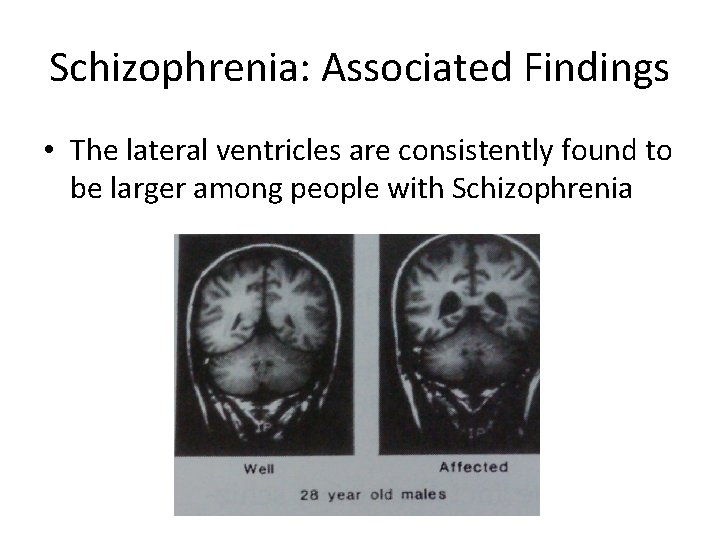
Schizophrenia: Associated Findings • The lateral ventricles are consistently found to be larger among people with Schizophrenia
Schizophrenia: Associated Findings • Decreased volume of the temporal lobe • Increased size of the basal ganglia (though this may be due to the medications used to treat Schizophrenia rather than the disorder itself) • Decreased blood flow in the front of the brain
Schizophrenia: Associated Features and Disorders • A majority of people with Schizophrenia have poor insight – This makes noncompliance with treatment and therefore relapse more likely • Anxiety and phobias are common • Approximately 10% of Schizophrenics commit suicide – 20% - 40% make at least one attempt – Suicide is particularly common immediately after a psychotic period • Schizophrenics overall are not any more prone to violence than the average person, but it varies by subgroup – Risks include: noncompliance, male, younger, past history of violence, substance abuse
Schizophrenia: Associated Features and Disorders • Extremely high comorbidity with substance abuse – 80% - 90% of people with Schizophrenia report being regular cigarette smokers • There is a high incidence of Obsessive-Compulsive Disorder and Panic Disorder among Schizophrenics and one of these disorders often precedes the diagnosis of Schizophrenia – It is unclear whether the disorder is separate • Other risks include: prenatal exposure to flu, prenatal exposure to famine, obstetric complications, and CNS infection in early childhood
Schizophrenia: Treatment • Antipsychotic medications are the most popular and effective treatment – It is generally believed that psychoanalysis should not be used • Other forms of therapy/talk therapy may be used in conjunction with medications to deal with nonbiological components of the disorder (e. g. , social training, self-care) • A longer time between onset of psychosis and treatment is suggested to be linked to a worse outcome
Schizophrenia: Treatment • Approximately 60% of Schizophrenics treated with medications recover to the point of full remission – The other 40% show improvement to varying levels – Some require chronic hospitalization, others are functional but continue to have some symptoms • A 4 – 6 week trial period on a medication is recommended for most patients to determine whether a medication is working
Schizophrenia: Treatment • Medications used for Schizophrenia block dopamine receptors (dopamine antagonists) • Newer medications act on both serotonin and dopamine • For patients who are noncompliant with medication, injections are available – Approximately 40% - 50% become noncompliant within two years
First Generation Antipsychotic Medications (Dopamine antagonists) • These largely act as tranquilizers • Side effects include: restlessness, tremors, and Tardive Dyskinesia, and weight gain • Thorazine is known for causing significant sedation – “Thorazine shuffle”
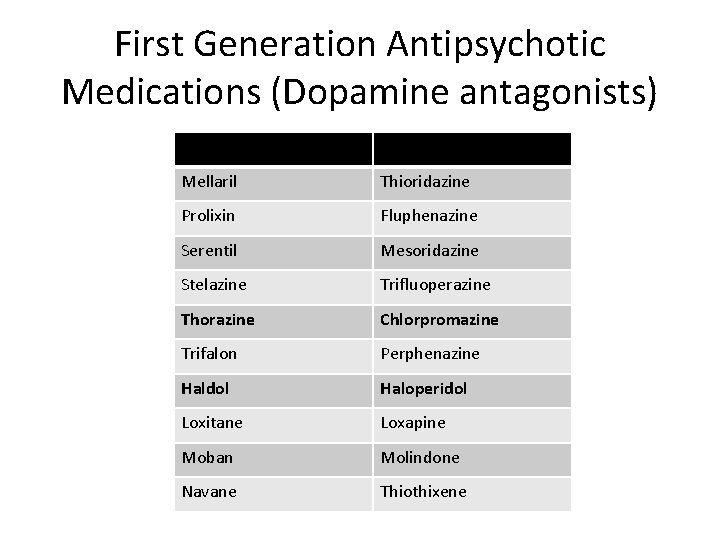
First Generation Antipsychotic Medications (Dopamine antagonists) Brand Name Generic Mellaril Thioridazine Prolixin Fluphenazine Serentil Mesoridazine Stelazine Trifluoperazine Thorazine Chlorpromazine Trifalon Perphenazine Haldol Haloperidol Loxitane Loxapine Moban Molindone Navane Thiothixene
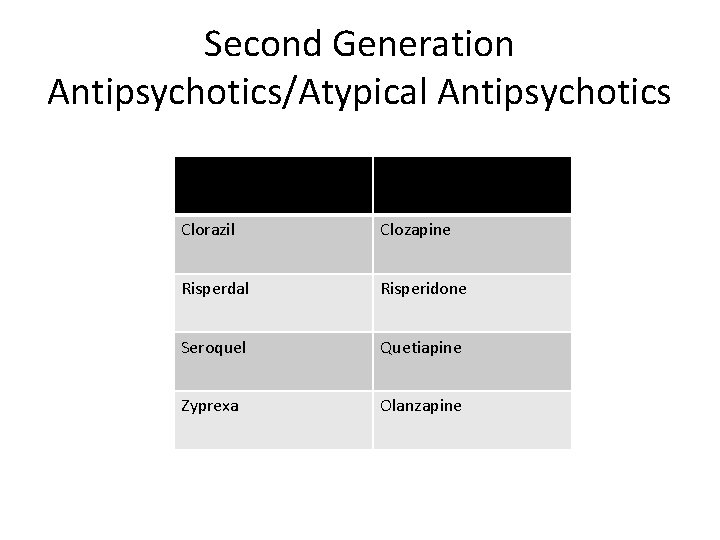
Second Generation Antipsychotics/Atypical Antipsychotics • Atypical antipsychotics act on serotonin as well as dopamine • They are often not as effective as the first generation antipsychotics, but have fewer side effects
Second Generation Antipsychotics/Atypical Antipsychotics Brand Name Generic Clorazil Clozapine Risperdal Risperidone Seroquel Quetiapine Zyprexa Olanzapine
Tardive Dyskinesia • Tardive Dyskinesia may develop as a side effect of antipsychotic medication and can be permanent • This was particularly problematic with the earlier medications • Tardive Dyskinesia is considered an area for further study in the DSM-IV-TR
Tardive Dyskinesia A. Involuntary movements of the tongue, jaw, trunk, or extremities have developed in association with the use of neuroleptic medication B. The involuntary movements are present over a period of at least 4 weeks and occur in any of the following patterns: 1. Choreiform movements (i. e. , rapid, jerky, nonrepetitive) 2. Athetoid movements (i. e. , slow, sinuous, continual) 3. Rhythmic movements (i. e. , stereotypies)
Tardive Dyskinesia C. The signs or symptoms in Criteria A and B develop during exposure to a neuroleptic medication or within 4 weeks of withdrawal from an oral (or within 8 weeks of withdrawal from a depot) neuroleptic medication D. There has been exposure to neuroleptic medication for at least 3 months (1 month if age 60 or older) E. The symptoms are not due to a neurological or general medical condition, ill-fitting dentures, or exposure to other medications that cause acute reversible dyskinesia. Evidence that the symptoms are due to one of these etiologies might include the following: the symptoms precede the exposure to the neuroleptic medication or unexplained focal neurological signs are present F. The symptoms are not better accounted for by a neurolepticinduced acute movement disorder
Tardive Dyskinesia http: //www. youtube. com/watch? v=FUr 8 lt. X h 1 Pc
Schizoaffective Disorder • An uninterrupted period of illness during which, at some time, there is a Major Depressive, Manic, or Mixed Episode concurrent with symptoms that meet Criterion A for Schizophrenia. In addition, during the same period of illness, there have been delusions or hallucinations for at least 2 weeks in the absence of prominent mood symptoms • The minimum amount of time that a Schizoaffective episode can last is one month (to meet Criterion A for Schizophrenia, the symptoms must last at least 1 month) • The mood symptoms must be present for a substantial portion of the entire period of illness (e. g. , Depressive symptoms lasting for 5 weeks in the course of 4 years of Schizophrenic symptoms would not apply)
Schizoaffective Disorder A. An uninterrupted period of illness during which, at some time, there is either a Major Depressive Episode, a Manic Episode, or a Mixed Episode concurrent with symptoms that meet Criterion A for Schizophrenia Note: The Major Depressive Episode must include Criterion A 1: depressed mood B. During the same period of illness, there have been delusions or hallucinations for at least 2 weeks in the absence of prominent mood symptoms
Schizoaffective Disorder C. Symptoms that meet criteria for a mood episode are present for a substantial portion of the total duration of the active and residual periods of the illness D. The disturbance is not due to the direct physiological effects of a substance (e. g. , a drug of abuse, a medication) or a general medical condition
Schizoaffective Disorder: Notes • Seems to be less common than Schizophrenia • Younger people are more likely to experience Bipolar Type, while older adults are more likely to experience Depressive Type • Schizoaffective Disorder is more common in women (mostly because more women experience the Depressive Type) • The prognosis may be better for the Bipolar Type • The prognosis is better if there is a precipitating event/stressor • Age of onset is usually early adulthood, but it can occur any time
Delusional Disorder A. Nonbizarre delusions (i. e. , involving situations that occur in real life, such as being followed, poisoned, infected, loved at a distance, or deceived by spouse or lover, or having a disease) of at least 1 month's duration B. Criterion A for Schizophrenia has never been met. Note: tactile and olfactory hallucinations may be present in Delusional Disorder if they are related to the delusional theme
Delusional Disorder C. Apart from the impact of the delusion(s) or its ramifications, functioning is not markedly impaired and behavior is not obviously odd or bizarre D. If mood episodes have occurred concurrently with delusions, their total duration has been brief relative to the duration of the delusional periods E. The disturbance is not due to the direct physiological effects of a substance (e. g. , a drug of abuse, a medication) or a general medical condition
Delusional Disorder Specify type (the following types are assigned based on the predominant delusional theme Erotomanic Type: delusions that another person, usually of higher status, is in love with the individual Grandiose Type: delusions of inflated worth, power, knowledge, identity, or special relationship to a deity or famous person Jealous Type: delusions that the individual’s sexual partner is unfaithful Persecutory Type: delusions that the person (or someone to whom the person is close) is being malevolently treated in some way
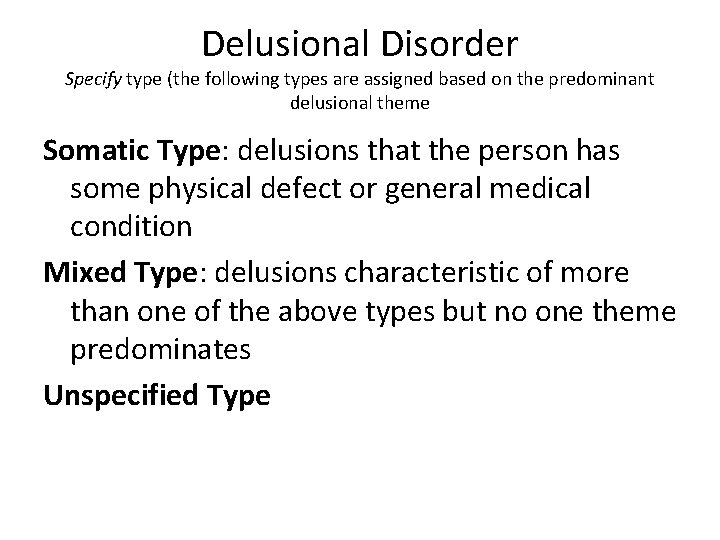
Delusional Disorder Specify type (the following types are assigned based on the predominant delusional theme Somatic Type: delusions that the person has some physical defect or general medical condition Mixed Type: delusions characteristic of more than one of the above types but no one theme predominates Unspecified Type
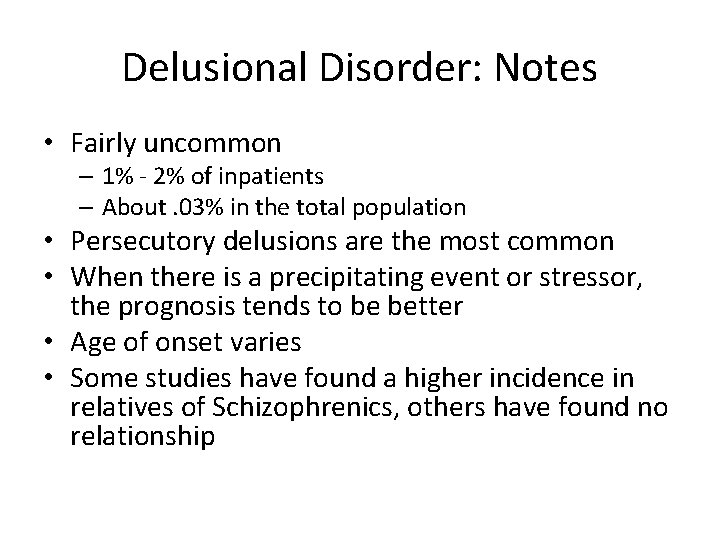
Delusional Disorder: Notes • Fairly uncommon – 1% - 2% of inpatients – About. 03% in the total population • Persecutory delusions are the most common • When there is a precipitating event or stressor, the prognosis tends to be better • Age of onset varies • Some studies have found a higher incidence in relatives of Schizophrenics, others have found no relationship
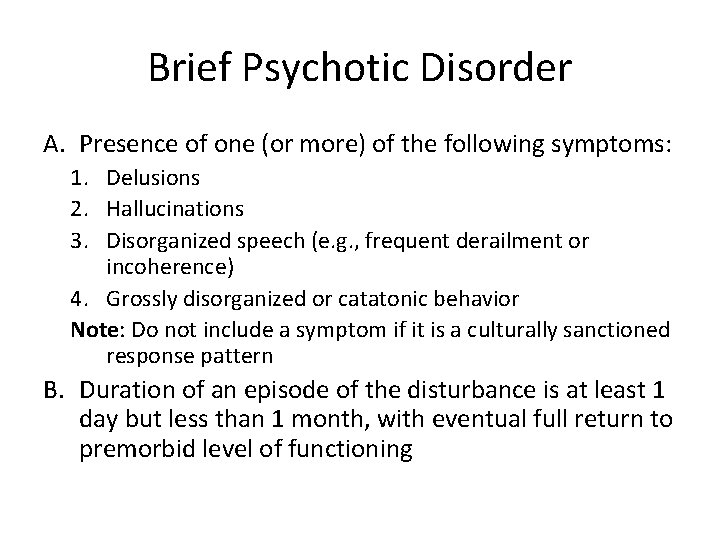
Brief Psychotic Disorder A. Presence of one (or more) of the following symptoms: 1. Delusions 2. Hallucinations 3. Disorganized speech (e. g. , frequent derailment or incoherence) 4. Grossly disorganized or catatonic behavior Note: Do not include a symptom if it is a culturally sanctioned response pattern B. Duration of an episode of the disturbance is at least 1 day but less than 1 month, with eventual full return to premorbid level of functioning
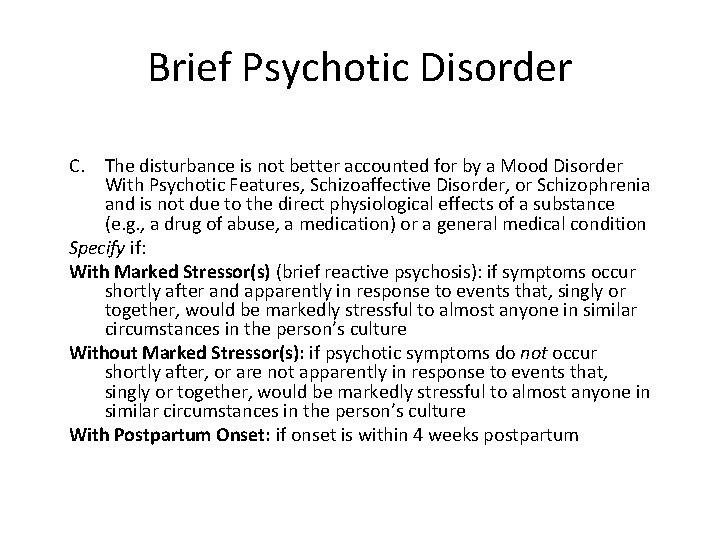
Brief Psychotic Disorder C. The disturbance is not better accounted for by a Mood Disorder With Psychotic Features, Schizoaffective Disorder, or Schizophrenia and is not due to the direct physiological effects of a substance (e. g. , a drug of abuse, a medication) or a general medical condition Specify if: With Marked Stressor(s) (brief reactive psychosis): if symptoms occur shortly after and apparently in response to events that, singly or together, would be markedly stressful to almost anyone in similar circumstances in the person’s culture Without Marked Stressor(s): if psychotic symptoms do not occur shortly after, or are not apparently in response to events that, singly or together, would be markedly stressful to almost anyone in similar circumstances in the person’s culture With Postpartum Onset: if onset is within 4 weeks postpartum
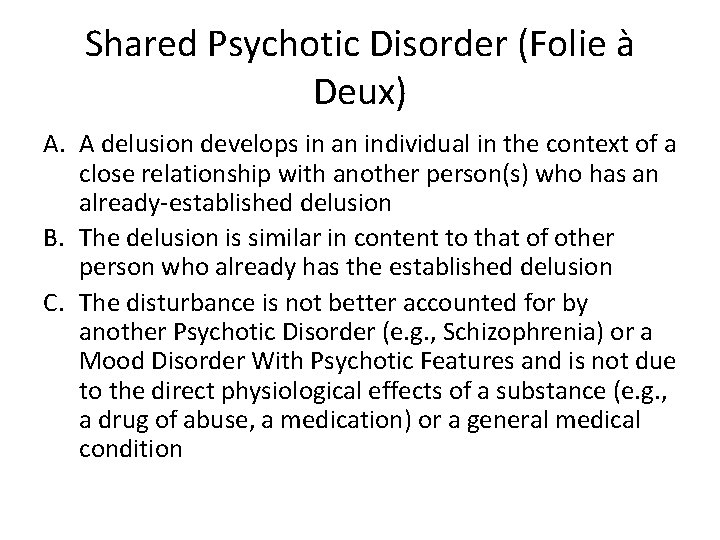
Shared Psychotic Disorder (Folie à Deux) A. A delusion develops in an individual in the context of a close relationship with another person(s) who has an already-established delusion B. The delusion is similar in content to that of other person who already has the established delusion C. The disturbance is not better accounted for by another Psychotic Disorder (e. g. , Schizophrenia) or a Mood Disorder With Psychotic Features and is not due to the direct physiological effects of a substance (e. g. , a drug of abuse, a medication) or a general medical condition
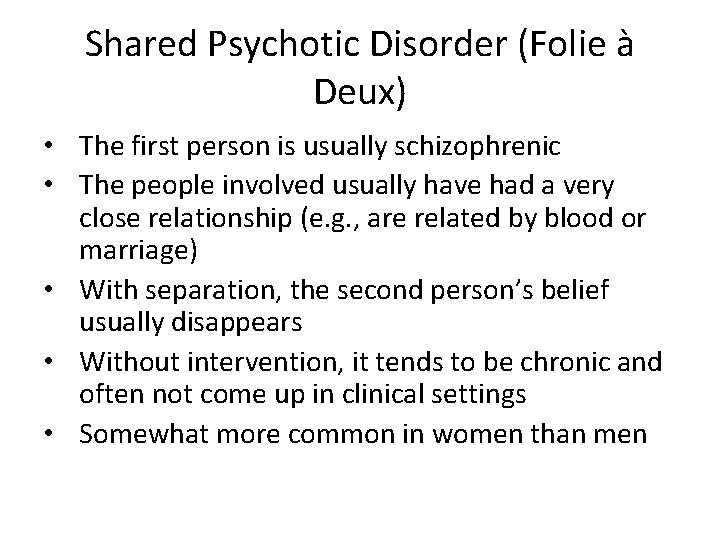
Shared Psychotic Disorder (Folie à Deux) • The first person is usually schizophrenic • The people involved usually have had a very close relationship (e. g. , are related by blood or marriage) • With separation, the second person’s belief usually disappears • Without intervention, it tends to be chronic and often not come up in clinical settings • Somewhat more common in women than men