Chapter 21 The Nature of Sound Section 1
- Slides: 16
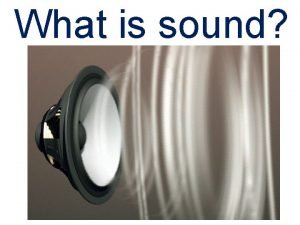
Chapter 21 The Nature of Sound Section 1 What is sound?
Sound is Produced by Vibrations o All sounds are created by vibrations. o A vibration is the complete back-andforth motion of an object. (see figure 1 on p. 534) o A wave is a disturbance that transmits energy through matter or space.
Section 1 continued o Sound waves travel in all directions away from their source. o Air or other matter does not travel with the sound waves. o The particles of air only vibrate back & forth in place.
Section 1 continued o Sound can be created without being detected. (Can you hear the other teachers in the building now, or the students in the lunch room or gym? ) o All sound waves require a medium. o The primary medium is air; other media include but not limited to metal, water, glass, wood.
Section 2 – Properties of Sound o Sound waves determine how high or low and how loud or soft they are. o The media determines the speed of sound. Therefore the speed of the sound waves will change when the medium changes. o The speed of sound also depends on the temperature.
Section 2 - continues o As a rule the cooler the medium, the slower the speed of sound. (Remember the temp determines the speed of the moles. ) o The sound’s pitch is determined by the frequency of the sound wave. o The frequency of the wave is the number of waves produced in a given period of time.
Section 2 - continues o Frequency is expressed in hertz (Hz), where 1 Hz = 1 wave per second. o The average human ear can detect sounds that have frequencies between 20 Hz and 20, 000 Hz. o Frequencies that humans can’t hear, lower than 20 Hz are called infrasonic and ultrasonic sounds have frequencies above 20, 000 Hz.
Section 2 - continues o Ultrasonic waves are used to clean jewelry and to remove ice from metal. o The doppler effect is the apparent change in the frequency of a sound caused by the motion of either the listener or the source of the sound. https: //www. youtube. com/watch? v=z 0 Eaoilzg. GE https: //www. youtube. com/watch? v=imox. Dcn 2 Sgo
Section 2 - continues o Loudness is related to amplitude. By applying force you can change the loudness of the sound that is created. Force equals energy and amplitude. o Loudness is how loud or soft a sound is perceived to be. o The decibel (d. B) is the unit used to express loudness.
Section 2 - continues o 0 d. B is the faintest sound an average human ear can hear. The level of 120 d. B is sometimes called the threshold of pain. (Sounds this loud or louder can cause pain to the ears. ) o Continued exposure to sounds about 85 d. B causes gradual hearing loss by permanently damaging the hair cells in your inner ear. (see p. 543)
Section 2 - continues o To “see” sound an oscilloscope must be used.
Section 3 Interactions of Sound waves o Reflection is the bouncing back of a wave after it strikes a barrier. o Echoes are reflected sound waves. o Echolocation is the process of using reflected sound waves to find objects. (Echolocation is used by animals, bats & whales for ex. ) to locate food. Sonar is a echolocation.
Section 3 - continued o Ultrasonography is used in medical procedures to use echoes to “see” inside a patient’s body. o Interference is the result of 2 or more waves overlapping. o A standing wave is a result of interference in which portions of the wave are at the rest position and other portions have a large amplitude.
Section 3 - continued o The sound barrier is “broken” when a jet plane, for instance, accelerates to the speed of sound which causes the sound waves in front of the plane to become compressed. o The sonic boom is the explosive sound heard when a shock wave reaches your ears.
Section 3 - continued o Resonance occurs when an object vibrating at or near a resonant frequency of a second object caused the second object to vibrate. o Diffraction is the bending of waves around barriers or through openings.
Section 4 – Sound Quality o Sound quality is the result of several pitches blending together through interference. o Noise can be described an any undesired sound, especially a nonmusical sound, that includes a random mix of pitches. o Noise pollution can be caused when noise reaches a level that can cause health problems.