Chapter 15 The Statement of Cash Flows Reporting

- Slides: 41
Chapter 15 The Statement of Cash Flows: Reporting and Analyzing
Topics to be Discussed Introduction Purpose of the Statement of Cash Flows The Definition of Cash: Cash and Cash Equivalents
Introduction The Statement of Cash Flows Reports the impact of a firm’s operations, investing, and financing activities on cash flows. Is a required component of a company’s external financial statements May be a better indicator of financial performance than net income or earnings per share.
Introduction The main purpose is to provide information to decision makers about a company’s cash inflows and outflows during the period.
Other Purposes of the Statement of Cash Flows Provides information relating to the change in cash balances between two balance sheet dates. Discloses items that affect how the balance sheet changed, but that don’t show up in the income statement such as issuance of stock or acquisitions of property, plant, and equipment.
Composition of the Statement of Cash Flows The SCF summarizes and explains all major cash receipts (inflows) and cash payments (outflows) during the period and categorizes the changes as resulting from operating, investing, or financing activities.
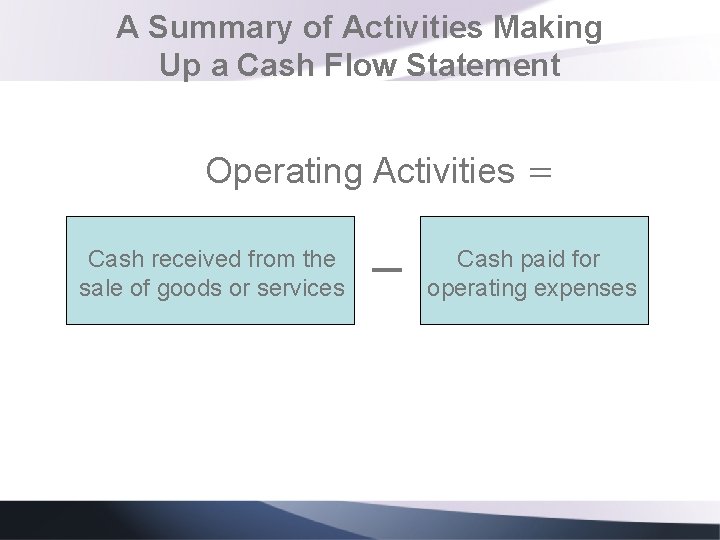
A Summary of Activities Making Up a Cash Flow Statement Operating Activities = Cash received from the sale of goods or services Cash paid for operating expenses
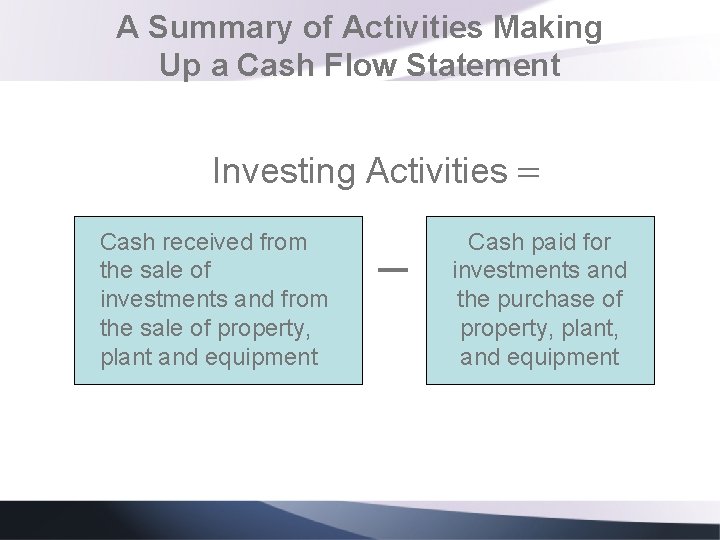
A Summary of Activities Making Up a Cash Flow Statement Investing Activities = Cash received from the sale of investments and from the sale of property, plant and equipment Cash paid for investments and the purchase of property, plant, and equipment
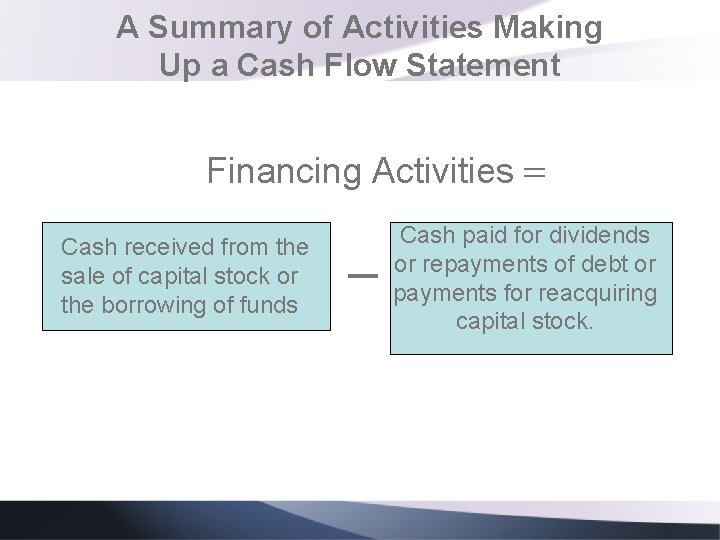
A Summary of Activities Making Up a Cash Flow Statement Financing Activities = Cash received from the sale of capital stock or the borrowing of funds Cash paid for dividends or repayments of debt or payments for reacquiring capital stock.
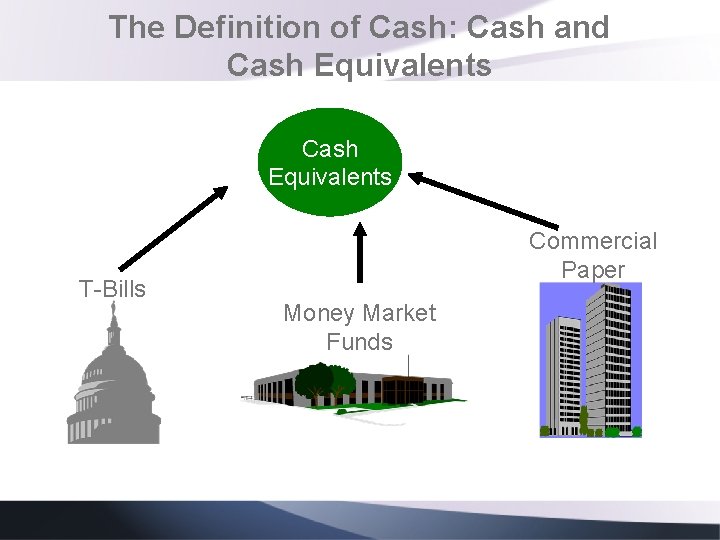
The Definition of Cash: Cash and Cash Equivalents T-Bills Commercial Paper Money Market Funds
Non-cash Transactions Exchange transactions that do not directly involve cash inflows or outflows but still warrant disclosure on a SCF: Exchange stock for equipment Converting preferred stock to common stock
Non-cash Transactions Non-cash transactions are reported: In a separate schedule OR In a footnote to the financial statements
Cash Flows Topics Cash Flows from Operating Activities The Statement of Cash Flows and the Accounting Equation Preparing the Statement of Cash Flows
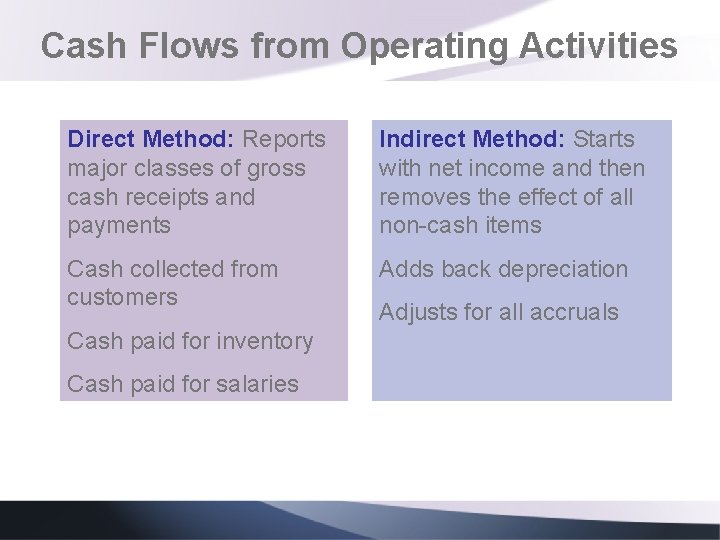
Cash Flows from Operating Activities Direct Method: Reports major classes of gross cash receipts and payments Indirect Method: Starts with net income and then removes the effect of all non-cash items Cash collected from customers Adds back depreciation Cash paid for inventory Cash paid for salaries Adjusts for all accruals
Direct Method When using the direct method, each item on the income statement must be looked at to determine how much cash each of these activities either generated or used during the year.
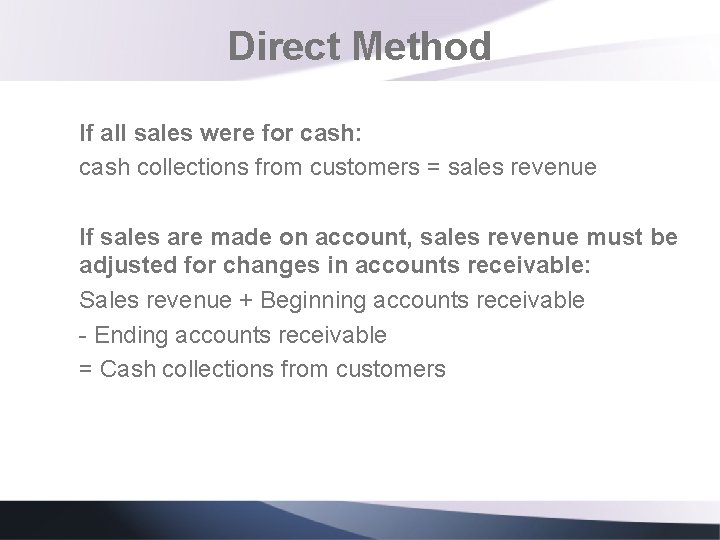
Direct Method If all sales were for cash: cash collections from customers = sales revenue If sales are made on account, sales revenue must be adjusted for changes in accounts receivable: Sales revenue + Beginning accounts receivable - Ending accounts receivable = Cash collections from customers
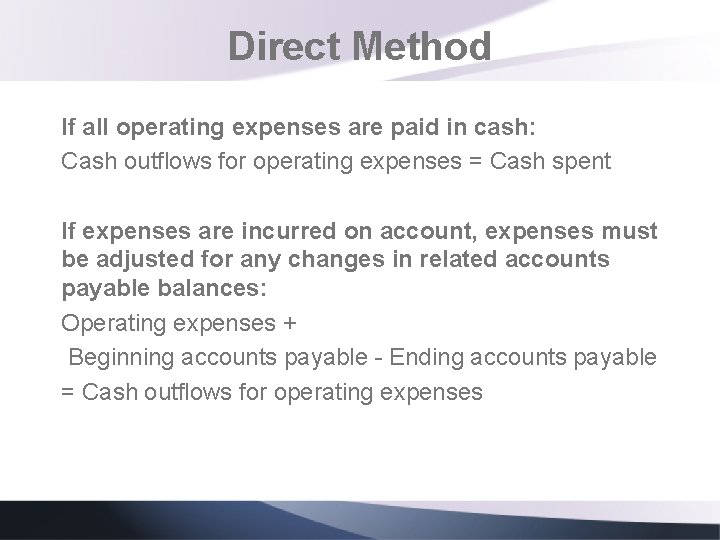
Direct Method If all operating expenses are paid in cash: Cash outflows for operating expenses = Cash spent If expenses are incurred on account, expenses must be adjusted for any changes in related accounts payable balances: Operating expenses + Beginning accounts payable - Ending accounts payable = Cash outflows for operating expenses
Indirect Method The indirect method of preparing the cash flows from operating activities starts with the net income for the period. Net income is then adjusted to arrive at the amount of cash provided by operating activities by adding or subtracting the increases or decreases in various accounts.
Operating Activities Key Concept The only difference between the direct and indirect methods is in the presentation of the cash flows from operating activities. Cash flows from investing activities and cash flows from financing activities are calculated in exactly the same way.
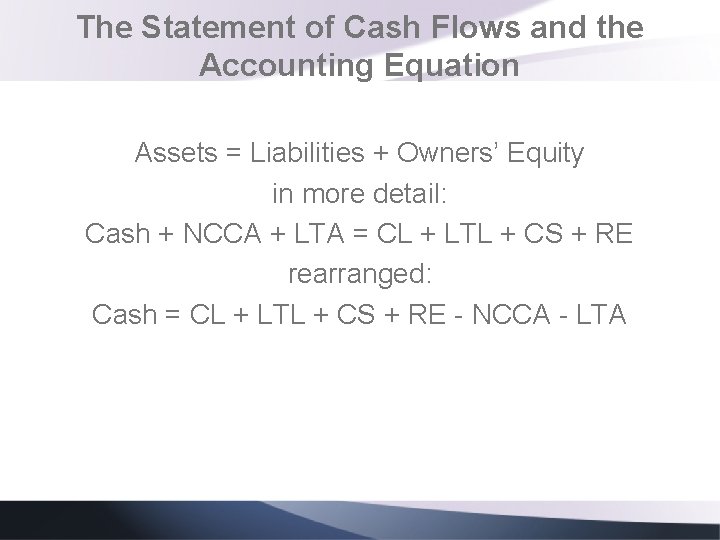
The Statement of Cash Flows and the Accounting Equation Assets = Liabilities + Owners’ Equity in more detail: Cash + NCCA + LTA = CL + LTL + CS + RE rearranged: Cash = CL + LTL + CS + RE - NCCA - LTA
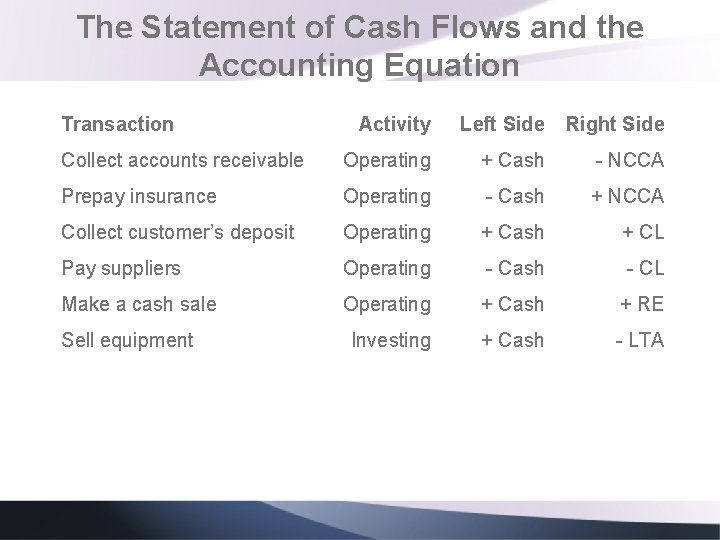
The Statement of Cash Flows and the Accounting Equation Transaction Activity Left Side Right Side Collect accounts receivable Operating + Cash - NCCA Prepay insurance Operating - Cash + NCCA Collect customer’s deposit Operating + Cash + CL Pay suppliers Operating - Cash - CL Make a cash sale Operating + Cash + RE Investing + Cash - LTA Sell equipment
Preparing the Statement of Cash Flows Comparative Balance Sheet Current Income Statement Any Additional Information Needed to Analyze Non-cash Transactions What information do I need to start?
Preparing the Statement of Cash Flows OK, now what do I do? 1. Compute the net change in cash (increase or decrease) 2. Compute net cash provided or used by operating activities 3. Compute net cash provided or used by investing activities
Preparing the Statement of Cash Flows OK, now what do I do? 4. Compute net cash provided or used by financing activities 5. Compute net cash flow by combing the results from operating, investing, and financing activities 6. Report on significant non-cash investing and/or financing activities in a separate schedule or a footnote
Preparing the Statement of Cash Flows Step 1: Compute the Net Change in Cash Using the comparative balance sheet, determine the difference in the cash balance.
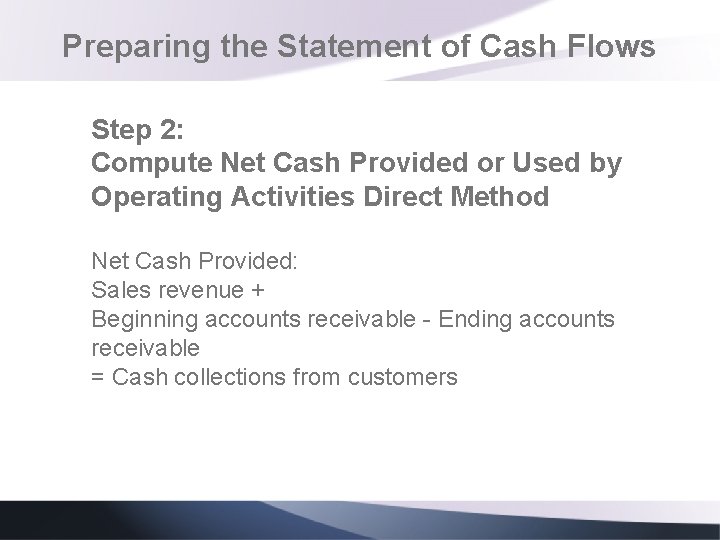
Preparing the Statement of Cash Flows Step 2: Compute Net Cash Provided or Used by Operating Activities Direct Method Net Cash Provided: Sales revenue + Beginning accounts receivable - Ending accounts receivable = Cash collections from customers
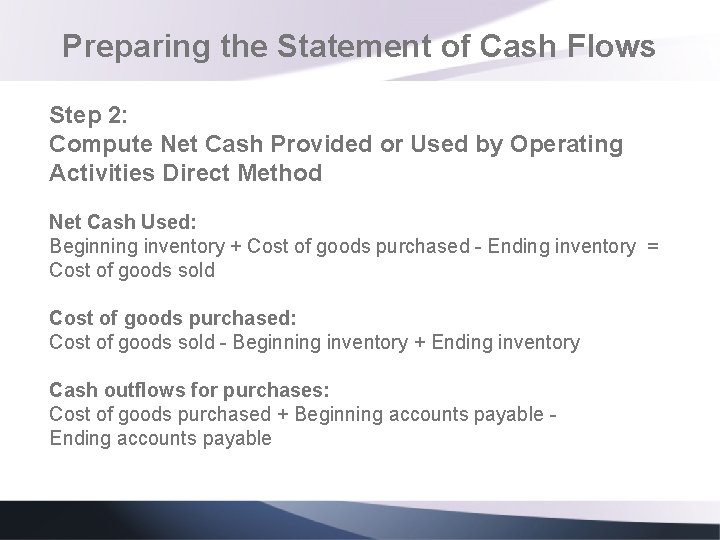
Preparing the Statement of Cash Flows Step 2: Compute Net Cash Provided or Used by Operating Activities Direct Method Net Cash Used: Beginning inventory + Cost of goods purchased - Ending inventory = Cost of goods sold Cost of goods purchased: Cost of goods sold - Beginning inventory + Ending inventory Cash outflows for purchases: Cost of goods purchased + Beginning accounts payable Ending accounts payable
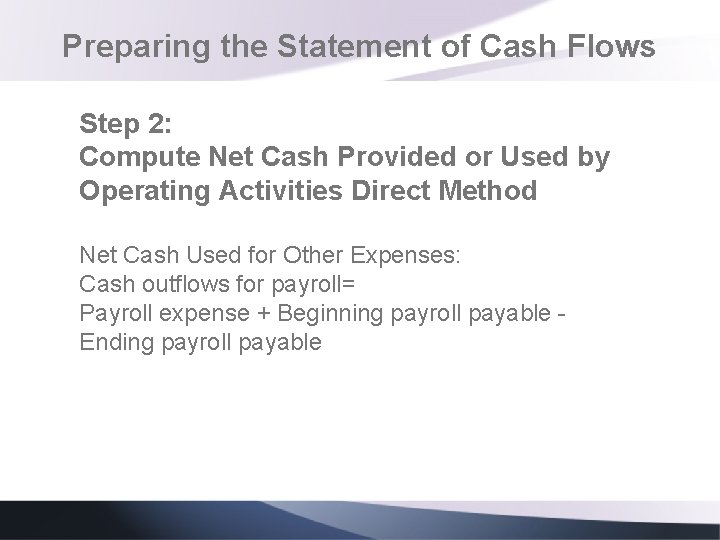
Preparing the Statement of Cash Flows Step 2: Compute Net Cash Provided or Used by Operating Activities Direct Method Net Cash Used for Other Expenses: Cash outflows for payroll= Payroll expense + Beginning payroll payable Ending payroll payable
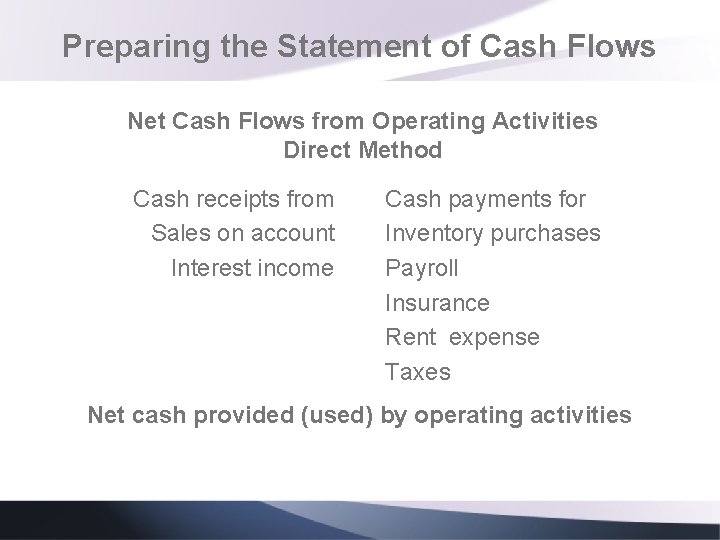
Preparing the Statement of Cash Flows Net Cash Flows from Operating Activities Direct Method Cash receipts from Sales on account Interest income Cash payments for Inventory purchases Payroll Insurance Rent expense Taxes Net cash provided (used) by operating activities
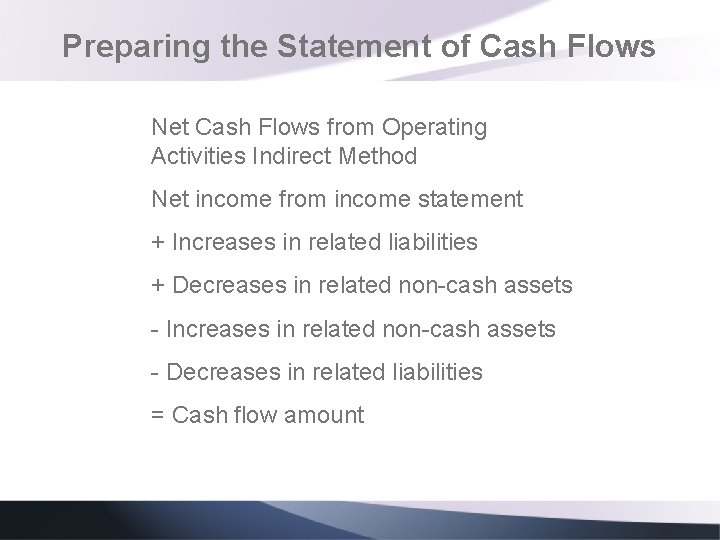
Preparing the Statement of Cash Flows Net Cash Flows from Operating Activities Indirect Method Net income from income statement + Increases in related liabilities + Decreases in related non-cash assets - Increases in related non-cash assets - Decreases in related liabilities = Cash flow amount
Preparing the Statement of Cash Flows Key Concept When using the indirect method, increases (decreases) in asset (liability) accounts during the year require deductions from net income. When asset (liability) accounts decrease (increase) during the year, the amount of decrease or increase must be added to net income in arriving at net cash provided by operating activities.
Preparing the Statement of Cash Flows Step 3: Compute Net Cash Provided or Used by Investing Activities Long-Term Assets If Purchased LTA, Decrease Cash If Sold LTA, Increase Cash
Preparing the Statement of Cash Flows Step 4: Compute Net Cash Provided or Used by Financing Activities Long-Term Liabilities Stock Retained Earnings (Dividends) If increase in above, increase cash If decrease in above, decrease cash
Preparing the Statement of Cash Flows Step 5: Compute Net Cash Flow by Combining the Results from Operating, Investing, and Financing Activities (Compare to Step 1) Net cash increase (decrease) + Cash balance at the beginning of the year = Cash balance at the end of the year
Preparing the Statement of Cash Flows Step 6: Report Any Significant Non-cash Investing or Financing Activities in a Separate Schedule or a Footnote Example: Acquisition of land in exchange for note payable $20, 000
More About Cash Flows Topics Using the Cash Flow Statement in Decision Making Cash Flow Adequacy
Using the Cash Flow Statement in Decision Making Source of information to investors and creditors. Many investors and bankers focus on cash flows as opposed to net income because they are concerned with the ability of the company to meets its short-term obligations. Details about cash flows not found on other financial statements can be useful.
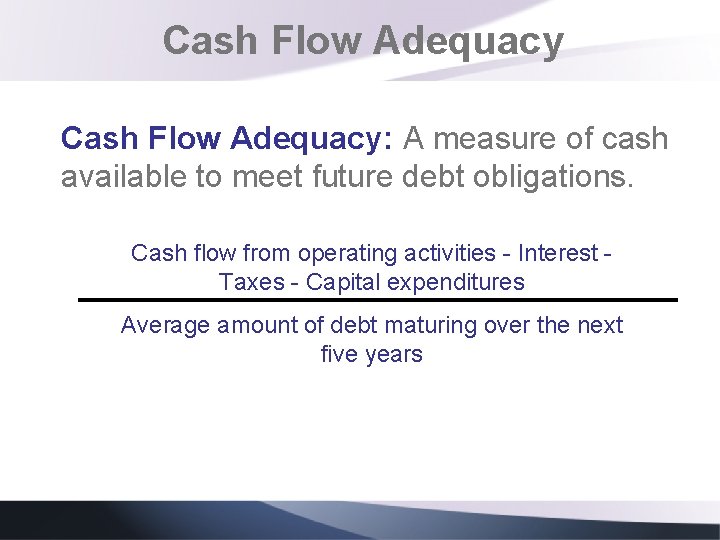
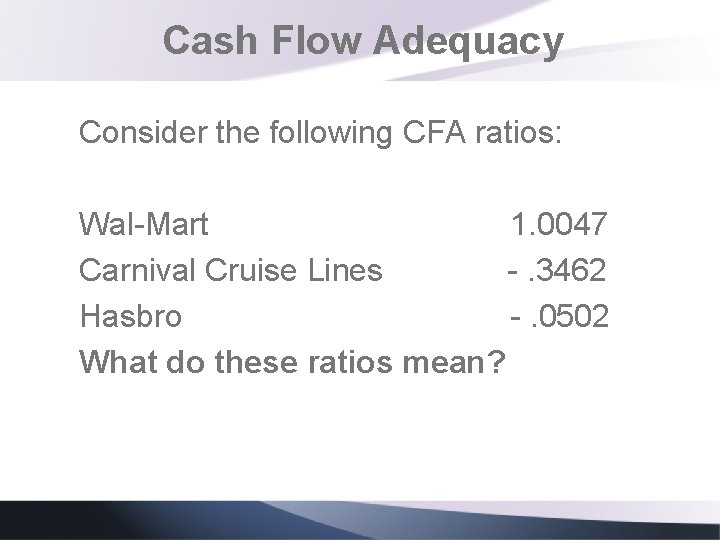
Cash Flow Adequacy: A measure of cash available to meet future debt obligations. Cash flow from operating activities - Interest Taxes - Capital expenditures Average amount of debt maturing over the next five years
Cash Flow Adequacy Consider the following CFA ratios: Wal-Mart 1. 0047 Carnival Cruise Lines -. 3462 Hasbro -. 0502 What do these ratios mean?
Cash Flow Adequacy Pause and Reflect Visit Web sites for Wal-Mart (www. walmart. com), Hasbro (www. hasbro. com), and Carnival Cruise (www. carnival. com) and examine their cash flow statements. How do these three companies compare?
End of Chapter 15 How do you keep track of your cash flow?