Chapter 14 Kinematics Of A Particle Work and
- Slides: 49
Chapter 14 : Kinematics Of A Particle – Work and Energy
Chapter Outline • The work of a Force • Principle of Work and Energy for a System of Particles • Power and Efficiency • Conservative Forces and Potential Energy • Conservation of Energy © 2007 Pearson Education South Asia Pte Ltd
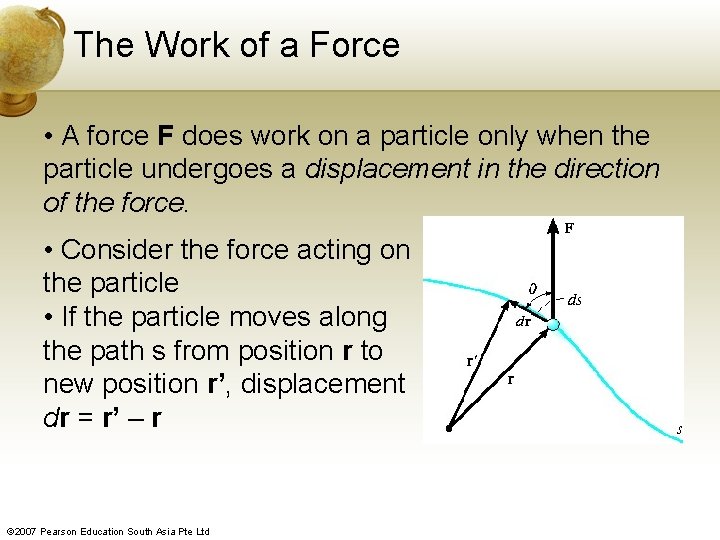
The Work of a Force • A force F does work on a particle only when the particle undergoes a displacement in the direction of the force. • Consider the force acting on the particle • If the particle moves along the path s from position r to new position r’, displacement dr = r’ – r © 2007 Pearson Education South Asia Pte Ltd
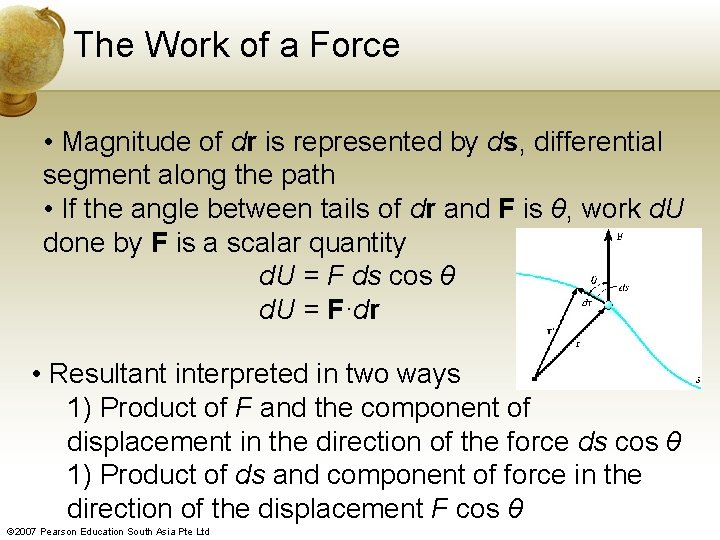
The Work of a Force • Magnitude of dr is represented by ds, differential segment along the path • If the angle between tails of dr and F is θ, work d. U done by F is a scalar quantity d. U = F ds cos θ d. U = F·dr • Resultant interpreted in two ways 1) Product of F and the component of displacement in the direction of the force ds cos θ 1) Product of ds and component of force in the direction of the displacement F cos θ © 2007 Pearson Education South Asia Pte Ltd
The Work of a Force • If 0° < θ < 90°, the force component and the displacement has the same sense so that the work is positive • If 90° < θ < 180°, the force component and the displacement has the opposite sense so that the work is negative • d. U = 0 if the force is perpendicular to the displacement since cos 90° = 0 or if the force is applied at a fixed point where displacement = 0 • Basic unit for work in SI units is Joule (J) © 2007 Pearson Education South Asia Pte Ltd
The Work of a Force • This unit combines the units force and displacement • 1 joule of work is done when a force of 1 newton moves 1 meter along its line of action 1 J = 1 N. m • Moment of a force has this same combination of units, however, the concepts of moment and work are in no way related • A moment is a vector quantity, whereas work is a scalar © 2007 Pearson Education South Asia Pte Ltd
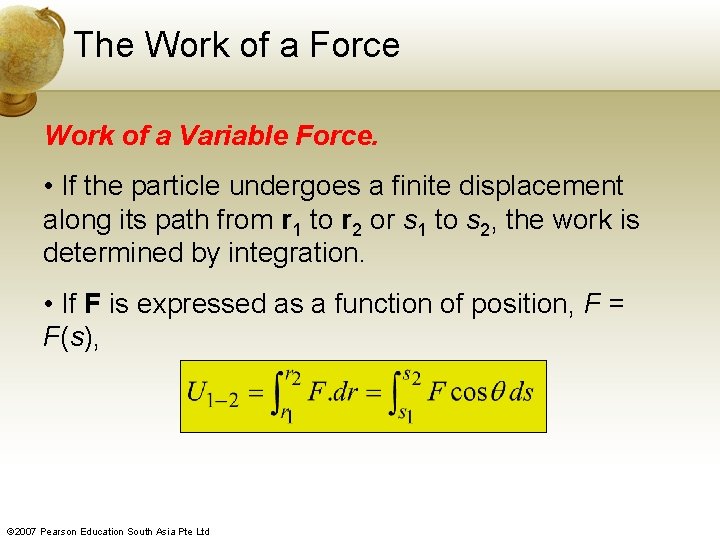
The Work of a Force Work of a Variable Force. • If the particle undergoes a finite displacement along its path from r 1 to r 2 or s 1 to s 2, the work is determined by integration. • If F is expressed as a function of position, F = F(s), © 2007 Pearson Education South Asia Pte Ltd
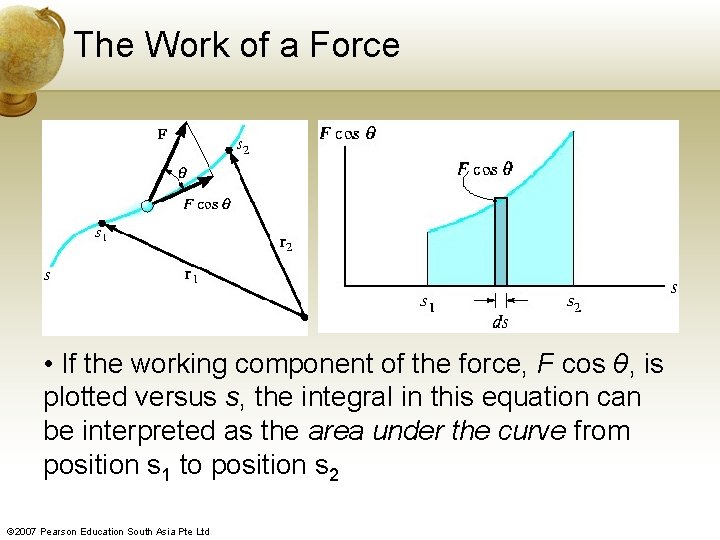
The Work of a Force • If the working component of the force, F cos θ, is plotted versus s, the integral in this equation can be interpreted as the area under the curve from position s 1 to position s 2 © 2007 Pearson Education South Asia Pte Ltd
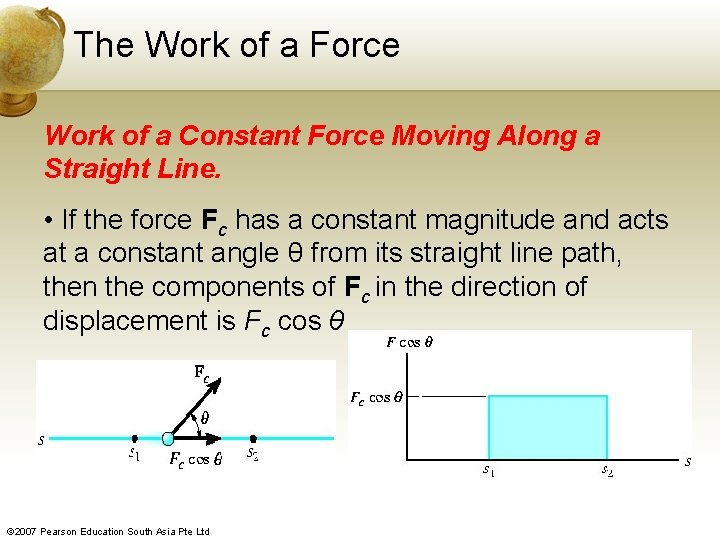
The Work of a Force Work of a Constant Force Moving Along a Straight Line. • If the force Fc has a constant magnitude and acts at a constant angle θ from its straight line path, then the components of Fc in the direction of displacement is Fc cos θ © 2007 Pearson Education South Asia Pte Ltd
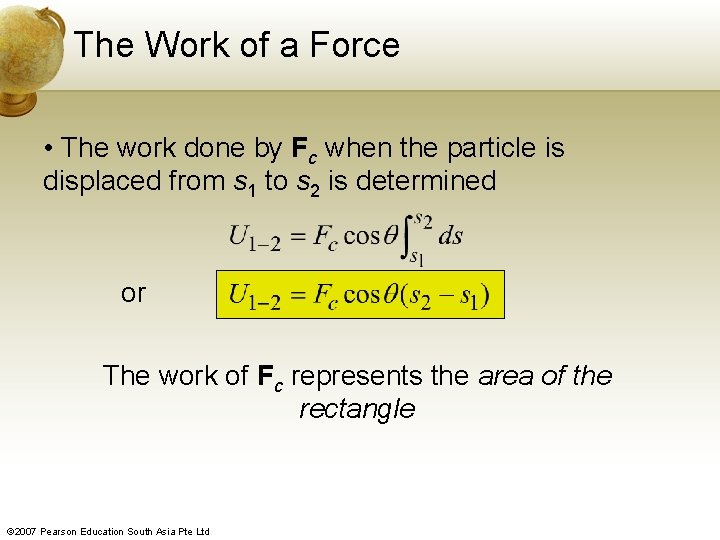
The Work of a Force • The work done by Fc when the particle is displaced from s 1 to s 2 is determined or The work of Fc represents the area of the rectangle © 2007 Pearson Education South Asia Pte Ltd
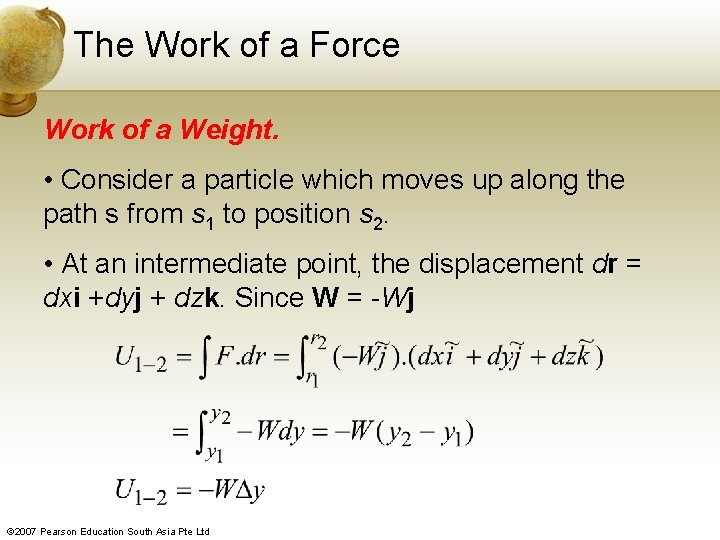
The Work of a Force Work of a Weight. • Consider a particle which moves up along the path s from s 1 to position s 2. • At an intermediate point, the displacement dr = dxi +dyj + dzk. Since W = -Wj © 2007 Pearson Education South Asia Pte Ltd
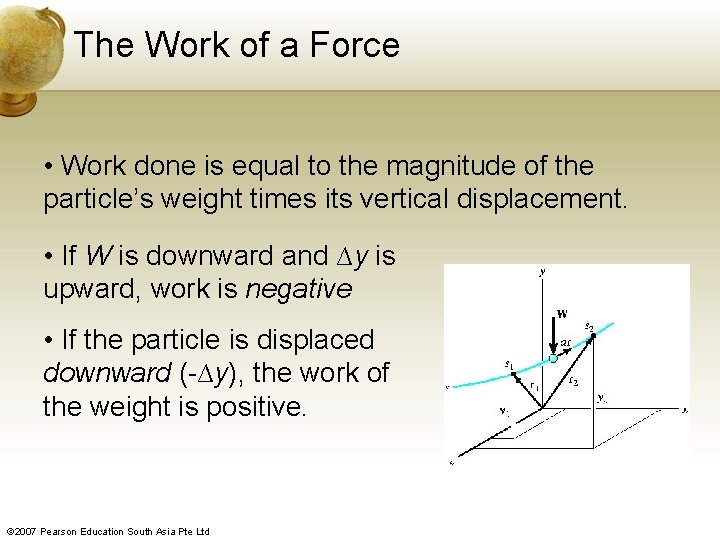
The Work of a Force • Work done is equal to the magnitude of the particle’s weight times its vertical displacement. • If W is downward and ∆y is upward, work is negative • If the particle is displaced downward (-∆y), the work of the weight is positive. © 2007 Pearson Education South Asia Pte Ltd
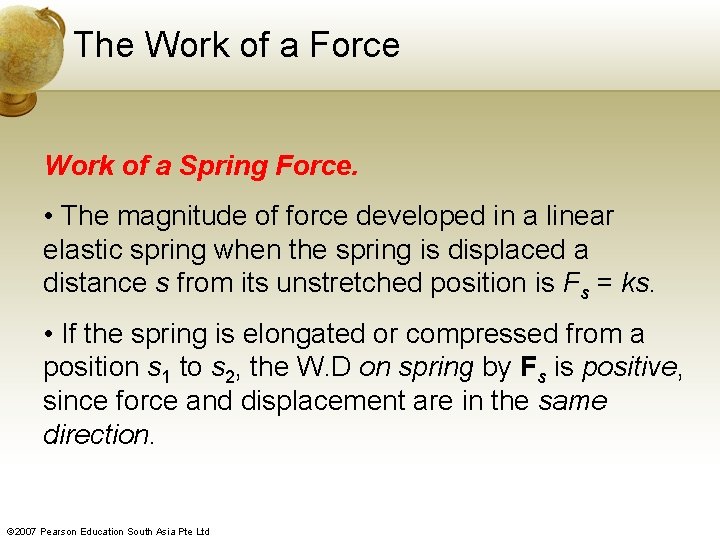
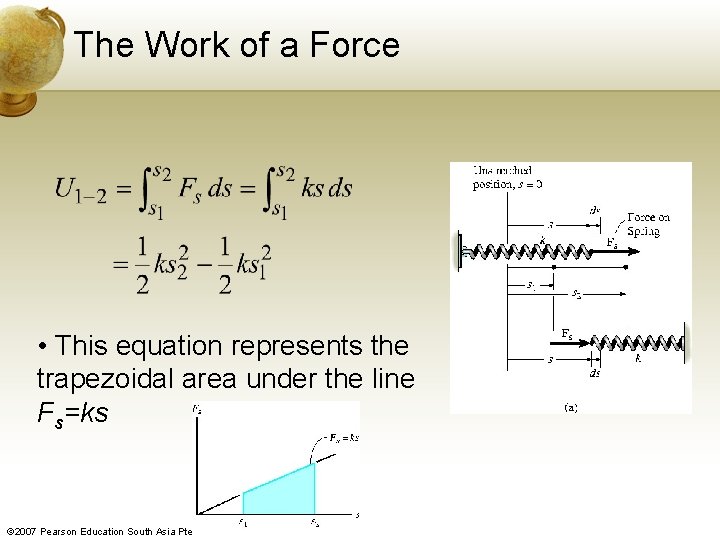
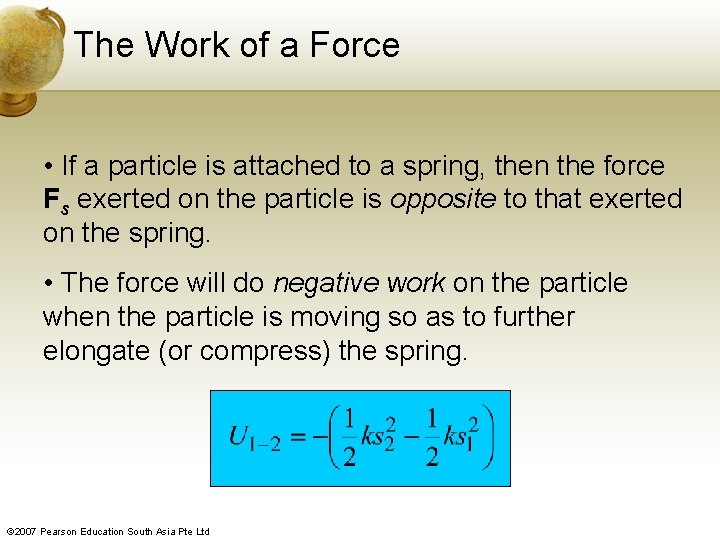
The Work of a Force Work of a Spring Force. • The magnitude of force developed in a linear elastic spring when the spring is displaced a distance s from its unstretched position is Fs = ks. • If the spring is elongated or compressed from a position s 1 to s 2, the W. D on spring by Fs is positive, since force and displacement are in the same direction. © 2007 Pearson Education South Asia Pte Ltd
The Work of a Force • This equation represents the trapezoidal area under the line Fs=ks © 2007 Pearson Education South Asia Pte Ltd
The Work of a Force • If a particle is attached to a spring, then the force Fs exerted on the particle is opposite to that exerted on the spring. • The force will do negative work on the particle when the particle is moving so as to further elongate (or compress) the spring. © 2007 Pearson Education South Asia Pte Ltd
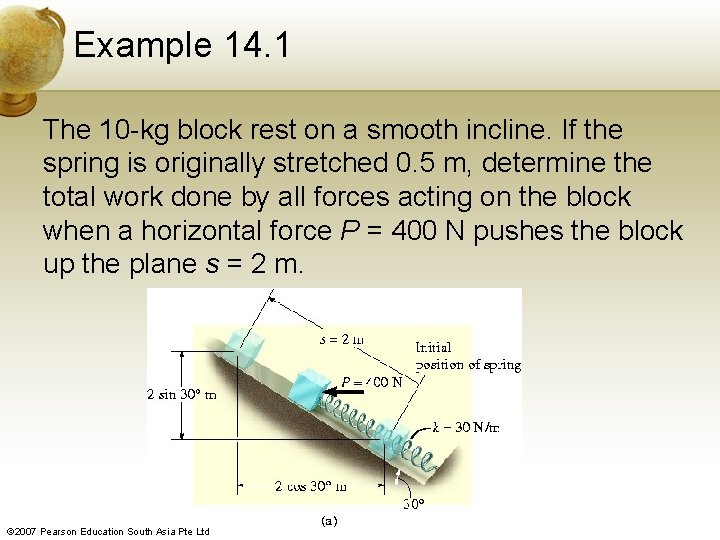
Example 14. 1 The 10 -kg block rest on a smooth incline. If the spring is originally stretched 0. 5 m, determine the total work done by all forces acting on the block when a horizontal force P = 400 N pushes the block up the plane s = 2 m. © 2007 Pearson Education South Asia Pte Ltd
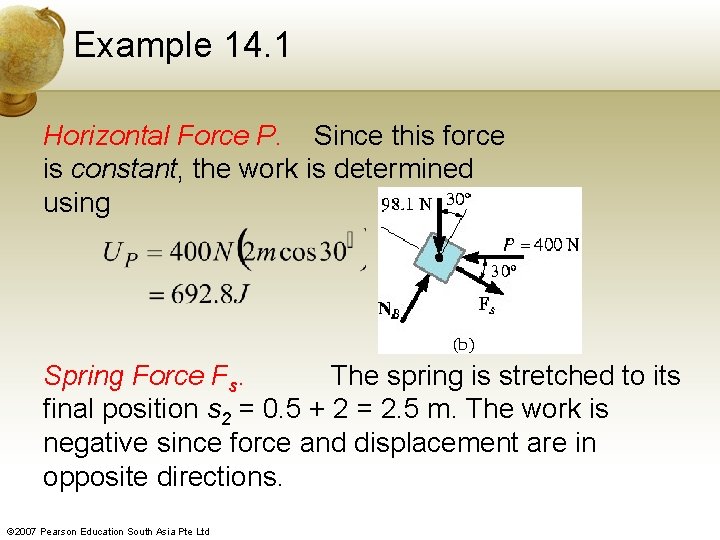
Example 14. 1 Horizontal Force P. Since this force is constant, the work is determined using Spring Force Fs. The spring is stretched to its final position s 2 = 0. 5 + 2 = 2. 5 m. The work is negative since force and displacement are in opposite directions. © 2007 Pearson Education South Asia Pte Ltd
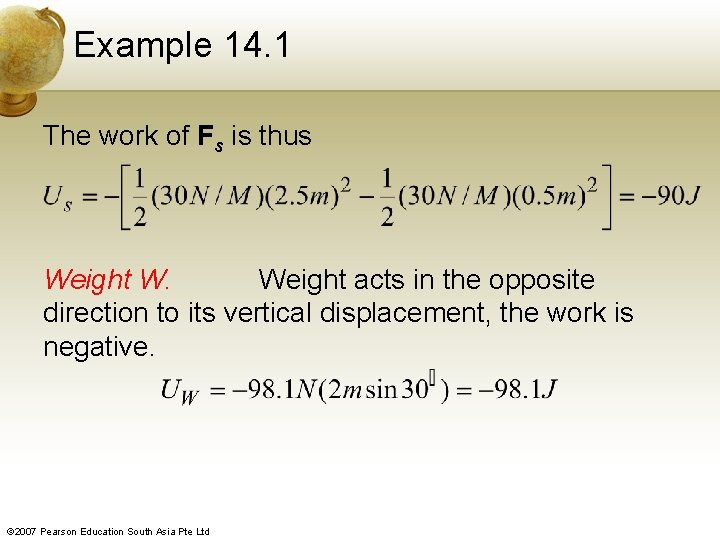
Example 14. 1 The work of Fs is thus Weight W. Weight acts in the opposite direction to its vertical displacement, the work is negative. © 2007 Pearson Education South Asia Pte Ltd
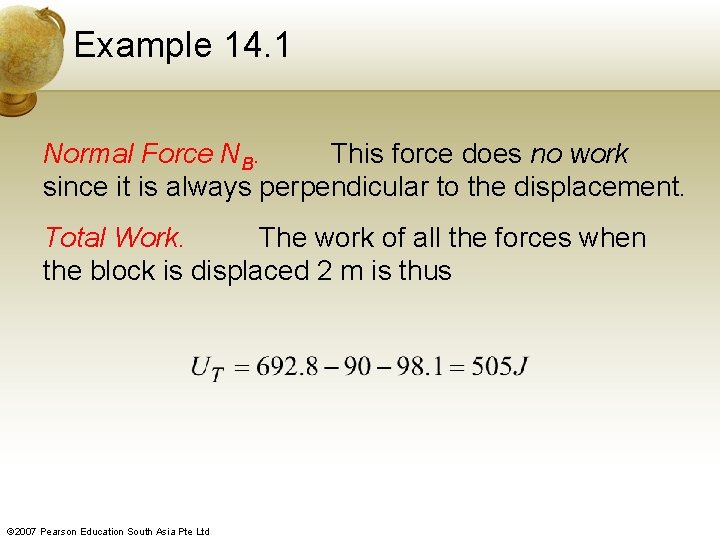
Example 14. 1 Normal Force NB. This force does no work since it is always perpendicular to the displacement. Total Work. The work of all the forces when the block is displaced 2 m is thus © 2007 Pearson Education South Asia Pte Ltd
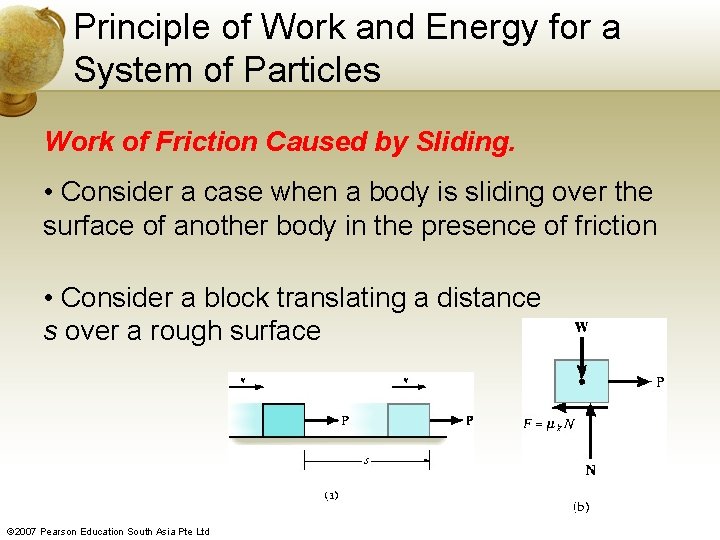
Principle of Work and Energy for a System of Particles Work of Friction Caused by Sliding. • Consider a case when a body is sliding over the surface of another body in the presence of friction • Consider a block translating a distance s over a rough surface © 2007 Pearson Education South Asia Pte Ltd
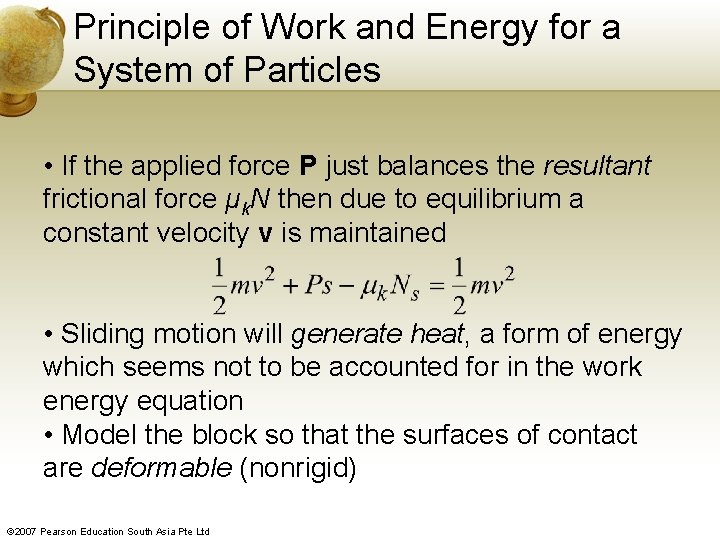
Principle of Work and Energy for a System of Particles • If the applied force P just balances the resultant frictional force μk. N then due to equilibrium a constant velocity v is maintained • Sliding motion will generate heat, a form of energy which seems not to be accounted for in the work energy equation • Model the block so that the surfaces of contact are deformable (nonrigid) © 2007 Pearson Education South Asia Pte Ltd
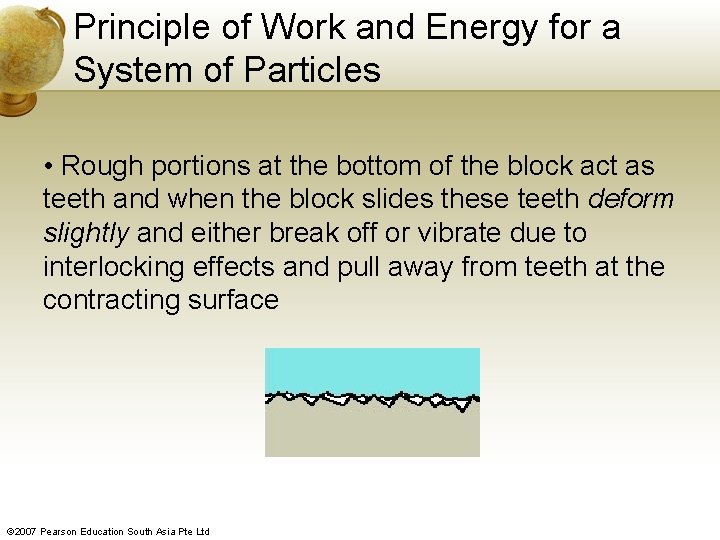
Principle of Work and Energy for a System of Particles • Rough portions at the bottom of the block act as teeth and when the block slides these teeth deform slightly and either break off or vibrate due to interlocking effects and pull away from teeth at the contracting surface © 2007 Pearson Education South Asia Pte Ltd
Principle of Work and Energy for a System of Particles • As a result, frictional forces that act on the block at these points are displaced slightly, due to localized deformations, and then they are replaced by other frictional forces as other points of contact are made • At any instant, the resultant F of these frictional forces remain essentially constant, μk. N, however, due to many localized deformations, the actual displacement s’ of μk. N is not the same displacement s as the applied force P © 2007 Pearson Education South Asia Pte Ltd
Principle of Work and Energy for a System of Particles • s’ < s and the external work done by the resultant force will be μk. Ns’ and not μk. Ns • the remaining work μk. N(s – s’) manifests itself as the increase in internal energy which in fact, causes the block temperature to increase © 2007 Pearson Education South Asia Pte Ltd
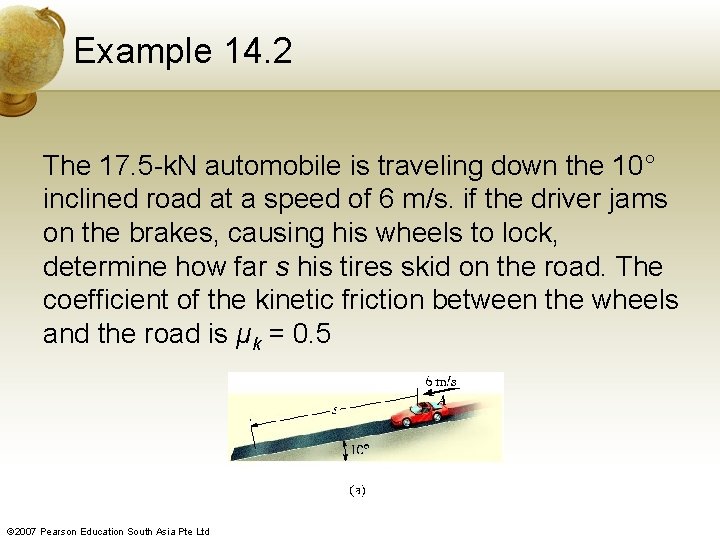
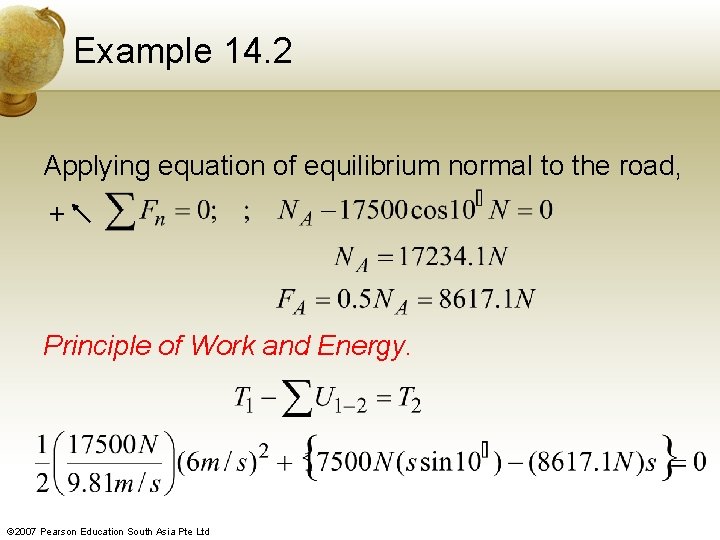
Example 14. 2 The 17. 5 -k. N automobile is traveling down the 10° inclined road at a speed of 6 m/s. if the driver jams on the brakes, causing his wheels to lock, determine how far s his tires skid on the road. The coefficient of the kinetic friction between the wheels and the road is μk = 0. 5 © 2007 Pearson Education South Asia Pte Ltd
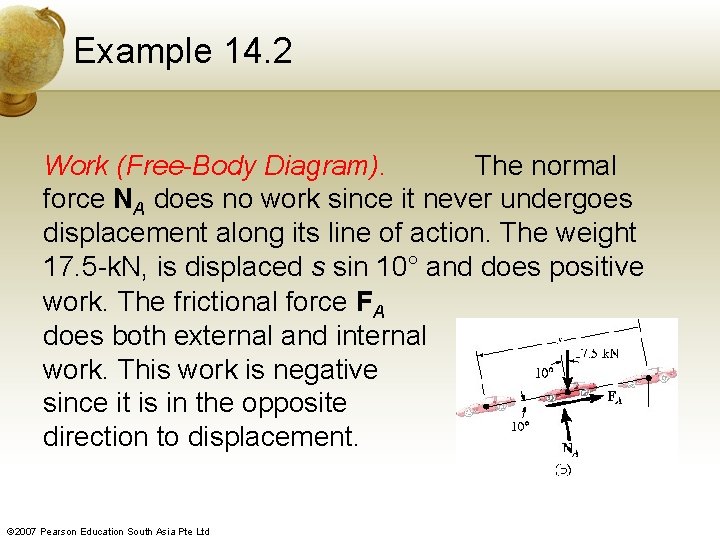
Example 14. 2 Work (Free-Body Diagram). The normal force NA does no work since it never undergoes displacement along its line of action. The weight 17. 5 -k. N, is displaced s sin 10° and does positive work. The frictional force FA does both external and internal work. This work is negative since it is in the opposite direction to displacement. © 2007 Pearson Education South Asia Pte Ltd
Example 14. 2 Applying equation of equilibrium normal to the road, + Principle of Work and Energy. © 2007 Pearson Education South Asia Pte Ltd
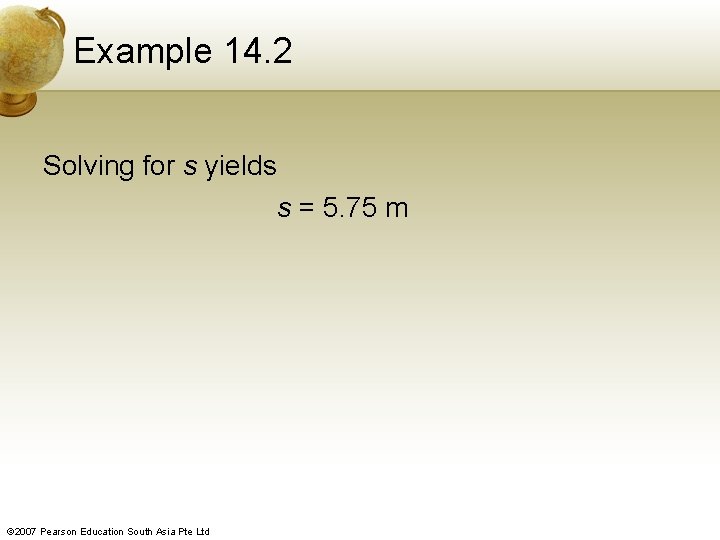
Example 14. 2 Solving for s yields s = 5. 75 m © 2007 Pearson Education South Asia Pte Ltd
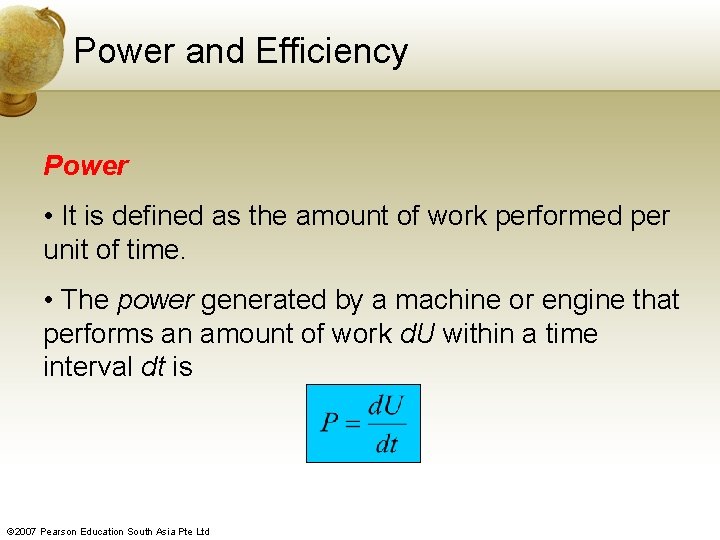
Power and Efficiency Power • It is defined as the amount of work performed per unit of time. • The power generated by a machine or engine that performs an amount of work d. U within a time interval dt is © 2007 Pearson Education South Asia Pte Ltd
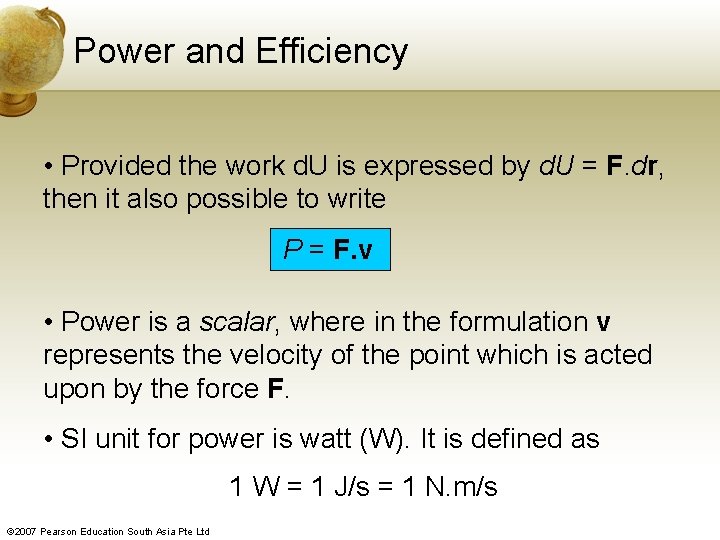
Power and Efficiency • Provided the work d. U is expressed by d. U = F. dr, then it also possible to write P = F. v • Power is a scalar, where in the formulation v represents the velocity of the point which is acted upon by the force F. • SI unit for power is watt (W). It is defined as 1 W = 1 J/s = 1 N. m/s © 2007 Pearson Education South Asia Pte Ltd
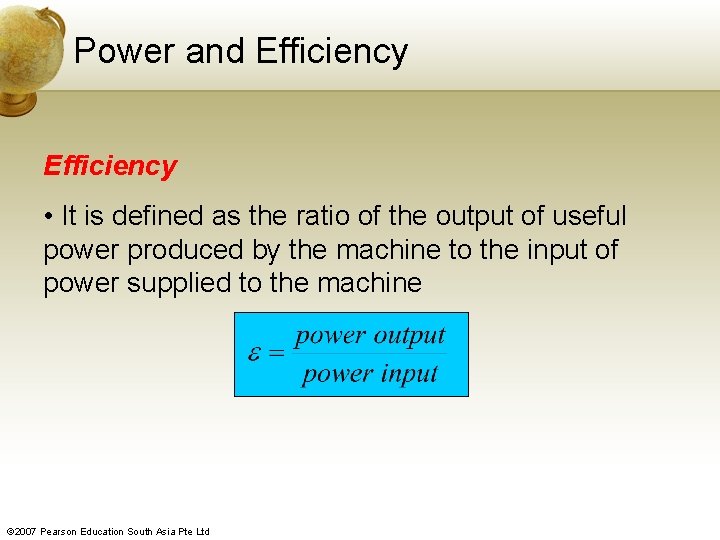
Power and Efficiency • It is defined as the ratio of the output of useful power produced by the machine to the input of power supplied to the machine © 2007 Pearson Education South Asia Pte Ltd
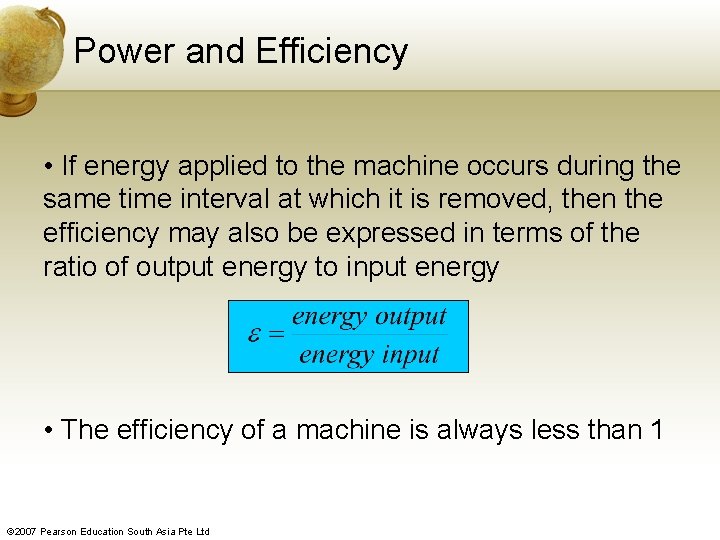
Power and Efficiency • If energy applied to the machine occurs during the same time interval at which it is removed, then the efficiency may also be expressed in terms of the ratio of output energy to input energy • The efficiency of a machine is always less than 1 © 2007 Pearson Education South Asia Pte Ltd
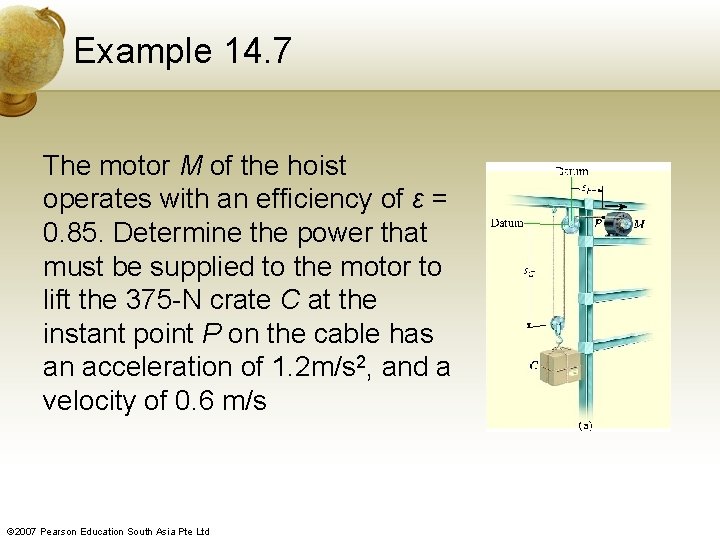
Example 14. 7 The motor M of the hoist operates with an efficiency of ε = 0. 85. Determine the power that must be supplied to the motor to lift the 375 -N crate C at the instant point P on the cable has an acceleration of 1. 2 m/s 2, and a velocity of 0. 6 m/s © 2007 Pearson Education South Asia Pte Ltd
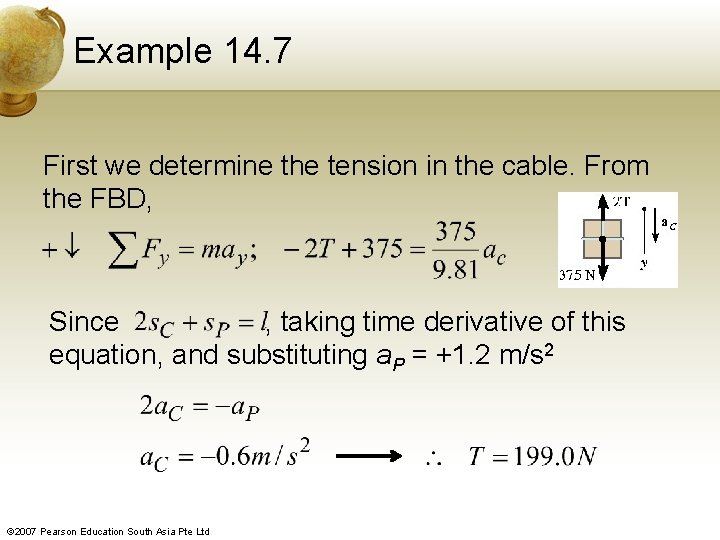
Example 14. 7 First we determine the tension in the cable. From the FBD, Since , taking time derivative of this equation, and substituting a. P = +1. 2 m/s 2 © 2007 Pearson Education South Asia Pte Ltd
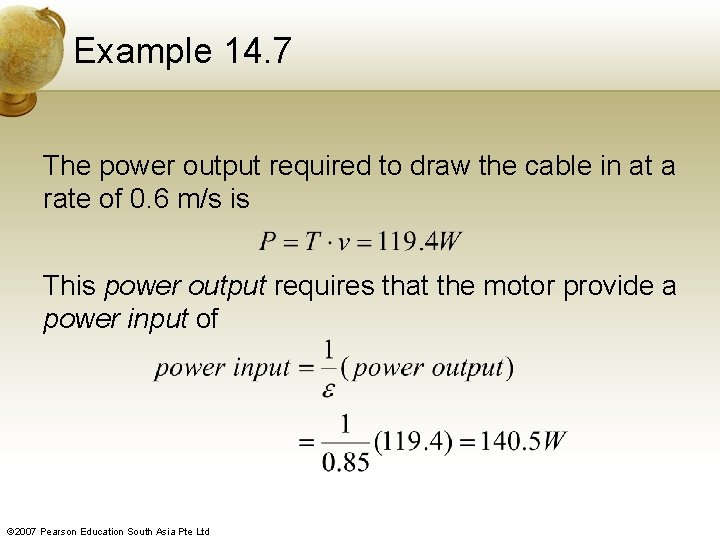
Example 14. 7 The power output required to draw the cable in at a rate of 0. 6 m/s is This power output requires that the motor provide a power input of © 2007 Pearson Education South Asia Pte Ltd
Conservative Forces and Potential Energy Conservative Force. • It is defined by the work done in moving a particle from one point to another that is independent of the path followed by the particle. • Two examples are weight of the particle and elastic force of the spring. © 2007 Pearson Education South Asia Pte Ltd
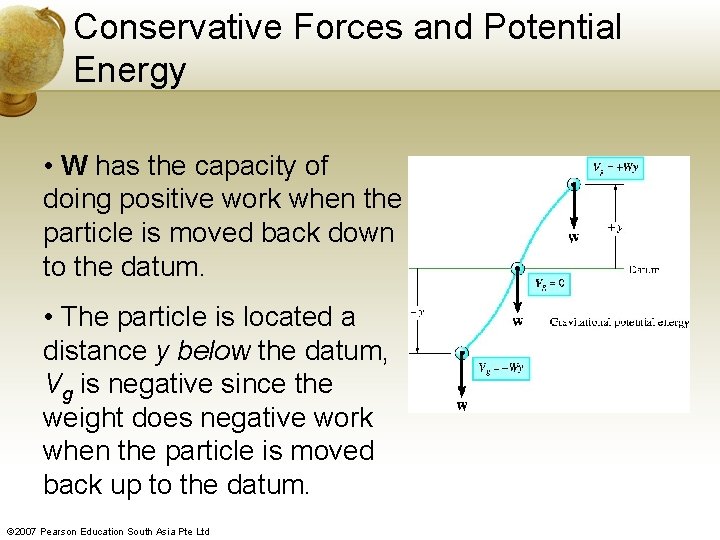
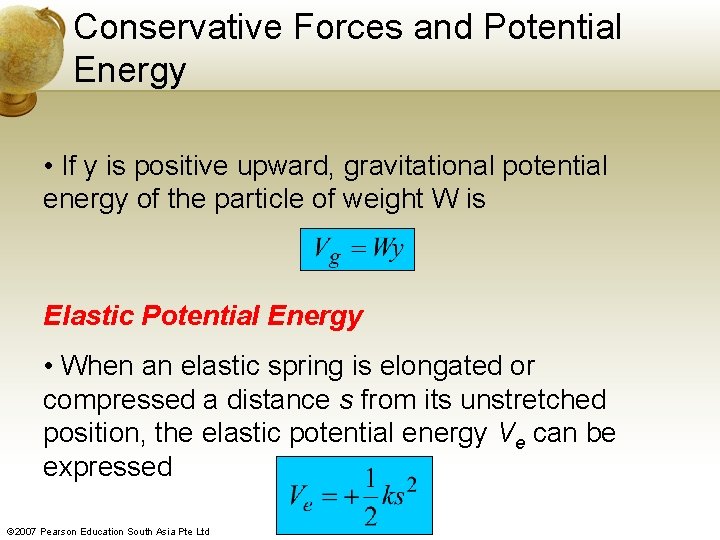
Conservative Forces and Potential Energy. • It is the measure of the amount of work a conservative force will do when it moves from a given position to the datum. Gravitational Potential Energy. • If a particle is located a distance y above an arbitrary selected datum, the particle’s weight W has positive gravitational potential energy Vg. © 2007 Pearson Education South Asia Pte Ltd
Conservative Forces and Potential Energy • W has the capacity of doing positive work when the particle is moved back down to the datum. • The particle is located a distance y below the datum, Vg is negative since the weight does negative work when the particle is moved back up to the datum. © 2007 Pearson Education South Asia Pte Ltd
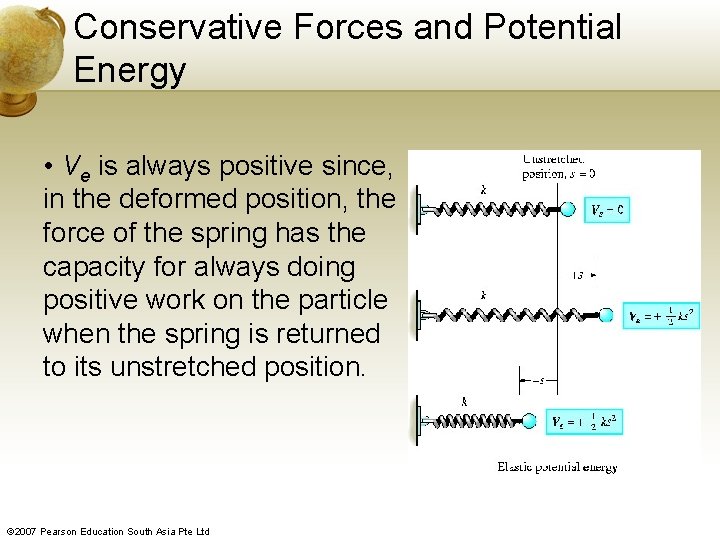
Conservative Forces and Potential Energy • If y is positive upward, gravitational potential energy of the particle of weight W is Elastic Potential Energy • When an elastic spring is elongated or compressed a distance s from its unstretched position, the elastic potential energy Ve can be expressed © 2007 Pearson Education South Asia Pte Ltd
Conservative Forces and Potential Energy • Ve is always positive since, in the deformed position, the force of the spring has the capacity for always doing positive work on the particle when the spring is returned to its unstretched position. © 2007 Pearson Education South Asia Pte Ltd
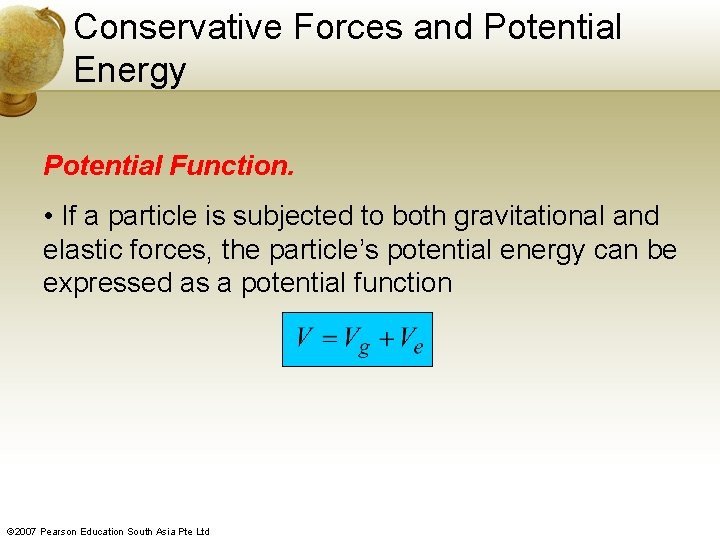
Conservative Forces and Potential Energy Potential Function. • If a particle is subjected to both gravitational and elastic forces, the particle’s potential energy can be expressed as a potential function © 2007 Pearson Education South Asia Pte Ltd
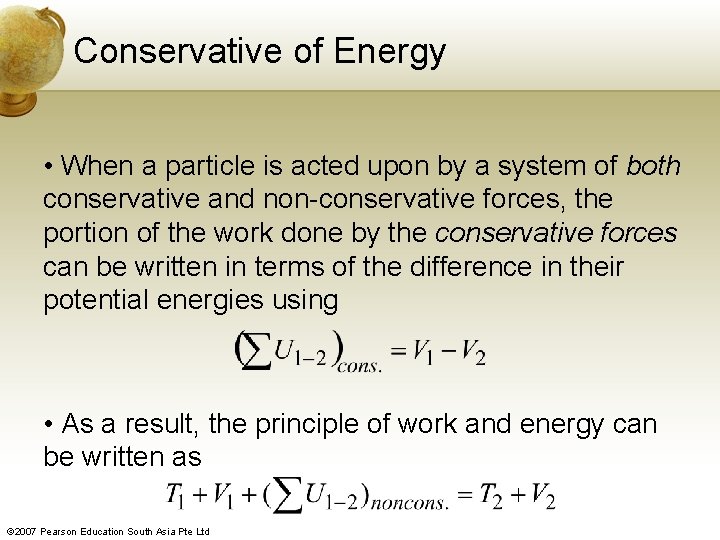
Conservative of Energy • When a particle is acted upon by a system of both conservative and non-conservative forces, the portion of the work done by the conservative forces can be written in terms of the difference in their potential energies using • As a result, the principle of work and energy can be written as © 2007 Pearson Education South Asia Pte Ltd
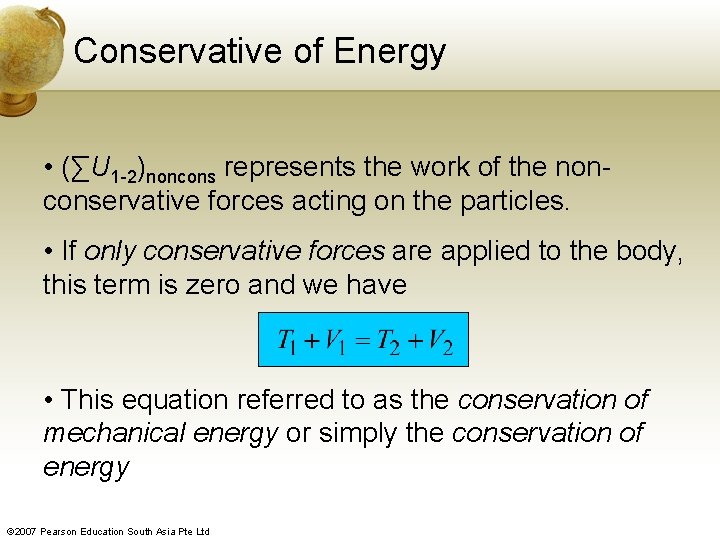
Conservative of Energy • (∑U 1 -2)noncons represents the work of the nonconservative forces acting on the particles. • If only conservative forces are applied to the body, this term is zero and we have • This equation referred to as the conservation of mechanical energy or simply the conservation of energy © 2007 Pearson Education South Asia Pte Ltd
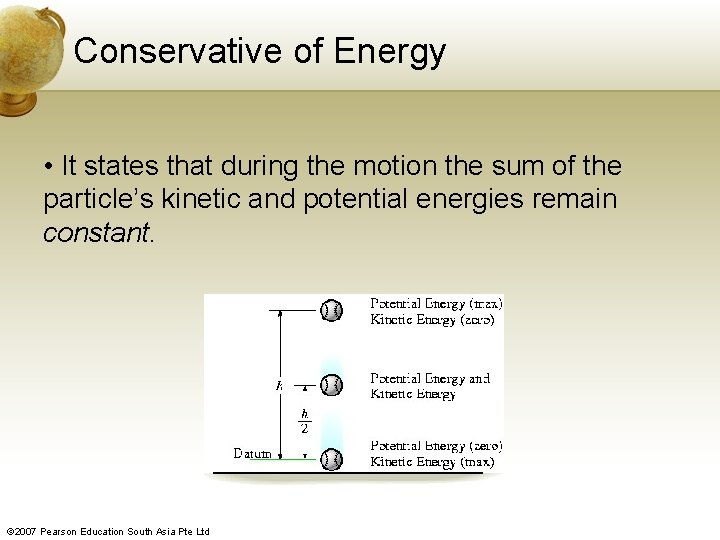
Conservative of Energy • It states that during the motion the sum of the particle’s kinetic and potential energies remain constant. © 2007 Pearson Education South Asia Pte Ltd
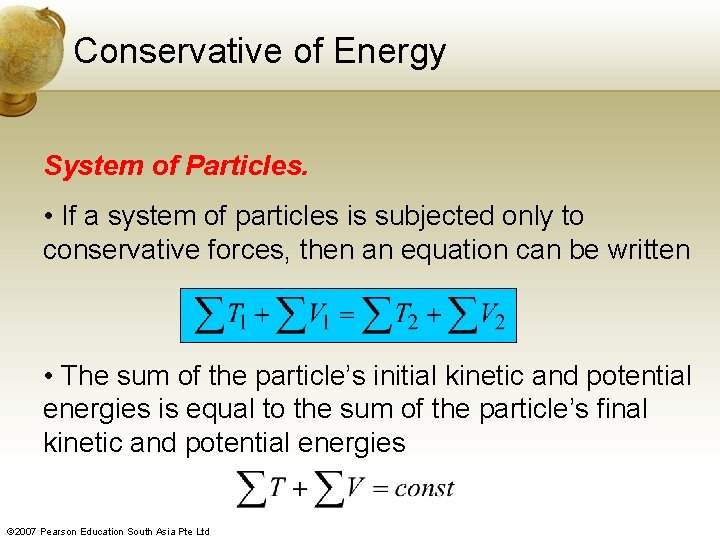
Conservative of Energy System of Particles. • If a system of particles is subjected only to conservative forces, then an equation can be written • The sum of the particle’s initial kinetic and potential energies is equal to the sum of the particle’s final kinetic and potential energies © 2007 Pearson Education South Asia Pte Ltd
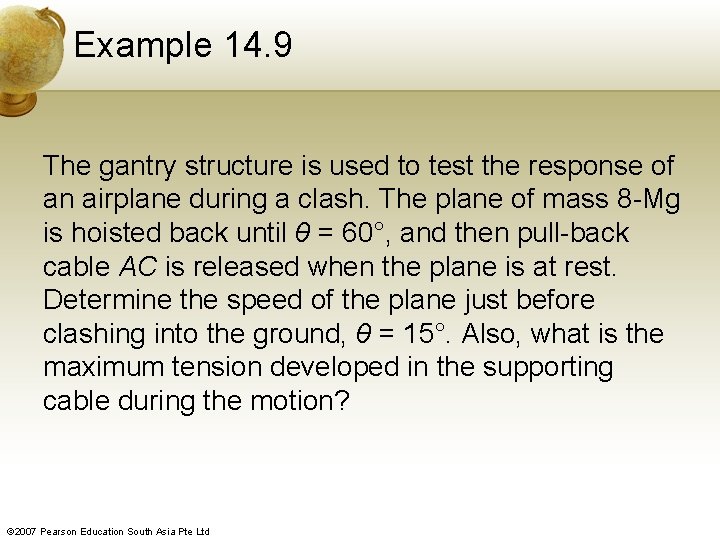
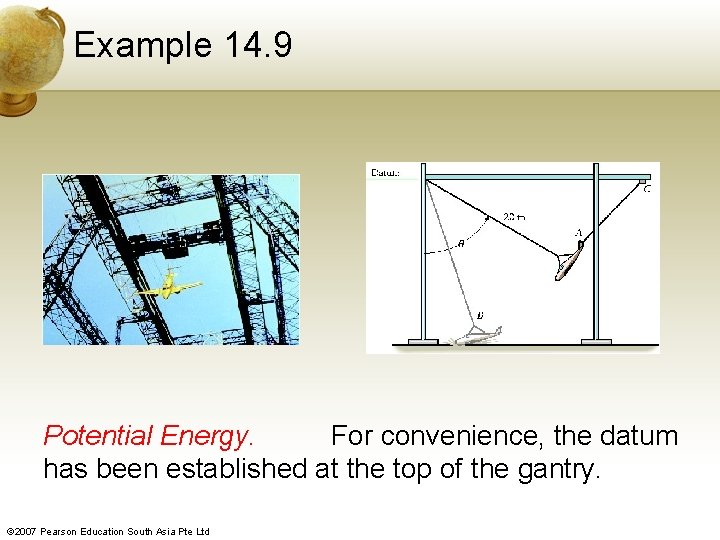
Example 14. 9 The gantry structure is used to test the response of an airplane during a clash. The plane of mass 8 -Mg is hoisted back until θ = 60°, and then pull-back cable AC is released when the plane is at rest. Determine the speed of the plane just before clashing into the ground, θ = 15°. Also, what is the maximum tension developed in the supporting cable during the motion? © 2007 Pearson Education South Asia Pte Ltd
Example 14. 9 Potential Energy. For convenience, the datum has been established at the top of the gantry. © 2007 Pearson Education South Asia Pte Ltd
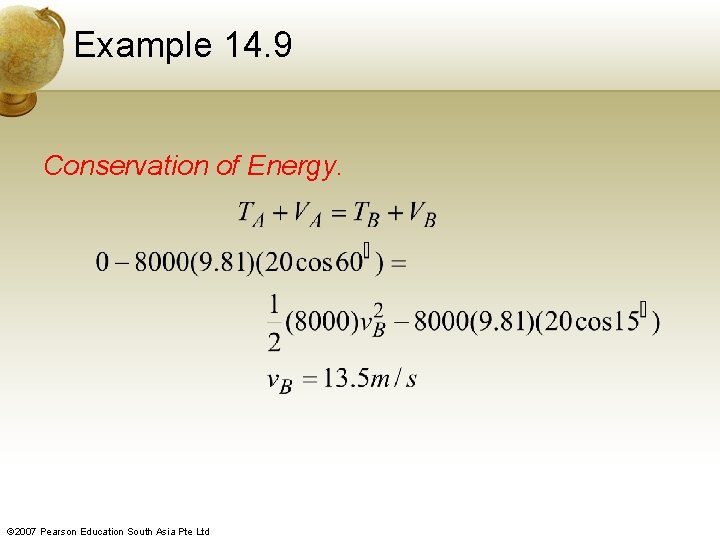
Example 14. 9 Conservation of Energy. © 2007 Pearson Education South Asia Pte Ltd
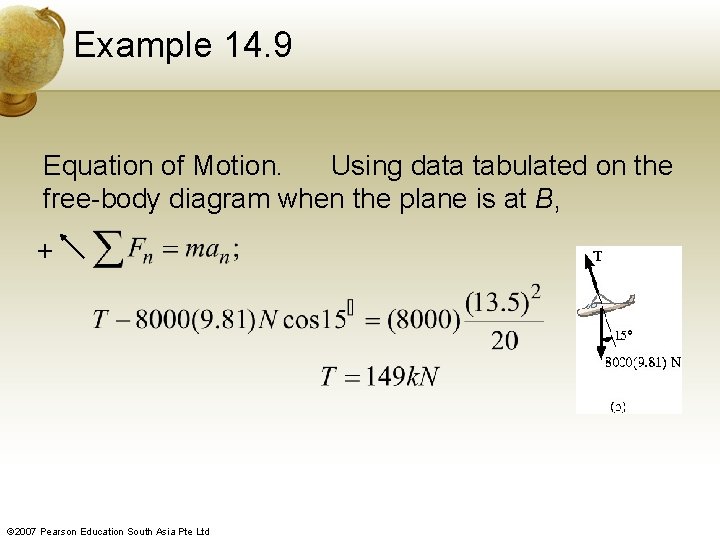
Example 14. 9 Equation of Motion. Using data tabulated on the free-body diagram when the plane is at B, + © 2007 Pearson Education South Asia Pte Ltd