Chapter 12 Power and Violence Miller Intimate Relationships
- Slides: 36
Chapter 12 Power and Violence Miller Intimate Relationships, 6/e Mc. Graw-Hill/Irwin 12 - Copyright (c) 2012 by The Mc. Graw-Hill Companies, Inc. All rights reserved.
Power and Interdependency Power is the ability to influence the behavior of others and to resist their influence on us. 12 -2
Power and Interdependency Sources of Power From an interdependency perspective, power is based on the control of valuable resources. – One need not necessarily possess these resources; one needs only to control access to them. – One’s power varies with the other person’s desire and need for the resource. – One’s power is reduced if the desired resources are readily available elsewhere. 12 -3
Power and Interdependency Sources of Power The principle of lesser interest observes that the partner who is less dependent on the relationship – who desires it less – has more power in that relationship. If your partner loves and needs you more than you love him or her, you’ll get to do what you want more often than not. 12 -4
Power and Interdependency Sources of Power There are two different broad types of power: – Fate control allows one to control a partner’s outcomes no matter what the partner does. – Behavior control allows one to encourage, but not compel, desired behavior from a partner. 12 -5
Power and Interdependency Sources of Power In almost all relationships, the partners both have power over each other, so that each is able to get the other to do what he or she wants some of the time. Thus, one partner’s ability to influence the other is often matched by considerable counterpower of the other partner over the first. 12 -6
Power and Interdependency Types of Resources • Six different resources provide people power over others: – Reward power – Coercive power – Legitimate power – Referent power – Expert power – Informational power 12 -7
Power and Interdependency Types of Resources • Reward power is the ability to bestow desired rewards; these may be either tangible, material goods or intangible, interpersonal benefits. 12 -8
Power and Interdependency Types of Resources • Coercive power is the ability to levy unwanted punishments, doing something a partner doesn’t like, or taking away something the partner does like. 12 -9
Power and Interdependency Types of Resources • Legitimate power exists when one partner has a reasonable right – by dint of authority, equity, or reciprocity – to tell the other what to do. 12 -10
Power and Interdependency Types of Resources • Referent power emerges from respect and love for a partner. Affection and adoration from another provides one some ability to influence that other person. 12 -11
Power and Interdependency Types of Resources • Expert power exists when one partner has superior knowledge and experience that is recognized and acknowledged by the other. • Finally, informational power exists when one partner has specific pieces of information that the other wants. 12 -12
Power and Interdependency Men, Women, and the Control of Resources • Men and women face a disparity in relative resources. • Some resources that provide people power can be used more flexibly than others can. – Universalistic resources (such as money) can be exchanged with almost anyone in a wide variety of situations. – Particularistic resources are valuable in some situations and not in others, and they confer power to their owner only with particular partners. 12 -13
Power and Interdependency Men, Women, and the Control of Resources Love is a particularistic resource. We have referent power over one who loves us, but that power is limited to that lover, and no one else. If men control more universalistic resources that are widely influential in social life, and women control more particularistic resources, it shouldn’t surprise us to find men being more influential than women in many relationships. 12 -14
Power and Interdependency Men, Women and the Control of Resources In addition to the disparity in relative resources, • Social norms support and maintain male dominance. • Worldwide most cultures are still governed by a norm of patriarchy. • Americans tend to think women are more honest, intelligent, compassionate, and creative, which makes them good leaders. • But cultural norms still keep women “in place. ” 12 -15
Power and Interdependency The Process of Power The process of power refers to the manner in which power is expressed. • Conversation: Men and women behave similarly when they are talking to others of the same sex. But in interactions with the other sex, men interrupt women more than vice versa. Men say more than women do, too. 12 -16
Power and Interdependency The Process of Power • Nonverbal Behavior: – Women use less assertive eye contact, body movement, and touch with men than with other women. – This is sensible: Women tend to get their way when they use authoritative behavior with other women, but they make poorer impressions when they direct such behavior toward men. 12 -17
Power and Interdependency The Process of Power • Nonverbal Sensitivity: Women decode others’ nonverbal communications more accurately than men do. This is a very useful skill, but powerful people tend to be relatively insensitive to others’ feelings. 12 -18
Power and Interdependency The Process of Power • Styles of Power: Influence tactics may be overt and direct, or indirect and implicit. They are also bilateral, involving both members of a couple in negotiation and bargaining, or unilateral, with individuals doing what they want without involving their partners. 12 -19
Power and Interdependency The Process of Power • Styles of Power (continued): There are no sex differences in the tactics people use in same-sex partnerships, but men tend to be more direct and bilateral, and women more indirect and unilateral, in heterosexual relationships. More often than women, men come right out and ask for what they want. By comparison, women more often hint about, but do not announce, their preferences. 12 -20
Power and Interdependency The Process of Power • Styles of Power (continued): – Men and women differ in this manner for two reasons. – First, masculine people tend to be more direct and bilateral than feminine people are. – Second, and more importantly, traditional norms accord husbands more status than wives, and high-status people are more direct and bilateral than people of lower status are. 12 -21
Power and Interdependency The Process of Power • Styles of Power (continued): – These norms are gradually changing, and that may be a good thing: – People who have to hint and pout to get (some of) what they want tend to be less content than are those who can come right out and ask for what they desire. 12 -22
Power and Interdependency The Outcome of Power • In a culture of male dominance, we often unwittingly perpetuate gender inequalities in our daily interactions. • These subtle imbalances of power can be hard to detect. • But the latest data suggest we should strive to create romantic partnerships giving both partners’ wishes equal weight. • While women benefit more than men do, both men and women are happier in equal partnerships. 12 -23
The Two Faces of Power There’s a dark side to power. Some people actively seek to be the top dogs in their relationships, and they tend to be controlling, domineering people who have unhappy partners. 12 -24
The Two Faces of Power However, when they are committed to a relationship, many people use power benevolently, generously enhancing their partners’ well-being as well as their own. Power need not be a corrosive, deleterious thing. Committed, happy lovers often use their influence to benefit their partners and to enhance, rather than undermine, their mutual contentment. 12 -25
Violence and Abuse in Relationships Violence involves acts carried out with the intention of physically hurting another person. Violent actions range from those that do little harm, such as grabbing or pushing, to others that inflict atrocious injury. 12 -26
Violence and Abuse in Relationships The Prevalence of Violence is as American as apple pie: • 22% of the women and 7% of the men in the U. S. have experienced a violent assault by an intimate partner. • Violence occurs more often in the same-sex relationships of men than women. Ethnicity matters, too. 12 -27
Violence and Abuse in Relationships Types of Couple Violence There are four distinct types of violence in romantic couples: – Situational couple violence erupts from specific angry arguments that get out of hand. – In intimate terrorism, one partner uses violence as a tool to control and oppress the other. – Mutual violent control, which is uncommon, occurs when both partners engage in intimate terrorism. – Violent resistance occurs when a partner forcibly fights back. 12 -28
Violence and Abuse in Relationships Types of Couple Violence Situational couple violence (SCV) and intimate terrorism (IT) are the more common forms of couple violence. Men and women engage in similar amounts of SCV, but a huge majority of those who use IT are men. 12 -29
Violence and Abuse in Relationships Gender Differences in Intimate Violence Women act violently towards their husbands just as often as men act violently toward their wives. However, men are more likely to cause injuries. Men are also more likely to use violence as a tool in an ongoing pattern of domination and force. 12 -30
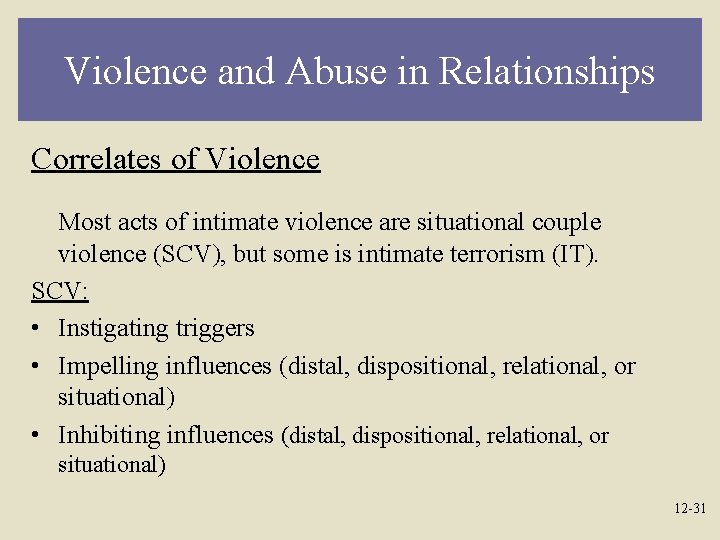
Violence and Abuse in Relationships Correlates of Violence Most acts of intimate violence are situational couple violence (SCV), but some is intimate terrorism (IT). SCV: • Instigating triggers • Impelling influences (distal, dispositional, relational, or situational) • Inhibiting influences (distal, dispositional, relational, or situational) 12 -31
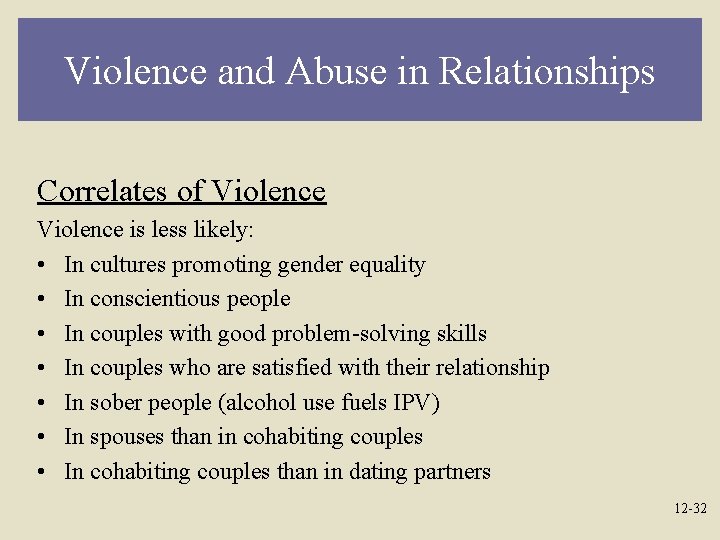
Violence and Abuse in Relationships Correlates of Violence is less likely: • In cultures promoting gender equality • In conscientious people • In couples with good problem-solving skills • In couples who are satisfied with their relationship • In sober people (alcohol use fuels IPV) • In spouses than in cohabiting couples • In cohabiting couples than in dating partners 12 -32
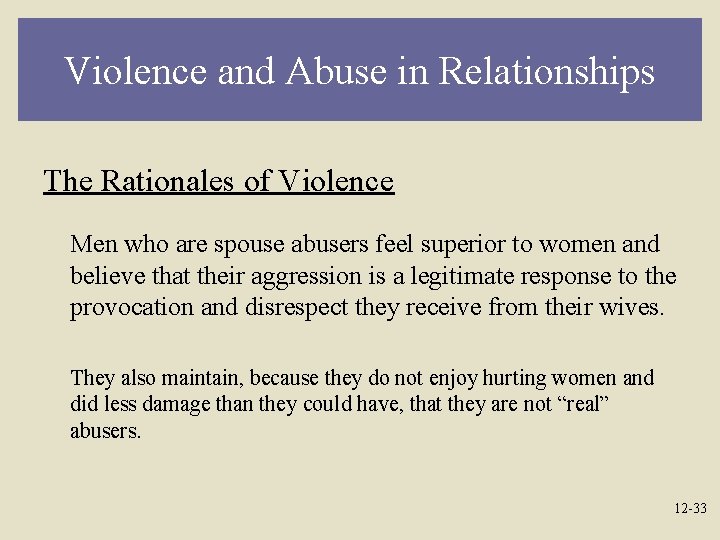
Violence and Abuse in Relationships The Rationales of Violence Men who are spouse abusers feel superior to women and believe that their aggression is a legitimate response to the provocation and disrespect they receive from their wives. They also maintain, because they do not enjoy hurting women and did less damage than they could have, that they are not “real” abusers. 12 -33
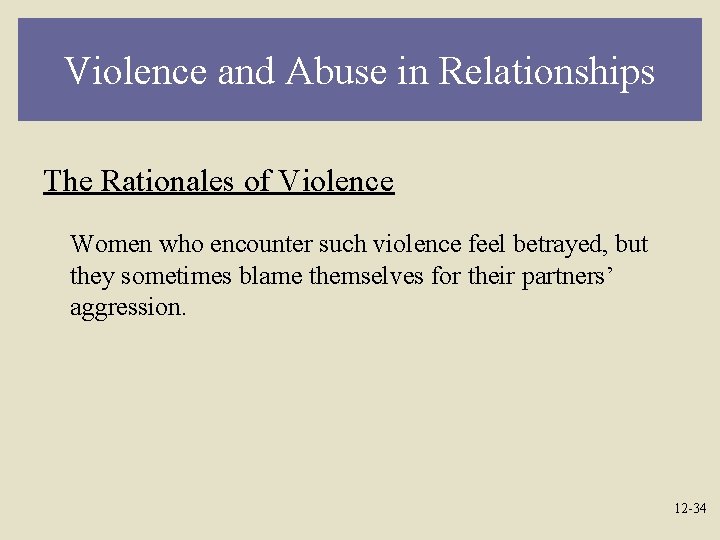
Violence and Abuse in Relationships The Rationales of Violence Women who encounter such violence feel betrayed, but they sometimes blame themselves for their partners’ aggression. 12 -34
Violence and Abuse in Relationships Why Don’t They All Leave? Most battered women either end the violence or leave their partners. However, about a third stay. They believe that, despite the abuse, they will not be better off if they go… …perhaps because they have no money and no place to go, or because they fear even greater violence if they leave. 12 -35
For Your Consideration During their first year of marriage, Britni and Jonathon fell into a patter in which he balanced the checkbook and paid all their bills each month. She was still a senior in college and didn’t have a job, but he was working and earning enough money to live on each month if they were careful. He took pride in his prudent management of money, but both of them were glad when she graduated and got a great job that actually paid her a little more than Jonathon’s did. He was surprised, however, when she announced that she wanted to maintain her own checking and savings accounts. She suggested that they each put half their earnings into a joint account that would pay the bills and then keep the rest of their money for their own use. He was hurt that she did not want to merge their monies and join financial forces, and he was annoyed when he realized that, if they each kept half their money, she would have a lot more money that he would in a few years. But she argued that she wanted to be allowed to do what she wanted with her extra earnings, spending or investing them as she saw fit, and she thought that separate accounts would actually avoid disagreements and conflict. What do you think the future holds for Britni and Jonathon? Why? 12 -36