
Academy on Violence Abuse Biennial Scientific Assembly April
Academy on Violence & Abuse Biennial Scientific Assembly April 19 -20, Minneapolis MN THE ROLE OF POVERTY UPON THE RELATIONSHIP BETWEEN PARTNER VIOLENCE & DEPRESSION Catherine Kothari MA Western Michigan University, School of Medicine Coauthors: Michael Liepman MD 1, Ruqiya Tareen MD 1, Luz Carmen Sweezy MPA 2, Phyllis Florian 3, Remitha M. Charoth 1, Suzanne Haas 1, Joseph Mc. Kean Ph. D 4, Angela Moe Ph. D 4, Amy Curtis. Ph. D MPH 4 1 Western Michigan School of Medicine 2 Kalamazoo County Health & Community Services 3 Michigan School of Professional Psychology 4 Western Michigan University
Introduction • Intimate partner violence (IPV) and depression are strongly linked 1 • Poverty is correlated to both 2 • Poverty has been under-examined as a primary variable of interest Wu, Q. , Hong-Lin, C. , Xu-Juan, Xu. (2012). Violence as a risk-factor for postpartum depression in mothers: A meta-analysis. Archives of Women’s mental Health. 15, 107. 2 Goodman, L. A. , Smyth, K. F. , Borges, A. M. , Singer, R. (2009) When crises collide: How intimate partner violence and poverty intersect to shape women’s mental health and coping? Trauma, Violence, & Abuse. 10, 306. 1
Review of Literature • Abuse by an intimate partner affects more than 1 in 3 women (35. 6%)3 • Abuse exacts a heavy physical and mental health toll 4 • 47. 6% victims experience depression 5 Black MC, Basile KC, Breiding MJ, Smith SG, Walters ML, Meririck MT, Chen J, & Stevens MR. (2011). The National Intimate Partner and Sexual Violence Survey: 2010 Summary Report. Atlanta GA: National Center for Injury Prevention and Control, Centers for Disease Control and Prevention. 4 Bonomi AE, Anderson ML, Reid RJ, Rivara FP, Carrell D & Thompson RS. 2009. . Medical and Psychosocial Diagnoses in Women with a History of Intiamte Partner Violence. Archives of Internal Medicine. 169 (18), 1692. 5 Golding, J. M. (1999) Intimate partner violence as a risk factor for mental disorders: A meta-analysis. Journal of Family Violence. 14 (2), 99. 3
Review of Literature • Poverty is a documented risk factor for partner abuse and for depression 6 • Perinatality increases vulnerability to IPV, depression and poverty 7 6 Beydoun, H. A. , Al-Sahab, B. , Beydoun, M. A. , Tamim, H. (2010) Intimate partner violence as a risk factor for postpartum depression among Canadian women in the maternity experience survey. Annals of Epidemiology, 20, 575. 7 Haas, J. S. , Jackson, R. A. , Fuentes-Afflick, E. , Stewart, A. L. , Dean, M. L. , Brawarsky, P. , Escobar, G. J. (2004) Changes in the health status of women during and after pregnancy. Journal of General Internal Medicine. 20. 45.
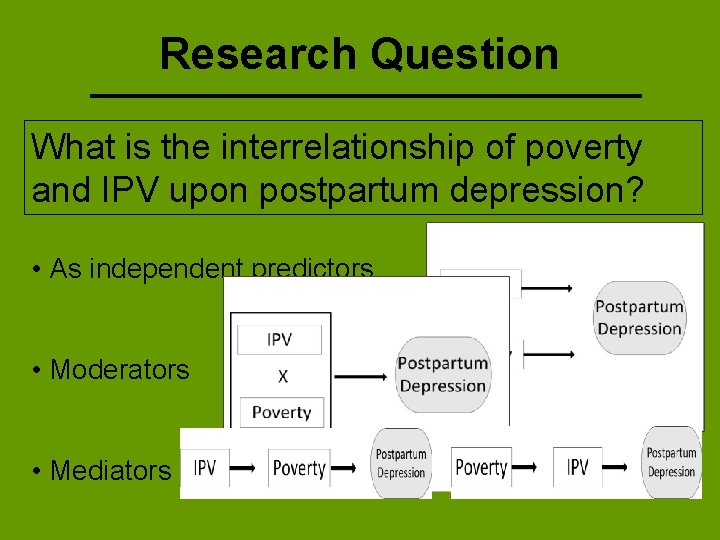
Research Question What is the interrelationship of poverty and IPV upon postpartum depression? • As independent predictors • Moderators • Mediators

Design • Secondary Data Analysis • Cross-sectional design • Phone survey interview • Birth record review • Kalamazoo County, Michigan • January, 2009 – May, 2009
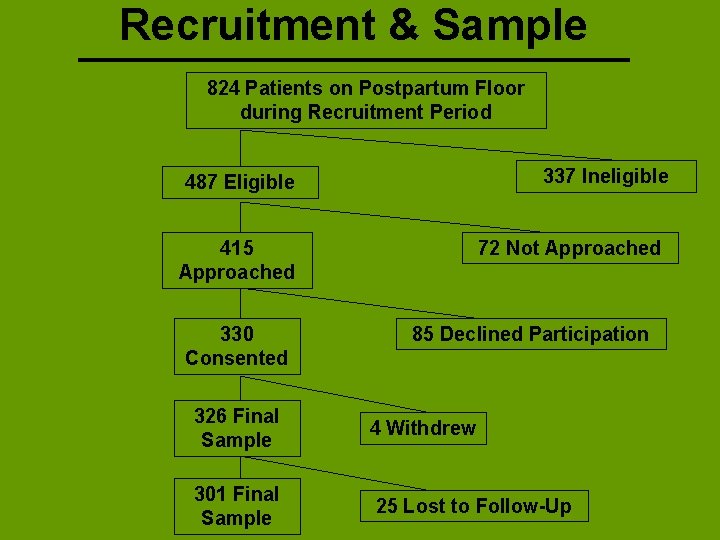
Recruitment & Sample 824 Patients on Postpartum Floor during Recruitment Period 337 Ineligible 487 Eligible 415 Approached 330 Consented 326 Final Sample 301 Final Sample 72 Not Approached 85 Declined Participation 4 Withdrew 25 Lost to Follow-Up
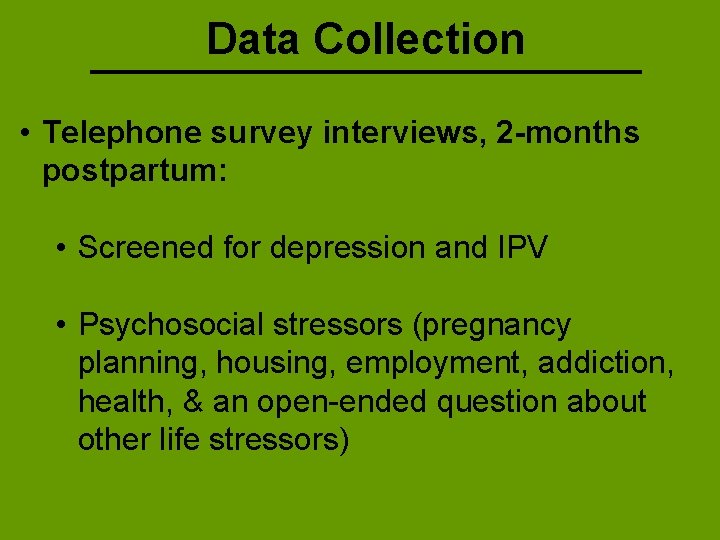
Data Collection • Telephone survey interviews, 2 -months postpartum: • Screened for depression and IPV • Psychosocial stressors (pregnancy planning, housing, employment, addiction, health, & an open-ended question about other life stressors)
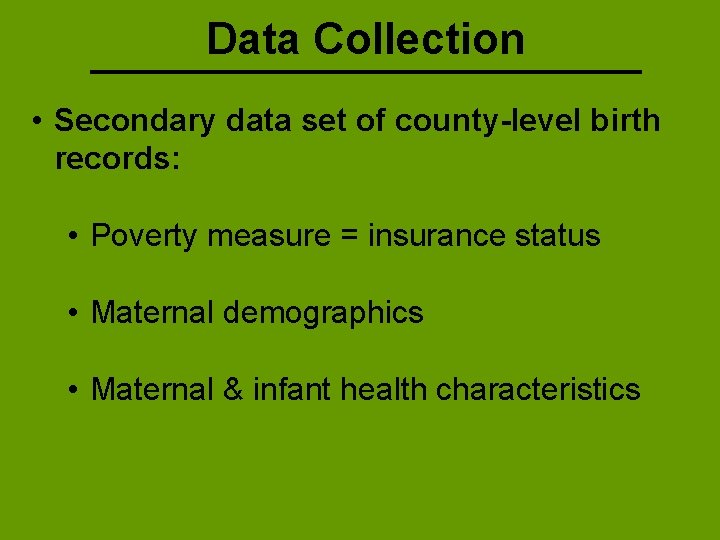
Data Collection • Secondary data set of county-level birth records: • Poverty measure = insurance status • Maternal demographics • Maternal & infant health characteristics
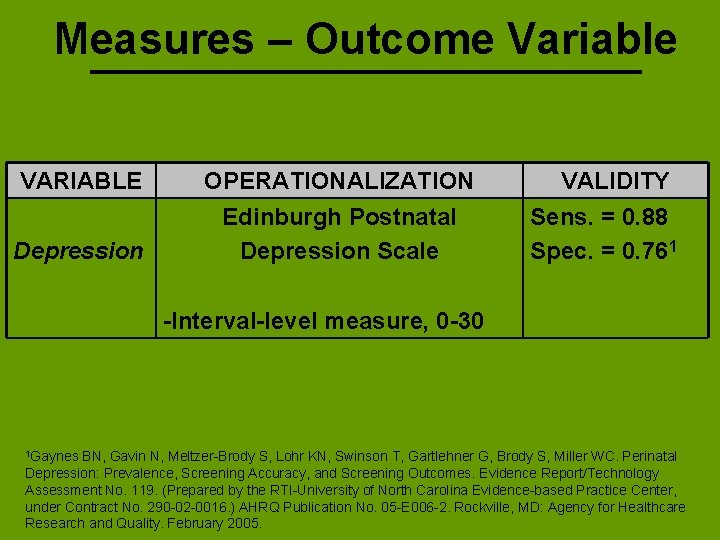
Measures – Outcome Variable VARIABLE Depression OPERATIONALIZATION Edinburgh Postnatal Depression Scale VALIDITY Sens. = 0. 88 Spec. = 0. 761 -Interval-level measure, 0 -30 1 Gaynes BN, Gavin N, Meltzer-Brody S, Lohr KN, Swinson T, Gartlehner G, Brody S, Miller WC. Perinatal Depression: Prevalence, Screening Accuracy, and Screening Outcomes. Evidence Report/Technology Assessment No. 119. (Prepared by the RTI-University of North Carolina Evidence-based Practice Center, under Contract No. 290 -02 -0016. ) AHRQ Publication No. 05 -E 006 -2. Rockville, MD: Agency for Healthcare Research and Quality. February 2005.
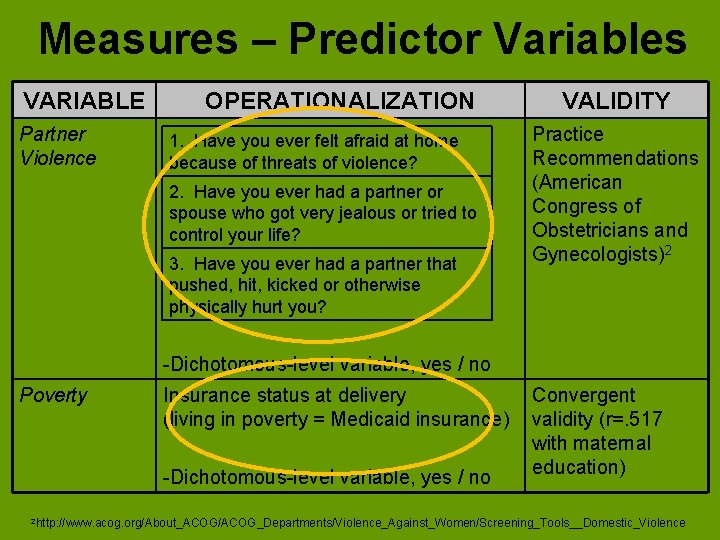
Measures – Predictor Variables VARIABLE Partner Violence OPERATIONALIZATION 1. Have you ever felt afraid at home because of threats of violence? 2. Have you ever had a partner or spouse who got very jealous or tried to control your life? 3. Have you ever had a partner that pushed, hit, kicked or otherwise physically hurt you? VALIDITY Practice Recommendations (American Congress of Obstetricians and Gynecologists)2 -Dichotomous-level variable, yes / no Poverty Insurance status at delivery (living in poverty = Medicaid insurance) -Dichotomous-level variable, yes / no Convergent validity (r=. 517 with maternal education) 2 http: //www. acog. org/About_ACOG/ACOG_Departments/Violence_Against_Women/Screening_Tools__Domestic_Violence
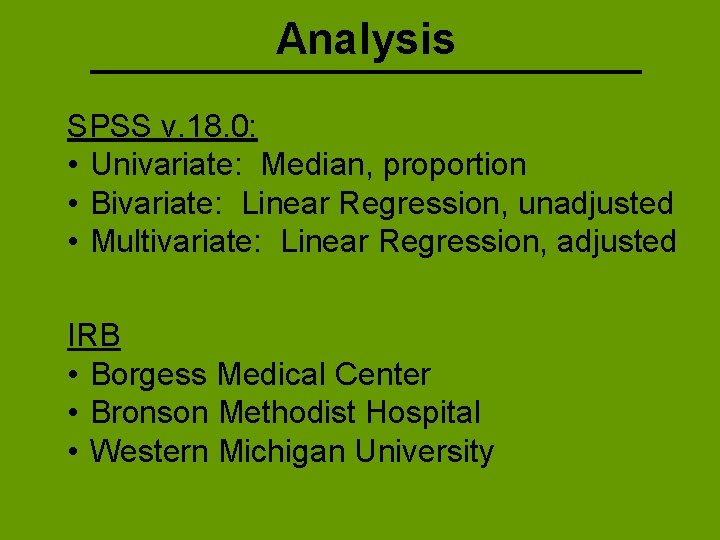
Analysis SPSS v. 18. 0: • Univariate: Median, proportion • Bivariate: Linear Regression, unadjusted • Multivariate: Linear Regression, adjusted IRB • Borgess Medical Center • Bronson Methodist Hospital • Western Michigan University
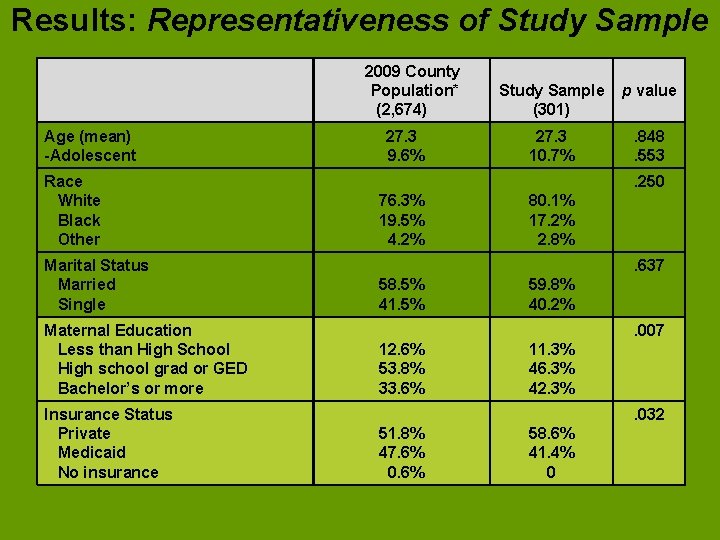
Results: Representativeness of Study Sample 2009 County Population* (2, 674) Age (mean) -Adolescent Race White Black Other Marital Status Married Single Maternal Education Less than High School High school grad or GED Bachelor’s or more Insurance Status Private Medicaid No insurance 27. 3 9. 6% Study Sample (301) p value 27. 3 10. 7% . 848. 553. 250 76. 3% 19. 5% 4. 2% 80. 1% 17. 2% 2. 8%. 637 58. 5% 41. 5% 59. 8% 40. 2%. 007 12. 6% 53. 8% 33. 6% 11. 3% 46. 3% 42. 3%. 032 51. 8% 47. 6% 0. 6% 58. 6% 41. 4% 0
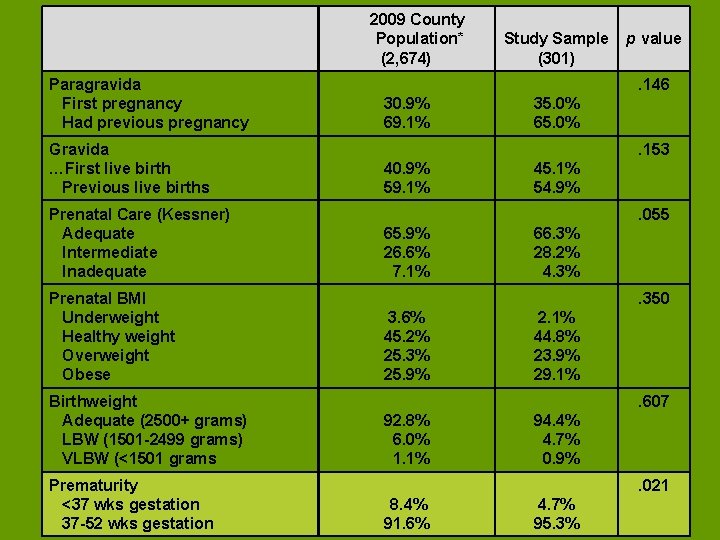
2009 County Population* (2, 674) Paragravida First pregnancy Had previous pregnancy Gravida …First live birth Previous live births Prenatal Care (Kessner) Adequate Intermediate Inadequate Prenatal BMI Underweight Healthy weight Overweight Obese Birthweight Adequate (2500+ grams) LBW (1501 -2499 grams) VLBW (<1501 grams Prematurity <37 wks gestation 37 -52 wks gestation Study Sample (301) p value. 146 30. 9% 69. 1% 35. 0% 65. 0%. 153 40. 9% 59. 1% 45. 1% 54. 9%. 055 65. 9% 26. 6% 7. 1% 66. 3% 28. 2% 4. 3%. 350 3. 6% 45. 2% 25. 3% 25. 9% 2. 1% 44. 8% 23. 9% 29. 1%. 607 92. 8% 6. 0% 1. 1% 94. 4% 4. 7% 0. 9%. 021 8. 4% 91. 6% 4. 7% 95. 3%
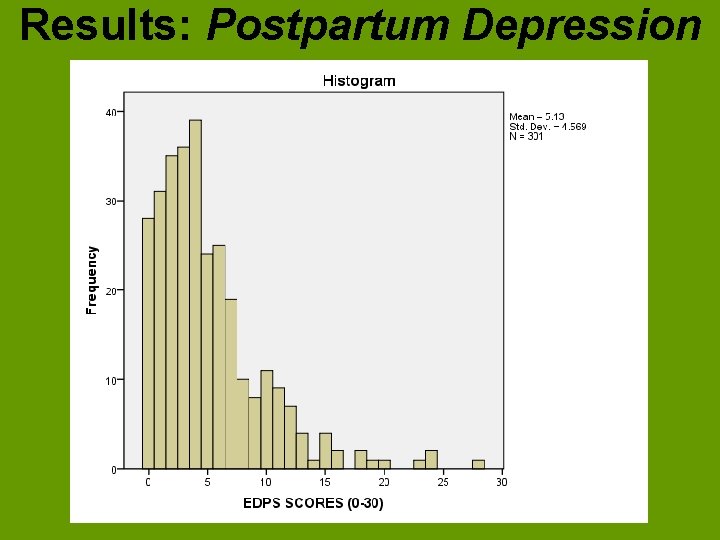
Results: Postpartum Depression
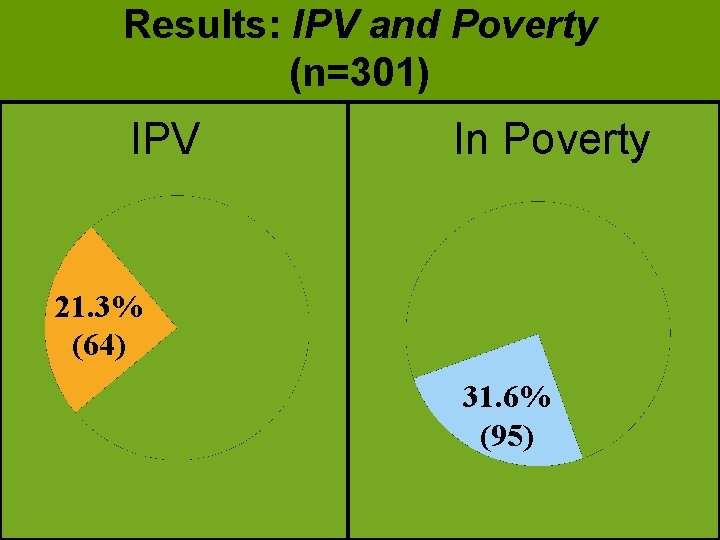
Results: IPV and Poverty (n=301) IPV In Poverty 21. 3% (64) 31. 6% (95)
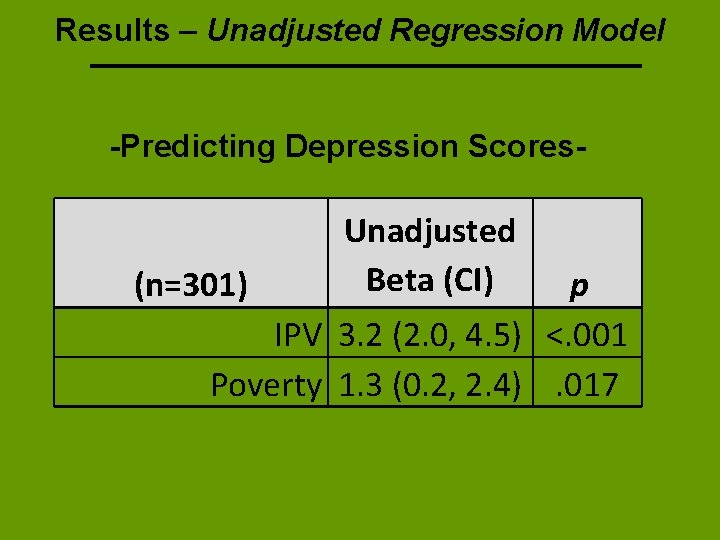
Results – Unadjusted Regression Model -Predicting Depression Scores- Unadjusted Beta (CI) p IPV 3. 2 (2. 0, 4. 5) <. 001 Poverty 1. 3 (0. 2, 2. 4). 017 (n=301)
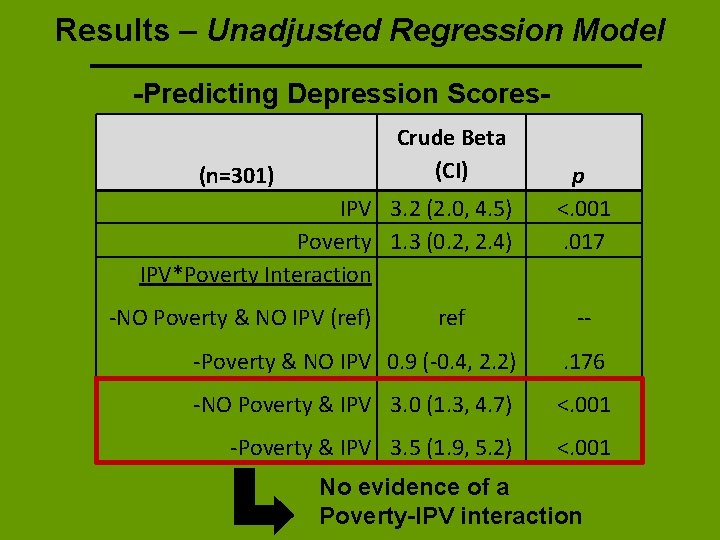
Results – Unadjusted Regression Model -Predicting Depression Scores. Crude Beta (CI) (n=301) IPV 3. 2 (2. 0, 4. 5) Poverty 1. 3 (0. 2, 2. 4) IPV*Poverty Interaction -NO Poverty & NO IPV (ref) ref p <. 001. 017 -- -Poverty & NO IPV 0. 9 (-0. 4, 2. 2) . 176 -NO Poverty & IPV 3. 0 (1. 3, 4. 7) <. 001 -Poverty & IPV 3. 5 (1. 9, 5. 2) <. 001 No evidence of a Poverty-IPV interaction
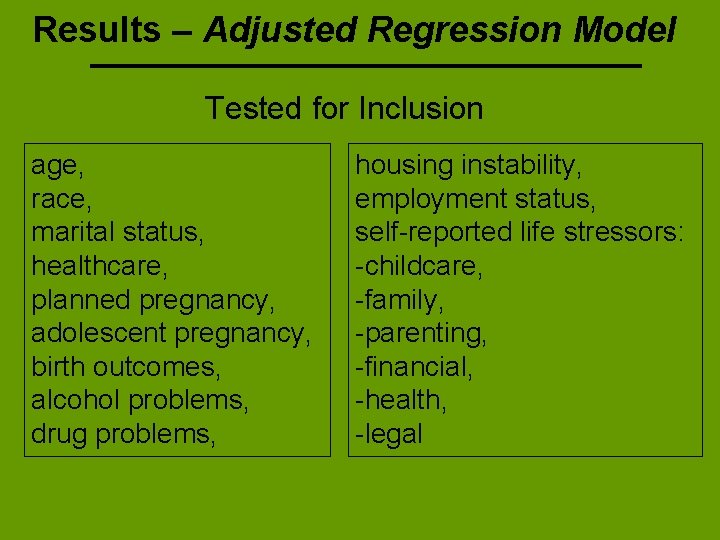
Results – Adjusted Regression Model Tested for Inclusion age, race, marital status, healthcare, planned pregnancy, adolescent pregnancy, birth outcomes, alcohol problems, drug problems, housing instability, employment status, self-reported life stressors: -childcare, -family, -parenting, -financial, -health, -legal
Results – Adjusted Regression Model Tested for Inclusion age, race, marital status, healthcare, planned pregnancy, adolescent pregnancy, birth outcomes, alcohol problems, drug problems, housing instability, employment status, self-reported life stressors: -childcare, -family, -parenting, -financial, -health, -legal
Results – Adjusted Regression Model Tested for Inclusion age, race, marital status, healthcare, planned pregnancy, adolescent pregnancy, birth outcomes, alcohol problems, drug problems, housing instability, employment status, self-reported life stressors: -childcare, -family, -parenting, -financial, -health, -legal
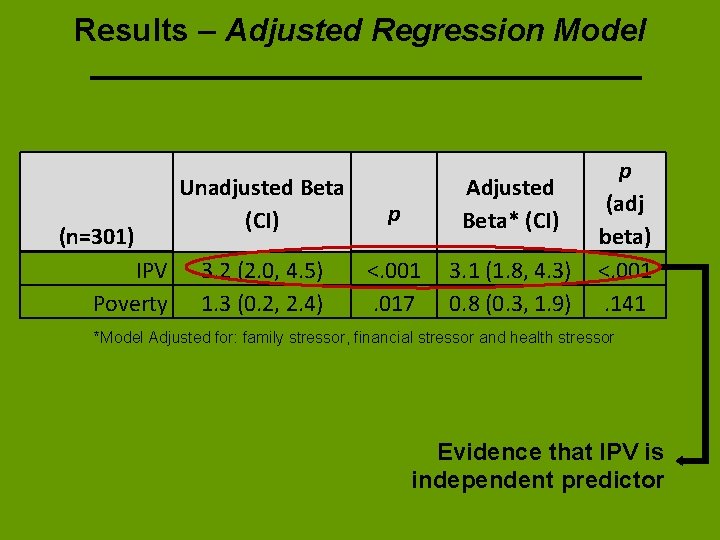
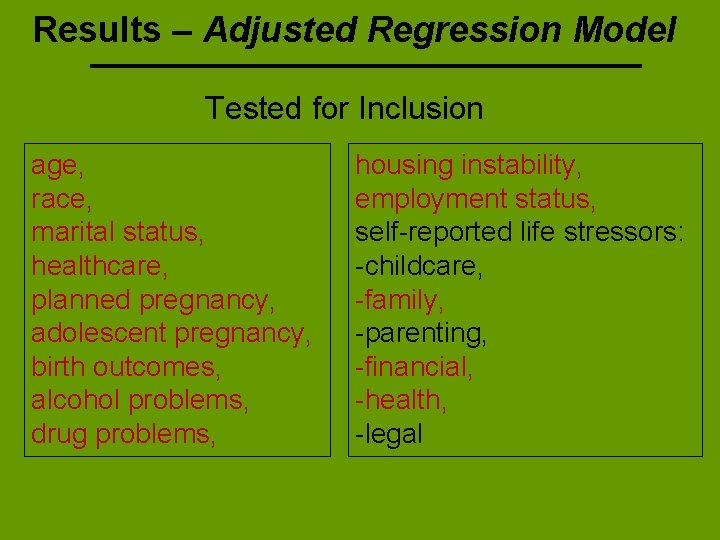
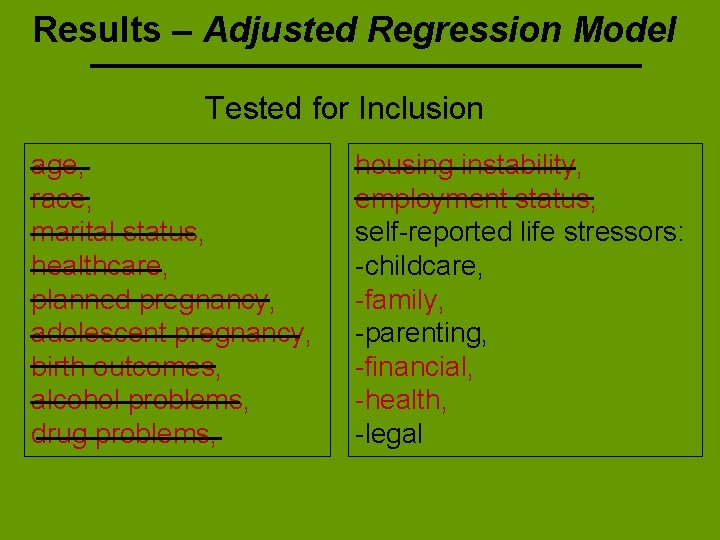
Results – Adjusted Regression Model (n=301) IPV Poverty Unadjusted Beta (CI) p Adjusted Beta* (CI) 3. 2 (2. 0, 4. 5) 1. 3 (0. 2, 2. 4) <. 001. 017 3. 1 (1. 8, 4. 3) 0. 8 (0. 3, 1. 9) p (adj beta) <. 001. 141 *Model Adjusted for: family stressor, financial stressor and health stressor Evidence that IPV is independent predictor
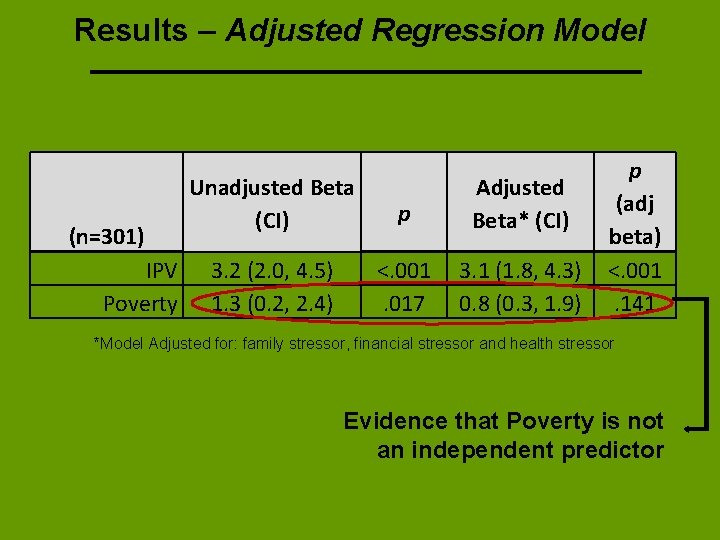
Results – Adjusted Regression Model (n=301) IPV Poverty Unadjusted Beta (CI) p Adjusted Beta* (CI) 3. 2 (2. 0, 4. 5) 1. 3 (0. 2, 2. 4) <. 001. 017 3. 1 (1. 8, 4. 3) 0. 8 (0. 3, 1. 9) p (adj beta) <. 001. 141 *Model Adjusted for: family stressor, financial stressor and health stressor Evidence that Poverty is not an independent predictor
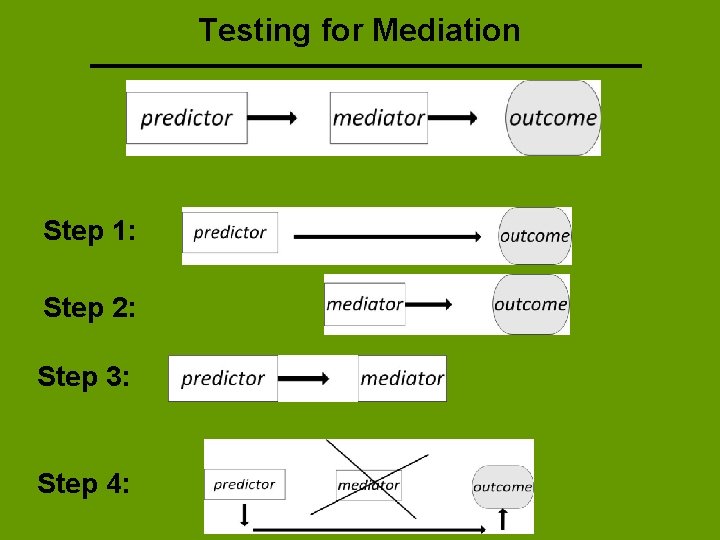
Testing for Mediation Step 1: Step 2: Step 3: Step 4:
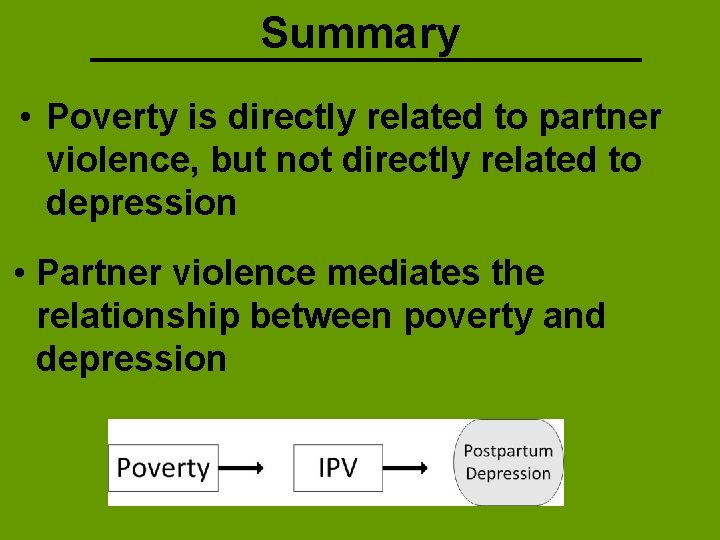
Summary • Poverty is directly related to partner violence, but not directly related to depression • Partner violence mediates the relationship between poverty and depression
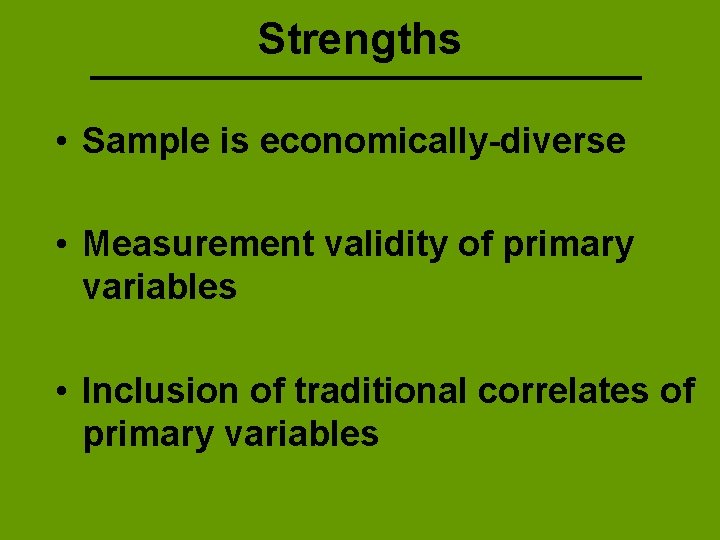
Strengths • Sample is economically-diverse • Measurement validity of primary variables • Inclusion of traditional correlates of primary variables
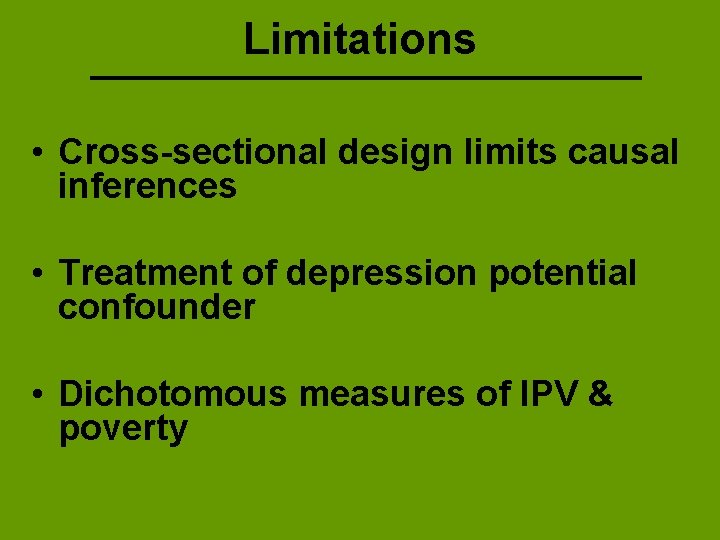
Limitations • Cross-sectional design limits causal inferences • Treatment of depression potential confounder • Dichotomous measures of IPV & poverty
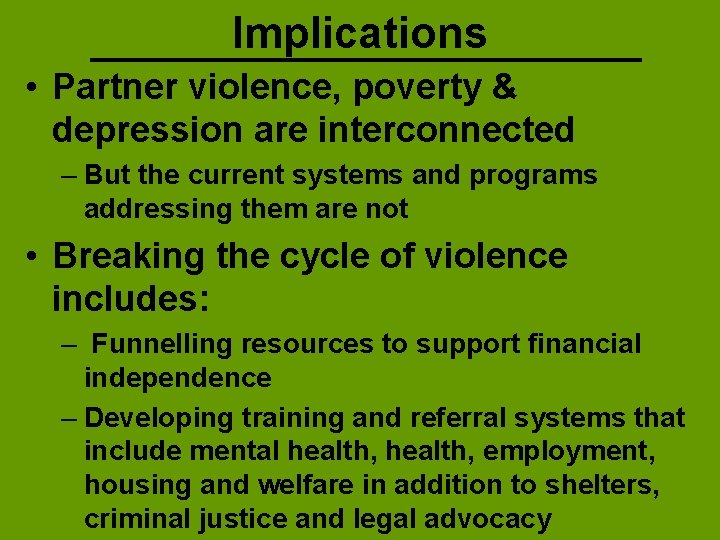
Implications • Partner violence, poverty & depression are interconnected – But the current systems and programs addressing them are not • Breaking the cycle of violence includes: – Funnelling resources to support financial independence – Developing training and referral systems that include mental health, employment, housing and welfare in addition to shelters, criminal justice and legal advocacy
THANK YOU Catherine Kothari WMU, School of Medicine catherine. kothari@med. wmich. edu (269) 501 -4149 QUESTIONS ?
- Slides: 29