Chapter 11 1 CHAPTER 11 DEPRECIATION IMPAIRMENTS AND



- Slides: 57
Chapter 11 -1
CHAPTER 11 DEPRECIATION, IMPAIRMENTS, AND DEPLETION Intermediate Accounting 13 th Edition Kieso, Weygandt, and Warfield Chapter 11 -2
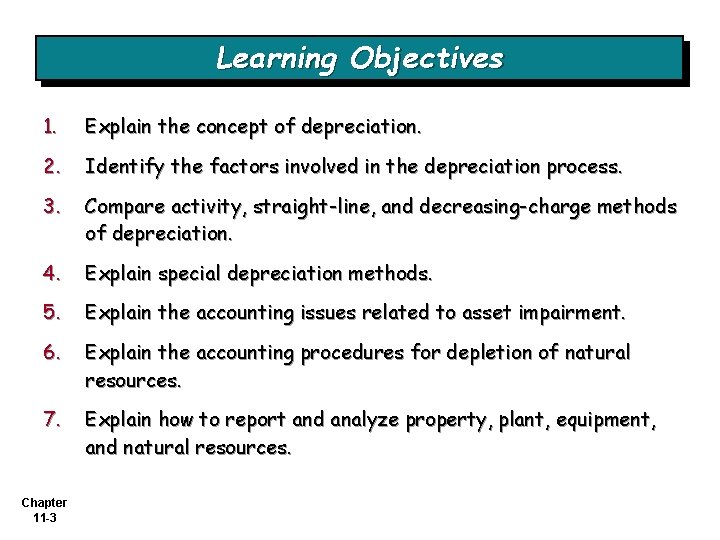
Learning Objectives 1. Explain the concept of depreciation. 2. Identify the factors involved in the depreciation process. 3. Compare activity, straight-line, and decreasing-charge methods of depreciation. 4. Explain special depreciation methods. 5. Explain the accounting issues related to asset impairment. 6. Explain the accounting procedures for depletion of natural resources. 7. Explain how to report and analyze property, plant, equipment, and natural resources. Chapter 11 -3
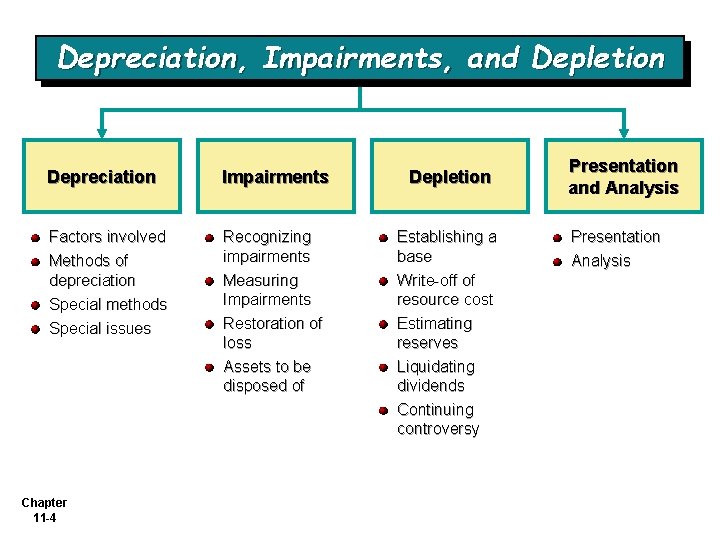
Depreciation, Impairments, and Depletion Depreciation Impairments Depletion Factors involved Methods of depreciation Special methods Recognizing impairments Measuring Impairments Restoration of loss Assets to be disposed of Establishing a base Write-off of resource cost Estimating reserves Liquidating dividends Continuing controversy Special issues Chapter 11 -4 Presentation and Analysis Presentation Analysis
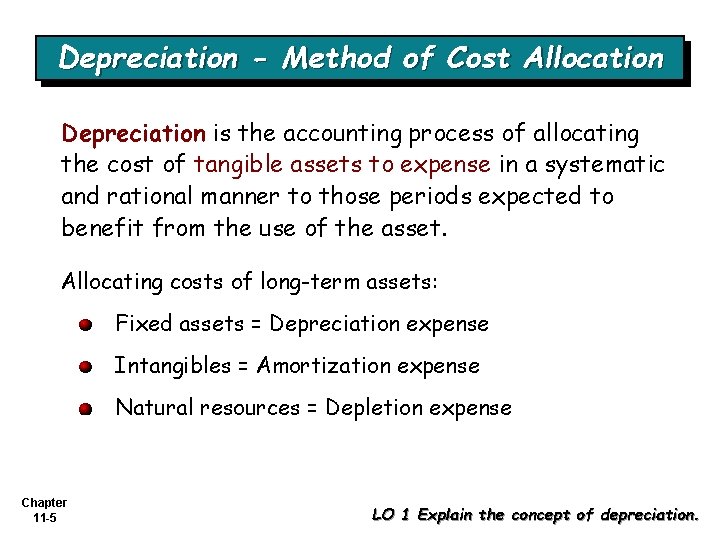
Depreciation - Method of Cost Allocation Depreciation is the accounting process of allocating the cost of tangible assets to expense in a systematic and rational manner to those periods expected to benefit from the use of the asset. Allocating costs of long-term assets: Fixed assets = Depreciation expense Intangibles = Amortization expense Natural resources = Depletion expense Chapter 11 -5 LO 1 Explain the concept of depreciation.
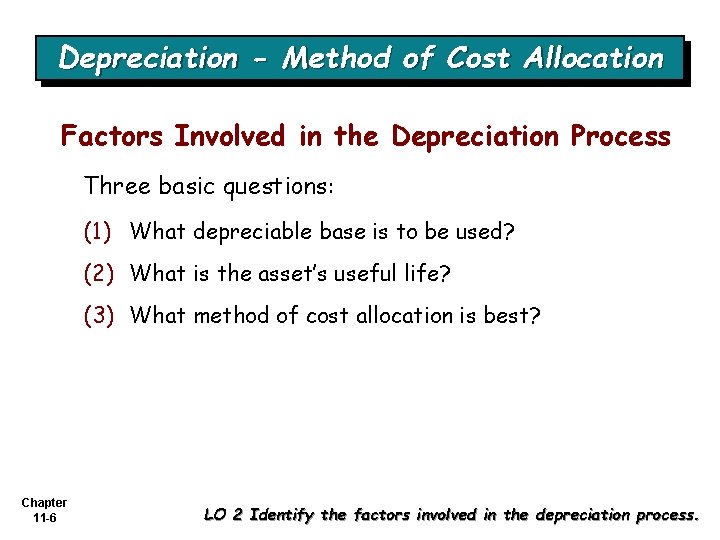
Depreciation - Method of Cost Allocation Factors Involved in the Depreciation Process Three basic questions: (1) What depreciable base is to be used? (2) What is the asset’s useful life? (3) What method of cost allocation is best? Chapter 11 -6 LO 2 Identify the factors involved in the depreciation process.
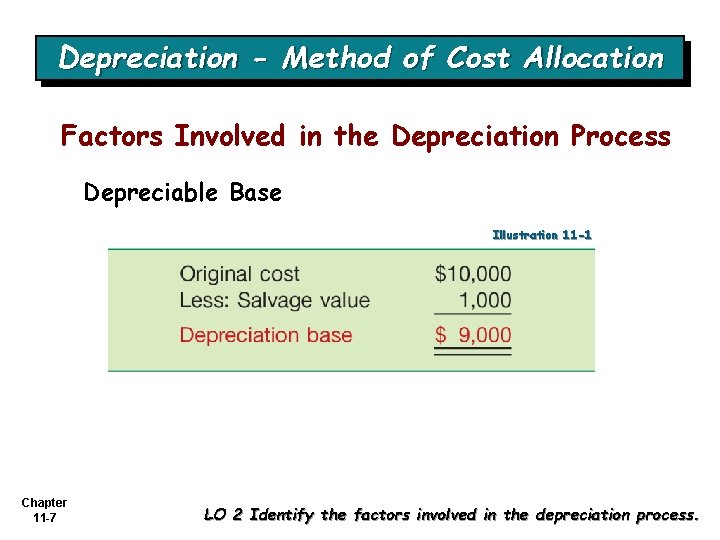
Depreciation - Method of Cost Allocation Factors Involved in the Depreciation Process Depreciable Base Illustration 11 -1 Chapter 11 -7 LO 2 Identify the factors involved in the depreciation process.
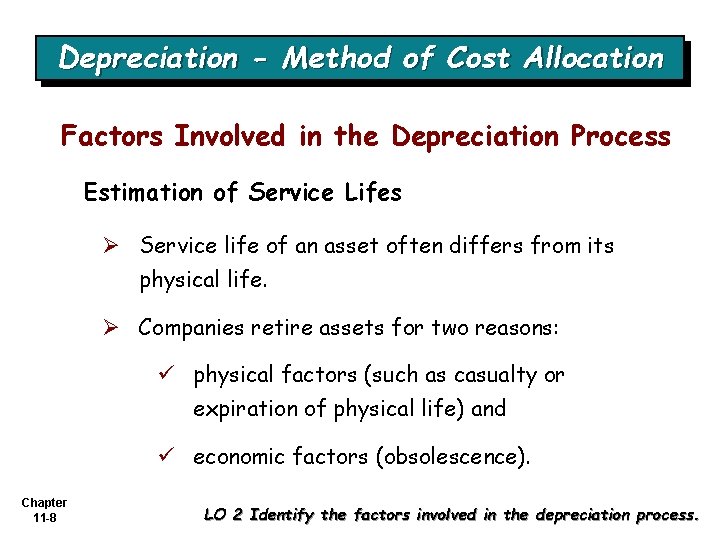
Depreciation - Method of Cost Allocation Factors Involved in the Depreciation Process Estimation of Service Lifes Ø Service life of an asset often differs from its physical life. Ø Companies retire assets for two reasons: ü physical factors (such as casualty or expiration of physical life) and ü economic factors (obsolescence). Chapter 11 -8 LO 2 Identify the factors involved in the depreciation process.
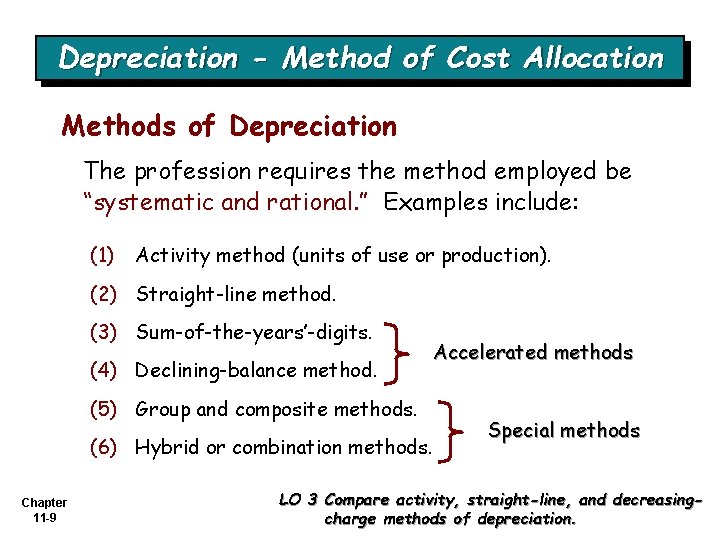
Depreciation - Method of Cost Allocation Methods of Depreciation The profession requires the method employed be “systematic and rational. ” Examples include: (1) Activity method (units of use or production). (2) Straight-line method. (3) Sum-of-the-years’-digits. (4) Declining-balance method. (5) Group and composite methods. (6) Hybrid or combination methods. Chapter 11 -9 Accelerated methods Special methods LO 3 Compare activity, straight-line, and decreasingcharge methods of depreciation.
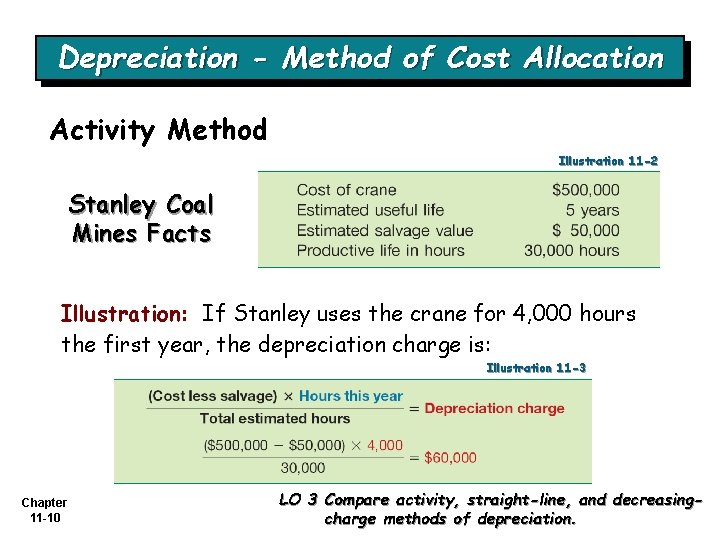
Depreciation - Method of Cost Allocation Activity Method Illustration 11 -2 Stanley Coal Mines Facts Illustration: If Stanley uses the crane for 4, 000 hours the first year, the depreciation charge is: Illustration 11 -3 Chapter 11 -10 LO 3 Compare activity, straight-line, and decreasingcharge methods of depreciation.
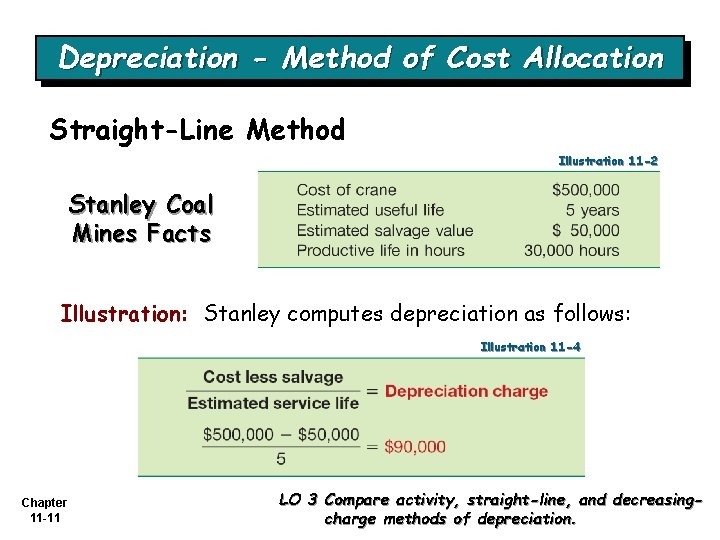
Depreciation - Method of Cost Allocation Straight-Line Method Illustration 11 -2 Stanley Coal Mines Facts Illustration: Stanley computes depreciation as follows: Illustration 11 -4 Chapter 11 -11 LO 3 Compare activity, straight-line, and decreasingcharge methods of depreciation.
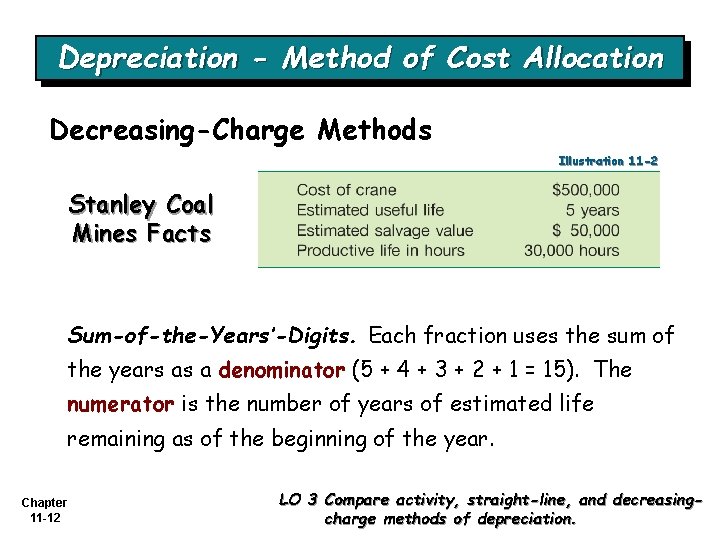
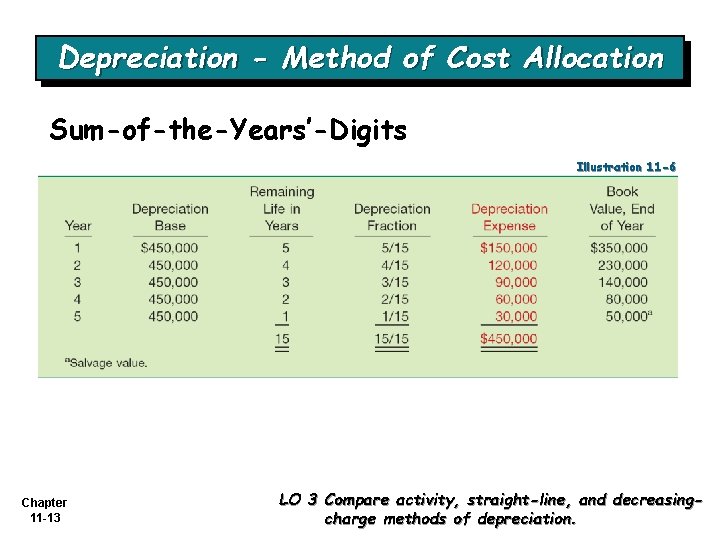
Depreciation - Method of Cost Allocation Decreasing-Charge Methods Illustration 11 -2 Stanley Coal Mines Facts Sum-of-the-Years’-Digits. Each fraction uses the sum of the years as a denominator (5 + 4 + 3 + 2 + 1 = 15). The numerator is the number of years of estimated life remaining as of the beginning of the year. Chapter 11 -12 LO 3 Compare activity, straight-line, and decreasingcharge methods of depreciation.
Depreciation - Method of Cost Allocation Sum-of-the-Years’-Digits Illustration 11 -6 Chapter 11 -13 LO 3 Compare activity, straight-line, and decreasingcharge methods of depreciation.
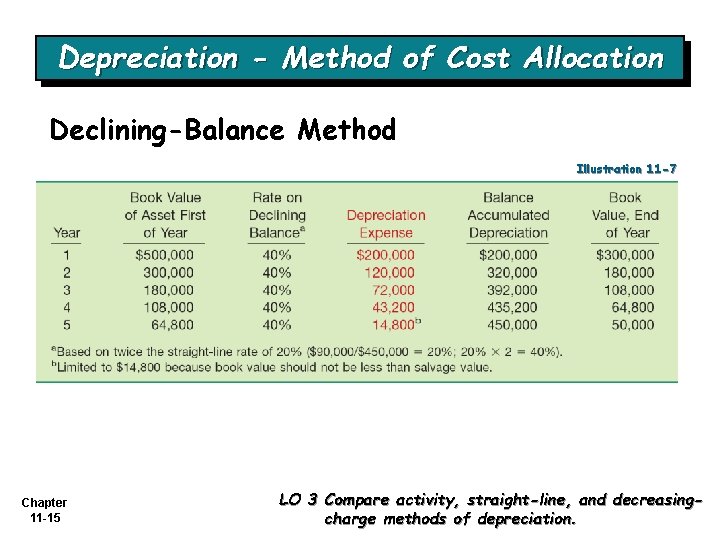
Depreciation - Method of Cost Allocation Decreasing-Charge Methods Illustration 11 -2 Stanley Coal Mines Facts Declining-Balance Method. Ø Utilizes a depreciation rate (percentage) that is some multiple of the straight-line method. Ø Does not deduct the salvage value in computing the depreciation base. Chapter 11 -14 LO 3 Compare activity, straight-line, and decreasingcharge methods of depreciation.
Depreciation - Method of Cost Allocation Declining-Balance Method Illustration 11 -7 Chapter 11 -15 LO 3 Compare activity, straight-line, and decreasingcharge methods of depreciation.
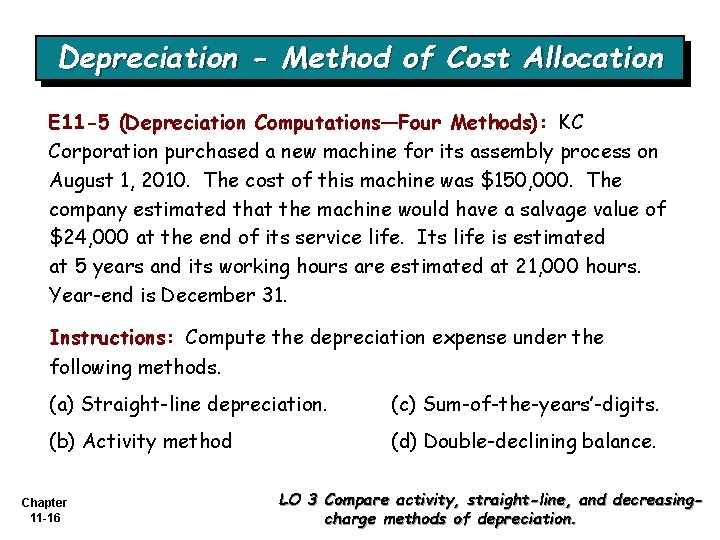
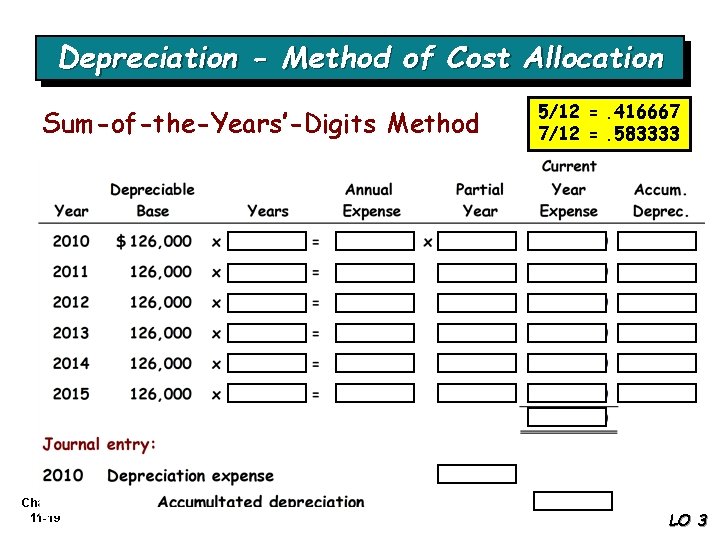
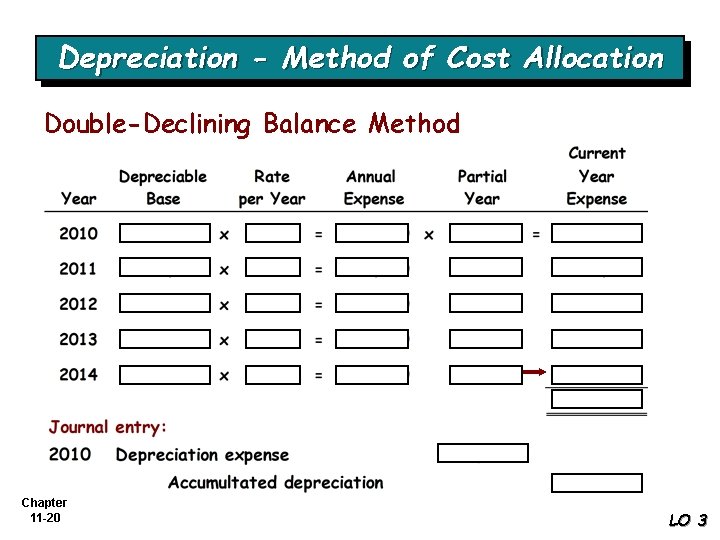
Depreciation - Method of Cost Allocation E 11 -5 (Depreciation Computations—Four Methods): KC Corporation purchased a new machine for its assembly process on August 1, 2010. The cost of this machine was $150, 000. The company estimated that the machine would have a salvage value of $24, 000 at the end of its service life. Its life is estimated at 5 years and its working hours are estimated at 21, 000 hours. Year-end is December 31. Instructions: Compute the depreciation expense under the following methods. (a) Straight-line depreciation. (c) Sum-of-the-years’-digits. (b) Activity method (d) Double-declining balance. Chapter 11 -16 LO 3 Compare activity, straight-line, and decreasingcharge methods of depreciation.
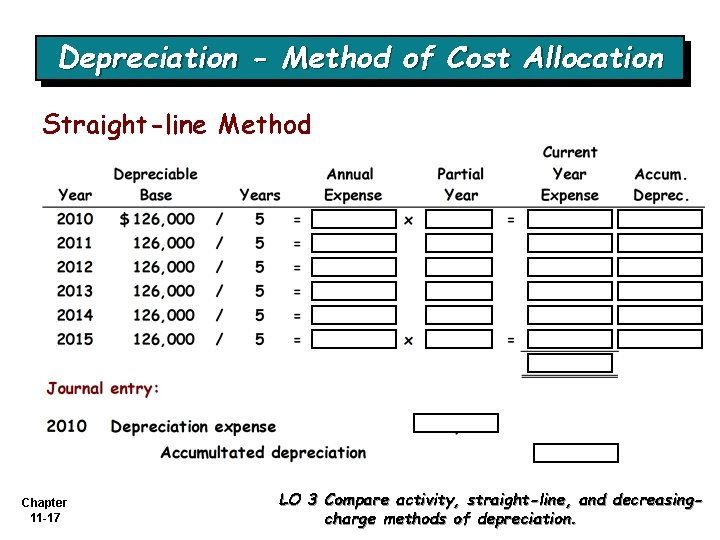
Depreciation - Method of Cost Allocation Straight-line Method Chapter 11 -17 LO 3 Compare activity, straight-line, and decreasingcharge methods of depreciation.
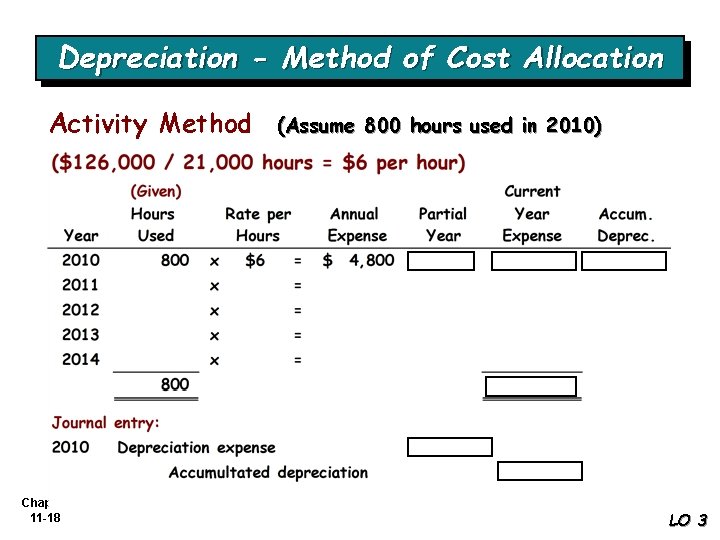
Depreciation - Method of Cost Allocation Activity Method Chapter 11 -18 (Assume 800 hours used in 2010) LO 3
Depreciation - Method of Cost Allocation Sum-of-the-Years’-Digits Method Chapter 11 -19 5/12 =. 416667 7/12 =. 583333 LO 3
Depreciation - Method of Cost Allocation Double-Declining Balance Method Chapter 11 -20 LO 3
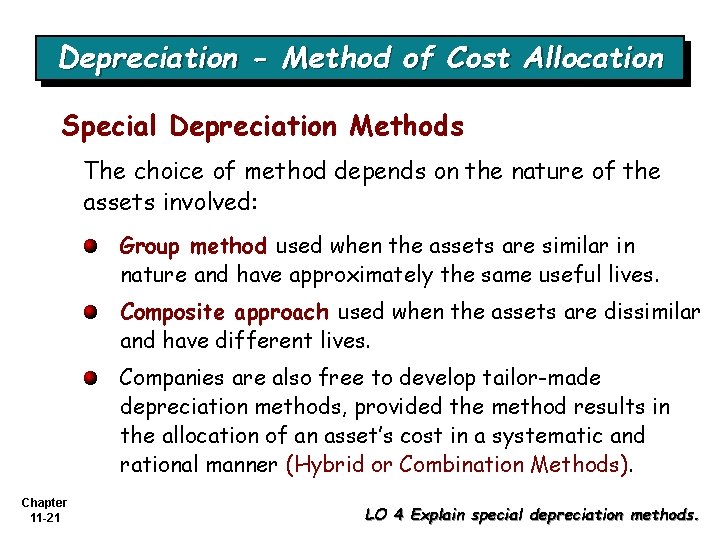
Depreciation - Method of Cost Allocation Special Depreciation Methods The choice of method depends on the nature of the assets involved: Group method used when the assets are similar in nature and have approximately the same useful lives. Composite approach used when the assets are dissimilar and have different lives. Companies are also free to develop tailor-made depreciation methods, provided the method results in the allocation of an asset’s cost in a systematic and rational manner (Hybrid or Combination Methods). Chapter 11 -21 LO 4 Explain special depreciation methods.
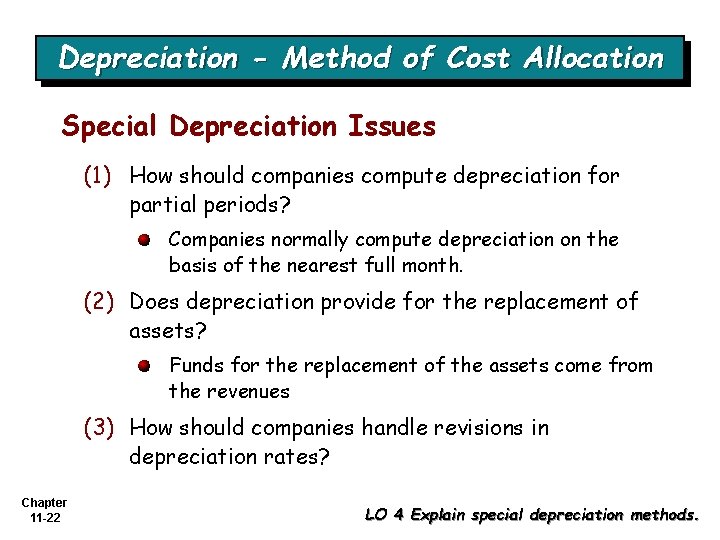
Depreciation - Method of Cost Allocation Special Depreciation Issues (1) How should companies compute depreciation for partial periods? Companies normally compute depreciation on the basis of the nearest full month. (2) Does depreciation provide for the replacement of assets? Funds for the replacement of the assets come from the revenues (3) How should companies handle revisions in depreciation rates? Chapter 11 -22 LO 4 Explain special depreciation methods.
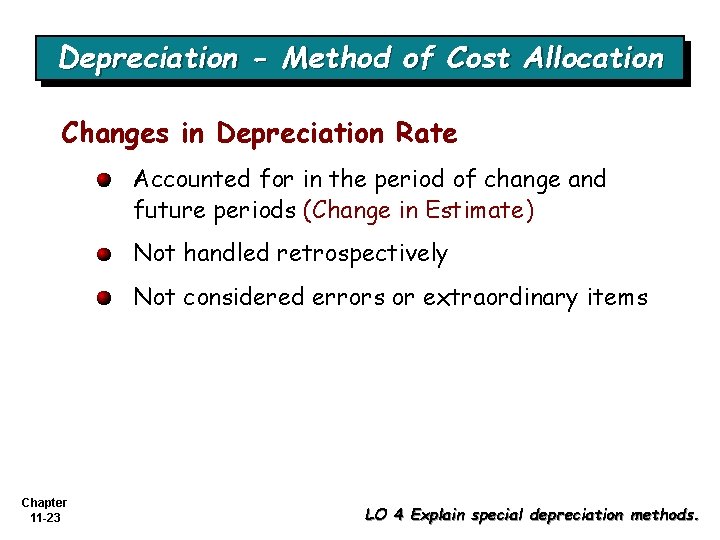
Depreciation - Method of Cost Allocation Changes in Depreciation Rate Accounted for in the period of change and future periods (Change in Estimate) Not handled retrospectively Not considered errors or extraordinary items Chapter 11 -23 LO 4 Explain special depreciation methods.
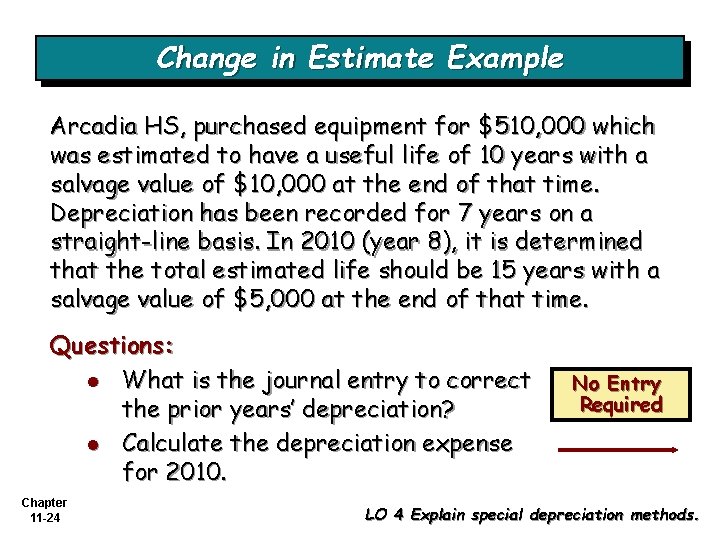
Change in Estimate Example Arcadia HS, purchased equipment for $510, 000 which was estimated to have a useful life of 10 years with a salvage value of $10, 000 at the end of that time. Depreciation has been recorded for 7 years on a straight-line basis. In 2010 (year 8), it is determined that the total estimated life should be 15 years with a salvage value of $5, 000 at the end of that time. Questions: l What is the journal entry to correct the prior years’ depreciation? l Calculate the depreciation expense for 2010. Chapter 11 -24 No Entry Required LO 4 Explain special depreciation methods.
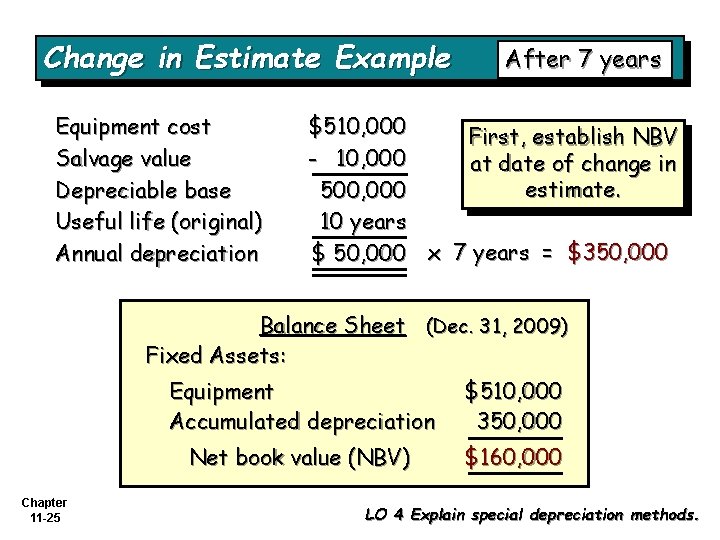
Change in Estimate Example Equipment cost Salvage value Depreciable base Useful life (original) Annual depreciation After 7 years $510, 000 First, establish NBV - 10, 000 at date of change in estimate. 500, 000 10 years $ 50, 000 x 7 years = $350, 000 Balance Sheet (Dec. 31, 2009) Fixed Assets: Chapter 11 -25 Equipment Accumulated depreciation $510, 000 350, 000 Net book value (NBV) $160, 000 LO 4 Explain special depreciation methods.
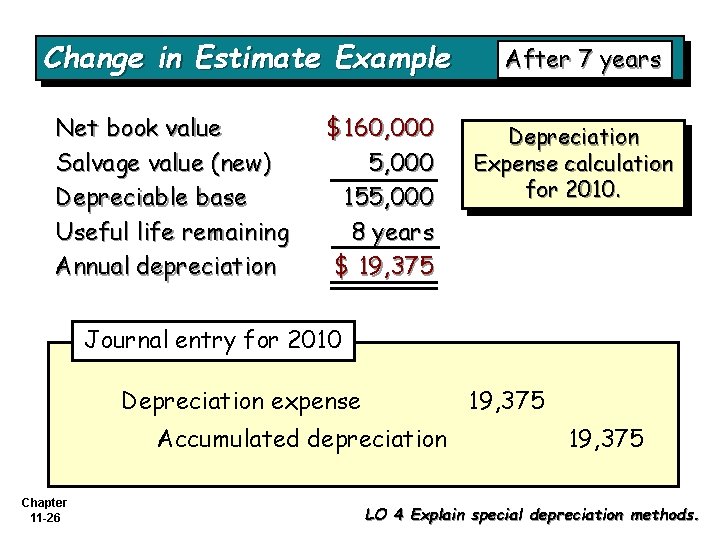
Change in Estimate Example Net book value Salvage value (new) Depreciable base Useful life remaining Annual depreciation $160, 000 5, 000 155, 000 8 years $ 19, 375 After 7 years Depreciation Expense calculation for 2010. Journal entry for 2010 Depreciation expense 19, 375 Accumulated depreciation Chapter 11 -26 19, 375 LO 4 Explain special depreciation methods.
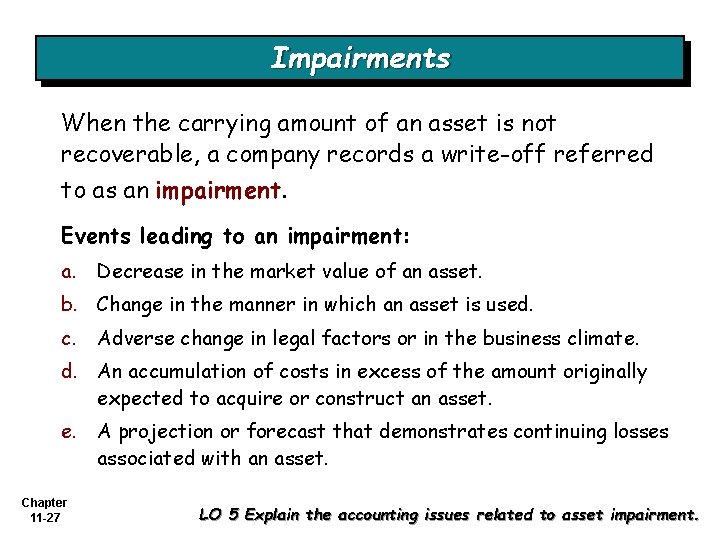
Impairments When the carrying amount of an asset is not recoverable, a company records a write-off referred to as an impairment. Events leading to an impairment: a. Decrease in the market value of an asset. b. Change in the manner in which an asset is used. c. Adverse change in legal factors or in the business climate. d. An accumulation of costs in excess of the amount originally expected to acquire or construct an asset. e. A projection or forecast that demonstrates continuing losses associated with an asset. Chapter 11 -27 LO 5 Explain the accounting issues related to asset impairment.
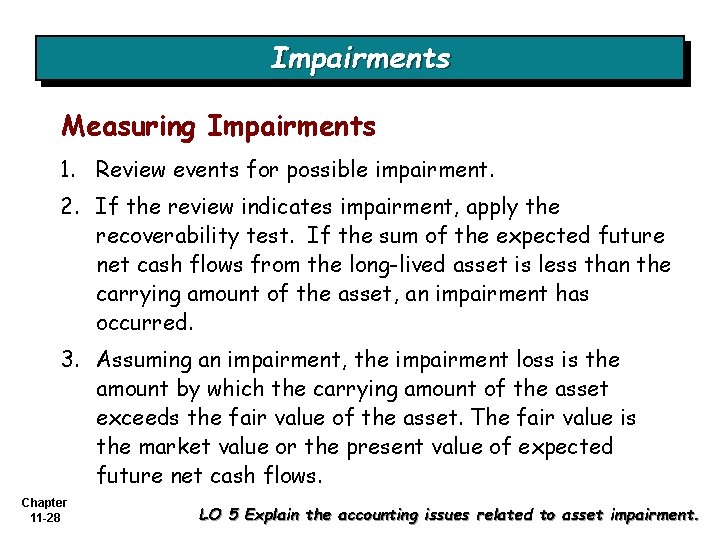
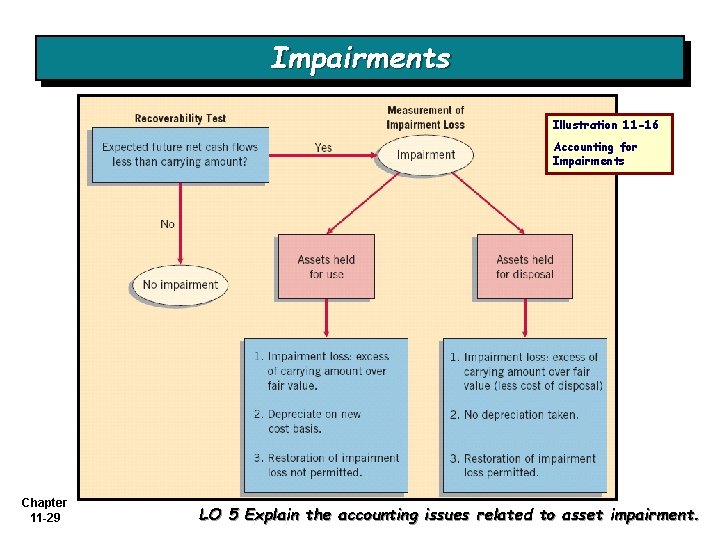
Impairments Measuring Impairments 1. Review events for possible impairment. 2. If the review indicates impairment, apply the recoverability test. If the sum of the expected future net cash flows from the long-lived asset is less than the carrying amount of the asset, an impairment has occurred. 3. Assuming an impairment, the impairment loss is the amount by which the carrying amount of the asset exceeds the fair value of the asset. The fair value is the market value or the present value of expected future net cash flows. Chapter 11 -28 LO 5 Explain the accounting issues related to asset impairment.
Impairments Illustration 11 -16 Accounting for Impairments Chapter 11 -29 LO 5 Explain the accounting issues related to asset impairment.
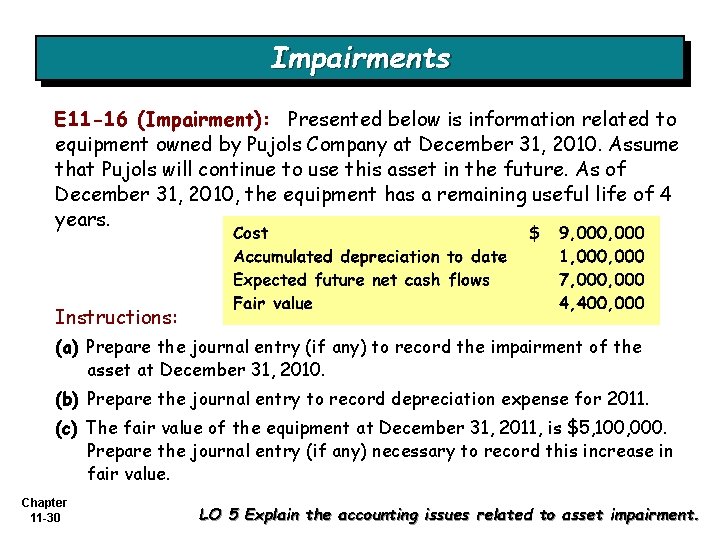
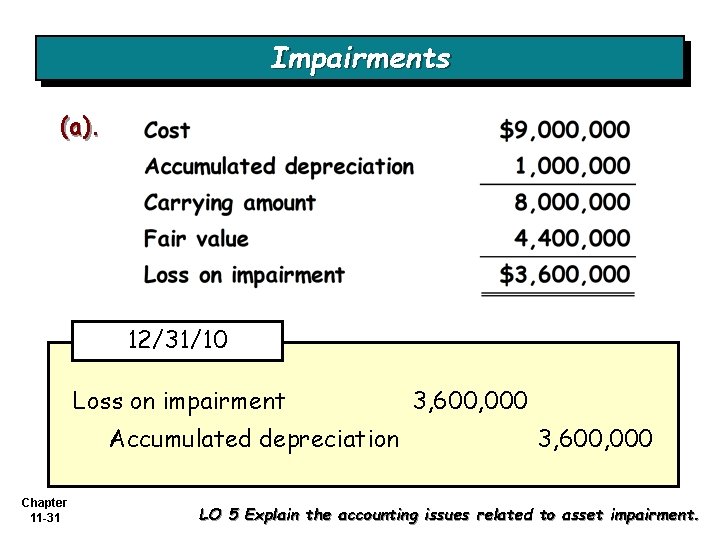
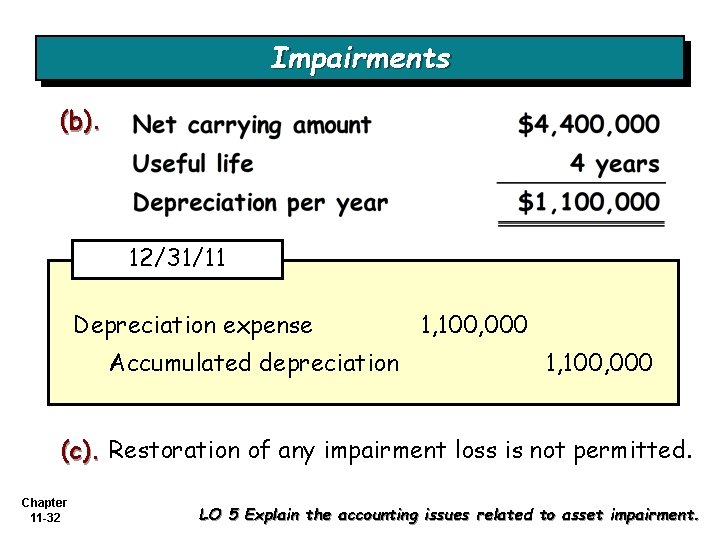
Impairments E 11 -16 (Impairment): Presented below is information related to equipment owned by Pujols Company at December 31, 2010. Assume that Pujols will continue to use this asset in the future. As of December 31, 2010, the equipment has a remaining useful life of 4 years. Instructions: (a) Prepare the journal entry (if any) to record the impairment of the asset at December 31, 2010. (b) Prepare the journal entry to record depreciation expense for 2011. (c) The fair value of the equipment at December 31, 2011, is $5, 100, 000. Prepare the journal entry (if any) necessary to record this increase in fair value. Chapter 11 -30 LO 5 Explain the accounting issues related to asset impairment.
Impairments (a). 12/31/10 Loss on impairment Accumulated depreciation Chapter 11 -31 3, 600, 000 LO 5 Explain the accounting issues related to asset impairment.
Impairments (b). 12/31/11 Depreciation expense Accumulated depreciation 1, 100, 000 (c). Restoration of any impairment loss is not permitted. Chapter 11 -32 LO 5 Explain the accounting issues related to asset impairment.
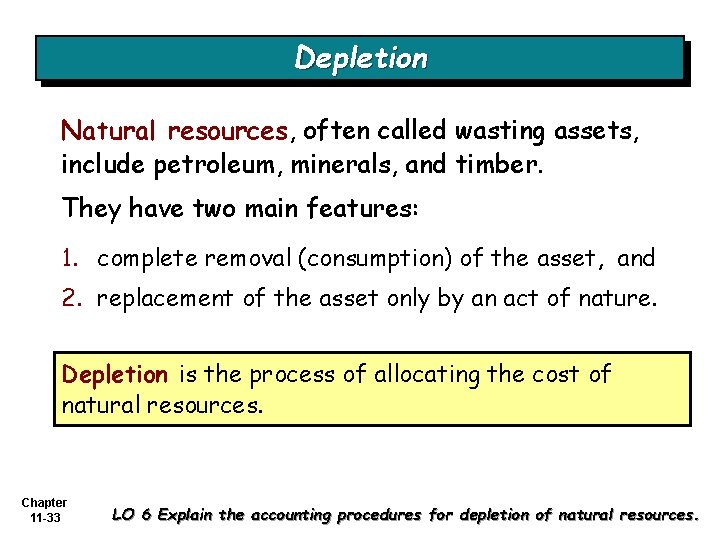
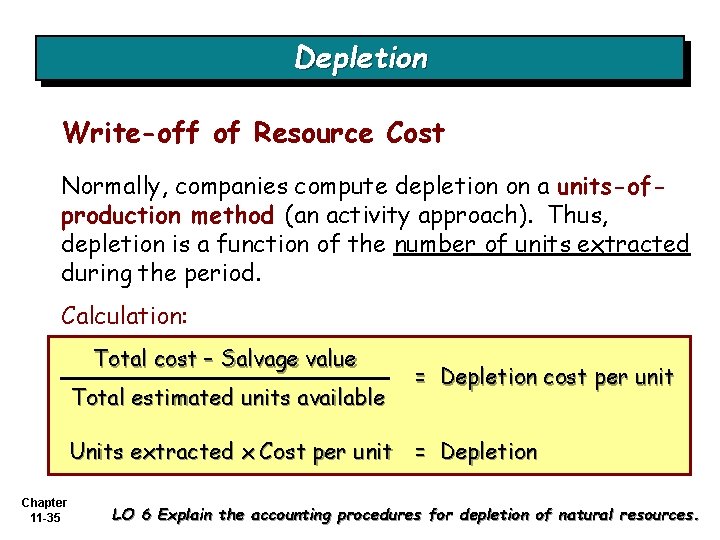
Depletion Natural resources, often called wasting assets, include petroleum, minerals, and timber. They have two main features: 1. complete removal (consumption) of the asset, and 2. replacement of the asset only by an act of nature. Depletion is the process of allocating the cost of natural resources. Chapter 11 -33 LO 6 Explain the accounting procedures for depletion of natural resources.
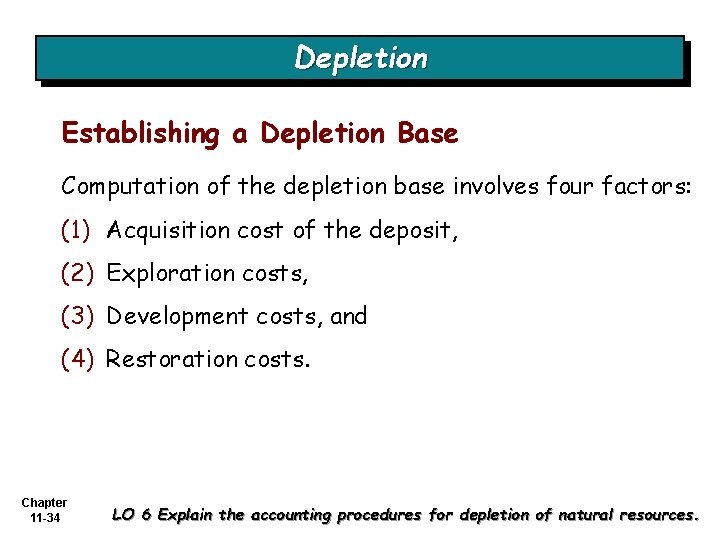
Depletion Establishing a Depletion Base Computation of the depletion base involves four factors: (1) Acquisition cost of the deposit, (2) Exploration costs, (3) Development costs, and (4) Restoration costs. Chapter 11 -34 LO 6 Explain the accounting procedures for depletion of natural resources.
Depletion Write-off of Resource Cost Normally, companies compute depletion on a units-ofproduction method (an activity approach). Thus, depletion is a function of the number of units extracted during the period. Calculation: Total cost – Salvage value Total estimated units available = Depletion cost per unit Units extracted x Cost per unit = Depletion Chapter 11 -35 LO 6 Explain the accounting procedures for depletion of natural resources.
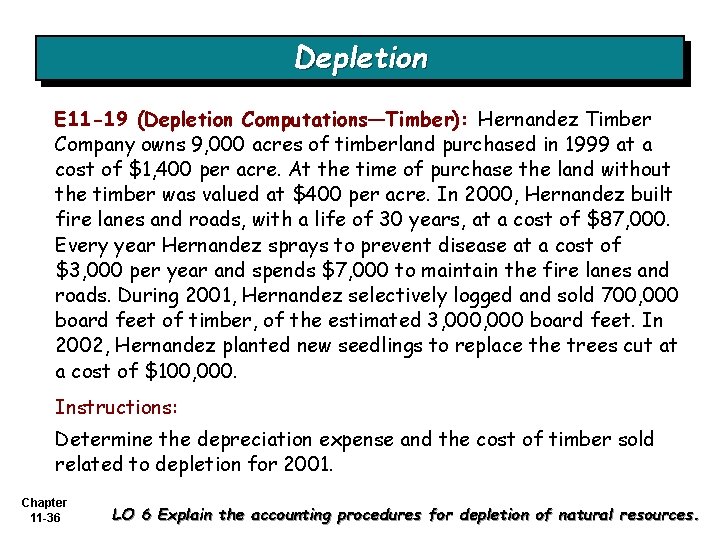
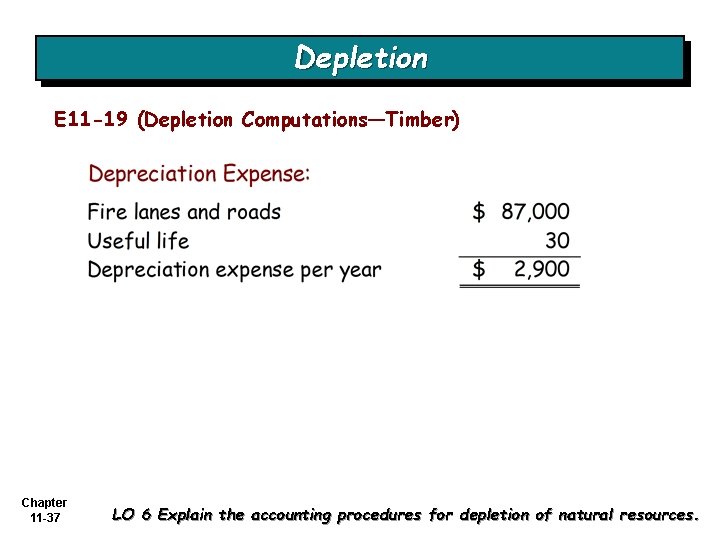
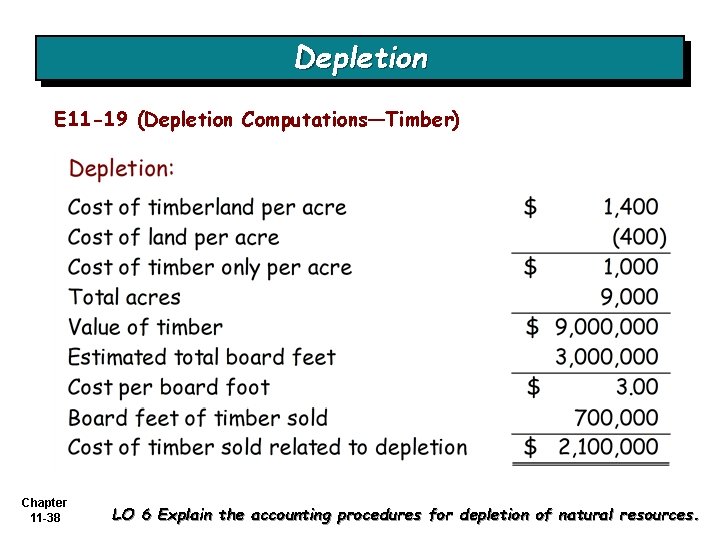
Depletion E 11 -19 (Depletion Computations—Timber): Hernandez Timber Company owns 9, 000 acres of timberland purchased in 1999 at a cost of $1, 400 per acre. At the time of purchase the land without the timber was valued at $400 per acre. In 2000, Hernandez built fire lanes and roads, with a life of 30 years, at a cost of $87, 000. Every year Hernandez sprays to prevent disease at a cost of $3, 000 per year and spends $7, 000 to maintain the fire lanes and roads. During 2001, Hernandez selectively logged and sold 700, 000 board feet of timber, of the estimated 3, 000 board feet. In 2002, Hernandez planted new seedlings to replace the trees cut at a cost of $100, 000. Instructions: Determine the depreciation expense and the cost of timber sold related to depletion for 2001. Chapter 11 -36 LO 6 Explain the accounting procedures for depletion of natural resources.
Depletion E 11 -19 (Depletion Computations—Timber) Chapter 11 -37 LO 6 Explain the accounting procedures for depletion of natural resources.
Depletion E 11 -19 (Depletion Computations—Timber) Chapter 11 -38 LO 6 Explain the accounting procedures for depletion of natural resources.
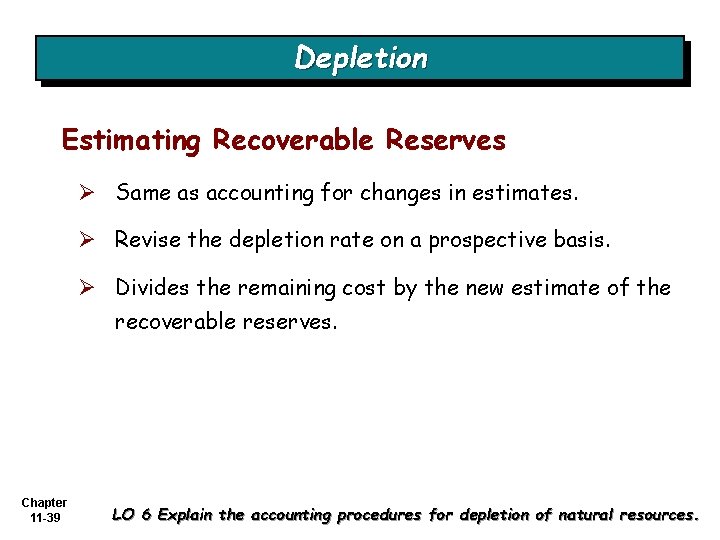
Depletion Estimating Recoverable Reserves Ø Same as accounting for changes in estimates. Ø Revise the depletion rate on a prospective basis. Ø Divides the remaining cost by the new estimate of the recoverable reserves. Chapter 11 -39 LO 6 Explain the accounting procedures for depletion of natural resources.
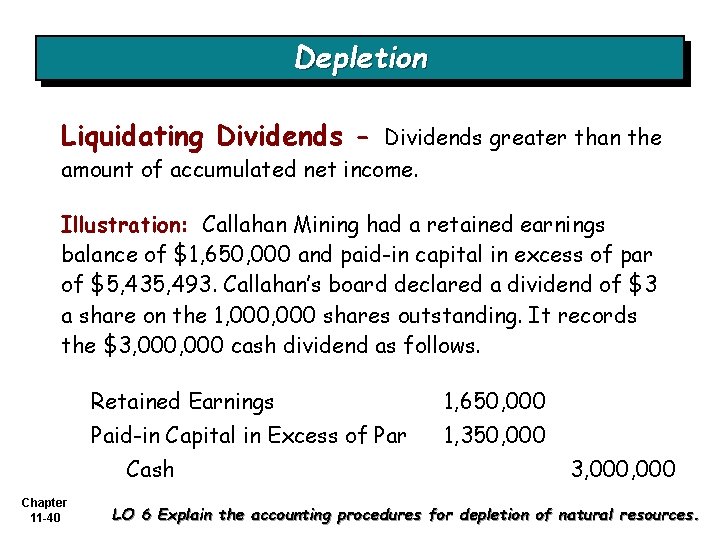
Depletion Liquidating Dividends - Dividends greater than the amount of accumulated net income. Illustration: Callahan Mining had a retained earnings balance of $1, 650, 000 and paid-in capital in excess of par of $5, 435, 493. Callahan’s board declared a dividend of $3 a share on the 1, 000 shares outstanding. It records the $3, 000 cash dividend as follows. Retained Earnings 1, 650, 000 Paid-in Capital in Excess of Par 1, 350, 000 Cash Chapter 11 -40 3, 000 LO 6 Explain the accounting procedures for depletion of natural resources.
Depletion Continuing Controversy Oil and Gas Industry: Full cost concept Successful efforts concept Chapter 11 -41 LO 6 Explain the accounting procedures for depletion of natural resources.
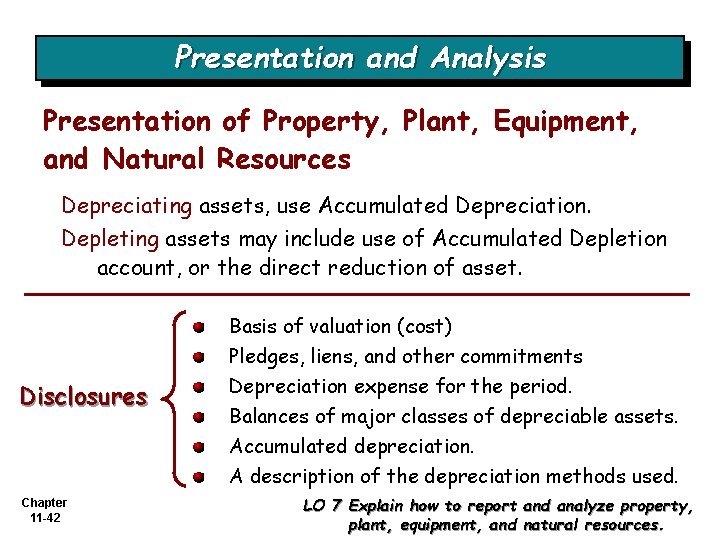
Presentation and Analysis Presentation of Property, Plant, Equipment, and Natural Resources Depreciating assets, use Accumulated Depreciation. Depleting assets may include use of Accumulated Depletion account, or the direct reduction of asset. Basis of valuation (cost) Disclosures Pledges, liens, and other commitments Depreciation expense for the period. Balances of major classes of depreciable assets. Accumulated depreciation. A description of the depreciation methods used. Chapter 11 -42 LO 7 Explain how to report and analyze property, plant, equipment, and natural resources.
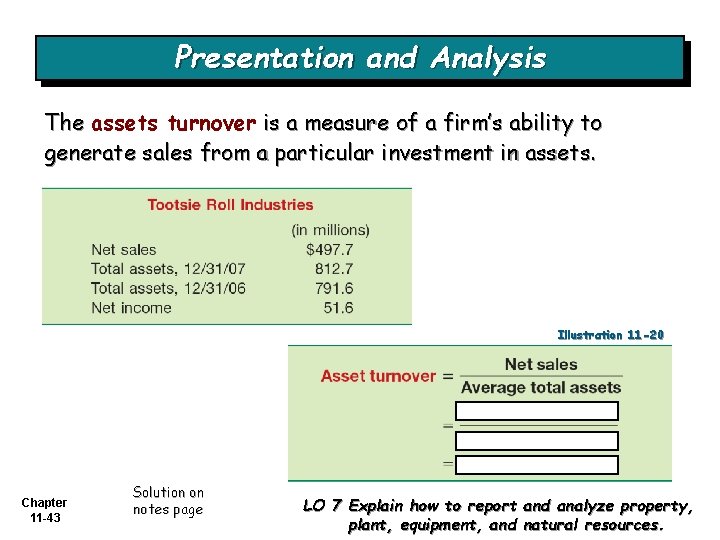
Presentation and Analysis The assets turnover is a measure of a firm’s ability to generate sales from a particular investment in assets. Illustration 11 -20 Chapter 11 -43 Solution on notes page LO 7 Explain how to report and analyze property, plant, equipment, and natural resources.
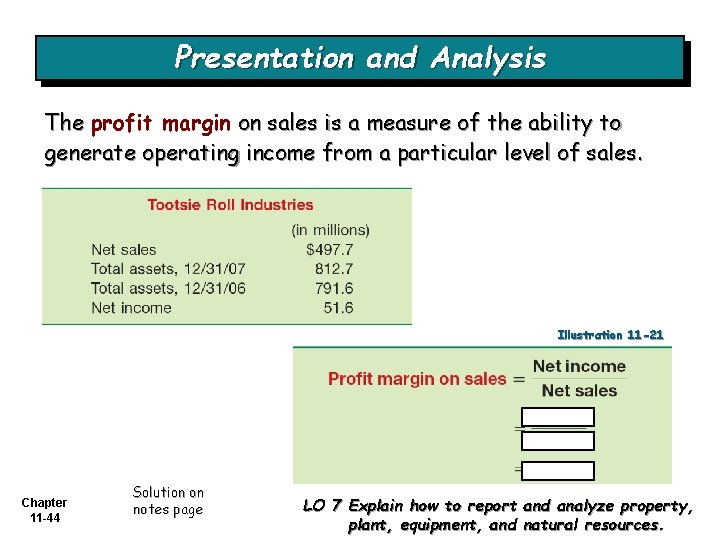
Presentation and Analysis The profit margin on sales is a measure of the ability to generate operating income from a particular level of sales. Illustration 11 -21 Chapter 11 -44 Solution on notes page LO 7 Explain how to report and analyze property, plant, equipment, and natural resources.
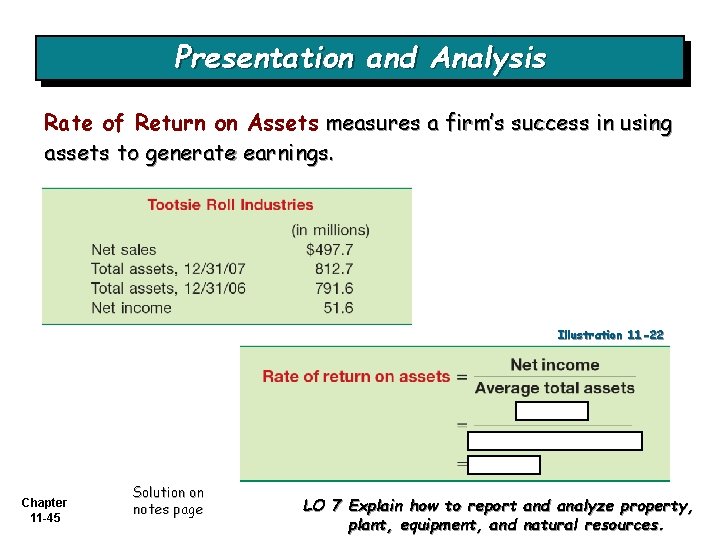
Presentation and Analysis Rate of Return on Assets measures a firm’s success in using assets to generate earnings. Illustration 11 -22 Chapter 11 -45 Solution on notes page LO 7 Explain how to report and analyze property, plant, equipment, and natural resources.
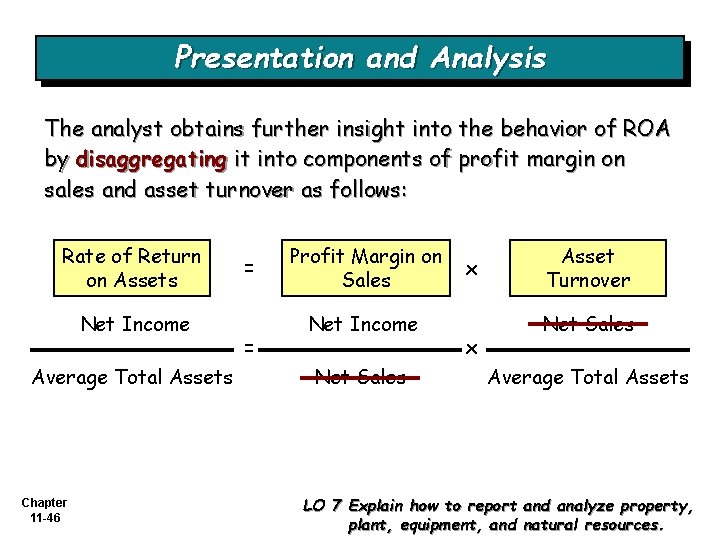
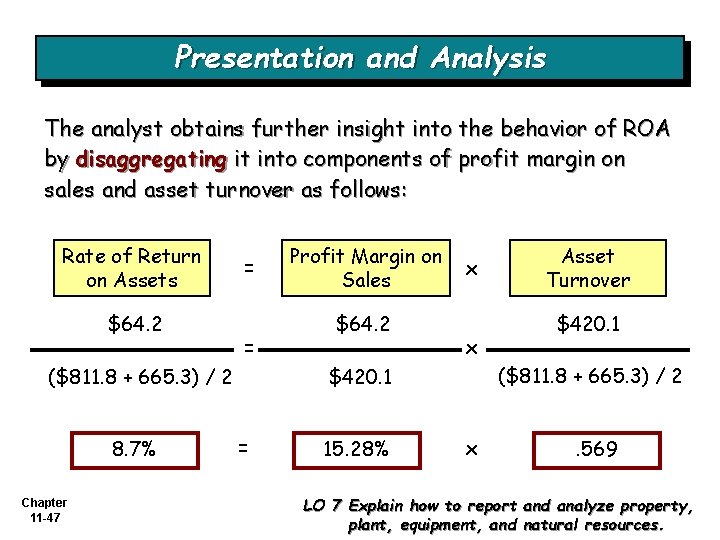
Presentation and Analysis The analyst obtains further insight into the behavior of ROA by disaggregating it into components of profit margin on sales and asset turnover as follows: Rate of Return on Assets Net Income Average Total Assets Chapter 11 -46 = = Profit Margin on Sales Net Income Net Sales x x Asset Turnover Net Sales Average Total Assets LO 7 Explain how to report and analyze property, plant, equipment, and natural resources.
Presentation and Analysis The analyst obtains further insight into the behavior of ROA by disaggregating it into components of profit margin on sales and asset turnover as follows: Rate of Return on Assets $64. 2 = = ($811. 8 + 665. 3) / 2 8. 7% Chapter 11 -47 Profit Margin on Sales $64. 2 x x 15. 28% $420. 1 ($811. 8 + 665. 3) / 2 $420. 1 = Asset Turnover x . 569 LO 7 Explain how to report and analyze property, plant, equipment, and natural resources.
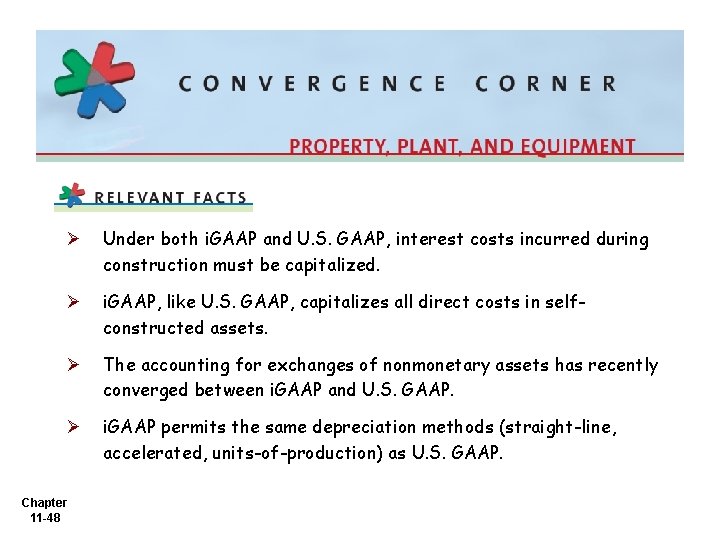
Ø Under both i. GAAP and U. S. GAAP, interest costs incurred during construction must be capitalized. Ø i. GAAP, like U. S. GAAP, capitalizes all direct costs in selfconstructed assets. Ø The accounting for exchanges of nonmonetary assets has recently converged between i. GAAP and U. S. GAAP. Ø i. GAAP permits the same depreciation methods (straight-line, accelerated, units-of-production) as U. S. GAAP. Chapter 11 -48
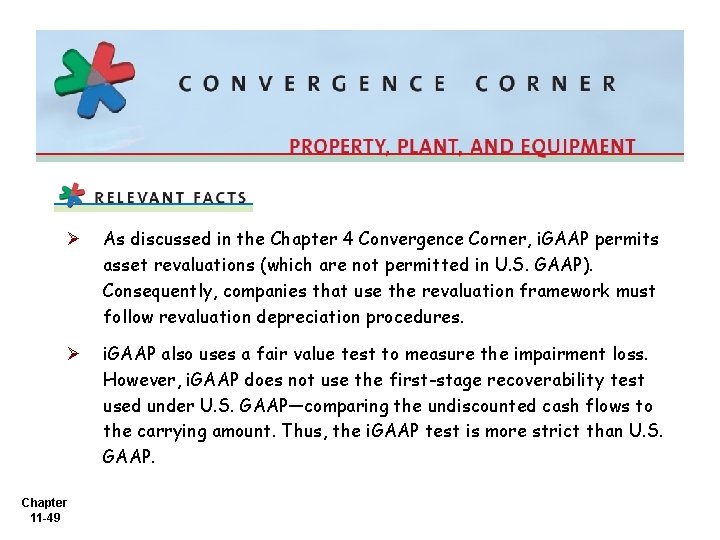
Ø As discussed in the Chapter 4 Convergence Corner, i. GAAP permits asset revaluations (which are not permitted in U. S. GAAP). Consequently, companies that use the revaluation framework must follow revaluation depreciation procedures. Ø i. GAAP also uses a fair value test to measure the impairment loss. However, i. GAAP does not use the first-stage recoverability test used under U. S. GAAP—comparing the undiscounted cash flows to the carrying amount. Thus, the i. GAAP test is more strict than U. S. GAAP. Chapter 11 -49
Modified Accelerated Cost Recovery System MACRS differs from GAAP in three respects: 1. a mandated tax life, which is generally shorter than the economic life; 2. cost recovery on an accelerated basis; and 3. an assigned salvage value of zero. Chapter 11 -50 LO 8 Describe income tax methods of depreciation.
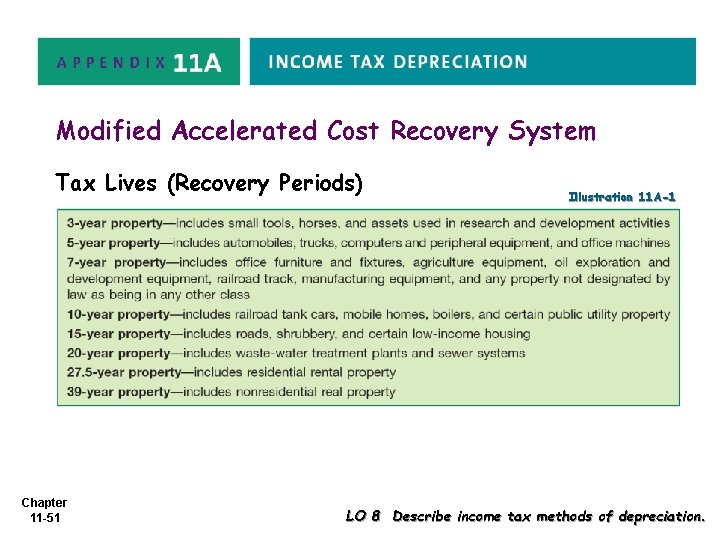
Modified Accelerated Cost Recovery System Tax Lives (Recovery Periods) Chapter 11 -51 Illustration 11 A-1 LO 8 Describe income tax methods of depreciation.
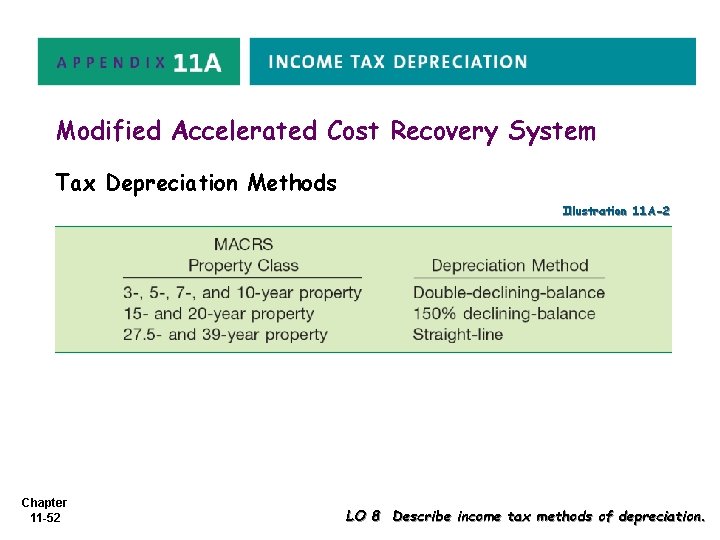
Modified Accelerated Cost Recovery System Tax Depreciation Methods Illustration 11 A-2 Chapter 11 -52 LO 8 Describe income tax methods of depreciation.
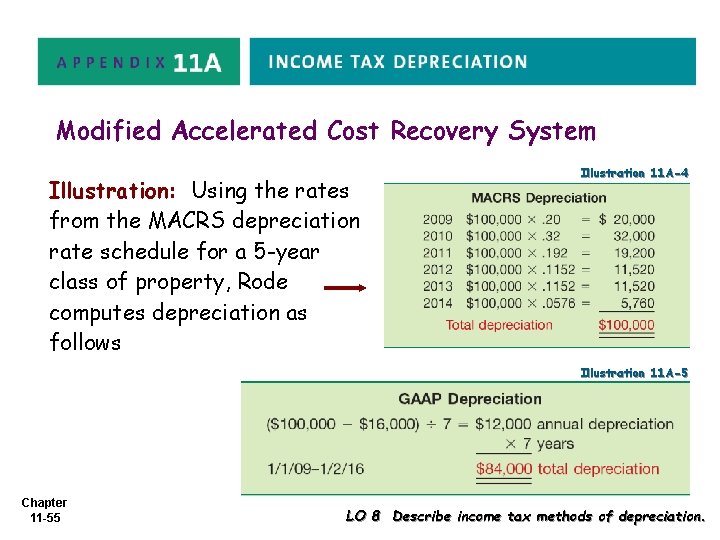
Modified Accelerated Cost Recovery System Illustration: Computer and peripheral equipment purchased by Denise Rode Company on January 1, 2009. Chapter 11 -53 LO 8 Describe income tax methods of depreciation.
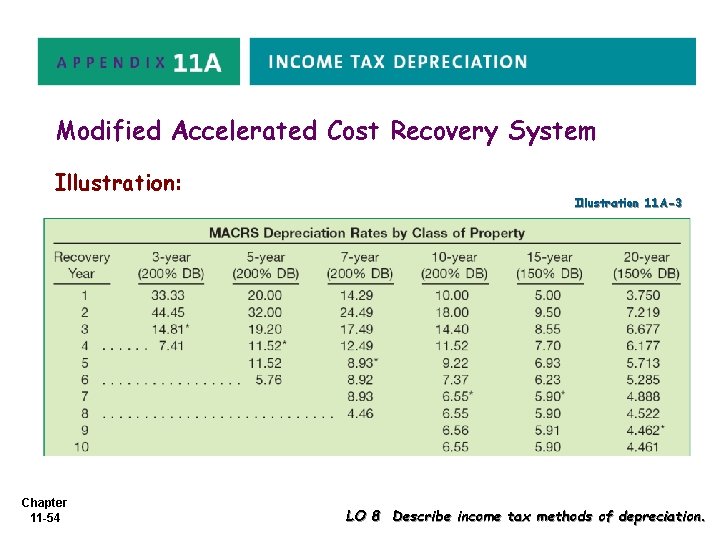
Modified Accelerated Cost Recovery System Illustration: Chapter 11 -54 Illustration 11 A-3 LO 8 Describe income tax methods of depreciation.
Modified Accelerated Cost Recovery System Illustration: Using the rates from the MACRS depreciation rate schedule for a 5 -year class of property, Rode computes depreciation as follows Illustration 11 A-4 Illustration 11 A-5 Chapter 11 -55 LO 8 Describe income tax methods of depreciation.
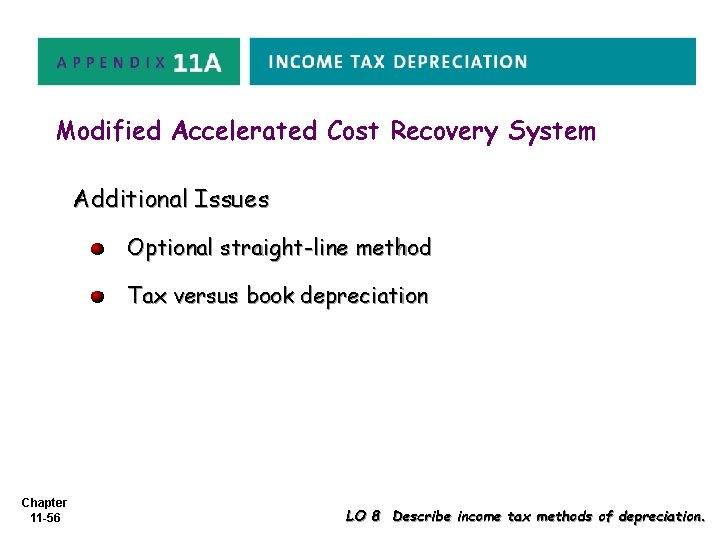
Modified Accelerated Cost Recovery System Additional Issues Optional straight-line method Tax versus book depreciation Chapter 11 -56 LO 8 Describe income tax methods of depreciation.
Copyright © 2009 John Wiley & Sons, Inc. All rights reserved. Reproduction or translation of this work beyond that permitted in Section 117 of the 1976 United States Copyright Act without the express written permission of the copyright owner is unlawful. Request for further information should be addressed to the Permissions Department, John Wiley & Sons, Inc. The purchaser may make back-up copies for his/her own use only and not for distribution or resale. The Publisher assumes no responsibility for errors, omissions, or damages, caused by the use of these programs or from the use of the information contained herein. Chapter 11 -57