
Chapter 11 LongLived Assets Mark Higgins Tangible LongLived
Chapter 11 Long-Lived Assets Mark Higgins
Tangible Long-Lived Assets Tangible long-lived assets (also sometimes referred to as plant assets) are resources that: F have physical substance. F are recorded at cost in accordance with the cost principle of accounting. F the cost consists of all expenditures necessary to acquire the asset and make it ready for its intended use. Transparency 11 -2
Examples: Tangible Long-Lived Assets Tangible long-lived assets include: F buildings F equipment, machinery F leasehold improvements F land Transparency 11 -3
Cost of Building When a new building is constructed, its cost consists of: Fthe contract price Farchitect's fees Fbuilding permits Fexcavation costs Finterest costs during the construction period Transparency 11 -4
Cost of Equipment The cost of equipment consists of the: Fcash purchase price Fsales tax Ffreight charges Finsurance during transit paid by the purchaser Fexpenditures required in assembling, installing and testing the unit. In essence, all the costs associated with placing the asset in service (i. e. , ready for use) Transparency 11 -5
Land Improvements The cost of land improvements includes all expenditures necessary to make the improvements ready for their intended use. For example, the cost of a parking lot would include the amount paid for paving, fencing, and lighting. Transparency 11 -6
Land The cost of land includes: Fthe cash purchase price Fclosing costs, such as title and attorney's fees Freal estate brokers’ commissions Faccrued property taxes and other liens on the land assumed by the purchaser Fall necessary costs incurred in making land ready for its intended use Transparency 11 -7
Depreciable Assets Depreciation applies to the following tangible assets: FBuildings FLeasehold Improvements FEquipment FLand improvements NOTE: Land is not a depreciable asset, since it does not have a finite useful life Transparency 11 -8
Capitalization Versus Expense Capitalization is the act of recognizing costs that provide a future economic benefit by setting up an asset account. FTangible assets whether purchased or selfconstructed are almost always recognized FIntangible assets that are acquired are generally recognized. Internally generated (i. e. , self-constructed) intangibles (e. g. , trained employees) are generally NOT recognized. Transparency 11 -9
Depreciation is the rational and systematic process of allocating the cost of a tangible asset over its useful (service) life. Transparency 11 -10
GAAP Versus Economic Values GAAP fails to accurately reflect economic values of tangible assets because it: FMakes incorrect assumptions regarding the pattern of future cash flows from the fixed asset FIgnores interest GAAP fails to accurately reflect economic values of intangible assets because: FSelf-produced intangibles are not recorded Transparency 11 -11
Accumulated Depreciation The balance in the Accumulated Depreciation (a contra asset account) represents the total amount of the asset's cost that has been expensed to date. Transparency 11 -12
Factors in Computing Depreciation Cost--historical cost of the asset. Useful life--estimate of the expected productive life, also called service life, of the asset. Salvage value--an estimate of the asset's value at the end of its useful life. NOTE: Salvage value is not used for double-declining balance. Transparency 11 -13
Depreciation Methods The following methods of depreciation are acceptable under generally accepted accounting principles (GAAP): & Straight-line & Units-of-Activity & Declining-Balance & Sum-of-the-Years’-Digits Transparency 11 -14
Straight-line Method & Straight-line depreciation is the most widely used method of depreciation. & Under the straight-line method, depreciation is the same for each year of the asset's useful life. Transparency 11 -15
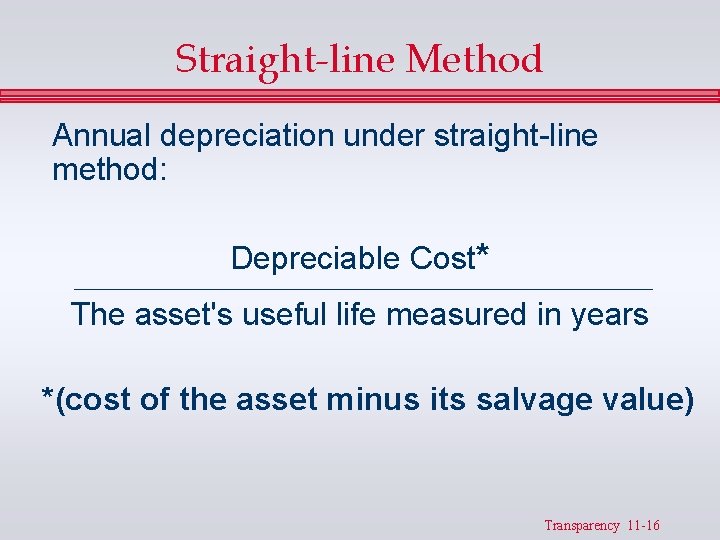
Straight-line Method Annual depreciation under straight-line method: Depreciable Cost* ____________________________________________________ The asset's useful life measured in years *(cost of the asset minus its salvage value) Transparency 11 -16
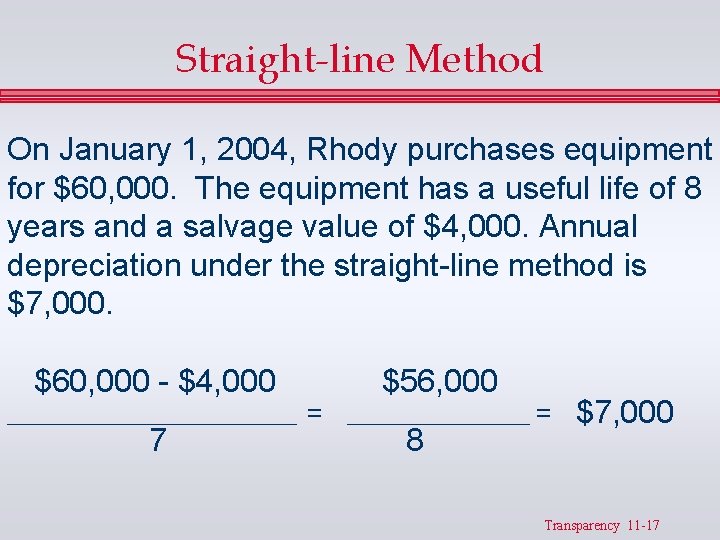
Straight-line Method On January 1, 2004, Rhody purchases equipment for $60, 000. The equipment has a useful life of 8 years and a salvage value of $4, 000. Annual depreciation under the straight-line method is $7, 000. $60, 000 - $4, 000 $56, 000 = __________________________ = $7, 000 _________________ 7 8 Transparency 11 -17
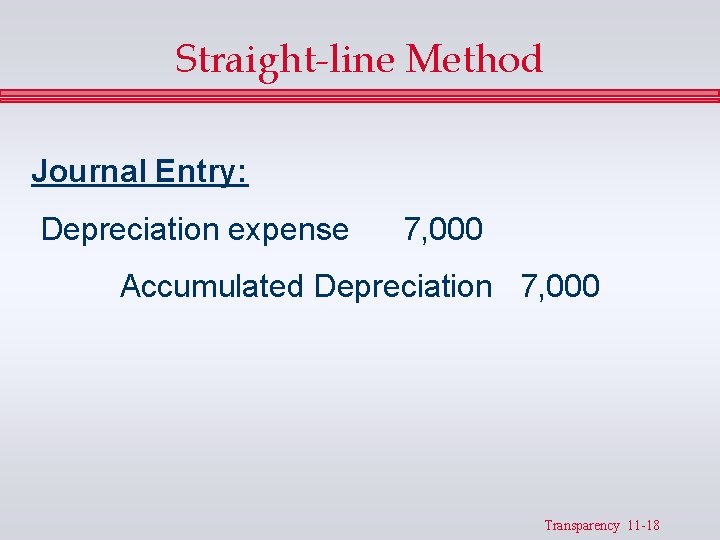
Straight-line Method Journal Entry: Depreciation expense 7, 000 Accumulated Depreciation 7, 000 Transparency 11 -18
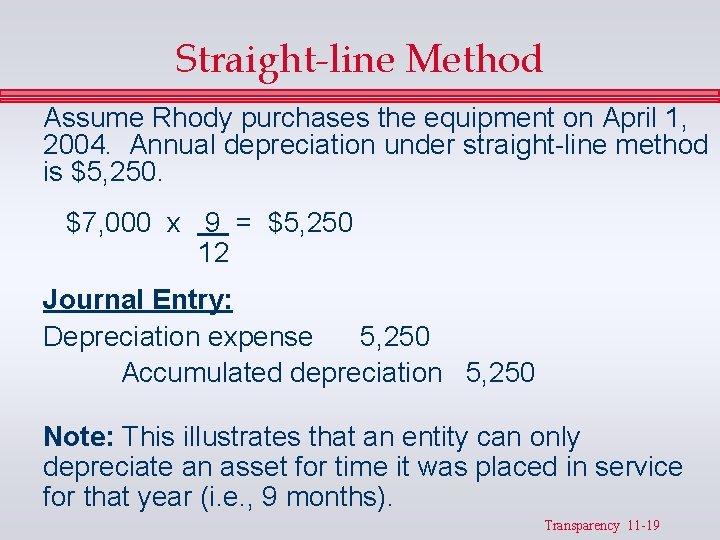
Straight-line Method Assume Rhody purchases the equipment on April 1, 2004. Annual depreciation under straight-line method is $5, 250. $7, 000 x 9 = $5, 250 12 Journal Entry: Depreciation expense 5, 250 Accumulated depreciation 5, 250 Note: This illustrates that an entity can only depreciate an asset for time it was placed in service for that year (i. e. , 9 months). Transparency 11 -19
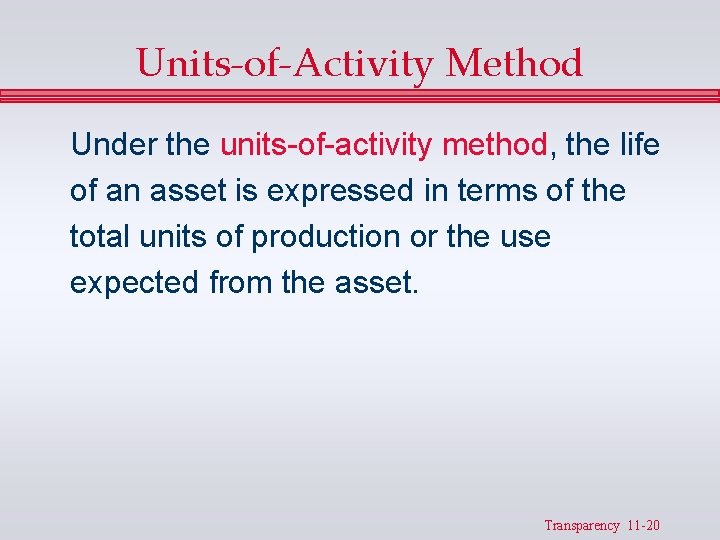
Units-of-Activity Method Under the units-of-activity method, the life of an asset is expressed in terms of the total units of production or the use expected from the asset. Transparency 11 -20
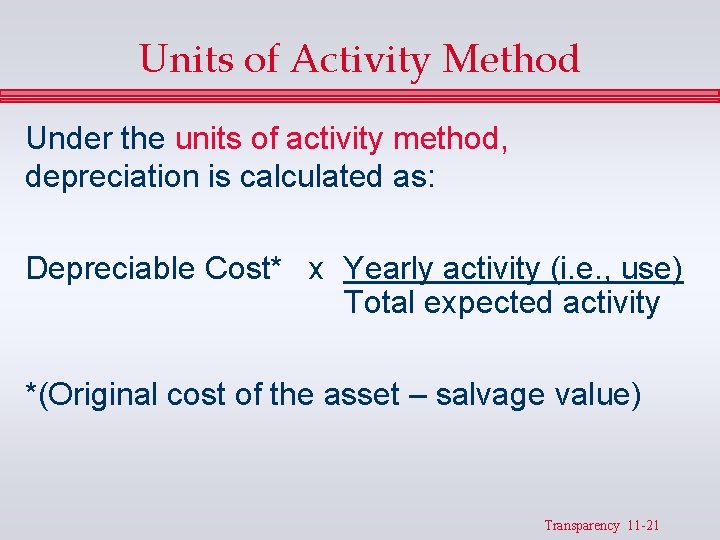
Units of Activity Method Under the units of activity method, depreciation is calculated as: Depreciable Cost* x Yearly activity (i. e. , use) Total expected activity *(Original cost of the asset – salvage value) Transparency 11 -21
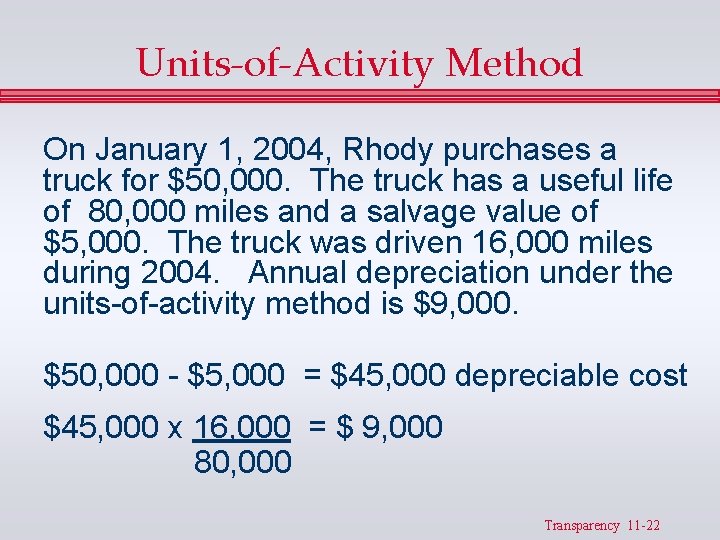
Units-of-Activity Method On January 1, 2004, Rhody purchases a truck for $50, 000. The truck has a useful life of 80, 000 miles and a salvage value of $5, 000. The truck was driven 16, 000 miles during 2004. Annual depreciation under the units-of-activity method is $9, 000. $50, 000 - $5, 000 = $45, 000 depreciable cost $45, 000 x 16, 000 = $ 9, 000 80, 000 Transparency 11 -22
Declining-Balance Method The declining-balance method is an accelerated method. Accelerated methods of depreciation result in more depreciation in the early years of an asset's life and less depreciation in the later years of an asset's life than does the straight-line approach. Transparency 11 -23
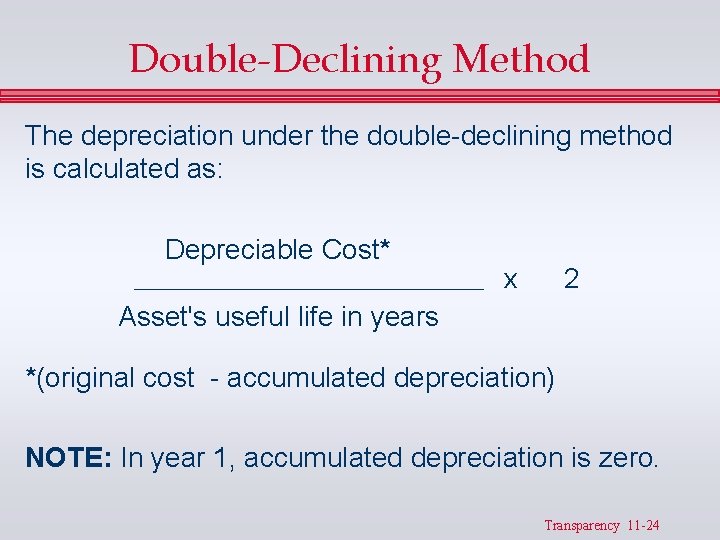
Double-Declining Method The depreciation under the double-declining method is calculated as: Depreciable Cost* x 2 ___________________________________ Asset's useful life in years *(original cost - accumulated depreciation) NOTE: In year 1, accumulated depreciation is zero. Transparency 11 -24
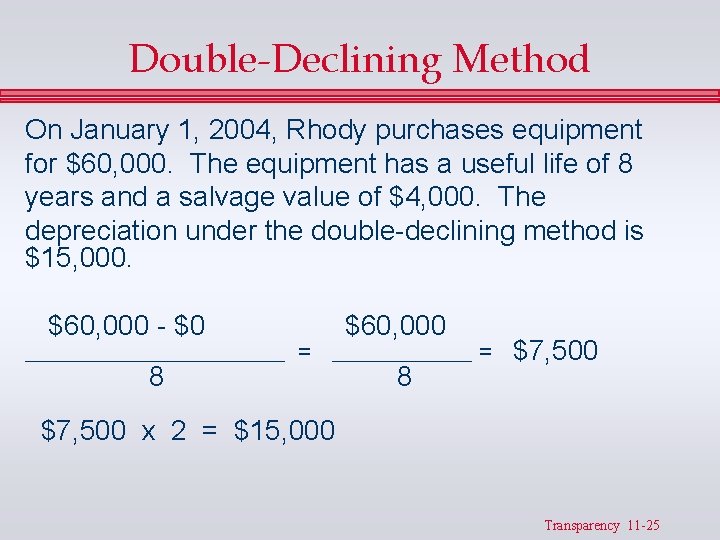
Double-Declining Method On January 1, 2004, Rhody purchases equipment for $60, 000. The equipment has a useful life of 8 years and a salvage value of $4, 000. The depreciation under the double-declining method is $15, 000. $60, 000 - $0 $60, 000 = __________________________ = $7, 500 ______________ 8 $7, 500 x 2 = $15, 000 Transparency 11 -25
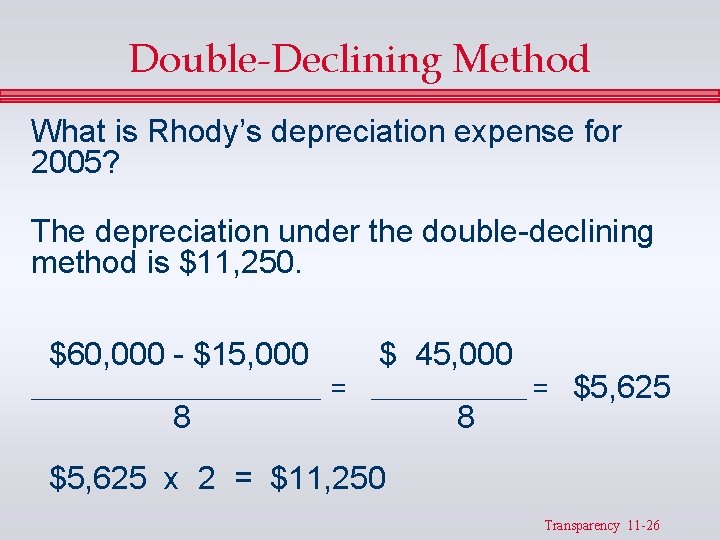
Double-Declining Method What is Rhody’s depreciation expense for 2005? The depreciation under the double-declining method is $11, 250. $60, 000 - $15, 000 $ 45, 000 = __________________________ = $5, 625 ______________ 8 $5, 625 x 2 = $11, 250 Transparency 11 -26
Sum-of-the-Years’-Digits The sum-of-the-years’-digits method is an accelerated method. As with the double-declining balance method, it will result in more depreciation in the early years of an asset's life and less depreciation in the later years of an asset's life. Transparency 11 -27
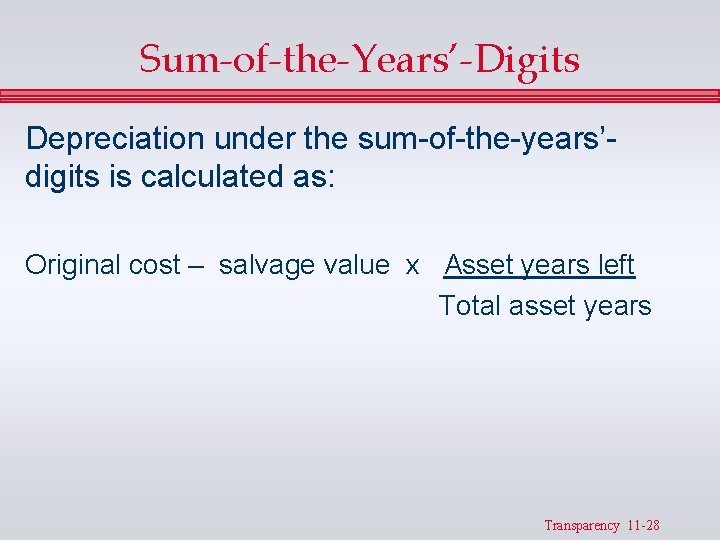
Sum-of-the-Years’-Digits Depreciation under the sum-of-the-years’digits is calculated as: Original cost – salvage value x Asset years left Total asset years Transparency 11 -28
Sum-of-the-Years’-Digits On January 1, 2004, Rhody purchases equipment for $60, 000. The equipment has a useful life of 8 years and a salvage value of $4, 000. The depreciation under sum-of-the-years’-digits is $12, 444 ($60, 000 - $4, 000) = $56, 000 x 8 = $12, 444 36* *(8+7+6+5+4+3+2+1) = 36 Transparency 11 -29
Disposal of Plant Assets Whether a plant asset is sold, retired, or traded in, the company must determine the book value of the plant asset at the time of disposal. & Book value is the difference between the cost of the plant asset and the accumulated depreciation to date. & If disposal occurs mid-year, the depreciation for the fraction of the year to the date of disposal must be recorded. Transparency 11 -30
Sale of Plant Assets Book Value: Original Cost - Accumulated Depreciation Book Value of Asset Gain on Sale: If sales proceeds > book value of the asset Loss on Sale: If sales proceeds < book value of the asset. Transparency 11 -31
Sale of Plant Assets On January 1, 2004, Rhody sells equipment for $20, 000. The original cost of the equipment is $40, 000 and the accumulated depreciation is $24, 000. What is Rhody’s gain or loss? Transparency 11 -32
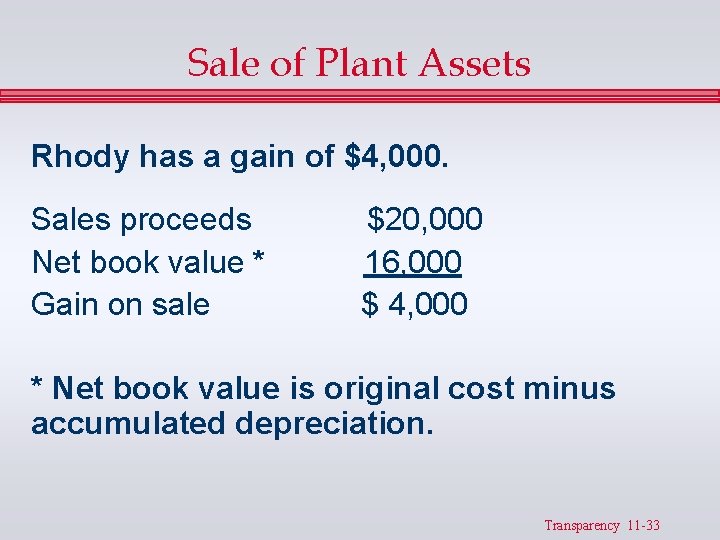
Sale of Plant Assets Rhody has a gain of $4, 000. Sales proceeds $20, 000 Net book value * 16, 000 Gain on sale $ 4, 000 * Net book value is original cost minus accumulated depreciation. Transparency 11 -33
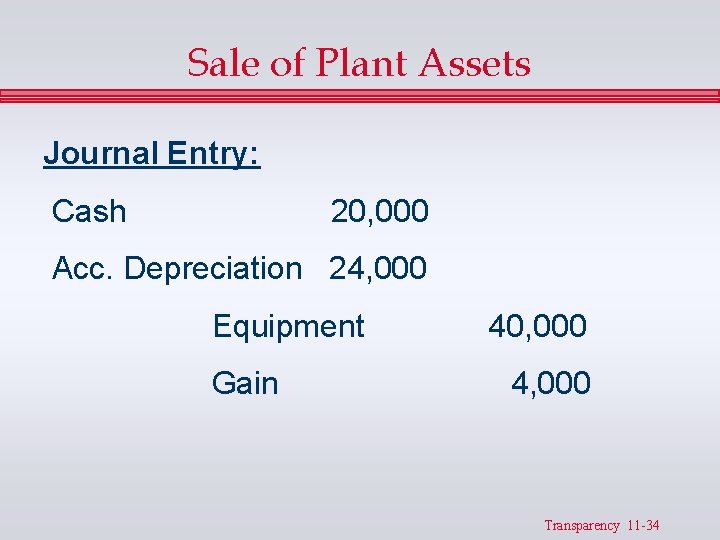
Sale of Plant Assets Journal Entry: Cash 20, 000 Acc. Depreciation 24, 000 Equipment 40, 000 Gain 4, 000 Transparency 11 -34
Asset Impairment GAAP requires that an entity review its tangible assets and determine if an asset is impaired. An asset might be impaired if: F The market value has significantly decreased. F The asset’s utilization has changed. F The entity forecasts losses from the asset’s continued use. F Adverse business conditions affect the asset. F Self-constructed assets cost significantly more than originally estimated. Transparency 11 -35
Asset Impairment Once an entity determines that an impairment might have taken place, it must perform an impairment test. This test requires that the entity compare the estimated undiscounted future cash flows of the asset to the asset’s current book value. Transparency 11 -36
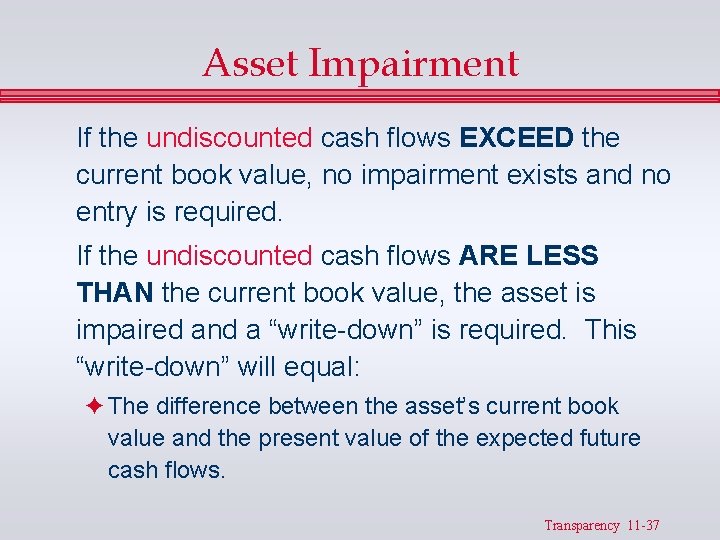
Asset Impairment If the undiscounted cash flows EXCEED the current book value, no impairment exists and no entry is required. If the undiscounted cash flows ARE LESS THAN the current book value, the asset is impaired and a “write-down” is required. This “write-down” will equal: F The difference between the asset’s current book value and the present value of the expected future cash flows. Transparency 11 -37
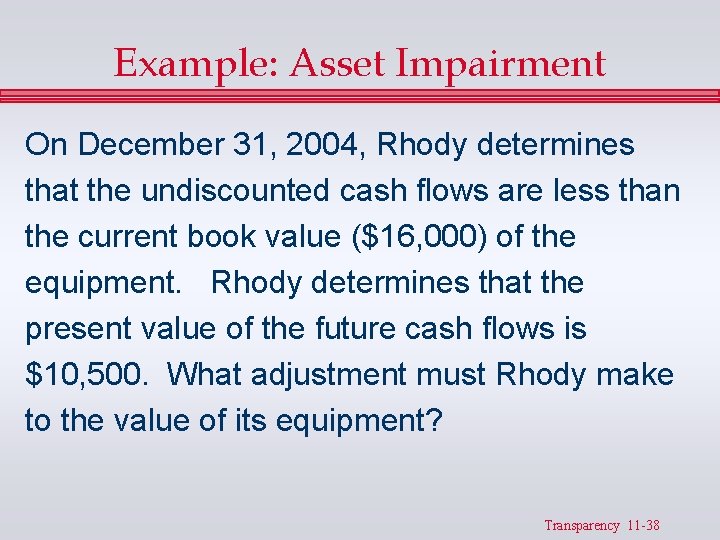
Example: Asset Impairment On December 31, 2004, Rhody determines that the undiscounted cash flows are less than the current book value ($16, 000) of the equipment. Rhody determines that the present value of the future cash flows is $10, 500. What adjustment must Rhody make to the value of its equipment? Transparency 11 -38
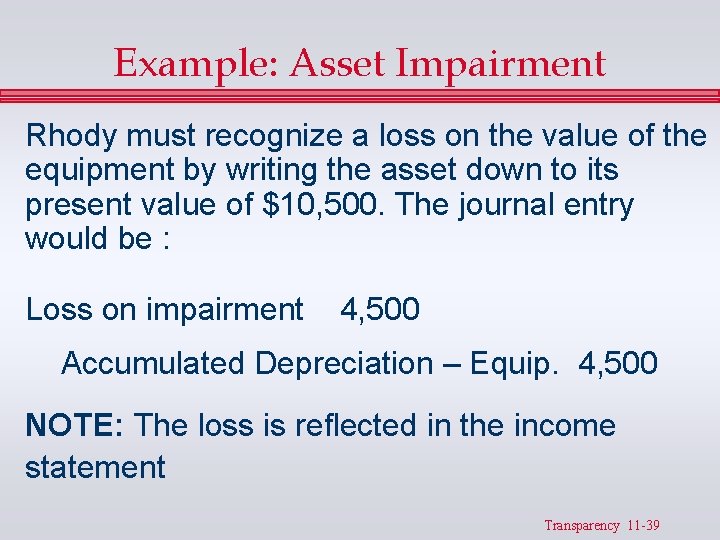
Example: Asset Impairment Rhody must recognize a loss on the value of the equipment by writing the asset down to its present value of $10, 500. The journal entry would be : Loss on impairment 4, 500 Accumulated Depreciation – Equip. 4, 500 NOTE: The loss is reflected in the income statement Transparency 11 -39
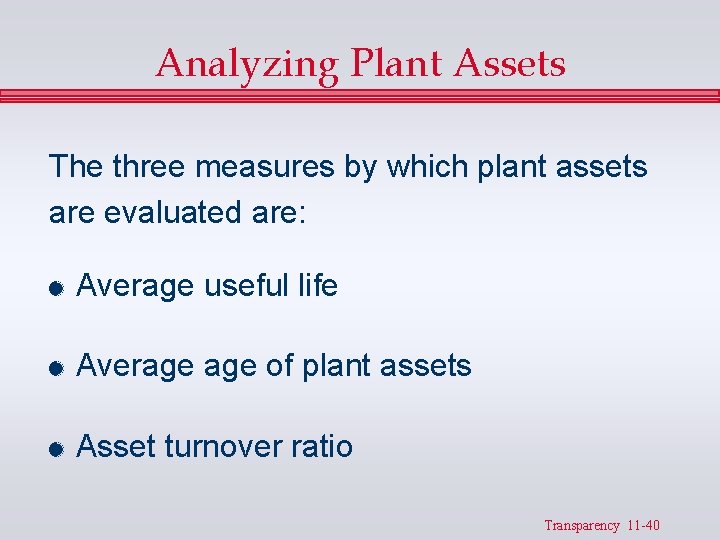
Analyzing Plant Assets The three measures by which plant assets are evaluated are: & Average useful life & Average of plant assets & Asset turnover ratio Transparency 11 -40
Average Useful Life To determine average useful life of assets: average cost of plant assets* depreciation expense * Total cost (i. e. original cost before any accumulated depreciation) of plant assets at the beginning of the period plus total cost of plant assets at the end of the period divided by 2. Transparency 11 -41
Average Age of Plant Assets To determine the average of plant assets: accumulated depreciation expense. Transparency 11 -42
Asset Turnover Ratios To calculate total asset turnover ratio: net sales average total assets To calculate fixed asset turnover ratio: net sales average fixed assets (PP&E) Transparency 11 -43
Intangible Assets Intangible assets are rights, privileges, and competitive advantages that result from ownership of long-lived assets that do not possess physical substance. Examples of intangible assets include goodwill and purchased patents. Transparency 11 -44
Intangible Assets & Intangible assets are recorded at cost and are expensed over the useful life of the intangible asset in a manner similar to depreciation. & The term used to describe how an intangible asset is expensed is called amortization. & Conceptual amortization and depreciation operate the same. Transparency 11 -45
Goodwill & Goodwill represents the value of all favorable attributes that relate to a business enterprise, including exceptional management, desirable location, good customer relations, skilled employees, etc. & When an entire business is purchased, goodwill is the difference between the purchase price of the business and the fair market value of the net assets (assets less liabilities) acquired. Transparency 11 -46
Where in the Balance Sheet Are Long-Lived Assets Presented? & Tangible assets are shown in the balance sheet under Property, Plant, and Equipment. Sometimes these assets are shown net (original cost minus accumulated depreciation). If shown net, then the firm must disclose accumulated depreciation in the footnotes. & Intangibles, if material, are shown separately; otherwise they are shown as part of other assets. Transparency 11 -47
- Slides: 47