
Depreciation at Delta Air Lines and Singapore Airlines




- Slides: 110
Depreciation at Delta Air Lines and Singapore Airlines UAA – ACCT 650 Seminar in Executive Uses of Accounting Dr. Fred Barbee
o n e p r e c i a ti Financial Reporting
Yeah! MB A
MBA
Why study this case? l To “compare and contrast” depreciation assumptions from two airlines that. . . l Are in some ways alike, and l In other ways vastly different 5
Why Look at an Airline? l PP&E for airlines usually comprise greater than 50% of total assets. l Aircraft of one airline are substantially similar to aircraft of another airline (at least to the lay person). 6
Depreciation – The Concept 1
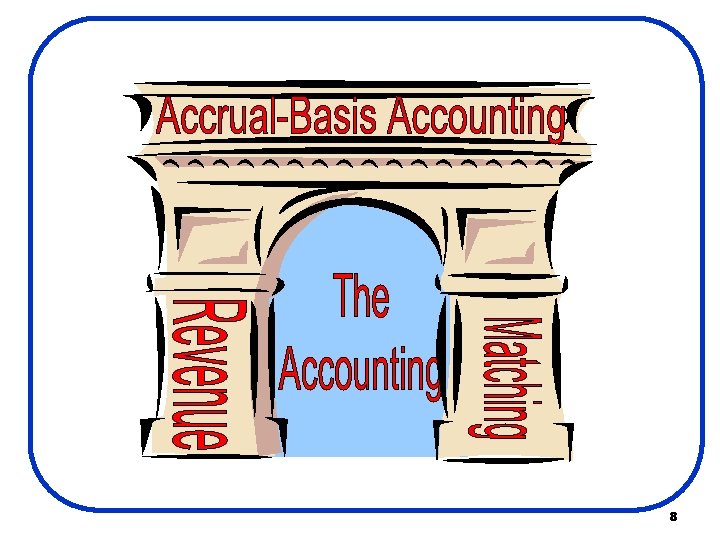
8
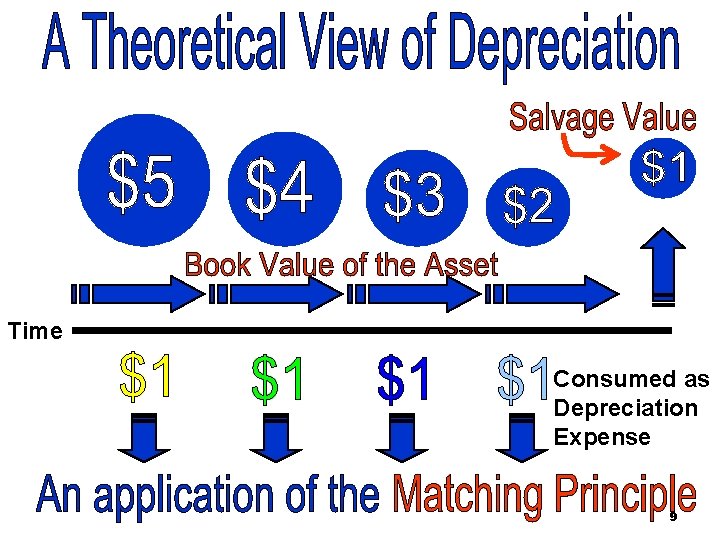
Time Consumed as Depreciation Expense 9
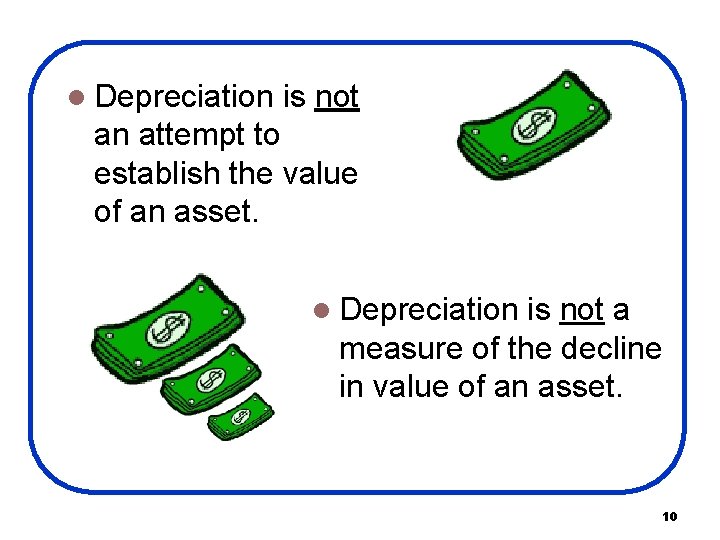
l Depreciation is not an attempt to establish the value of an asset. l Depreciation is not a measure of the decline in value of an asset. 10
Depreciation Defined l The process of allocating the cost of property, plant, and equipment as an expense in a systematic and rational manner to those periods expected to benefit from the use of the asset. 11
B E G I N N I N G Depreciation 96 97 98 99 00 01 02 03 04 05 Life of the Asset E N D I N G Depreciation is a process of allocation, not valuation. 12
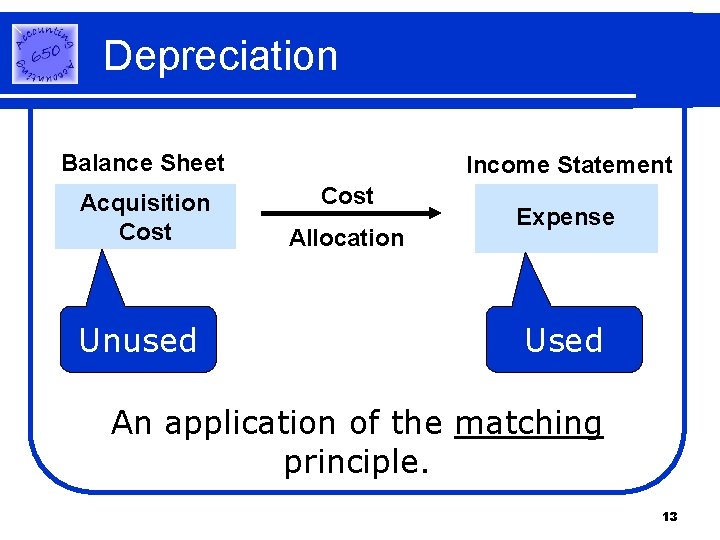
Depreciation Balance Sheet Acquisition Cost Unused Income Statement Cost Allocation Expense Used An application of the matching principle. 13
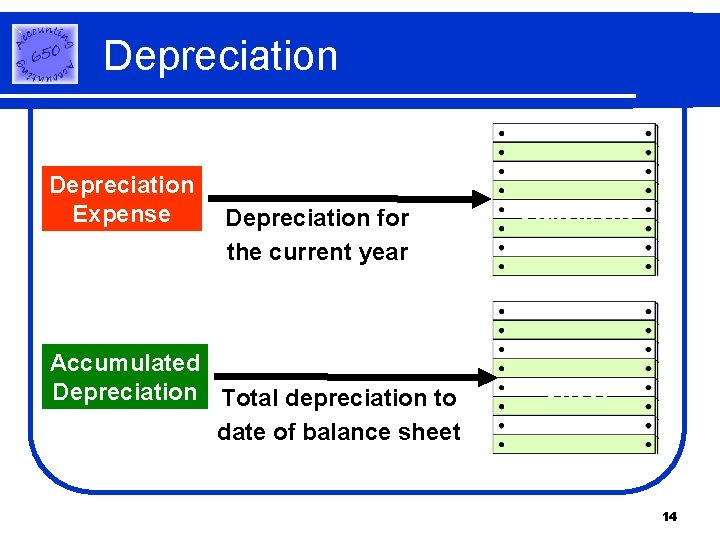
Depreciation Expense Income Depreciation for the current year Accumulated Depreciation Total depreciation to date of balance sheet Statement Balance Sheet 14
Long-Term Assets
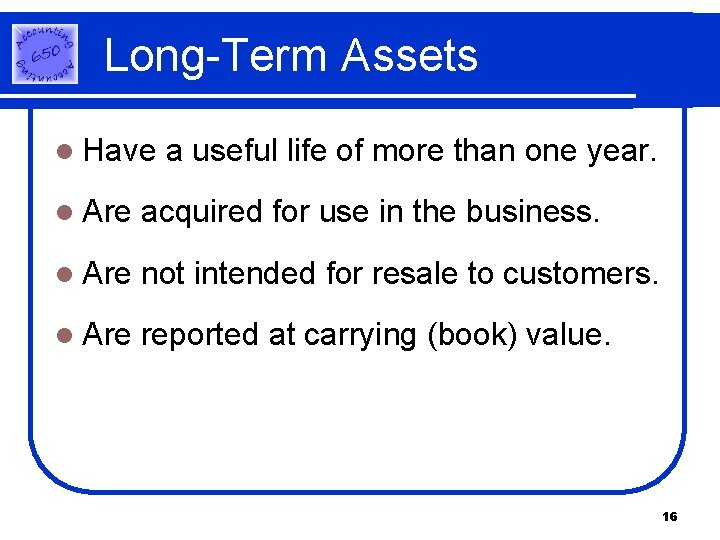
Long-Term Assets l Have a useful life of more than one year. l Are acquired for use in the business. l Are not intended for resale to customers. l Are reported at carrying (book) value. 16
Management Issues related to Accounting for Long Term Assets
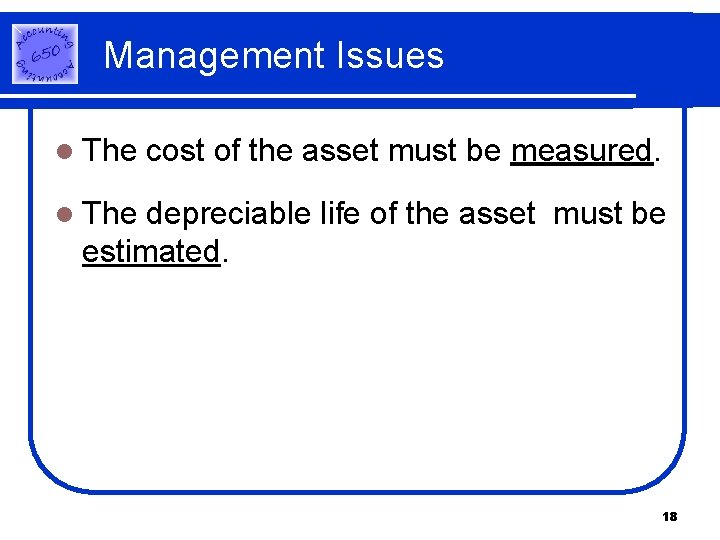
Management Issues l The cost of the asset must be measured. l The depreciable life of the asset must be estimated. 18
Management Issues l The salvage value of the asset at the end of its life must be estimated l. A pattern for recognizing depreciation over the depreciable life of the asset must be selected. 19
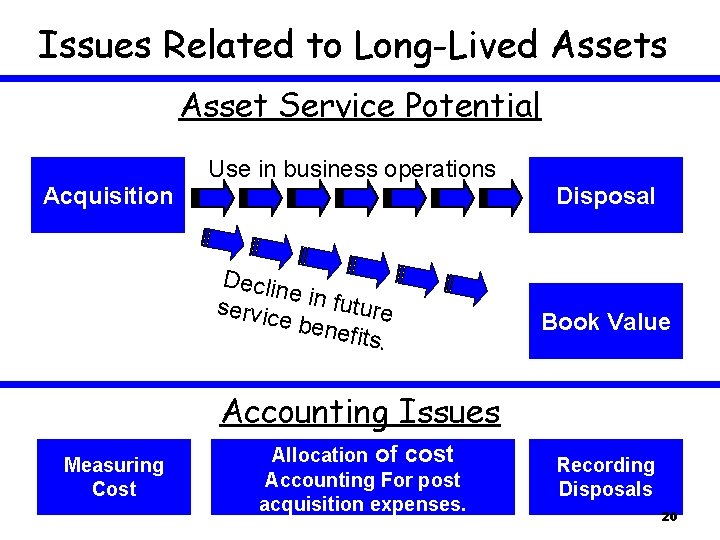
Issues Related to Long-Lived Assets Asset Service Potential Use in business operations Acquisition Disposal Declin e servic in future e ben efits. Time Book Value Accounting Issues Measuring Cost Allocation of cost Accounting For post acquisition expenses. Recording Disposals 20
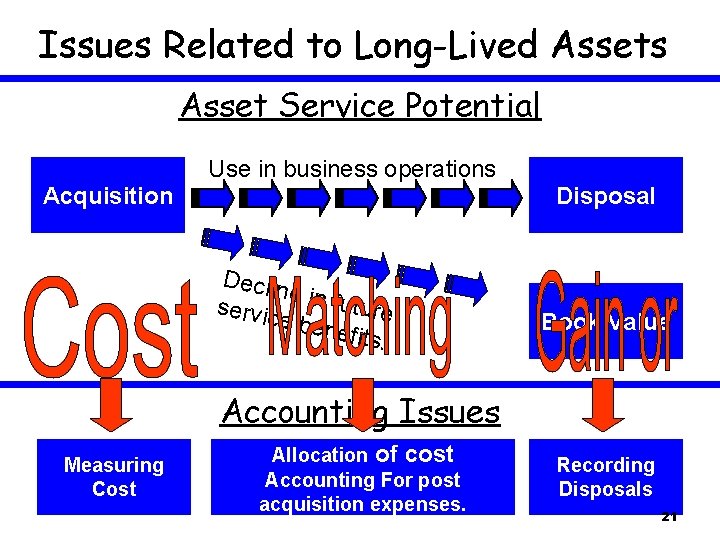
Issues Related to Long-Lived Assets Asset Service Potential Use in business operations Acquisition Disposal Declin e servic in future e ben efits. Time Book Value Accounting Issues Measuring Cost Allocation of cost Accounting For post acquisition expenses. Recording Disposals 21
Acquisition cost of Property, Plant, and Equipment Fundamental Issue #1: What is the value of the asset?
Measuring the Carrying Amount of Long-Lived Assets 1
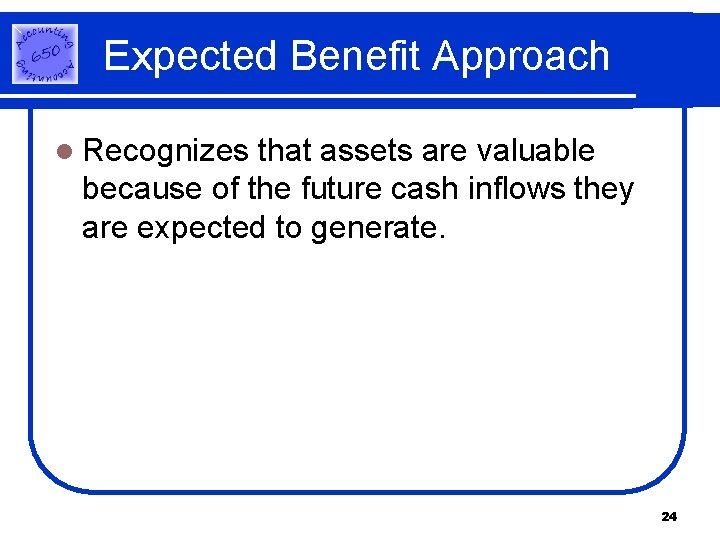
Expected Benefit Approach l Recognizes that assets are valuable because of the future cash inflows they are expected to generate. 24
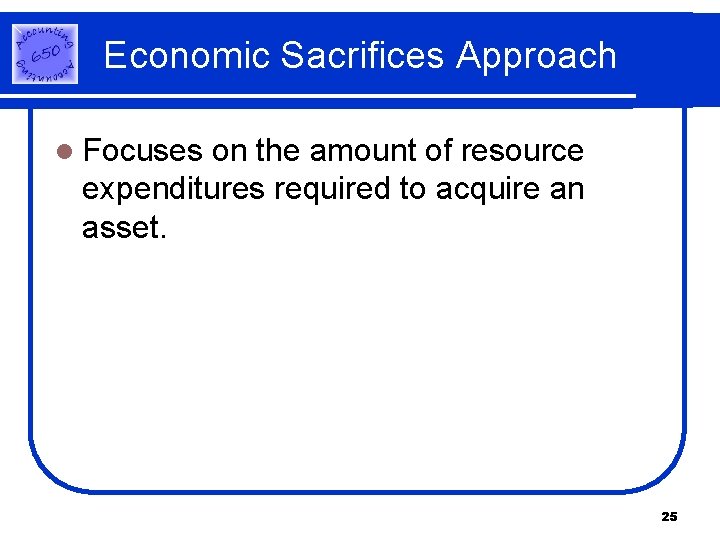
Economic Sacrifices Approach l Focuses on the amount of resource expenditures required to acquire an asset. 25
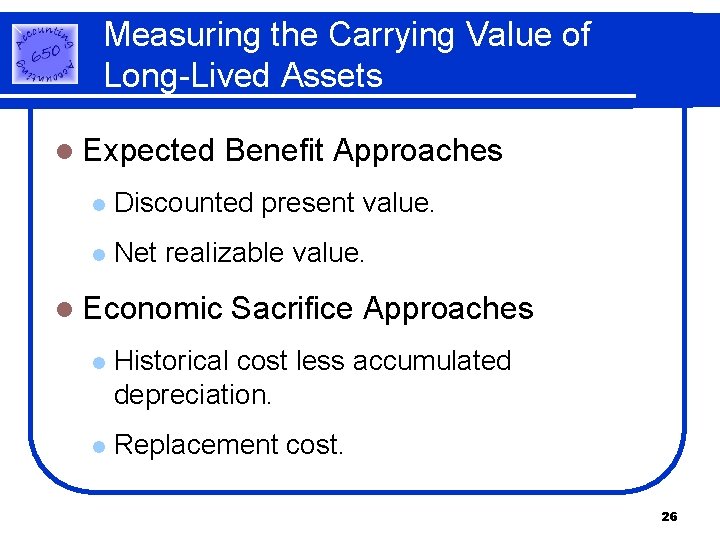
Measuring the Carrying Value of Long-Lived Assets l Expected Benefit Approaches l Discounted present value. l Net realizable value. l Economic Sacrifice Approaches l Historical cost less accumulated depreciation. l Replacement cost. 26
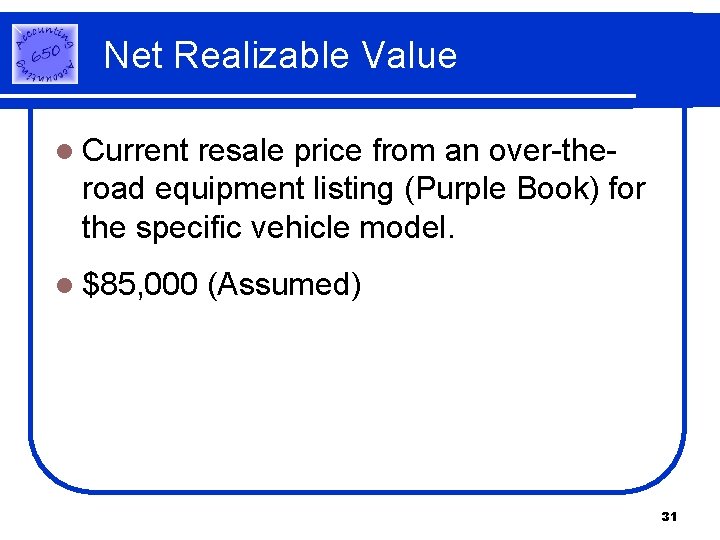
1
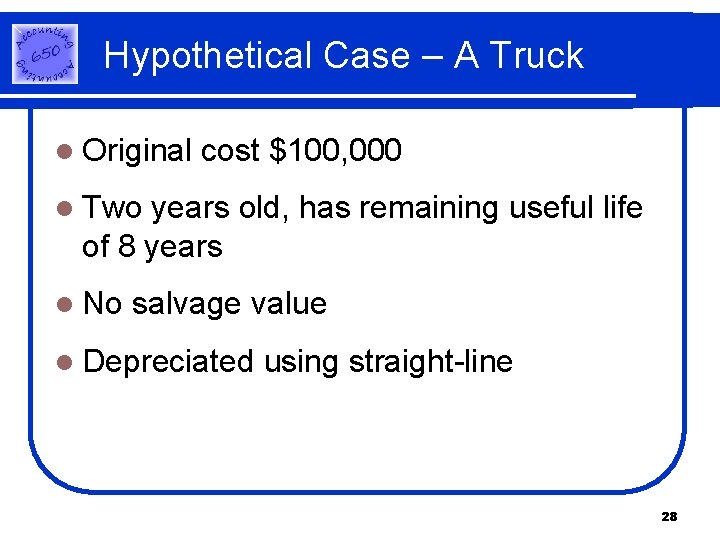
Hypothetical Case – A Truck l Original cost $100, 000 l Two years old, has remaining useful life of 8 years l No salvage value l Depreciated using straight-line 28
1
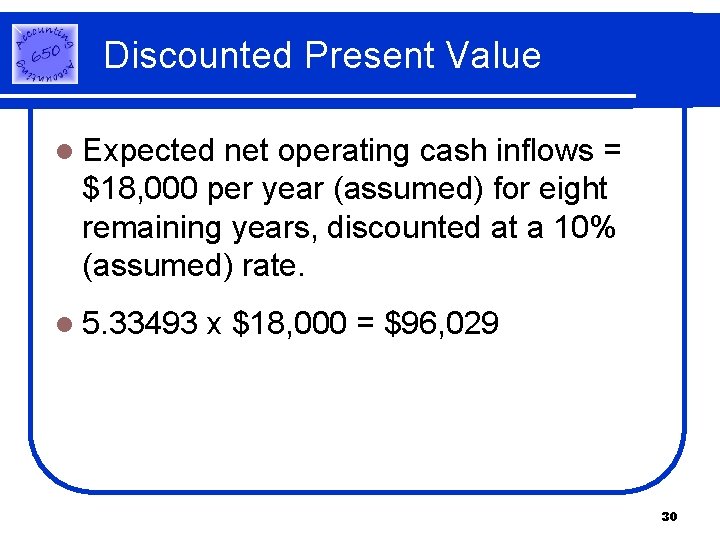
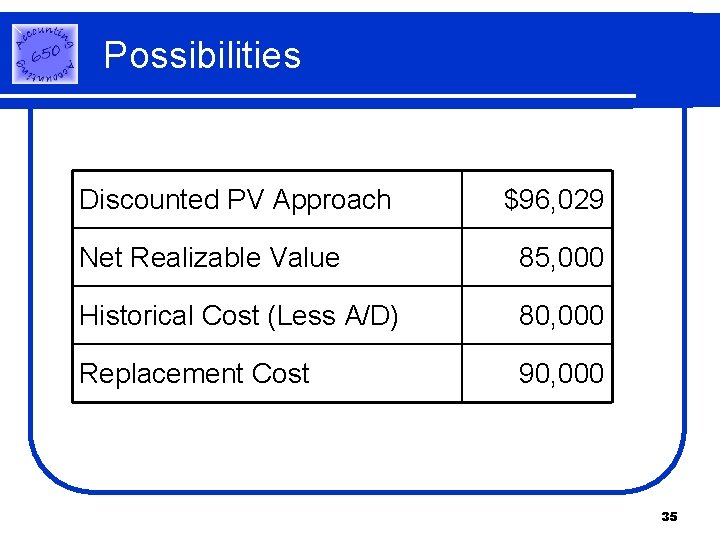
Discounted Present Value l Expected net operating cash inflows = $18, 000 per year (assumed) for eight remaining years, discounted at a 10% (assumed) rate. l 5. 33493 x $18, 000 = $96, 029 30
Net Realizable Value l Current resale price from an over-theroad equipment listing (Purple Book) for the specific vehicle model. l $85, 000 (Assumed) 31
1
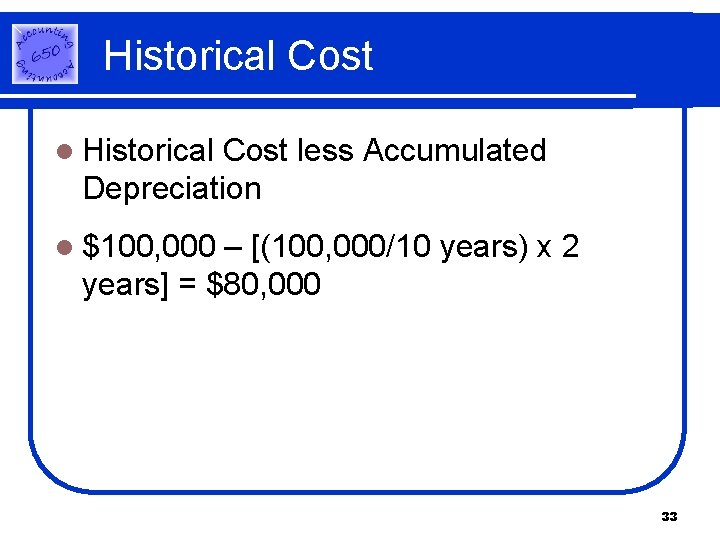
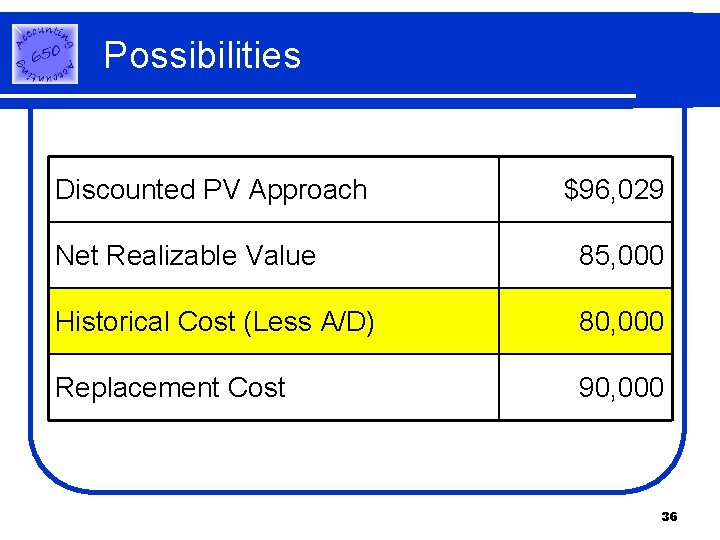
Historical Cost less Accumulated Depreciation l $100, 000 – [(100, 000/10 years) x 2 years] = $80, 000 33
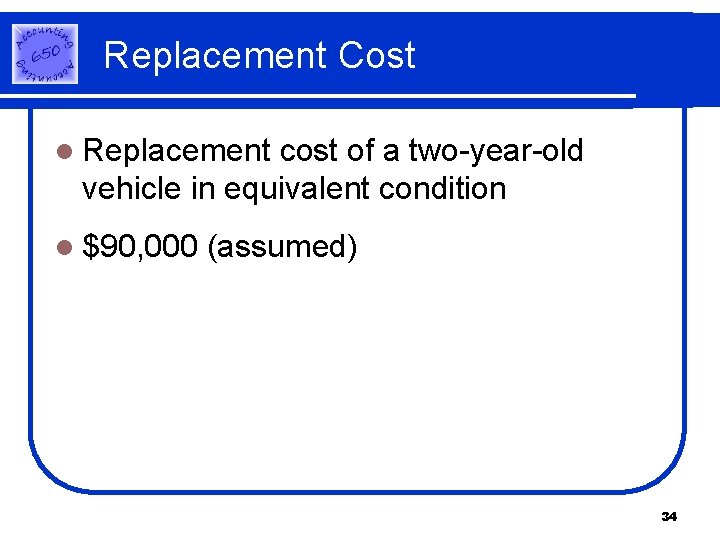
Replacement Cost l Replacement cost of a two-year-old vehicle in equivalent condition l $90, 000 (assumed) 34
Possibilities Discounted PV Approach $96, 029 Net Realizable Value 85, 000 Historical Cost (Less A/D) 80, 000 Replacement Cost 90, 000 35
Possibilities Discounted PV Approach $96, 029 Net Realizable Value 85, 000 Historical Cost (Less A/D) 80, 000 Replacement Cost 90, 000 36
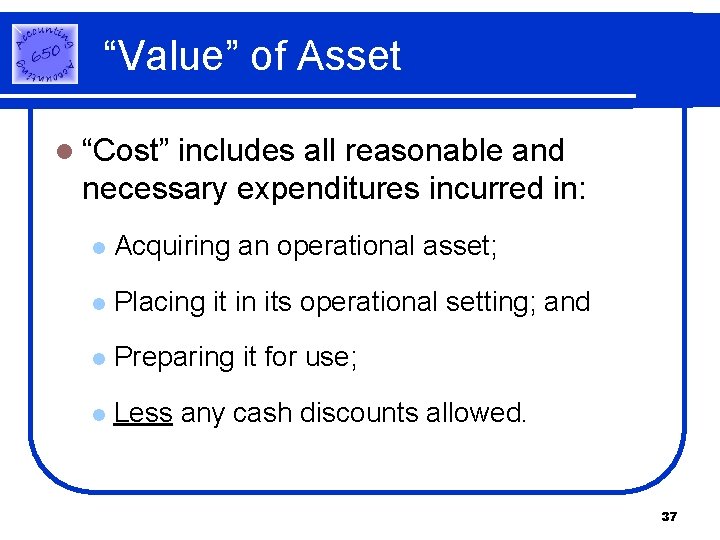
“Value” of Asset l “Cost” includes all reasonable and necessary expenditures incurred in: l Acquiring an operational asset; l Placing it in its operational setting; and l Preparing it for use; l Less any cash discounts allowed. 37
Acquisition cost of Property, Plant, and Equipment Fundamental Issue #2: Allocating the Cost of an Asset?
Theoretical Justification l The matching principle requires the cost of an asset be charged to expense in the periods benefited. l The allocation process is called depreciation. 39
Revenue-Expense Association The Matching Principle l Three principles govern the inclusion of an expense in the matching process: l Association of cause and effect l Systematic and rational allocation 40
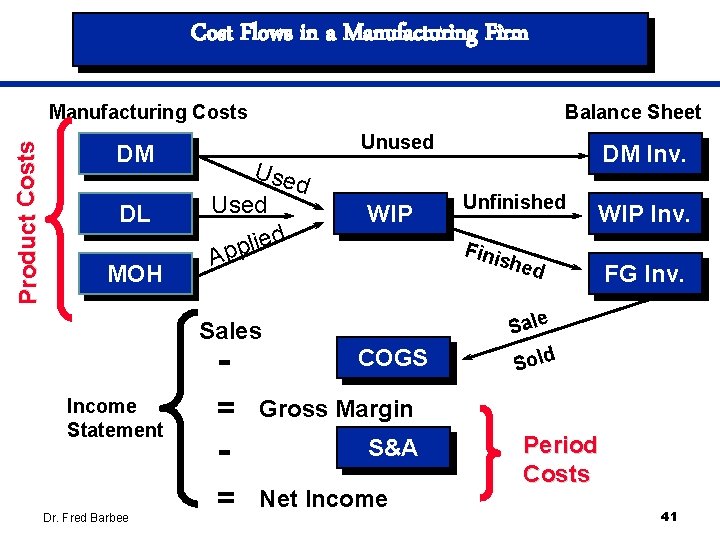
Cost Flows in a Manufacturing Firm Product Costs Manufacturing Costs DM DL MOH Balance Sheet Unused Used d e i l App WIP Income Statement she Dr. Fred Barbee COGS = Gross Margin - S&A = Unfinished Fini Sales - DM Inv. Net Income WIP Inv. d FG Inv. Sale Sold Period Costs 41
Revenue-Expense Association The Matching Principle l Three principles govern the inclusion of an expense in the matching process: l Association of cause and effect l Systematic and rational allocation l Immediate recognition 42
Factors in Computing Depreciation
Factors in Computing Depreciation l The calculation of depreciation requires three amounts for each asset: l Cost l Useful life l Salvage value 45
Depreciation Methods Based on Time l Straight-Line l Accelerated l Sum-of-the-years’digits l Declining Balance 46
Depreciation Methods Based on Activity Level l Productive output l Service quantity 47
Depreciation l If an asset is expected to benefit all periods equally, l a straight-line method of depreciation would be appropriate. 48
Depreciation l If more benefits are expected early in the life of an asset. . . l an accelerated method of depreciation would be appropriate. 49
Depreciation l If benefits are related to the output of an asset. . . l the units-of-production method of depreciation would be appropriate. 50
Types of Accounting Changes
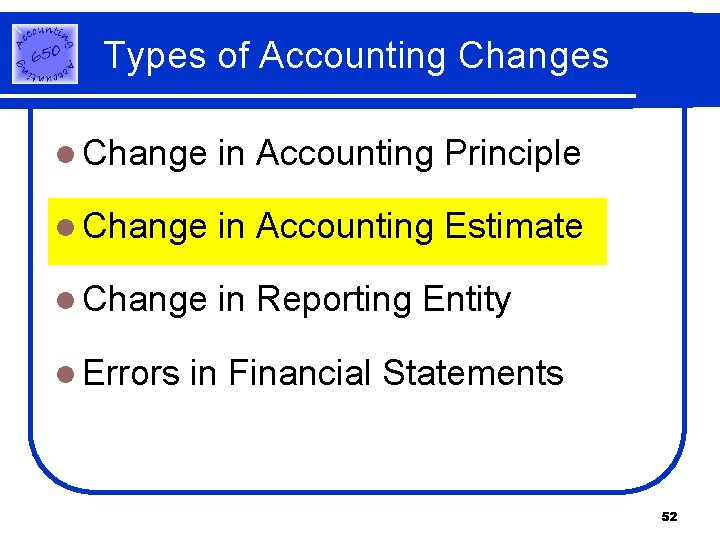
Types of Accounting Changes l Change in Accounting Principle l Change in Accounting Estimate l Change in Reporting Entity l Errors in Financial Statements 52
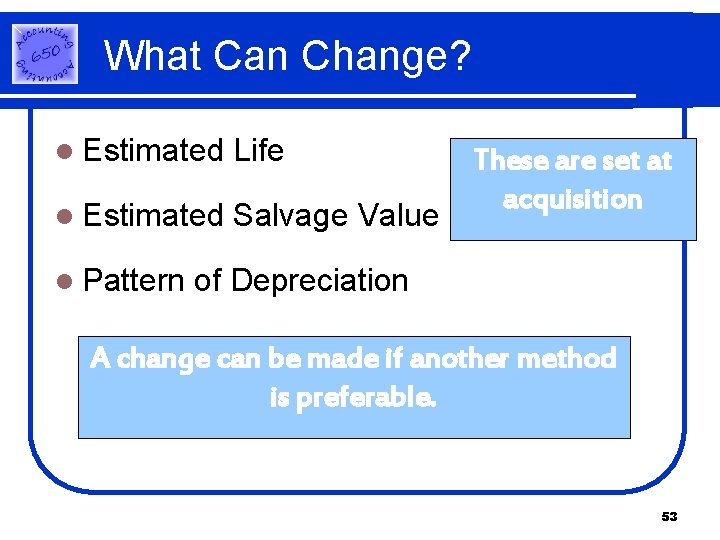
What Can Change? l Estimated Life l Estimated Salvage Value l Pattern These are set at acquisition of Depreciation A change can be made if another method is preferable. 53
Methods of Depreciation Straight-Line Method
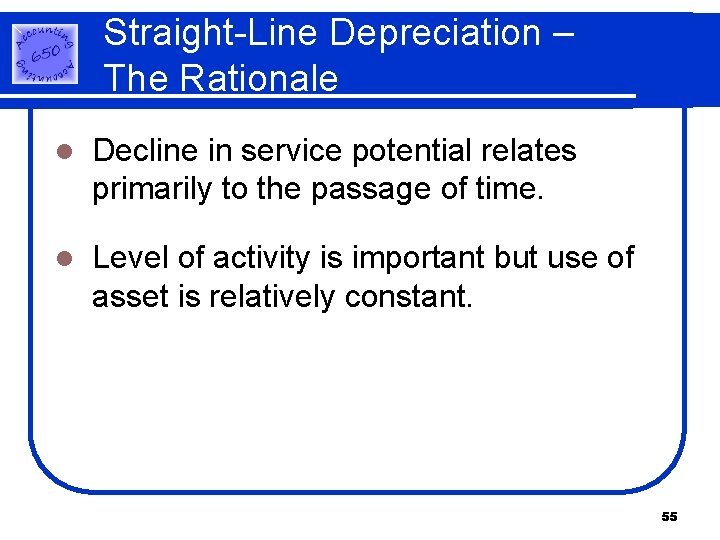
Straight-Line Depreciation – The Rationale l Decline in service potential relates primarily to the passage of time. l Level of activity is important but use of asset is relatively constant. 55
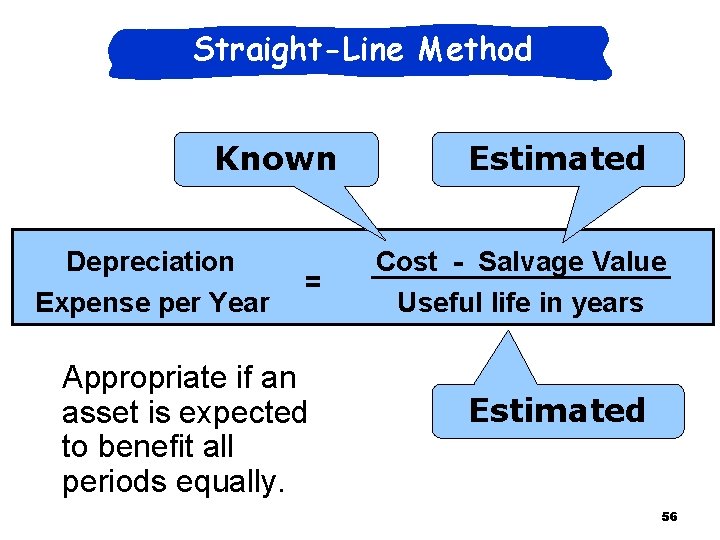
Straight-Line Method Known Depreciation Expense per Year = Appropriate if an asset is expected to benefit all periods equally. Estimated Cost - Salvage Value Useful life in years Estimated 56
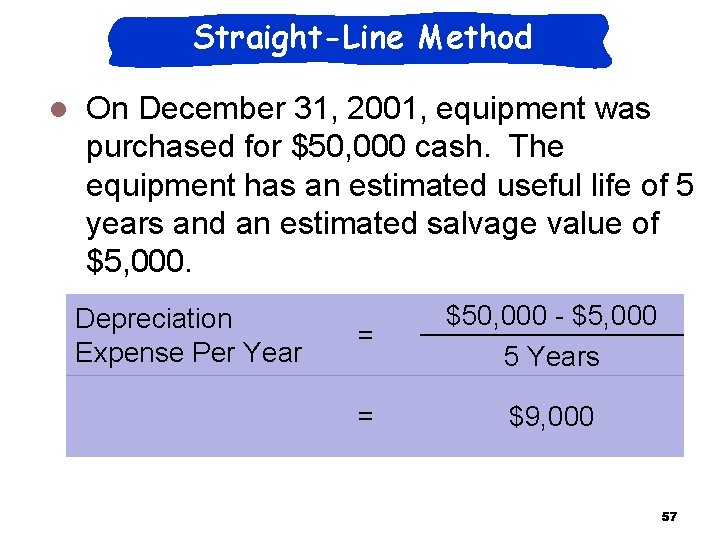
Straight-Line Method l On December 31, 2001, equipment was purchased for $50, 000 cash. The equipment has an estimated useful life of 5 years and an estimated salvage value of $5, 000. Depreciation Expense Per Year = $50, 000 - $5, 000 5 Years = $9, 000 57
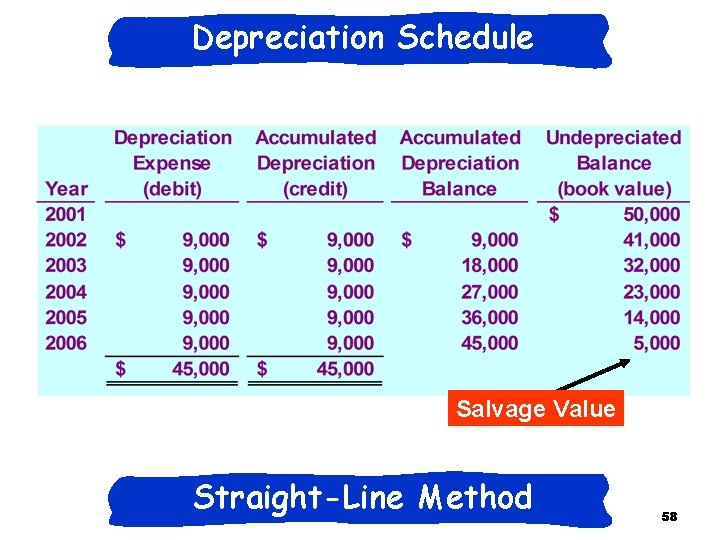
Depreciation Schedule Salvage Value Straight-Line Method 58
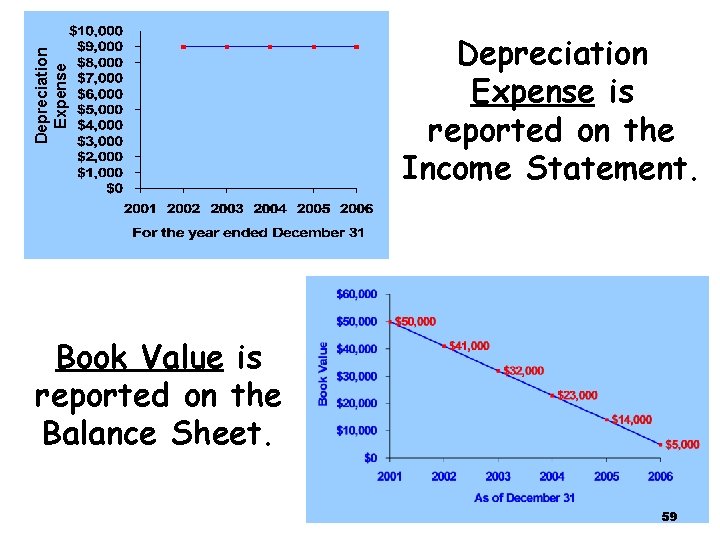
Depreciation Expense is reported on the Income Statement. Book Value is reported on the Balance Sheet. 59
Methods of Depreciation Declining-Balance
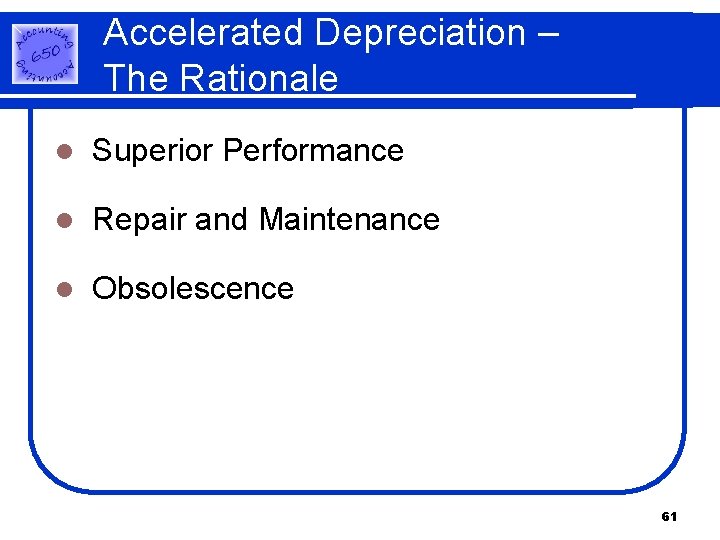
Accelerated Depreciation – The Rationale l Superior Performance l Repair and Maintenance l Obsolescence 61
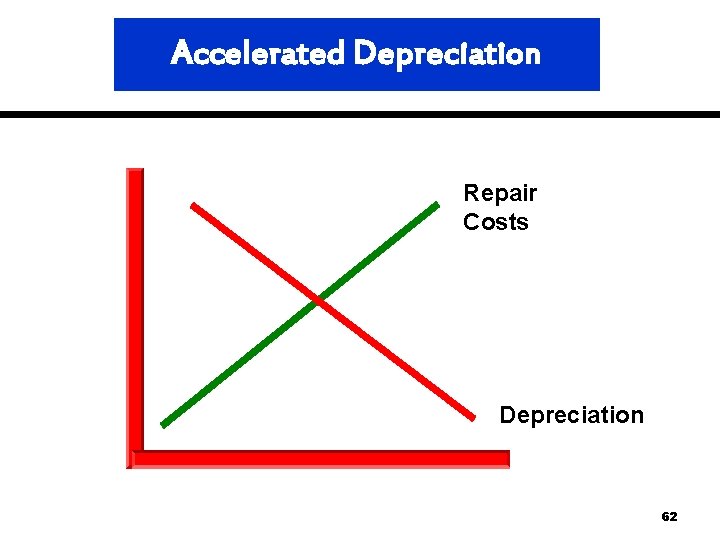
Accelerated Depreciation Repair Costs Depreciation 62
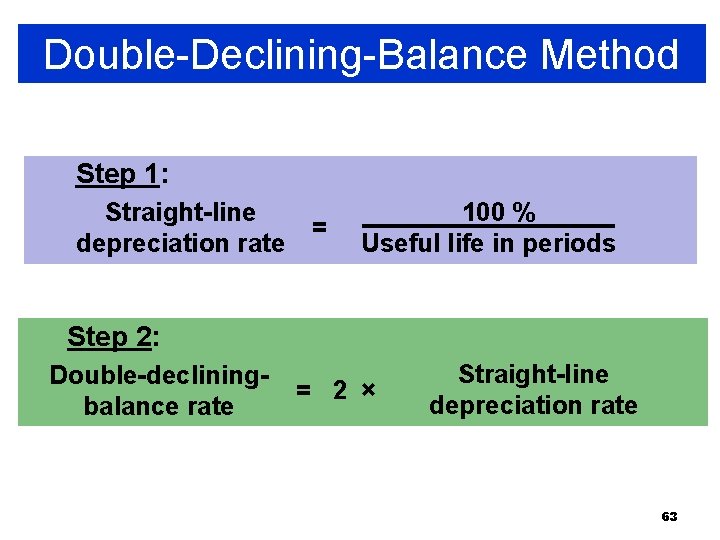
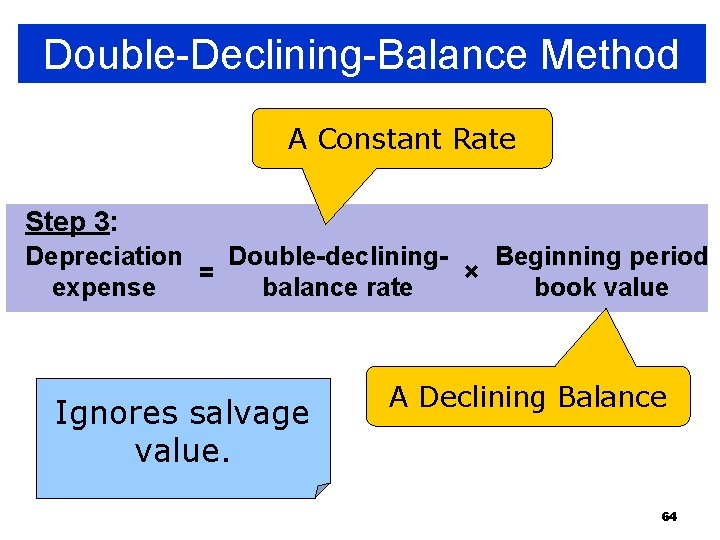
Double-Declining-Balance Method Step 1: Straight-line depreciation rate = 100 % Useful life in periods Step 2: Double-decliningbalance rate = 2 × Straight-line depreciation rate 63
Double-Declining-Balance Method A Constant Rate Step 3: Depreciation Double-declining. Beginning period = × expense balance rate book value Ignores salvage value. A Declining Balance 64
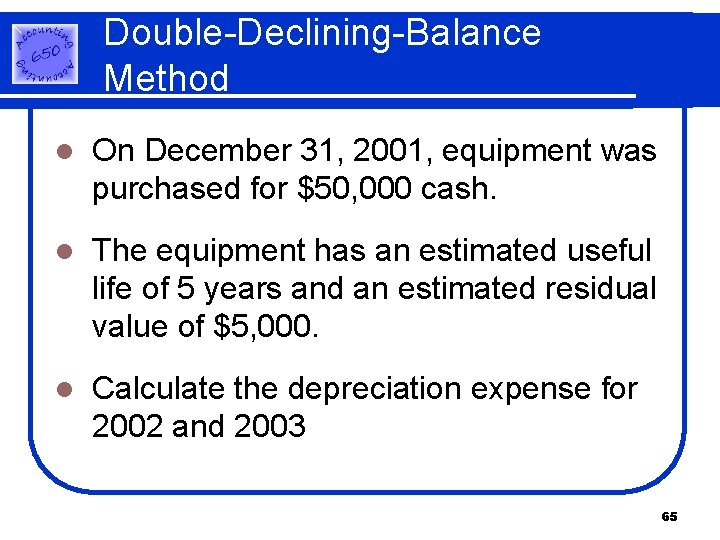
Double-Declining-Balance Method l On December 31, 2001, equipment was purchased for $50, 000 cash. l The equipment has an estimated useful life of 5 years and an estimated residual value of $5, 000. l Calculate the depreciation expense for 2002 and 2003 65
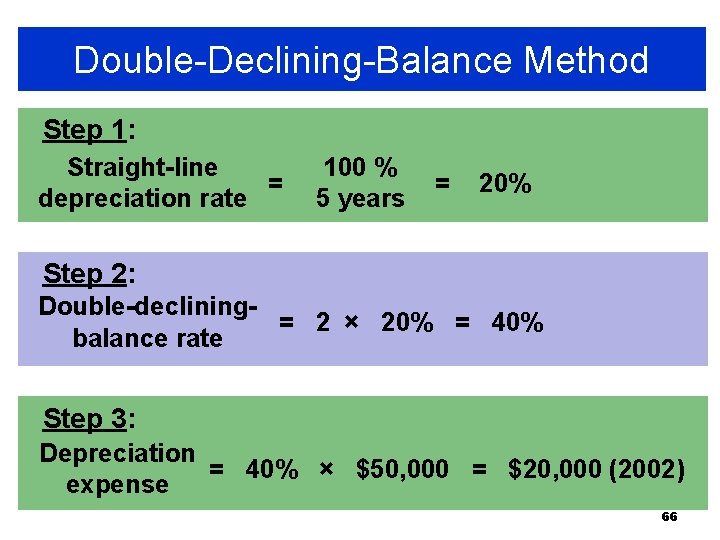
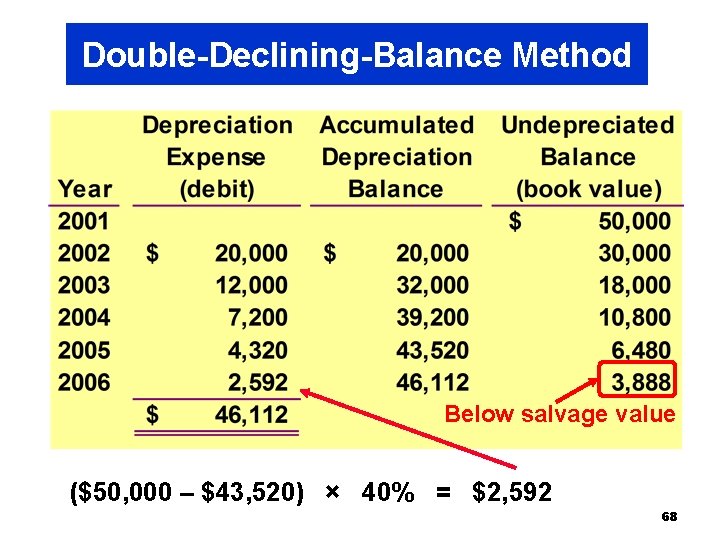
Double-Declining-Balance Method Step 1: Straight-line = depreciation rate 100 % 5 years = 20% Step 2: Double-declining= 2 × 20% = 40% balance rate Step 3: Depreciation = 40% × $50, 000 = $20, 000 (2002) expense 66
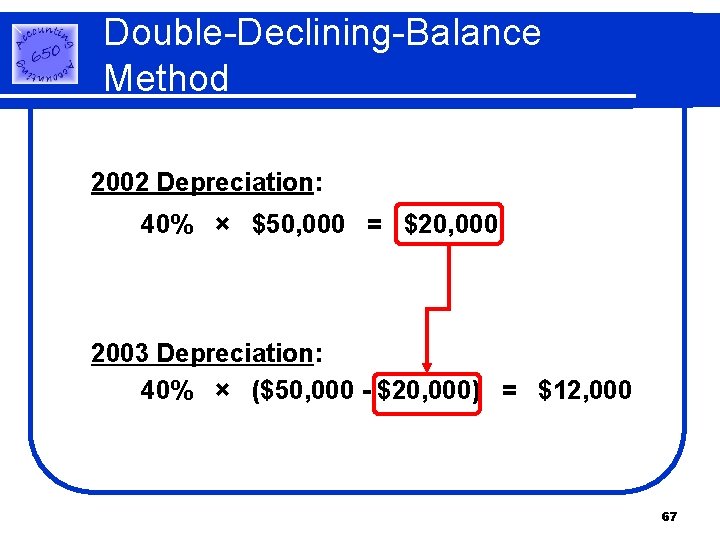
Double-Declining-Balance Method 2002 Depreciation: 40% × $50, 000 = $20, 000 2003 Depreciation: 40% × ($50, 000 - $20, 000) = $12, 000 67
Double-Declining-Balance Method Below salvage value ($50, 000 – $43, 520) × 40% = $2, 592 68
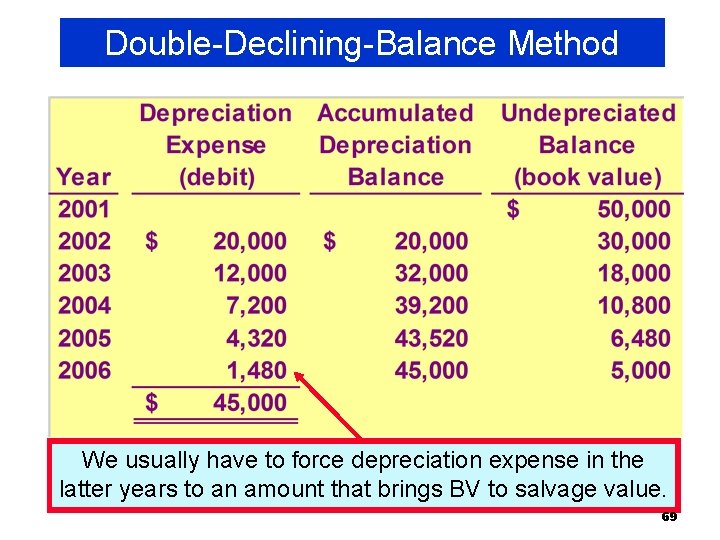
Double-Declining-Balance Method We usually have to force depreciation expense in the latter years to an amount that brings BV to salvage value. 69
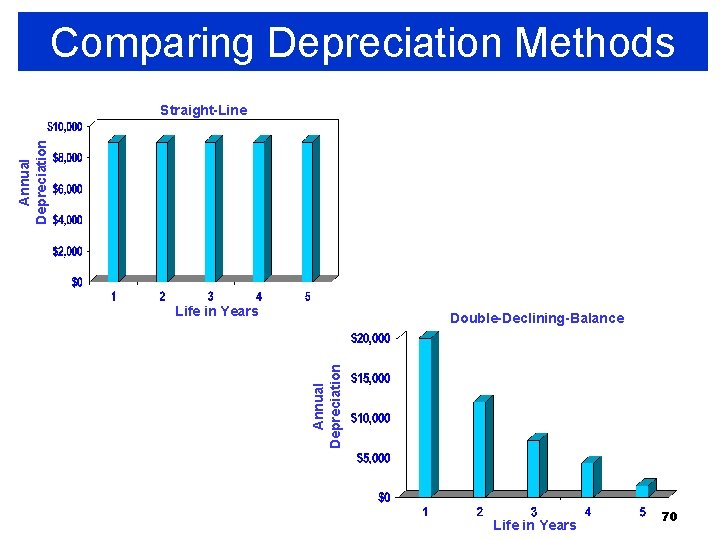
Comparing Depreciation Methods Annual Depreciation Straight-Line Life in Years Annual Depreciation Double-Declining-Balance Life in Years 70
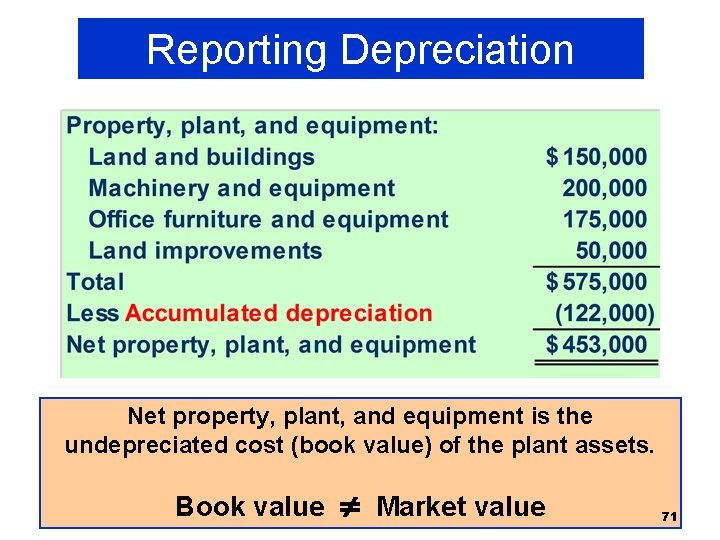
Reporting Depreciation Net property, plant, and equipment is the undepreciated cost (book value) of the plant assets. Book value Market value 71
Selecting an Appropriate Depreciation Method What are the factors that should be considered in selecting a depreciation method? 72
Depreciation at Delta Air Lines and Singapore Airlines Now. . . On to the case!!!
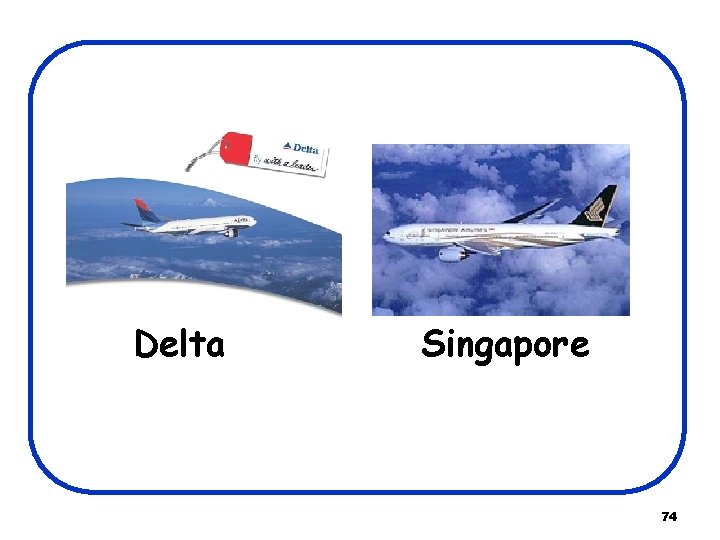
Delta Singapore Let’s Compare 74
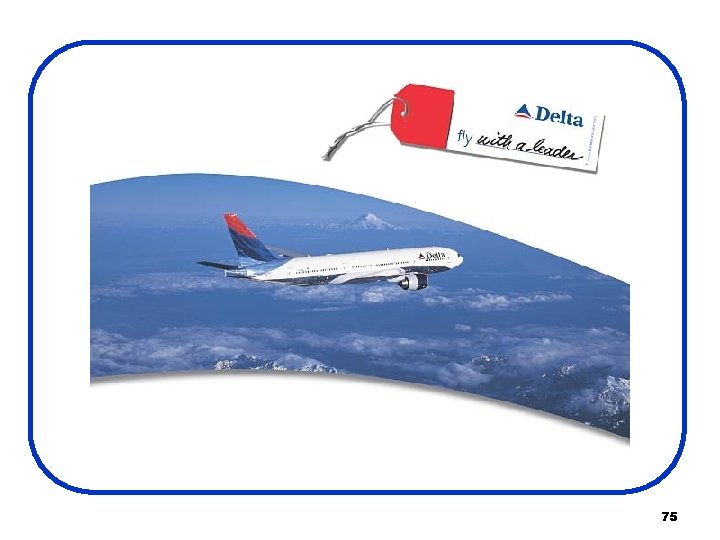
Delta Air Lines 75
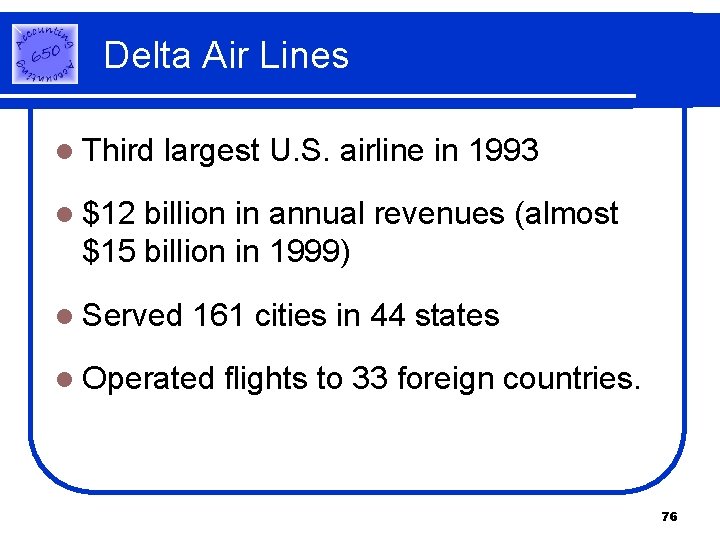
Delta Air Lines l Third largest U. S. airline in 1993 l $12 billion in annual revenues (almost $15 billion in 1999) l Served 161 cities in 44 states l Operated flights to 33 foreign countries. 76
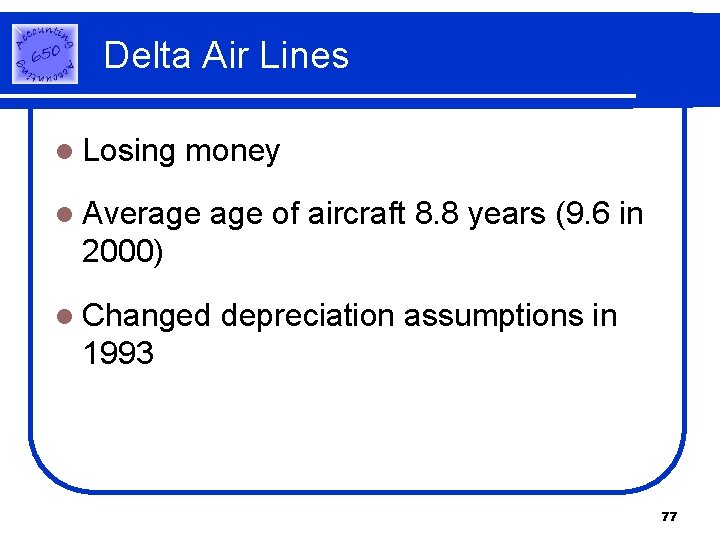
Delta Air Lines l Losing money l Average of aircraft 8. 8 years (9. 6 in 2000) l Changed depreciation assumptions in 1993 77
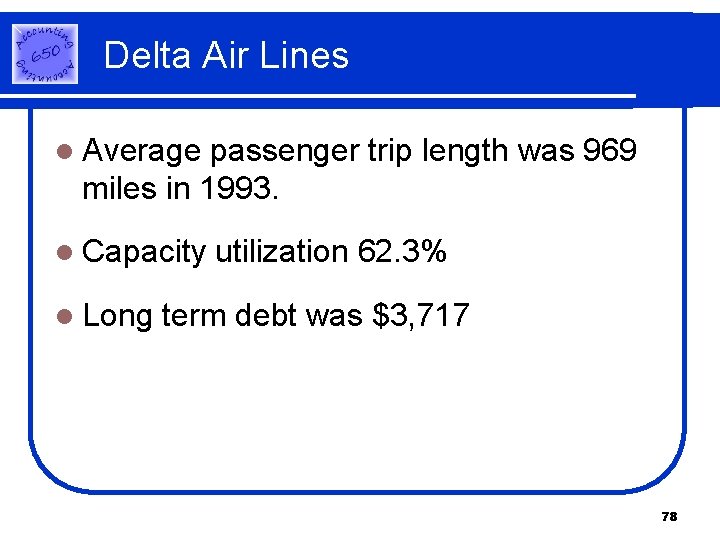
Delta Air Lines l Average passenger trip length was 969 miles in 1993. l Capacity l Long utilization 62. 3% term debt was $3, 717 78
Singapore Airlines 79
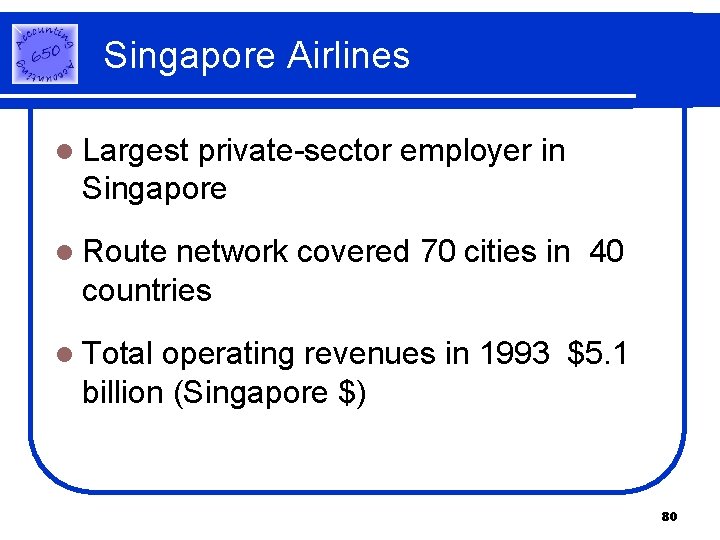
Singapore Airlines l Largest private-sector employer in Singapore l Route network covered 70 cities in 40 countries l Total operating revenues in 1993 $5. 1 billion (Singapore $) 80
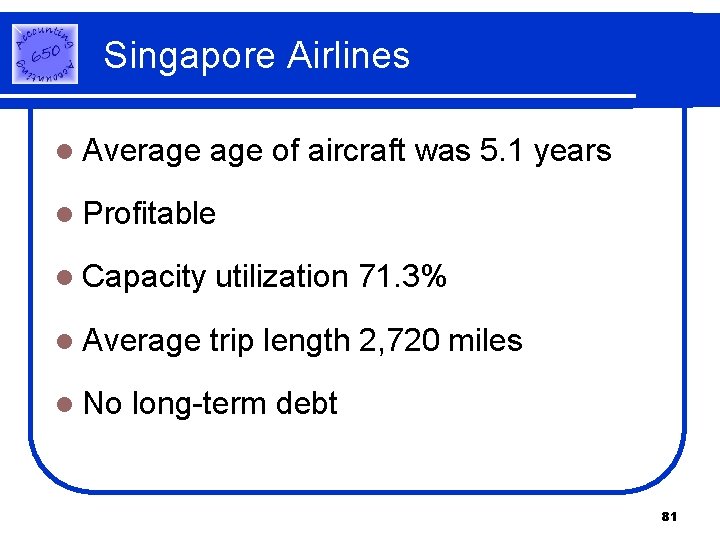
Singapore Airlines l Average of aircraft was 5. 1 years l Profitable l Capacity utilization 71. 3% l Average trip length 2, 720 miles l No long-term debt 81
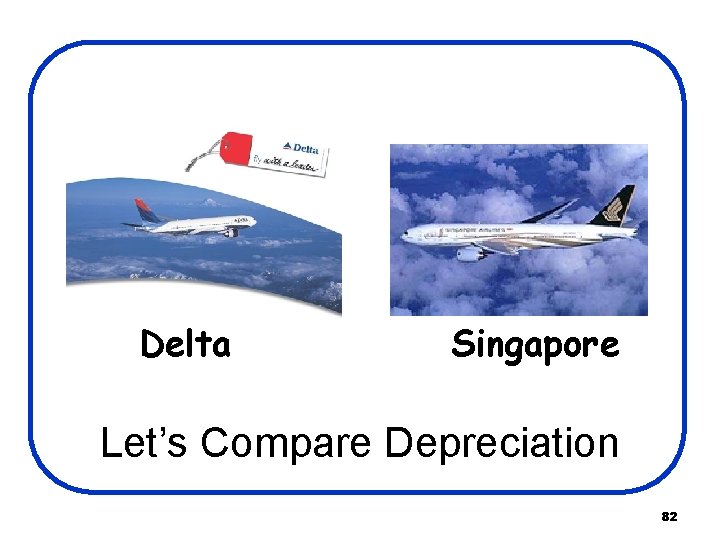
Delta Singapore Let’s Compare Depreciation 82
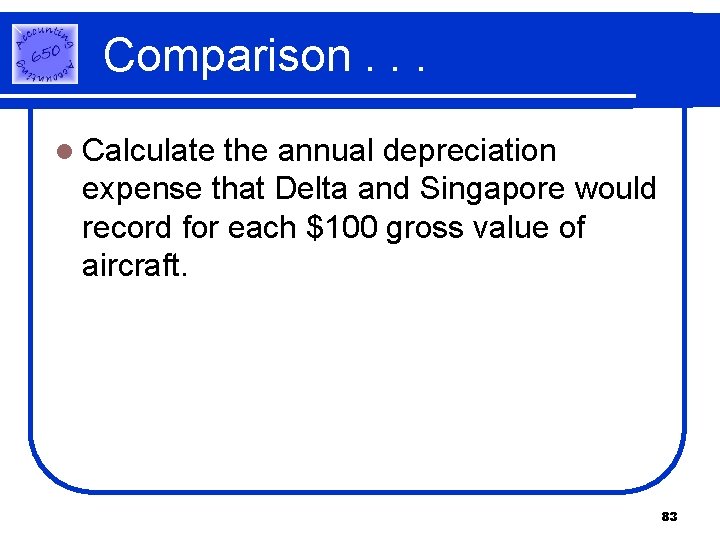
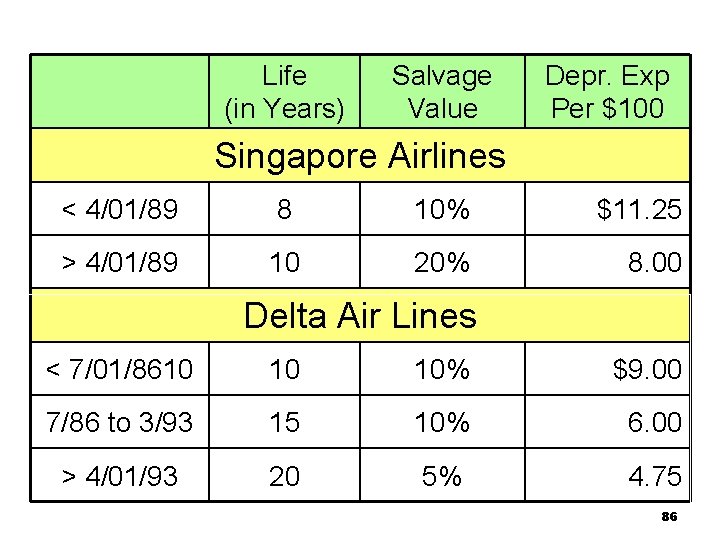
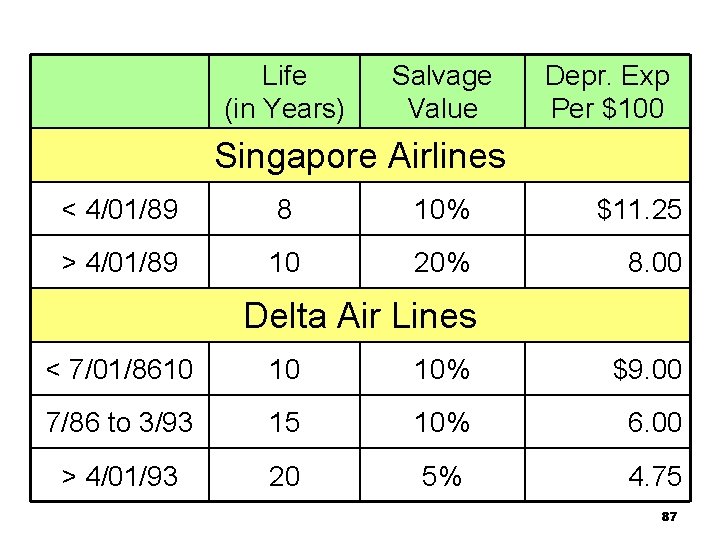
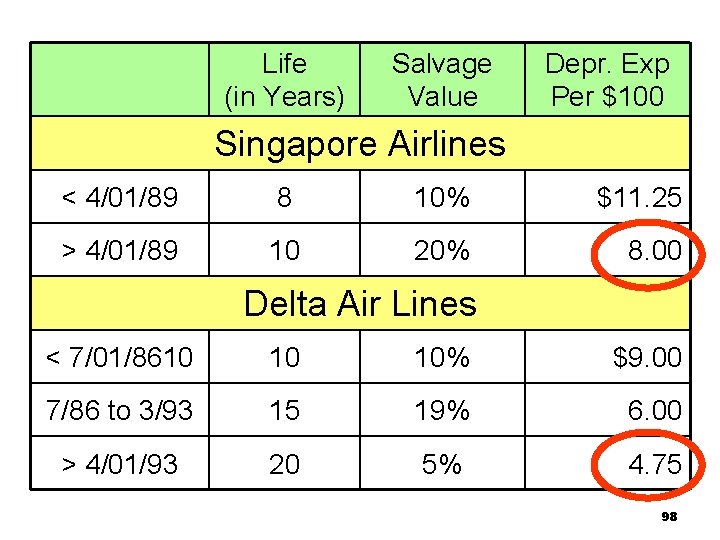
Comparison. . . l Calculate the annual depreciation expense that Delta and Singapore would record for each $100 gross value of aircraft. 83
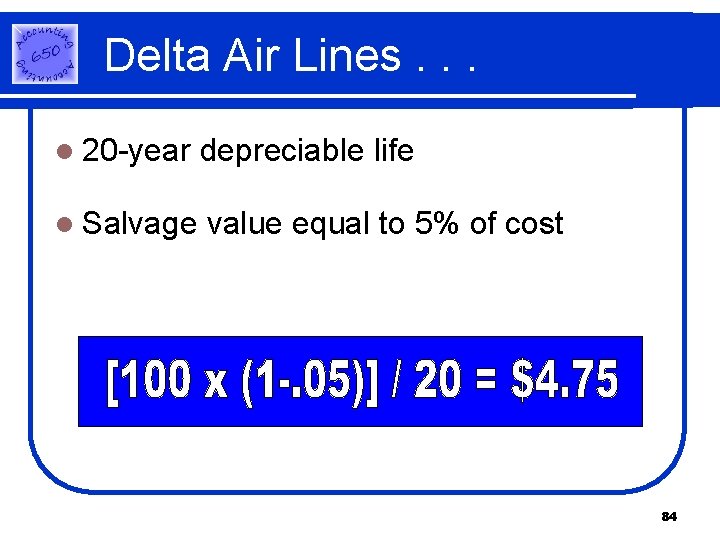
Delta Air Lines. . . l 20 -year depreciable life l Salvage value equal to 5% of cost 84
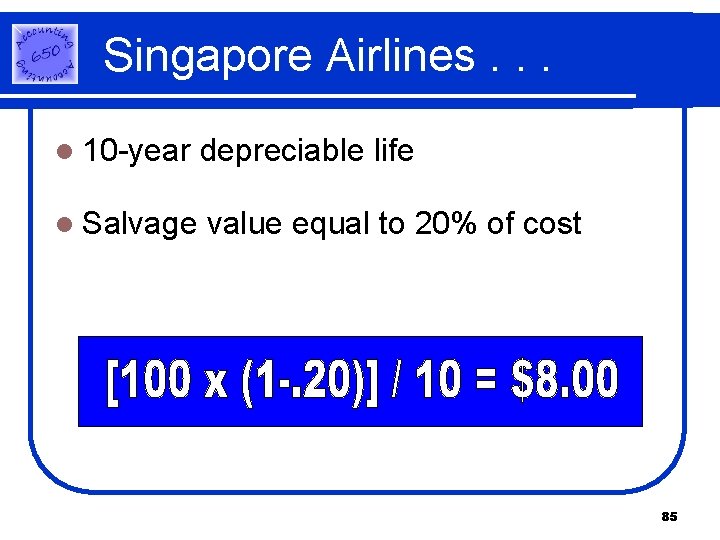
Singapore Airlines. . . l 10 -year depreciable life l Salvage value equal to 20% of cost 85
Life (in Years) Salvage Value Depr. Exp Per $100 Singapore Airlines < 4/01/89 8 10% $11. 25 > 4/01/89 10 20% 8. 00 Delta Air Lines < 7/01/8610 10 10% $9. 00 7/86 to 3/93 15 10% 6. 00 > 4/01/93 20 5% 4. 75 86
Life (in Years) Salvage Value Depr. Exp Per $100 Singapore Airlines < 4/01/89 8 10% $11. 25 > 4/01/89 10 20% 8. 00 Delta Air Lines < 7/01/8610 10 10% $9. 00 7/86 to 3/93 15 10% 6. 00 > 4/01/93 20 5% 4. 75 87
Comparison. . . l Are the differences in the ways the two airlines account for depreciation expense significant? l Why would companies depreciate aircraft using different depreciable lives and salvage? 88
Useful Life
Comparison. . . l Why would companies depreciate aircraft using different depreciable lives and salvage values? l What reasons could be given to support these differences? l Is different treatment proper? 90
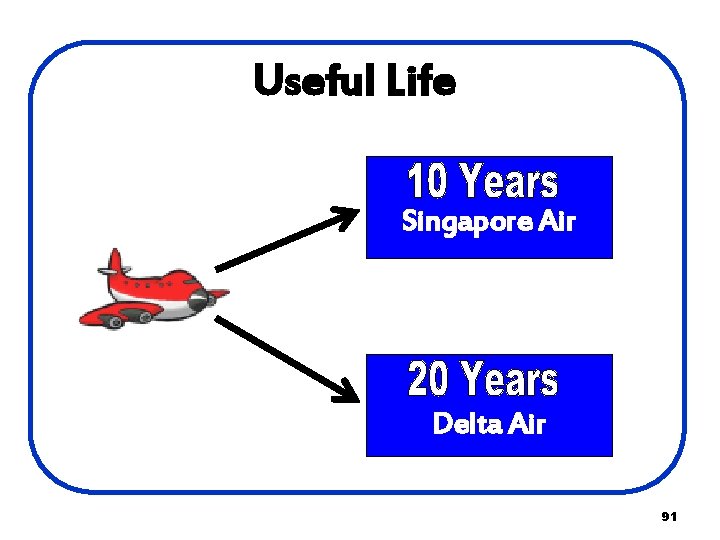
Useful Life Singapore Air Delta Air 91
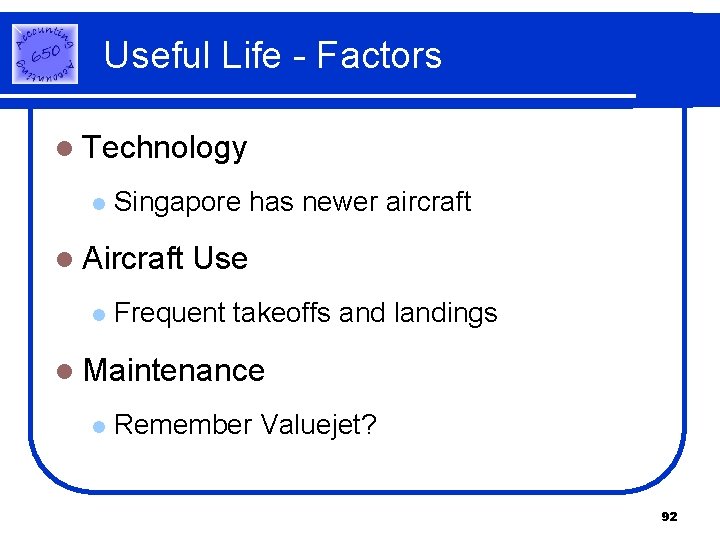
Useful Life - Factors l Technology l Singapore has newer aircraft l Aircraft l Use Frequent takeoffs and landings l Maintenance l Remember Valuejet? 92
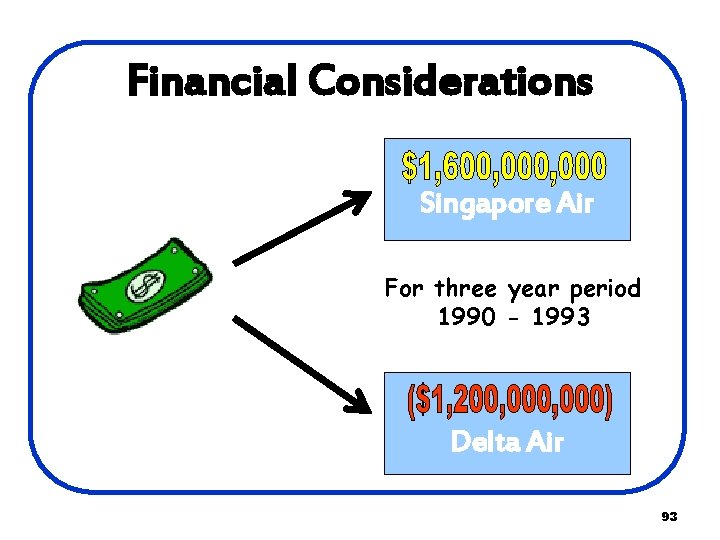
Financial Considerations Singapore Air For three year period 1990 - 1993 Delta Air 93
Delta Air Lines Can we quantify Delta’s more liberal depreciation policies? 94
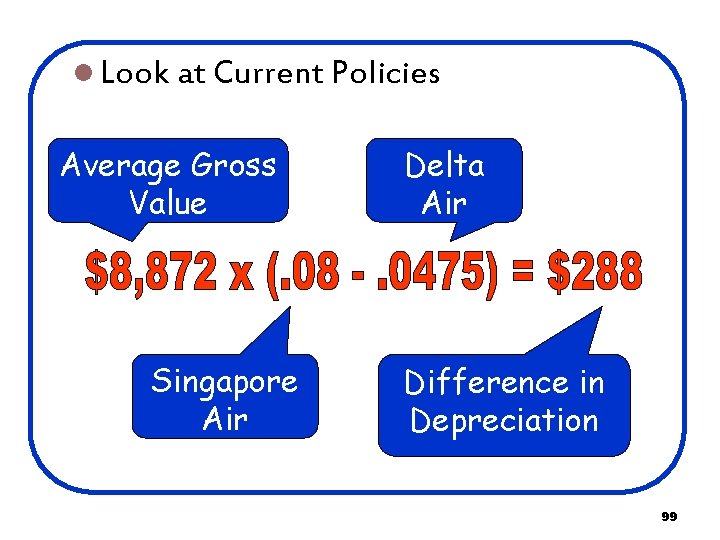
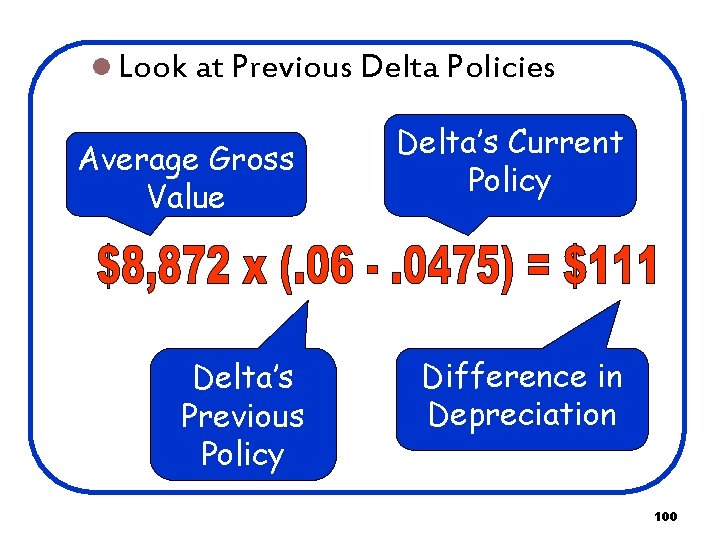
Delta Air Lines l Assuming the average value of flight equipment that Delta had in 1993, how much of a difference do the depreciation assumptions it adopted on April 1, 1993 make? 95
Delta Air Lines l How much more or less will its annual depreciation expense be compared to what it would be were it using Singapore’s depreciation assumptions? 96
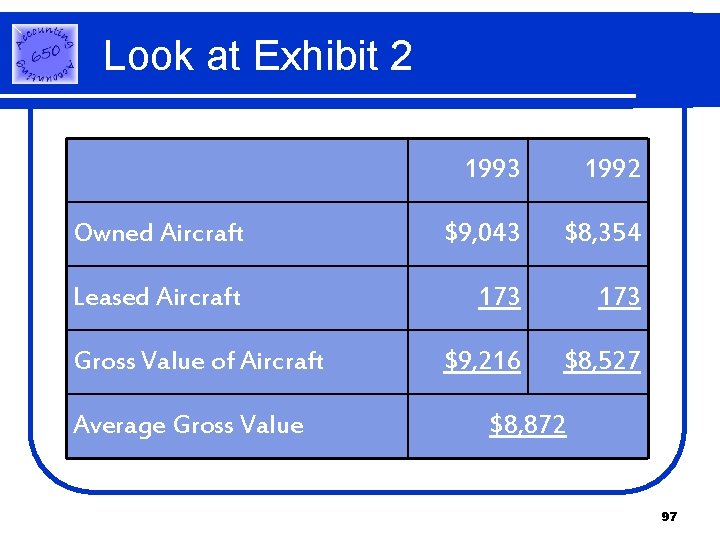
Look at Exhibit 2 1993 1992 Owned Aircraft $9, 043 $8, 354 Leased Aircraft 173 $9, 216 $8, 527 Gross Value of Aircraft Average Gross Value $8, 872 97
Life (in Years) Salvage Value Depr. Exp Per $100 Singapore Airlines < 4/01/89 8 10% $11. 25 > 4/01/89 10 20% 8. 00 Delta Air Lines < 7/01/8610 10 10% $9. 00 7/86 to 3/93 15 19% 6. 00 > 4/01/93 20 5% 4. 75 98
l Look at Current Policies Average Gross Value Singapore Air Delta Air Difference in Depreciation 99
l Look at Previous Delta Policies Average Gross Value Delta’s Previous Policy Delta’s Current Policy Difference in Depreciation 100
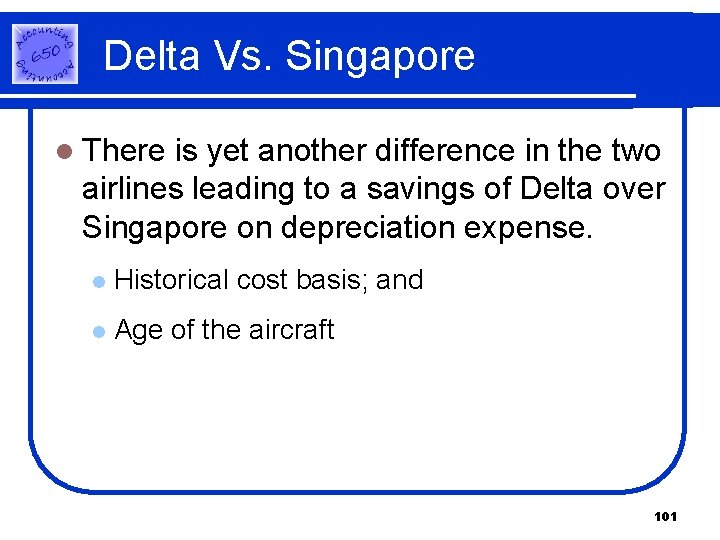
Delta Vs. Singapore l There is yet another difference in the two airlines leading to a savings of Delta over Singapore on depreciation expense. l Historical cost basis; and l Age of the aircraft 101
Delta Vs. Singapore l Does the difference in the average of Delta’s and Singapore’s aircraft fleets have any impact on the amount of depreciation expense they record? l If so, how much? 102
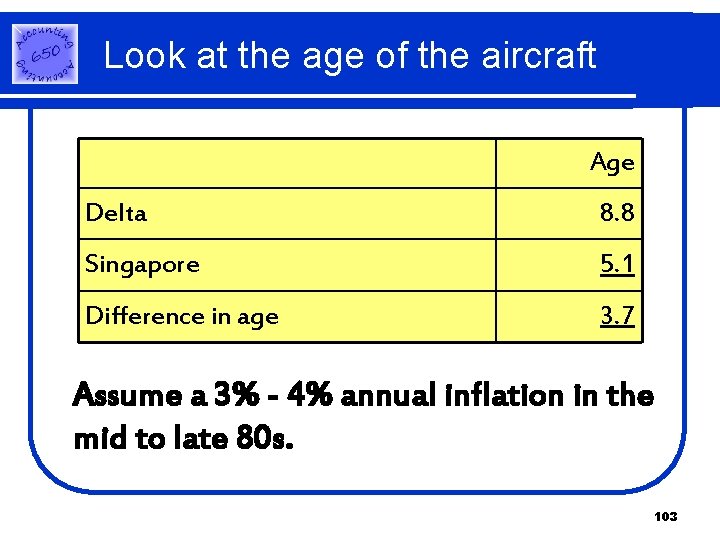
Look at the age of the aircraft Age Delta 8. 8 Singapore 5. 1 Difference in age 3. 7 Assume a 3% - 4% annual inflation in the mid to late 80 s. 103
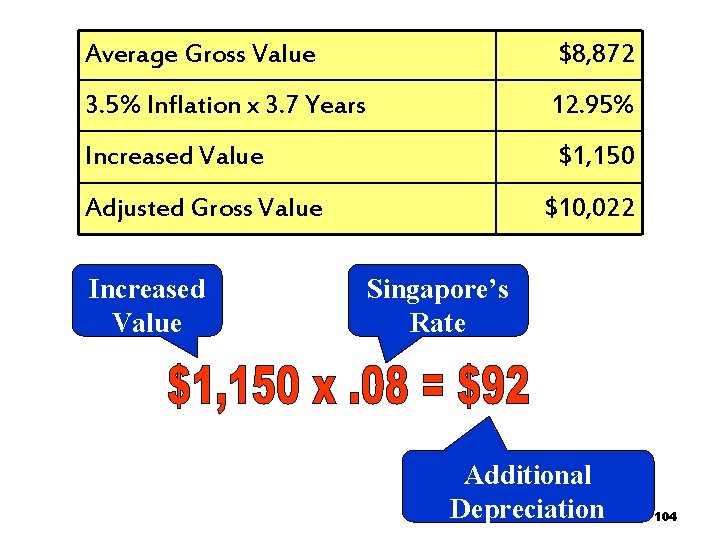
Average Gross Value $8, 872 3. 5% Inflation x 3. 7 Years 12. 95% Increased Value $1, 150 Adjusted Gross Value Increased Value $10, 022 Singapore’s Rate Additional Depreciation 104
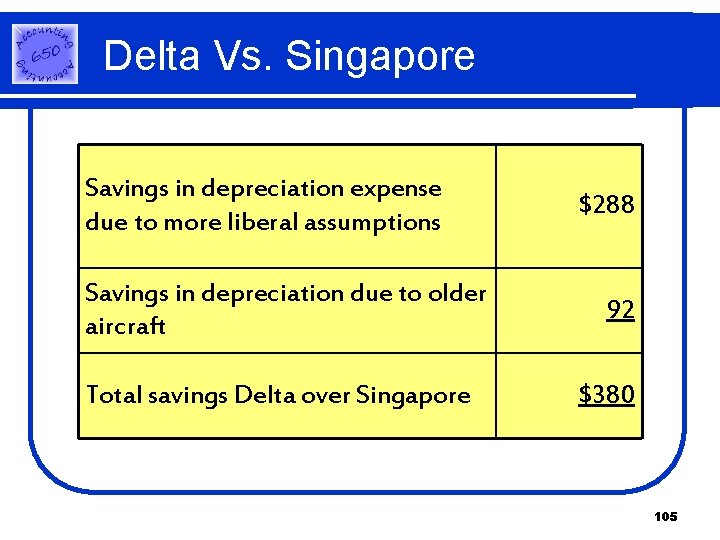
Delta Vs. Singapore Savings in depreciation expense due to more liberal assumptions Savings in depreciation due to older aircraft Total savings Delta over Singapore $288 92 $380 105
Delta Vs. Singapore l Singapore Airlines maintains depreciation assumptions that are very different from Delta’s l What does it gain or lose by doing so? l How does this relate to the company’s overall strategy? l Compare Strategies 106
Singapore Airlines 1. Renowned for customer service l State-of-the-art aircraft l Capacity utilization = 71. 3% l 1993 Annual Report: “A superior product will probably enable us to sustain relatively high load factors. 107
Singapore Airlines 2. Long-haul Airline v Average passenger trip length in 1993 was 2, 720 miles (Delta = 969) v Less wear and tear on aircraft – long trips are less stressful than frequent landings and takeoffs 108
Singapore Airlines 3. Gain on sale of aircraft v Average gain $134 million v Direct result of depreciation policies? v Result of corporate strategy v Depreciate fast resulting in low book values on disposal 109
Singapore Airlines 4. Owned Vs. Leased Aircraft v Singapore operates none of their aircraft under operating leases v Delta operates close to 50% of their aircraft under non-cancelable operating leases. 110
Delta Air Lines 4. Owned Vs. Leased Aircraft v Singapore operates none of their aircraft under operating leases v Delta operates close to 50% of their aircraft under non-cancelable operating leases. 111