Chapter 10 Earth Sun and Moon Preview Section
- Slides: 39
Chapter 10 Earth, Sun, and Moon Preview Section 1 Days and Seasons on Earth Section 2 Lunar Cycles Section 3 Tides, the Sun, and the Moon Concept Mapping
Chapter 10 Section 1 Days and Seasons on Earth Bellringer Write a paragraph describing all the different ways that you are moving relative to the sun and moon at this moment. Write your answer in your science journal.
Chapter 10 Section 1 Days and Seasons on Earth Objectives • Explain the cause of daylight and night. • Explain how the tilt and movement of the Earth cause changes in seasons and the length of a day. • Describe what causes equinoxes and solstices. • Describe how latitude affects the amount of seasonal change that an area experiences.
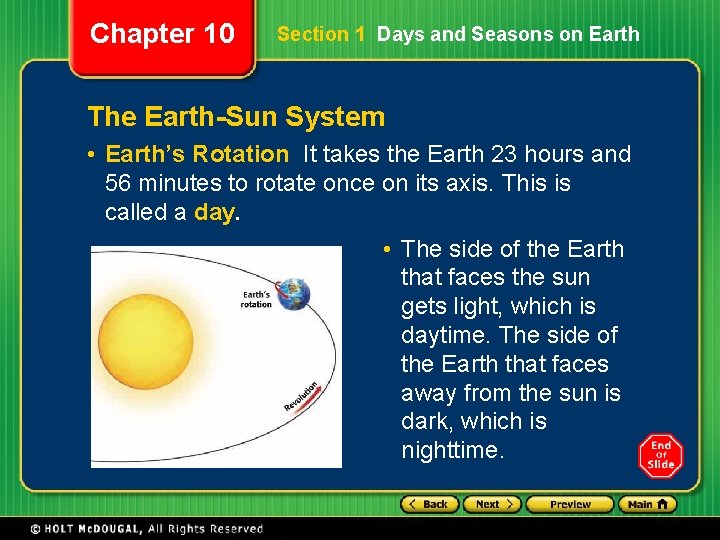
Chapter 10 Section 1 Days and Seasons on Earth The Earth-Sun System • Earth’s Rotation It takes the Earth 23 hours and 56 minutes to rotate once on its axis. This is called a day. • The side of the Earth that faces the sun gets light, which is daytime. The side of the Earth that faces away from the sun is dark, which is nighttime.
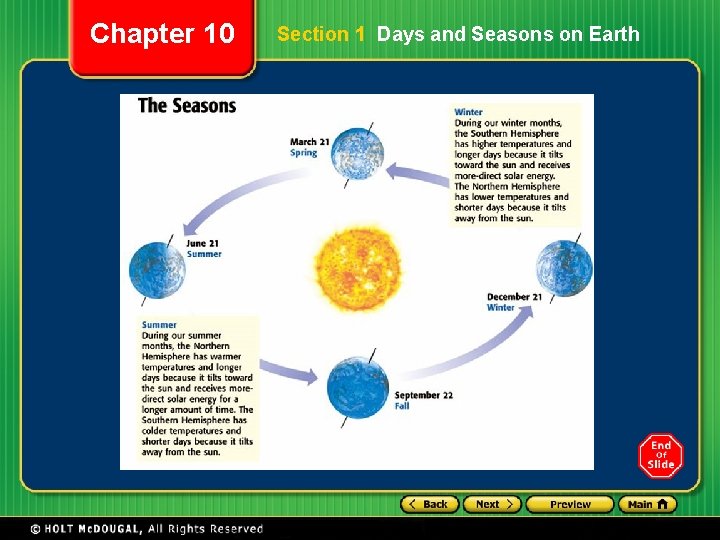
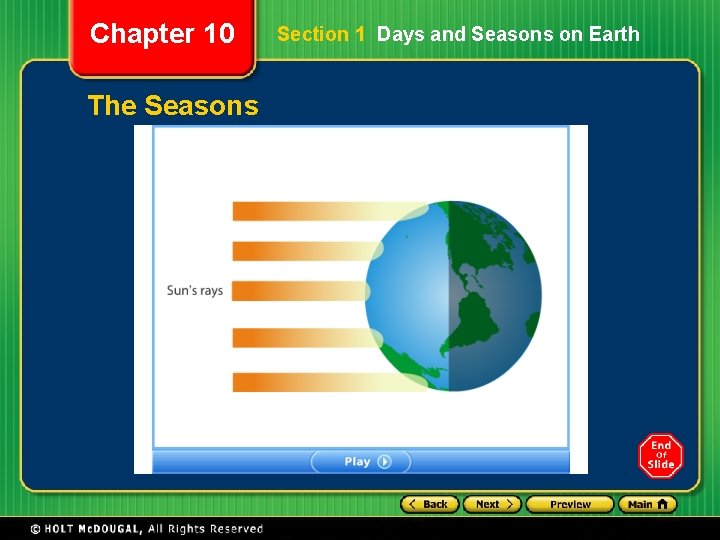
Chapter 10 Section 1 Days and Seasons on Earth The Earth-Sun System, continued • Earth’s Tilt The seasons are caused mainly by the 23. 5° tilt of the Earth’s axis. • During summer months, the Northern Hemisphere has warmer temperatures and longer days because it tilts toward the sun and receives more direct solar energy. • In winter months, the Northern Hemisphere has lower temperatures and shorter days because it tilts away from the sun.
Chapter 10 Section 1 Days and Seasons on Earth
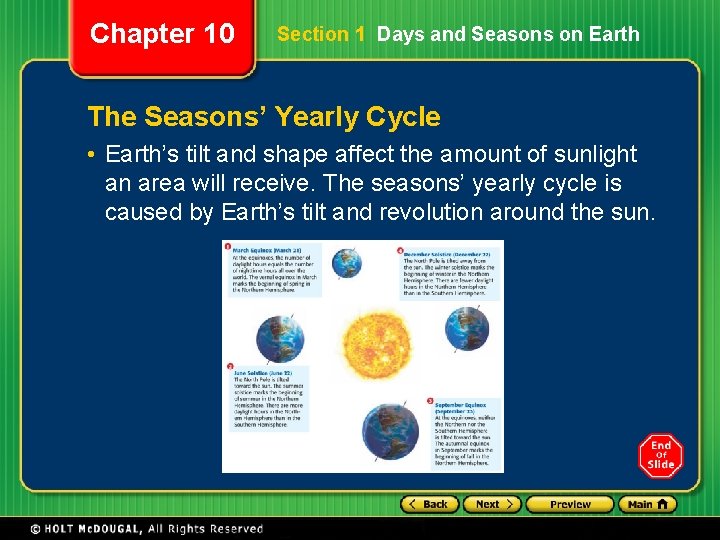
Chapter 10 Section 1 Days and Seasons on Earth The Seasons’ Yearly Cycle • Earth’s tilt and shape affect the amount of sunlight an area will receive. The seasons’ yearly cycle is caused by Earth’s tilt and revolution around the sun.
Chapter 10 Section 1 Days and Seasons on Earth The Seasons’ Yearly Cycle, continued • Equinoxes In March and September, neither end of Earth’s axis is tilted toward the sun. Both hemispheres receive the same amount of solar energy because the sun is directly above the equator. • The time when the sun is directly above the equator is called equinox.
Chapter 10 Section 1 Days and Seasons on Earth The Seasons’ Yearly Cycle, continued • Solstices In June, the Northern Hemisphere is tilted toward the sun, so it is warmer than the Southern Hemisphere. In December, the opposite happens because the Southern Hemisphere is tilted toward the sun. • The time when the sun is as far north or as far south of the equator as possible is called a solstice.
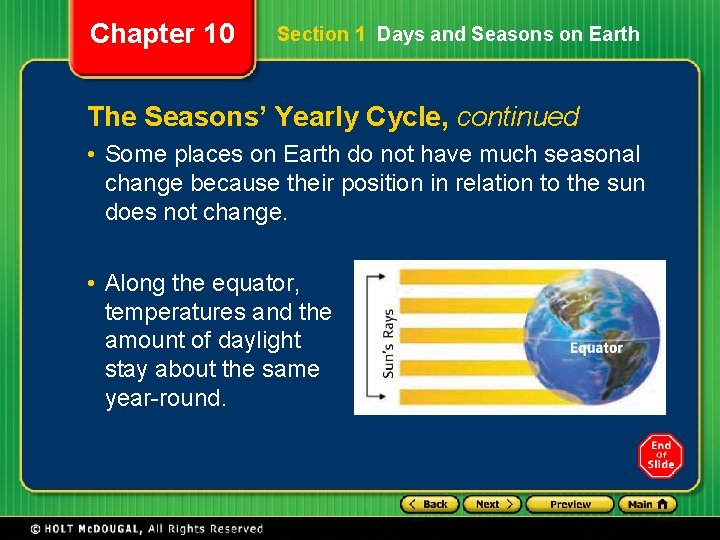
Chapter 10 Section 1 Days and Seasons on Earth The Seasons’ Yearly Cycle, continued • Some places on Earth do not have much seasonal change because their position in relation to the sun does not change. • Along the equator, temperatures and the amount of daylight stay about the same year-round.
Chapter 10 The Seasons Section 1 Days and Seasons on Earth
Chapter 10 Section 1 Days and Seasons on Earth Seasons and Latitude Click below to watch the Visual Concept
Chapter 10 Section 2 Lunar Cycles Bellringer Why does the moon go through phases, such as a full moon or crescent moon? Write your answers in your science journal.
Chapter 10 Section 2 Lunar Cycles Objectives • Explain how the Earth’s movement and the moon’s orbit cause the phases of the moon. • Explain the difference between a solar eclipse and a lunar eclipse.
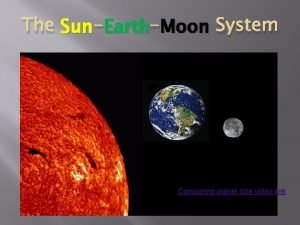
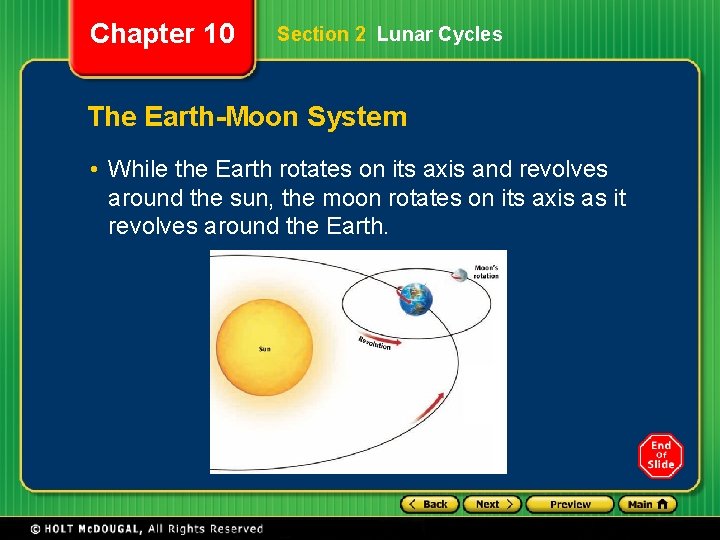
Chapter 10 Section 2 Lunar Cycles The Earth-Moon System • While the Earth rotates on its axis and revolves around the sun, the moon rotates on its axis as it revolves around the Earth.
Chapter 10 Section 2 Lunar Cycles The Earth-Moon System, continued • Every 27. 3 days, about once a month, the moon revolves once around the Earth and rotates once on its axis. • Since the moon rotates on its axis and revolves around the Earth at the same rate, we always see the same side of the moon.
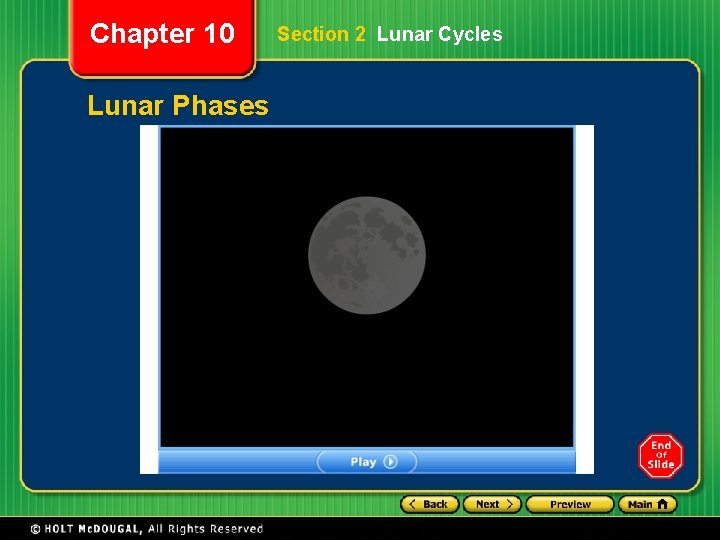
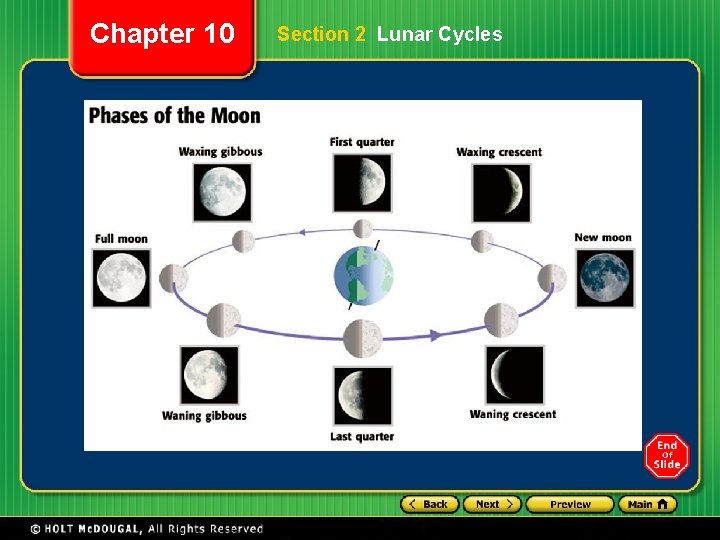
Chapter 10 Section 2 Lunar Cycles Phases of the Moon • Within a month the Earthward face of the moon changes from a fully lit circle to a thin crescent and back again. • These different appearances of the moon result from its changing position with respect to the Earth and sun. These different appearances are called phases.
Chapter 10 Lunar Phases Section 2 Lunar Cycles
Chapter 10 Section 2 Lunar Cycles Waxing and Waning • When the moon is waxing, the sunlit part we can see from the Earth appears to get larger. When the moon is waning, the sunlit part appears to get smaller. • Even as the phases of the moon change, the total amount of sunlight that the moon receives remains the same.
Chapter 10 Section 2 Lunar Cycles
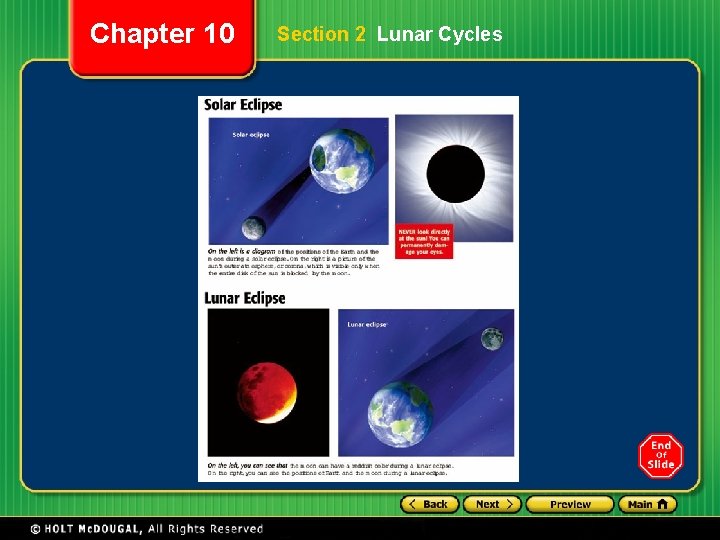
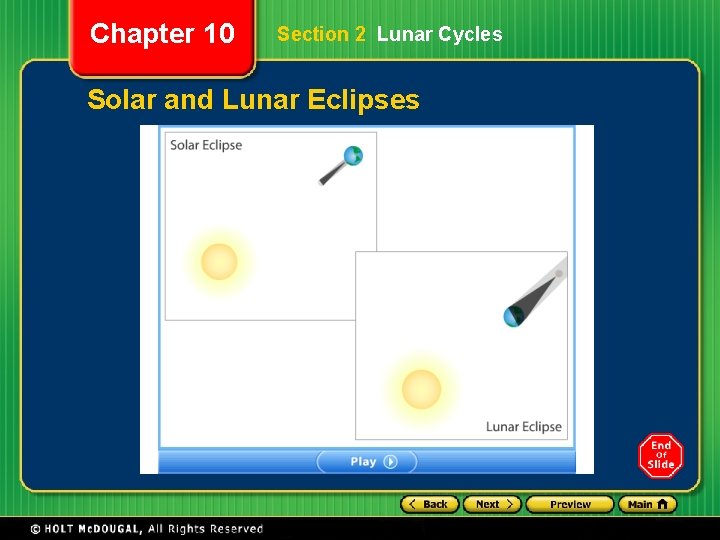
Chapter 10 Section 2 Lunar Cycles Eclipses • An eclipse happens when the shadow of one celestial body falls on another body. • A lunar eclipse happens when the Earth comes between the sun and the moon, and the shadow of the Earth falls on the moon. • A solar eclipse occurs when the moon comes between the Earth and the sun, and the shadow of the moon falls on part of the Earth.
Chapter 10 Section 2 Lunar Cycles
Chapter 10 Section 2 Lunar Cycles Eclipses, continued • The Moon’s Tilted Orbit Why don’t we see solar and lunar eclipses every month? • The moon’s orbit around the Earth is tilted by about 5° with respect to the Earth’s orbit around the sun. This places the moon out of the Earth’s shadow for most full-moon phases. • The moon’s tilted orbit also places the Earth out of the moon’s shadow for most new-moon phases.
Chapter 10 Section 2 Lunar Cycles Eclipses, continued • Solar Eclipses The moon’s orbit is elliptical, so the distance between the moon and the Earth changes. • During an annular eclipse, the moon is farther from the Earth, so the disk of the moon does not completely cover the disk of the sun. • During a total solar eclipse, the disk of the moon completely covers the disk of the sun. Only the sun’s corona, or faint outer atmosphere, is visible.
Chapter 10 Section 2 Lunar Cycles Eclipses, continued • Lunar Eclipses In a lunar eclipse, the Earth comes between the sun and the moon. Lunar eclipses can happen only during a full moon. • During a lunar eclipse, Earth’s atmosphere acts like a lens and bends some of the sunlight into the Earth’s shadow. When sunlight hits the atmosphere, the blue light is filtered out and most of the remaining lighting the moon is red.
Chapter 10 Section 2 Lunar Cycles Solar and Lunar Eclipses
Chapter 10 Section 3 Tides, the Sun, and the Moon Bellringer If the moon had the mass of a golf ball, the approximate mass of the sun would be about 110 school busses! Even though the moon is smaller than the sun, the moon most influences the Earth’s tides. Can you guess why this might be? Record your answer in your science journal.
Chapter 10 Section 3 Tides, the Sun, and the Moon Objectives • Explain tides and their relationship with the Earth, sun, and moon. • Describe four types of tides. • Analyze the relationship between tides and coastal land.
Chapter 10 Section 3 Tides, the Sun, and the Moon The Lure of the Moon • The gravity of the moon pulls on every particle of the Earth. The pull on liquids is much more noticeable than on solids, because liquids move more easily. • Tides are the daily changes in the level of ocean water. These tides are influenced by the sun and moon. • High Tide and Low Tide How often tides occur and the difference in tidal levels depend on the position of the moon as it revolves around the Earth.
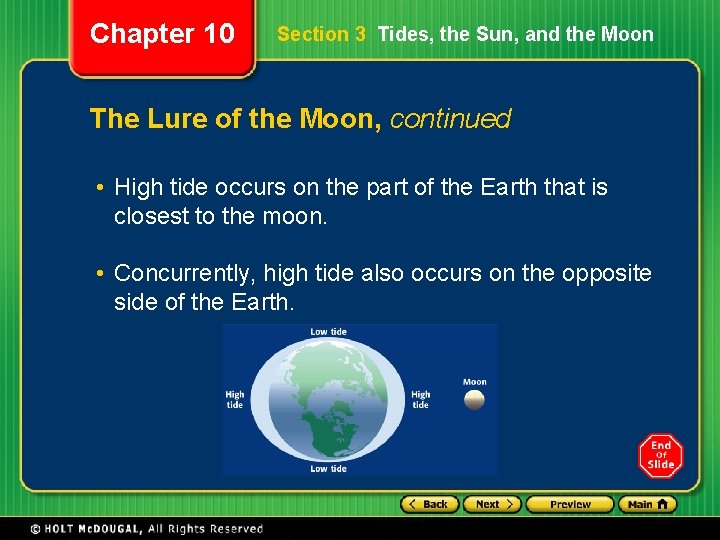
Chapter 10 Section 3 Tides, the Sun, and the Moon The Lure of the Moon, continued • Battle of the Bulge When part of the ocean is directly facing the moon, the water there bulges toward the moon. • At the same time, water on the opposite of the Earth bulges because of the rotation of the Earth and the motion of the moon around the Earth.
Chapter 10 Section 3 Tides, the Sun, and the Moon The Lure of the Moon, continued • High tide occurs on the part of the Earth that is closest to the moon. • Concurrently, high tide also occurs on the opposite side of the Earth.
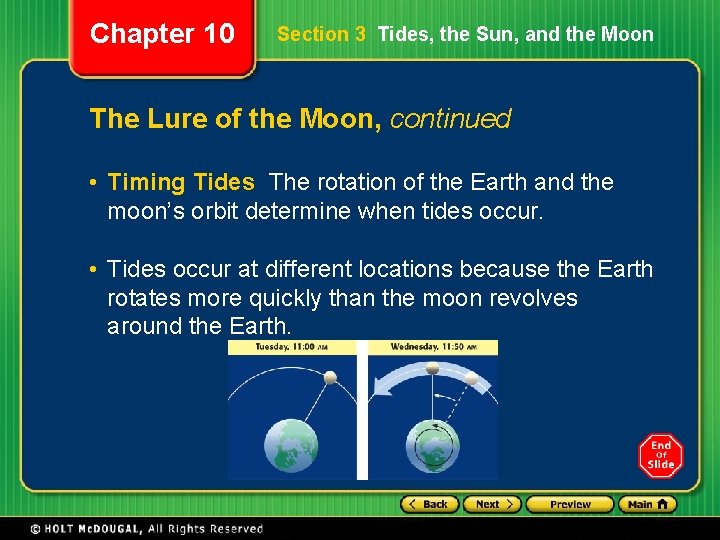
Chapter 10 Section 3 Tides, the Sun, and the Moon The Lure of the Moon, continued • Timing Tides The rotation of the Earth and the moon’s orbit determine when tides occur. • Tides occur at different locations because the Earth rotates more quickly than the moon revolves around the Earth.
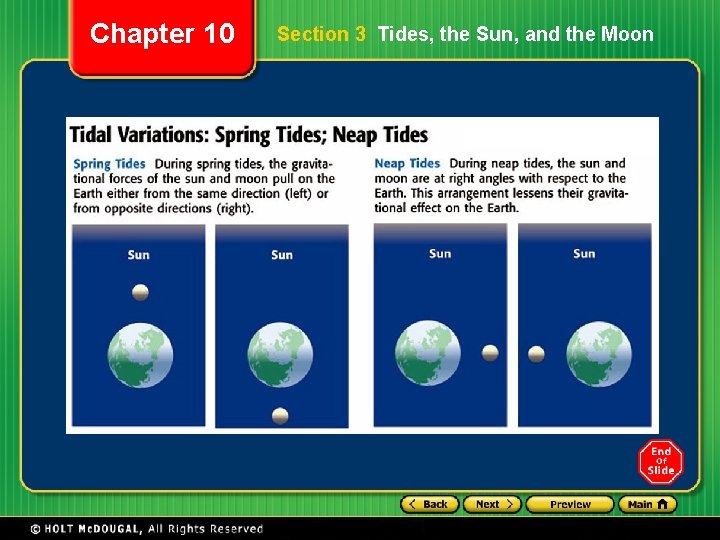
Chapter 10 Section 3 Tides, the Sun, and the Moon Tidal Variations • The sun also affects tides. Because the sun is much farther away, its influence is less powerful than the moon’s. • The combined forces of the sun and the moon result in tidal ranges that vary based on the position of all three bodies. • A tidal range is the difference between levels of ocean water at high tide and low tide.
Chapter 10 Section 3 Tides, the Sun, and the Moon Tidal Variations, continued • Spring tides occur at the new and full moon when the sun, Earth, and moon are aligned. Springs tides have the largest daily tidal range. • Neap tides occur when the sun, Earth, and moon form a 90° angle. Neap tides have the smallest daily tidal range.
Chapter 10 Section 3 Tides, the Sun, and the Moon
Chapter 10 Section 3 Tides, the Sun, and the Moon Tides and Topography • After a tidal range has been measured, the times that tides occur can be accurately predicted. This data can be useful for people who live near the coast. • In some coastal areas with narrow inlets, movements of water called tidal bores occur. A tidal bore is a body of water that rushes up through a narrow bay, estuary, or river channel during the rise of high tide and causes a sudden tidal rise.
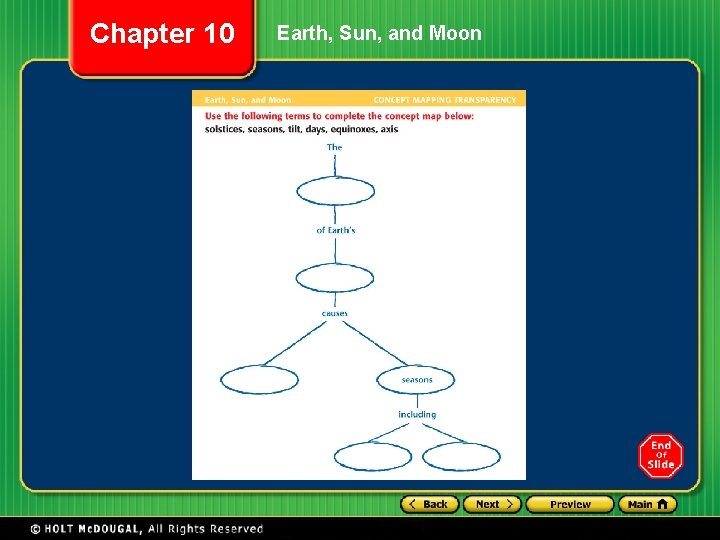
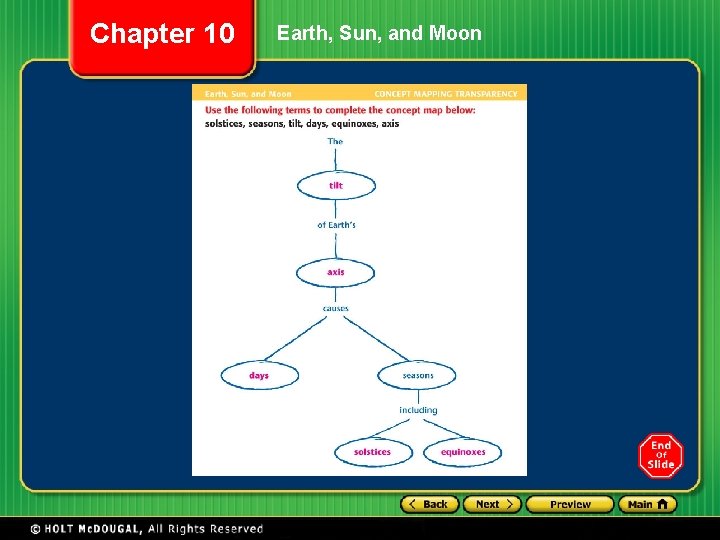
Chapter 10 Earth, Sun, and Moon Concept Mapping Use the terms below to complete the concept map on the next slide. solstices seasons tilt days equinoxes axis
Chapter 10 Earth, Sun, and Moon
Chapter 10 Earth, Sun, and Moon