Case studies in Identity Management for Meeting HIPAA
- Slides: 46
Case studies in Identity Management for Meeting HIPAA Privacy and Security Requirements
Agenda • E-business trends in healthcare • Challenges in Identity Management • The Impact of HIPAA Privacy and Security Standards • Meeting the standards: technology options • Solutions in Identity Management • Case studies
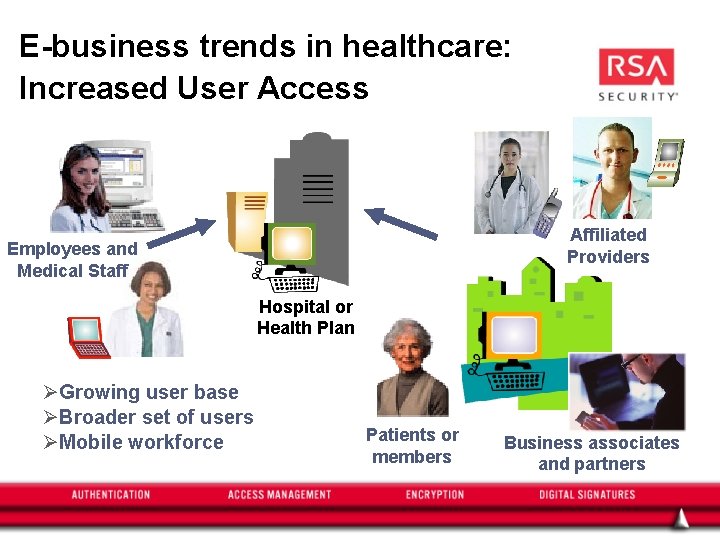
E-business trends in healthcare: Increased User Access Affiliated Providers Employees and Medical Staff Hospital or Health Plan ØGrowing user base ØBroader set of users ØMobile workforce Patients or members Business associates and partners
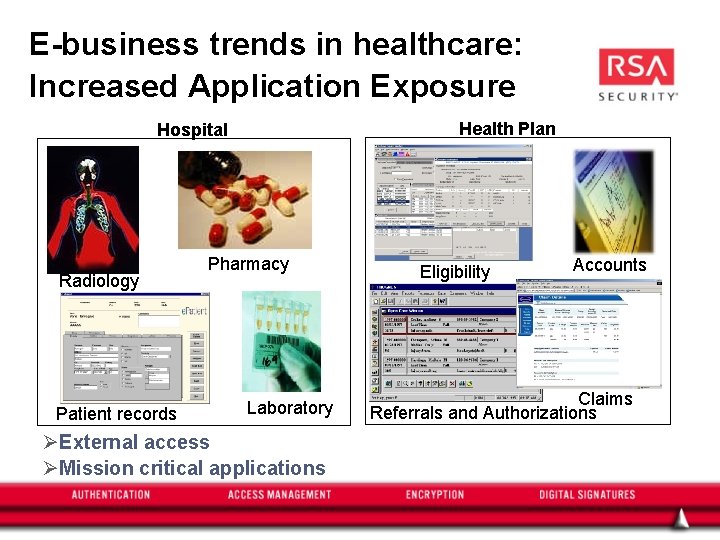
E-business trends in healthcare: Increased Application Exposure Health Plan Hospital Radiology Patient records Pharmacy Laboratory ØExternal access ØMission critical applications Eligibility Accounts Claims Referrals and Authorizations
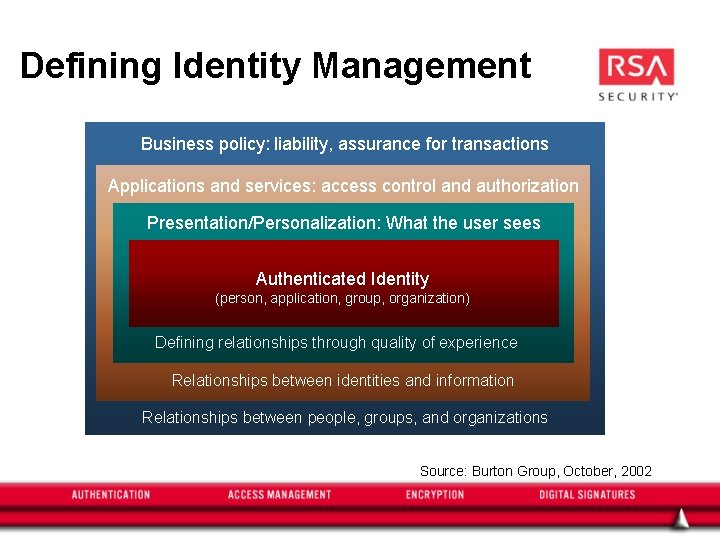
Defining Identity Management Business policy: liability, assurance for transactions Applications and services: access control and authorization Presentation/Personalization: What the user sees Authenticated Identity (person, application, group, organization) Defining relationships through quality of experience Relationships between identities and information Relationships between people, groups, and organizations Source: Burton Group, October, 2002
Challenges in Identity Management • User base is diverse, dynamic, and demanding • Stronger authentication required for more applications • Consistent enforcement of security policy across entire enterprise • Increased Exposure to Risk
The Impact of HIPAA Privacy and Security
Privacy and Security Work Together • The Privacy Rule covers what information is to be protected, the uses and disclosures of information, and patients’ privacy rights – Finalized with a compliance date of April 14, 2003 • Security covers what safeguards must be in place to protect information from unauthorized access, alteration, deletion, or transmission. – Finalized with a compliance date of April 21, 2005 – April 14, 2003 is also relevant since security measures must be in place to meet the Privacy Regulation
HIPAA Privacy Standards • Mostly organizational, procedural – Inform patients of privacy rights – Provide notice of privacy practices – Appoint a privacy officer • Requires Role-based Access Control – Based on “Minimum necessary” provisions • Must provide workers access to only the minimum necessary information needed to perform their work • Must develop policies and procedures and implement security measures to comply with minimum necessary provisions
HIPAA Security Standards • General requirements – Ensure the confidentiality, integrity, and availability of all electronic protected health information – Protect against any reasonably anticipated threats or hazards, or uses or disclosures • Flexible Approach – Use security measures that reasonably and appropriately implement the standards based on risk analysis – Technology-neutral • Administrative, Physical, and Technical Safeguards
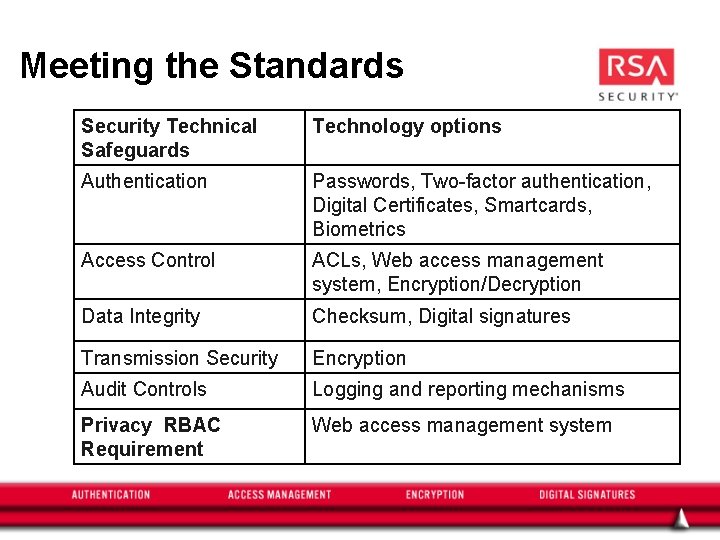
Meeting the Standards Security Technical Safeguards Technology options Authentication Passwords, Two-factor authentication, Digital Certificates, Smartcards, Biometrics Access Control ACLs, Web access management system, Encryption/Decryption Data Integrity Checksum, Digital signatures Transmission Security Encryption Audit Controls Logging and reporting mechanisms Privacy RBAC Requirement Web access management system
Authentication: Time-synchronous two-factor • Users authenticated through the use of an authenticator (token or smart card) by providing the token code (something the user has) and PIN (something the user knows) • OR • User authenticated through the use of existing mobile phones and PDAs by receiving a one-time access code as an SMS or text message
Authentication: Digital Certificates • Data files containing information about the user and digitally signed by the issuing organization – Tied to corresponding public/private key pair • Certificate management system issues and manages digital certificates • Relative strength depends on protection of private key – Password governed by policy – Time-synchronous token – Smartcard
Access Control: Web Access Management • Centrally manages user privileges – Secures applications, Web sites, and other Web-based resources via intranets, extranets, and B 2 B and B 2 C infrastructures – Ensures only authorized users get access to specific resources – Provides fine-grained control over who can access what – Designed to flexibly integrate into environment – Transparent Web single sign-on – Delegated user management
Access Control: Encryption/Decryption • Digital certificates – Encrypt document or message using public key – Access is limited only to those who can decrypt the data with private key – Provides a system to retrieve encryption keys in case of loss • Encryption/compression utility – Utility for encrypting and compressing desktop files and e-mail attachments • Incorporates ZIP technology – Supports both password and certificate-based encryption
Data Integrity: Digital Signatures • Digital certificates – Used for digitally signing web-based forms and e-mail messages – Digital signature process protects data integrity • Uses cryptographic techniques • Applications that have been digital signatureenabled can automatically verify signature and determine if the data that was signed has been altered
Transmission Security: Encryption • Encryption technology should support strong encryption up to 2048 bits (asymmetric) and 128 bits (symmetric) • Digital certificates for secure e-mail • SSL server certificates for secure web communications • Encryption/compression utility for files in transit
Audit Controls: Logging and reporting • Authentication and access control systems should provide logging and reporting mechanisms for monitoring and analyzing users’ access to resources, applications and files • Should allow administrator to trace actions to individual users • Logs should be configurable (e. g. what events, when, to where), time-stamped and strictly limited to system administrators
RBAC: Web access management • Rights and permissions are granted to roles rather than individual users – Users are logically combined into Groups (role category) and Sub-groups (role sub-category) – Individuals and sub-groups inherit rights of group – Create exceptions for individuals using policy-based rules • Rules based on static and dynamic attributes
Are passwords good enough for HIPAA Compliance? • Standard does not prescribe authentication method • Do risk analysis and select appropriate and reasonable method – Look at security best practices in the industry • For some applications, best practices require more than passwords – E. g. “Remote access requires two-factor authentication. ”* • For others, current best practices say passwords okay – E. g. For patient or member access to web sites** • For many applications, will depend on organization • Best practices evolving *HIPAA Security: the latest and best practices, Tom Walsh, CISSP, HIMSS, 2003 **Gartner
Solutions in Identity Management
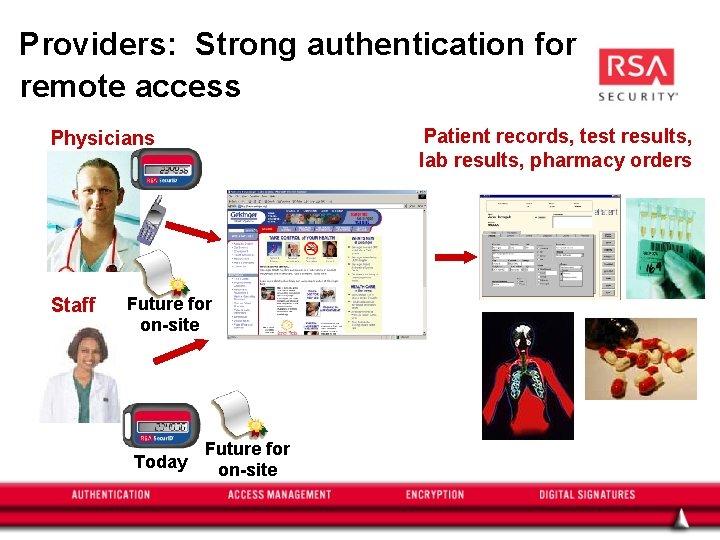
Providers: Strong authentication for remote access Patient records, test results, lab results, pharmacy orders Physicians Staff Future for on-site Today Future for on-site
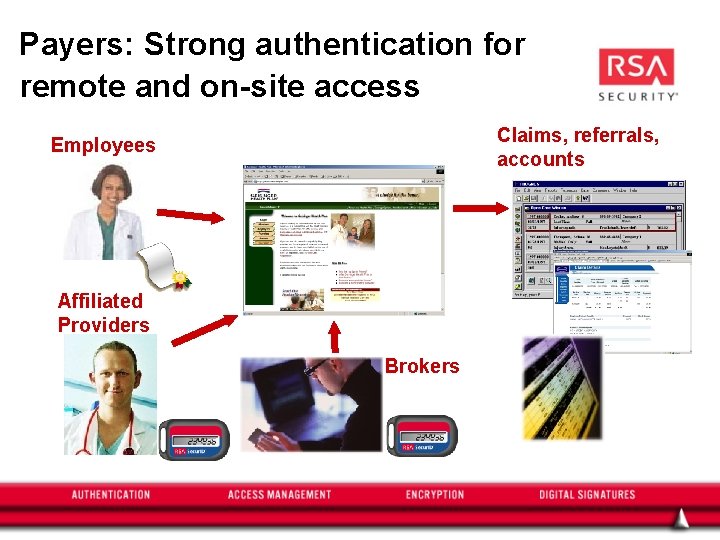
Payers: Strong authentication for remote and on-site access Claims, referrals, accounts Employees Affiliated Providers Brokers
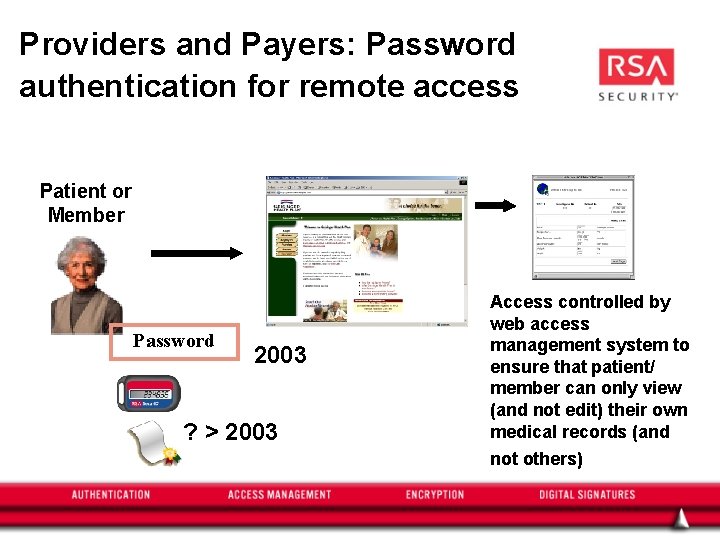
Providers and Payers: Password authentication for remote access Patient or Member Password 2003 ? > 2003 Access controlled by web access management system to ensure that patient/ member can only view (and not edit) their own medical records (and not others)
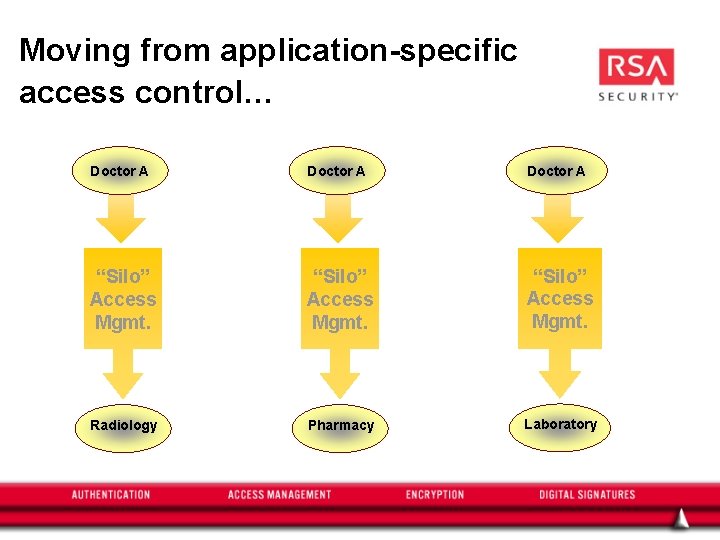
Moving from application-specific access control… Doctor A “Silo” Access Mgmt. Radiology Pharmacy Laboratory
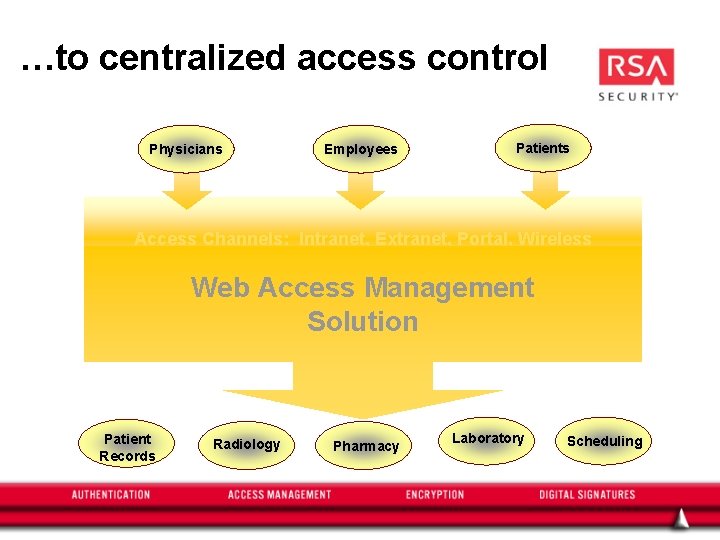
…to centralized access control Physicians Employees Patients Access Channels: Intranet, Extranet, Portal, Wireless Web Access Management Solution Patient Records Radiology Pharmacy Laboratory Scheduling
Case studies
Blue Cross Blue Shield of Kansas • Independent member of BCBS Association – 700, 000 members and 2, 000 employees – $940 M underwritten business and $2. 1 B Medicare claims • Objectives – Manage access to information on Web site and intranet – Provide different users with access to different views (RBAC) – Ensure only authorized users access confidential health information – Provide SSO to multiple Web-based applications – Monitor user activity: audit trails – Save time on security administration – Scalable infrastructure – Meet HIPAA requirements
Blue Cross Blue Shield of Kansas • Solution: – Web Access Management and Two-factor Authentication – 25, 000 users • Key factors – Graded authentication • Remote employees, remote-hospital nurses and in-house IT administrators use two-factor authentication • Patients use passwords – – – Policy-based rules using dynamic attributes Ability to provide RBAC Ease of install Delegated administrative model Fine-grained access control
Large U. S. Health Plan • National healthcare and benefits organization – Millions of members – Tens of thousands of employees • Objectives – – Decrease costs for remote access Develop security framework for web-based applications Strengthen user authentication practices Meet HIPAA requirements
Large U. S. Health Plan • Solution – Digital certificate management infrastructure – Employee user authentication (20, 000+ users) • Remote access and on-site access • Key factors – – Reduced costs by moving from dial-up to VPN Implemented stronger authentication Scalable to handle large user base Foundation for secure web communications (deployed SSL server certificates), secure e-mail (in process) and digital signing (future)
Boston Medical Center • Private, not for profit, 547 -licensed bed AMC – Provides full spectrum of pediatric and adult care services – 800, 000 patient visits and 25, 000 admissions annually • Objectives – Provide secure remote access for doctors and other staff to key clinical applications • Sunrise Clinical Manager, CPOE for in-patient care • Logician from G. E. Med, EPR for outpatient and ambulatory care – – – Provide SSO to multiple Web-based applications Centralize administrative control of user access privileges Ensure only authorized medical staff have access to PHI Implement role-based access control Meet HIPAA requirements
Boston Medical Center • Solution – Web Access Management and Two-factor Authentication – 4, 000 users • Key factors – Provides right balance between end-user convenience and security for sensitive patient records – Ease of integration – Web Single Sign-on: reducing the number of passwords – Centralized management of Web access privileges
Geisinger Health System • Physician-led healthcare system – Serves more than two million people – In 38 counties in Pennsylvania • Objectives – Rollout secure Web applications • Portals for affiliated providers and patients – Integrate with existing systems • Epic System’s My. Chart, Novell’s LDAP-compliant e. Directory, ™ Sybase databases and Macromedia’s Cold. Fusion application development software – Provide a high level of security – Meet HIPAA requirements
Geisinger Health System • Solution – Web Access Management and Two-factor Authentication – 10, 000 users currently and growing (8, 500 employees and 1, 500 external users) • Key factors – Graded authentication • Access to certain information requires two-factor authentication – Fine-grained access control – Role-based access control – Ability to monitoring user activity with detailed audit trails
Providence Health System • Comprehensive array of services across a four-state area – Including 20 acute care hospitals, 9 long-term care facilities, and a network of physician organizations – Sponsors health plans covering more than 850, 000 members • Objectives – Deliver critical information to doctors wherever they are • Lab results, X-Ray reports, billing information, ECG, X-ray images and medication information – Integrate with Citrix Meta. Frame XP – Ensure personal medical information remains confidential – Security solution fail-safe and easy for the clinicians to manage – Meet HIPAA requirements
Providence Health System • Solution – Two-factor Authentication – 2, 000 users • Key factors – – – Convenient and easy to use for doctors Keeps patient information confidential Reduces operating costs Easily deployed Seamless interoperability with Citrix Meta. Frame
Catholic Health System • Large provider in upstate New York – 8, 000 employees and 1, 200 physicians – Serves over 200, 000 patients through network of hospitals, centers and facilities (total of 40 sites) • Goals – Reduce costs and complexity of remote access – Allow medical staff to have fast, easy, and secure access to patient data from external clinics or home • Deliver applications with strong encryption and strong authentication – Protect privacy of patient data – Meet the requirements of HIPAA
Catholic Health System • Solution – Two-factor authentication – Users use same authentication method to sign-on to multiple applications – Physicians get secure access to patient data from any location at any time • Key factors – Reduced cost of installation and on-going support – Medical staff can quickly, securely, and easily access central resources – Integration with Neoteris Instant Virtual Extranet (SSL VPN gateway)
North Shore Long Island Jewish Health System • Located in Great Neck, N. Y – 18 hospitals and 30, 000 employees • Objectives – For remote access to the intranet by physicians and contractors – Compatible with environment which includes wireless LANs, LDAP-based directories – Meet HIPAA privacy and security rules – Use audit and access controls to protect patient data – Implement "industry best practices"
North Shore Long Island Jewish Health System • Solution – Two-factor authentication with time synchronous tokens and Mobile two-factor authentication using phones/PDAs for remote access – Digital certificates for patient bedside-registration system (planned) • A digital signature will be applied to every use of electronic patient record – Digital certificates for encrypting and digitally signing e-mail (planned) • Key factors – Integration with Cisco-based VPN – Integration with Novell e. Directory (metadirectory for patient information) and Microsoft Active Directory (directory service) – Comprehensive audit trail of changes and non-repudiation
Siemens Medical Solutions Health Services Corporation • Application service provider – Processes more than 116 million transactions daily and manages more than 67 terabytes of data – Employs 30, 000 people worldwide – Hosts applications such as registration, financial tracking and clinical systems for more than 1, 000 HCOs • Objectives – Provide secure Internet access to mission-critical applications and patient information hosted by Siemens – Employ security protocols equivalent to HCOs • i. e. Meet the requirements of HIPAA
Siemens Medical Solutions Health Services Corporation • Solution – Two-factor Authentication – 11, 000 external users – 4, 000 internal employees • Key factors – Only authorized users to gain entry to networks and confidential healthcare information – Interoperability with Cisco VPN
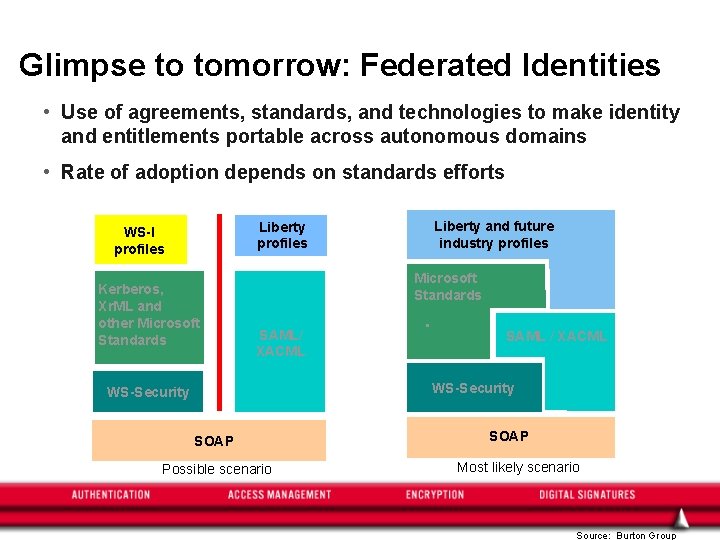
Glimpse to tomorrow: Federated Identities • Use of agreements, standards, and technologies to make identity and entitlements portable across autonomous domains • Rate of adoption depends on standards efforts Liberty and future industry profiles Liberty profiles WS-I profiles Kerberos, Xr. ML and other Microsoft Standards SAML/ XACML . SAML / XACML WS-Security SOAP Possible scenario SOAP Most likely scenario Source: Burton Group
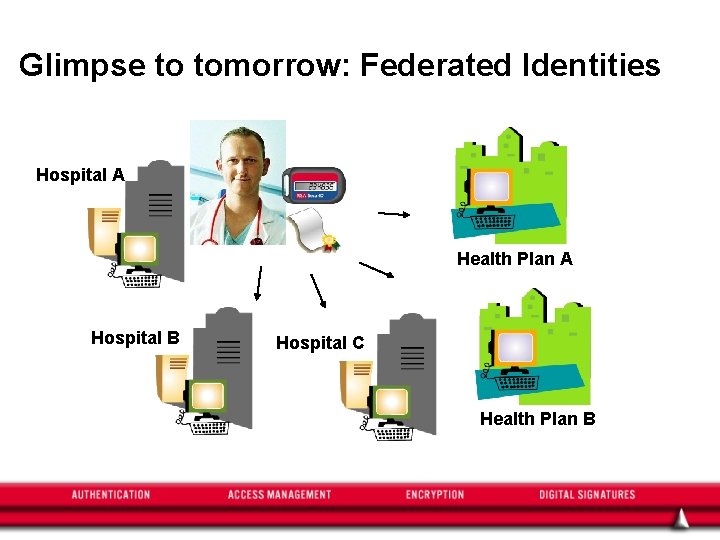
Glimpse to tomorrow: Federated Identities Hospital A Health Plan A Hospital B Hospital C Health Plan B
www. rsasecurity. com lrobinson@rsasecruity. com