Assessment Online Assessment Online on TKI offers a
- Slides: 33
Assessment Online
Assessment Online on TKI offers a wide range of information on how leaders and teachers can use assessment to enhance teaching and learning. This workshop will assist you to navigate quickly and easily within the Assessment site and find its wealth of resources. http: //assessment. tki. org. nz
Welcome to this tour of the website that shows you where to find information and resources and more about: • formative assessment in the classroom • the collection and analysis of data • moderation • overall teacher judgments • reporting to parents and whānau • assessment tools and their most effective use. http: //assessment. tki. org. nz
Assessment Online homepage
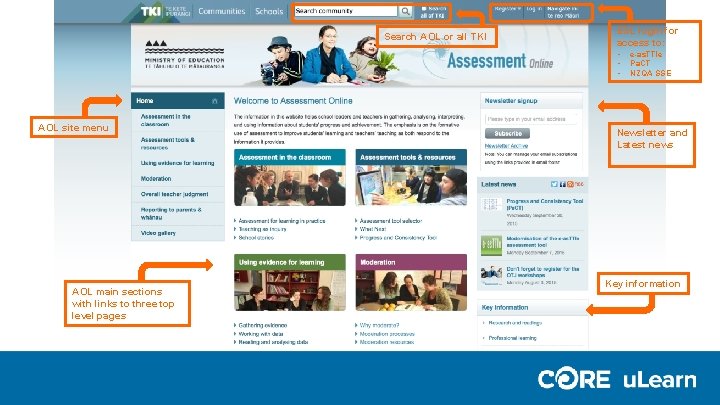
Search AOL or all TKI ESL login for access to: • • • AOL site menu AOL main sections with links to three top level pages e-as. TTle Pa. CT NZQA SSE Newsletter and Latest news Key information
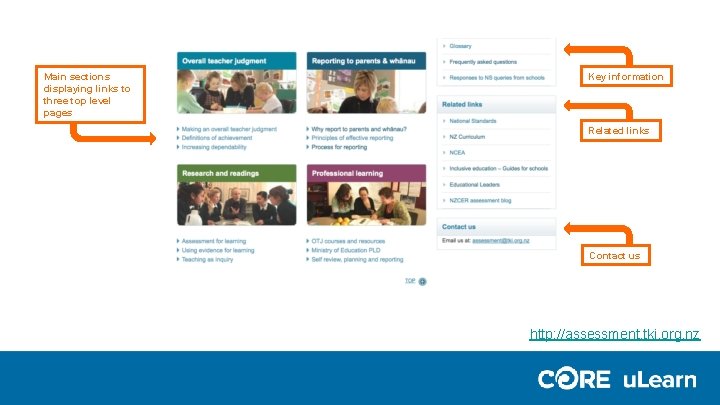
Main sections displaying links to three top level pages Key information Related links Contact us http: //assessment. tki. org. nz
Assessment in the classroom Formative assessment
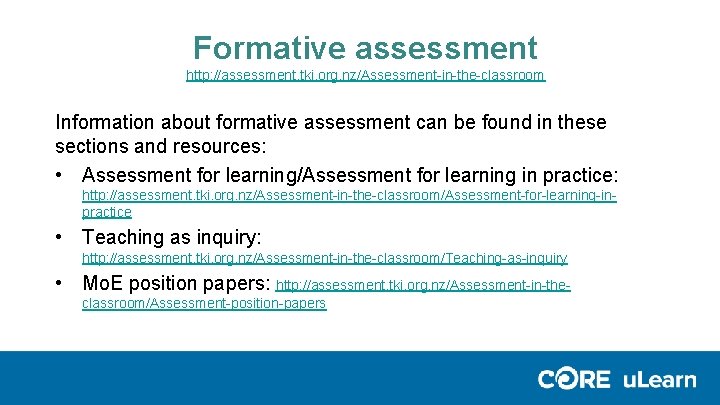
Formative assessment http: //assessment. tki. org. nz/Assessment-in-the-classroom Information about formative assessment can be found in these sections and resources: • Assessment for learning/Assessment for learning in practice: http: //assessment. tki. org. nz/Assessment-in-the-classroom/Assessment-for-learning-inpractice • Teaching as inquiry: http: //assessment. tki. org. nz/Assessment-in-the-classroom/Teaching-as-inquiry • Mo. E position papers: http: //assessment. tki. org. nz/Assessment-in-theclassroom/Assessment-position-papers
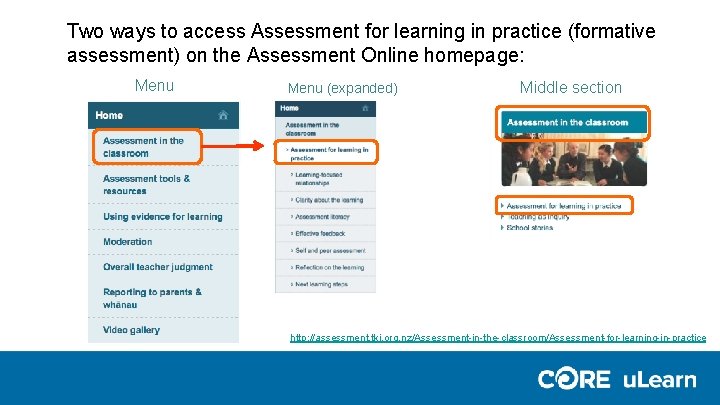
Two ways to access Assessment for learning in practice (formative assessment) on the Assessment Online homepage: Menu (expanded) Middle section http: //assessment. tki. org. nz/Assessment-in-the-classroom/Assessment-for-learning-in-practice
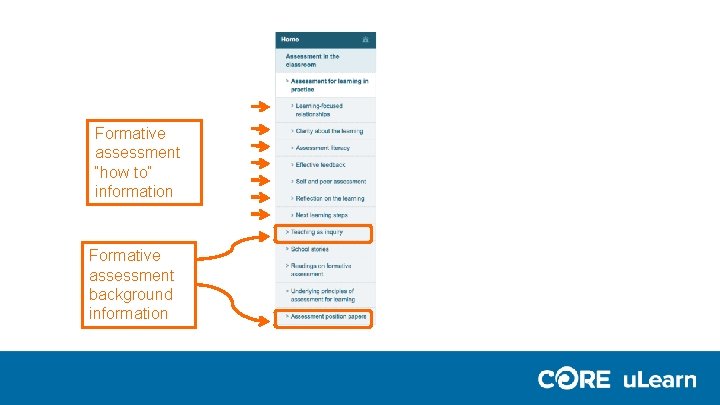
Formative assessment “how to” information Formative assessment background information
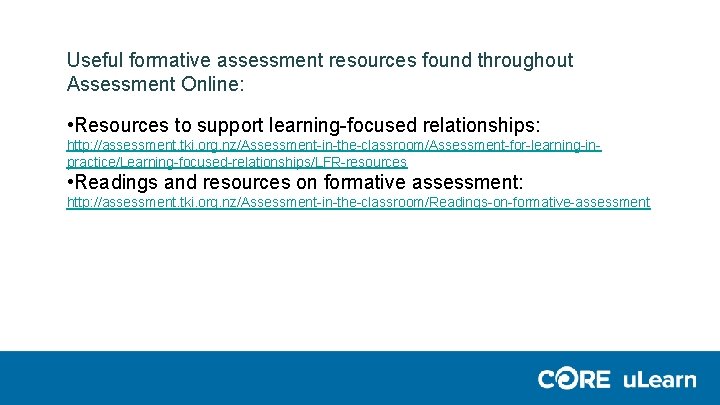
Useful formative assessment resources found throughout Assessment Online: • Resources to support learning-focused relationships: http: //assessment. tki. org. nz/Assessment-in-the-classroom/Assessment-for-learning-inpractice/Learning-focused-relationships/LFR-resources • Readings and resources on formative assessment: http: //assessment. tki. org. nz/Assessment-in-the-classroom/Readings-on-formative-assessment
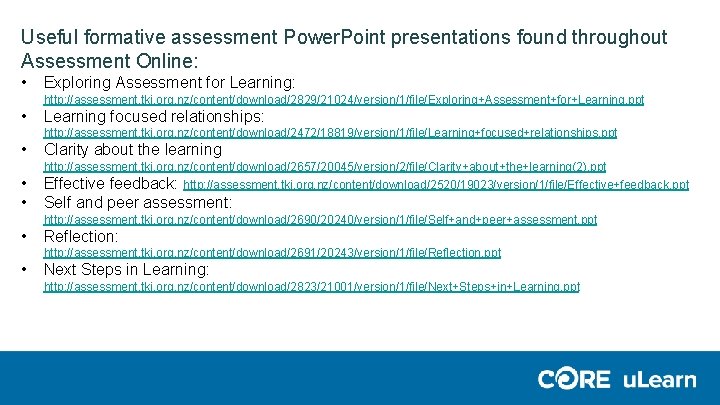
Useful formative assessment Power. Point presentations found throughout Assessment Online: • Exploring Assessment for Learning: http: //assessment. tki. org. nz/content/download/2829/21024/version/1/file/Exploring+Assessment+for+Learning. ppt • Learning focused relationships: http: //assessment. tki. org. nz/content/download/2472/18819/version/1/file/Learning+focused+relationships. ppt • Clarity about the learning http: //assessment. tki. org. nz/content/download/2657/20045/version/2/file/Clarity+about+the+learning(2). ppt • • Effective feedback: http: //assessment. tki. org. nz/content/download/2520/19023/version/1/file/Effective+feedback. ppt Self and peer assessment: http: //assessment. tki. org. nz/content/download/2690/20240/version/1/file/Self+and+peer+assessment. ppt • Reflection: http: //assessment. tki. org. nz/content/download/2691/20243/version/1/file/Reflection. ppt • Next Steps in Learning: http: //assessment. tki. org. nz/content/download/2823/21001/version/1/file/Next+Steps+in+Learning. ppt
Using evidence for learning The collection and analysis of data
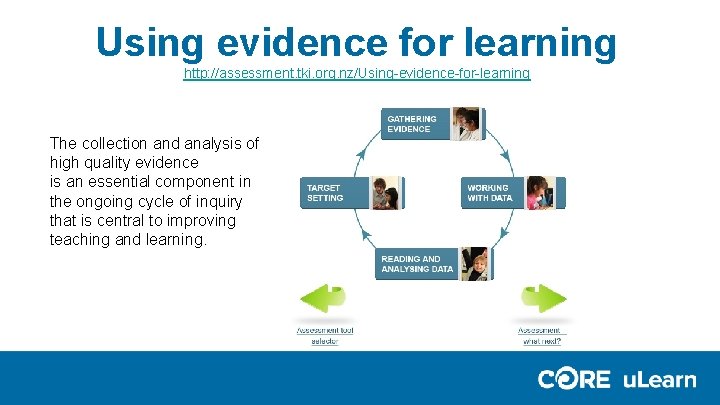
Using evidence for learning http: //assessment. tki. org. nz/Using-evidence-for-learning The collection and analysis of high quality evidence is an essential component in the ongoing cycle of inquiry that is central to improving teaching and learning.
Gathering evidence http: //assessment. tki. org. nz/Using-evidence-for-learning/Gathering-evidence Gathering evidence involves understanding about: • Types of evidence: http: //assessment. tki. org. nz/Using-evidence-for-learning/Gatheringevidence/Topics/Types-of-evidence • Using a range of assessment methods: http: //assessment. tki. org. nz/Using-evidence-forlearning/Gathering-evidence/Topics/Assessment-methods • Formative and summative assessment: http: //assessment. tki. org. nz/Using-evidence-forlearning/Gathering-evidence/Topics/Formative-and-summative-assessment • Involving students in assessment processes: http: //assessment. tki. org. nz/Using-evidence-for -learning/Gathering-evidence/Topics/Involving-students
• Developing a school-wide assessment strategy: http: //assessment. tki. org. nz/Usingevidence-for-learning/Gathering-evidence/Topics/Assessment-strategy • Selecting an assessment tool: http: //assessment. tki. org. nz/Using-evidence-for-learning/Gathering -evidence/Topics/Assessment-selection • Managing assessment processes: http: //assessment. tki. org. nz/Using-evidence-forlearning/Gathering-evidence/Topics/Assessment-processes
Working with data http: //assessment. tki. org. nz/Using-evidence-for-learning/Working-with-data Working with data requires an understanding of the principles of data analysis. Topics, including interactive illustrations in this section cover: • Standards-based assessment • Types of data • Reliability and validity • Mean, median and standard deviation • Percentages, percentiles and stanines • Norms and effect sizes
The Excel tutorials on these pages provide practical instructions for: • Loading or downloading data onto a spreadsheet http: //assessment. tki. org. nz/Using-evidence-for-learning/Working-with-data/Topics/Downloading-data • Cleaning and formatting data http: //assessment. tki. org. nz/Using-evidence-for-learning/Working-with-data/Topics/Cleaning-and-formatting-data • Creating your own simple graphs http: //assessment. tki. org. nz/Using-evidence-for-learning/Working-with-data/Topics/Creating-your-own-simple-graphs • Disaggregating data http: //assessment. tki. org. nz/Using-evidence-for-learning/Working-with-data/Topics/Disaggregating-data
Reading and analysing data http: //assessment. tki. org. nz/Using-evidence-for-learning/Reading-and-analysing-data It is essential that educators are able to accurately read and interpret data, so that they know where students are in their learning, and are able to best set goals and plan for optimum teaching and learning. The topics in this section cover: • Commonly used graphs: http: //assessment. tki. org. nz/Using-evidence-for-learning/Reading-and-analysingdata/Topics/Common-graphs • Data reports from assessment tools (e-as. TTle, PAT, and STAR): http: //assessment. tki. org. nz/Using-evidence-for-learning/Reading-and-analysing-data/Topics/Data-reports-fromassessment-tools • Data reports from SMS including KAMAR & Schoolmaster: http: //assessment. tki. org. nz/Usingevidence-for-learning/Reading-and-analysing-data/ Topics/SMS-data-reports
Target or goal setting http: //assessment. tki. org. nz/Using-evidence-for-learning/Target-setting The general principles of target or goal setting should apply at each level of the school, including goal setting by students. The topics in this section cover: • Effective target setting • Target setting at the Board of Trustees level • Target setting at the school and classroom level • Planning for improvement • Goal setting for students.
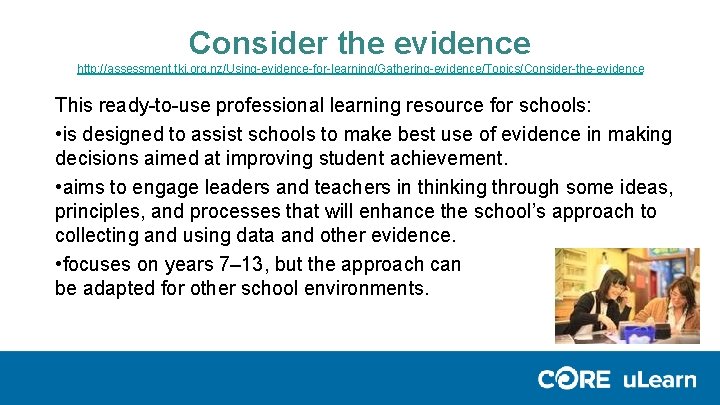
Consider the evidence http: //assessment. tki. org. nz/Using-evidence-for-learning/Gathering-evidence/Topics/Consider-the-evidence This ready-to-use professional learning resource for schools: • is designed to assist schools to make best use of evidence in making decisions aimed at improving student achievement. • aims to engage leaders and teachers in thinking through some ideas, principles, and processes that will enhance the school’s approach to collecting and using data and other evidence. • focuses on years 7– 13, but the approach can be adapted for other school environments.
Moderation
Moderation http: //assessment. tki. org. nz/Moderation Using moderation to ensure consistency of Overall teacher judgments (OTJs). The topics in this section cover: • Why moderate? • Moderation processes • Moderation resources • Moderation professional learning modules • Cluster moderation project – a case study
Overall teacher judgments
Overall teacher judgments http: //assessment. tki. org. nz/Overall-teacher-judgment Guidance on the types of information and the definitions of achievement teachers can bring to bear on making their overall teacher judgments, and ways to increase the dependability of the judgments. • Making an overall teacher judgment • Definitions of achievement • Increasing the dependability of OTJs • NS Policy documents • 2014 OTJ workshop resources
Assessment tools and resources
Assessment tools and resources http: //assessment. tki. org. nz/Assessment-tools-resources • Assessment tool selector, now housed on Assessment Online, provides comparative information about the range of assessment tools used in New Zealand schools. • Alignment of assessment tools with National Standards supports teachers making OTJs with information on how scores for assessment tools align to the NS at that year level. • What Next, a version of the e-as. TTle What next tool, uses the TKI search to help teachers find resources for “what next” teaching and learning within chosen curriculum levels and areas.
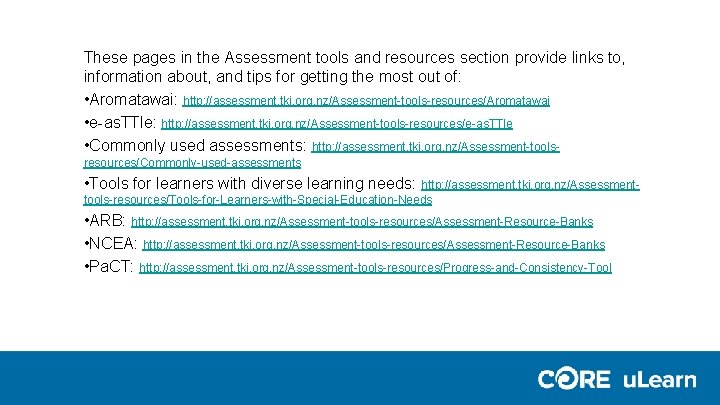
These pages in the Assessment tools and resources section provide links to, information about, and tips for getting the most out of: • Aromatawai: http: //assessment. tki. org. nz/Assessment-tools-resources/Aromatawai • e-as. TTle: http: //assessment. tki. org. nz/Assessment-tools-resources/e-as. TTle • Commonly used assessments: http: //assessment. tki. org. nz/Assessment-toolsresources/Commonly-used-assessments • Tools for learners with diverse learning needs: http: //assessment. tki. org. nz/Assessmenttools-resources/Tools-for-Learners-with-Special-Education-Needs • ARB: http: //assessment. tki. org. nz/Assessment-tools-resources/Assessment-Resource-Banks • NCEA: http: //assessment. tki. org. nz/Assessment-tools-resources/Assessment-Resource-Banks • Pa. CT: http: //assessment. tki. org. nz/Assessment-tools-resources/Progress-and-Consistency-Tool
Reporting to parents and whānau
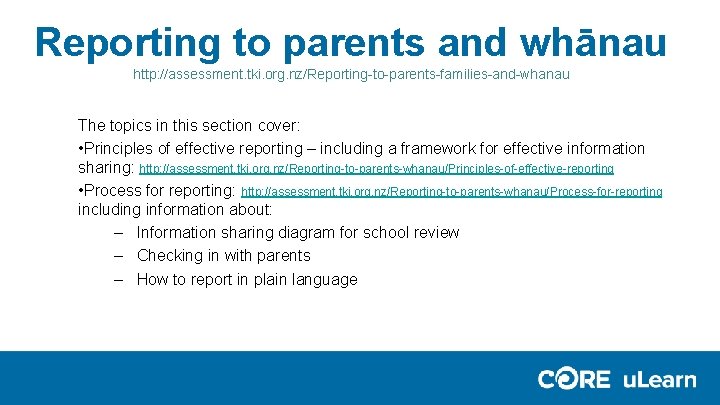
Reporting to parents and whānau http: //assessment. tki. org. nz/Reporting-to-parents-families-and-whanau The topics in this section cover: • Principles of effective reporting – including a framework for effective information sharing: http: //assessment. tki. org. nz/Reporting-to-parents-whanau/Principles-of-effective-reporting • Process for reporting: http: //assessment. tki. org. nz/Reporting-to-parents-whanau/Process-for-reporting including information about: – Information sharing diagram for school review – Checking in with parents – How to report in plain language
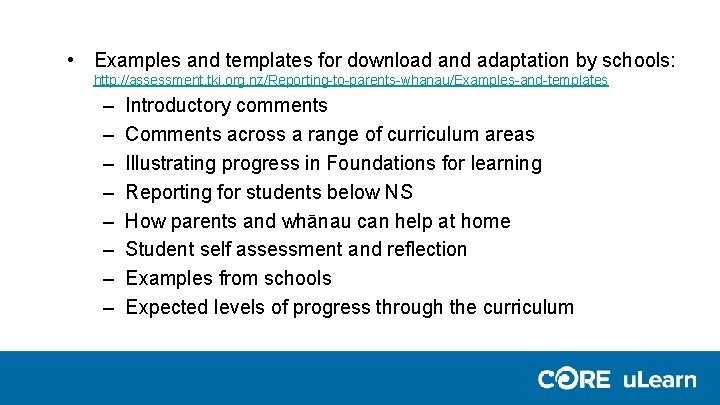
• Examples and templates for download and adaptation by schools: http: //assessment. tki. org. nz/Reporting-to-parents-whanau/Examples-and-templates – – – – Introductory comments Comments across a range of curriculum areas Illustrating progress in Foundations for learning Reporting for students below NS How parents and whānau can help at home Student self assessment and reflection Examples from schools Expected levels of progress through the curriculum
Other useful resources • Assessment Literacy: the possession of knowledge about the basic principles of sound assessment practice, including its terminology, the development and use of assessment methodologies and techniques, and familiarity with standards of quality in assessment. • Target setting: a resource for Boards of Trustees
Thank you For further support please contact: assessment@tki. org. nz