
Artificial Life Lecture 13 EASy Tierra and Avida
![Artificial Life Lecture 13 EASy Tierra and Avida [Plus PDW] This line of Alife](https://slidetodoc.com/presentation_image/9b60814c4ff58b1bf45b9cade0575701/image-1.jpg "Artificial Life Lecture 13 EASy Tierra and Avida [Plus PDW] This line of Alife")
- Slides: 35
Artificial Life Lecture 13 EASy Tierra and Avida [Plus PDW] This line of Alife investigation can be traced back to early games of COREWARS -- A. K. 'Kee' Dewdney, 1983 and in Sci American columns. . Competing assembly language programs: 'My aim is for my program to over-write and destroy yours. ' Obvious connection with computer viruses. Artificial Life lecture 13 17 November 2009
Assembly language EASy In 1950 s, 60 s, memory was on ferromagnetic cores, 1 bit per core. Programs are written in a simplified Assembly language Redcode, and run in a virtual computer memory of 8000 addresses. Two human competitors write their own Assembly language programs, which are placed in memory at random positions. Two 'program counters' execute one instruction of each program in turn, with consequent writing into other parts of memory, and jumping execution position according to whatever instructions are met. Artificial Life lecture 13 17 November 2009
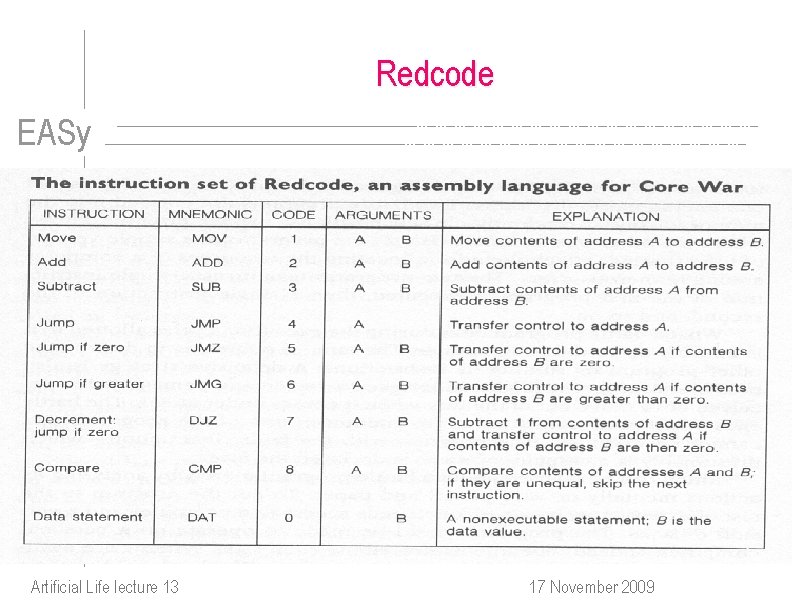
Redcode EASy Artificial Life lecture 13 17 November 2009
Partial Recursion EASy Note that there are conditional jumps -- this provides enough for partial recursive programs, ie the works! Variation Add to the above list a 10 th SPL instrn = split -- this then allows programs to multiply. One needs rules such as 'each players share of CPU time is divided between all their various programs' Artificial Life lecture 13 17 November 2009
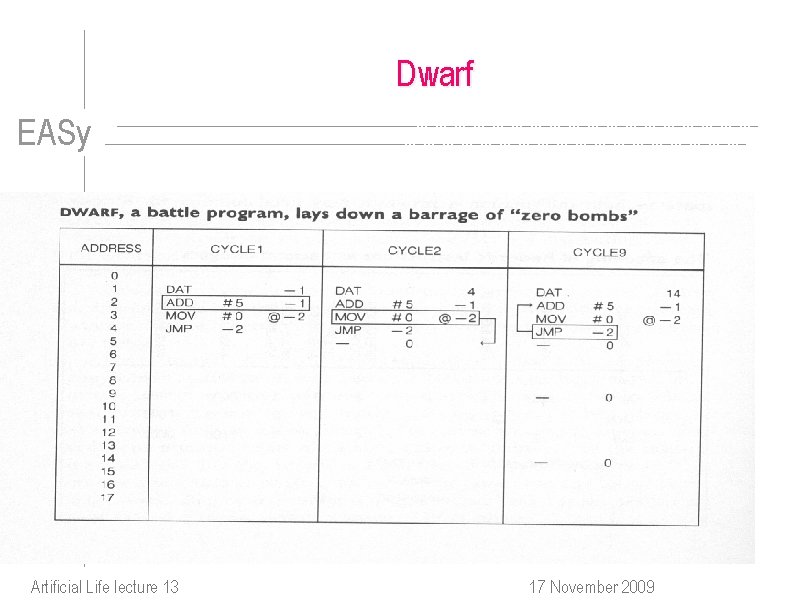
Dwarf EASy Artificial Life lecture 13 17 November 2009
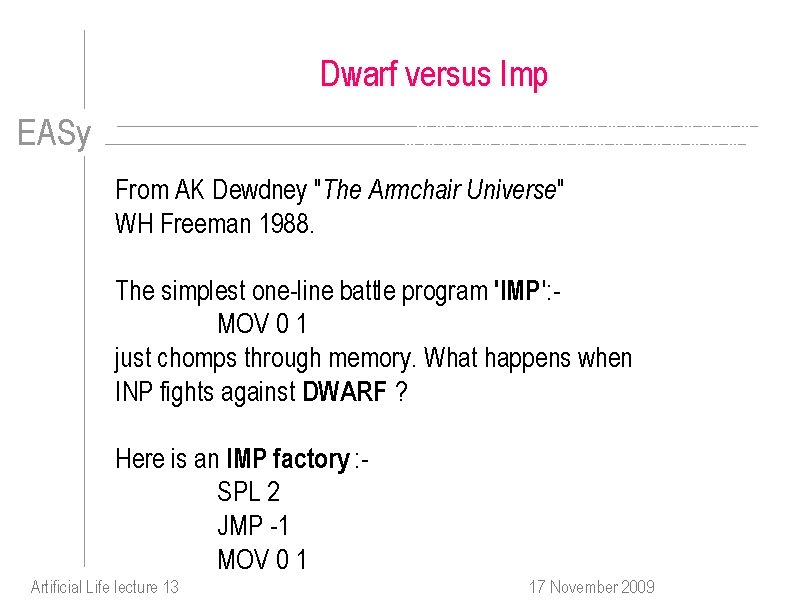
Dwarf versus Imp EASy From AK Dewdney "The Armchair Universe" WH Freeman 1988. The simplest one-line battle program 'IMP': MOV 0 1 just chomps through memory. What happens when INP fights against DWARF ? Here is an IMP factory : SPL 2 JMP -1 MOV 0 1 Artificial Life lecture 13 17 November 2009
A bit of pre-history EASy Actually, 1983 Core Wars was preceded by a much earlier piece of what must be the earliest version of such work -almost completely forgotten. Nils A. Barricelli's 'Symbioorganisms' -- paper by him "Symbiogenetic evolution processes realized by artificial methods", Methodos 9 (35 -36) 1957. Other papers by him reprinted in "Evolutionary Computation: The Fossil Record" DB Fogel (ed) IEEE Press, New York 1998. Artificial Life lecture 13 17 November 2009
Old classics EASy This work demonstrated, at such an early date, evolution within a computer program, crossbreeding, growth and selfrepair, parasitism. . . I accidentally came across a reference to this decades ago, which triggered my own interest in the area -- and then never saw any discussion of this work again until "Darwin Among the Machines" GB Dyson Addison Wesley 1997. Well worth looking at some of these early papers. Artificial Life lecture 13 17 November 2009
Tierra EASy At the second Alife Conference, Santa Fe Feb 1990, proceedings in "Artificial Life II" eds Langton, Taylor, Farmer, Rasmussen, Addison Wesley 1992 Steen Rasmussen and co-authors presented an updated version of Core World in an Alife context -- see paper in those proceedings. But also Tom Ray presented Tierra for the first time -- all the breakthrough work had been in the preceding month or so on his Toshiba laptop (20 MHz). TS Ray "An Approach to the Synthesis of Life“ in same proceedings. Artificial Life lecture 13 17 November 2009
Tom Ray EASy Tom Ray is an ecologist who learnt to program, so as to see if computer-virus-like things could evolve in a computer, in virtual memory. Actually the Barricelli work (of which he was unaware) prefigured some of the ideas -- but the results Ray got, with 1990 computer power, made an enormous impression. Artificial Life lecture 13 17 November 2009
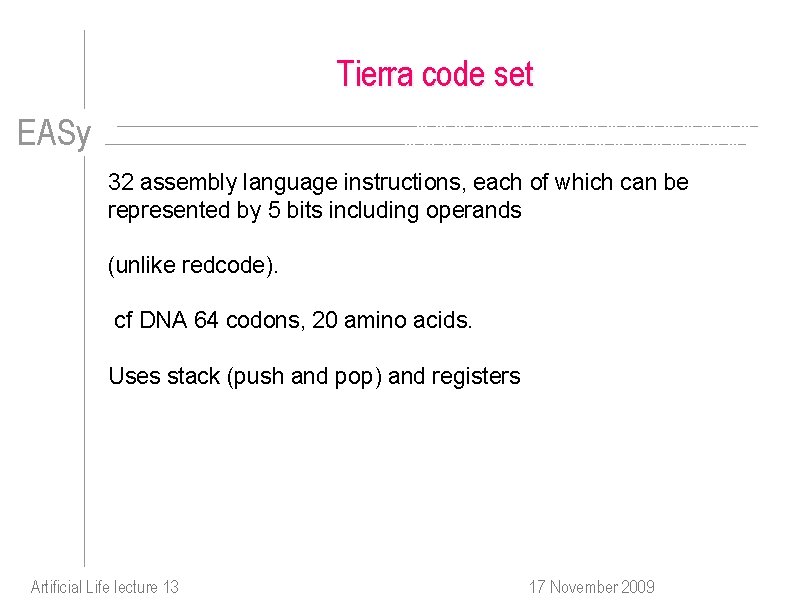
Tierra code set EASy 32 assembly language instructions, each of which can be represented by 5 bits including operands (unlike redcode). cf DNA 64 codons, 20 amino acids. Uses stack (push and pop) and registers Artificial Life lecture 13 17 November 2009
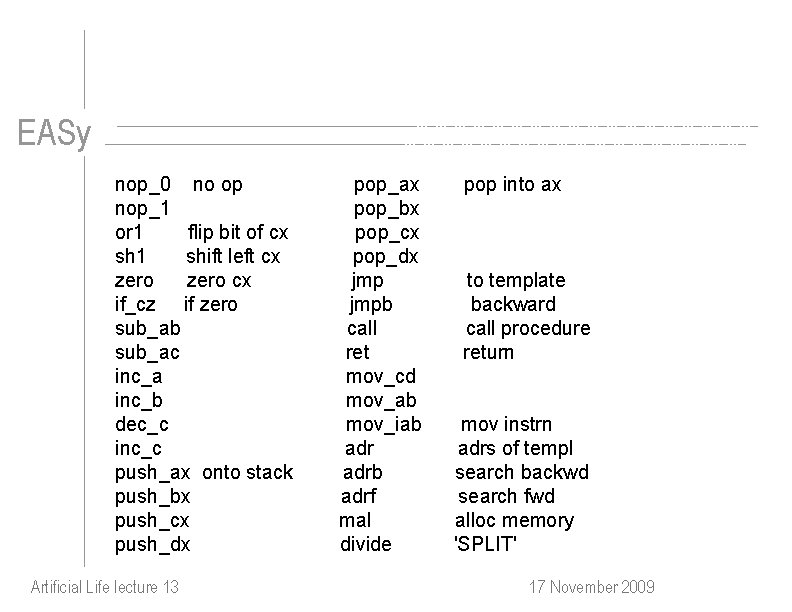
EASy nop_0 no op nop_1 or 1 flip bit of cx sh 1 shift left cx zero cx if_cz if zero sub_ab sub_ac inc_a inc_b dec_c inc_c push_ax onto stack push_bx push_cx push_dx Artificial Life lecture 13 pop_ax pop_bx pop_cx pop_dx jmpb call ret mov_cd mov_ab mov_iab adrb adrf mal divide pop into ax to template backward call procedure return mov instrn adrs of templ search backwd search fwd alloc memory 'SPLIT' 17 November 2009
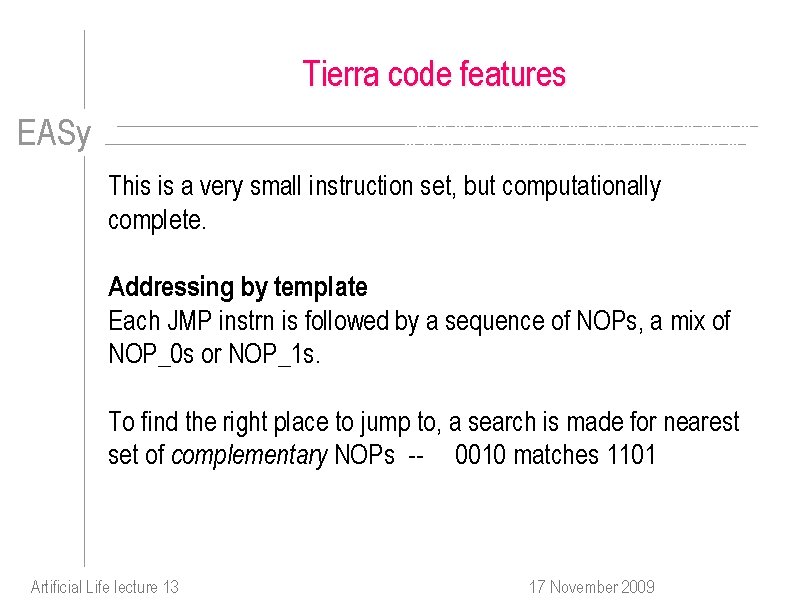
Tierra code features EASy This is a very small instruction set, but computationally complete. Addressing by template Each JMP instrn is followed by a sequence of NOPs, a mix of NOP_0 s or NOP_1 s. To find the right place to jump to, a search is made for nearest set of complementary NOPs -- 0010 matches 1101 Artificial Life lecture 13 17 November 2009
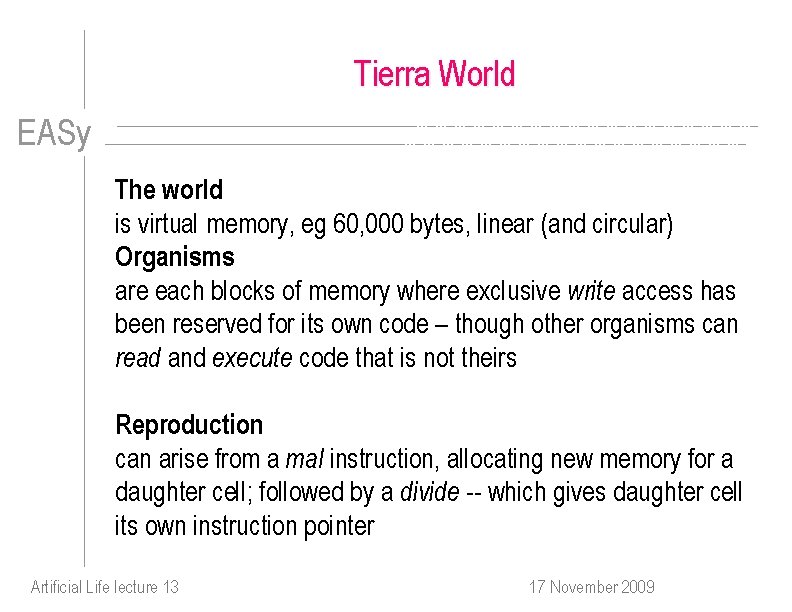
Tierra World EASy The world is virtual memory, eg 60, 000 bytes, linear (and circular) Organisms are each blocks of memory where exclusive write access has been reserved for its own code – though other organisms can read and execute code that is not theirs Reproduction can arise from a mal instruction, allocating new memory for a daughter cell; followed by a divide -- which gives daughter cell its own instruction pointer Artificial Life lecture 13 17 November 2009
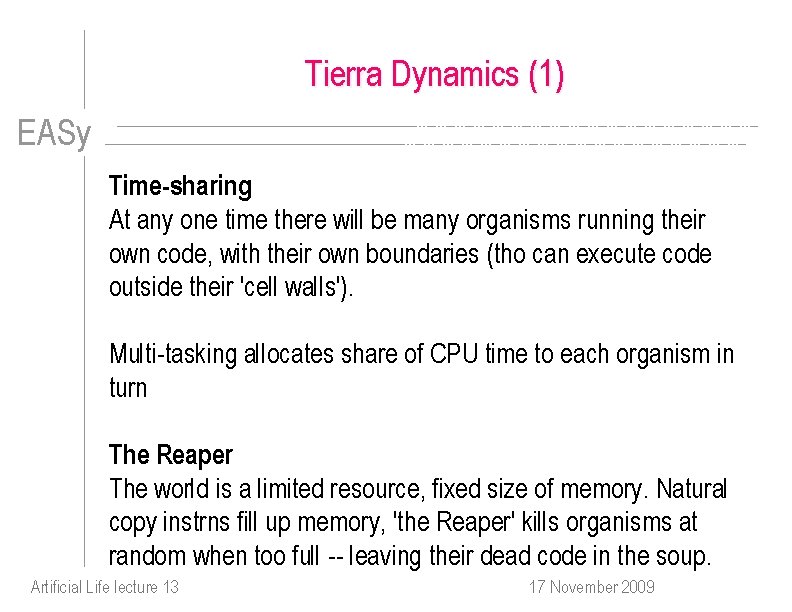
Tierra Dynamics (1) EASy Time-sharing At any one time there will be many organisms running their own code, with their own boundaries (tho can execute code outside their 'cell walls'). Multi-tasking allocates share of CPU time to each organism in turn The Reaper The world is a limited resource, fixed size of memory. Natural copy instrns fill up memory, 'the Reaper' kills organisms at random when too full -- leaving their dead code in the soup. Artificial Life lecture 13 17 November 2009
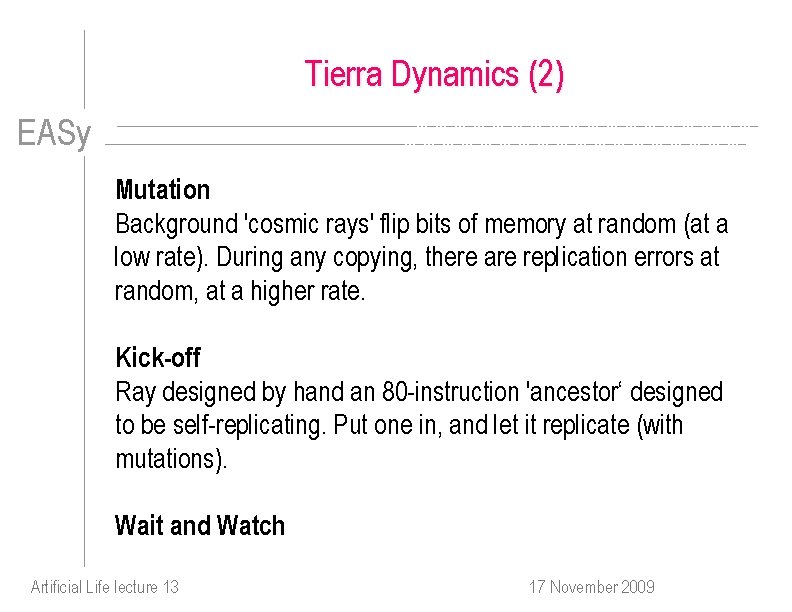
Tierra Dynamics (2) EASy Mutation Background 'cosmic rays' flip bits of memory at random (at a low rate). During any copying, there are replication errors at random, at a higher rate. Kick-off Ray designed by hand an 80 -instruction 'ancestor‘ designed to be self-replicating. Put one in, and let it replicate (with mutations). Wait and Watch Artificial Life lecture 13 17 November 2009
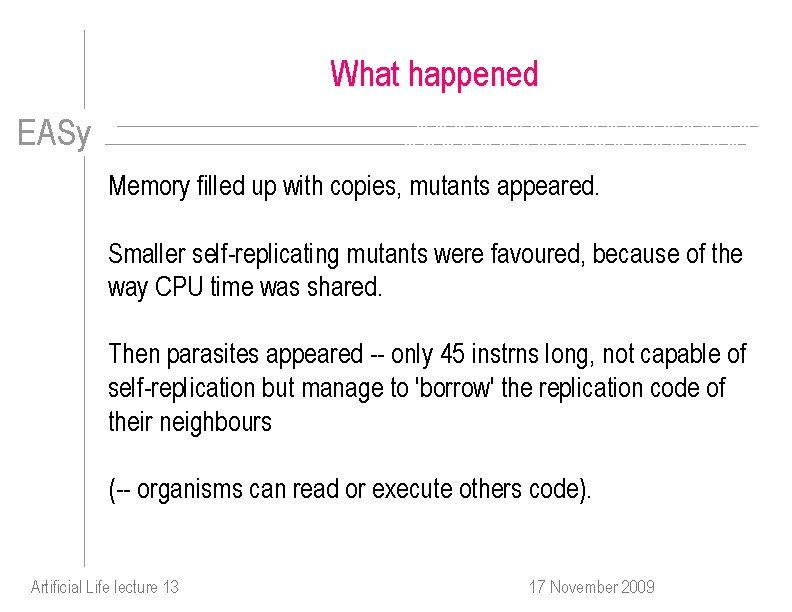
What happened EASy Memory filled up with copies, mutants appeared. Smaller self-replicating mutants were favoured, because of the way CPU time was shared. Then parasites appeared -- only 45 instrns long, not capable of self-replication but manage to 'borrow' the replication code of their neighbours (-- organisms can read or execute others code). Artificial Life lecture 13 17 November 2009
Parasites and hyper-parasites … EASy An ecology of different organism types builds up. Some immunity to parasites appears in some self-replicators Hyper-parasites 'steal the instruction pointers‘ from parasites Social parasites. . . hyper-parasites. . . etc. . . Artificial Life lecture 13 17 November 2009
Macro-dynamics EASy Tierra is a rich experimental domain for watching a diverse ecology grow, possible parallels to situations in the real world. For each organism, the 'physical world' consists of 'energy' (CPU time = sunlight) and 'space' in memory, which is limited. But above all, the environment which affects their fitness includes the other organisms around. Ray was interested in looking for such features as punctuated equilibrium (punk eek), and any light that could be shed on the Cambrian explosion of diversity. Artificial Life lecture 13 17 November 2009
…still going on… EASy This work has been a fruitful source of ideas, has spawned a whole industry, Tierra on the Internet 'with patterns of activity following the night around the globe' etc. Personally, I consider the early Tierra work was truly exciting and mind-opening, but I am not so sure about the continuation. . . Artificial Life lecture 13 17 November 2009
Avida EASy Several variations spun off from Tierra, with varying motives. Avida is one of these, coming out of more a physics background than a biology one. Chris Adami, Titus Brown and others "Introduction to Artificial Life" Christoph Adami Springer-Verlag New York 1998 Plus (as with Tierra) many publications online on www Artificial Life lecture 13 17 November 2009
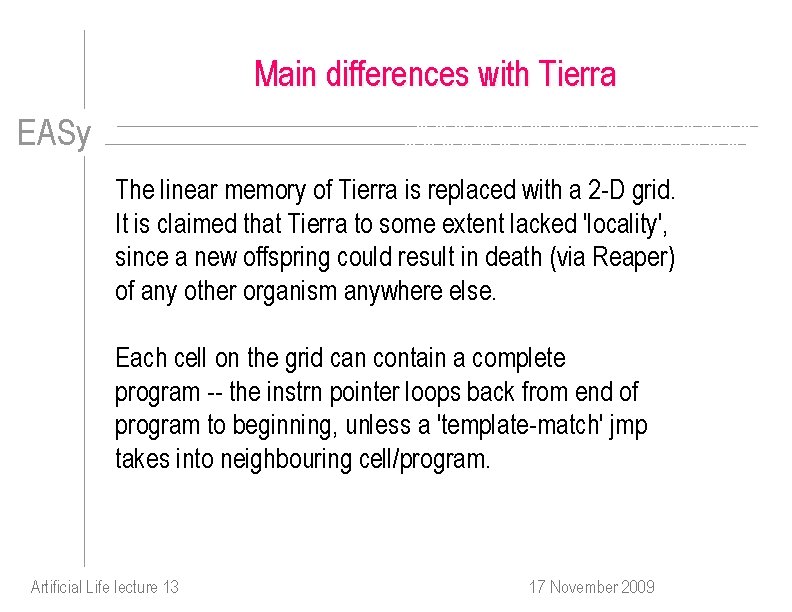
Main differences with Tierra EASy The linear memory of Tierra is replaced with a 2 -D grid. It is claimed that Tierra to some extent lacked 'locality', since a new offspring could result in death (via Reaper) of any other organism anywhere else. Each cell on the grid can contain a complete program -- the instrn pointer loops back from end of program to beginning, unless a 'template-match' jmp takes into neighbouring cell/program. Artificial Life lecture 13 17 November 2009
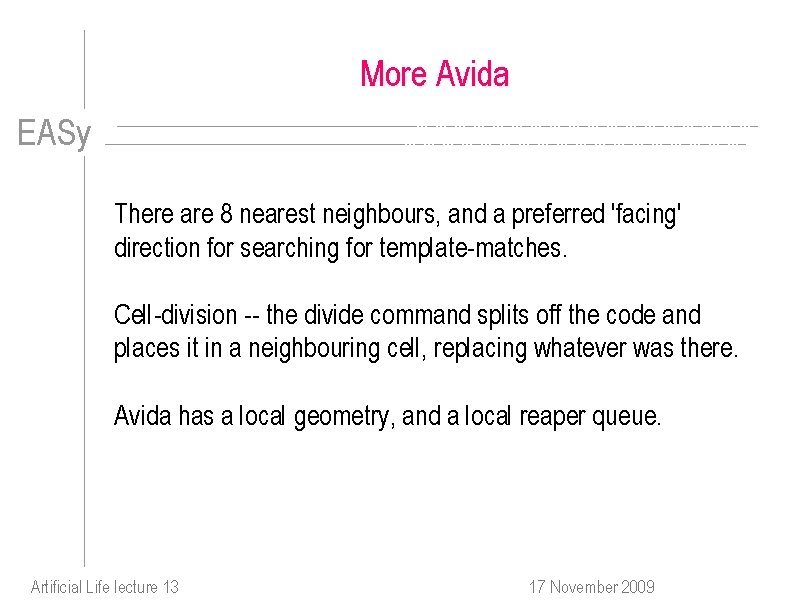
More Avida EASy There are 8 nearest neighbours, and a preferred 'facing' direction for searching for template-matches. Cell-division -- the divide command splits off the code and places it in a neighbouring cell, replacing whatever was there. Avida has a local geometry, and a local reaper queue. Artificial Life lecture 13 17 November 2009
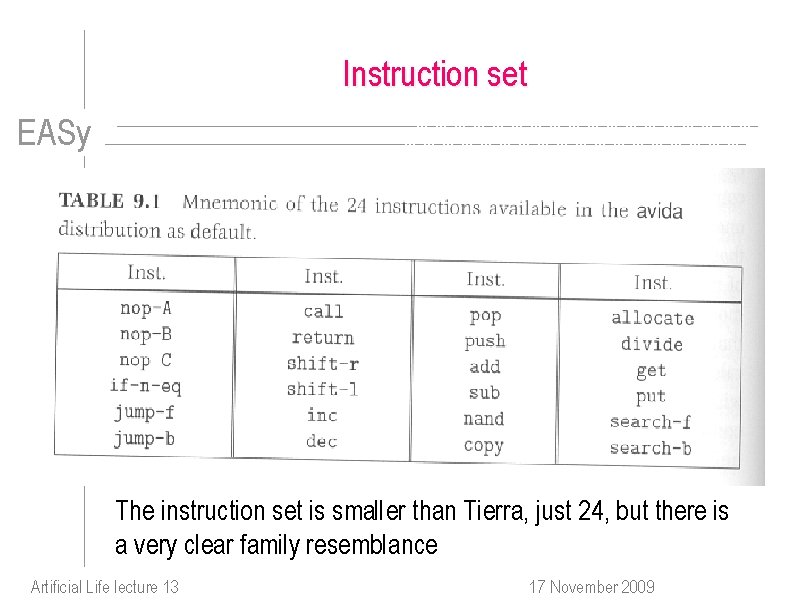
Instruction set EASy The instruction set is smaller than Tierra, just 24, but there is a very clear family resemblance Artificial Life lecture 13 17 November 2009
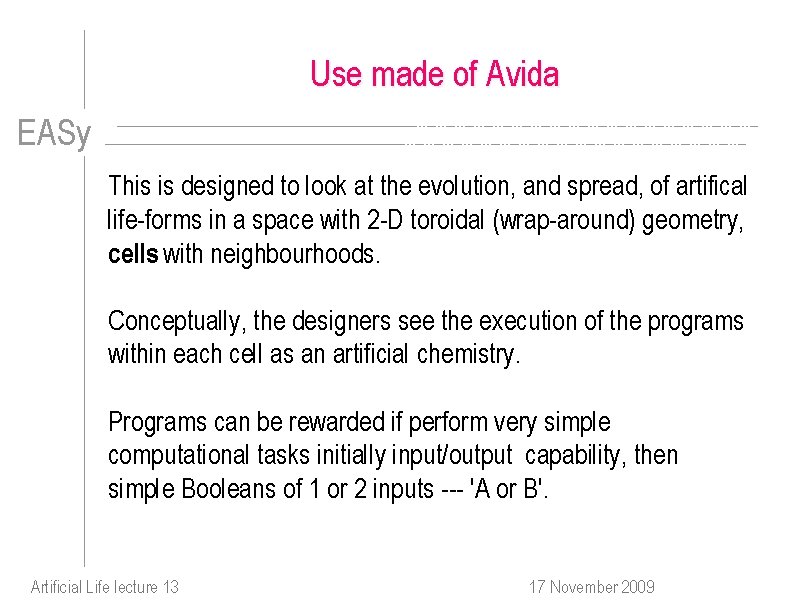
Use made of Avida EASy This is designed to look at the evolution, and spread, of artifical life-forms in a space with 2 -D toroidal (wrap-around) geometry, cells with neighbourhoods. Conceptually, the designers see the execution of the programs within each cell as an artificial chemistry. Programs can be rewarded if perform very simple computational tasks initially input/output capability, then simple Booleans of 1 or 2 inputs --- 'A or B'. Artificial Life lecture 13 17 November 2009
Dynamics of Evolution EASy This gives a 'fitness landscape', some programs artifically fitter than others. In particular, the experimenters are interested in the dynamics of evolution in such a complex artificial world -- such factors as speciation, propagation of genetic 'information' through a population, etc. Generally, as physicists, they were asking different sorts of questions from Tierra. In recent years, collaborating with a Microbial Evolutionary person, Rich Lenski, and testing biological ideas – fruitful collaboration. Artificial Life lecture 13 17 November 2009
EG some Avida-based publications EASy Adaptive Radiation from Resource Competition in Digital Organisms; S. S. Chow, C. O. Wilke, C. Ofria, R. E. Lenski, C. Adami. Science 305 (2004) 84 -86 The Evolutionary Origin of Complex Features; R. E. Lenski, C. Ofria, R. T. Pennock, and C. Adami, Nature 423 (2003) 139 -145. Evolution of Digital Organisms at High Mutation Rate Leads To Survival of the Flattest; C. O. Wilke, J. L. Wang, C. Ofria, R. E. Lenski, and C. Adami, Nature 412 (2001) 331 -333. Genomic Complexity, Robustness, and Genetic Interactions in Digital Organisms R. E. Lenski, C. Ofria, T. C. Collier, C. Adami, Nature 400 (1999) 661 -664. Artificial Life lecture 13 17 November 2009
References – Tierra and Avida EASy Tierra publications http: //www. his. atr. co. jp/~ray/pubs/ More general on Tierra http: //www. his. atr. co. jp/~ray/tierra Avida publications http: //dllab. caltech. edu/avida/ Artificial Life lecture 13 17 November 2009
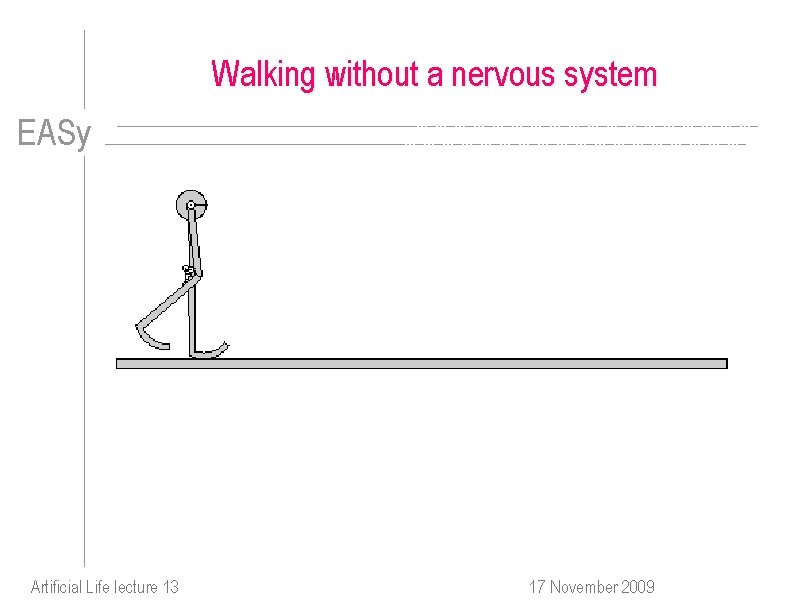
Change of topic … EASy Time for a few slides relating to Passive Dynamic Walking and beyond. Cf. work by Eric Vaughan, Artificial Life lecture 13 www. droidlogic. com 17 November 2009
Walking without a nervous system EASy Artificial Life lecture 13 17 November 2009
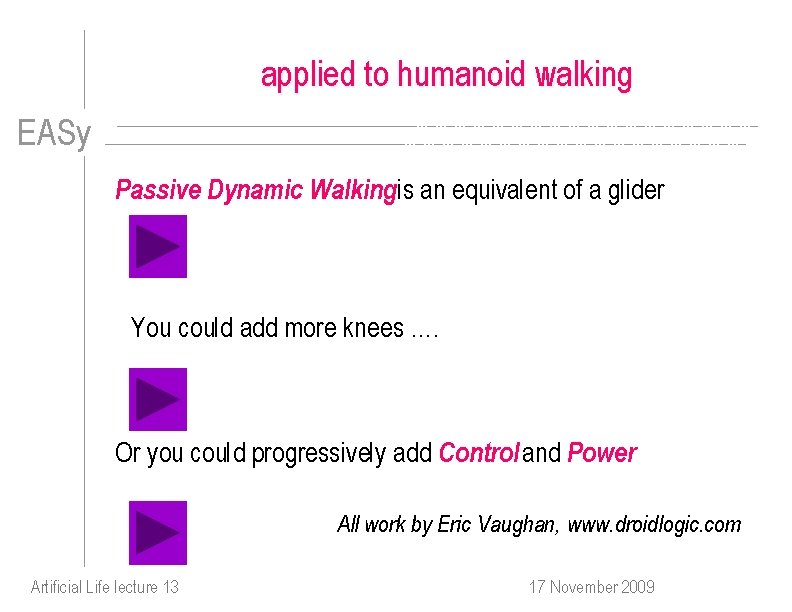
applied to humanoid walking EASy Passive Dynamic Walkingis an equivalent of a glider You could add more knees …. Or you could progressively add Control and Power All work by Eric Vaughan, www. droidlogic. com Artificial Life lecture 13 17 November 2009
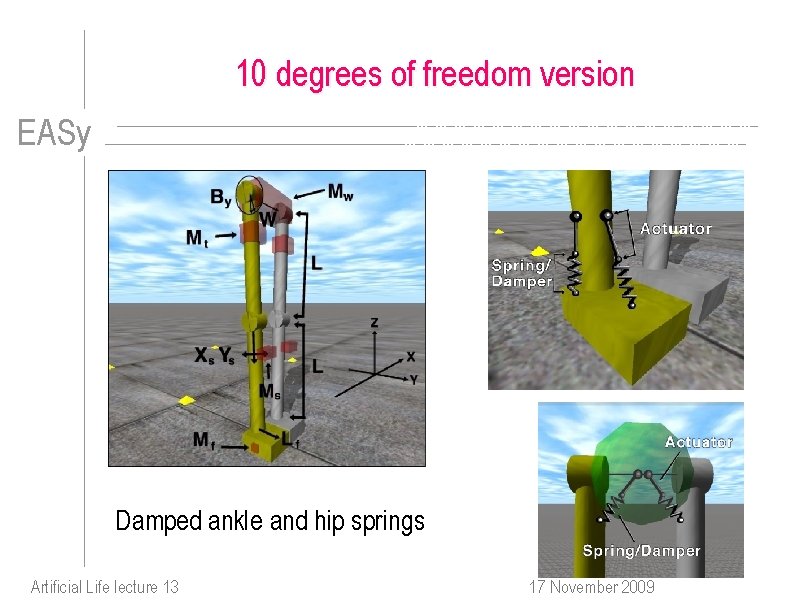
10 degrees of freedom version EASy Damped ankle and hip springs Artificial Life lecture 13 17 November 2009
Some examples EASy Walking back and forward (2 D version, 6 Do. F) Balancing on a moving platform Powered walking on the flat All work by Eric Vaughan, www. droidlogic. com Artificial Life lecture 13 17 November 2009
ODE EASy These simulations are done within a ‘Physics Engine’ – that takes over most of the hard work of calculating how component parts move under forces of gravity, of motors, of meeting the ground or other objects. We often use ODE (Open Dynamics Engine – Russell Smith and others) http: //www. ode. org/ Artificial Life lecture 13 17 November 2009
Natural Motion EASy Natural Motion http: //www. naturalmotion. com/ Torsten Reil – EASy MSc 1998/99 Artificial Life lecture 13 17 November 2009