Applied Industrial Ergonomics IE 665 Arijit Sengupta Ph
- Slides: 34
Applied Industrial Ergonomics (IE 665) Arijit Sengupta, Ph. D. New Jersey Institute of Technology Department of Mechanical and Industrial Engineering Occupational Safety and Health Engineering Program 11/29/2020 Dr. A. K. Sengupta 1
Ergonomics • Ergonomics is the scientific study of how people interact effectively with products, equipment, facilities, procedures and environments used at work and in everyday living. • Ergonomics seeks to match the design of machines, jobs and workplaces with the capabilities, limitations and needs of people. • Ergonomics seeks to maximize ease of use and optimize operator productivity, comfort and health. 11/29/2020 Dr. A. K. Sengupta 2
Ergonomics/Human Factors • Ergonomics (European) and Human Factors (US) are the same disciplines. • Ergonomics came from ‘ergon’ or ‘ergos’ (Greek word for work) and ‘nomos’ or ‘nomikos’ (Greek word for laws). • Ergonomics is the “science of work” • Ergonomics is multidisciplinary and uses multiple methods. • Ergonomics is user focused • If it doesn’t affect design in some way, it isn’t ergonomics. 11/29/2020 Dr. A. K. Sengupta 3
Ergonomics definition by the International Ergonomics Association (IEA) Executive Council Ergonomics (or human factors) is the scientific discipline concerned with the understanding of the interactions among human and other elements of a system, and the profession that applies theory, principles, data and methods to design in order to optimize human well-being and overall system performance. 11/29/2020 Dr. A. K. Sengupta 4
Ergonomics: Foundations in the Industrial Society • The association between occupations and musculoskeletal injuries was documented centuries ago. Bernardino Ramazinni (1633 -1714) wrote about work-related complaints (that he saw in his medical practice) in the 1713 supplement to his 1700 publication, “De Morbis Artificum (Diseases of Workers). ” ü Encouraged eventual passage of factory safety and workmen’s compensation laws. ü In 1700 he wrote De morbis artificum diatriba (Diseases of Workers) in Latin describing the health hazards of repetitive motions and postures, irritating chemicals, dust, metals, and other abrasive agents for workers in 52 occupations. 11/29/2020 Dr. A. K. Sengupta 5
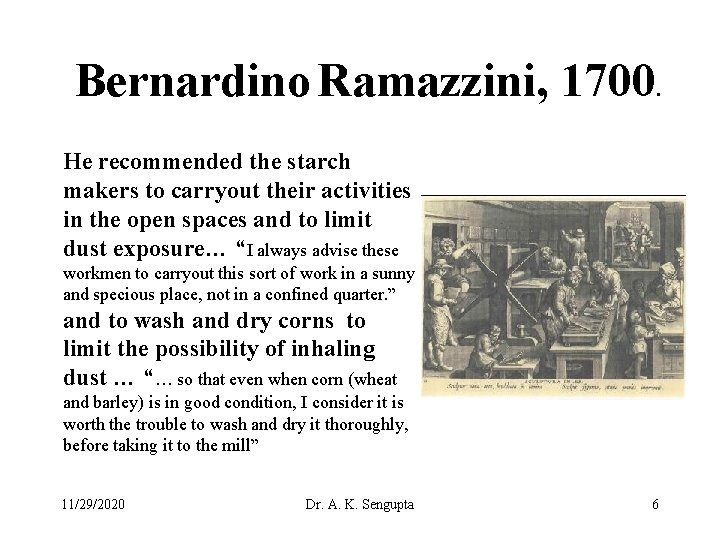
Bernardino Ramazzini, 1700. He recommended the starch makers to carryout their activities in the open spaces and to limit dust exposure… “I always advise these workmen to carryout this sort of work in a sunny and specious place, not in a confined quarter. ” and to wash and dry corns to limit the possibility of inhaling dust … “… so that even when corn (wheat and barley) is in good condition, I consider it is worth the trouble to wash and dry it thoroughly, before taking it to the mill” 11/29/2020 Dr. A. K. Sengupta 6
Bernardino Ramazzini, 1700. • “[I have seen] workers in whom certain morbid affections gradually arise from some particular posture of the limbs or unnatural movements of the body called for while they work. ” • “Such are the workers who all day stand or sit, stoop or are bent double, who run or ride or exercise their bodies in all sorts of [excess] ways. ” … “. . . the harvest of diseases reaped by certain workers. . . [from] irregular motions in unnatural postures of the body. ” 11/29/2020 Dr. A. K. Sengupta 7
Bernardino Ramazzini, 1700. • Standing: – “Those who work standing. . . carpenters, sawyers, carvers, blacksmiths, masons. . . are liable to varicose veins. . . [because] the strain on the muscles is such that the circulation of the blood is retarded. ” – “Standing even for a short time proves exhausting compared with walking and running though it be for a long time. . Nature delights and is restored by alternating and varied actions. ” 11/29/2020 Dr. A. K. Sengupta 8
Bernardino Ramazzini, 1700. Sitting – “Those who sit at their work suffer from their own particular diseases. [As noted back in Roman times by the learned slave] Plautus, ‘sitting hurts your loins, staring, your eyes. ’ ” – “All sedentary workers. . . suffer from the itch, are a bad color, and in poor condition. . For when the body is not kept moving the blood becomes tainted, its waste matter lodges in the skin, and the condition of the whole body deteriorates. ” 11/29/2020 Dr. A. K. Sengupta 9
Bernardino Ramazzini, 1700. Office work – “The maladies that affect the clerks arise from three causes: first, constant sitting; secondly, incessant movement of the hand always in the same direction; and thirdly, the strain on the mind…” – “The incessant driving of the pen over paper causes intense fatigue of the hand the whole arm because of the continuous. . . strain on the muscles and tendons. ” – “An acquaintance of mine, a notary by profession, who, by perpetual writing, began first to complain of an excessive wariness of his whole right arm which could be removed by no medicines, and which was at last succeeded by a perfect palsy of the whole arm. . He learned to write with his left hand, which was soon thereafter seized with the same disorder. ” 11/29/2020 Dr. A. K. Sengupta 10
History of Ergonomics Wojciech Jastrzebowski, a Polish scientist and author created the word ergonomics in 1857 in a philosophical narrative, “based upon the truths drawn from the Science of Nature” (Jastrzebowski, 1857). 11/29/2020 Dr. A. K. Sengupta 11
History of Ergonomics: Late 1800 s / Early 1900 s: The Industrial Revolution In the early 1900’s, the production of industry was still largely dependent on human power/motion. In the 19 th century, Frederick Taylor pioneered the "scientific management" method, which proposed a way to find the optimum method of carrying out a given task. Taylor found that he could, for example, triple the amount of coal that workers were shoveling by incrementally reducing the size and weight of shovels until the fastest shoveling rate was reached. 11/29/2020 Dr. A. K. Sengupta 12
Early 1900 s Frank and Lillian Gilbreth expanded Taylor's methods in the early 1900 s to develop the "time and motion study". They aimed to improve efficiency by eliminating unnecessary steps and actions. By applying this approach, the Gilbreths reduced the number of motions in bricklaying from 18 to 4. 5, allowing bricklayers to increase their productivity from 120 to 350 bricks per hour. 11/29/2020 Dr. A. K. Sengupta 13
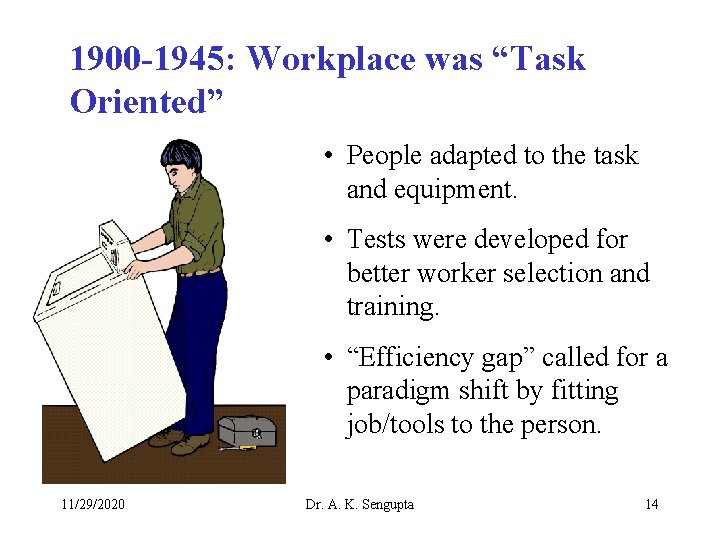
1900 -1945: Workplace was “Task Oriented” • People adapted to the task and equipment. • Tests were developed for better worker selection and training. • “Efficiency gap” called for a paradigm shift by fitting job/tools to the person. 11/29/2020 Dr. A. K. Sengupta 14
1945 -1960: “Human Factors” Profession was born First engineering psychology labs were established in US & Britain • first ‘Ergonomics Research Society’ was formed in Britain • First scientific journal in 1957 – ‘Ergonomics’ • International Ergonomics Society launched in 1959. 11/29/2020 Dr. A. K. Sengupta 15
After World War II The focus of concern expanded to include worker safety as well as productivity. Research began in a variety of areas such as: • Muscle force required to perform manual tasks • Compressive low back disk force when lifting • Cardiovascular response when performing heavy labor • Perceived maximum load that can be carried, pushed or pulled 11/29/2020 Dr. A. K. Sengupta 16
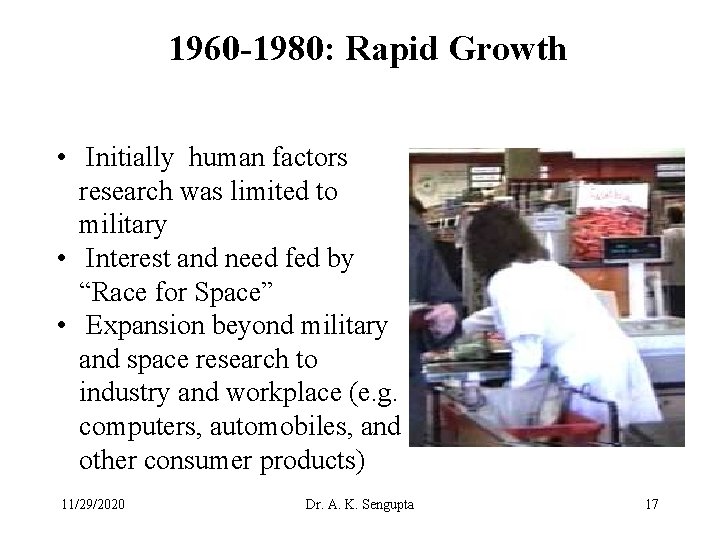
1960 -1980: Rapid Growth • Initially human factors research was limited to military • Interest and need fed by “Race for Space” • Expansion beyond military and space research to industry and workplace (e. g. computers, automobiles, and other consumer products) 11/29/2020 Dr. A. K. Sengupta 17
1980 -Today: Computers, Disasters, & Lawsuits • Computers - desire for “people-oriented” technology grew through ergonomically designed computers, user -friendly software, and office design • Disasters – Three Mile Island, Chernobyl, and various high-profile chemical plant explosions were linked to lack of attention to “human factor” considerations • Lawsuits – courts came to recognize the need for experts in explaining human behavior, responses, defective design, and effectiveness of workplace warnings and instructions 11/29/2020 Dr. A. K. Sengupta 18
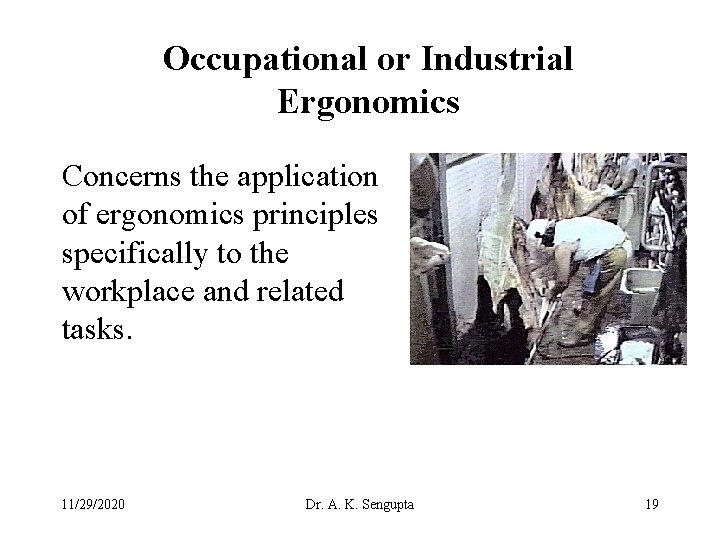
Occupational or Industrial Ergonomics Concerns the application of ergonomics principles specifically to the workplace and related tasks. 11/29/2020 Dr. A. K. Sengupta 19
Need for Occupational Ergonomics • “Social Justice” understanding of work and employment • Trend in industrialized countries to accommodate individual workers regardless of physical capabilities, age, gender, or race • Changing international standards for “work capacity” limits and “worker selection” tests • Research reveals greater diversity of “performance” within age and gender groups than previously thought. For example, recommended weight-lifting standard in 1960 s by International Standards Organization is illegal now in many countries because it “stereotypes” age/gender lifting limits 11/29/2020 Dr. A. K. Sengupta 20
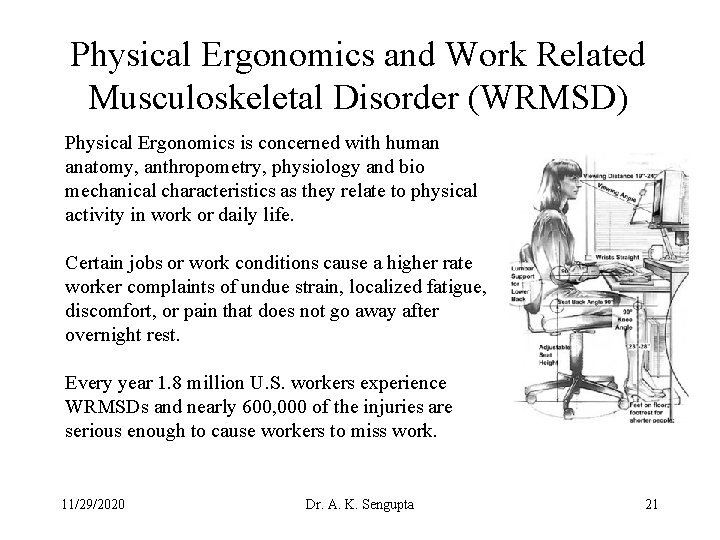
Physical Ergonomics and Work Related Musculoskeletal Disorder (WRMSD) Physical Ergonomics is concerned with human anatomy, anthropometry, physiology and bio mechanical characteristics as they relate to physical activity in work or daily life. Certain jobs or work conditions cause a higher rate worker complaints of undue strain, localized fatigue, discomfort, or pain that does not go away after overnight rest. Every year 1. 8 million U. S. workers experience WRMSDs and nearly 600, 000 of the injuries are serious enough to cause workers to miss work. 11/29/2020 Dr. A. K. Sengupta 21
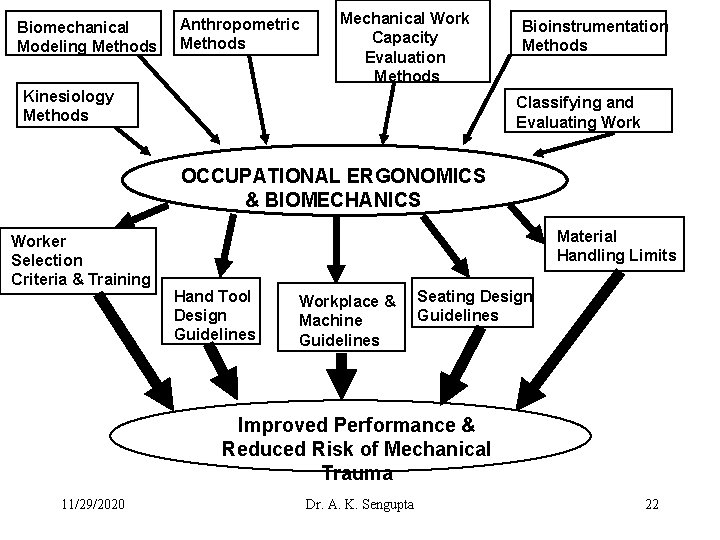
Biomechanical Modeling Methods Anthropometric Methods Mechanical Work Capacity Evaluation Methods Kinesiology Methods Bioinstrumentation Methods Classifying and Evaluating Work OCCUPATIONAL ERGONOMICS & BIOMECHANICS Worker Selection Criteria & Training Material Handling Limits Hand Tool Design Guidelines Workplace & Machine Guidelines Seating Design Guidelines Improved Performance & Reduced Risk of Mechanical Trauma 11/29/2020 Dr. A. K. Sengupta 22
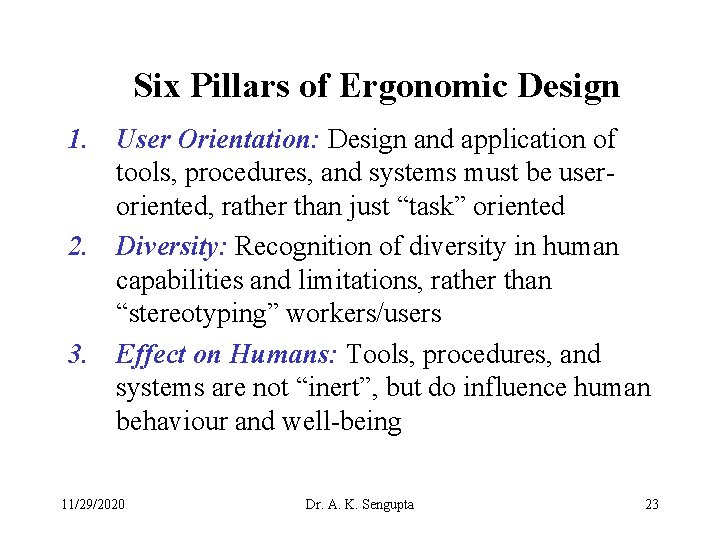
Six Pillars of Ergonomic Design 1. User Orientation: Design and application of tools, procedures, and systems must be useroriented, rather than just “task” oriented 2. Diversity: Recognition of diversity in human capabilities and limitations, rather than “stereotyping” workers/users 3. Effect on Humans: Tools, procedures, and systems are not “inert”, but do influence human behaviour and well-being 11/29/2020 Dr. A. K. Sengupta 23
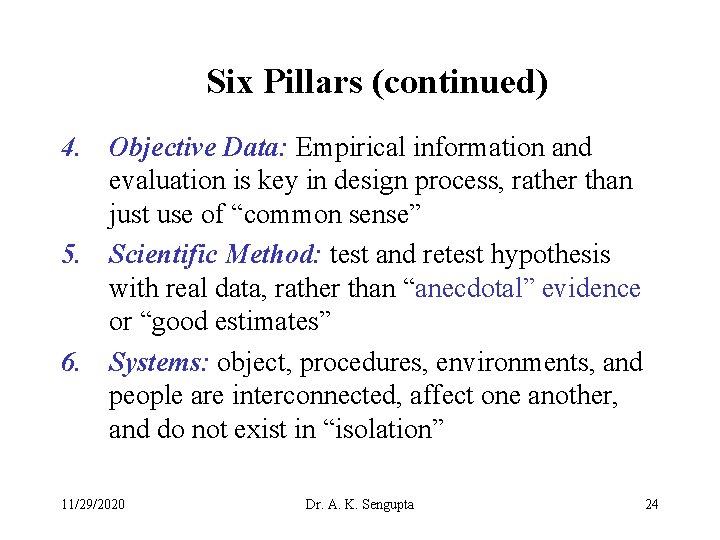
Six Pillars (continued) 4. Objective Data: Empirical information and evaluation is key in design process, rather than just use of “common sense” 5. Scientific Method: test and retest hypothesis with real data, rather than “anecdotal” evidence or “good estimates” 6. Systems: object, procedures, environments, and people are interconnected, affect one another, and do not exist in “isolation” 11/29/2020 Dr. A. K. Sengupta 24
Ergonomics – Physical Design • Who are the users? • How does technology fit different user dimensions? • How does technology fit user anatomy? • How does technology fit user strength? • How does technology fit different user abilities? • How safe is the technology (health, comfort, performance)? • How do users interact with technology? 11/29/2020 Dr. A. K. Sengupta 25
Ergonomics – Cognitive design • • How do users expect the technology to work? How is information displayed? How well are stereotypical expectations met? How complex is the interface? How much training is required? What user knowledge assumptions are met? How does information facilitate learning and memory? 11/29/2020 Dr. A. K. Sengupta 26
Ergonomics - Layout • Are the work items optimally positioned in terms of comfort, convenience, and frequency of use? • How well does the layout support the work flow? • Who can be accommodated by the layout? • How flexible is the layout when work content changes? 11/29/2020 Dr. A. K. Sengupta 27
Ergonomics - Ambient conditions • Physical environment conditions at work • What are the prevailing climate conditions that could effect the work (thermal, luminous, acoustic, vibration, air quality, electromagnetic field) • What are the exposures? • What protection is required? 11/29/2020 Dr. A. K. Sengupta 28
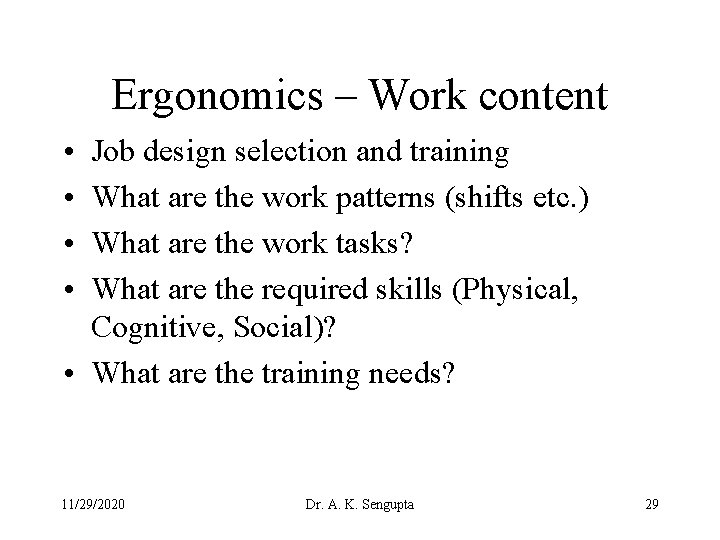
Ergonomics – Work content • • Job design selection and training What are the work patterns (shifts etc. ) What are the work tasks? What are the required skills (Physical, Cognitive, Social)? • What are the training needs? 11/29/2020 Dr. A. K. Sengupta 29
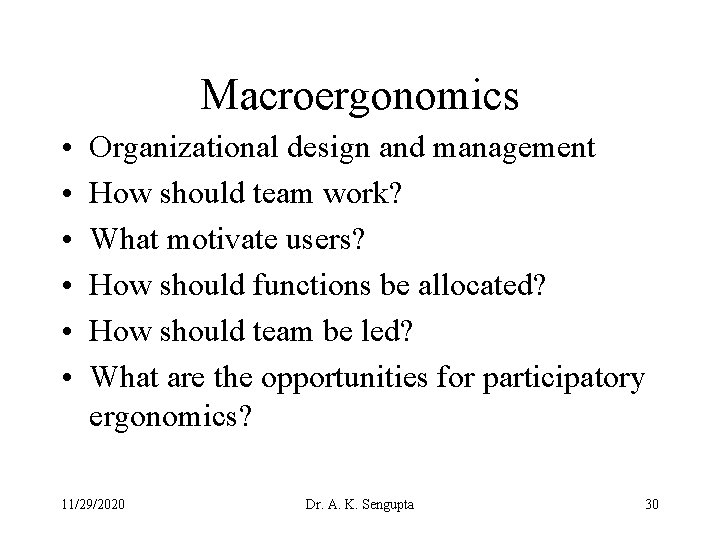
Macroergonomics • • • Organizational design and management How should team work? What motivate users? How should functions be allocated? How should team be led? What are the opportunities for participatory ergonomics? 11/29/2020 Dr. A. K. Sengupta 30
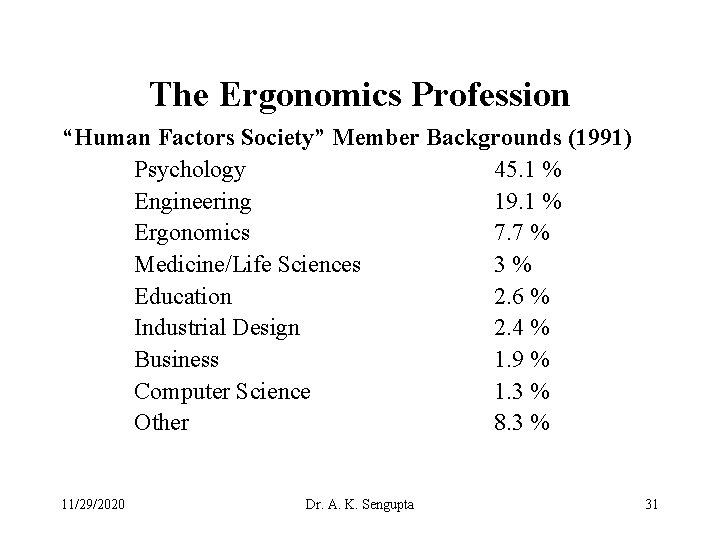
The Ergonomics Profession “Human Factors Society” Member Backgrounds (1991) Psychology 45. 1 % Engineering 19. 1 % Ergonomics 7. 7 % Medicine/Life Sciences 3 % Education 2. 6 % Industrial Design 2. 4 % Business 1. 9 % Computer Science 1. 3 % Other 8. 3 % 11/29/2020 Dr. A. K. Sengupta 31
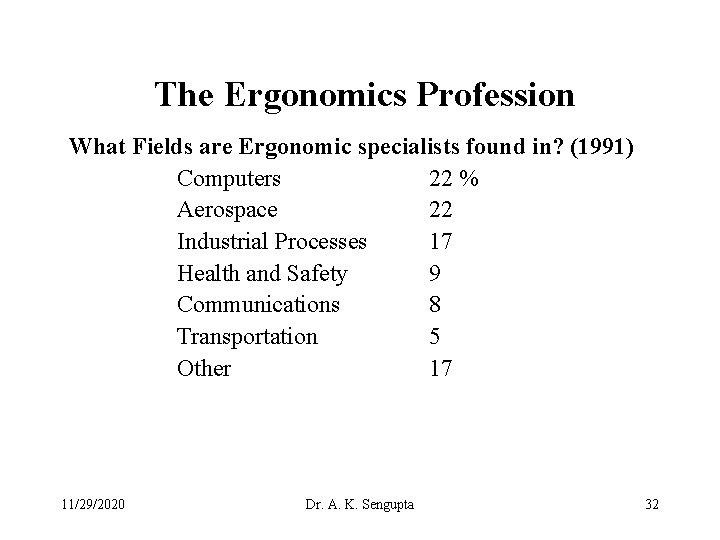
The Ergonomics Profession What Fields are Ergonomic specialists found in? (1991) Computers 22 % Aerospace 22 Industrial Processes 17 Health and Safety 9 Communications 8 Transportation 5 Other 17 11/29/2020 Dr. A. K. Sengupta 32
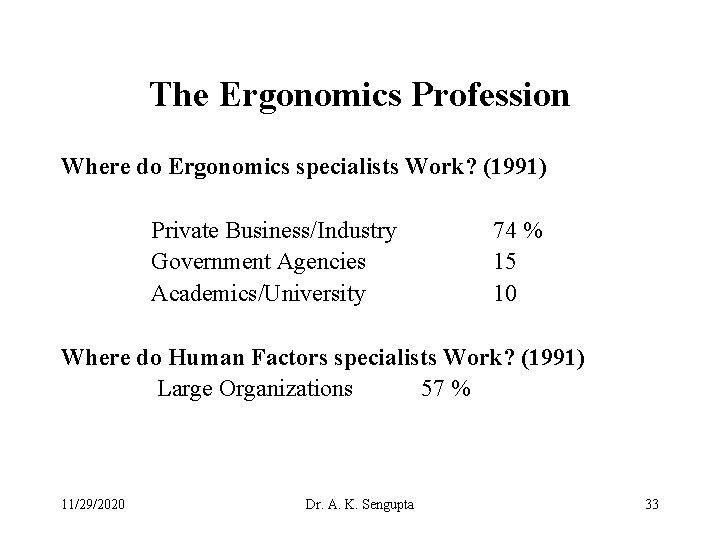
The Ergonomics Profession Where do Ergonomics specialists Work? (1991) Private Business/Industry Government Agencies Academics/University 74 % 15 10 Where do Human Factors specialists Work? (1991) Large Organizations 57 % 11/29/2020 Dr. A. K. Sengupta 33
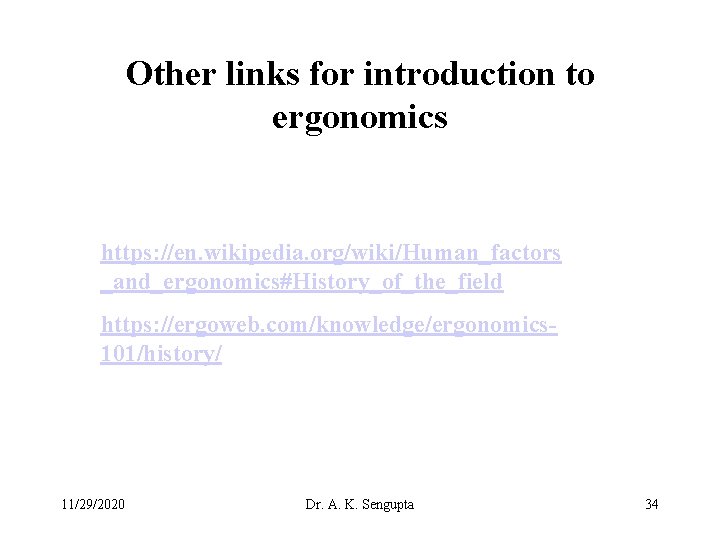
Other links for introduction to ergonomics https: //en. wikipedia. org/wiki/Human_factors _and_ergonomics#History_of_the_field https: //ergoweb. com/knowledge/ergonomics 101/history/ 11/29/2020 Dr. A. K. Sengupta 34