Ergonomics Guidelines for Nursing Homes Recommendations for preventing



- Slides: 31
Ergonomics Guidelines for Nursing Homes Recommendations for preventing and reducing musculoskeletal disorders (MSDs) Module 1
What this presentation covers • How to develop an ergonomics process to protect workers • Benefits of implementing an ergonomics process • Identify and analyze problem jobs in nursing homes • Recognize practical solutions to address problem jobs Ø Module 1 addresses problems involved with manual lifting and repositioning of residents. Ø Module 2 covers other activities.
What this presentation covers Note: The recommended solutions presented in these slides are not intended to be an exhaustive list, nor are they all expected to be used in any given facility. The information represents a range of available options that a facility can consider using.
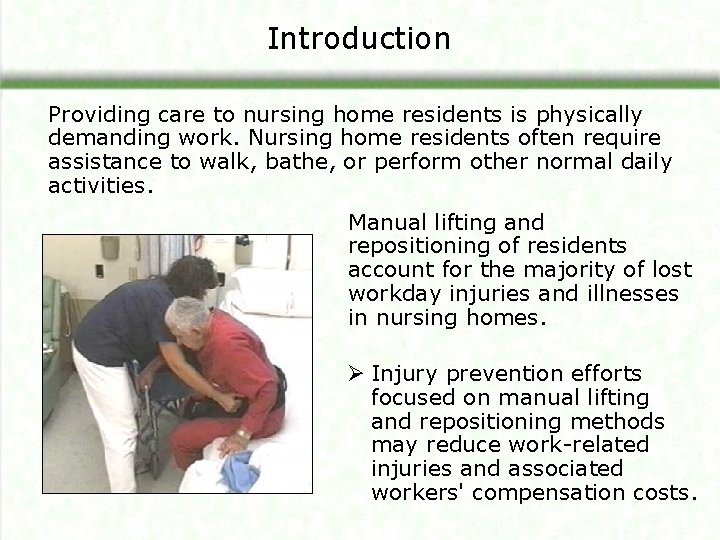
Introduction Providing care to nursing home residents is physically demanding work. Nursing home residents often require assistance to walk, bathe, or perform other normal daily activities. Manual lifting and repositioning of residents account for the majority of lost workday injuries and illnesses in nursing homes. Ø Injury prevention efforts focused on manual lifting and repositioning methods may reduce work-related injuries and associated workers' compensation costs.
Introduction Providing a safer and more comfortable work environment can also result in additional benefits to staff as well as residents: • reduced staff turnover and associated training and administrative costs • reduced absenteeism • increased productivity • improved employee morale • increased resident comfort
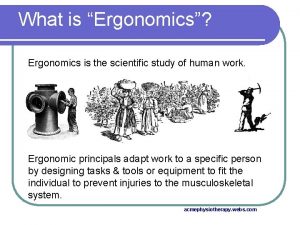
What is Ergonomics? Ergonomics is the science of fitting the job to the worker. Ergonomics involves designing equipment and work tasks to conform to the capability of the worker.
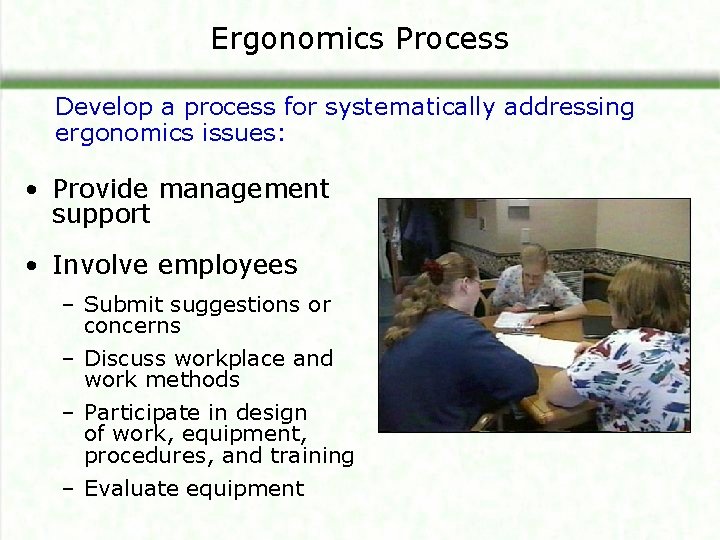
Ergonomics Process Develop a process for systematically addressing ergonomics issues: • Provide management support • Involve employees – Submit suggestions or concerns – Discuss workplace and work methods – Participate in design of work, equipment, procedures, and training – Evaluate equipment
Ergonomics Process (Continued) • Identify problems – Use systematic methods • Implement solutions Workplace modifications that – Eliminate hazards and – Improve work environment
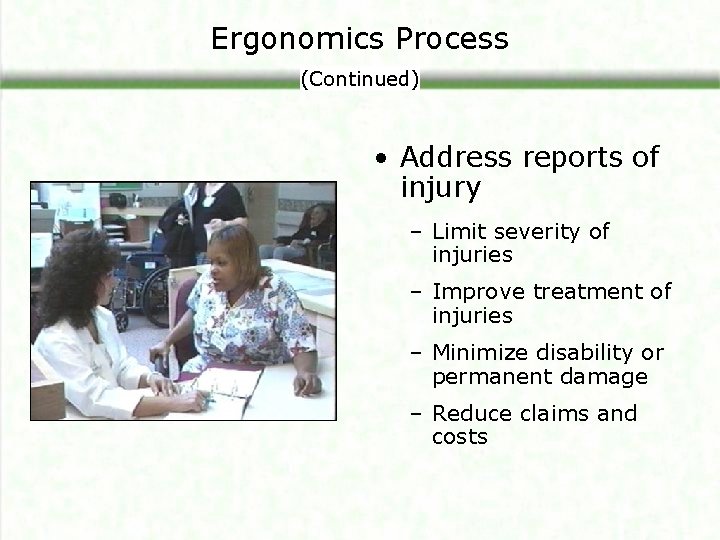
Ergonomics Process (Continued) • Address reports of injury – Limit severity of injuries – Improve treatment of injuries – Minimize disability or permanent damage – Reduce claims and costs
Ergonomics Process (Continued) • Provide training – recognize potential hazards – understand measures available to correct them – cover hazards found in each job – provide refresher training as needed • Evaluate ergonomic efforts
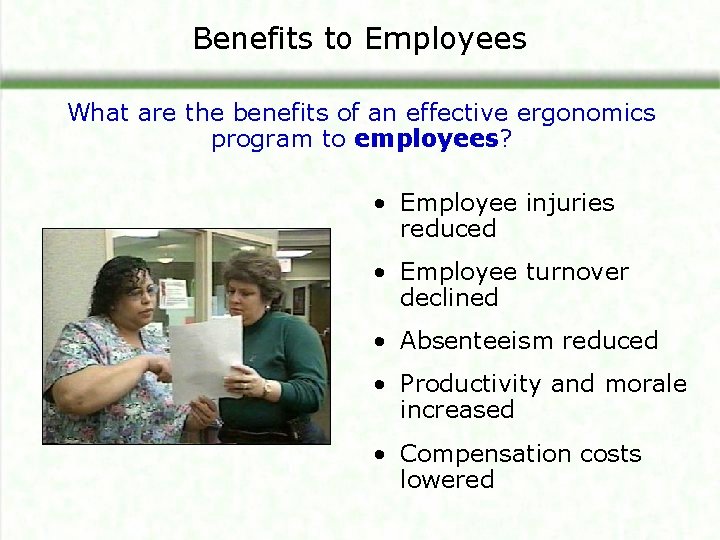
Benefits to Employees What are the benefits of an effective ergonomics program to employees? • Employee injuries reduced • Employee turnover declined • Absenteeism reduced • Productivity and morale increased • Compensation costs lowered
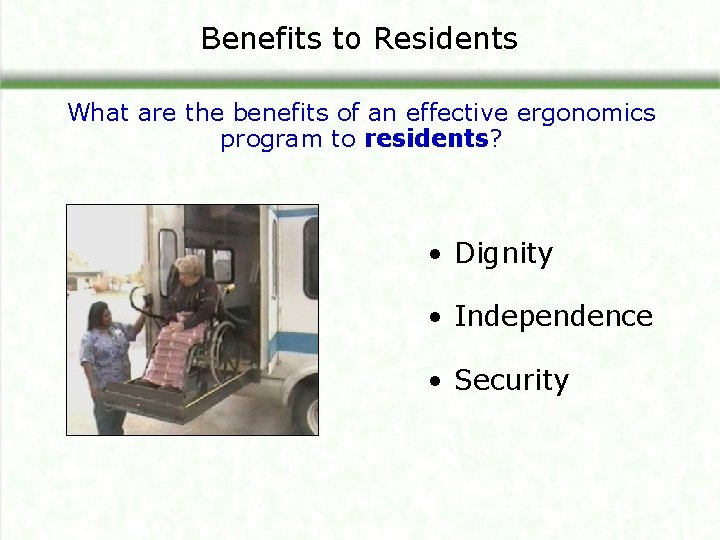
Benefits to Residents What are the benefits of an effective ergonomics program to residents? • Dignity • Independence • Security
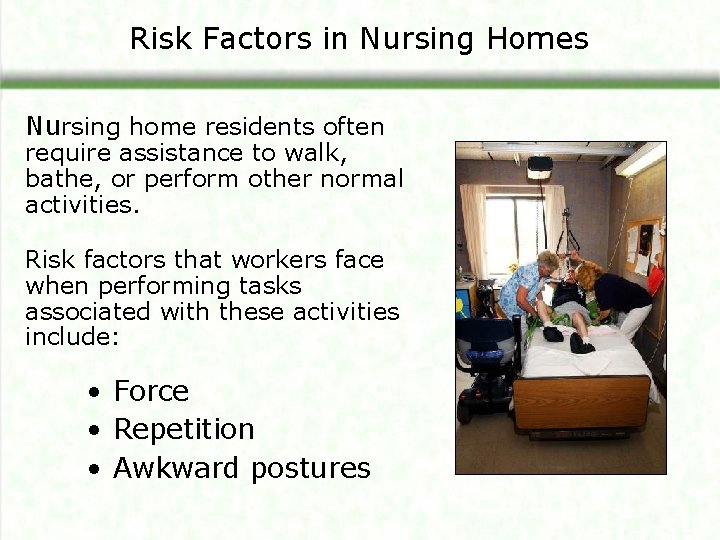
Risk Factors in Nursing Homes Nursing home residents often require assistance to walk, bathe, or perform other normal activities. Risk factors that workers face when performing tasks associated with these activities include: • Force • Repetition • Awkward postures
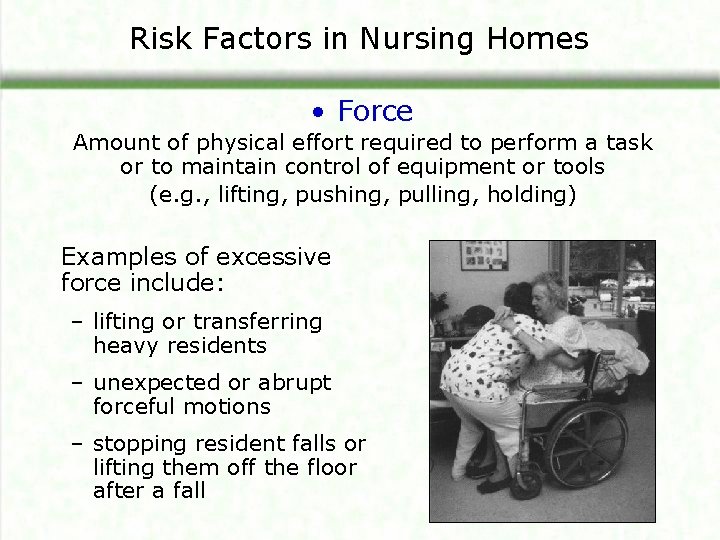
Risk Factors in Nursing Homes • Force Amount of physical effort required to perform a task or to maintain control of equipment or tools (e. g. , lifting, pushing, pulling, holding) Examples of excessive force include: – lifting or transferring heavy residents – unexpected or abrupt forceful motions – stopping resident falls or lifting them off the floor after a fall
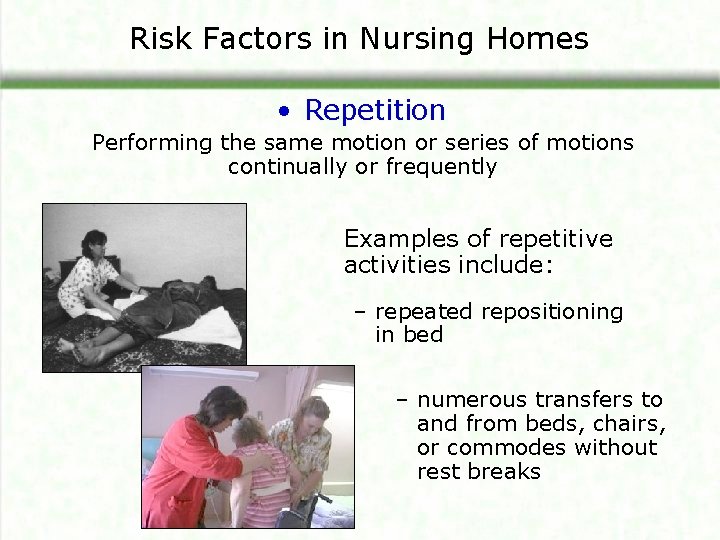
Risk Factors in Nursing Homes • Repetition Performing the same motion or series of motions continually or frequently Examples of repetitive activities include: – repeated repositioning in bed – numerous transfers to and from beds, chairs, or commodes without rest breaks
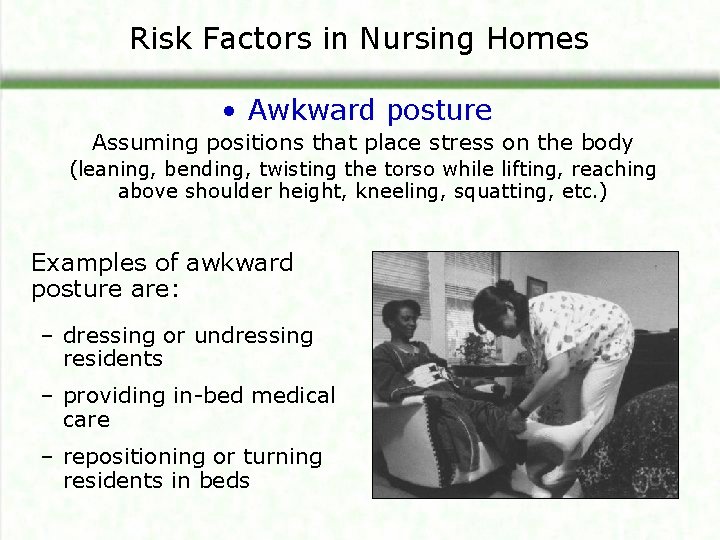
Risk Factors in Nursing Homes • Awkward posture Assuming positions that place stress on the body (leaning, bending, twisting the torso while lifting, reaching above shoulder height, kneeling, squatting, etc. ) Examples of awkward posture are: – dressing or undressing residents – providing in-bed medical care – repositioning or turning residents in beds
Exposure to Risk Factors Excessive exposure to risk factors result in musculoskeletal disorders, which include: • Low back pain • Sciatica • Rotator cuff injuries • Epicondylitis (elbow injuries) • Carpal tunnel syndrome
Identifying Problem Jobs To obtain information, analyze and review • Injury and illness logs • Workers’ compensation reports • Accident and near-miss reports • Insurance company reports • Employee interviews • Workplace observations
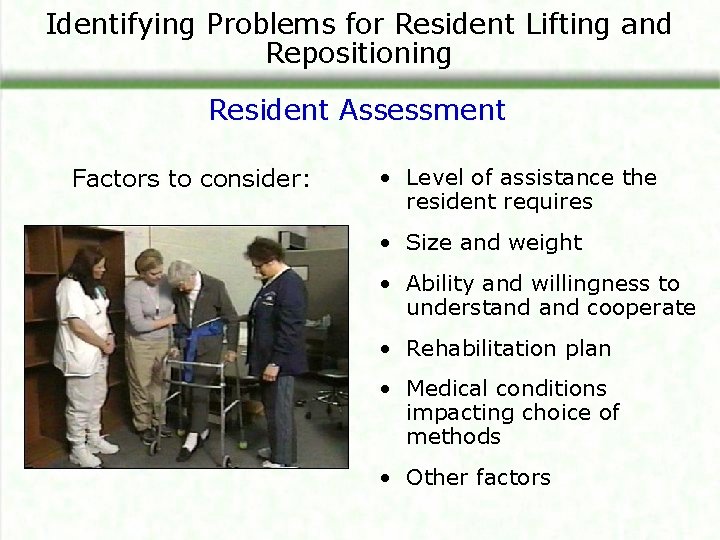
Identifying Problems for Resident Lifting and Repositioning Resident Assessment Factors to consider: • Level of assistance the resident requires • Size and weight • Ability and willingness to understand cooperate • Rehabilitation plan • Medical conditions impacting choice of methods • Other factors
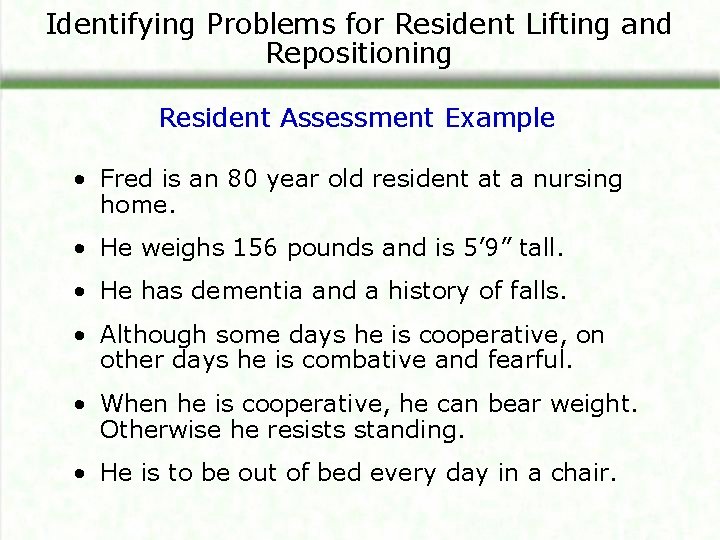
Identifying Problems for Resident Lifting and Repositioning Resident Assessment Example • Fred is an 80 year old resident at a nursing home. • He weighs 156 pounds and is 5’ 9” tall. • He has dementia and a history of falls. • Although some days he is cooperative, on other days he is combative and fearful. • When he is cooperative, he can bear weight. Otherwise he resists standing. • He is to be out of bed every day in a chair.
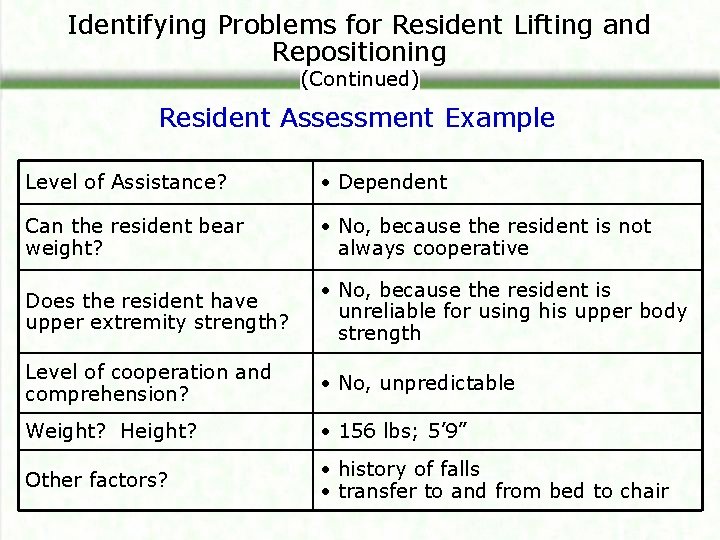
Identifying Problems for Resident Lifting and Repositioning (Continued) Resident Assessment Example Level of Assistance? • Dependent Can the resident bear weight? • No, because the resident is not always cooperative Does the resident have upper extremity strength? • No, because the resident is unreliable for using his upper body strength Level of cooperation and comprehension? • No, unpredictable Weight? Height? • 156 lbs; 5’ 9” Other factors? • history of falls • transfer to and from bed to chair
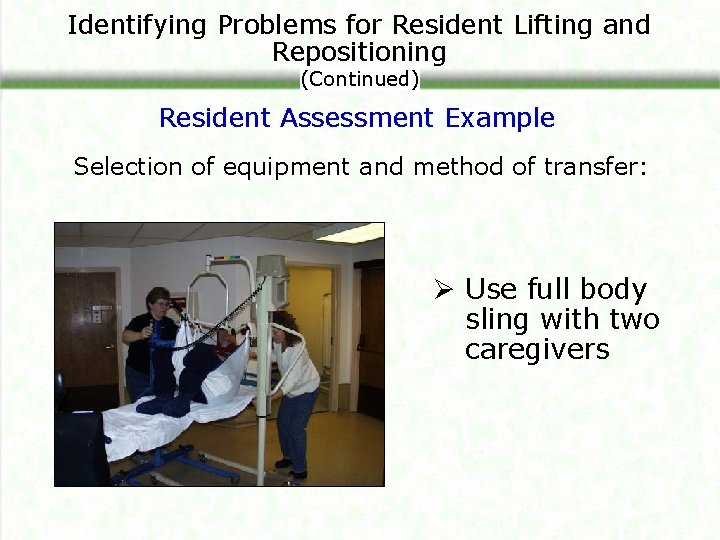
Identifying Problems for Resident Lifting and Repositioning (Continued) Resident Assessment Example Selection of equipment and method of transfer: Ø Use full body sling with two caregivers
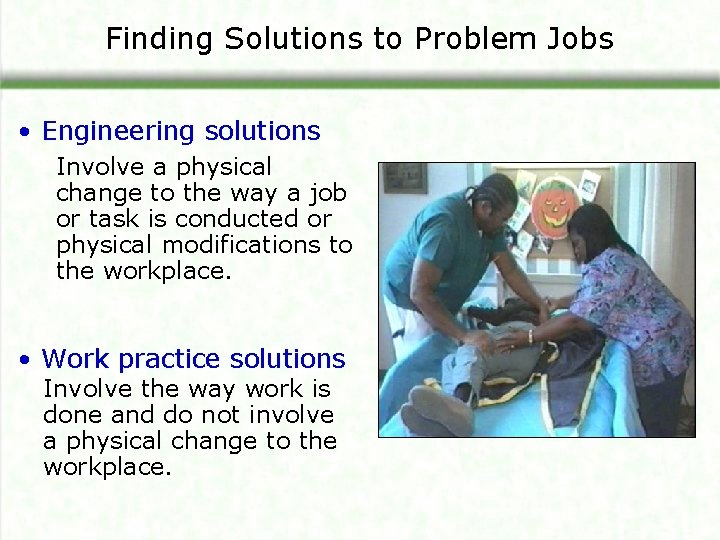
Finding Solutions to Problem Jobs • Engineering solutions Involve a physical change to the way a job or task is conducted or physical modifications to the workplace. • Work practice solutions Involve the way work is done and do not involve a physical change to the workplace.
Factors That May Affect Solutions • Resident’s rehabilitation plan • Need to restore resident’s functional abilities • Medical contraindications • Emergency situations • Resident dignity and rights
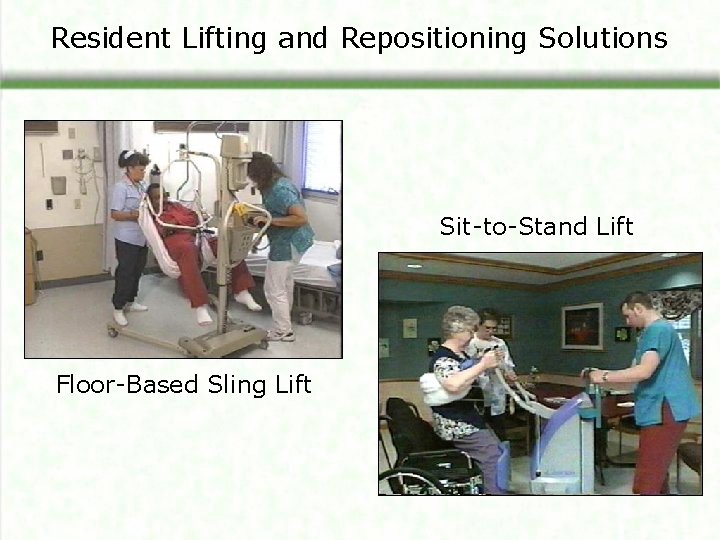
Resident Lifting and Repositioning Solutions Sit-to-Stand Lift Floor-Based Sling Lift
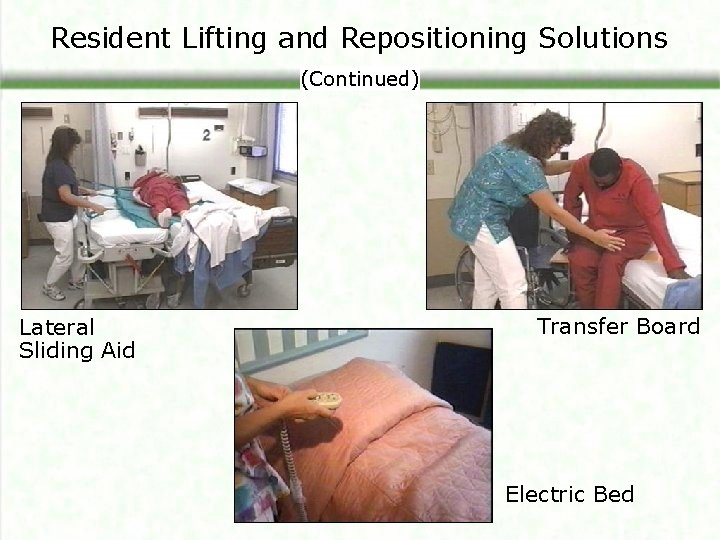
Resident Lifting and Repositioning Solutions (Continued) Lateral Sliding Aid Transfer Board Electric Bed
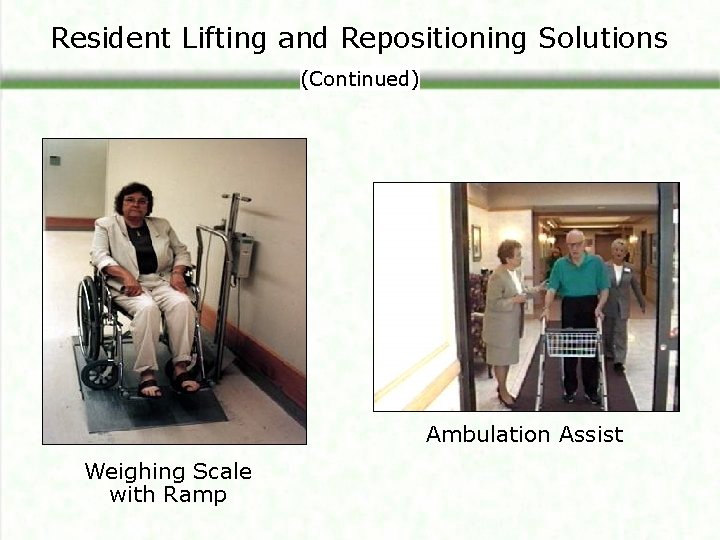
Resident Lifting and Repositioning Solutions (Continued) Ambulation Assist Weighing Scale with Ramp
Summary In this module, you learned about the following: • Ergonomics process – Provide management support – Involve employees – Identify problems – Implement solutions – Address reports of injuries – Provide training – Evaluate ergonomic efforts • Identifying and analyzing problem jobs in nursing homes • Recognizing practical solutions to address problem jobs
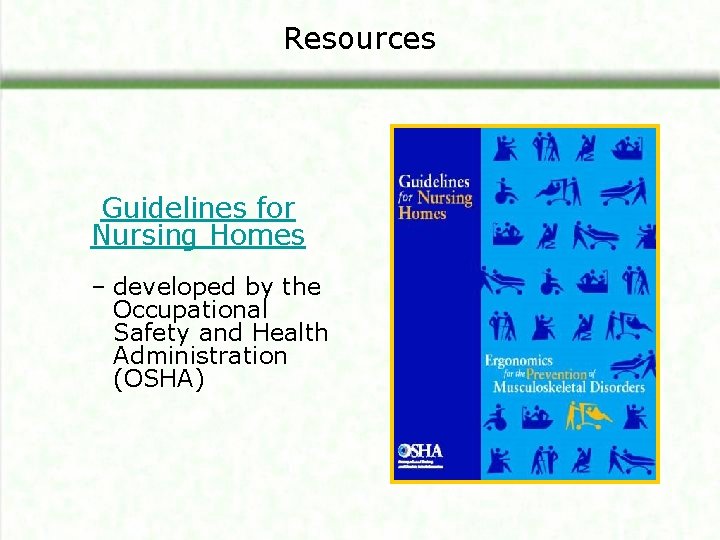
Resources Guidelines for Nursing Homes – developed by the Occupational Safety and Health Administration (OSHA)
Resources • WISHA http: //www. lni. wa. gov/Safety/Topics/Ergonomi cs/default. asp • OSHA http: //www. osha. gov/ergonomics/guidelines/nu rsinghome/index. html • NIOSH http: //www. cdc. gov/niosh/topics/ergonomics/
Thank you for taking the time to learn about safety and health and how to prevent future injuries and illnesses.