Antihydrogen Physics with ALPHA Mike Charlton Physics Swansea
- Slides: 39
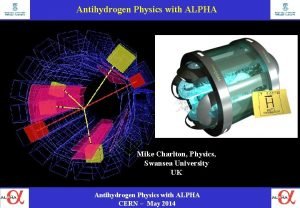
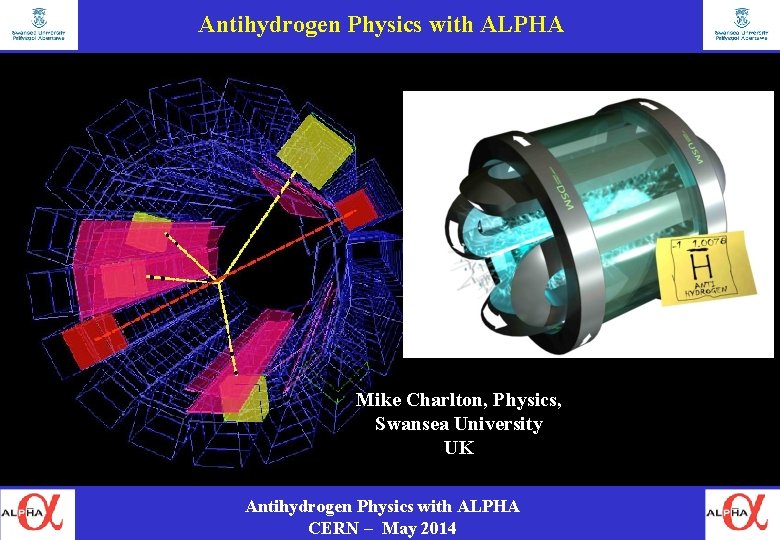
Antihydrogen Physics with ALPHA Mike Charlton, Physics, Swansea University UK Antihydrogen Physics with ALPHA CERN – May 2014
Summary of the Talk Introductory Remarks - The Hydrogen/Antihydrogen Playground Antihydrogen Production: Formation Processes Antihydrogen Production for Trapping ALPHA -Antihydrogen Trapping and Physics ALPHA - What’s Next? Antihydrogen Physics with ALPHA CERN – May 2014
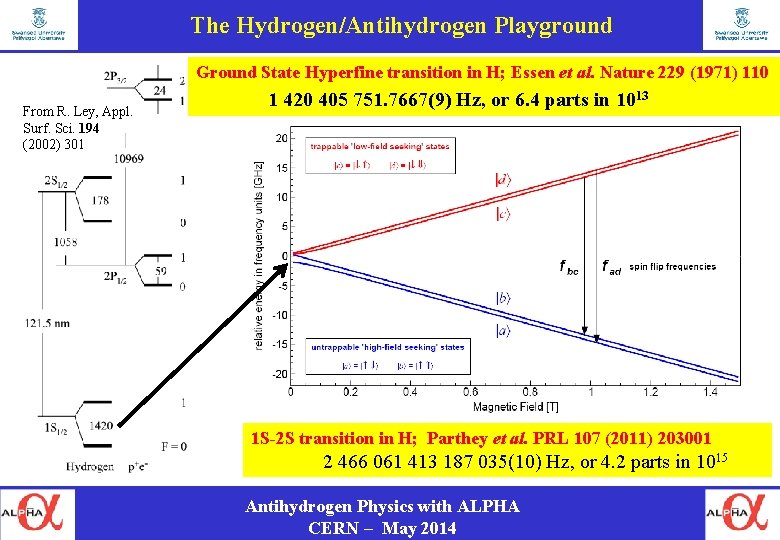
The Hydrogen/Antihydrogen Playground Ground State Hyperfine transition in H; Essen et al. Nature 229 (1971) 110 From R. Ley, Appl. Surf. Sci. 194 (2002) 301 1 420 405 751. 7667(9) Hz, or 6. 4 parts in 1013 1 S-2 S transition in H; Parthey et al. PRL 107 (2011) 203001 2 466 061 413 187 035(10) Hz, or 4. 2 parts in 1015 Antihydrogen Physics with ALPHA CERN – May 2014
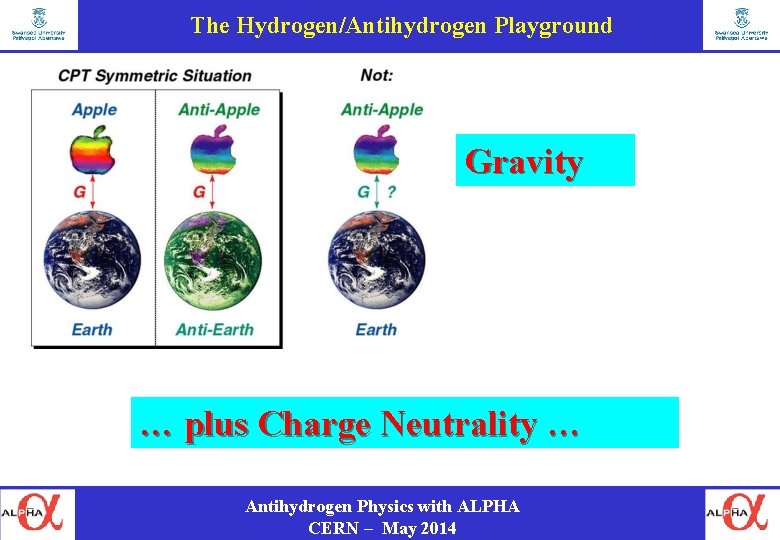
The Hydrogen/Antihydrogen Playground Gravity … plus Charge Neutrality … Antihydrogen Physics with ALPHA CERN – May 2014
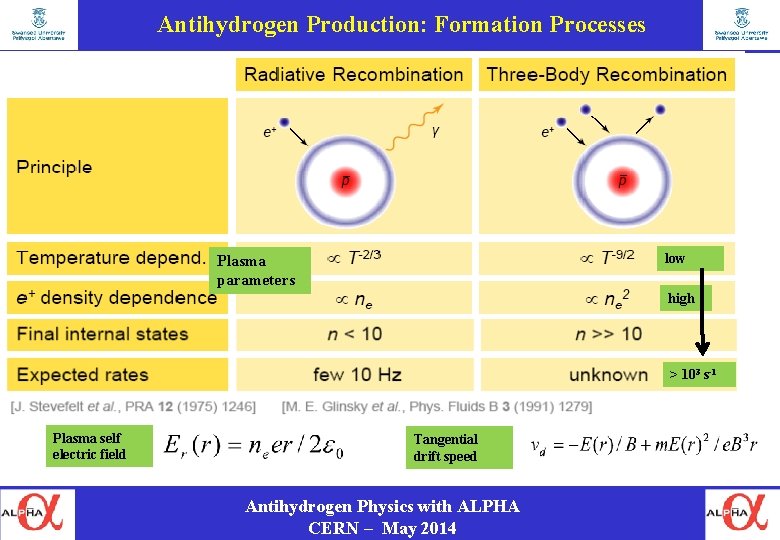
Antihydrogen Production: Formation Processes low Plasma parameters high > 103 s-1 Plasma self electric field Tangential drift speed Antihydrogen Physics with ALPHA CERN – May 2014
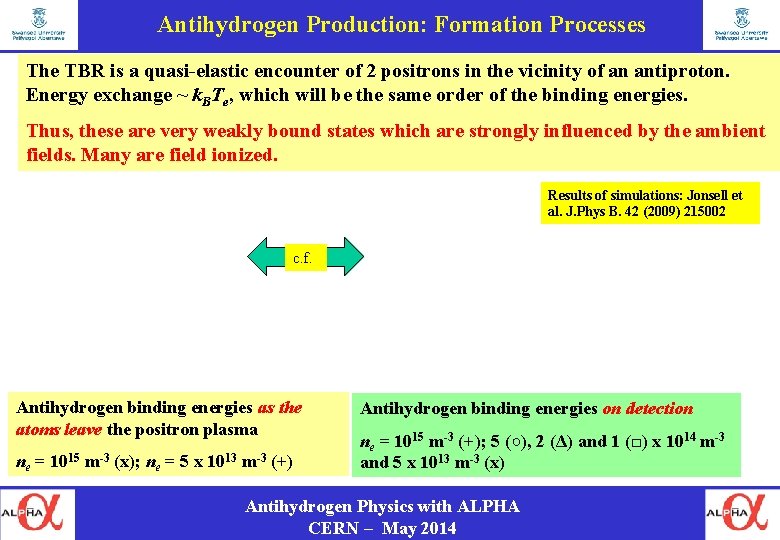
Antihydrogen Production: Formation Processes The TBR is a quasi-elastic encounter of 2 positrons in the vicinity of an antiproton. Energy exchange ~ k. BTe, which will be the same order of the binding energies. Thus, these are very weakly bound states which are strongly influenced by the ambient fields. Many are field ionized. Results of simulations: Jonsell et al. J. Phys B. 42 (2009) 215002 c. f. Antihydrogen binding energies as the atoms leave the positron plasma ne = 1015 m-3 (x); ne = 5 x 10¹³ m-3 (+) Antihydrogen binding energies on detection ne = 1015 m-3 (+); 5 (○), 2 (Δ) and 1 (□) x 1014 m-3 and 5 x 10¹³ m-3 (x) Antihydrogen Physics with ALPHA CERN – May 2014
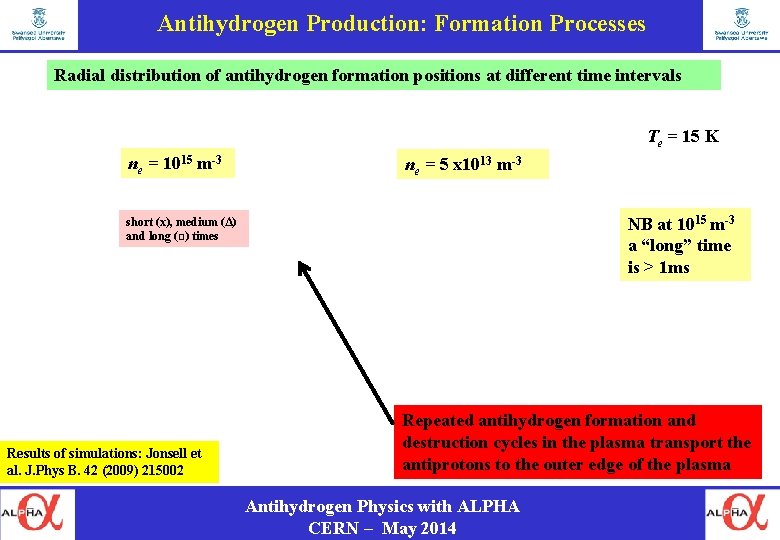
Antihydrogen Production: Formation Processes Radial distribution of antihydrogen formation positions at different time intervals Te = 15 K ne = 1015 m-3 ne = 5 x 10¹³ m-3 NB at 1015 m-3 a “long” time is > 1 ms short (x), medium (Δ) and long (□) times Results of simulations: Jonsell et al. J. Phys B. 42 (2009) 215002 Repeated antihydrogen formation and destruction cycles in the plasma transport the antiprotons to the outer edge of the plasma Antihydrogen Physics with ALPHA CERN – May 2014
Antihydrogen Production: Formation Processes So … want high positron density and low temperatures to drive 3 -body reaction to form antihydrogen efficiently, but: Field ionization … Cross-field antiproton transport driven by the antihydrogen production mechanism … Higher tangential drift speeds at higher radius and density … To say nothing of plasma expansion effects, which are most deleterious at high densities … Antihydrogen Physics with ALPHA CERN – May 2014
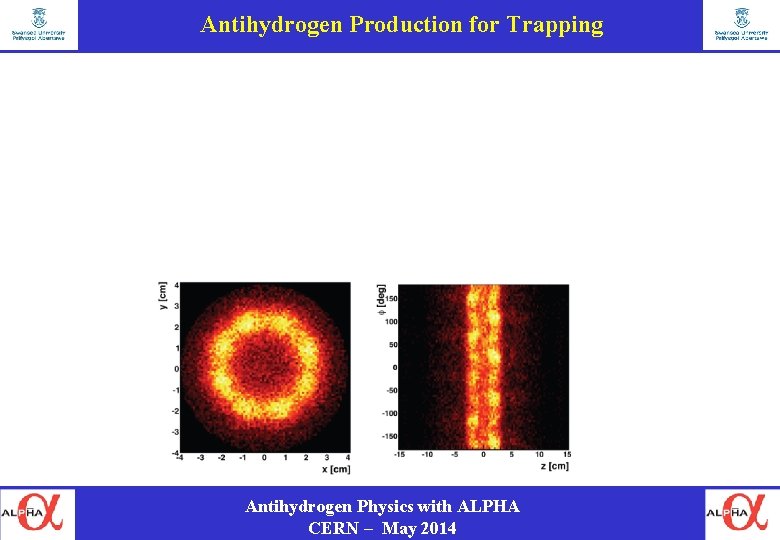
Antihydrogen Production for Trapping We have machines to manipulate and capture positrons and antiprotons using a raft of longestablished techniques These are then fed into a central apparatus where – eventually – they are mixed to form antihydrogen. A small fraction of the anti-atoms (to date at least) may then be trapped … The manipulations of the positrons and antiprotons before, and upon, mixing are crucial to this achievement Antihydrogen Physics with ALPHA CERN – May 2014
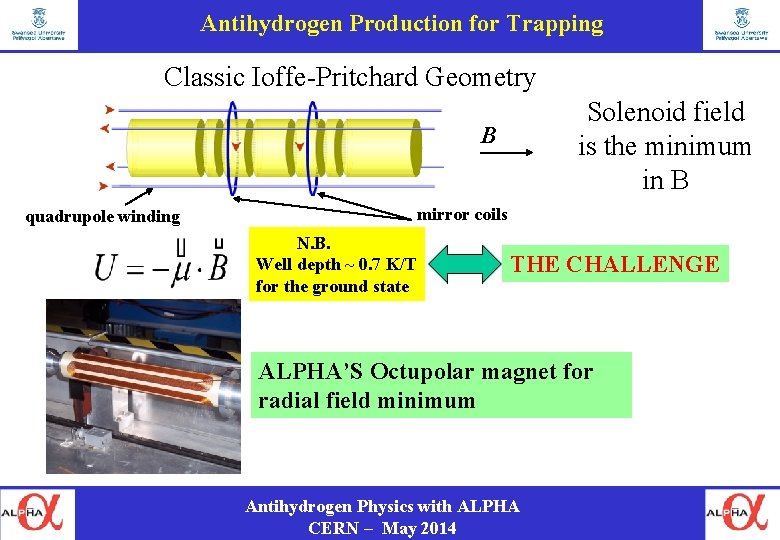
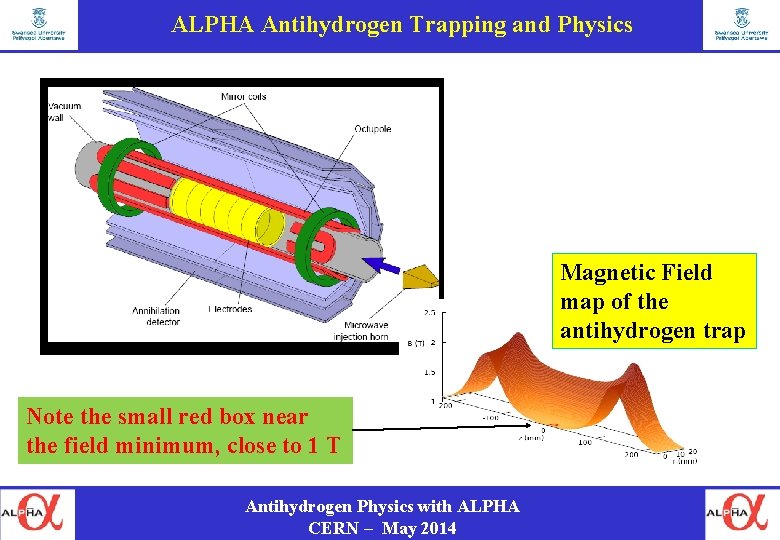
Antihydrogen Production for Trapping Classic Ioffe-Pritchard Geometry Solenoid field is the minimum in B B quadrupole winding mirror coils N. B. Well depth ~ 0. 7 K/T for the ground state THE CHALLENGE ALPHA’S Octupolar magnet for radial field minimum Antihydrogen Physics with ALPHA CERN – May 2014
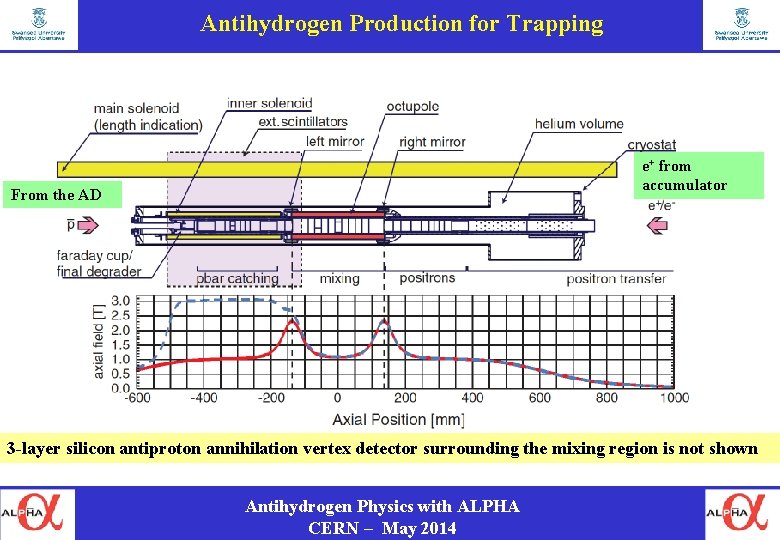
Antihydrogen Production for Trapping e+ from accumulator From the AD 3 -layer silicon antiproton annihilation vertex detector surrounding the mixing region is not shown Antihydrogen Physics with ALPHA CERN – May 2014
Antihydrogen Production for Trapping Antihydrogen Physics with ALPHA CERN – May 2014
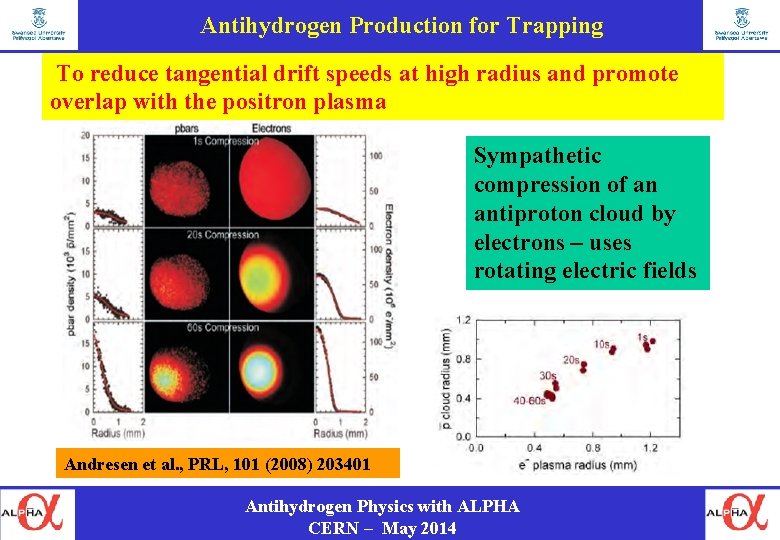
Antihydrogen Production for Trapping To reduce tangential drift speeds at high radius and promote overlap with the positron plasma Sympathetic compression of an antiproton cloud by electrons – uses rotating electric fields Andresen et al. , PRL, 101 (2008) 203401 Antihydrogen Physics with ALPHA CERN – May 2014
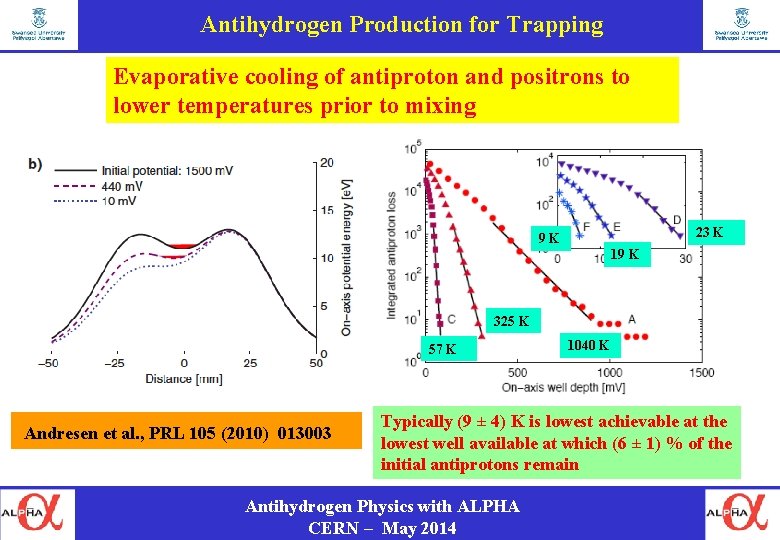
Antihydrogen Production for Trapping Evaporative cooling of antiproton and positrons to lower temperatures prior to mixing 23 K 9 K 19 K 325 K 57 K Andresen et al. , PRL 105 (2010) 013003 1040 K Typically (9 ± 4) K is lowest achievable at the lowest well available at which (6 ± 1) % of the initial antiprotons remain Antihydrogen Physics with ALPHA CERN – May 2014
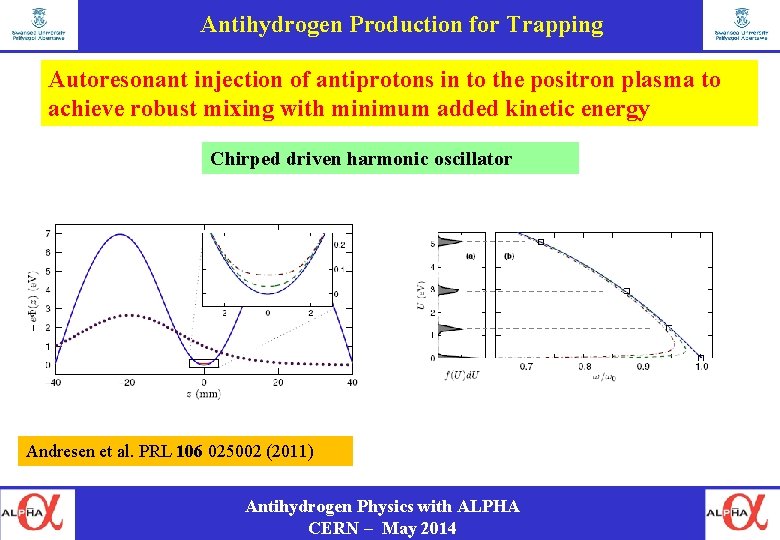
Antihydrogen Production for Trapping Autoresonant injection of antiprotons in to the positron plasma to achieve robust mixing with minimum added kinetic energy Chirped driven harmonic oscillator Andresen et al. PRL 106 025002 (2011) Antihydrogen Physics with ALPHA CERN – May 2014
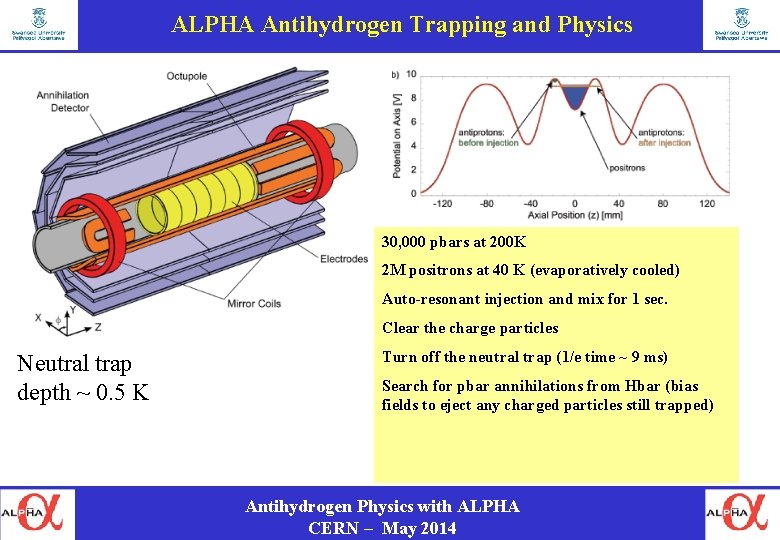
ALPHA Antihydrogen Trapping and Physics 30, 000 pbars at 200 K 2 M positrons at 40 K (evaporatively cooled) Auto-resonant injection and mix for 1 sec. Clear the charge particles Neutral trap depth ~ 0. 5 K Turn off the neutral trap (1/e time ~ 9 ms) Search for pbar annihilations from Hbar (bias fields to eject any charged particles still trapped) Antihydrogen Physics with ALPHA CERN – May 2014
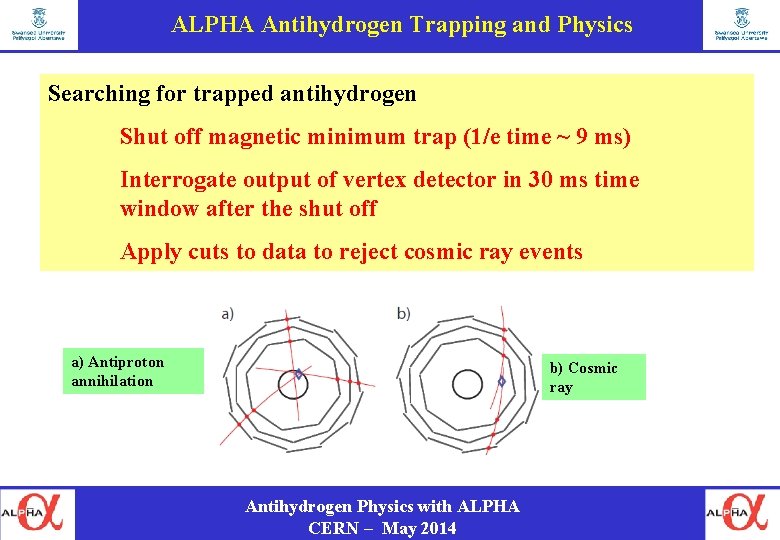
ALPHA Antihydrogen Trapping and Physics Searching for trapped antihydrogen Shut off magnetic minimum trap (1/e time ~ 9 ms) Interrogate output of vertex detector in 30 ms time window after the shut off Apply cuts to data to reject cosmic ray events a) Antiproton annihilation b) Cosmic ray Antihydrogen Physics with ALPHA CERN – May 2014
ALPHA Antihydrogen Trapping and Physics Published in Nature 468 (2010) 673 Initial success – just 38 events Antihydrogen Physics with ALPHA CERN – May 2014
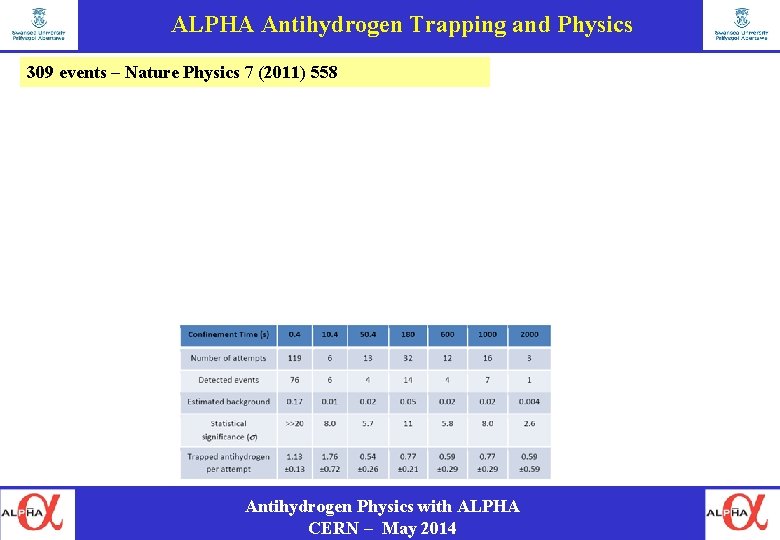
ALPHA Antihydrogen Trapping and Physics 309 events – Nature Physics 7 (2011) 558 Antihydrogen Physics with ALPHA CERN – May 2014
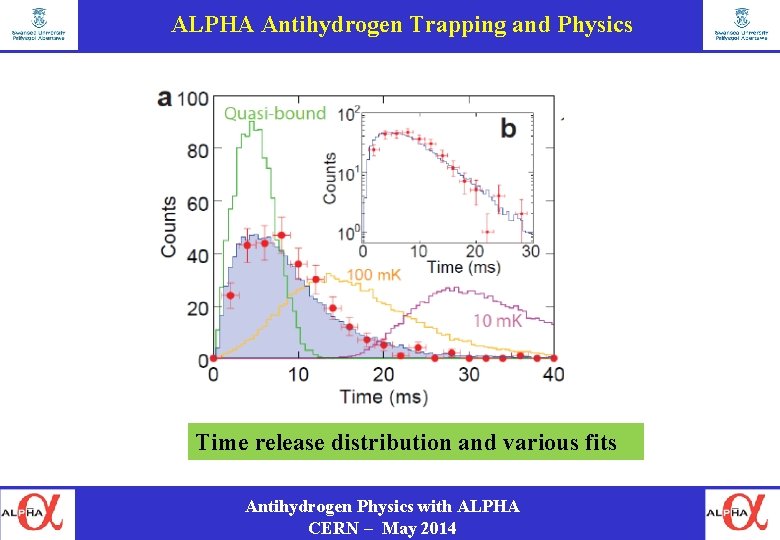
ALPHA Antihydrogen Trapping and Physics Time release distribution and various fits Antihydrogen Physics with ALPHA CERN – May 2014
ALPHA Antihydrogen Trapping and Physics Magnetic Field map of the antihydrogen trap Note the small red box near the field minimum, close to 1 T Antihydrogen Physics with ALPHA CERN – May 2014
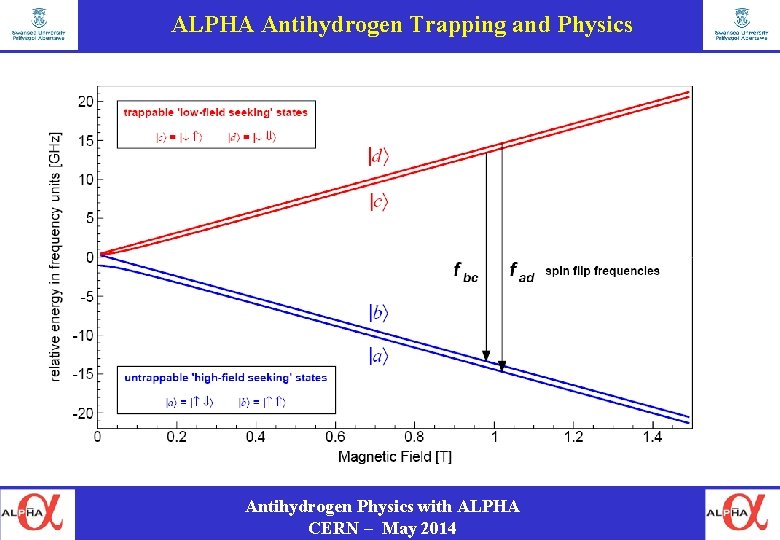
ALPHA Antihydrogen Trapping and Physics Antihydrogen Physics with ALPHA CERN – May 2014
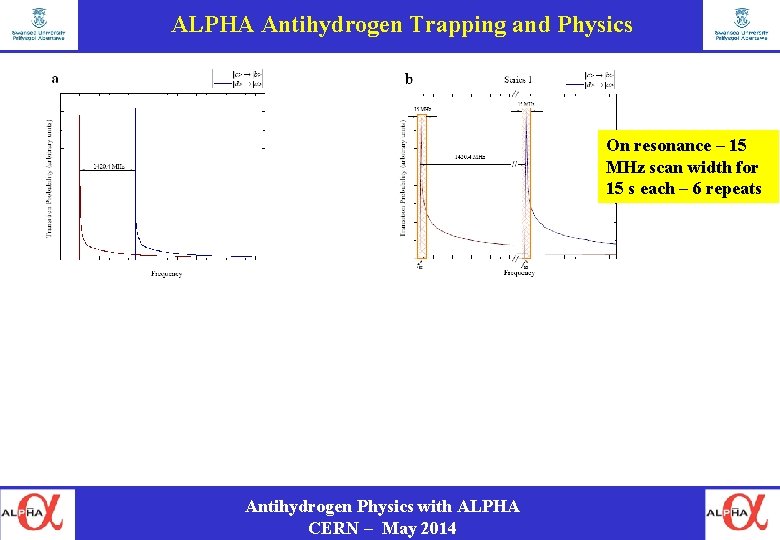
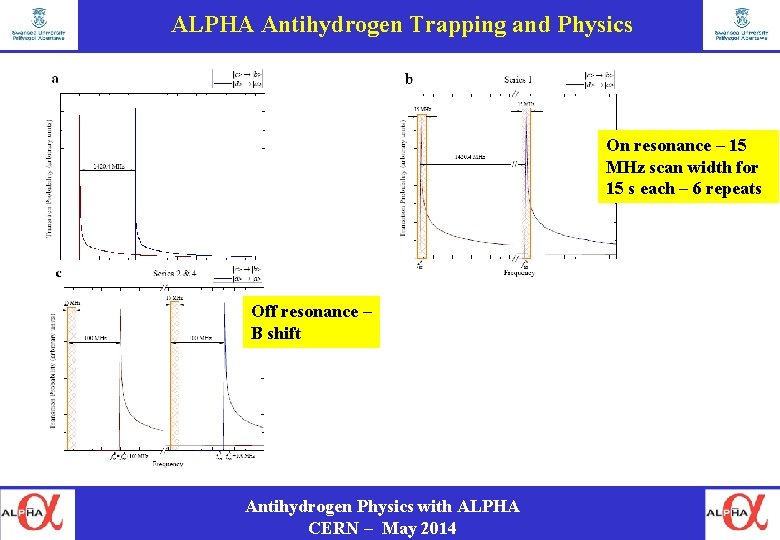
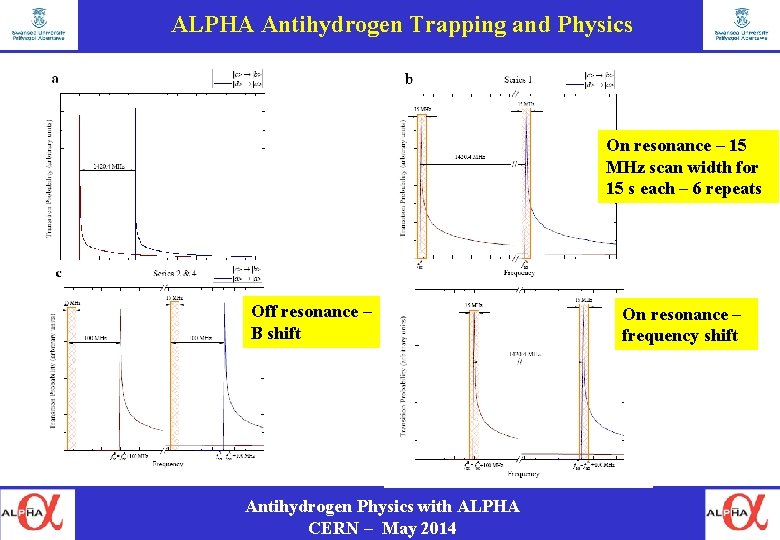
ALPHA Antihydrogen Trapping and Physics On resonance – 15 MHz scan width for 15 s each – 6 repeats Antihydrogen Physics with ALPHA CERN – May 2014
ALPHA Antihydrogen Trapping and Physics On resonance – 15 MHz scan width for 15 s each – 6 repeats Off resonance – B shift Antihydrogen Physics with ALPHA CERN – May 2014
ALPHA Antihydrogen Trapping and Physics On resonance – 15 MHz scan width for 15 s each – 6 repeats Off resonance – B shift Antihydrogen Physics with ALPHA CERN – May 2014 On resonance – frequency shift
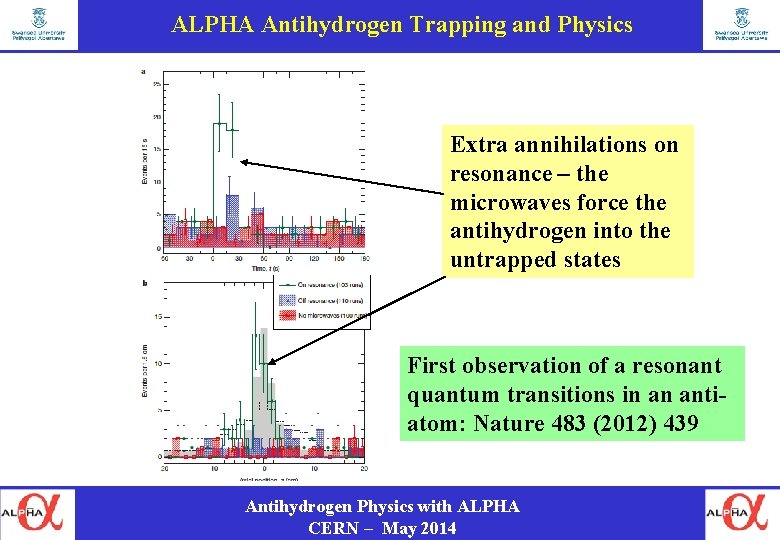
ALPHA Antihydrogen Trapping and Physics Extra annihilations on resonance – the microwaves force the antihydrogen into the untrapped states First observation of a resonant quantum transitions in an antiatom: Nature 483 (2012) 439 Antihydrogen Physics with ALPHA CERN – May 2014
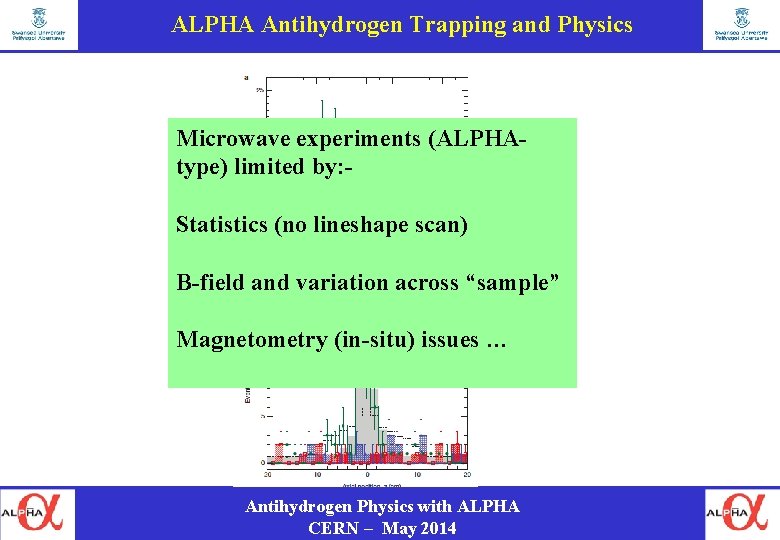
ALPHA Antihydrogen Trapping and Physics Microwave experiments (ALPHAtype) limited by: Statistics (no lineshape scan) B-field and variation across “sample” Magnetometry (in-situ) issues … Antihydrogen Physics with ALPHA CERN – May 2014
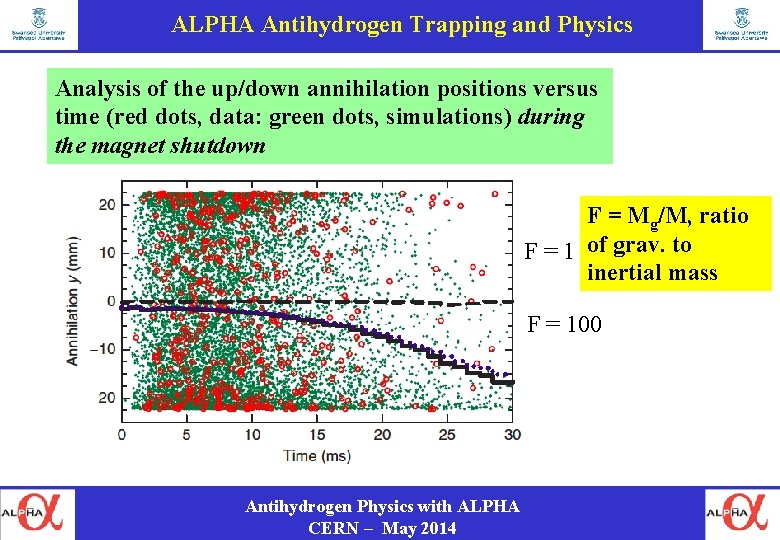
ALPHA Antihydrogen Trapping and Physics Analysis of the up/down annihilation positions versus time (red dots, data: green dots, simulations) during the magnet shutdown F = Mg/M, ratio F = 1 of grav. to inertial mass F = 100 Antihydrogen Physics with ALPHA CERN – May 2014
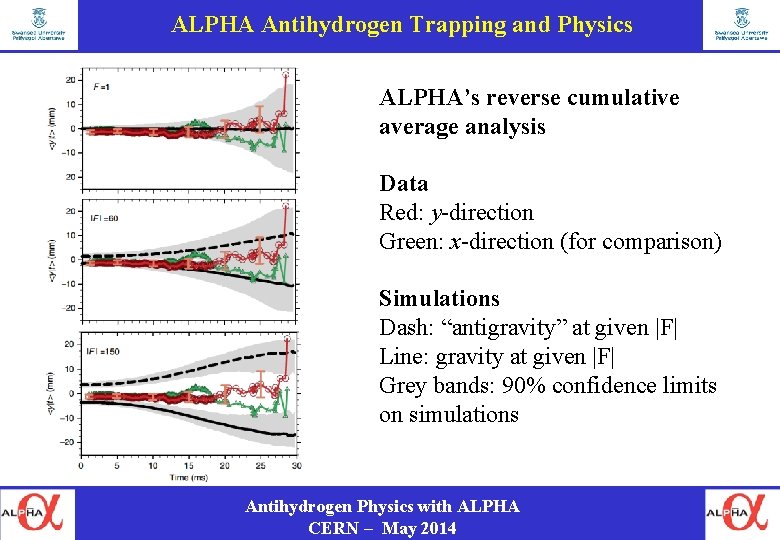
ALPHA Antihydrogen Trapping and Physics ALPHA’s reverse cumulative average analysis Data Red: y-direction Green: x-direction (for comparison) Simulations Dash: “antigravity” at given |F| Line: gravity at given |F| Grey bands: 90% confidence limits on simulations Antihydrogen Physics with ALPHA CERN – May 2014
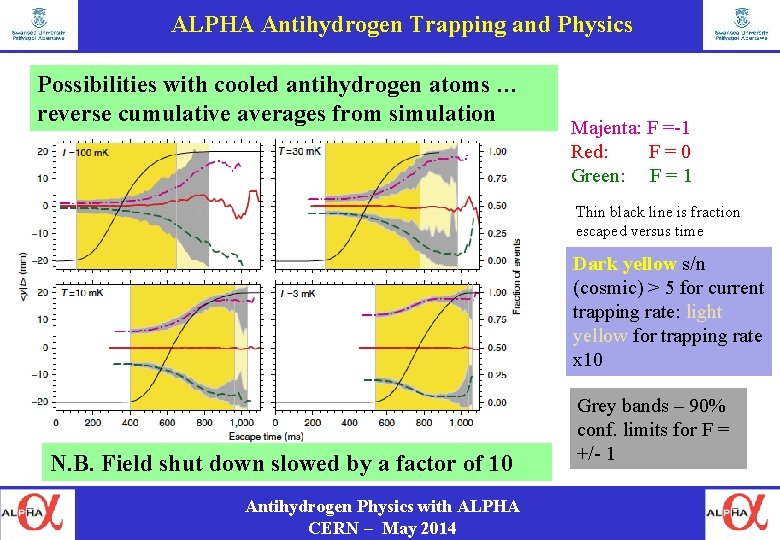
ALPHA Antihydrogen Trapping and Physics Possibilities with cooled antihydrogen atoms … reverse cumulative averages from simulation Majenta: F =-1 Red: F=0 Green: F = 1 Thin black line is fraction escaped versus time Dark yellow s/n (cosmic) > 5 for current trapping rate: light yellow for trapping rate x 10 N. B. Field shut down slowed by a factor of 10 Antihydrogen Physics with ALPHA CERN – May 2014 Grey bands – 90% conf. limits for F = +/- 1
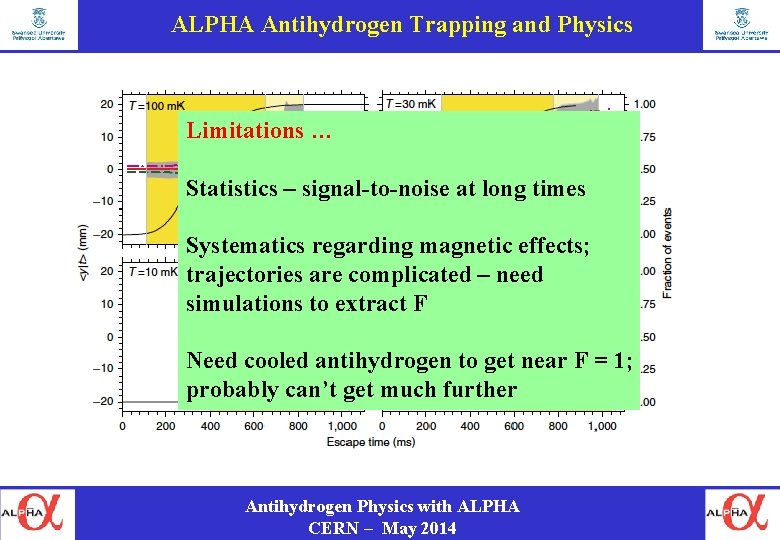
ALPHA Antihydrogen Trapping and Physics Limitations … Statistics – signal-to-noise at long times Systematics regarding magnetic effects; trajectories are complicated – need simulations to extract F Need cooled antihydrogen to get near F = 1; probably can’t get much further Antihydrogen Physics with ALPHA CERN – May 2014
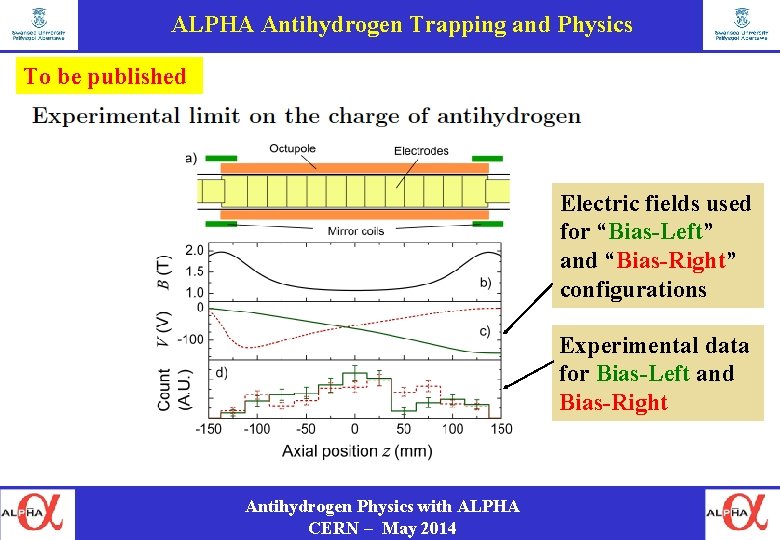
ALPHA Antihydrogen Trapping and Physics To be published Electric fields used for “Bias-Left” and “Bias-Right” configurations Experimental data for Bias-Left and Bias-Right Antihydrogen Physics with ALPHA CERN – May 2014
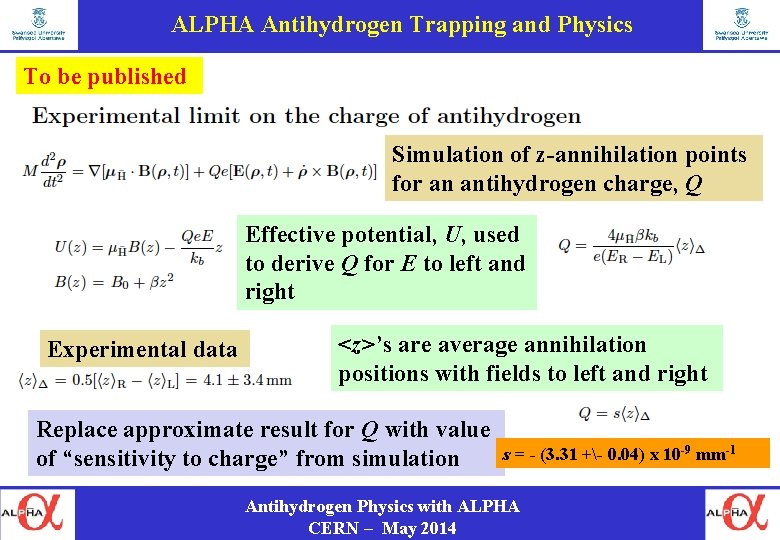
ALPHA Antihydrogen Trapping and Physics To be published Simulation of z-annihilation points for an antihydrogen charge, Q Effective potential, U, used to derive Q for E to left and right Experimental data <z>’s are average annihilation positions with fields to left and right Replace approximate result for Q with value of “sensitivity to charge” from simulation s = - (3. 31 +- 0. 04) x 10 -9 mm-1 Antihydrogen Physics with ALPHA CERN – May 2014
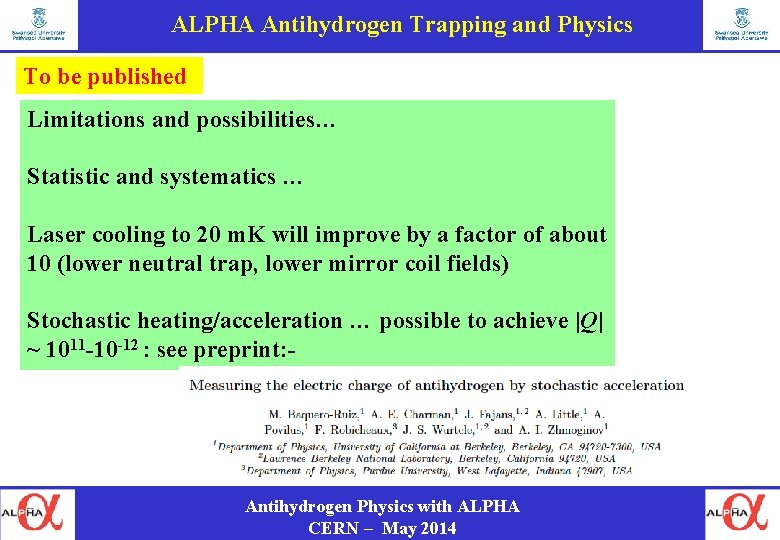
ALPHA Antihydrogen Trapping and Physics To be published Limitations and possibilities… Statistic and systematics … Laser cooling to 20 m. K will improve by a factor of about 10 (lower neutral trap, lower mirror coil fields) Stochastic heating/acceleration … possible to achieve |Q| ~ 1011 -10 -12 : see preprint: - Antihydrogen Physics with ALPHA CERN – May 2014
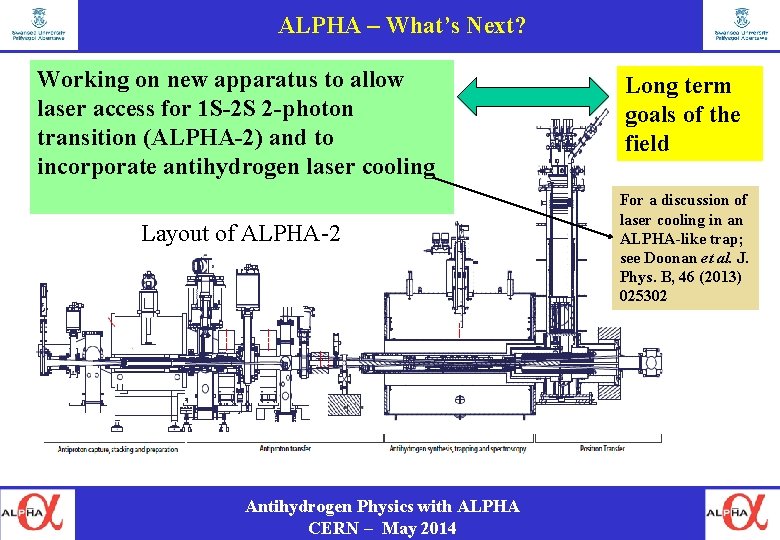
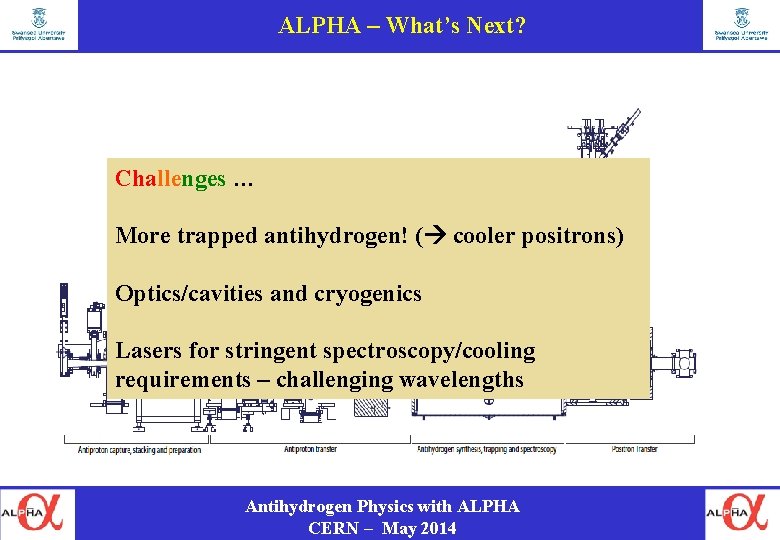
ALPHA – What’s Next? Working on new apparatus to allow laser access for 1 S-2 S 2 -photon transition (ALPHA-2) and to incorporate antihydrogen laser cooling Layout of ALPHA-2 Antihydrogen Physics with ALPHA CERN – May 2014 Long term goals of the field For a discussion of laser cooling in an ALPHA-like trap; see Doonan et al. J. Phys. B, 46 (2013) 025302
ALPHA – What’s Next? Challenges … More trapped antihydrogen! ( cooler positrons) Optics/cavities and cryogenics Lasers for stringent spectroscopy/cooling requirements – challenging wavelengths Antihydrogen Physics with ALPHA CERN – May 2014
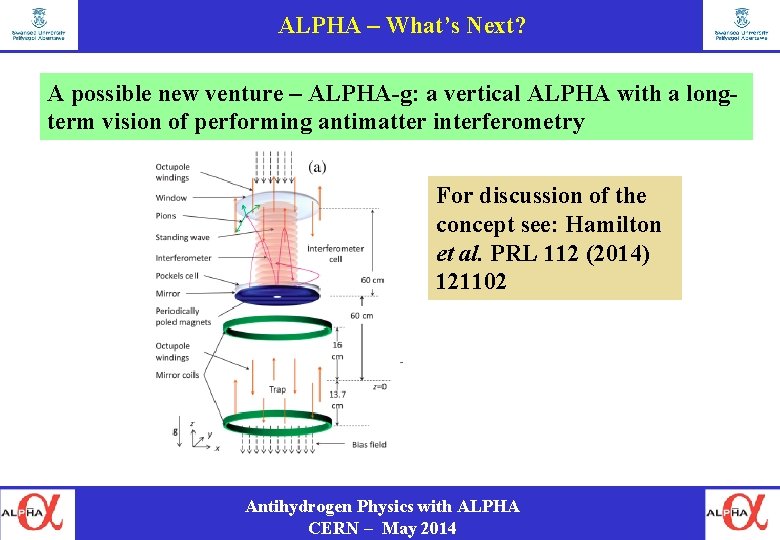
ALPHA – What’s Next? A possible new venture – ALPHA-g: a vertical ALPHA with a longterm vision of performing antimatter interferometry For discussion of the concept see: Hamilton et al. PRL 112 (2014) 121102 Antihydrogen Physics with ALPHA CERN – May 2014
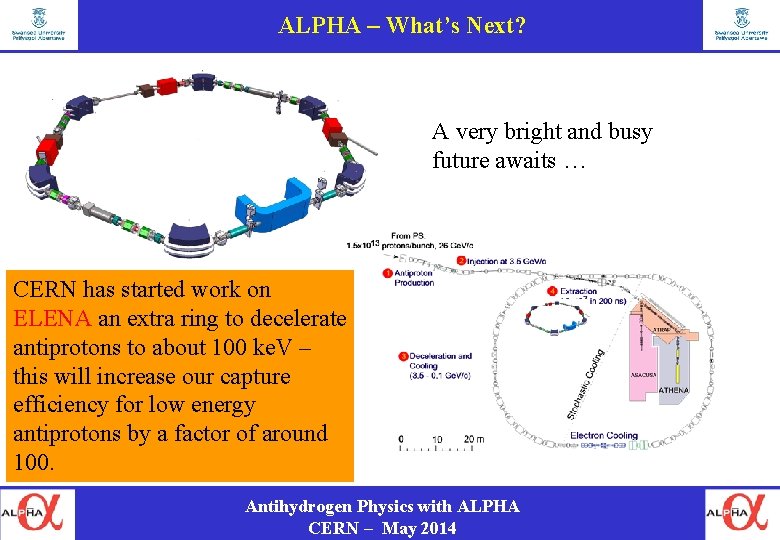
ALPHA – What’s Next? A very bright and busy future awaits … CERN has started work on ELENA an extra ring to decelerate antiprotons to about 100 ke. V – this will increase our capture efficiency for low energy antiprotons by a factor of around 100. Antihydrogen Physics with ALPHA CERN – May 2014
Acknowledgements – ALPHA circa 2013 -4 University of Aarhus: J. S. Hangst, C. Rasmussen Auburn University/Purdue University: P. H. Donnan, F. Robicheaux University of British Columbia: N. Evetts, A. Gutierrez, W. N. Hardy, T. Momose University of Calgary: T. Friesen, R. I. Thompson University of California, Berkeley: M. Baquero-Ruiz, J. Fajans, A. Little, H. Mueller, C. So, T. Tharp, J. S. Wurtele CERN: E. Butler – now a JRF at Imperial College University of Liverpool: J. T. K. Mc. Kenna, P. Nolan, P. Pusa University of Liverpool/Cockcroft: S. Chattopadhyay University of Manchester/Cockcroft: W. Bertsche NRCN, Negev: E. Sarid Federal University of Rio de Janeiro: C. L. Cesar, D. M. Silveira Simon Fraser University : M. D. Ashkezari, M. E. Hayden York University, Toronto : C. Amole, A. Capra, S. Menary Swansea University: M. Charlton, D. Edwards, S. J. Eriksson, C. A. Isaac, S. Jones, N. Madsen, M. Sameed, D. P. van der Werf Stockholm University : S. Jonsell TRIUMF: M. C. Fujiwara, D. R. Gill, L. Kurchaninov, K. Olchanski, A. Olin, S. Straka Antihydrogen Physics with ALPHA CERN – May 2014