
Introduction to Astronomy Instructor Dr Elizabeth Charlton Meeting
Introduction to Astronomy Instructor: Dr. Elizabeth Charlton Meeting times: Thursdays, 7: 00 pm-9: 00 pm for 10 weeks beginning October 6, 2016 Meeting place: Ewert House (HERE) Contact information direct email: astrotutor. conted@gmail. com weekly class office: ppweekly@conted. ox. ac. uk Course details can also be found at the Oxford University Department for Continuing Education website: https: //www. conted. ox. ac. uk/ Elizabeth Charlton 2016
Introduction to Astronomy Formal Assessment Formative coursework – the instructor will give written comments in order to provide guidance to students on how to approach their formally assessed coursework. Summative coursework – The assessment method for this course will be Option A, a portfolio of four exercises designed to reinforce the concepts presented in class. Elizabeth Charlton 2016
Introduction to Astronomy Libraries and Reading List All weekly class students may become borrowing members of the Rewley House Continuing Education Library for the duration of their course. Prospective students whose courses have not yet started are welcome to use the Library for reference. Background Reading: Tyson, N. , Liu, C. , Irion, R. - Our Universe: At Home in the Cosmos Hartmann, W. K. - Moons and Planets Green, S. F. , Jones, M. H. - An Introduction to the Sun and Stars Freedman, R. Geller, R. Kaufmann, W. J. - Universe Elizabeth Charlton 2016
Course News Letter Each week I will send a course news letter to your provided email address. The news letter will provide course reminders, links to the lecture slides, astronomical observing opportunities, answers to questions we didn’t get to in class, etc. If you do not wish to provide an email address I can give you a hard copy of the news letter in class. Elizabeth Charlton 2016
Introduction to Astronomy Lecture 1 Introduction: A Brief History and Constellations, Size Scales of the Universe Elizabeth Charlton 2016
What is Astronomy? Your thoughts? Astronomy is the study of the universe. What does this include? “No, but that’s what you do. The human race. Making sense out of chaos. ” - The 10 th Doctor Dr. Who Elizabeth Charlton 2016
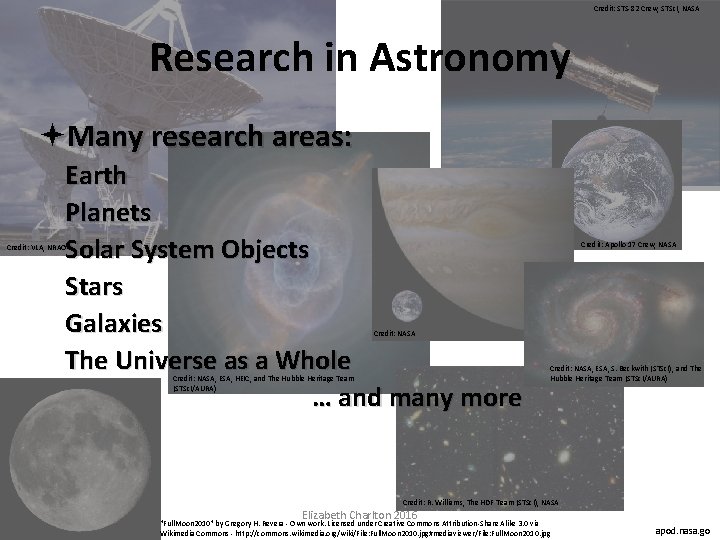
Credit: STS-82 Crew, STSc. I, NASA Research in Astronomy Many research areas: Earth Planets Solar System Objects Stars Galaxies The Universe as a Whole … and many more Credit: Apollo 17 Crew, NASA Credit: VLA, NRAO Credit: NASA, ESA, HEIC, and The Hubble Heritage Team (STSc. I/AURA) Credit: NASA, ESA, S. Beckwith (STSc. I), and The Hubble Heritage Team (STSc. I/AURA) Credit: R. Williams, The HDF Team (STSc. I), NASA Elizabeth Charlton 2016 "Full. Moon 2010" by Gregory H. Revera - Own work. Licensed under Creative Commons Attribution-Share Alike 3. 0 via Wikimedia Commons - http: //commons. wikimedia. org/wiki/File: Full. Moon 2010. jpg#mediaviewer/File: Full. Moon 2010. jpg apod. nasa. go
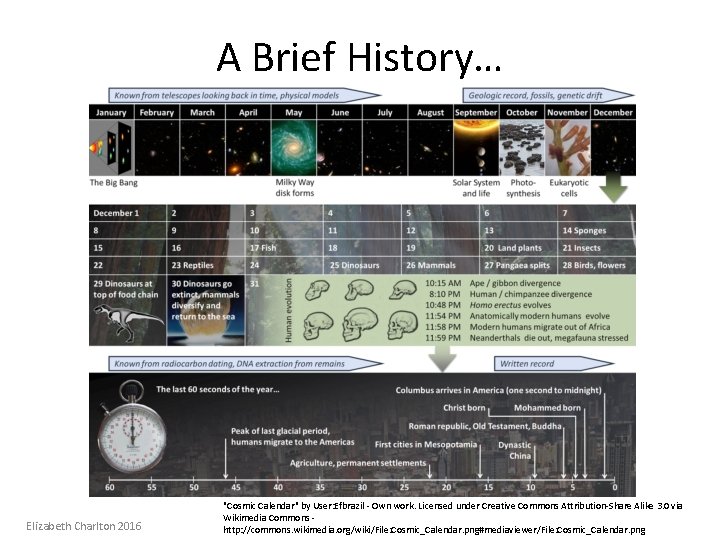
A Brief History… Elizabeth Charlton 2016 "Cosmic Calendar" by User: Efbrazil - Own work. Licensed under Creative Commons Attribution-Share Alike 3. 0 via Wikimedia Commons http: //commons. wikimedia. org/wiki/File: Cosmic_Calendar. png#mediaviewer/File: Cosmic_Calendar. png
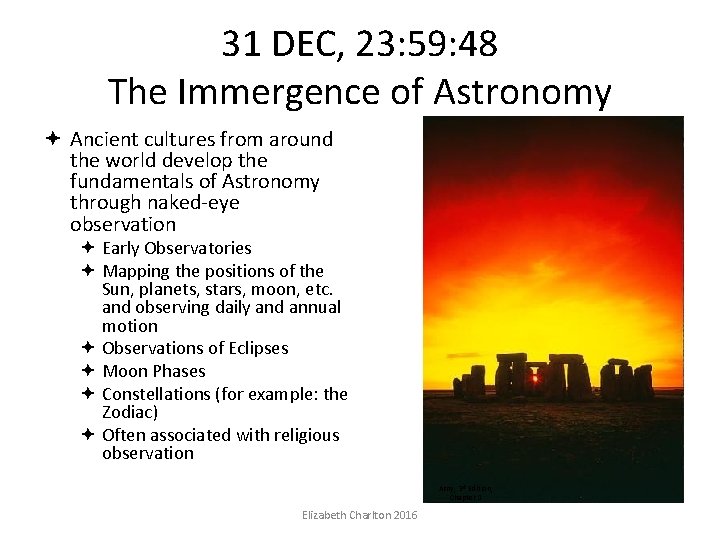
31 DEC, 23: 59: 48 The Immergence of Astronomy Ancient cultures from around the world develop the fundamentals of Astronomy through naked-eye observation Early Observatories Mapping the positions of the Sun, planets, stars, moon, etc. and observing daily and annual motion Observations of Eclipses Moon Phases Constellations (for example: the Zodiac) Often associated with religious observation Arny, 3 rd Edition, Chapter 1 Elizabeth Charlton 2016
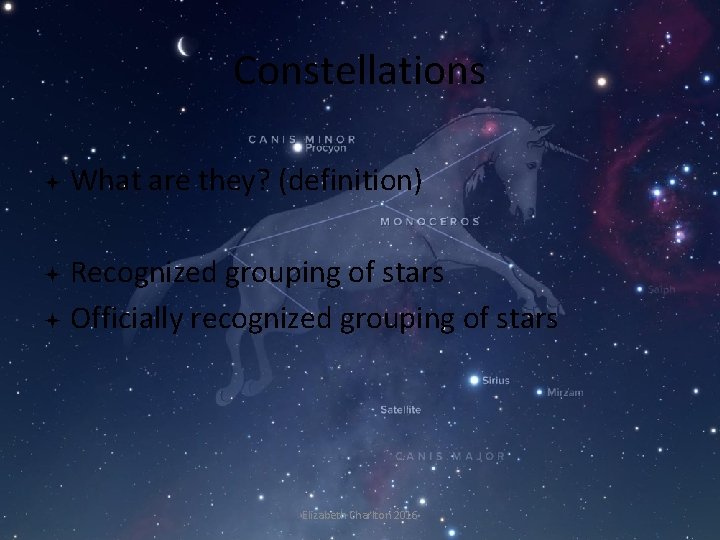
Constellations What are they? (definition) Recognized grouping of stars Officially recognized grouping of stars Elizabeth Charlton 2016
Official Constellations Who is responsible? IAU (International Astronomical Union) How many are there? 88 Recognized since 1922 Based on the 48 listed in Ptolemy’s Almagest Elizabeth Charlton 2016
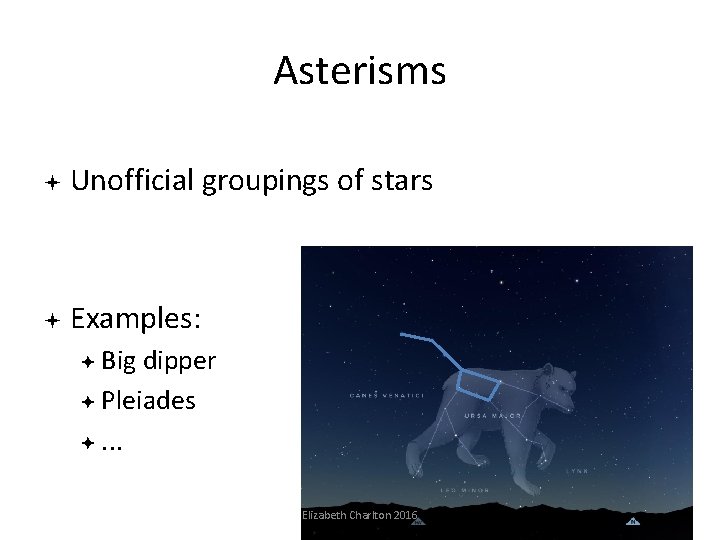
Asterisms Unofficial groupings of stars Examples: Big dipper Pleiades . . . Elizabeth Charlton 2016
Cultural History Many stories from many cultures Many names come from Greek and Roman myths Many star names from Arabic Elizabeth Charlton 2016
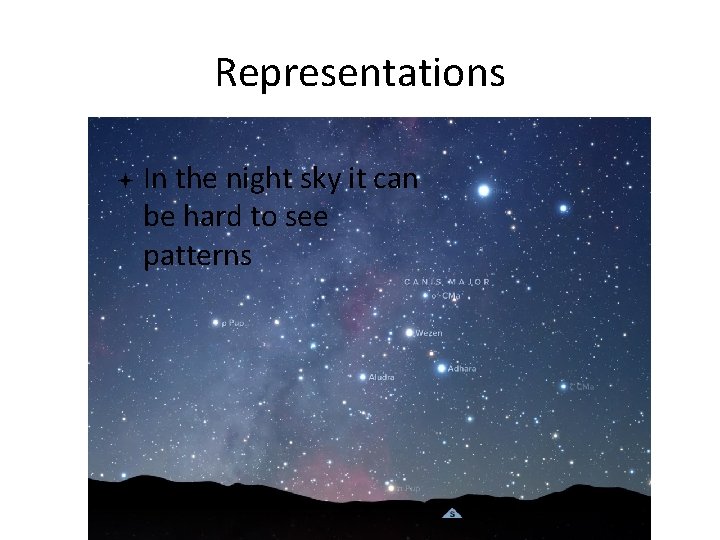
Representations In the night sky it can be hard to see patterns
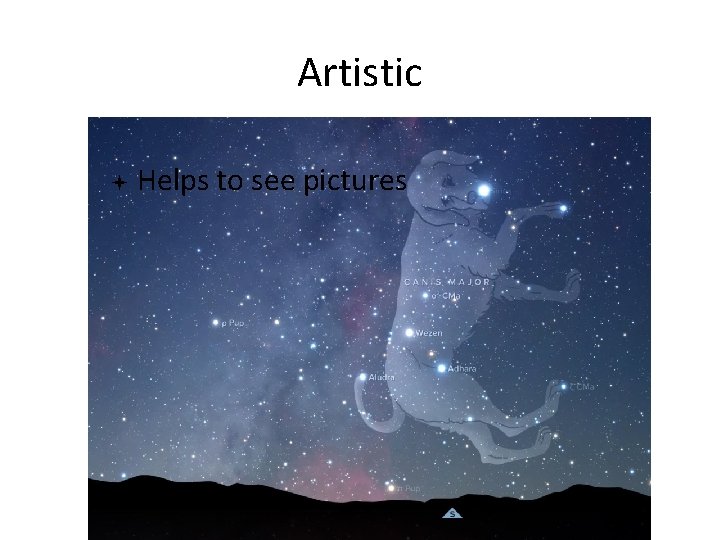
Artistic Helps to see pictures
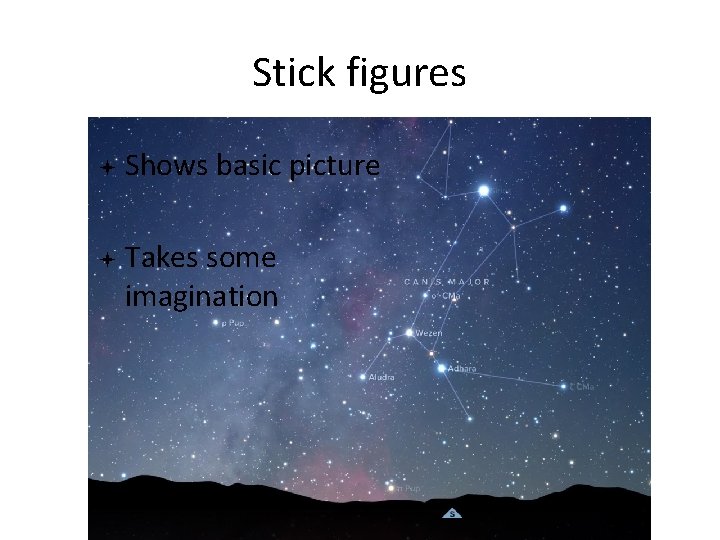
Stick figures Shows basic picture Takes some imagination
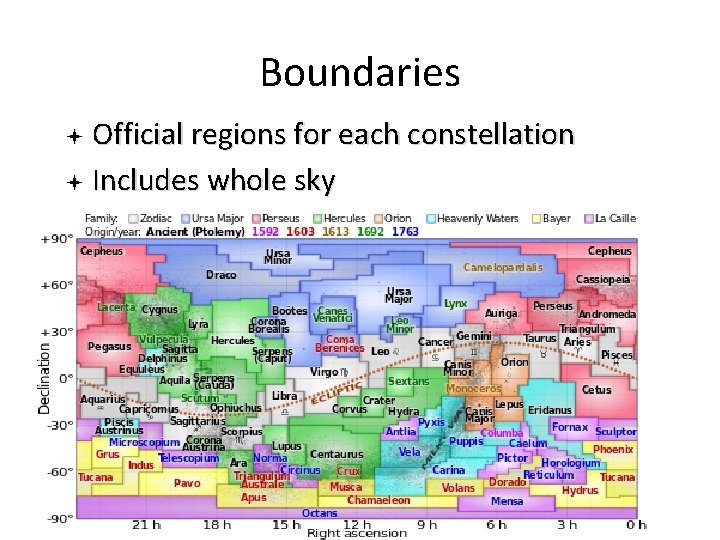
Boundaries Official regions for each constellation Includes whole sky
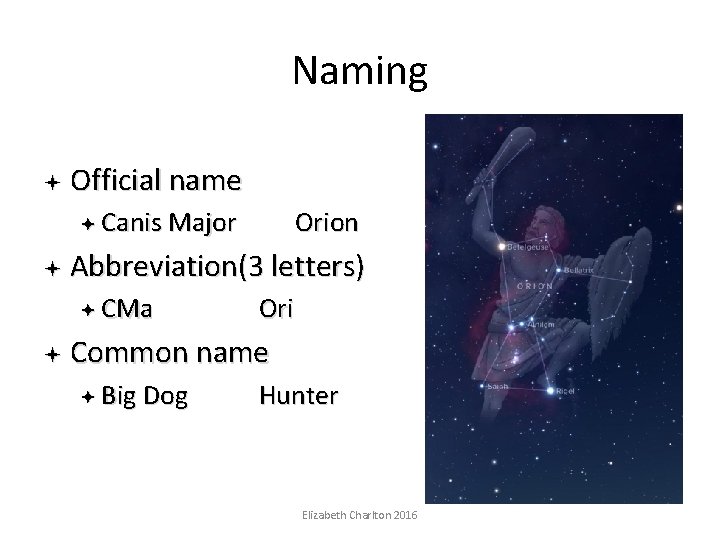
Naming Official name Canis Major Abbreviation(3 letters) CMa Orion Ori Common name Big Dog Hunter Elizabeth Charlton 2016
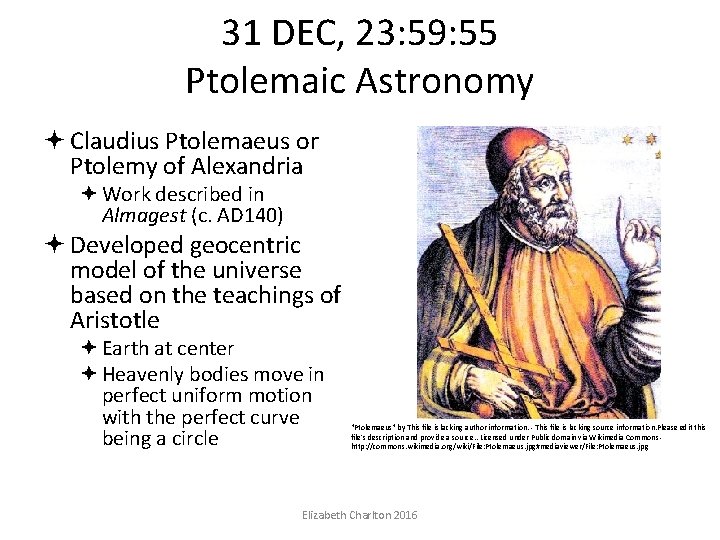
31 DEC, 23: 59: 55 Ptolemaic Astronomy Claudius Ptolemaeus or Ptolemy of Alexandria Work described in Almagest (c. AD 140) Developed geocentric model of the universe based on the teachings of Aristotle Earth at center Heavenly bodies move in perfect uniform motion with the perfect curve being a circle "Ptolemaeus" by This file is lacking author information. - This file is lacking source information. Please edit this file's description and provide a source. . Licensed under Public domain via Wikimedia Commons http: //commons. wikimedia. org/wiki/File: Ptolemaeus. jpg#mediaviewer/File: Ptolemaeus. jpg Elizabeth Charlton 2016
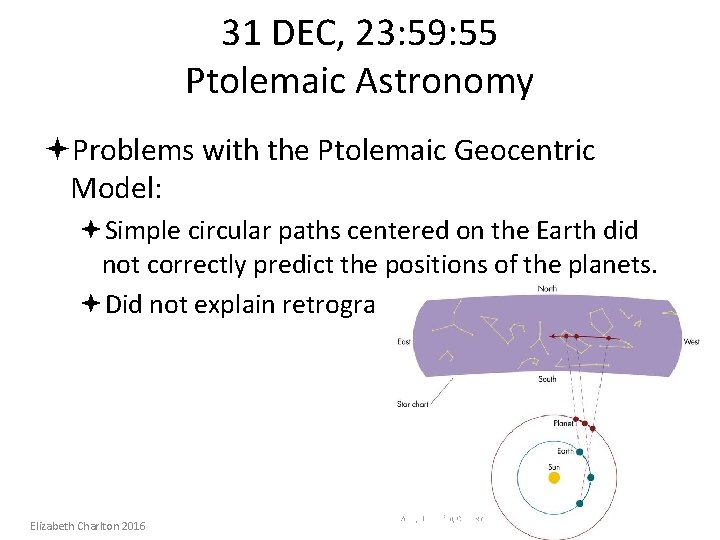
31 DEC, 23: 59: 55 Ptolemaic Astronomy Problems with the Ptolemaic Geocentric Model: Simple circular paths centered on the Earth did not correctly predict the positions of the planets. Did not explain retrograde motion of planets. Elizabeth Charlton 2016 Arny, 3 rd Edition, Chapter 1
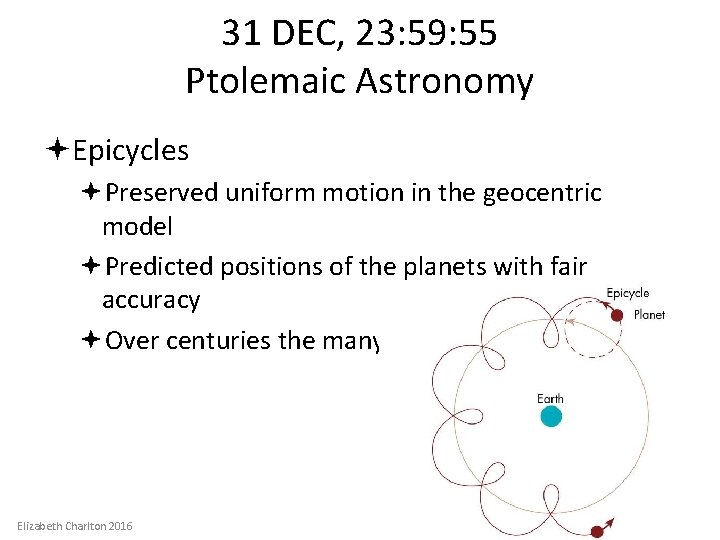
31 DEC, 23: 59: 55 Ptolemaic Astronomy Epicycles Preserved uniform motion in the geocentric model Predicted positions of the planets with fair accuracy Over centuries the many errors accumulated Elizabeth Charlton 2016
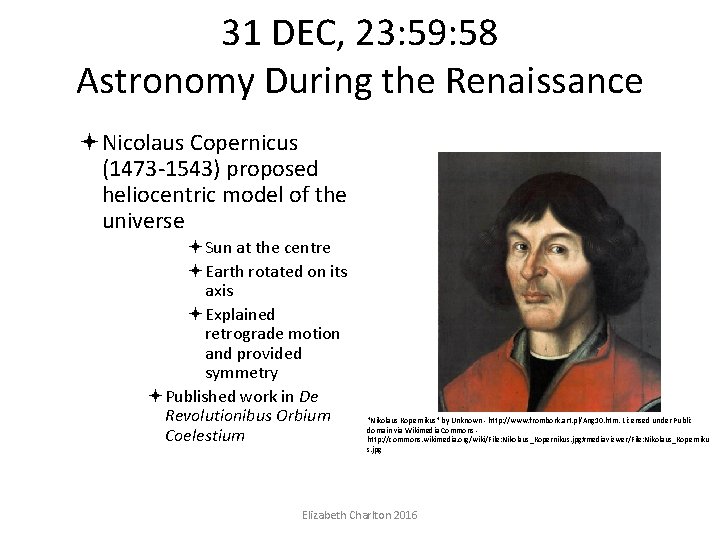
31 DEC, 23: 59: 58 Astronomy During the Renaissance Nicolaus Copernicus (1473 -1543) proposed heliocentric model of the universe Sun at the centre Earth rotated on its axis Explained retrograde motion and provided symmetry Published work in De Revolutionibus Orbium Coelestium "Nikolaus Kopernikus" by Unknown - http: //www. frombork. art. pl/Ang 10. htm. Licensed under Public domain via Wikimedia Commons http: //commons. wikimedia. org/wiki/File: Nikolaus_Kopernikus. jpg#mediaviewer/File: Nikolaus_Koperniku s. jpg Elizabeth Charlton 2016
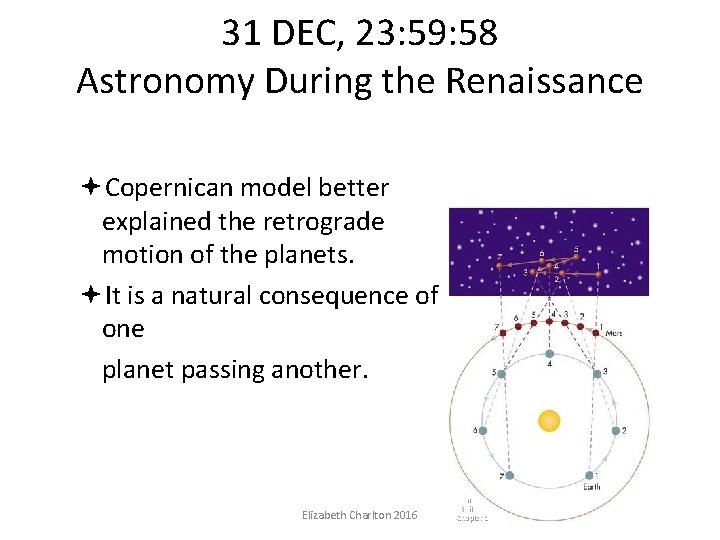
31 DEC, 23: 59: 58 Astronomy During the Renaissance Copernican model better explained the retrograde motion of the planets. It is a natural consequence of one planet passing another. Elizabeth Charlton 2016 Arny, 3 rd Edition, Chapter 1
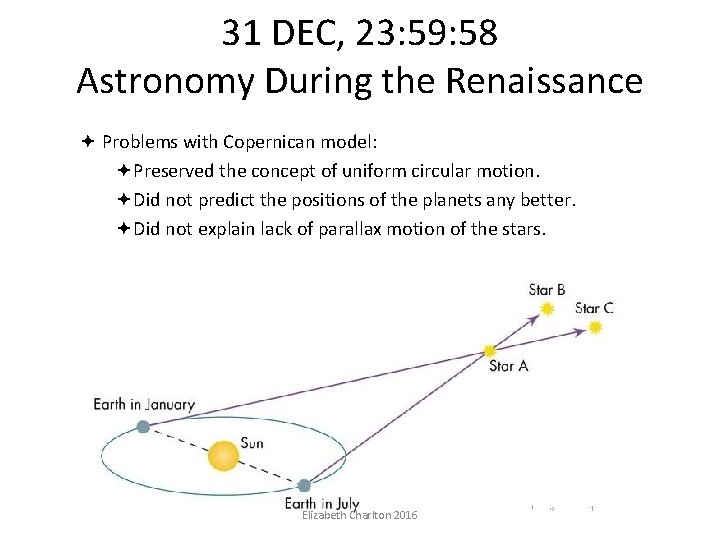
31 DEC, 23: 59: 58 Astronomy During the Renaissance Problems with Copernican model: Preserved the concept of uniform circular motion. Did not predict the positions of the planets any better. Did not explain lack of parallax motion of the stars. Elizabeth Charlton 2016 Arny, 3 rd Edition, Chapter 1
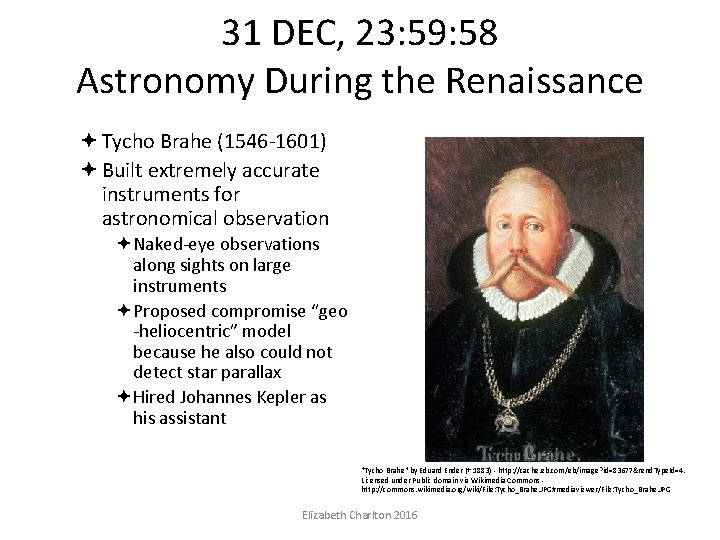
31 DEC, 23: 59: 58 Astronomy During the Renaissance Tycho Brahe (1546 -1601) Built extremely accurate instruments for astronomical observation Naked-eye observations along sights on large instruments Proposed compromise “geo -heliocentric” model because he also could not detect star parallax Hired Johannes Kepler as his assistant "Tycho Brahe" by Eduard Ender († 1883) - http: //cache. eb. com/eb/image? id=83677&rend. Type. Id=4. Licensed under Public domain via Wikimedia Commons http: //commons. wikimedia. org/wiki/File: Tycho_Brahe. JPG#mediaviewer/File: Tycho_Brahe. JPG Elizabeth Charlton 2016
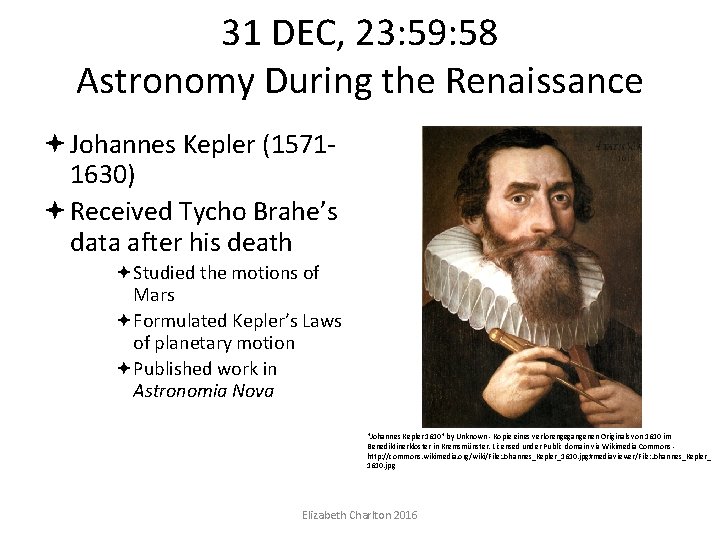
31 DEC, 23: 59: 58 Astronomy During the Renaissance Johannes Kepler (15711630) Received Tycho Brahe’s data after his death Studied the motions of Mars Formulated Kepler’s Laws of planetary motion Published work in Astronomia Nova "Johannes Kepler 1610" by Unknown - Kopie eines verlorengegangenen Originals von 1610 im Benediktinerkloster in Kremsmünster. Licensed under Public domain via Wikimedia Commons http: //commons. wikimedia. org/wiki/File: Johannes_Kepler_1610. jpg#mediaviewer/File: Johannes_Kepler_ 1610. jpg Elizabeth Charlton 2016
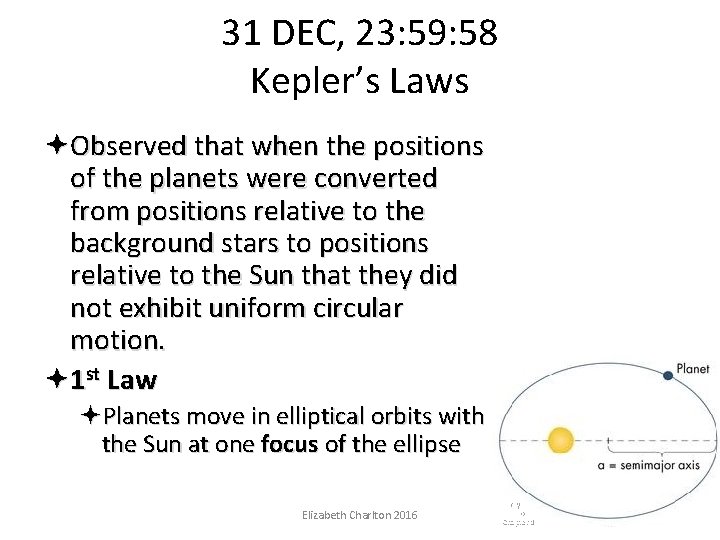
31 DEC, 23: 59: 58 Kepler’s Laws Observed that when the positions of the planets were converted from positions relative to the background stars to positions relative to the Sun that they did not exhibit uniform circular motion. 1 st Law Planets move in elliptical orbits with the Sun at one focus of the ellipse Elizabeth Charlton 2016 Arny, 3 rd Edition, Chapter 1
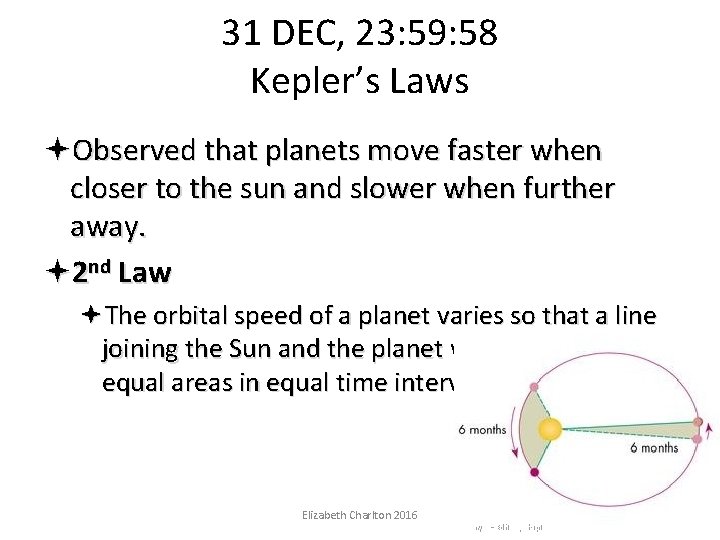
31 DEC, 23: 59: 58 Kepler’s Laws Observed that planets move faster when closer to the sun and slower when further away. 2 nd Law The orbital speed of a planet varies so that a line joining the Sun and the planet will sweep out equal areas in equal time intervals Elizabeth Charlton 2016 Arny, 3 rd Edition, Chapter 1
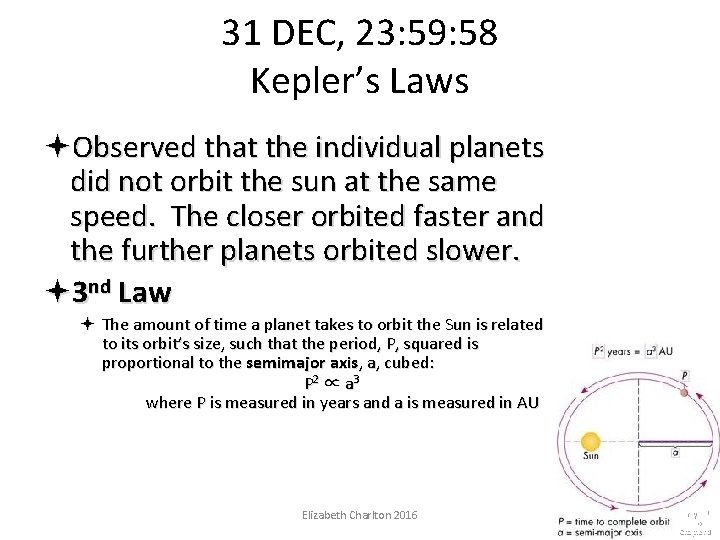
31 DEC, 23: 59: 58 Kepler’s Laws Observed that the individual planets did not orbit the sun at the same speed. The closer orbited faster and the further planets orbited slower. 3 nd Law The amount of time a planet takes to orbit the Sun is related to its orbit’s size, such that the period, P, squared is proportional to the semimajor axis, a, cubed: P 2 ∝ a 3 where P is measured in years and a is measured in AU Elizabeth Charlton 2016 Arny, 3 rd Edition, Chapter 1
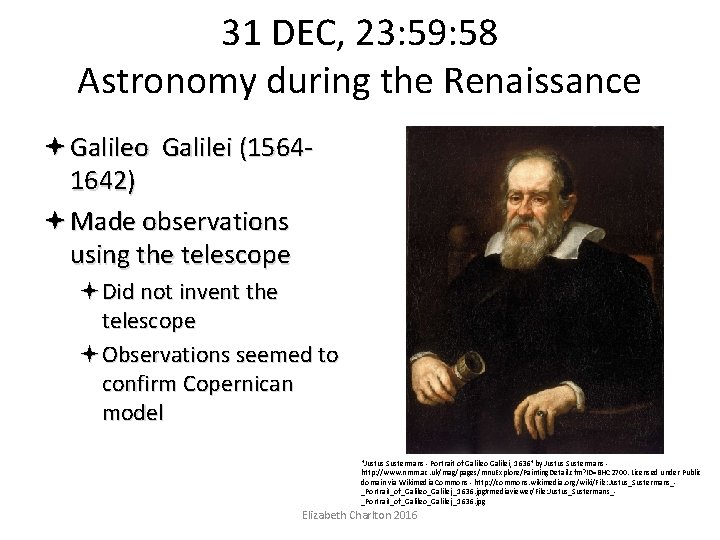
31 DEC, 23: 59: 58 Astronomy during the Renaissance Galileo Galilei (15641642) Made observations using the telescope Did not invent the telescope Observations seemed to confirm Copernican model "Justus Sustermans - Portrait of Galileo Galilei, 1636" by Justus Sustermans http: //www. nmm. ac. uk/mag/pages/mnu. Explore/Painting. Detail. cfm? ID=BHC 2700. Licensed under Public domain via Wikimedia Commons - http: //commons. wikimedia. org/wiki/File: Justus_Sustermans__Portrait_of_Galileo_Galilei, _1636. jpg#mediaviewer/File: Justus_Sustermans__Portrait_of_Galileo_Galilei, _1636. jpg Elizabeth Charlton 2016
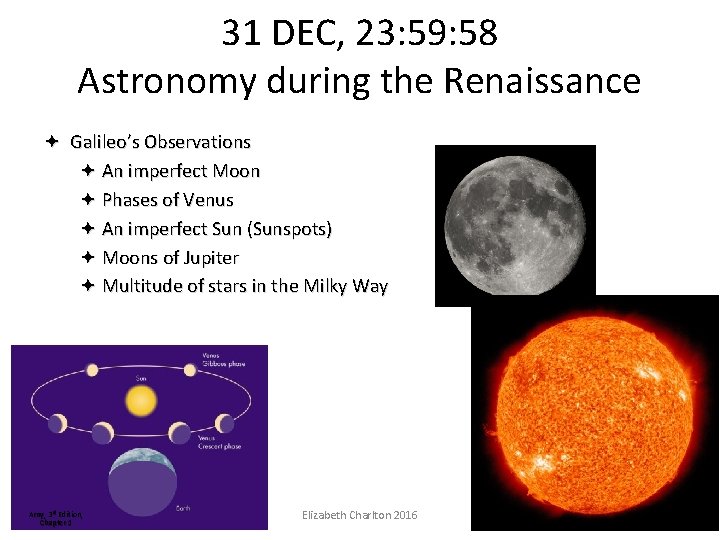
31 DEC, 23: 59: 58 Astronomy during the Renaissance Galileo’s Observations An imperfect Moon Phases of Venus An imperfect Sun (Sunspots) Moons of Jupiter Multitude of stars in the Milky Way Arny, 3 rd Edition, Chapter 1 Elizabeth Charlton 2016
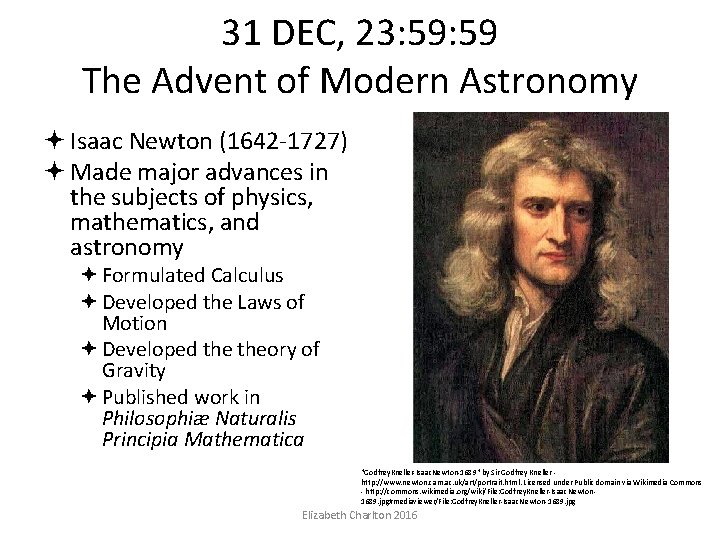
31 DEC, 23: 59 The Advent of Modern Astronomy Isaac Newton (1642 -1727) Made major advances in the subjects of physics, mathematics, and astronomy Formulated Calculus Developed the Laws of Motion Developed theory of Gravity Published work in Philosophiæ Naturalis Principia Mathematica "Godfrey. Kneller-Isaac. Newton-1689" by Sir Godfrey Kneller http: //www. newton. cam. ac. uk/art/portrait. html. Licensed under Public domain via Wikimedia Commons - http: //commons. wikimedia. org/wiki/File: Godfrey. Kneller-Isaac. Newton 1689. jpg#mediaviewer/File: Godfrey. Kneller-Isaac. Newton-1689. jpg Elizabeth Charlton 2016
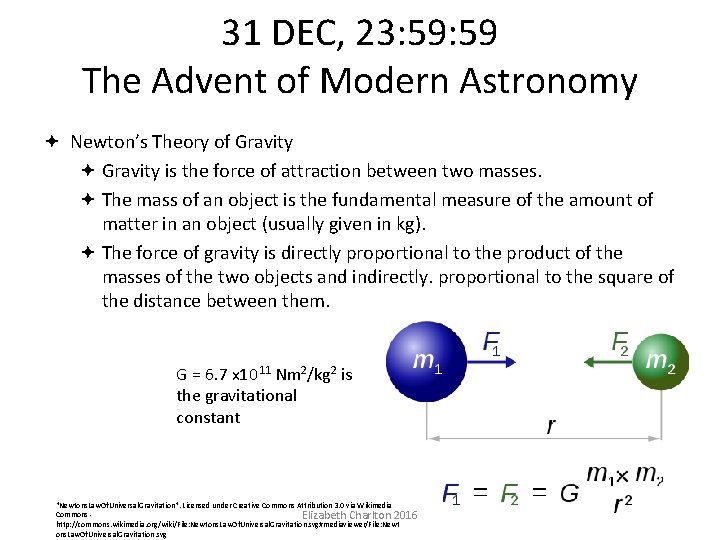
31 DEC, 23: 59 The Advent of Modern Astronomy Newton’s Theory of Gravity is the force of attraction between two masses. The mass of an object is the fundamental measure of the amount of matter in an object (usually given in kg). The force of gravity is directly proportional to the product of the masses of the two objects and indirectly. proportional to the square of the distance between them. G = 6. 7 x 10 11 Nm 2/kg 2 is the gravitational constant "Newtons. Law. Of. Universal. Gravitation". Licensed under Creative Commons Attribution 3. 0 via Wikimedia Commons Elizabeth Charlton 2016 http: //commons. wikimedia. org/wiki/File: Newtons. Law. Of. Universal. Gravitation. svg#mediaviewer/File: Newt ons. Law. Of. Universal. Gravitation. svg
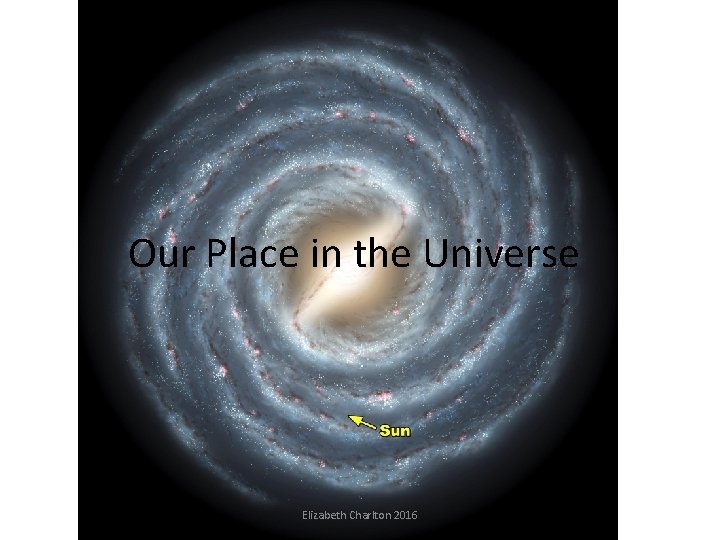
Our Place in the Universe Elizabeth Charlton 2016
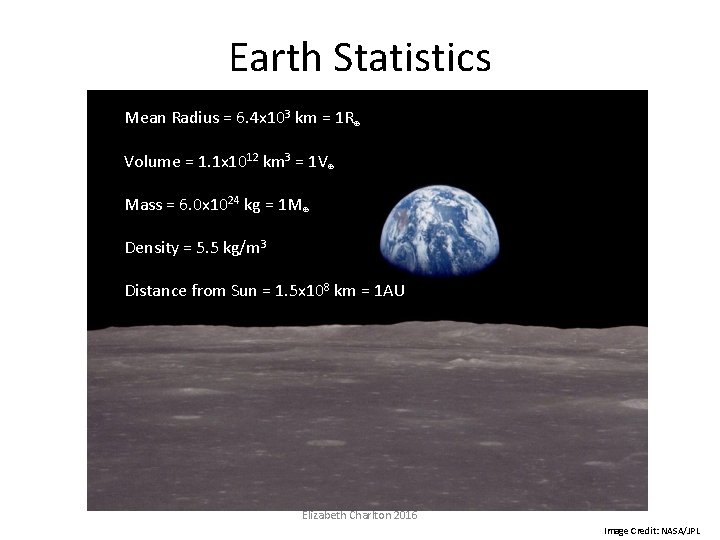
Earth Statistics Mean Radius = 6. 4 x 10³ km = 1 R⊕ Volume = 1. 1 x 10¹² km 3 = 1 V⊕ Mass = 6. 0 x 1024 kg = 1 M⊕ Density = 5. 5 kg/m 3 Distance from Sun = 1. 5 x 10⁸ km = 1 AU Elizabeth Charlton 2016 Image Credit: NASA/JPL
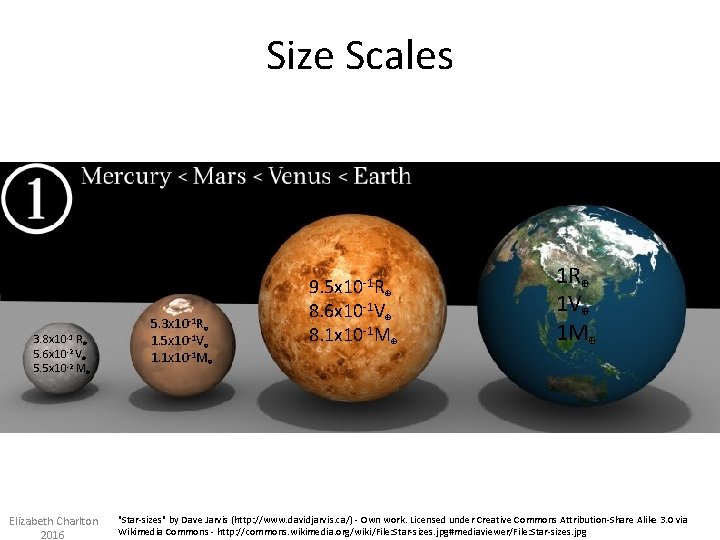
Size Scales 3. 8 x 10 -1 R⊕ -2 5. 6 x 10 V⊕ 5. 5 x 10 -2 M⊕ Elizabeth Charlton 2016 5. 3 x 10 -1 R⊕ 1. 5 x 10 -1 V⊕ 1. 1 x 10 -1 M⊕ 9. 5 x 10 -1 R⊕ 8. 6 x 10 -1 V⊕ 8. 1 x 10 -1 M⊕ 1 R⊕ 1 V⊕ 1 M⊕ "Star-sizes" by Dave Jarvis (http: //www. davidjarvis. ca/) - Own work. Licensed under Creative Commons Attribution-Share Alike 3. 0 via Wikimedia Commons - http: //commons. wikimedia. org/wiki/File: Star-sizes. jpg#mediaviewer/File: Star-sizes. jpg
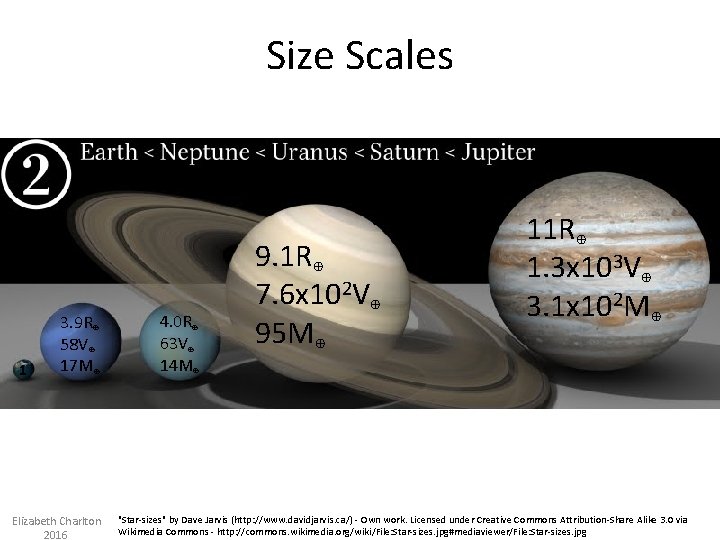
Size Scales 1 3. 9 R⊕ 58 V⊕ 17 M⊕ Elizabeth Charlton 2016 4. 0 R⊕ 63 V⊕ 14 M⊕ 9. 1 R⊕ 7. 6 x 10² V⊕ 95 M⊕ 11 R⊕ 1. 3 x 10³ V⊕ 3. 1 x 10² M⊕ "Star-sizes" by Dave Jarvis (http: //www. davidjarvis. ca/) - Own work. Licensed under Creative Commons Attribution-Share Alike 3. 0 via Wikimedia Commons - http: //commons. wikimedia. org/wiki/File: Star-sizes. jpg#mediaviewer/File: Star-sizes. jpg
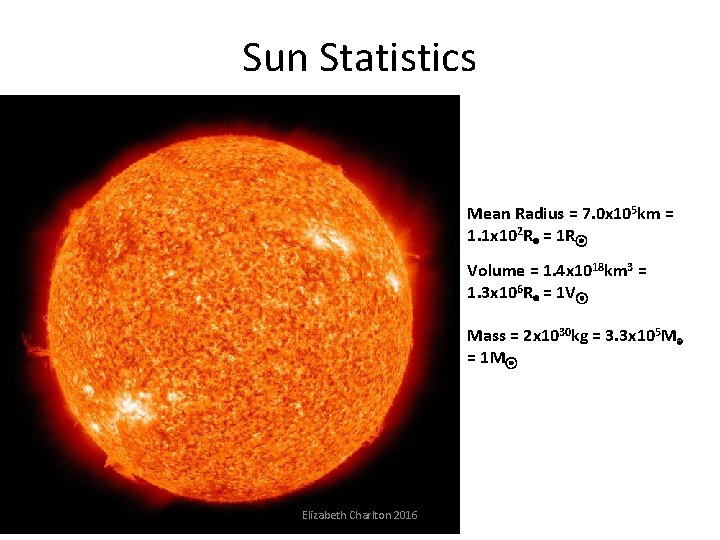
Sun Statistics Mean Radius = 7. 0 x 105 km = 1. 1 x 10² R⊕ = 1 R⦿ Volume = 1. 4 x 10¹⁸ km 3 = 1. 3 x 10⁶ R⊕ = 1 V⦿ Mass = 2 x 1030 kg = 3. 3 x 10⁵ M⊕ = 1 M⦿ Elizabeth Charlton 2016
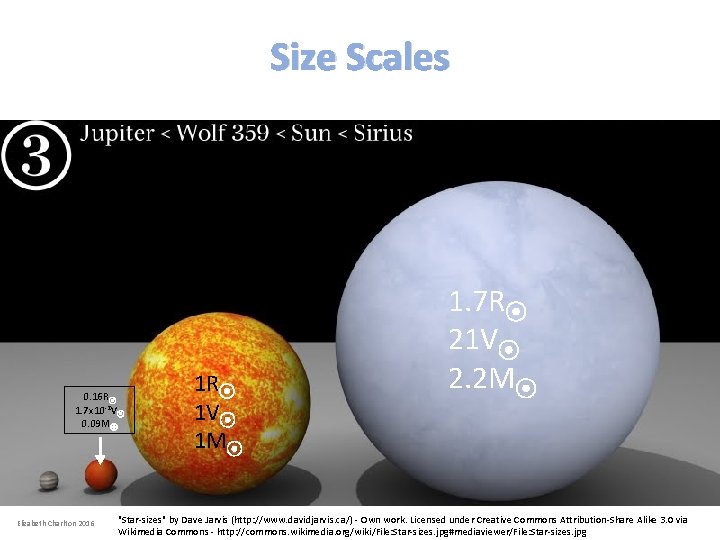
Size Scales 0. 16 R⦿ 1. 7 x 10 -2 V⦿ 0. 09 M⦿ Elizabeth Charlton 2016 1 R⦿ 1 V⦿ 1 M⦿ 1. 7 R⦿ 21 V⦿ 2. 2 M⦿ "Star-sizes" by Dave Jarvis (http: //www. davidjarvis. ca/) - Own work. Licensed under Creative Commons Attribution-Share Alike 3. 0 via Wikimedia Commons - http: //commons. wikimedia. org/wiki/File: Star-sizes. jpg#mediaviewer/File: Star-sizes. jpg
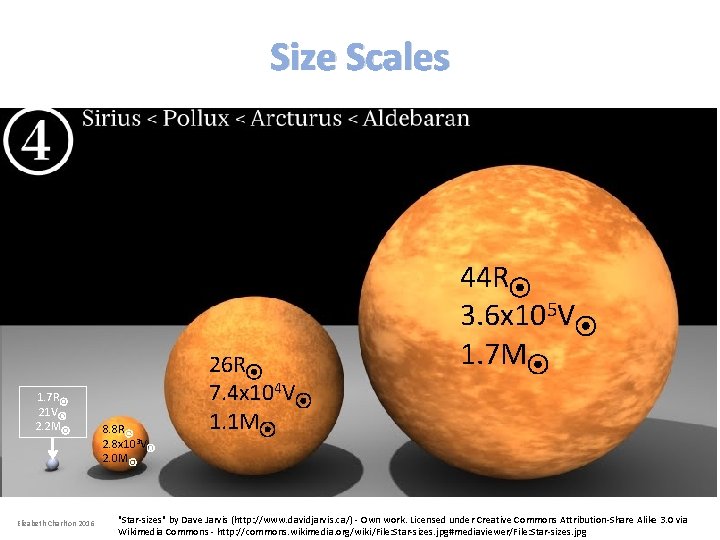
Size Scales 1. 7 R⦿ 21 V⦿ 2. 2 M⦿ Elizabeth Charlton 2016 8. 8 R⦿ 2. 8 x 10³ V⦿ 2. 0 M⦿ 26 R⦿ 7. 4 x 10⁴ V⦿ 1. 1 M⦿ 44 R⦿ 3. 6 x 10⁵ V⦿ 1. 7 M⦿ "Star-sizes" by Dave Jarvis (http: //www. davidjarvis. ca/) - Own work. Licensed under Creative Commons Attribution-Share Alike 3. 0 via Wikimedia Commons - http: //commons. wikimedia. org/wiki/File: Star-sizes. jpg#mediaviewer/File: Star-sizes. jpg
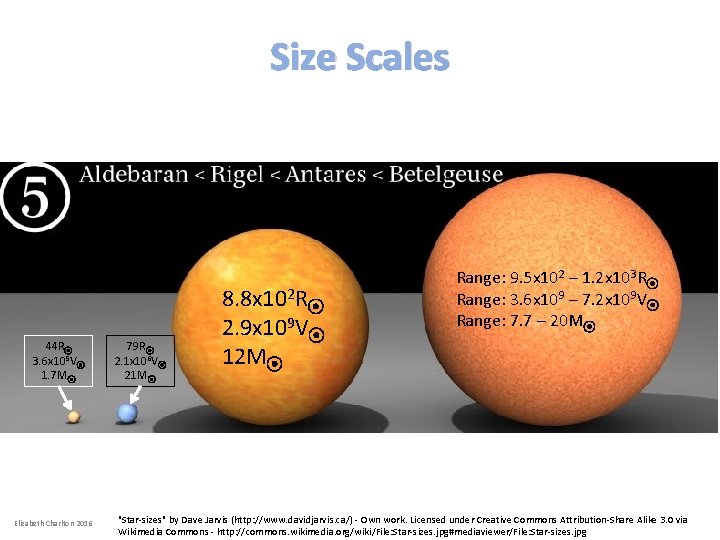
Size Scales 44 R⦿ 3. 6 x 10⁵ V⦿ 1. 7 M⦿ Elizabeth Charlton 2016 79 R⦿ 2. 1 x 10⁶ V⦿ 21 M⦿ 8. 8 x 10² R⦿ 2. 9 x 10⁹ V⦿ 12 M⦿ Range: 9. 5 x 10² – 1. 2 x 10³ R⦿ Range: 3. 6 x 10⁹ – 7. 2 x 10⁹ V⦿ Range: 7. 7 – 20 M⦿ "Star-sizes" by Dave Jarvis (http: //www. davidjarvis. ca/) - Own work. Licensed under Creative Commons Attribution-Share Alike 3. 0 via Wikimedia Commons - http: //commons. wikimedia. org/wiki/File: Star-sizes. jpg#mediaviewer/File: Star-sizes. jpg
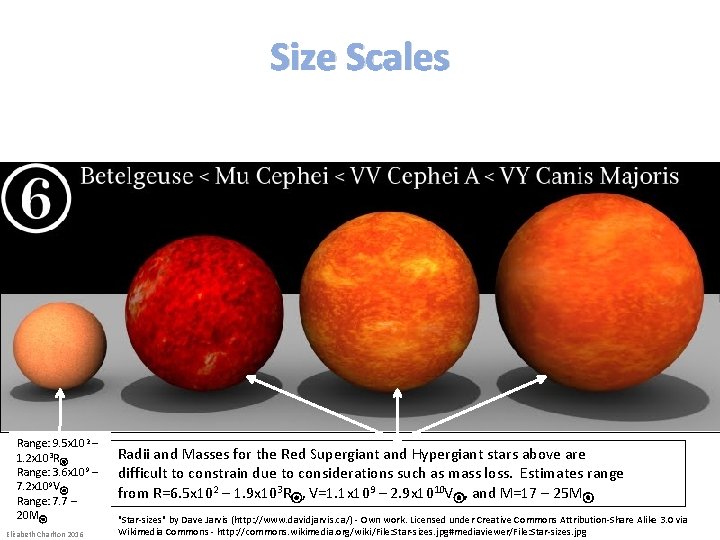
Size Scales Range: 9. 5 x 10² – 1. 2 x 10³ R⦿ Range: 3. 6 x 10⁹ – 7. 2 x 10⁹ V⦿ Range: 7. 7 – 20 M⦿ Elizabeth Charlton 2016 Radii and Masses for the Red Supergiant and Hypergiant stars above are difficult to constrain due to considerations such as mass loss. Estimates range from R=6. 5 x 10² – 1. 9 x 10³ R⦿, V=1. 1 x 10⁹ – 2. 9 x 10¹⁰ V⦿, and M=17 – 25 M⦿ "Star-sizes" by Dave Jarvis (http: //www. davidjarvis. ca/) - Own work. Licensed under Creative Commons Attribution-Share Alike 3. 0 via Wikimedia Commons - http: //commons. wikimedia. org/wiki/File: Star-sizes. jpg#mediaviewer/File: Star-sizes. jpg
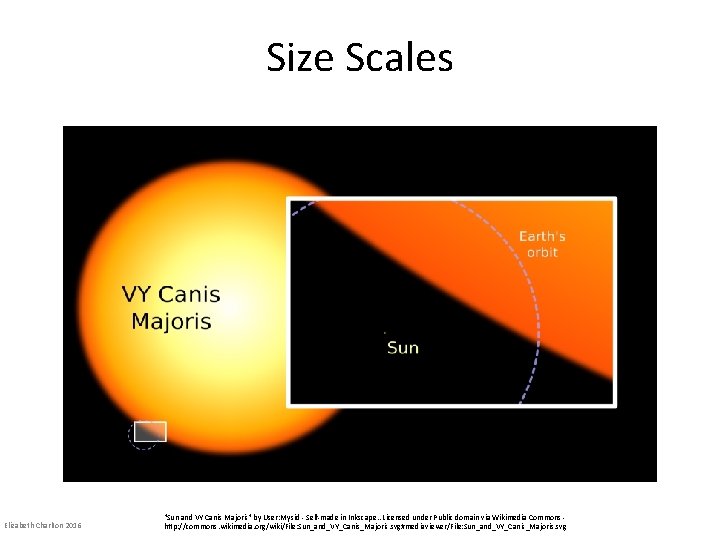
Size Scales Elizabeth Charlton 2016 "Sun and VY Canis Majoris" by User: Mysid - Self-made in Inkscape. . Licensed under Public domain via Wikimedia Commons http: //commons. wikimedia. org/wiki/File: Sun_and_VY_Canis_Majoris. svg#mediaviewer/File: Sun_and_VY_Canis_Majoris. svg
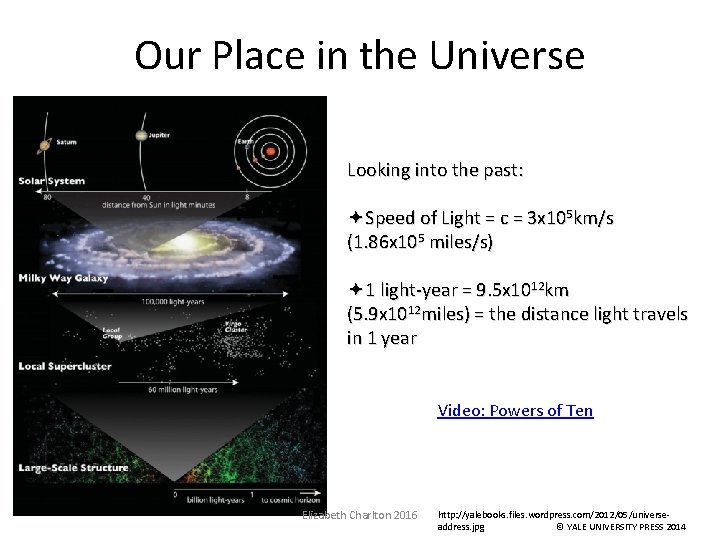
Our Place in the Universe Looking into the past: Speed of Light = c = 3 x 10⁵ km/s (1. 86 x 105 miles/s) 1 light-year = 9. 5 x 10¹² km (5. 9 x 10¹² miles) = the distance light travels in 1 year Video: Powers of Ten Elizabeth Charlton 2016 http: //yalebooks. files. wordpress. com/2012/05/universe© YALE UNIVERSITY PRESS 2014 address. jpg
- Slides: 44