
IST 230 Sanket Khara James Bachert Michael Linsenbigler
IST 230 Sanket Khara James Bachert Michael Linsenbigler Miguel Sanchez
TOPIC: Logic and Methods of Proofs. Project Objective: To arrive at an understanding and appreciation of the applicability of discrete mathematics to various aspects in the field of technology. Determine why the topic of choice is important and relevant in the field of technology.
LOGIC: Logic is the study of reasoning; it is specifically connected with whether reasoning is correct. Logic focuses on the relationship among the statements as opposed to the content of any particular statement. LOGICAL METHODS: On the other hand , they are the means of proving mathematical theorems and the correctness of computer programs. METHOD OF PROOFS: There are many kinds of proofs that you can prove your solution. Some are proof by contradiction, proof by
How is our discrete mathematics topic applied in the field of technology? Nowadays, the technology has been growing faster and faster by using so many mathematical concepts and strategies. Our topic was on logic and methods of proofs where we found many sites and many software that used the concept of logic applications. Because there were many sites on Logic applications, we picked some of the main sites that explained in detail where they used logic in today’s IT field. Also, some of the sites went really deep into logic applications which we never learned in the class. But, it was very interesting to look at those sites and software that they
Basically, the articles that we found are from an European site called ERCIM (European Research Consortium for Informatics and Mathematics) which is known to be specifically for Mathematics and Informatics. This site is an leading research institute in which fourteen countries of Europe are members of ERCIM and are committed to advancement of information technology and applied mathematics. Their goals are: • To develop a common policy to strengthen European community in information technology and applied mathematics. • To identify key research areas important for the future development of IT in Europe. The actual site is
Our first article “Proof theory and Programming” was written by Didier Galmiche. This article talks about an research project called TYPES which was done in Italy and France. The project basically focuses on the relationship between logic (mainly proof theory) and programming with the aim to propose methods and tools usable for development of correct software. The results are issued from studies on the analysis and automatized construction of proofs and involved into two paradigms “Proof-as-programs” and “Proof-searchas-computation”.
Some of the points that logic is used in this project are: • the problem that consists in representing concepts and development steps with appropriate logics and formal methods. • Logics are involved in computer science and software design. For example: Linear Logic is a good example of the interaction between proof theory and programming. • The type theory between lambda terms and intuitonistic proofs is am important conceptual tool for programming ( language definition, validity properties, program synthesis). • Finally, the TYPES project uses Analysis and representation of logics of programming concepts such as contradiction, contrapositive, control, and sequentially. Also, they have used Theoretical results, methods and tools for
Our Second article “Symbolic Techniques for Program Analysis” was written by Henk Nieland. This article talks about how software systems were not properly functioning and their reliability was taken indeed seriously after a long time. Even though, such proofs were feasible for systems whose size were far below what was found in practice. But, recently they developed techniques that offered a solution on how these techniques would be successfully analyzed on real-life systems by combining mathematical proofs called Manual proof and Fully automated proof. Manual Proof is just a process that is carried out in the context of Process Algebra (PA). . On the other hand, Fully automated uses proof techniques based on state automata. Therefore, several instances of faulty software have been revealed by applying formal proof checkers under manual control.
Some of the points that logic is used in this article are: • The advantage of Manual Proof is that it uses the statements of form such as Specification Languages = Implementation in “Cones and Foci Theorem”. The idea is to create a basis for symbolic techniques rather than adding another language by carrying out the proofs manually using strict Logic rules. • Whereas, Fully Automated Proof uses statements based on state automata. An example of fully automated proof would be an safety railway yard which was recently analyzed by Propositional Logic. Lastly, to rewrite the process again, Linear Process Operation (automated induction, tree automata) was used in which it can reduce the number of states.
Our Third article “DANIT: Denmark’s Representative in ERCIM” was written by Fritz Henglein. This article tells you about DANIT, a Danish Consortium for Information technology consisting of five research groups/institutions. The five partners include more than 100 members covering all six Danish universities and computer science departments. But, out of five groups/institutions, the only groups that uses logic applications is BRICS is a Basic Research in Computer Science. BRICS goal is to establish and reinforce important areas of basic research in the mathematical foundations of computer science. BRICS organizes dozens of major activities, seminars, workshops, and conferences twice a year.
Some of the areas that logic has been used by DANIT program are: • Logic: Constructive and Categorical Logic, Logic and Automata, Logic and Complexity, Contrapositive, Contradiction • Algorithms and Complexity: Lower bounds, Algorithms, and Data Security. • Semantics: Foundations, Concurrency, Programmed verification.
We have found some software which is easier to learn logic applications and also it is very helpful for the students as a proof assistants. Most of the software developed in European places and some are developed in US. We thought that these software were very useful and interesting to look at it. We were very surprised to see that they these kinds of software out there and how it is easy to learn logic applications. On the next few slides we are going to explained some of the software that we have found which used logic applications.
Win. KE is an interactive proof assistant software that serve you as a tutoring system to support the teaching of logic and reasoning on an introductory level. The main purpose of the software is to lead students through a logic proof step by step, and also, it can be used as an automated theorem. The Win. KE process of constructing a proof tree directly corresponds to what traditionally has been done using pen and paper. Running under Windows, the system is easy to use and visually satisfying. The interactive graphical user interface consists of four windows: the main window providing menus and buttons for quick access to the most basic functions, the graphic window to display and manipulate KE proof trees, a viewer which displays a scaled-down view of the virtual drawing board, allowing
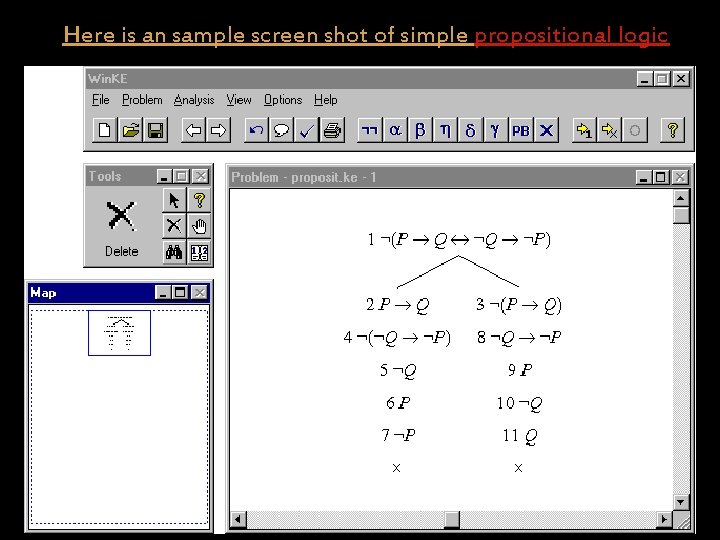
Here is an sample screen shot of simple propositional logic
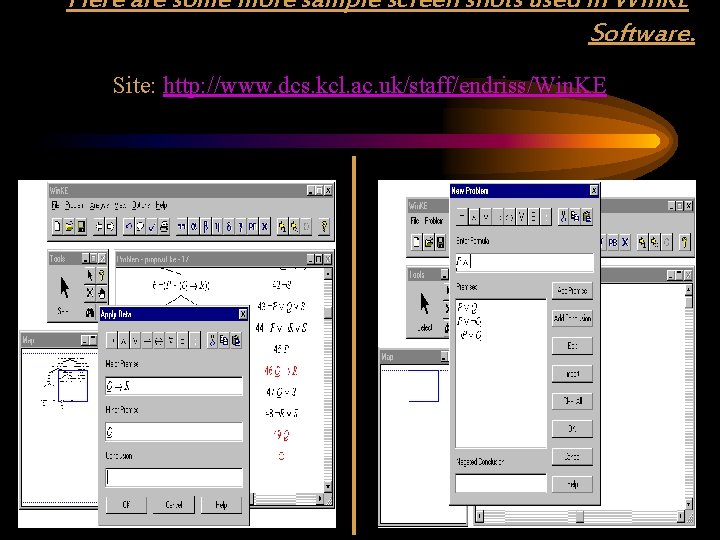
Here are some more sample screen shots used in Win. KE Software. Site: http: //www. dcs. kcl. ac. uk/staff/endriss/Win. KE
Proof General is a generic interface for proof assistants, currently based on Emacs. IT has been developed at the LFCS (Laboratory for Foundation of Computer Science) in the University of Edinburgh. LFCS is a community of theoretical computer scientists with interests in concurrency, semantics, categories, algebra, types, logic, and complexity. Proof General works best under Xemacs, which is a highly customizable open source text editor and application development system. Its emphasis is on modern graphical user interface support and an open software development model, similar to Linux. XEmacs has an active development community numbering in the hundreds, and runs on Windows 95 and NT, Linux and nearly every other version of Unix in existence. Proof General’s aim is to provide powerful and configurable interfaces which help user-
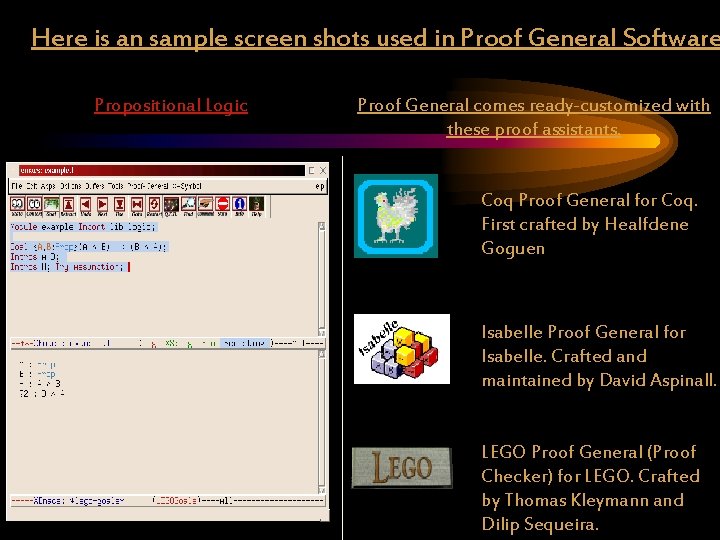
Here is an sample screen shots used in Proof General Software Propositional Logic Proof General comes ready-customized with these proof assistants. Coq Proof General for Coq. First crafted by Healfdene Goguen Isabelle Proof General for Isabelle. Crafted and maintained by David Aspinall. LEGO Proof General (Proof Checker) for LEGO. Crafted by Thomas Kleymann and Dilip Sequeira.
Language, Proof, and Logic is a software that is made by Jon Barwise (Indiana University) and John Etchemendy (Stanford University). This software was published in fall 1999 at CSLI (Center for the Study of Language and Information) which is located at Stanford university. CSLI is devoted to research in the emerging science of information, computing, and cognition. Its origins were found by many computer scientists, linguists, logicians, philosophers, psychologists, and artificial intelligence researchers, seeking solutions to problems in their own disciplines, turned to one another for help. Basically, this package includes fours pieces of software such as Tarski’s World 5. 0 which is a new version of the popular that teaches the basic first-order language and its semantics, Fitch, a natural deduction proof environment for giving and checking first order proofs, Boole, a natural deduction proof that checks the truth tables and related notations like tautology, tautological consequence, and lastly Submit, a
Logic. xla is a Microsoft Excel add-in that processes logical statements. It was created by Jim Burke. This program requires Microsoft Excel 7 or higher. It features: • Logic Menu • Calculates “Exclusive or” Function. • Calculates “If and If only” Function. • Calculates a Logical “If then” Function. • Lastly, it changes “Greek Letters into Symbols”.
- Slides: 19