
AMFM Screen Design Using Donut Filters Niranjan DameraVenkata
![Green-noise statistics [Lau et al. ] G=0. 10 G=0. 25 Spatial Spectral SPIE Electronic](https://slidetodoc.com/presentation_image_h2/ff6410d4e648d9f8ecb53c0ec8e2c526/image-6.jpg "Green-noise statistics [Lau et al. ] G=0. 10 G=0. 25 Spatial Spectral SPIE Electronic")
![AM-FM Screen design • Filter based methods – Donut Filters [Lin] • Optimal void](https://slidetodoc.com/presentation_image_h2/ff6410d4e648d9f8ecb53c0ec8e2c526/image-7.jpg "AM-FM Screen design • Filter based methods – Donut Filters [Lin] • Optimal void")
![Results (epxand images to see dot structure) Optimized donut filter Gaussian donut filter [Lin]](https://slidetodoc.com/presentation_image_h2/ff6410d4e648d9f8ecb53c0ec8e2c526/image-20.jpg "Results (epxand images to see dot structure) Optimized donut filter Gaussian donut filter [Lin]")

- Slides: 21
AM-FM Screen Design Using Donut Filters Niranjan Damera-Venkata and Qian Lin Hewlett-Packard Laboratories 1501 Page Mill Road, MS 1203 Palo Alto CA 94304
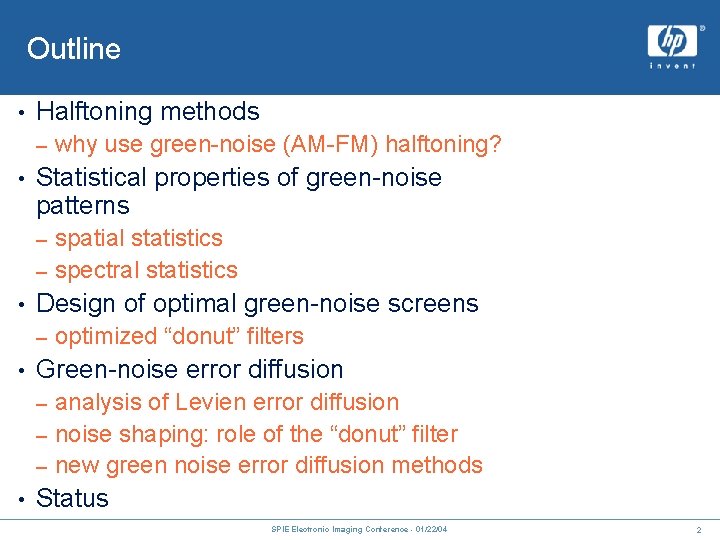
Outline • Halftoning methods – • why use green-noise (AM-FM) halftoning? Statistical properties of green-noise patterns spatial statistics – spectral statistics – • Design of optimal green-noise screens – • optimized “donut” filters Green-noise error diffusion analysis of Levien error diffusion – noise shaping: role of the “donut” filter – new green noise error diffusion methods – • Status SPIE Electronic Imaging Conference - 01/22/04 2
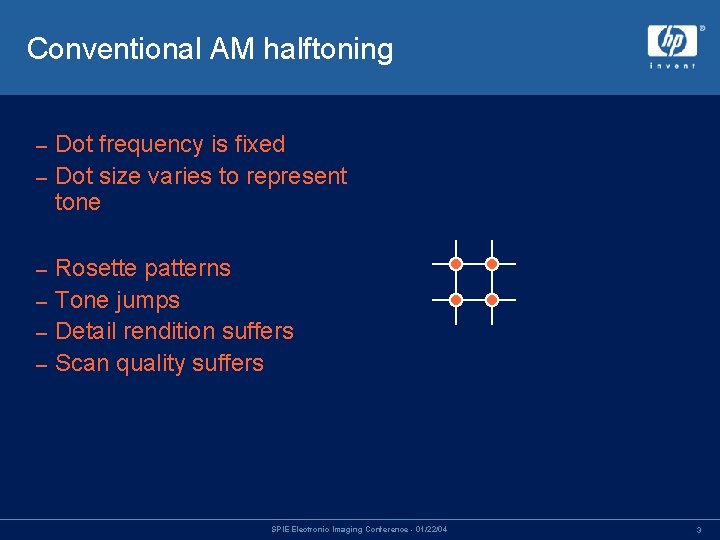
Conventional AM halftoning • Indigo’s “Sequin” halftoning Dot frequency is fixed – Dot size varies to represent tone – • Disadvantages Rosette patterns – Tone jumps – Detail rendition suffers – Scan quality suffers – SPIE Electronic Imaging Conference - 01/22/04 3
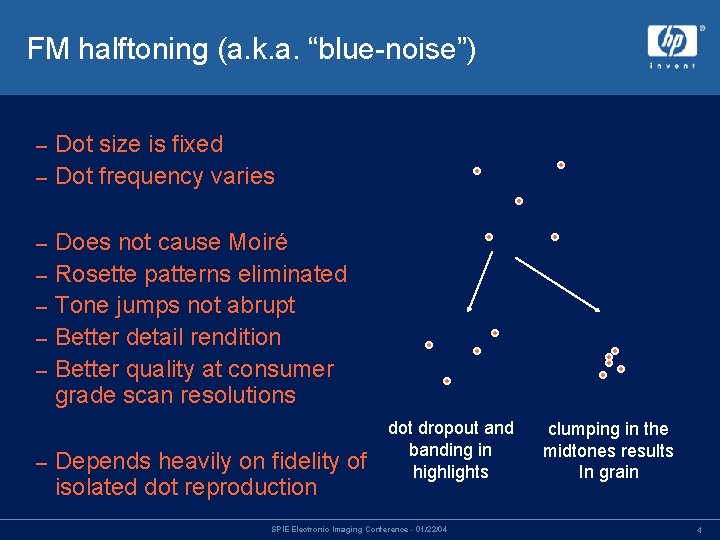
FM halftoning (a. k. a. “blue-noise”) • Photo printers Dot size is fixed – Dot frequency varies – • Advantages – – – • Does not cause Moiré Rosette patterns eliminated Tone jumps not abrupt Better detail rendition Better quality at consumer grade scan resolutions Disadvantages – Depends heavily on fidelity of isolated dot reproduction dot dropout and banding in highlights SPIE Electronic Imaging Conference - 01/22/04 clumping in the midtones results In grain 4
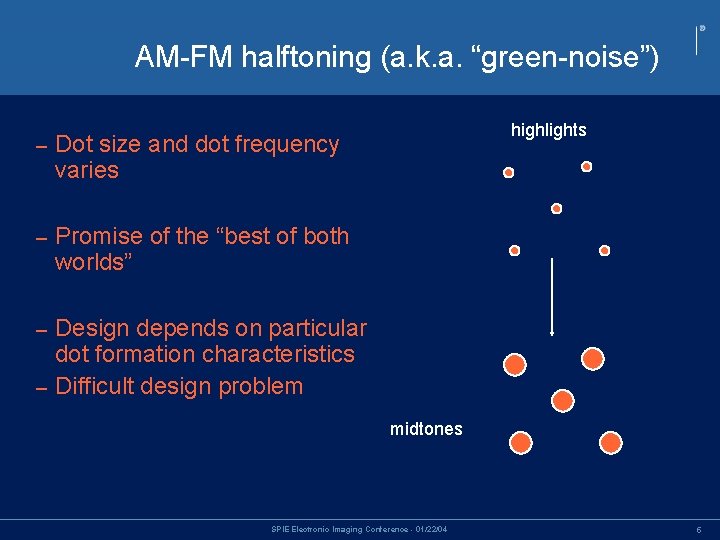
AM-FM halftoning (a. k. a. “green-noise”) • AM-FM – • Dot size and dot frequency varies Advantages – • highlights Promise of the “best of both worlds” Disadvantages Design depends on particular dot formation characteristics – Difficult design problem – midtones SPIE Electronic Imaging Conference - 01/22/04 5
Green-noise statistics [Lau et al. ] G=0. 10 G=0. 25 Spatial Spectral SPIE Electronic Imaging Conference - 01/22/04 6
AM-FM Screen design • Filter based methods – Donut Filters [Lin] • Optimal void and cluster approach • Donut filter parameters must be empirically chosen for each graylevel – Color. Smooth Dither [Lin and Allebach] • Computationally very expensive • Handles joint design for a set of colorants • Several parameters must be set empirically • Optimal method – Green Noise Mask [Lau, Arce and Gallagher] • Approximates green-noise Markov statistics in Maximum Likelihood sense SPIE Electronic Imaging Conference - 01/22/04 7
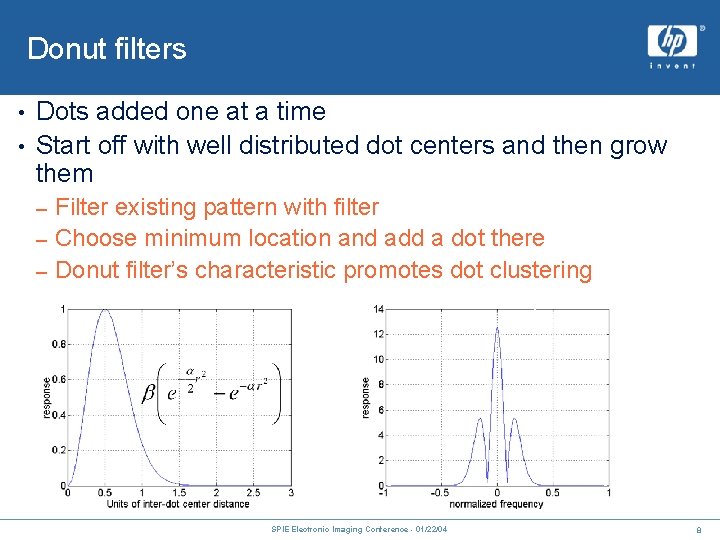
Donut filters Dots added one at a time • Start off with well distributed dot centers and then grow them • Filter existing pattern with filter – Choose minimum location and add a dot there – Donut filter’s characteristic promotes dot clustering – Spectral Spatial SPIE Electronic Imaging Conference - 01/22/04 8
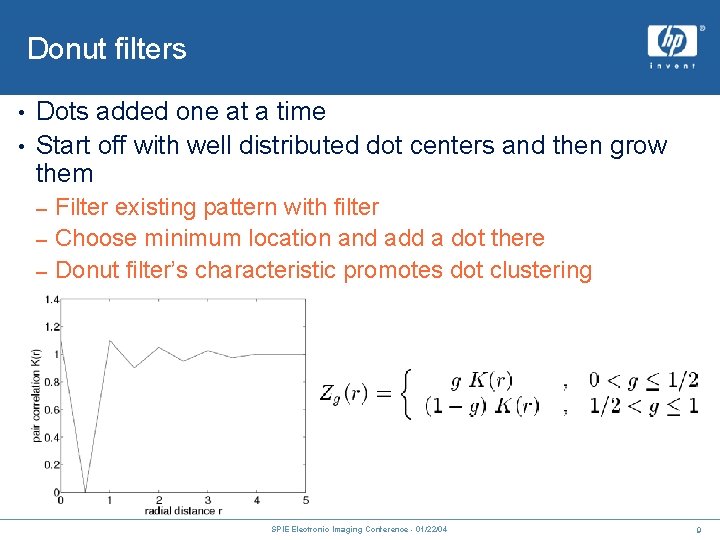
Donut filters Dots added one at a time • Start off with well distributed dot centers and then grow them • Filter existing pattern with filter – Choose minimum location and add a dot there – Donut filter’s characteristic promotes dot clustering – SPIE Electronic Imaging Conference - 01/22/04 9
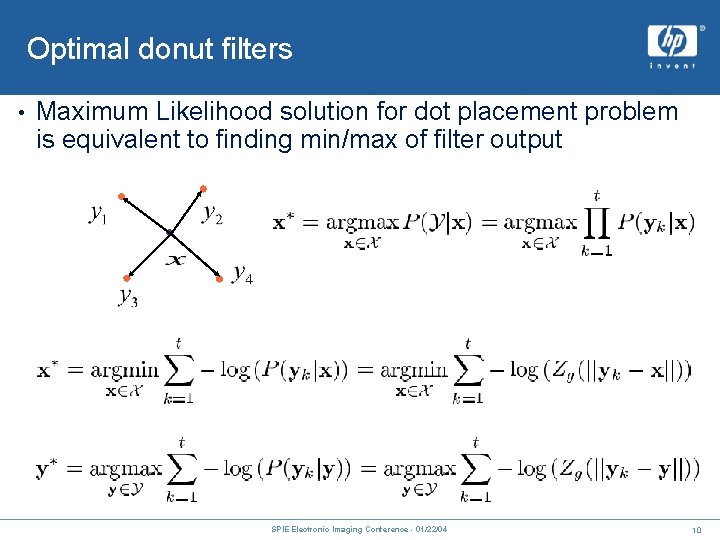
Optimal donut filters • Maximum Likelihood solution for dot placement problem is equivalent to finding min/max of filter output SPIE Electronic Imaging Conference - 01/22/04 10
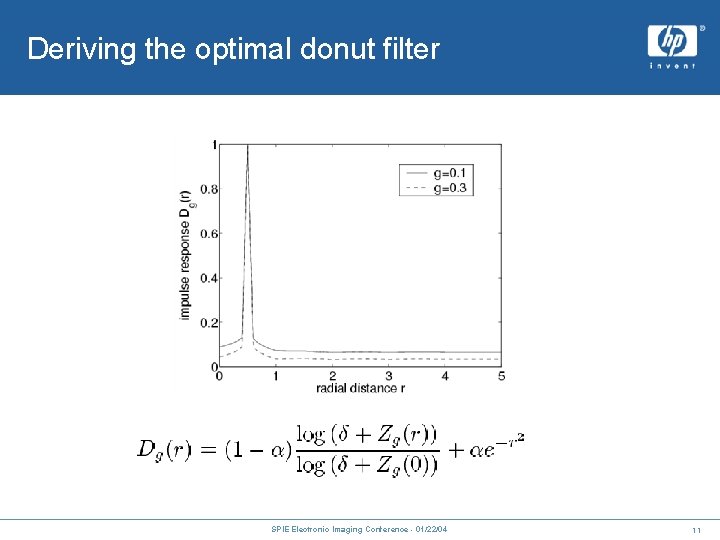
Deriving the optimal donut filter SPIE Electronic Imaging Conference - 01/22/04 11
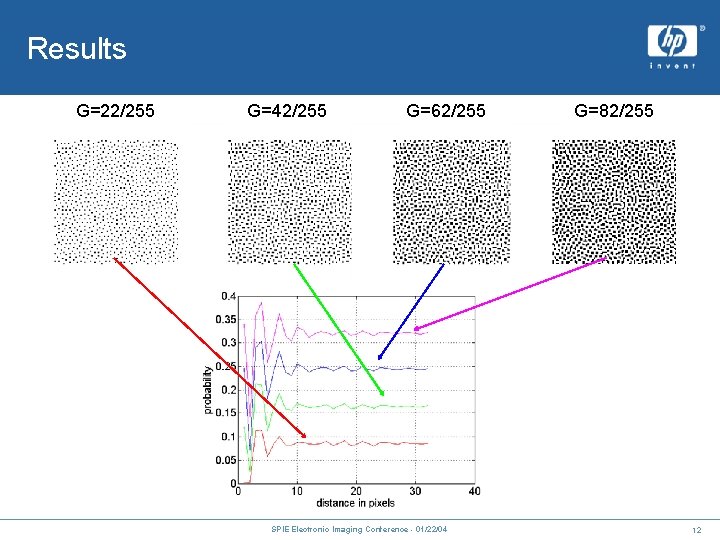
Results G=22/255 G=42/255 G=62/255 SPIE Electronic Imaging Conference - 01/22/04 G=82/255 12
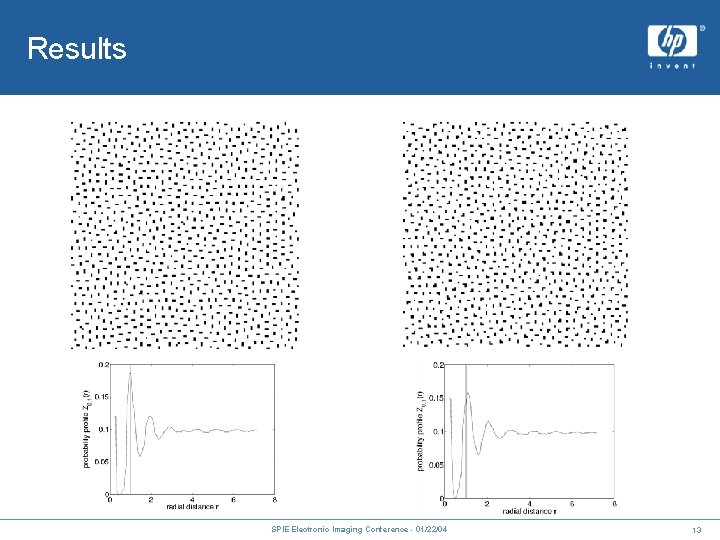
Results SPIE Electronic Imaging Conference - 01/22/04 13
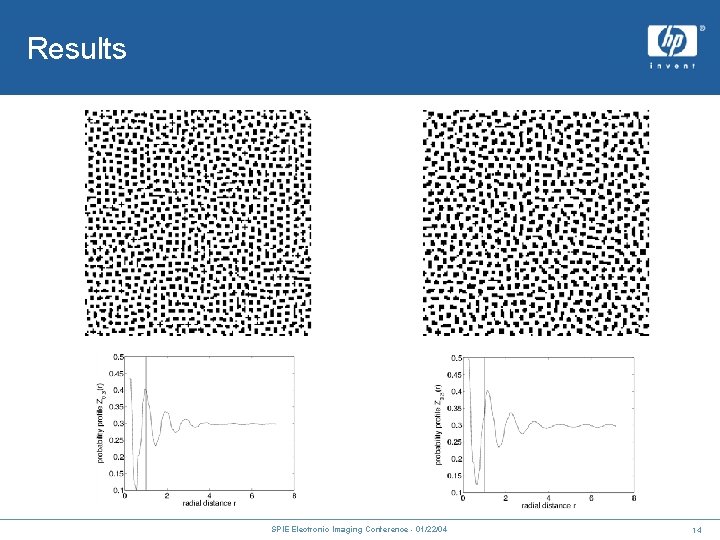
Results SPIE Electronic Imaging Conference - 01/22/04 14
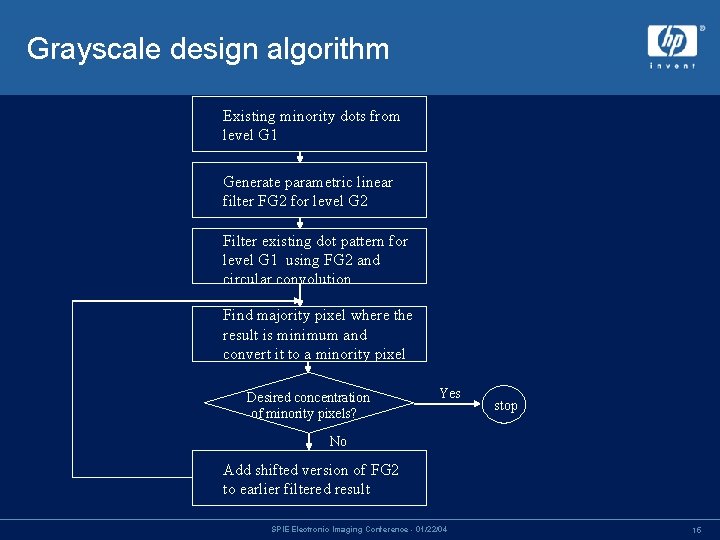
Grayscale design algorithm Existing minority dots from level G 1 Generate parametric linear filter FG 2 for level G 2 Filter existing dot pattern for level G 1 using FG 2 and circular convolution Find majority pixel where the result is minimum and convert it to a minority pixel Desired concentration of minority pixels? Yes stop No Add shifted version of FG 2 to earlier filtered result SPIE Electronic Imaging Conference - 01/22/04 15
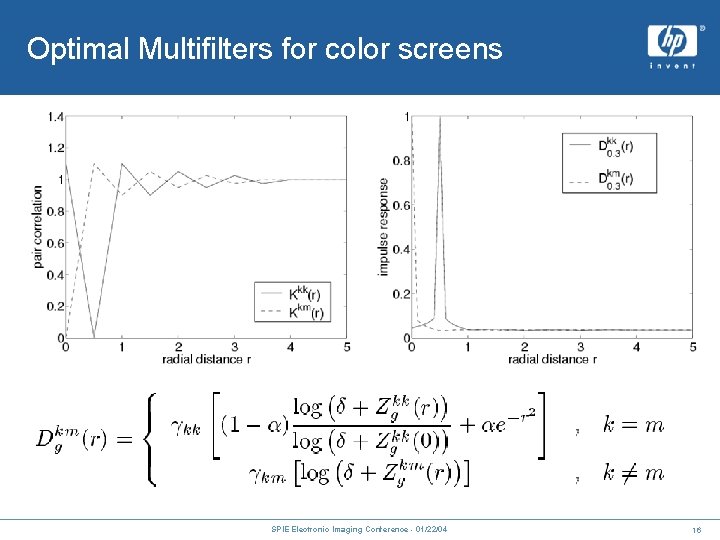
Optimal Multifilters for color screens SPIE Electronic Imaging Conference - 01/22/04 16
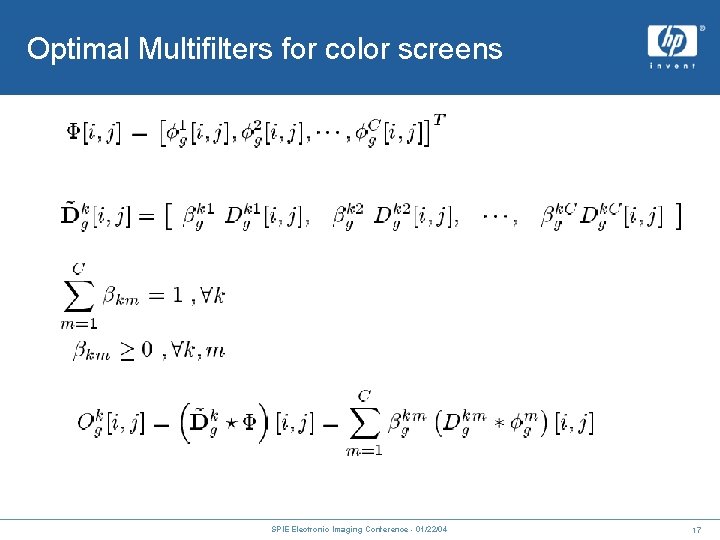
Optimal Multifilters for color screens SPIE Electronic Imaging Conference - 01/22/04 17
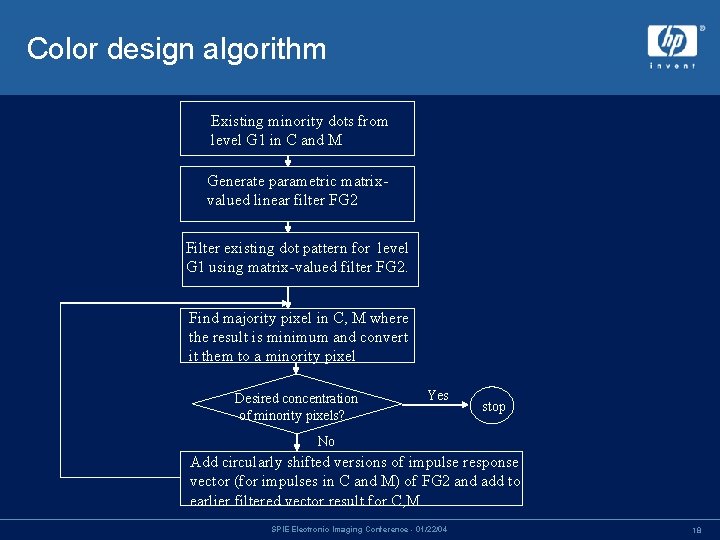
Color design algorithm Existing minority dots from level G 1 in C and M Generate parametric matrixvalued linear filter FG 2 Filter existing dot pattern for level G 1 using matrix-valued filter FG 2. Find majority pixel in C, M where the result is minimum and convert it them to a minority pixel Desired concentration of minority pixels? Yes stop No Add circularly shifted versions of impulse response vector (for impulses in C and M) of FG 2 and add to earlier filtered vector result for C, M SPIE Electronic Imaging Conference - 01/22/04 18
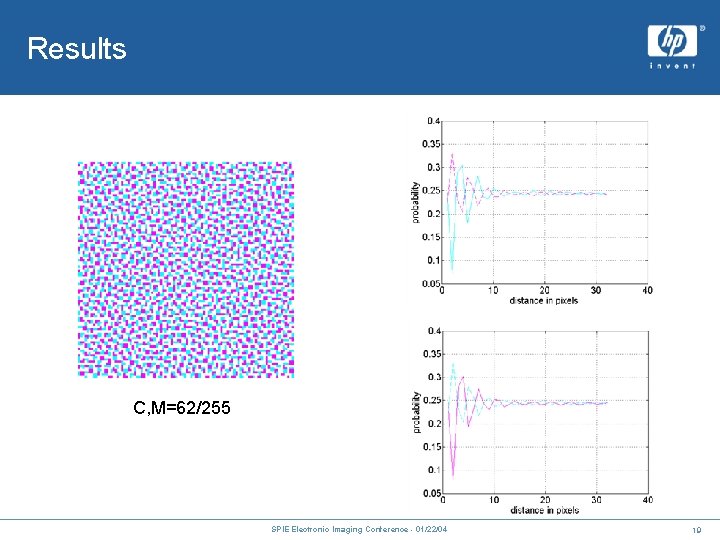
Results C, M=62/255 SPIE Electronic Imaging Conference - 01/22/04 19
Results (epxand images to see dot structure) Optimized donut filter Gaussian donut filter [Lin] SPIE Electronic Imaging Conference - 01/22/04 20
HP logo SPIE Electronic Imaging Conference - 01/22/04 21