AI CS 289 Fuzzy Logic 2 09 th



- Slides: 42
AI – CS 289 Fuzzy Logic 2 09 th October 2006 Dr Bogdan L. Vrusias b. vrusias@surrey. ac. uk 09 th October 2006 Bogdan L. Vrusias © 2006
AI – CS 289 Fuzzy Logic Contents • • • Characteristics of Fuzzy Sets Operations Properties Fuzzy Rules Examples 09 th October 2006 Bogdan L. Vrusias © 2006 2
AI – CS 289 Fuzzy Logic Characteristics of Fuzzy Sets • The classical set theory developed in the late 19 th century by Georg Cantor describes how crisp sets can interact. These interactions are called operations. • Also fuzzy sets have well defined properties. • These properties and operations are the basis on which the fuzzy sets are used to deal with uncertainty on the one hand to represent knowledge on the other. 09 th October 2006 Bogdan L. Vrusias © 2006 3
AI – CS 289 Fuzzy Logic Note: Membership Functions • For the sake of convenience, usually a fuzzy set is denoted as: A = A(xi)/xi + …………. + A(xn)/xn where A(xi)/xi (a singleton) is a pair “grade of membership” element, that belongs to a finite universe of discourse: A = {x 1, x 2, . . , xn} 09 th October 2006 Bogdan L. Vrusias © 2006 4
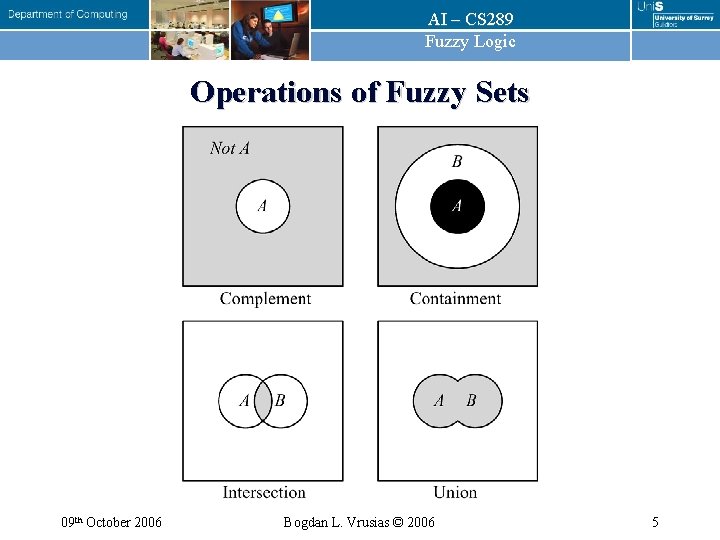
AI – CS 289 Fuzzy Logic Operations of Fuzzy Sets 09 th October 2006 Bogdan L. Vrusias © 2006 5
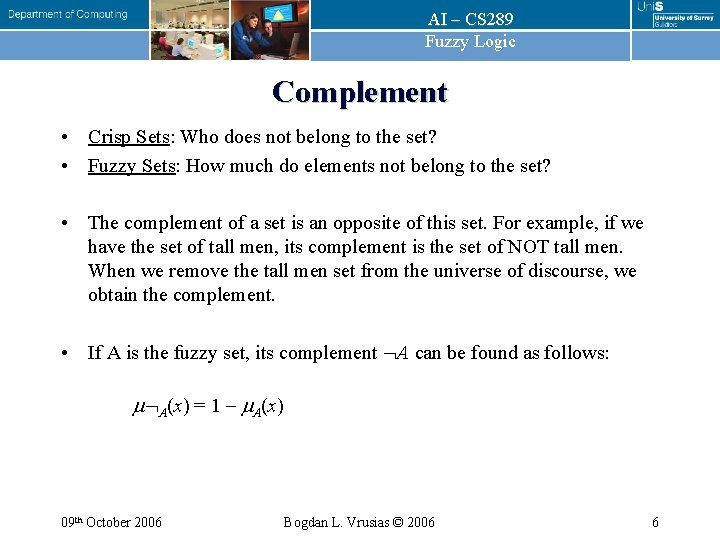
AI – CS 289 Fuzzy Logic Complement • Crisp Sets: Who does not belong to the set? • Fuzzy Sets: How much do elements not belong to the set? • The complement of a set is an opposite of this set. For example, if we have the set of tall men, its complement is the set of NOT tall men. When we remove the tall men set from the universe of discourse, we obtain the complement. • If A is the fuzzy set, its complement A can be found as follows: A(x) = 1 A(x) 09 th October 2006 Bogdan L. Vrusias © 2006 6
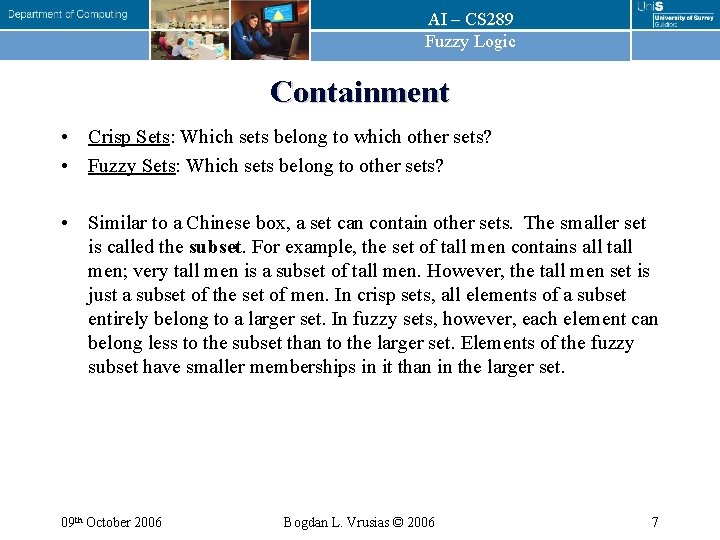
AI – CS 289 Fuzzy Logic Containment • Crisp Sets: Which sets belong to which other sets? • Fuzzy Sets: Which sets belong to other sets? • Similar to a Chinese box, a set can contain other sets. The smaller set is called the subset. For example, the set of tall men contains all tall men; very tall men is a subset of tall men. However, the tall men set is just a subset of the set of men. In crisp sets, all elements of a subset entirely belong to a larger set. In fuzzy sets, however, each element can belong less to the subset than to the larger set. Elements of the fuzzy subset have smaller memberships in it than in the larger set. 09 th October 2006 Bogdan L. Vrusias © 2006 7
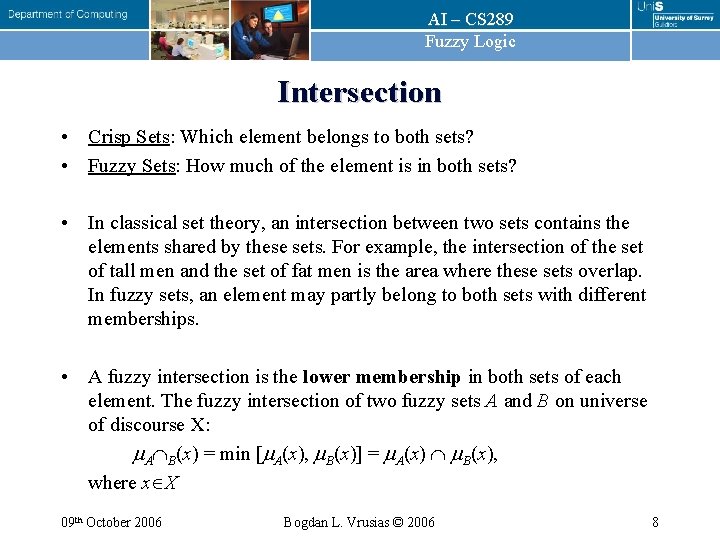
AI – CS 289 Fuzzy Logic Intersection • Crisp Sets: Which element belongs to both sets? • Fuzzy Sets: How much of the element is in both sets? • In classical set theory, an intersection between two sets contains the elements shared by these sets. For example, the intersection of the set of tall men and the set of fat men is the area where these sets overlap. In fuzzy sets, an element may partly belong to both sets with different memberships. • A fuzzy intersection is the lower membership in both sets of each element. The fuzzy intersection of two fuzzy sets A and B on universe of discourse X: A B(x) = min [ A(x), B(x)] = A(x) B(x), where x X 09 th October 2006 Bogdan L. Vrusias © 2006 8
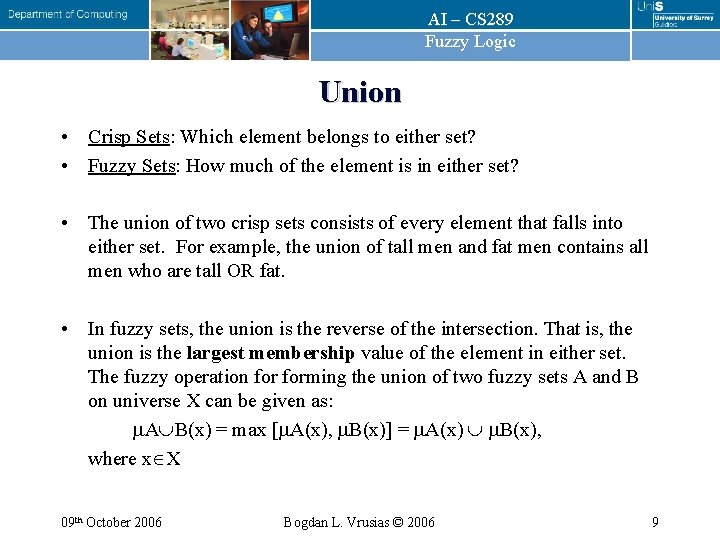
AI – CS 289 Fuzzy Logic Union • Crisp Sets: Which element belongs to either set? • Fuzzy Sets: How much of the element is in either set? • The union of two crisp sets consists of every element that falls into either set. For example, the union of tall men and fat men contains all men who are tall OR fat. • In fuzzy sets, the union is the reverse of the intersection. That is, the union is the largest membership value of the element in either set. The fuzzy operation forming the union of two fuzzy sets A and B on universe X can be given as: A B(x) = max [ A(x), B(x)] = A(x) B(x), where x X 09 th October 2006 Bogdan L. Vrusias © 2006 9
AI – CS 289 Fuzzy Logic Operations of Fuzzy Sets 09 th October 2006 Bogdan L. Vrusias © 2006 10
AI – CS 289 Fuzzy Logic Properties of Fuzzy Sets • • • Equality of two fuzzy sets Inclusion of one set into another fuzzy set Cardinality of a fuzzy set An empty fuzzy set -cuts (alpha-cuts) 09 th October 2006 Bogdan L. Vrusias © 2006 11
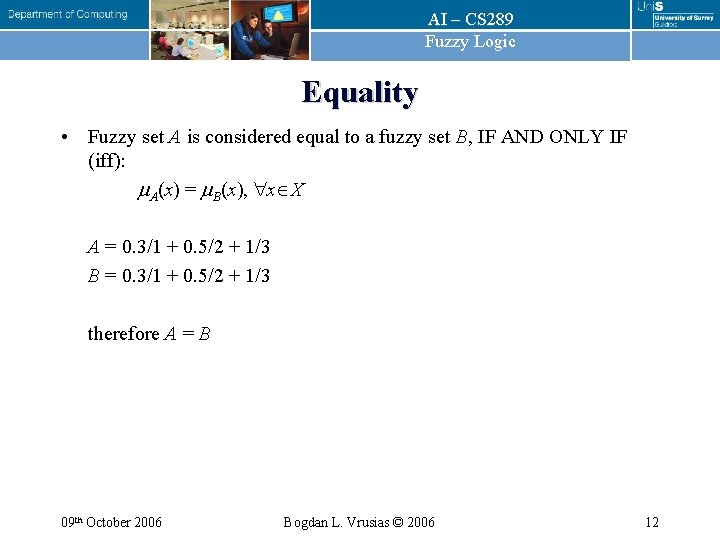
AI – CS 289 Fuzzy Logic Equality • Fuzzy set A is considered equal to a fuzzy set B, IF AND ONLY IF (iff): A(x) = B(x), x X A = 0. 3/1 + 0. 5/2 + 1/3 B = 0. 3/1 + 0. 5/2 + 1/3 therefore A = B 09 th October 2006 Bogdan L. Vrusias © 2006 12
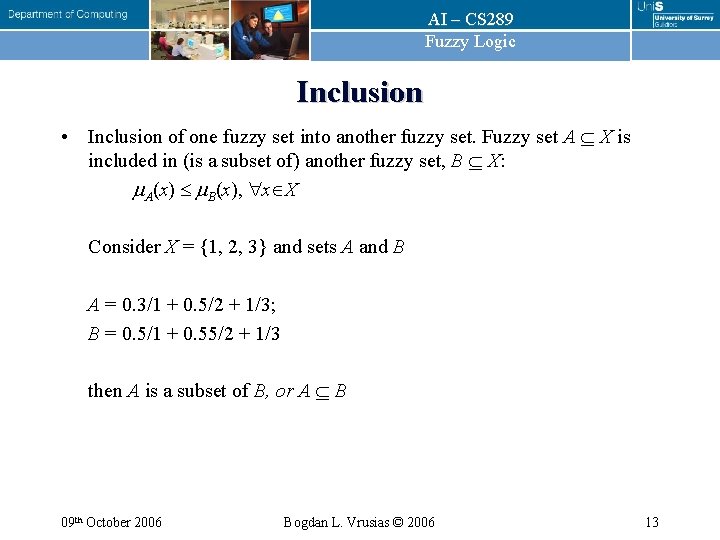
AI – CS 289 Fuzzy Logic Inclusion • Inclusion of one fuzzy set into another fuzzy set. Fuzzy set A X is included in (is a subset of) another fuzzy set, B X: A(x) B(x), x X Consider X = {1, 2, 3} and sets A and B A = 0. 3/1 + 0. 5/2 + 1/3; B = 0. 5/1 + 0. 55/2 + 1/3 then A is a subset of B, or A B 09 th October 2006 Bogdan L. Vrusias © 2006 13
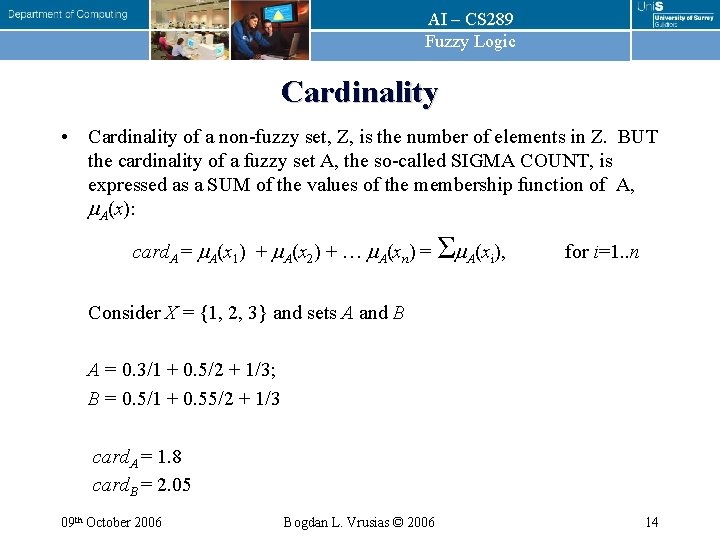
AI – CS 289 Fuzzy Logic Cardinality • Cardinality of a non-fuzzy set, Z, is the number of elements in Z. BUT the cardinality of a fuzzy set A, the so-called SIGMA COUNT, is expressed as a SUM of the values of the membership function of A, A(x): card. A = A(x 1) + A(x 2) + … A(xn) = Σ A(xi), for i=1. . n Consider X = {1, 2, 3} and sets A and B A = 0. 3/1 + 0. 5/2 + 1/3; B = 0. 5/1 + 0. 55/2 + 1/3 card. A = 1. 8 card. B = 2. 05 09 th October 2006 Bogdan L. Vrusias © 2006 14
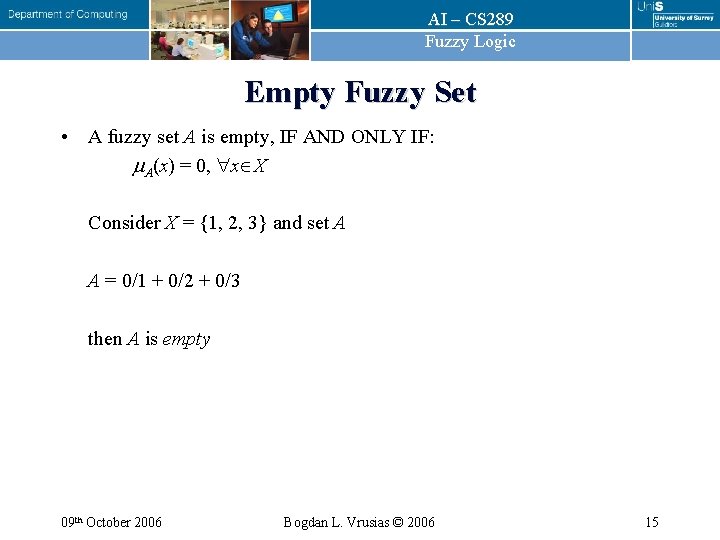
AI – CS 289 Fuzzy Logic Empty Fuzzy Set • A fuzzy set A is empty, IF AND ONLY IF: A(x) = 0, x X Consider X = {1, 2, 3} and set A A = 0/1 + 0/2 + 0/3 then A is empty 09 th October 2006 Bogdan L. Vrusias © 2006 15
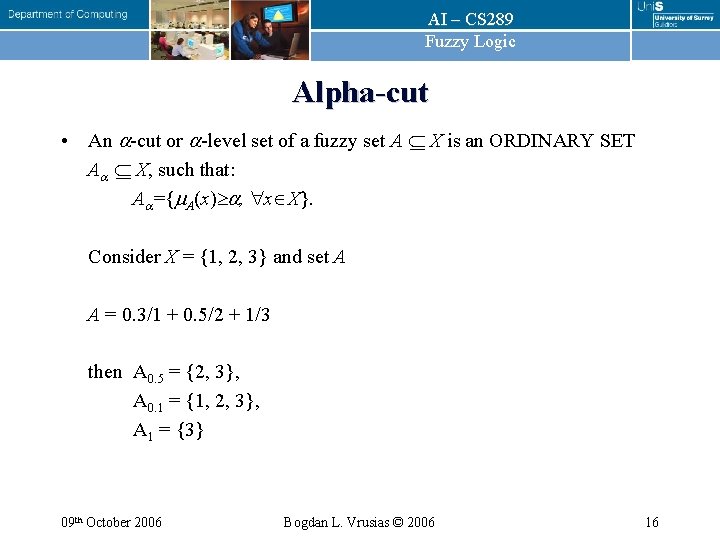
AI – CS 289 Fuzzy Logic Alpha-cut • An -cut or -level set of a fuzzy set A X is an ORDINARY SET A X, such that: A ={ A(x) , x X}. Consider X = {1, 2, 3} and set A A = 0. 3/1 + 0. 5/2 + 1/3 then A 0. 5 = {2, 3}, A 0. 1 = {1, 2, 3}, A 1 = {3} 09 th October 2006 Bogdan L. Vrusias © 2006 16
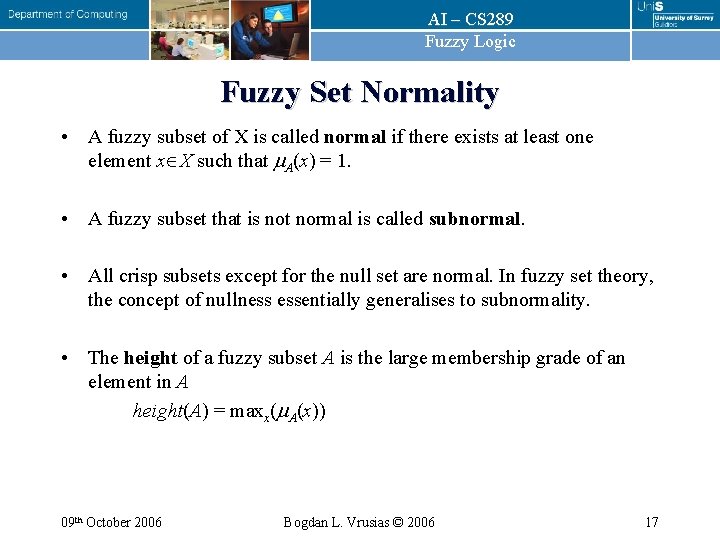
AI – CS 289 Fuzzy Logic Fuzzy Set Normality • A fuzzy subset of X is called normal if there exists at least one element x X such that A(x) = 1. • A fuzzy subset that is not normal is called subnormal. • All crisp subsets except for the null set are normal. In fuzzy set theory, the concept of nullness essentially generalises to subnormality. • The height of a fuzzy subset A is the large membership grade of an element in A height(A) = maxx( A(x)) 09 th October 2006 Bogdan L. Vrusias © 2006 17
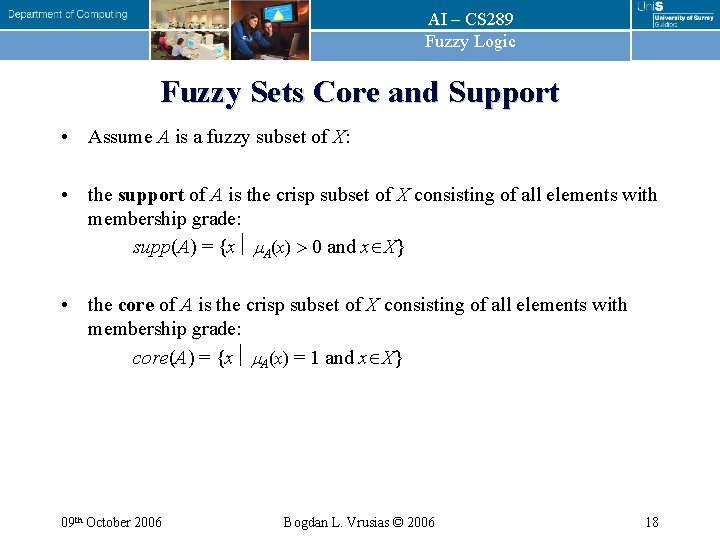
AI – CS 289 Fuzzy Logic Fuzzy Sets Core and Support • Assume A is a fuzzy subset of X: • the support of A is the crisp subset of X consisting of all elements with membership grade: supp(A) = {x A(x) 0 and x X} • the core of A is the crisp subset of X consisting of all elements with membership grade: core(A) = {x A(x) = 1 and x X} 09 th October 2006 Bogdan L. Vrusias © 2006 18
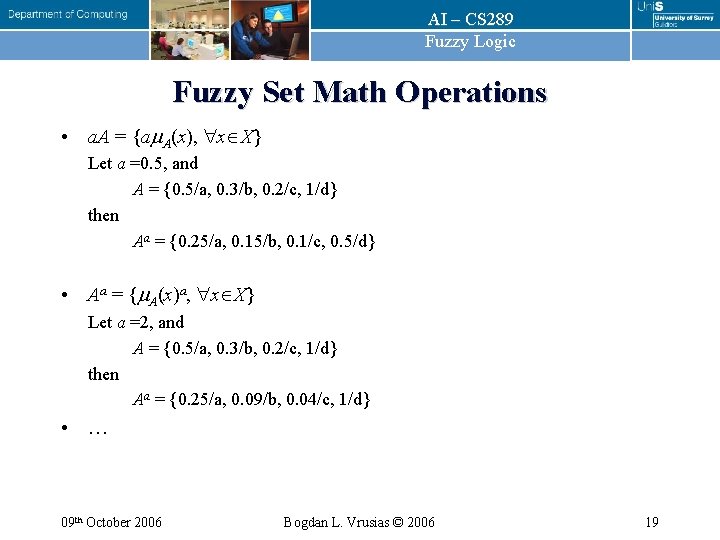
AI – CS 289 Fuzzy Logic Fuzzy Set Math Operations • a. A = {a A(x), x X} Let a =0. 5, and A = {0. 5/a, 0. 3/b, 0. 2/c, 1/d} then Aa = {0. 25/a, 0. 15/b, 0. 1/c, 0. 5/d} • Aa = { A(x)a, x X} Let a =2, and A = {0. 5/a, 0. 3/b, 0. 2/c, 1/d} then Aa = {0. 25/a, 0. 09/b, 0. 04/c, 1/d} • … 09 th October 2006 Bogdan L. Vrusias © 2006 19
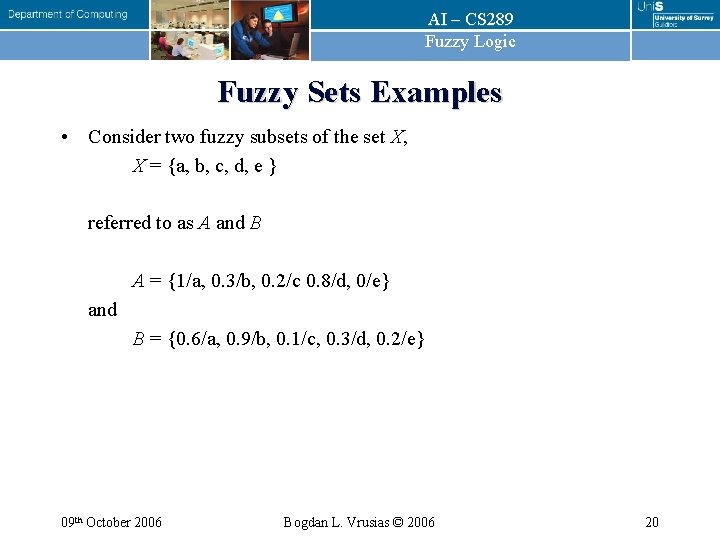
AI – CS 289 Fuzzy Logic Fuzzy Sets Examples • Consider two fuzzy subsets of the set X, X = {a, b, c, d, e } referred to as A and B A = {1/a, 0. 3/b, 0. 2/c 0. 8/d, 0/e} and B = {0. 6/a, 0. 9/b, 0. 1/c, 0. 3/d, 0. 2/e} 09 th October 2006 Bogdan L. Vrusias © 2006 20
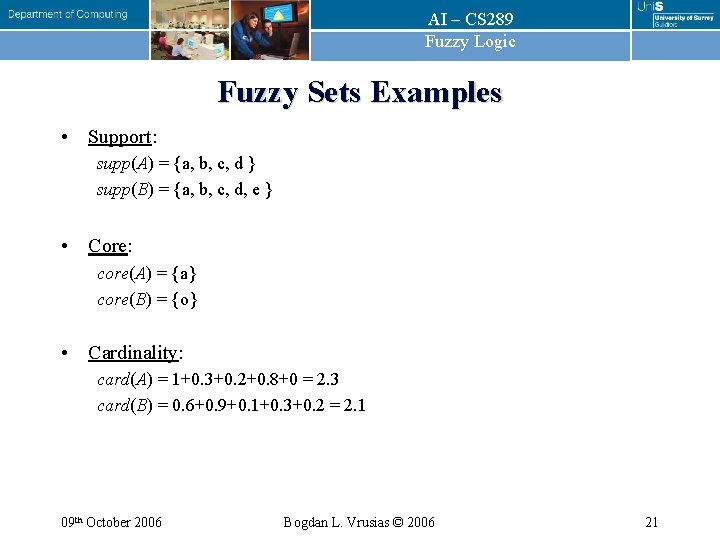
AI – CS 289 Fuzzy Logic Fuzzy Sets Examples • Support: supp(A) = {a, b, c, d } supp(B) = {a, b, c, d, e } • Core: core(A) = {a} core(B) = {o} • Cardinality: card(A) = 1+0. 3+0. 2+0. 8+0 = 2. 3 card(B) = 0. 6+0. 9+0. 1+0. 3+0. 2 = 2. 1 09 th October 2006 Bogdan L. Vrusias © 2006 21
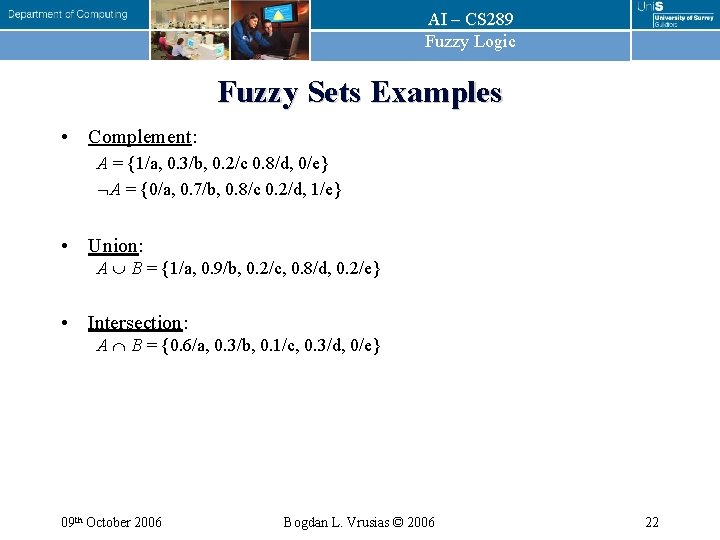
AI – CS 289 Fuzzy Logic Fuzzy Sets Examples • Complement: A = {1/a, 0. 3/b, 0. 2/c 0. 8/d, 0/e} A = {0/a, 0. 7/b, 0. 8/c 0. 2/d, 1/e} • Union: A B = {1/a, 0. 9/b, 0. 2/c, 0. 8/d, 0. 2/e} • Intersection: A B = {0. 6/a, 0. 3/b, 0. 1/c, 0. 3/d, 0/e} 09 th October 2006 Bogdan L. Vrusias © 2006 22
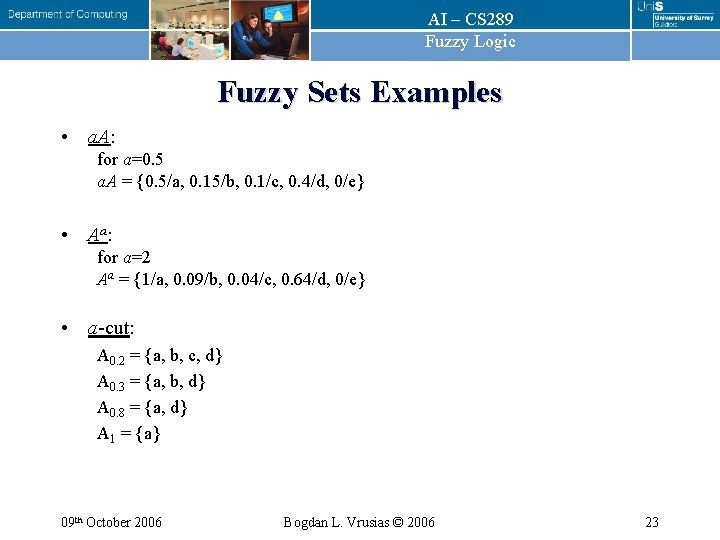
AI – CS 289 Fuzzy Logic Fuzzy Sets Examples • a. A: for a=0. 5 a. A = {0. 5/a, 0. 15/b, 0. 1/c, 0. 4/d, 0/e} • Aa : for a=2 Aa = {1/a, 0. 09/b, 0. 04/c, 0. 64/d, 0/e} • a-cut: A 0. 2 = {a, b, c, d} A 0. 3 = {a, b, d} A 0. 8 = {a, d} A 1 = {a} 09 th October 2006 Bogdan L. Vrusias © 2006 23
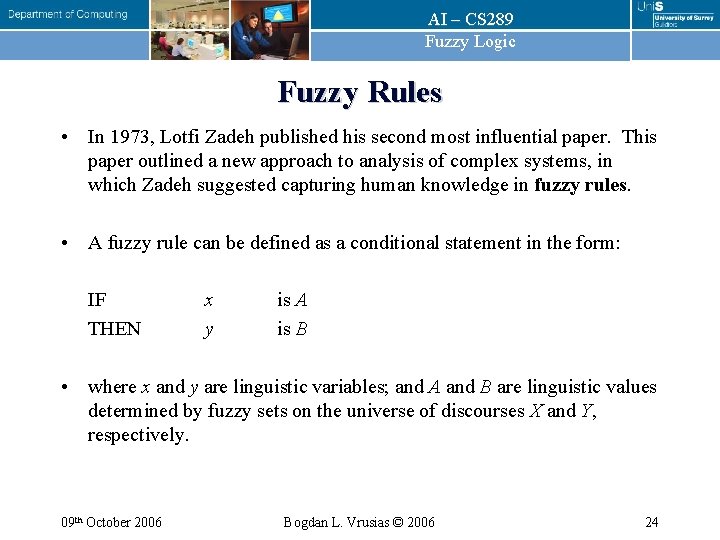
AI – CS 289 Fuzzy Logic Fuzzy Rules • In 1973, Lotfi Zadeh published his second most influential paper. This paper outlined a new approach to analysis of complex systems, in which Zadeh suggested capturing human knowledge in fuzzy rules. • A fuzzy rule can be defined as a conditional statement in the form: IF THEN x y is A is B • where x and y are linguistic variables; and A and B are linguistic values determined by fuzzy sets on the universe of discourses X and Y, respectively. 09 th October 2006 Bogdan L. Vrusias © 2006 24
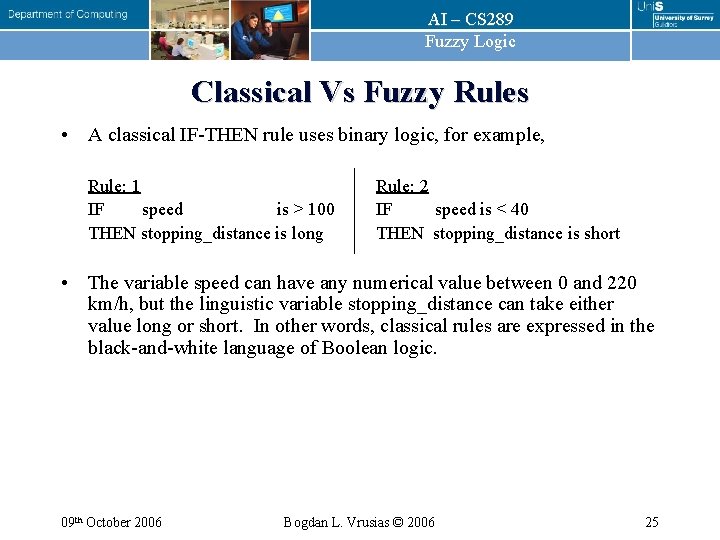
AI – CS 289 Fuzzy Logic Classical Vs Fuzzy Rules • A classical IF-THEN rule uses binary logic, for example, Rule: 1 IF speed is > 100 THEN stopping_distance is long Rule: 2 IF speed is < 40 THEN stopping_distance is short • The variable speed can have any numerical value between 0 and 220 km/h, but the linguistic variable stopping_distance can take either value long or short. In other words, classical rules are expressed in the black-and-white language of Boolean logic. 09 th October 2006 Bogdan L. Vrusias © 2006 25
AI – CS 289 Fuzzy Logic Classical Vs Fuzzy Rules • We can also represent the stopping distance rules in a fuzzy form: Rule: 1 IF speed is fast THEN stopping_distance is long Rule: 2 IF speed is slow THEN stopping_distance is short • In fuzzy rules, the linguistic variable speed also has the range (the universe of discourse) between 0 and 220 km/h, but this range includes fuzzy sets, such as slow, medium and fast. The universe of discourse of the linguistic variable stopping_distance can be between 0 and 300 m and may include such fuzzy sets as short, medium and long. 09 th October 2006 Bogdan L. Vrusias © 2006 26
AI – CS 289 Fuzzy Logic Classical Vs Fuzzy Rules • Fuzzy rules relate fuzzy sets. • In a fuzzy system, all rules fire to some extent, or in other words they fire partially. If the antecedent is true to some degree of membership, then the consequent is also true to that same degree. 09 th October 2006 Bogdan L. Vrusias © 2006 27
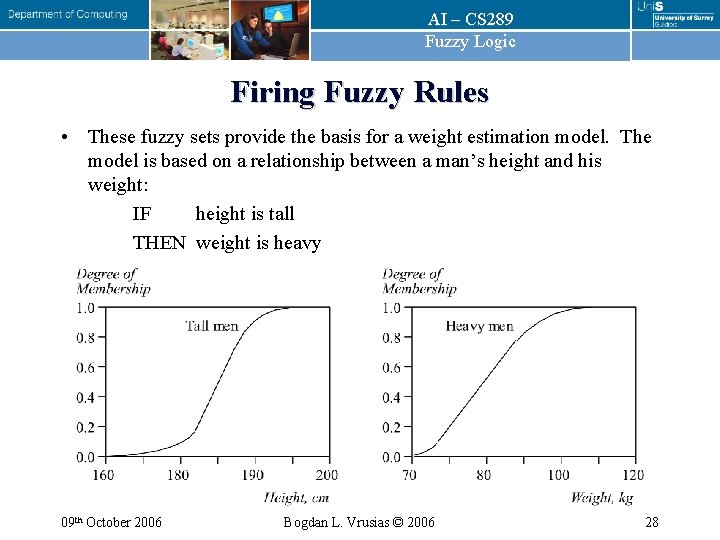
AI – CS 289 Fuzzy Logic Firing Fuzzy Rules • These fuzzy sets provide the basis for a weight estimation model. The model is based on a relationship between a man’s height and his weight: IF height is tall THEN weight is heavy 09 th October 2006 Bogdan L. Vrusias © 2006 28
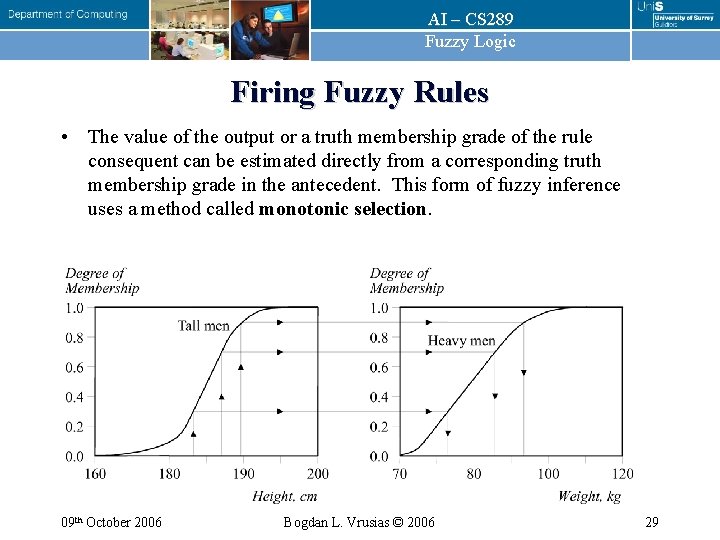
AI – CS 289 Fuzzy Logic Firing Fuzzy Rules • The value of the output or a truth membership grade of the rule consequent can be estimated directly from a corresponding truth membership grade in the antecedent. This form of fuzzy inference uses a method called monotonic selection. 09 th October 2006 Bogdan L. Vrusias © 2006 29
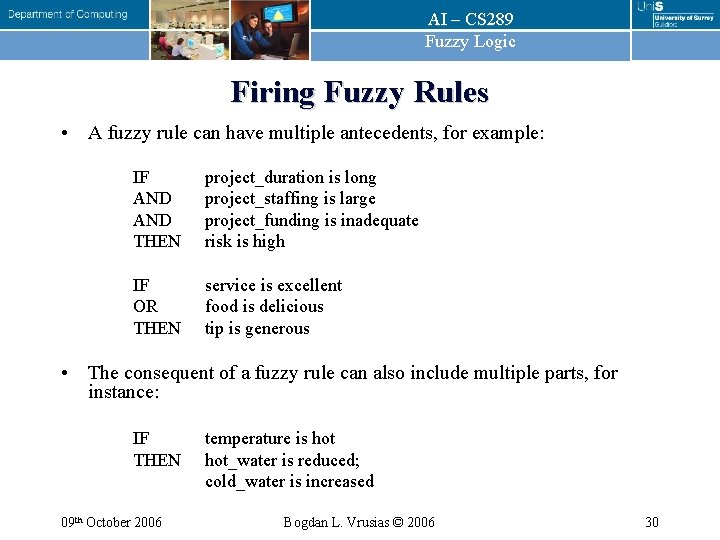
AI – CS 289 Fuzzy Logic Firing Fuzzy Rules • A fuzzy rule can have multiple antecedents, for example: IF AND THEN project_duration is long project_staffing is large project_funding is inadequate risk is high IF OR THEN service is excellent food is delicious tip is generous • The consequent of a fuzzy rule can also include multiple parts, for instance: IF THEN 09 th October 2006 temperature is hot_water is reduced; cold_water is increased Bogdan L. Vrusias © 2006 30
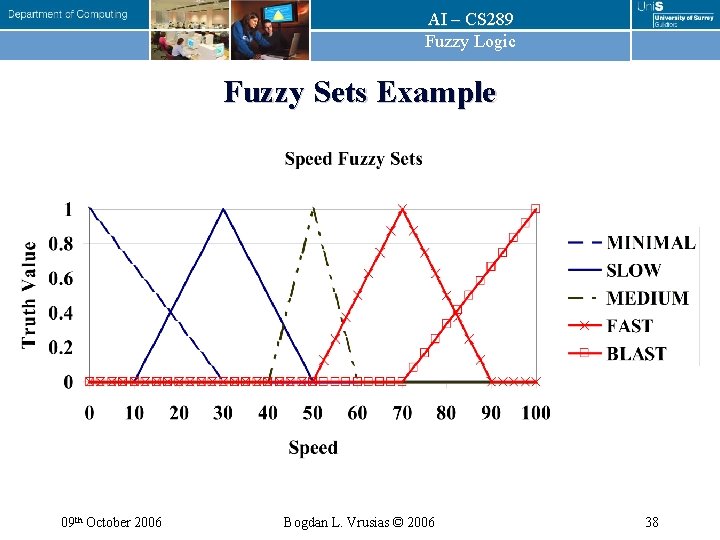
AI – CS 289 Fuzzy Logic Fuzzy Sets Example • Air-conditioning involves the delivery of air which can be warmed or cooled and have its humidity raised or lowered. • An air-conditioner is an apparatus for controlling, especially lowering, the temperature and humidity of an enclosed space. An air-conditioner typically has a fan which blows/cools/circulates fresh air and has cooler and the cooler is under thermostatic control. Generally, the amount of air being compressed is proportional to the ambient temperature. • Consider Johnny’s air-conditioner which has five control switches: COLD, COOL, PLEASANT, WARM and HOT. The corresponding speeds of the motor controlling the fan on the air-conditioner has the graduations: MINIMAL, SLOW, MEDIUM, FAST and BLAST. 09 th October 2006 Bogdan L. Vrusias © 2006 31
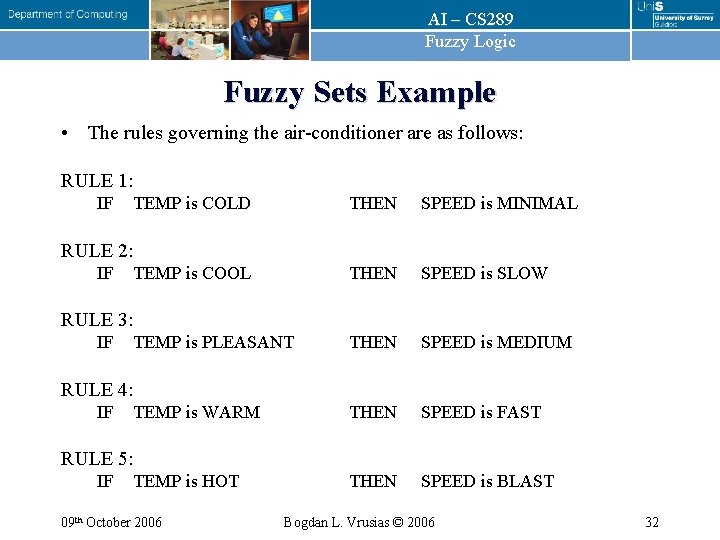
AI – CS 289 Fuzzy Logic Fuzzy Sets Example • The rules governing the air-conditioner are as follows: RULE 1: IF TEMP is COLD THEN SPEED is MINIMAL THEN SPEED is SLOW THEN SPEED is MEDIUM THEN SPEED is FAST THEN SPEED is BLAST RULE 2: IF TEMP is COOL RULE 3: IF TEMP is PLEASANT RULE 4: IF TEMP is WARM RULE 5: IF TEMP is HOT 09 th October 2006 Bogdan L. Vrusias © 2006 32
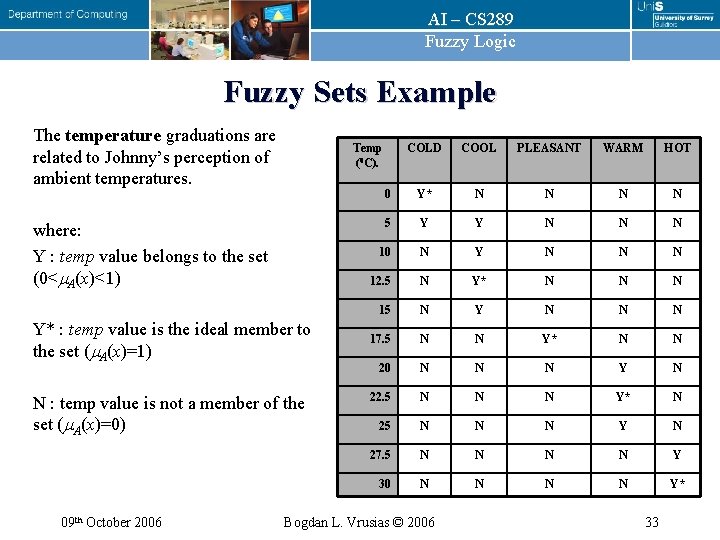
AI – CS 289 Fuzzy Logic Fuzzy Sets Example The temperature graduations are related to Johnny’s perception of ambient temperatures. Temp (0 C). where: Y : temp value belongs to the set (0< A(x)<1) Y* : temp value is the ideal member to the set ( A(x)=1) N : temp value is not a member of the set ( A(x)=0) 09 th October 2006 COLD COOL PLEASANT WARM HOT 0 Y* N N 5 Y Y N N N 10 N Y N N N 12. 5 N Y* N N N 15 N Y N N N 17. 5 N N Y* N N 20 N N N Y N 22. 5 N N N Y* N 25 N N N Y N 27. 5 N N Y 30 N N Y* Bogdan L. Vrusias © 2006 33
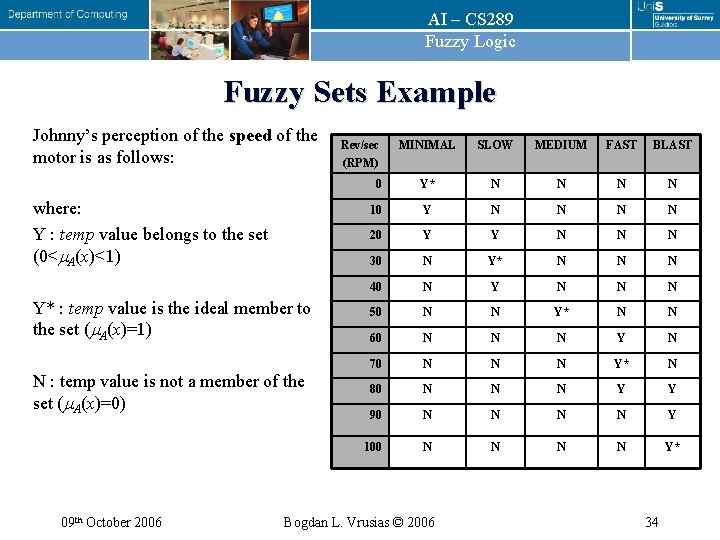
AI – CS 289 Fuzzy Logic Fuzzy Sets Example Johnny’s perception of the speed of the motor is as follows: where: Y : temp value belongs to the set (0< A(x)<1) Y* : temp value is the ideal member to the set ( A(x)=1) N : temp value is not a member of the set ( A(x)=0) 09 th October 2006 Rev/sec (RPM) MINIMAL SLOW MEDIUM FAST BLAST 0 Y* N N 10 Y N N 20 Y Y N N N 30 N Y* N N N 40 N Y N N N 50 N N Y* N N 60 N N N Y N 70 N N N Y* N 80 N N N Y Y 90 N N Y 100 N N Y* Bogdan L. Vrusias © 2006 34
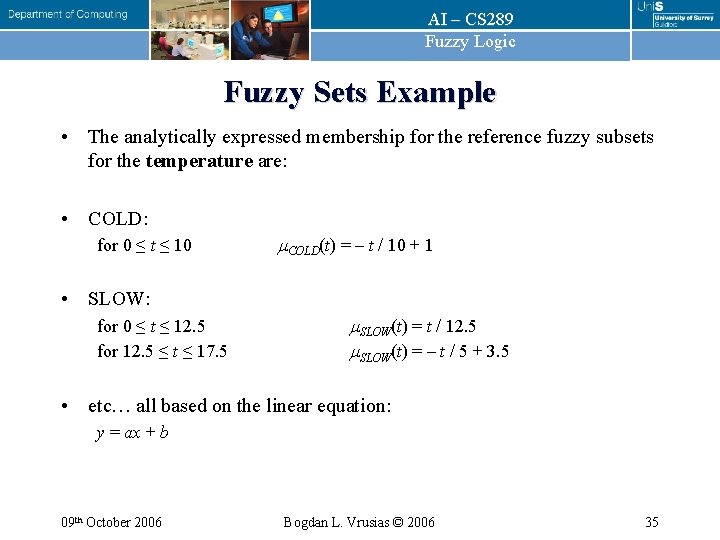
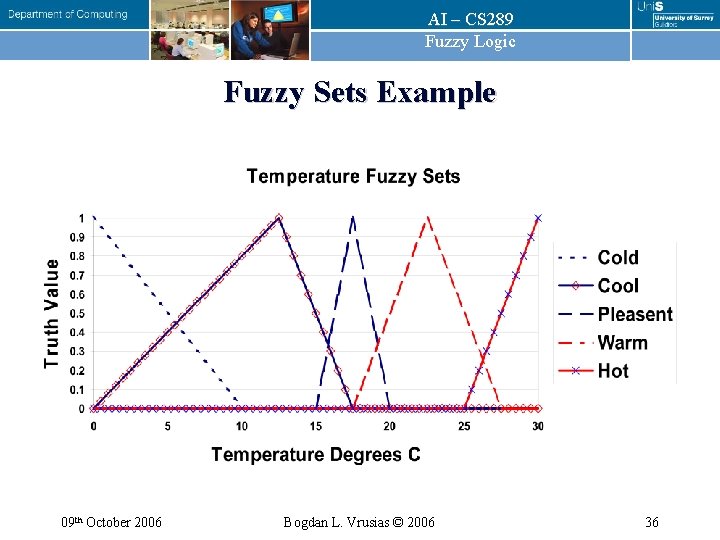
AI – CS 289 Fuzzy Logic Fuzzy Sets Example • The analytically expressed membership for the reference fuzzy subsets for the temperature are: • COLD: for 0 ≤ t ≤ 10 COLD(t) = – t / 10 + 1 • SLOW: for 0 ≤ t ≤ 12. 5 for 12. 5 ≤ t ≤ 17. 5 SLOW(t) = t / 12. 5 SLOW(t) = – t / 5 + 3. 5 • etc… all based on the linear equation: y = ax + b 09 th October 2006 Bogdan L. Vrusias © 2006 35
AI – CS 289 Fuzzy Logic Fuzzy Sets Example 09 th October 2006 Bogdan L. Vrusias © 2006 36
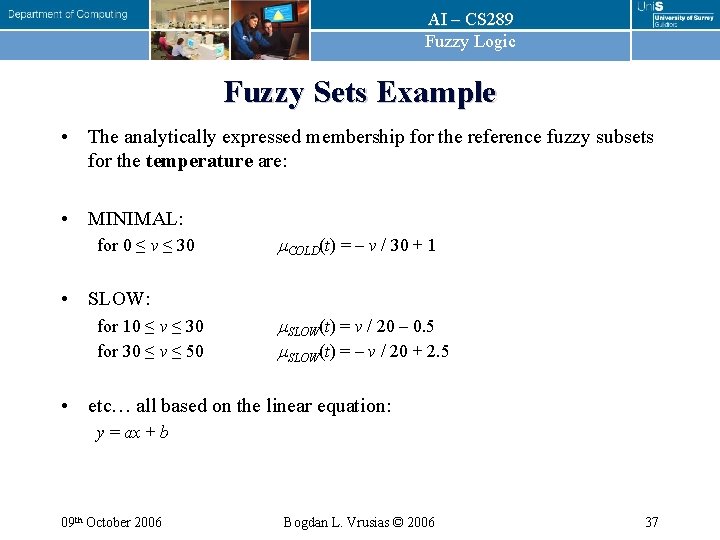
AI – CS 289 Fuzzy Logic Fuzzy Sets Example • The analytically expressed membership for the reference fuzzy subsets for the temperature are: • MINIMAL: for 0 ≤ v ≤ 30 COLD(t) = – v / 30 + 1 • SLOW: for 10 ≤ v ≤ 30 for 30 ≤ v ≤ 50 SLOW(t) = v / 20 – 0. 5 SLOW(t) = – v / 20 + 2. 5 • etc… all based on the linear equation: y = ax + b 09 th October 2006 Bogdan L. Vrusias © 2006 37
AI – CS 289 Fuzzy Logic Fuzzy Sets Example 09 th October 2006 Bogdan L. Vrusias © 2006 38
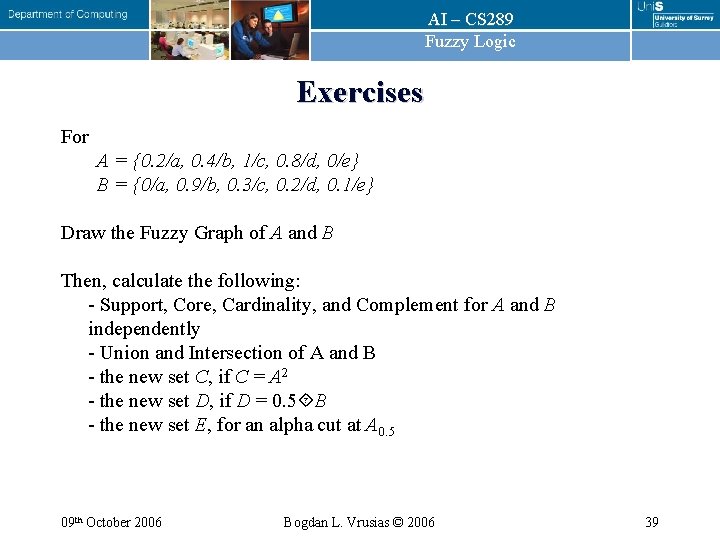
AI – CS 289 Fuzzy Logic Exercises For A = {0. 2/a, 0. 4/b, 1/c, 0. 8/d, 0/e} B = {0/a, 0. 9/b, 0. 3/c, 0. 2/d, 0. 1/e} Draw the Fuzzy Graph of A and B Then, calculate the following: - Support, Core, Cardinality, and Complement for A and B independently - Union and Intersection of A and B - the new set C, if C = A 2 - the new set D, if D = 0. 5 B - the new set E, for an alpha cut at A 0. 5 09 th October 2006 Bogdan L. Vrusias © 2006 39
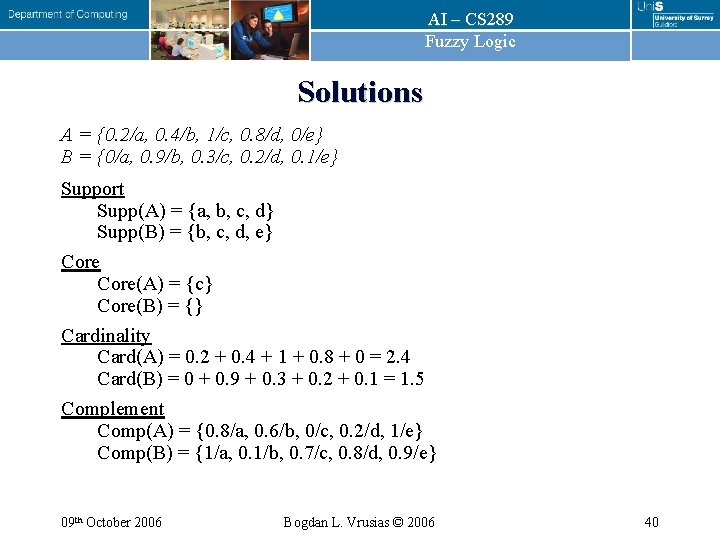
AI – CS 289 Fuzzy Logic Solutions A = {0. 2/a, 0. 4/b, 1/c, 0. 8/d, 0/e} B = {0/a, 0. 9/b, 0. 3/c, 0. 2/d, 0. 1/e} Support Supp(A) = {a, b, c, d} Supp(B) = {b, c, d, e} Core(A) = {c} Core(B) = {} Cardinality Card(A) = 0. 2 + 0. 4 + 1 + 0. 8 + 0 = 2. 4 Card(B) = 0 + 0. 9 + 0. 3 + 0. 2 + 0. 1 = 1. 5 Complement Comp(A) = {0. 8/a, 0. 6/b, 0/c, 0. 2/d, 1/e} Comp(B) = {1/a, 0. 1/b, 0. 7/c, 0. 8/d, 0. 9/e} 09 th October 2006 Bogdan L. Vrusias © 2006 40
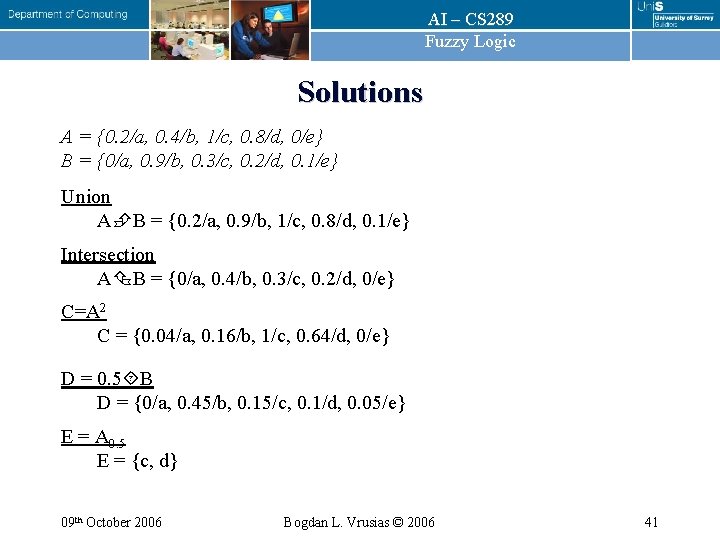
AI – CS 289 Fuzzy Logic Solutions A = {0. 2/a, 0. 4/b, 1/c, 0. 8/d, 0/e} B = {0/a, 0. 9/b, 0. 3/c, 0. 2/d, 0. 1/e} Union A B = {0. 2/a, 0. 9/b, 1/c, 0. 8/d, 0. 1/e} Intersection A B = {0/a, 0. 4/b, 0. 3/c, 0. 2/d, 0/e} C=A 2 C = {0. 04/a, 0. 16/b, 1/c, 0. 64/d, 0/e} D = 0. 5 B D = {0/a, 0. 45/b, 0. 15/c, 0. 1/d, 0. 05/e} E = A 0. 5 E = {c, d} 09 th October 2006 Bogdan L. Vrusias © 2006 41
AI – CS 289 Fuzzy Logic Closing • • Questions? ? ? Remarks? ? ? Comments!!! Evaluation! 09 th October 2006 Bogdan L. Vrusias © 2006 42