Advanced Asylum Topics Amanda Crews Slezak Supervising Attorney


- Slides: 37
Advanced Asylum Topics Amanda Crews Slezak, Supervising Attorney, National Immigrant Justice Center Jessica Larson, Esq. , The Benos Law Firm LLC Madhu N. Sharma, Executive Director, International Institute of Akron
Applying for Asylum after Matter of A-BChallenges in Bringing Asylum Claims Based on Harm by Non-State Actors
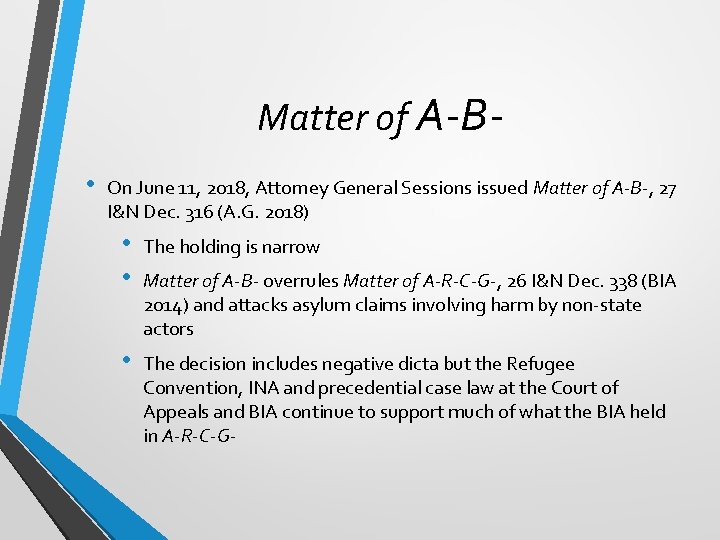
Matter of A-B • On June 11, 2018, Attorney General Sessions issued Matter of A-B-, 27 I&N Dec. 316 (A. G. 2018) • • The holding is narrow • The decision includes negative dicta but the Refugee Convention, INA and precedential case law at the Court of Appeals and BIA continue to support much of what the BIA held in A-R-C-G- Matter of A-B- overrules Matter of A-R-C-G-, 26 I&N Dec. 338 (BIA 2014) and attacks asylum claims involving harm by non-state actors
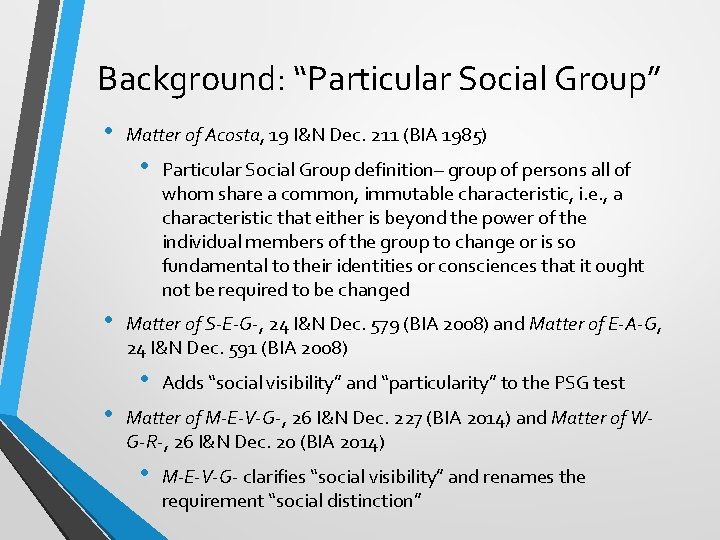
Background: “Particular Social Group” • Matter of Acosta, 19 I&N Dec. 211 (BIA 1985) • • Matter of S-E-G-, 24 I&N Dec. 579 (BIA 2008) and Matter of E-A-G, 24 I&N Dec. 591 (BIA 2008) • • Particular Social Group definition– group of persons all of whom share a common, immutable characteristic, i. e. , a characteristic that either is beyond the power of the individual members of the group to change or is so fundamental to their identities or consciences that it ought not be required to be changed Adds “social visibility” and “particularity” to the PSG test Matter of M-E-V-G-, 26 I&N Dec. 227 (BIA 2014) and Matter of WG-R-, 26 I&N Dec. 20 (BIA 2014) • M-E-V-G- clarifies “social visibility” and renames the requirement “social distinction”
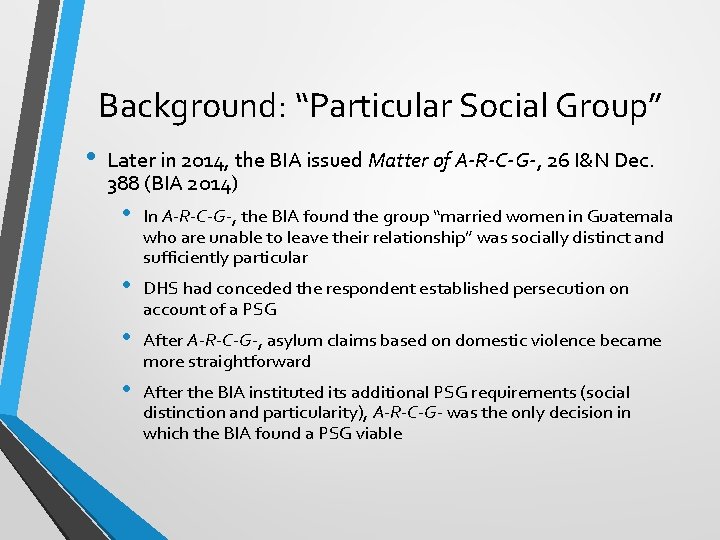
Background: “Particular Social Group” • Later in 2014, the BIA issued Matter of A-R-C-G-, 26 I&N Dec. 388 (BIA 2014) • In A-R-C-G-, the BIA found the group “married women in Guatemala who are unable to leave their relationship” was socially distinct and sufficiently particular • DHS had conceded the respondent established persecution on account of a PSG • After A-R-C-G-, asylum claims based on domestic violence became more straightforward • After the BIA instituted its additional PSG requirements (social distinction and particularity), A-R-C-G- was the only decision in which the BIA found a PSG viable
Background: Matter of A-B • A-B’s case was initially heard and denied by Judge Couch at the Charlotte Immigration Court • Judge Couch made adverse findings in nearly all the elements of AB’s asylum case • On appeal, BIA reversed on all grounds, found A-B-’s claim similar to that of A-R-C-G-, determined she was eligible for asylum, and remanded her case for issuance of a decision after background checks were completed • • On remand, Judge Couch attempted to certify the case to the BIA AG Sessions learned of the decision, certified the case to himself and issued a request for amicus briefing
Holding: Matter of A-B • Eliminates Matter of A-R-C-G- as a precedential decision • The BIA held in Matter of A-R-C-G- that the PSG of “married women in Guatemala who are unable to leave their relationship” was socially distinct and sufficiently particular • AG Sessions asserts he is overturning Matter of A-R-C-Gbecause of the manner in which the BIA came to its decisión • AG Sessions found that Matter of A-R-C-G- was a product of concessions by DHS, not applications of law by the BIA • AG Sessions further found that the BIA’s PSG analysis was cursory and did not accurately apply M-E-V-G- and W-G-R-
Holding: Matter of A-B • Remanded Matter of A-B- for new analysis • AG Sessions found that the BIA erred and the PSG “El Salvadorian women who are unable to leave their domestic relationships where they have children in common” is likely not cognizable
Holding: Matter of A-B • • Restates BIA’s case law regarding PSG definition and other asylum elements Does not create new asylum standards Does not hold that a variation of A-R-C-G-’s PSG can never be viable Includes extremely negative dicta that casts doubt on viability of claims involving non-state actors • “[g]enerally, claims. . . pertaining to domestic violence or gang violence perpetrated by non-governmental actors will not qualify for asylum. ” A-B-, 27 I&N Dec. at 320. ”
Practice Pointers • Due Process: • Matter of Fefe, 20 I&N Dec. 116 (BIA): “[a]t a minimum, the regulations require that an asylum applicant take the stand, be placed under oath, and be questioned as to whether the information in his written application is complete and correct” • Remind adjudicators that asylum claims must be evaluated on a case-by-case basis, paying close attention to the particular facts and evidence of the individual case
Practice Pointers • Particular Social Group • • PSG test remains the same • • Explore why the persecutor targeted/will target your client • • Do not define PSG by harm suffered or feared AG Sessions overruled A-R-C-G- because he found the BIA’s analysis insufficient, but he did not say the characteristics of gender, nationality, and relationship status could never form a PSG Determine whether those reasons are characteristcs your client cannot change or should not be required to change Look to Circuit case law
Practice Pointers • Unwilling/Unable to Control Element • Given the extensive, damaging dicta throughout the decision, and the possibility adjudicators will rely on it, presenting claims based on persecution by non-state actors will require additional preparation • Matter of A-B- does not raise or re-interpret the standard for establishing the unable/unwilling to control element in claims based on non-state actor violence • Consider whethere is any reasonable argument that the client’s persecutor was a governmental entity, even if informal • If no reasonable argument that the persecutor was a governmental entity, carefully consider what evidence will corroborate the argument that the government is unable/unwilling to control the persecutor
Practice Pointers • Discretion: • • • AG Sessions suggests that adjudicators should consider denying asylum as a matter of discretion where government documents indicate the asylum seeker failed to tell a border immigration official s/he wanted asylum or where the asylum seeker entered without inspection There is well-established law regarding how adjudicators should make discretionary determinations and Matter of A-B- does not purport to change that law UNHCR has made clear that an asylum seeker cannot be penalized based on manner of entry Substanitial documentation/case law regarding unreliability of immigration records related to border interviews File FOIAs
Mendez Rojas The One-Year Filing Deadline and Exceptions for Class Members
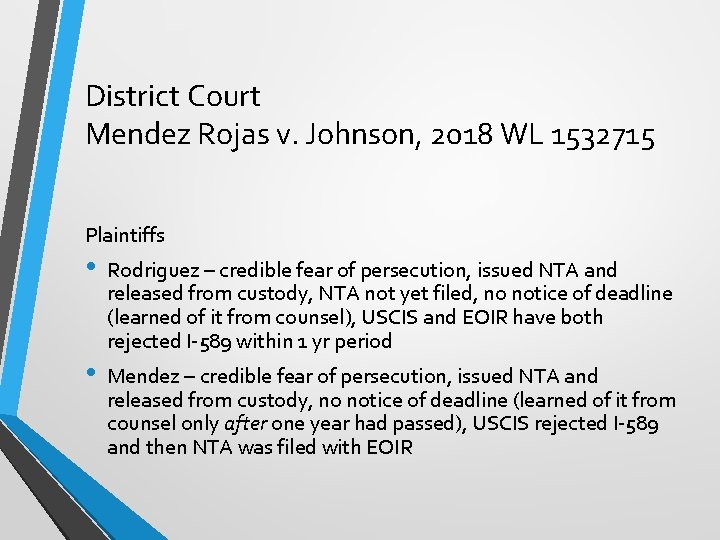
District Court Mendez Rojas v. Johnson, 2018 WL 1532715 Plaintiffs • • Rodriguez – credible fear of persecution, issued NTA and released from custody, NTA not yet filed, no notice of deadline (learned of it from counsel), USCIS and EOIR have both rejected I-589 within 1 yr period Mendez – credible fear of persecution, issued NTA and released from custody, no notice of deadline (learned of it from counsel only after one year had passed), USCIS rejected I-589 and then NTA was filed with EOIR
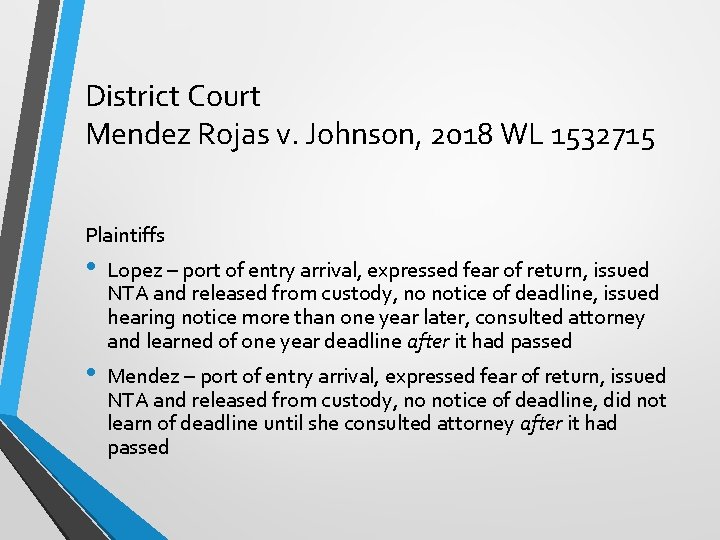
District Court Mendez Rojas v. Johnson, 2018 WL 1532715 Plaintiffs • • Lopez – port of entry arrival, expressed fear of return, issued NTA and released from custody, no notice of deadline, issued hearing notice more than one year later, consulted attorney and learned of one year deadline after it had passed Mendez – port of entry arrival, expressed fear of return, issued NTA and released from custody, no notice of deadline, did not learn of deadline until she consulted attorney after it had passed
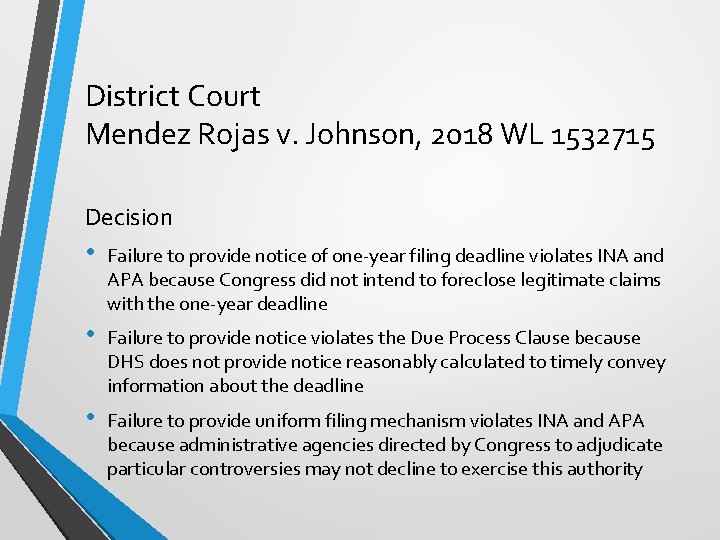
District Court Mendez Rojas v. Johnson, 2018 WL 1532715 Decision • Failure to provide notice of one-year filing deadline violates INA and APA because Congress did not intend to foreclose legitimate claims with the one-year deadline • Failure to provide notice violates the Due Process Clause because DHS does not provide notice reasonably calculated to timely convey information about the deadline • Failure to provide uniform filing mechanism violates INA and APA because administrative agencies directed by Congress to adjudicate particular controversies may not decline to exercise this authority
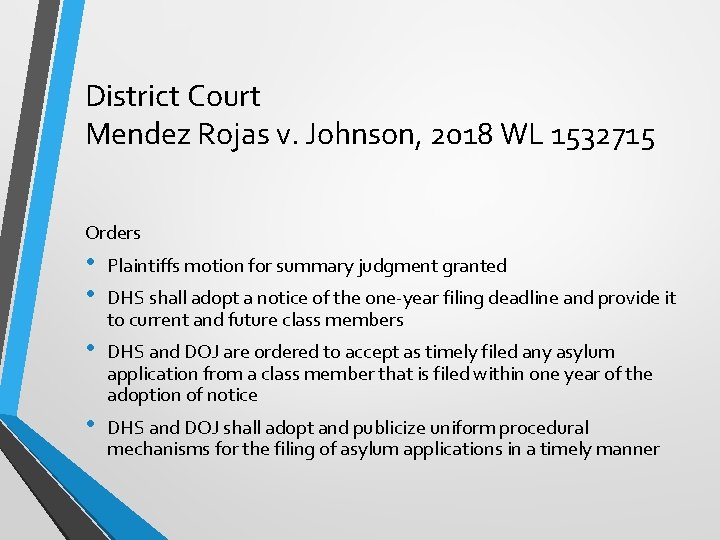
District Court Mendez Rojas v. Johnson, 2018 WL 1532715 Orders • • Plaintiffs motion for summary judgment granted • DHS and DOJ are ordered to accept as timely filed any asylum application from a class member that is filed within one year of the adoption of notice • DHS and DOJ shall adopt and publicize uniform procedural mechanisms for the filing of asylum applications in a timely manner DHS shall adopt a notice of the one-year filing deadline and provide it to current and future class members
9 th Circuit (pending) Mendez Rojas v. Johnson, No. 18 -35443 • In mediation • Settlement conference scheduled for October 17, 2018
Class Members Class A comprises individuals who: • Have been or will be released from Department of Homeland Security (DHS) custody after having been found to have a credible fear of persecution within the meaning of 8 U. S. C. § 1225(b)(1)(B)(v); and • Did not receive a notice from DHS of the one-year filing deadline for asylum applications (this is everyone); and • Either • • Have not filed an asylum application; or Filed an asylum application more than one year after their arrival in the United States Additionally, Class A is divided into two sub-classes: 1) those who are not in removal proceedings; and 2) those who are in removal proceedings
Class Members Class B comprises individuals who: • • • Have been or will be detained by DHS upon arrival into the country; and • • Are issued a Notice to Appear (NTA); • Either Express a fear of return to their home country to a DHS official; Have been or will be released from DHS custody without a credible fear determination; Did not receive a notice from DHS of the one-year filing deadline for asylum applications (this is everyone); and • • Have not filed an asylum application; or Filed an asylum application more than one year after their arrival in the United States. Additionally, Class B is divided into two sub-classes: 1) those who are not in removal proceedings; and 2) those who are in removal proceedings.
Interim Stay Agreement • Under the stay agreement, EOIR and USCIS have agreed to “find all class members’ asylum applications were timely filed in pending adjudications before an Immigration Judge, the Board of Immigration Appeals, and USCIS during the stay. ”
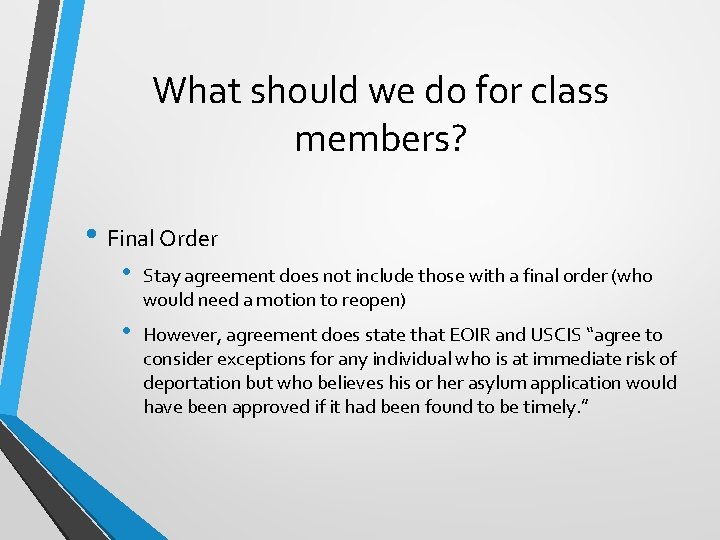
What should we do for class members? • Final Order • Stay agreement does not include those with a final order (who would need a motion to reopen) • However, agreement does state that EOIR and USCIS “agree to consider exceptions for any individual who is at immediate risk of deportation but who believes his or her asylum application would have been approved if it had been found to be timely. ”
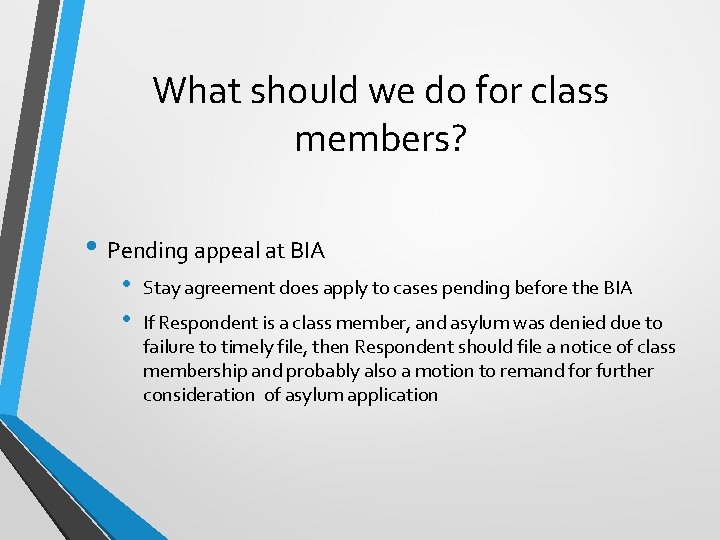
What should we do for class members? • Pending appeal at BIA • • Stay agreement does apply to cases pending before the BIA If Respondent is a class member, and asylum was denied due to failure to timely file, then Respondent should file a notice of class membership and probably also a motion to remand for further consideration of asylum application
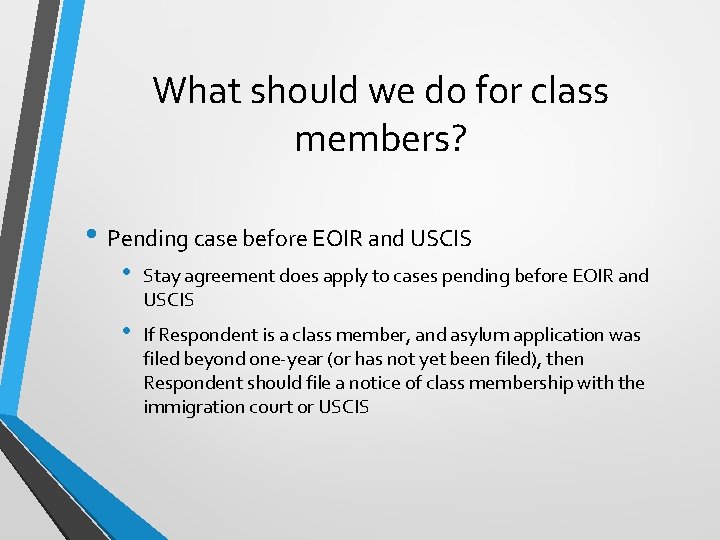
What should we do for class members? • Pending case before EOIR and USCIS • Stay agreement does apply to cases pending before EOIR and USCIS • If Respondent is a class member, and asylum application was filed beyond one-year (or has not yet been filed), then Respondent should file a notice of class membership with the immigration court or USCIS
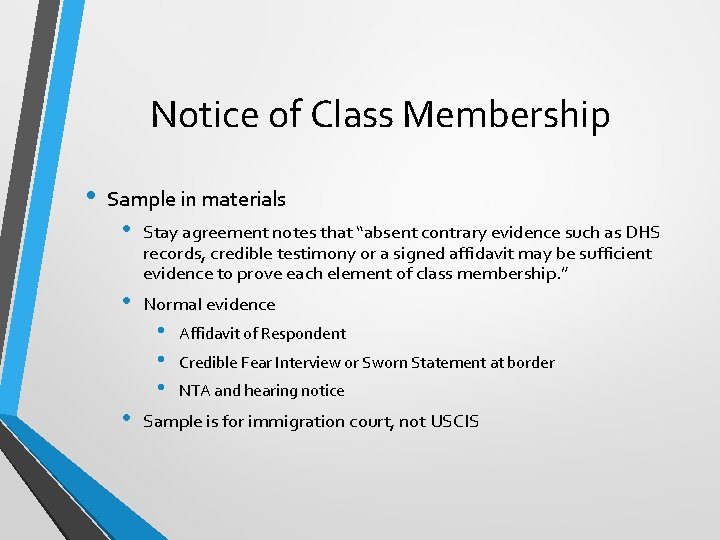
Notice of Class Membership • Sample in materials • Stay agreement notes that “absent contrary evidence such as DHS records, credible testimony or a signed affidavit may be sufficient evidence to prove each element of class membership. ” • Normal evidence • • Affidavit of Respondent Credible Fear Interview or Sworn Statement at border NTA and hearing notice Sample is for immigration court, not USCIS
Other Asylum Updates Backlog Policy: From “FIFO to LIFO” Form I-765 Updates
New Asylum Backlog Policy • On January 29, 2018, the Asylum Division changed the way it prioritizes affirmative asylum applications to “last in, first out” – LIFO • LIFO is not new; it existed before 2015 • In 2015, LIFO was switched to “first in, first out” - FIFO - to create a more “fair” backlog where people wouldn’t disappear in the queue • Since January 20, 2018, we are back to LIFO
LIFO Order of Priority • First priority: Applications that were scheduled for an interview, but the interview had to be rescheduled, whether by the applicant or USCIS • Second priority: Applications that have been pending 21 days or less • Third priority: All other pending affirmative asylum applications starting with newer filings working back towards older filings • www. uscis. gov/humanitarian/refugees-asylum/affirmative-asyluminterview-scheduling
How does LIFO work? • Does not mean interview will take place within 21 days • “Urgent Scheduling Requests” will still be considered by Asylum Office Directors on a case-by-case basis • USCIS field office interviews or “circuit ride” locations are only subject to the new policy as resources permit
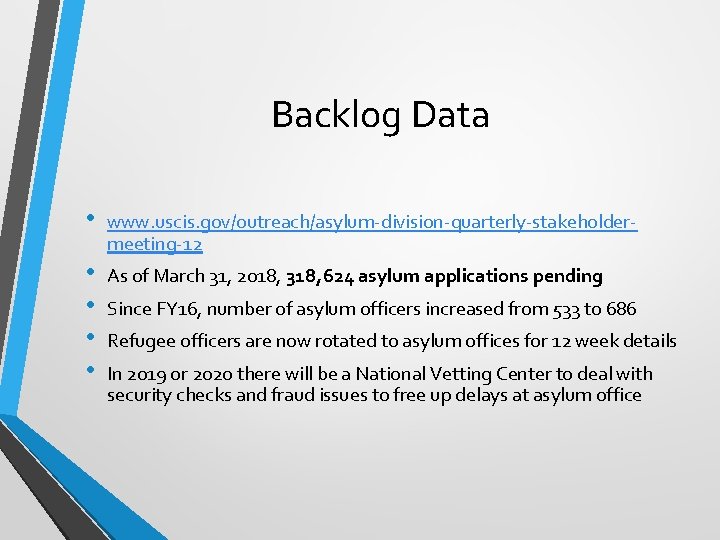
Backlog Data • www. uscis. gov/outreach/asylum-division-quarterly-stakeholdermeeting-12 • • As of March 31, 2018, 318, 624 asylum applications pending Since FY 16, number of asylum officers increased from 533 to 686 Refugee officers are now rotated to asylum offices for 12 week details In 2019 or 2020 there will be a National Vetting Center to deal with security checks and fraud issues to free up delays at asylum office
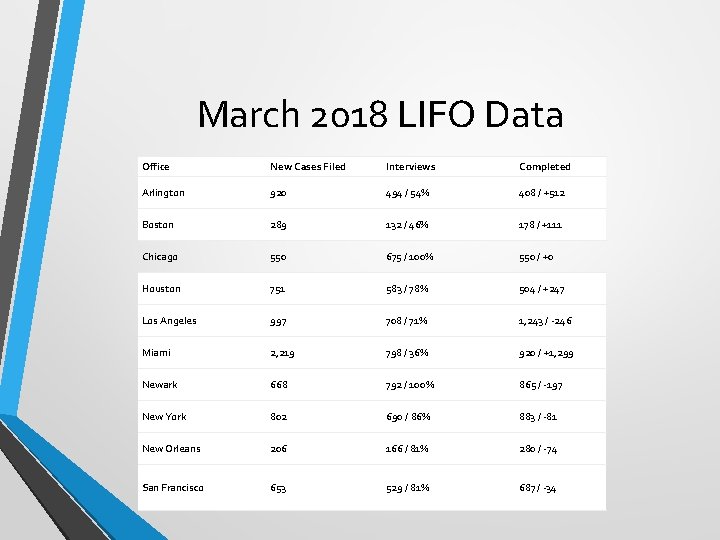
March 2018 LIFO Data Office New Cases Filed Interviews Completed Arlington 920 494 / 54% 408 / +512 Boston 289 132 / 46% 178 / +111 Chicago 550 675 / 100% 550 / +0 Houston 751 583 / 78% 504 / +247 Los Angeles 997 708 / 71% 1, 243 / -246 Miami 2, 219 798 / 36% 920 / +1, 299 Newark 668 792 / 100% 865 / -197 New York 802 690 / 86% 883 / -81 New Orleans 206 166 / 81% 280 / -74 San Francisco 653 529 / 81% 687 / -34
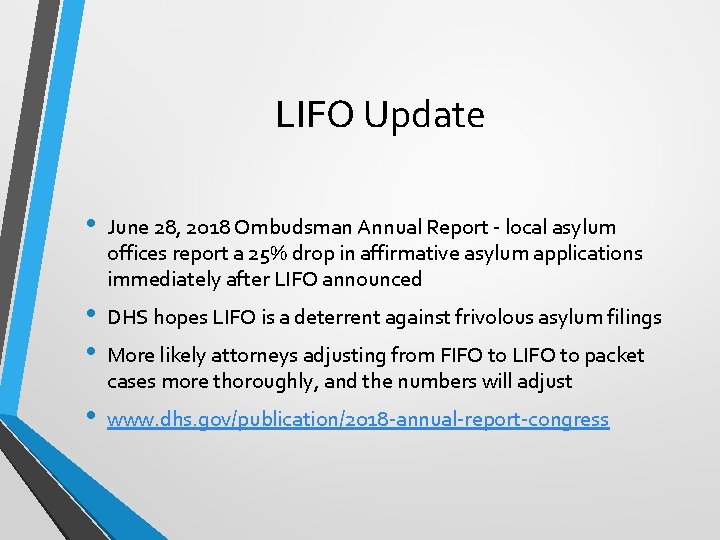
LIFO Update • June 28, 2018 Ombudsman Annual Report - local asylum offices report a 25% drop in affirmative asylum applications immediately after LIFO announced • • DHS hopes LIFO is a deterrent against frivolous asylum filings • www. dhs. gov/publication/2018 -annual-report-congress More likely attorneys adjusting from FIFO to LIFO to packet cases more thoroughly, and the numbers will adjust
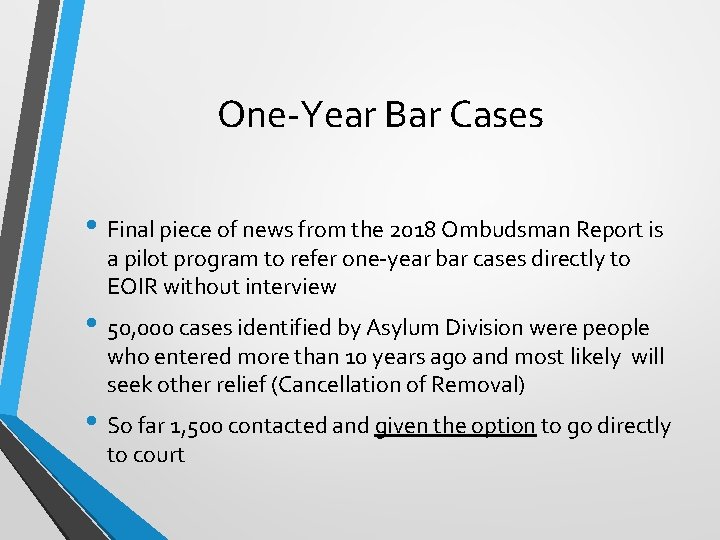
One-Year Bar Cases • Final piece of news from the 2018 Ombudsman Report is a pilot program to refer one-year bar cases directly to EOIR without interview • 50, 000 cases identified by Asylum Division were people who entered more than 10 years ago and most likely will seek other relief (Cancellation of Removal) • So far 1, 500 contacted and given the option to go directly to court
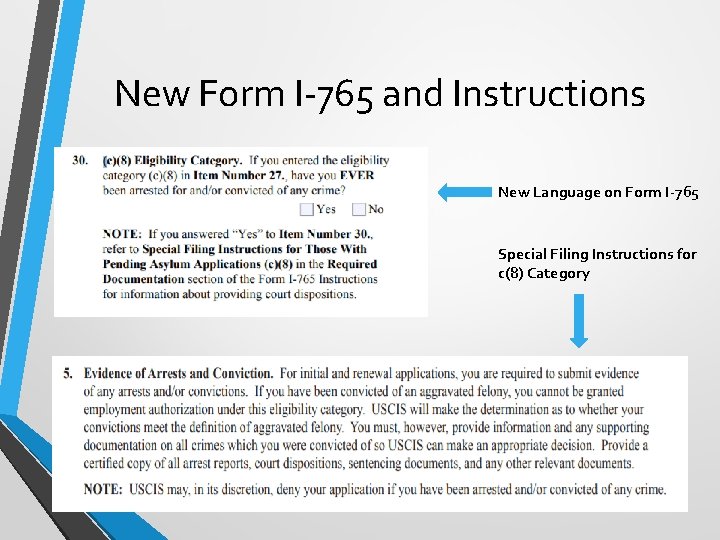
New Form I-765 and Instructions New Language on Form I-765 Special Filing Instructions for c(8) Category
Initial Evidence or RFE for Crimes • 8 C. F. R. § 208. 7 states that an applicant for asylum who is not an aggravated felon “shall” be eligible for employment authorization • Nothing in the regulations bars all criminals or makes employment authorization a discretionary consideration based on other crimes • • • The new form and instructions are overbroad Possibly building record for discretionary denials of asylum Strategies on responding to RFE
Questions and Discussion