
Law Office of Jacob Wallace Carry a Big
Law Office of Jacob Wallace Carry a “Big Stick” without the Big Bill
Disclamer ❖ ❖ ❖ This presentation is for informational purposes only and does not provide legal advice. Please do not act or refrain from acting based upon anything presented in this presentation. This presentation does not create an attorney/client relationship between the Law Office of Jacob Wallace and anyone. The individual facts of your case will determine what you should do. If you have any questions, please speak with your attorney.
Jacob “Jack” Wallace ❖ Licensed to practice law in Texas- November 2, 2007 ❖ For the past 13 years, represented individuals and small businesses in consumer and commercial disputes ❖ Jacob@Jacob. Wallace. Law. com
Goals ❖ Act 1: Understanding the Dispute ❖ Act 2: Do I need an attorney? ❖ Act 3: Pretrial- Well, that did not work ❖ Act 4: Trial ❖ Act 5: The Aftermath
Act 1: Understanding the Dispute ❖ Almost always over money ❖ Almost always really over something else ❖ Number one way a dispute gets to court- lack of communication
What do I do when a dispute happens? ❖ 1) Read the contract ❖ Any problems? ❖ Is it signed? ❖ Does it accurately state what is to be done? ❖ Is the payment amount correct? ❖ Does it have any rules for how disputes are handled? ❖ Communication rules (in writing, certified mail? ) ❖ Resolution rules (mediation/arbitration)
What do I do when a dispute happens? ❖ 2) Other Documents ❖ ❖ Did I send emails or Text Messages? Did we agree to anything other than what was in the contract?
What do I do when a dispute happens? ❖ 3) What are the damages? ❖ What does the other side want? What do I want? ❖ What will it cost to get out of this? ❖ Easy- the customer did not pay $5, 000 ❖ Hard- the customer fell down stairs I built and is injured ❖ If you can’t figure out the damages, that is a good sign you need to hire an attorney
What do I do when a dispute happens? ❖ ❖ Insurance If you are accused of doing anything wrong, stop and ask if any of your insurance policies may handle this matter. Insurance is frequently required to provide legal defense Insurance may try to deny coverage if you delay in notifying them
What do I do when a dispute happens? ❖ Decide if you want to hire an attorney.
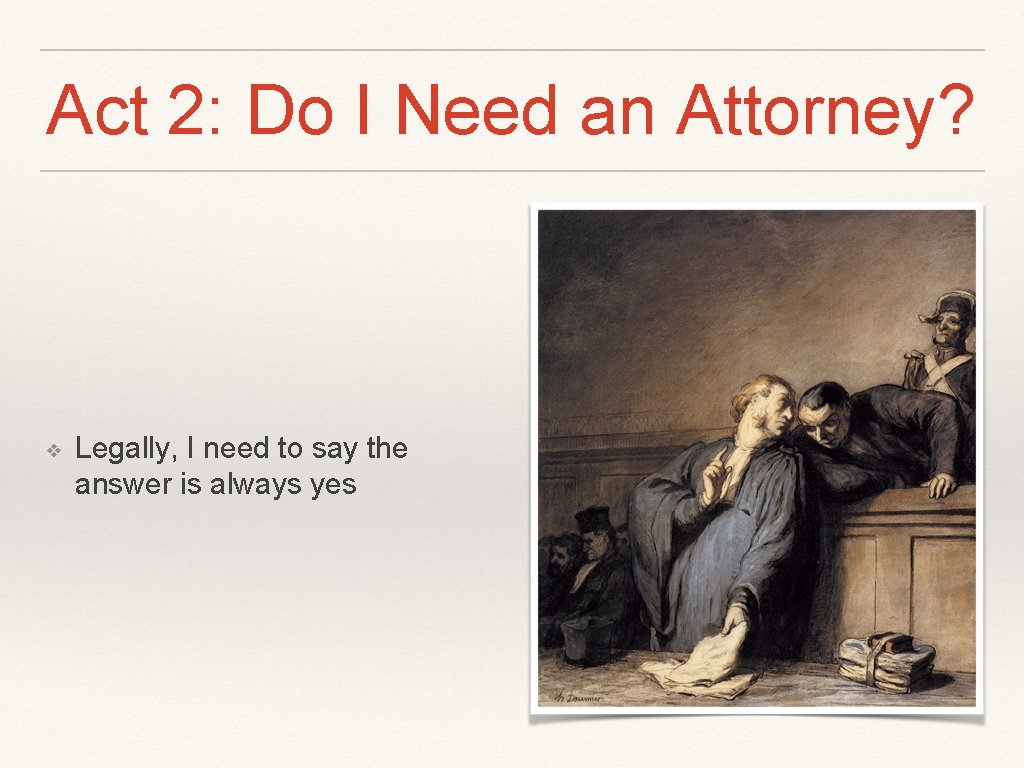
Act 2: Do I Need an Attorney? ❖ Legally, I need to say the answer is always yes
Do I Need an Attorney? ❖ 1) What are the damages? ❖ ❖ ❖ The higher the damages are, the more likely you need an attorney You should only consider representing yourself or your business if you can file this matter in JP court, which has a $20, 000 limit in Texas (as of September 1, 2020) If you cannot place a value on the case, get an attorney
Do I Need an Attorney? ❖ 2) Are you O. K. with losing ❖ ❖ An attorney can’t guarantee success, but it can help If you are ok with any outcome from the case, try to settle instead
Do I Need an Attorney? ❖ 3) Does the other side have an attorney? ❖ If so, you need one too
Do I Need an Attorney? ❖ 4) Do you understand the issue? ❖ ❖ Sometimes it is simple, like they did not pay. Sometimes it is more complicated, like a DTPA issue If you do not understand what is happening, get an attorney
Do I Need an Attorney? ❖ 5) Do I have time for this? ❖ Lawsuits take time and energy ❖ If you do not have time to handle it, get an attorney
Do I Need an Attorney? ❖ 5) Do I want to deal with this person? ❖ If you hire an attorney, that person is now my problem, not yours
We Can Work It Out ❖ If you decide to try to work it out without an attorney, be careful ❖ Everything in writing ❖ Document phone calls in follow up letters explaining what you believed the phone call said ❖ Remember: anything you say or write may be used in court. Never say anything you would be embarrassed to say in front of your grandmother. ❖ If you reach a settlement, get it in writing, signed by all parties, stating, at minimum, 1) identify the parties and recite the dispute 2) recite the date, place, time, and what is being given to resolve the dispute and 3) stating that this finally resolves all disputes between the parties
Act 3: Well, That Did Not Work ❖ So, you decided not to hire an attorney, but that did not work out and it looks like you are heading to court ❖ First, it is not too late. Most cases don’t go to an attorney until filed ❖ But, if you want to, here are some steps to help you represent yourself
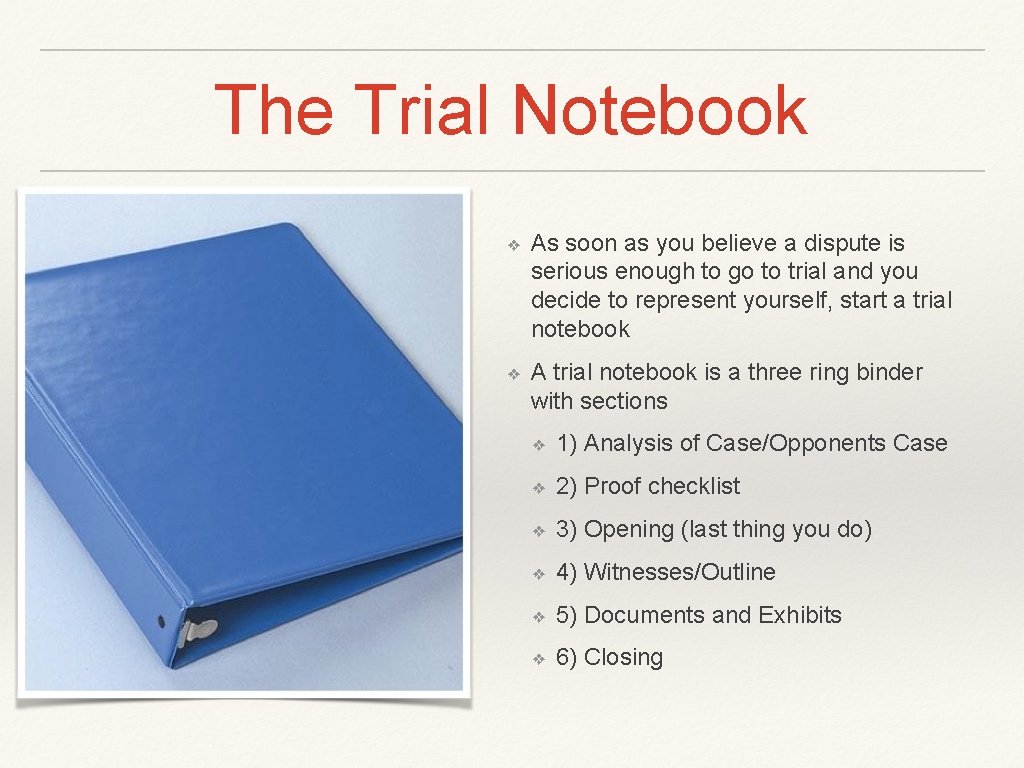
The Trial Notebook ❖ As soon as you believe a dispute is serious enough to go to trial and you decide to represent yourself, start a trial notebook ❖ A trial notebook is a three ring binder with sections ❖ 1) Analysis of Case/Opponents Case ❖ 2) Proof checklist ❖ 3) Opening (last thing you do) ❖ 4) Witnesses/Outline ❖ 5) Documents and Exhibits ❖ 6) Closing
Alternative Dispute Resolution ❖ Look at your contract ❖ Does it require any specific notices and opportunity to curer? ❖ Does it require pre-suit mediation? ❖ Does it require arbitration?
What Court? ❖ Texas has three civil trial courts ❖ Justice Court ❖ County Court at Law ❖ District Court
Why Justice Court? ❖ ❖ County and District Courts use the full rules of evidence and procedure, which you do not know Justice Court is designed to allow people to represent themselves
What kind of cases can a Justice Court hear? ❖ Small Claims- this is what we are doing- up to $20, 000 (excluding cost, including attorney fees) ❖ Debt Claims- banks want money too ❖ Eviction Matters ❖ Repair and Remedy cases- tenant forcing a landlord to repair
Which Justice Court? ❖ ❖ Generally, you must file your claim in 1) the county and precinct in which the dispute arose or 2) the county and precinct in which the defendant resides It can get more complicated
Who is the Justice of the Peace? ❖ Elected ❖ Not required to be an attorney ❖ Many have law enforcement backgrounds ❖ Look up your JP before going to court
What to Consider Before You Sue ❖ Are they going to counterclaim? ❖ Do they have money to pay a judgment? ❖ Am I really sure I can’t work this out without the court?
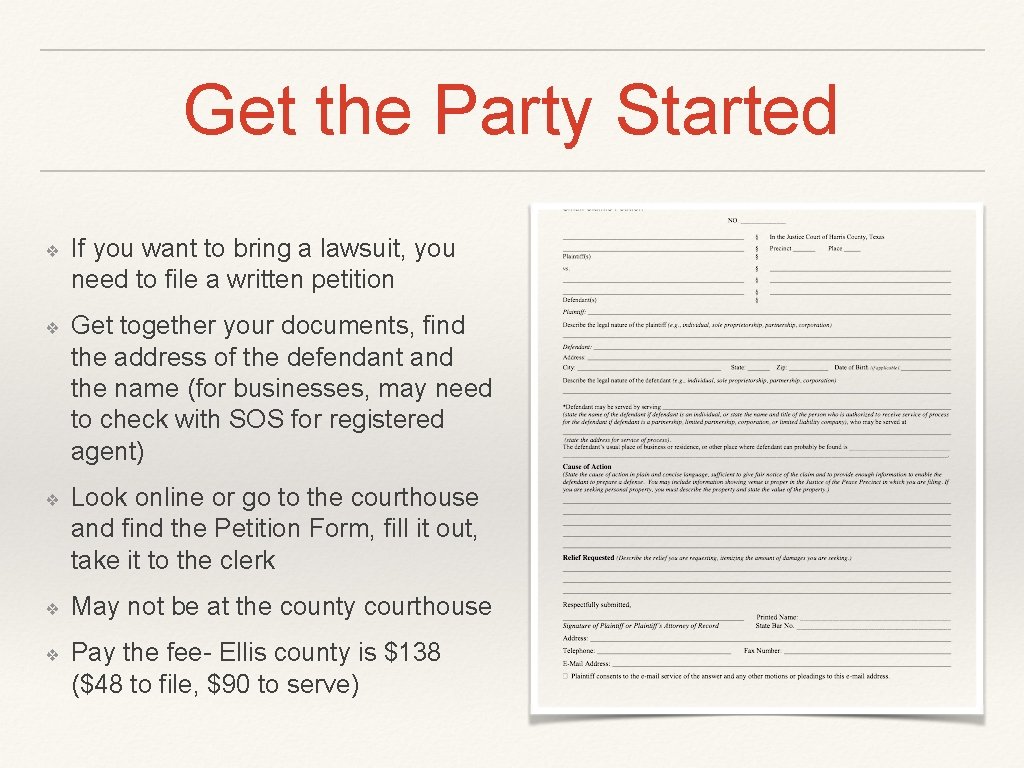
Get the Party Started ❖ If you want to bring a lawsuit, you need to file a written petition ❖ Get together your documents, find the address of the defendant and the name (for businesses, may need to check with SOS for registered agent) ❖ Look online or go to the courthouse and find the Petition Form, fill it out, take it to the clerk ❖ May not be at the county courthouse ❖ Pay the fee- Ellis county is $138 ($48 to file, $90 to serve)
Defendant ❖ “Greetings, you have been sued. ” ❖ If you are sued, you will be served with a petition ❖ Should be service by a constable or process server, or by certified mail, but even if you just get a regular mail letter or email, look up the case/call the court to verify ❖ Also, take a second to verify your registered agent for service of process is correctly on file ❖ Once served, you have 14 days to answer (deadline is different in different courts, follow the information on the citation)
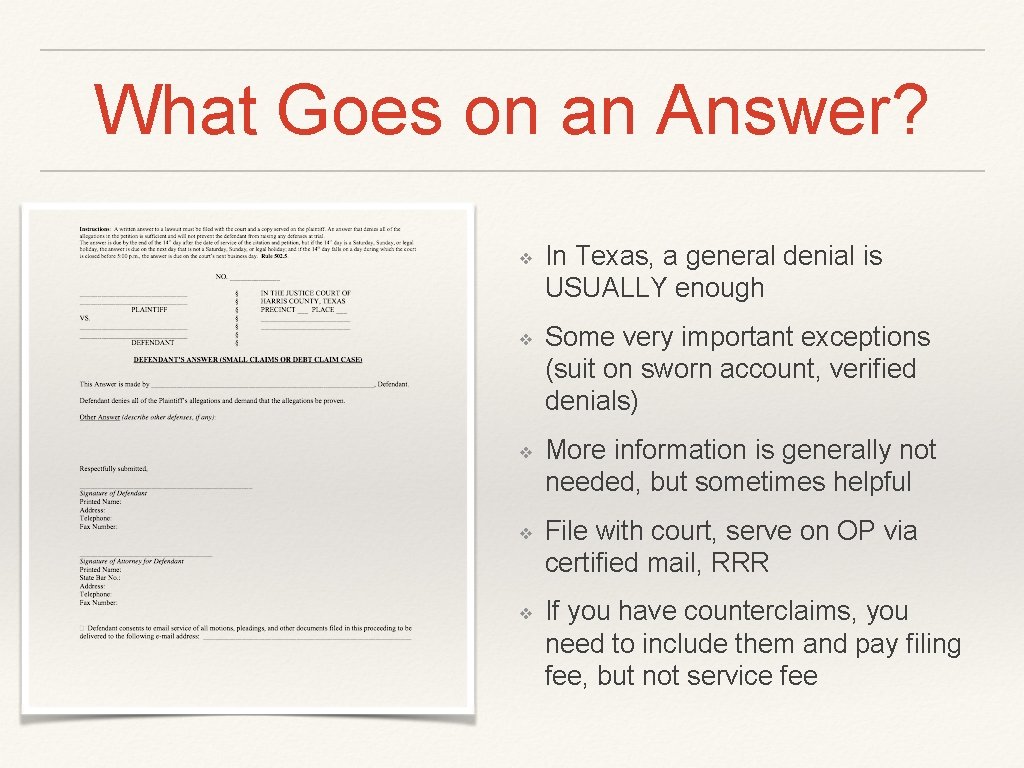
What Goes on an Answer? ❖ In Texas, a general denial is USUALLY enough ❖ Some very important exceptions (suit on sworn account, verified denials) ❖ More information is generally not needed, but sometimes helpful ❖ File with court, serve on OP via certified mail, RRR ❖ If you have counterclaims, you need to include them and pay filing fee, but not service fee
The Black Hole ❖ Now the ball is with the court ❖ Normally JP court moves quickly, but not always ❖ Sometimes you will wait months to hear anything
What happens before trial (sometimes) ❖ 1) Discovery ❖ 2) Pretrial Conference ❖ 3) Mediation
Discovery ❖ You can ask the other side questions ❖ ❖ Normally in writing, depositions are unlikely in JP court You do NOT have a right to do this, the JP must give you written permission Consider if you really do not have other ways to find out information, like photos of what the other side said you did wrong, records and receipts of cost, etc. Many JP courts will not consider, but it does not hurt to ask
Pretrial Conference ❖ Some courts (JP in Arlington) use to control docket ❖ Set hearing for sometime soon after filing ❖ If you don’t show, you lose ❖ If you are the only one who shows, you win ❖ If both show, they try to get you to settle or agree to mediation
Mediation ❖ ❖ ❖ Impartial third party tries to help you settle your case Has a cost involved, depends on county ($15 -$250 standard) Both sides must agree to settlement- mediator cannot force Come prepared with all documents Last chance to resolve this matter yourselves- in court you will win or lose, and you almost always feel like you lost
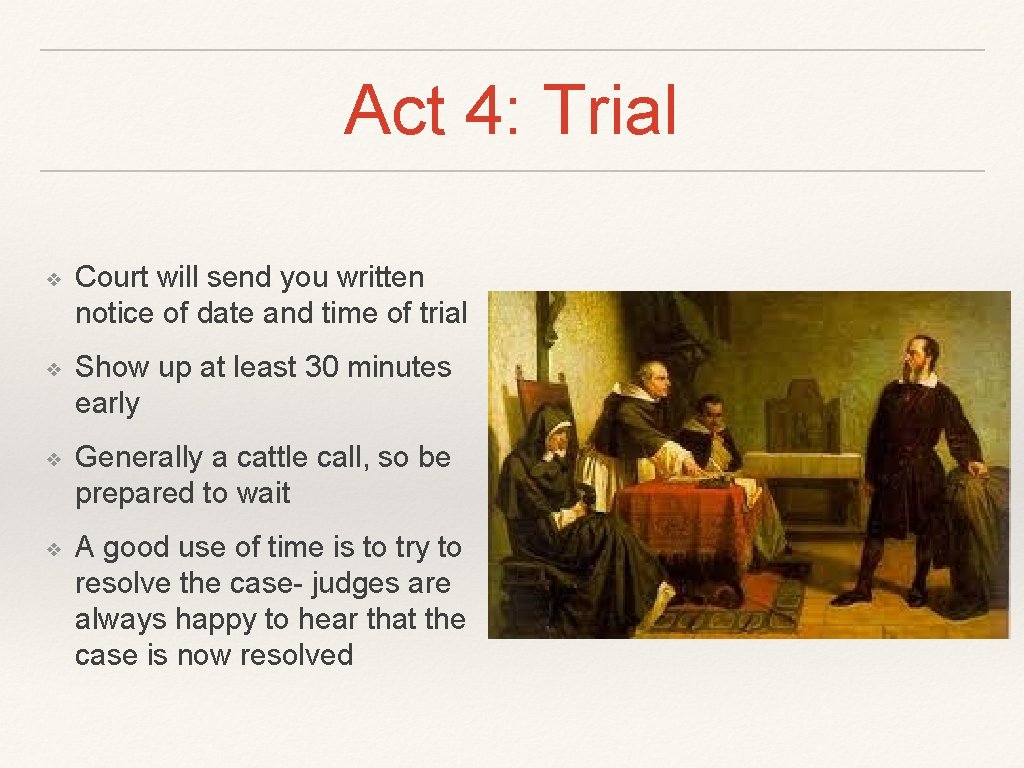
Act 4: Trial ❖ Court will send you written notice of date and time of trial ❖ Show up at least 30 minutes early ❖ Generally a cattle call, so be prepared to wait ❖ A good use of time is to try to resolve the case- judges are always happy to hear that the case is now resolved
Quick note on formality ❖ JP courts have varying levels of formality ❖ Many will just call you up to the bench and talk with you ❖ ❖ Others will have you at the tables and do a full trial, with witnesses in the box and formal openings and closings Courtrooms are open to the public, so consider going and watching a trial before your own
What is your goal ❖ The best thing you can try to do to win is to try to make the case as clear as possible ❖ Do not follow rabbit trails ❖ Do not get into fights over unimportant questions ❖ Stick to your elements ❖ HOWEVER, if you did something wrong and are just trying not to lose, confusion may help you…
What to Bring ❖ Trial Notebook ❖ Witnesses ❖ ❖ ❖ Exhibits (four copies, one for you, one for the opposing party, one for the court, and one for the witness) Pen and paper for notes If you don’t bring it, you cant use it, so take whatever files you have on the case
Parts of the Trial ❖ Opening ❖ Direct ❖ Cross ❖ Closing ❖ Judgment ❖ Plaintiff goes first, Defendant second
Opening ❖ Judge may give you a brief opportunity to explain your case ❖ Be brief ❖ Look at your Trial Notebook ❖ Notes should be bullet points of what happened and what the evidence is, not a long written out story ❖ Timeline of events ❖ Major things the court needs to look out for ❖ NEVER attack the other side- be polite
Direct ❖ You tell your story, either through yourself or your witnesses ❖ Call your witness and have them identify themselves ❖ Focus on main points ❖ ❖ Introduce your evidence (contracts, emails, texts, photos, etc. ) Tell your full story- don’t rely on the other side
Cross ❖ Once a witness presents on Direct, you have an opportunity to cross ❖ You ask them questions ❖ Do not argue ❖ Do not interrupt ❖ Ask leading questions- you want yes/no answers ❖ If you don’t know the answer, don’t ask the question ❖ If you don’t have a reason to ask the question, don’t ask it ❖ ❖ If you don’t have any questions for the witness, just say so DON’T RELY ON THE OTHER SIDE TO PROVE YOUR CASE
Final Check ❖ ❖ Judge will ask if you have any other witnesses Quickly review your trial notebook- did you get everything in?
Closing ❖ ❖ Justice Courts frequently do not allow closing argument If they let you, quickly state what the evidence showed and why that proves you are right ❖ Focus ❖ Tie it to the elements of your cause of action ❖ For example, for Breach of Contract show 1) you had a contract, 2) you performed under the contract, 3) the other side breached by not paying, and 4) that damaged you for the amount due under the contract
The Judgment ❖ ❖ The Justice Court will normally issue its judgment immediately at the end of the trial They will generally say they find in favor of the Plaintiff or Defendant and award monetary damages, or issue a “take nothing” judgment Generally they will send out the written judgment a few days later to all parties Write down the amount the court awards. Strange things have happened.
Act 5: The Aftermath ❖ Appeal ❖ Collections
Appeal ❖ ❖ If the amount in controversy is more that $250, either party may appeal the judgment to the County Court at Law Must post a bond in the amount set by the court ❖ ❖ ❖ for Defendant, double the amount of the judgment for Plaintiff- double the cost of the JP and estimated County Court at Law Trial De Novo in County Court at Law
Collections ❖ ❖ ❖ If you were awarded a judgment and the other side did not appeal, congratulations, you now have a very expensive piece of paper Converting that paper into money is VERY complicated in Texas Now you probably need a lawyer
Final Notes ❖ ❖ The rules for practice in a Texas Justice Court are found in the Texas Rules of Civil Procedure in the 500 section If you are representing yourself, read them
- Slides: 50