
Mary Helen Farris General Counsel Hillsborough County Attorneys

Mary Helen Farris General Counsel Hillsborough County Attorney’s Office
• Florida Statute Section 112. 312 indicates it is the policy of the State that public employees are agents of the people and hold their positions for the benefit of the public. • Thus, employees are bound to observe, in their official acts, the highest standards of ethics regardless of personal considerations, recognizing that promoting the public interest and maintaining the respect of the people in their government must be of foremost concern.
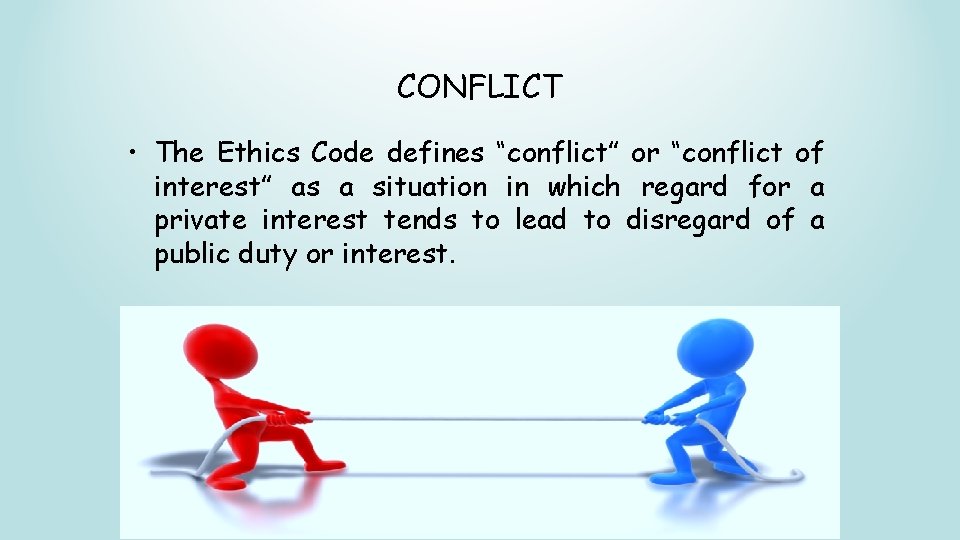
CONFLICT • The Ethics Code defines “conflict” or “conflict of interest” as a situation in which regard for a private interest tends to lead to disregard of a public duty or interest.
SOLICITATION OR ACCEPTANCE OF GIFTS • No public officer, employee of an agency, local government attorney, or candidate for nomination or election shall solicit or accept anything of value to the recipient, including a gift, loan, reward, promise of future employment, favor, or service, based upon any understanding that the vote, official action, or judgment of the public officer, employee, local government attorney, or candidate would be influenced thereby.
• Therefore, under Section 112. 313(2), Florida Statutes, you may not solicit or accept a financial gift which is based upon any understanding that your official action or judgment would be influenced.
• This provision places the burden upon a public officer to exercise reasonable care in determining whether a particular payment or thing of value has been given with the intent to influence his or her official action. Assuming the donor is in a position to be benefited by the officer's action, the officer should weigh the value of the thing received against the ostensible purpose for its having been given. The larger its value, the more difficult it should be to justify its having been given for any reason except to influence, assuming that there is some official action on the part of the recipient anticipated in the future which would affect the donor or some other specific person or entity related to the donor.
DOING BUSINESS WITH ONE'S AGENCY. • No employee of an agency acting in his or her official capacity as a purchasing agent, or public officer acting in his or her official capacity, shall either directly or indirectly purchase, rent, or lease any realty, goods, or services for his or her own agency from any business entity of which the officer or employee or the officer's or employee's spouse or child is an officer, partner, director, or proprietor or in which such officer or employee or the officer's or employee's spouse or child, or any combination of them, has a material interest. Nor shall a public officer or employee, acting in a private capacity, rent, lease, or sell any realty, goods, or services to the officer's or employee's own agency, if he or she is a state officer or employee, or to any political subdivision or any agency thereof, if he or she is serving as an officer or employee of that political subdivision.
DOING BUSINESS WITH ONE'S AGENCY • This provision would prohibit you acting, in your official capacity as a purchases agent, from leasing or purchasing for the Housing Finance Authority any goods, realty or services from a business entity of which you (or your spouse or child) are an officer, partner, director or proprietor.
• This provision also would prohibit you from acting in your private capacity to sell to your agency. For purposes of the Code of Ethics, your "agency" is the Housing Finance Authority. EXAMPLE: You are a partner in a travel agency that makes travel arrangements for his or her office.
DOING BUSINESS WITH: • A city mayor is prohibited by Section 112. 313(7)(a), Florida Statutes, from working as a consultant for a waste-management company providing services to the city. The mayor would hold a contractual relationship with a business entity subject to the regulation of and doing business with the city, no exemption of Section 112. 313(12), Florida Statutes would apply.
• A city mayor is prohibited from working as a consultant for a waste-management company providing services to the city. The mayor would hold a contractual relationship with a business entity subject to the regulation of and doing business with the city.
DOING BUSINESS 1. Respondent must have been either a public employee acting in an official capacity as a purchasing agent, or a public officer acting in an official capacity. 2. Respondent must have either directly or indirectly purchased, rented or leased some realty, goods or services. 3. Such purchase, rental or lease must have been for Respondent’s own agency.
4. Such purchase, rental or lease must have been from a business entity: Respondent’s pondent, Respondent’s ichofor (a) spouse (b) child is an officer, partner, director or proprietor, or in which Respondent’s, Respondent’s spouse or Respondent’s child, or any combination of them, has a material interest.
OR 1. Respondent must have been either a public officer or employee acting in a private capacity. 2. Respondent must have rented, leased or sold realty, goods or services. 3. Such rental, lease or sale must have been to Respondent’s own agency, if Respondent’s was a state officer or employee, or to Respondent’s political subdivision or an agency thereof, if Respondent’s was serving as an officer or employee or that political subdivision.
UNAUTHORIZED COMPENSATION. • No public officer, employee of an agency, or local government attorney or his or her spouse or minor child shall, at any time, accept any compensation, payment, or thing of value when such public officer, employee, or local government attorney knows, or, with the exercise of reasonable care, should know, that it was given to influence a vote or other action in which the officer, employee, or local government attorney was expected to participate in his or her official capacity.
UNAUTHORIZED COMPENSATION A member of a city council is not prohibited under the Code of Ethics from accepting a chamber of commerce designation of the councilmember’s business as an “endorsed vendor” of a particular insurance product as long as such designation is offered absent any understanding or intent that it would influence the councilmember’s votes or other official actions. CEO 09 -21 is referenced. 1 A former Associate Director of Facilities Planning at Florida Atlantic University was found to have violated ethics law by soliciting or accepting a personal loan from a company with the understanding that his official actions would be influenced. He also was found to have received unauthorized compensation by accepting the loan.
He misused his position to receive a personal loan from the owner of the company and that he had a conflicting contractual relationship because the loan was from the owner of a company doing business with the University. In light of the Director’s suspension by the University for two weeks without pay and demotion to the position of Project Coordinator, which resulted in a $10, 000 reduction in salary, the Commission recommended the Governor impose a civil penalty of $2, 500 and public censure and reprimand for the violation.
MISUSE OF PUBLIC POSITION. • No public officer, employee of an agency, or local government attorney shall corruptly use or attempt to use his or her official position or any property or resource which may be within his or her trust, or perform his or her official duties, to secure a special privilege, benefit, or exemption for himself, herself, or others. This section shall not be construed to conflict with s. 104. 31.
• 'Corruptly' means done with a wrongful intent and for the purpose of obtaining, or compensating or receiving compensation for, any benefit resulting from some act or omission of a public servant which is inconsistent with the proper performance of his public duties.
CONFLICTING EMPLOYMENT OR CONTRACTUAL RELATIONSHIP. (a) employment or contractual relationship with any business entity or any agency which is subject to the regulation of, or is doing business with, an agency of which he or she is an officer or employee, excluding those organizations and their officers who, when acting in their official capacity, enter into or negotiate a collective bargaining contract with the state or any municipality, county, or other political subdivision of the state; nor shall an officer or employee of an agency have or hold any employment or contractual relationship that will create a continuing or frequently recurring conflict between his or her private interests and the performance of his or her public duties or that would impede the full and faithful discharge of his or her public duties.
his (b) employee from practicing in a particular profession or occupation when such practice by persons holding such public office or employment is required or permitted by law or ordinance.
CONFLICTING CONTRACTUAL OR EMPLOYMENT RELATIONSHIP A prohibited conflict of interest is created under Section 112. 313(7)(a), Florida Statutes, where a member of a community redevelopment agency is a partner in a real estate partnership that applies to participate in a low interest loan program sponsored by the redevelopment agency. The member would have a contractual relationship with a business entity – the real estate partnership – which is doing business with his agency.
A prohibited conflict of interest exits where a member of the governing board of a solid waste authority applies for and receives a grant from a waste tire grant fund administrated by the solid waste authority. A transaction of this type would be considered doing business with one’s own agency as well as a conflicting employment or contractual relationship in violation of Sections 112. 313(3) and 112. 313(7)(a), Florida Statutes.
DISCLOSURE OR USE OF CERTAIN INFORMATION. • A current or former public officer, employee of an agency, or local government attorney may not disclose or use information not available to members of the general public and gained by reason of his or her official position, except for information relating exclusively to governmental practices, for his or her personal gain or benefit or for the personal gain or benefit of any other person or business entity.
• Section 112. 313(8) prohibits you from using any information for your personal gain which is gained through your official position or developed as part of your responsibilities as the Postal Coordinator for the County and which is not available to members of the general public. • Section 112. 313(8) prohibits a public employee from taking unfair advantage of his position in order to benefit himself or others through the use of information gained by virtue of his public position

VOTING CONFLICTS OF INTEREST
VOTING CONFLICTS OF INTEREST • "Principal by whom retained" means an individual or entity, other than an agency as defined in s. 112. 312(2), • that for compensation, salary, pay, consideration, or similar thing of value, has permitted or directed another to act for the individual or entity,
• and includes, but is not limited to, one's client, employer, or the parent, subsidiary, or sibling organization of one's client or employer. • Public officer" includes any person elected or appointed to hold office in any agency, including any person serving on an advisory body. • "Relative" means any father, mother, son, daughter, husband, wife, brother, sister, father-in-law, mother-in-law, son-in-law, or daughter-in-law.
• "Special private gain or loss" means: an economic benefit or harm that would inure to the officer, his or her relative, business associate, or principal, • unless the measure affects a class that includes the officer, his or her relative, business associate, or principal,
• in which case, at least the following factors must be considered when determining whether a special private gain or loss exists: 1. The size of the class affected by the vote. 2. The nature of the interests involved. 3. The degree to which the interests of all members of the class are affected by the vote.
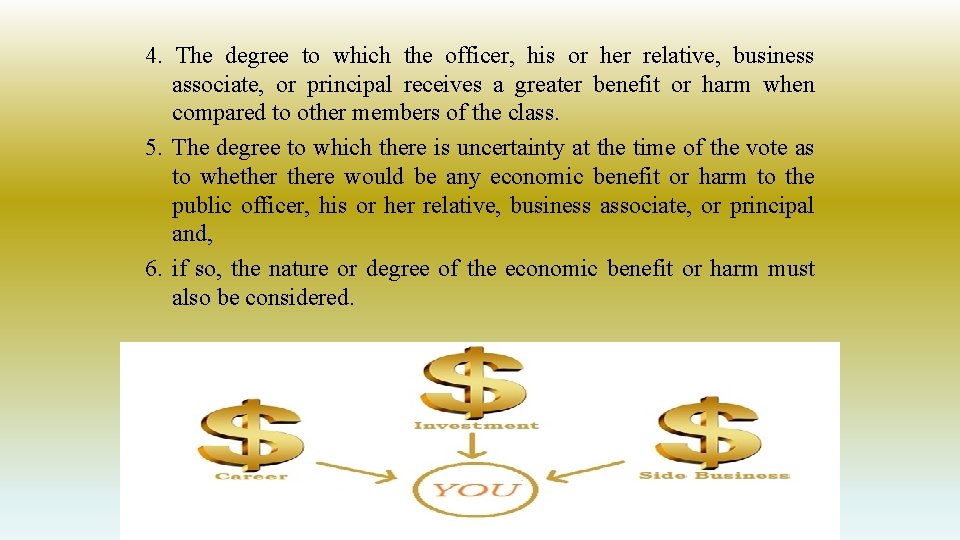
4. The degree to which the officer, his or her relative, business associate, or principal receives a greater benefit or harm when compared to other members of the class. 5. The degree to which there is uncertainty at the time of the vote as to whethere would be any economic benefit or harm to the public officer, his or her relative, business associate, or principal and, 6. if so, the nature or degree of the economic benefit or harm must also be considered.
• No county, municipal, or other local public officer shall vote in an official capacity upon any measure which would inure to his or her special private gain or loss; • Which he or she knows would inure to the special private gain or loss of any principal by whom he or she is retained, • Or to the parent organization or subsidiary of a or which he or she knows would inure to the special private gain or loss of a relative or business associate of the public officer.
• Such public officer shall, prior to the vote being taken: 1. publicly state to the assembly the nature of the officer's interest in the matter from which he or she is abstaining from voting and, 2. within 15 days after the vote occurs, disclose the nature of his or her interest as a public record in a memorandum and, 3. filed with the person responsible for recording the minutes of the meeting, who shall incorporate the memorandum in the minutes. • Whenever a public officer or former public officer is being considered for appointment or reappointment to public office, the appointing body shall consider the number and nature of the memoranda of conflict previously filed under this section by said officer.
EXAMPLES • A county commissioner is not presented with a voting conflict under Section 112. 3143(3)(a), Florida Statutes, regarding votes/measures of the county commission concerning a proposed county judicial complex to be located near properties owned by her and her husband's companies. Ø Under the circumstances, any gain or loss to the commissioner or her husband is "remote and speculative" or is not "special. "
• A city commission member is prohibited by Section 112. 3143, Florida Statutes, from voting on a proposed ordinance prohibiting billboards, where the commission member owns several billboards within the city. Ø Under the circumstances presented, the measure would inure to the commissioner's special private gain, and he would be required to disclose the nature of his interest, abstain from voting, and file a voting conflict memorandum.
• No voting conflict of interest would be created, were a Mayor to vote on matters relating to the de-annexation from the Town's boundaries part of a subdivision where he resides. Ø Under the circumstances, the number of lots in the subdivision that could be de-annexed from the Town is significant-108 lots (85 homes)-and their de-annexation would affect all of them in a proportionally equal manner such that there is no special private gain or loss to the Mayor as a result.
• A city councilmember is not prohibited by Section 112. 3143(3)(a), Florida Statutes, from voting on the city's ratification of the collective bargaining agreement or on amendments to the city's ordinances required to effectuate changes to the health insurance subsidy he and other union members receive under the collective bargaining agreement between the city and the union. Ø The number of members receiving retirement benefits and in the deferred retirement option program who would be benefited immediately is sufficiently large that any gain or loss resulting from the city commission's ratification of the collective bargaining agreement would not be "special. "
Ø Finally, always ask the County Attorney’s Office if you may possibly have a voting conflict. Ø Generally, if a public official seeks advice of counsel and is advised that he or she can vote, and a complaint is filed and the Commission on Ethics rules that he or she should have abstained, no action will be taken against the public official.
WHAT IS THE SUNSHINE LAW? All meetings of any Board or Commission of any State agency or authority or of any agency or authority of any county, municipal corporation, or political subdivision… at which official acts are to be taken are… public meetings… at all times. The board or commission must provide reasonable notice of all such meetings.
WHAT IS ITS AUTHORITY? • The Florida Constitution, Article I, Section 24 • Florida Sunshine Law – Chapter 286 Florida Statutes.
WHAT IS A MEETING SUBJECT TO THE SUNSHINE LAW? • Any gathering of two or more members of the same board or commission to discuss some matter on which foreseeable action will be taken by the public board or commission. • Does not require a quorum. • Any gathering, formal or casual. • applicable to discussions, deliberations and formal action taken by a public board
WHAT IS THE SCOPE OF THE SUNSHINE LAW? 1. Meetings on State and Local levels must be open to the public 2. Reasonable notice must be given 3. Minutes must be taken
THIS INCLUDES: • Public Collegial Bodies, per Florida Constitution • Elected or Appointed Boards or Commissions • Public Officers or staff acting with delegated authority • Note: Federal agencies operating within state are not subject to Sunshine Law
WHEN ARE BOARDS SUBJECT TO THE SUNSHINE LAW? • Any group that helps narrow the issue for the sunshine-required board or commission • Subject even though recommendations are not binding • Private entities subject when created by or delegated function of public agency • Staff “standing in shoes” of public officials • It is the nature of the act performed not the makeup of the committee
WHEN BOARDS ARE NOT SUBJECT TO THE SUNSHINE LAW • Established for fact finding only • Merely informational
WHAT ELSE IS SUBJECT TO THE SUNSHINE LAW? • Phone calls • Letters that go back and forth between members of the same board prior to meetings • Discussions of a single member delegated board authority • Discussions between board member and non board member when non member is being used as a liaison
MEETINGS THAT ARE NOT EXEMPT • Investigations • Meetings to discipline staff • Meetings to handle personnel issues • Real estate negotiations • Quasi-judicial hearings
WHEN DOES THE SUNSHINE LAW BEGIN TO APPLY? • Upon election or appointment
HOW ABOUT MEMBERS OF DIFFERENT BOARDS? • Let’s say you have a member of City Council and a County Commissioner – they do not have any Sunshine obligation for discussions between themselves. • BUT, if both are members of another group (Example: a Regional Planning Council), then they have a Sunshine obligation for those sorts of issues.
HOW ABOUT EX-OFFICIO MEMBERS? • Ex-Officio members are subject to the same requirements as voting members.
HOW ABOUT SOCIAL EVENTS? • Members can still go to dinner or parties. • Members can’t talk about business coming before the board.

HOW ABOUT A BUS TRIP OR A TOUR? • Some Boards wish to review property, see a site, etc. This is not a Sunshine problem if there is no discussion of issues coming before the Board.
NOTICE • Reasonable notice required. • What is “reasonable? ” • At least 24 hour notice needed for special or emergency meetings • Keep in mind that there may be other notice requirements imposed by statutes, codes or ordinances
DOES THE SUNSHINE LAW REQUIRE THAT AN AGENDA BE WRITTEN? • Not prohibited from adding topics to agenda, and taking formal action on them; but should postpone formal action on any added items that are controversial. • Not required to consider only items on a published agenda • Up to body to decide flow of agenda • Ok for board to establish procedures
OPEN TO THE PUBLIC • Bodies subject to the Sunshine Law are prohibited from holding meetings at any facility or location which discriminates on the basis of sex, age, race, creed, color, origin, or economic status or which operates in such a manner as to unreasonably restrict public access to such a facility. • Cannot vote by secret ballot. If a member is participating by phone, the public must be able to hear that member.
PENALTIES • Any public officer who violates any provision of this section is guilty of a noncriminal infraction, punishable by fine not exceeding $500. • (b) Any person who is a member of a board or commission or of any state agency or authority of any county, municipal corporation, or political subdivision who knowingly violates the provisions of this section by attending a meeting not held in accordance with the provisions hereof is guilty of a misdemeanor of the second degree, punishable as provided in s. 775. 082 or s. 775. 083
- Slides: 56