Adolescent Development Allison Eliscu MD FAAP Rev Aug


- Slides: 40
Adolescent Development Allison Eliscu, MD, FAAP Rev. Aug 2012
Adolescent Development Ø Physical growth and development Ø Psychosocial development Ø Sexual development
Physical Growth and Development during Adolescence
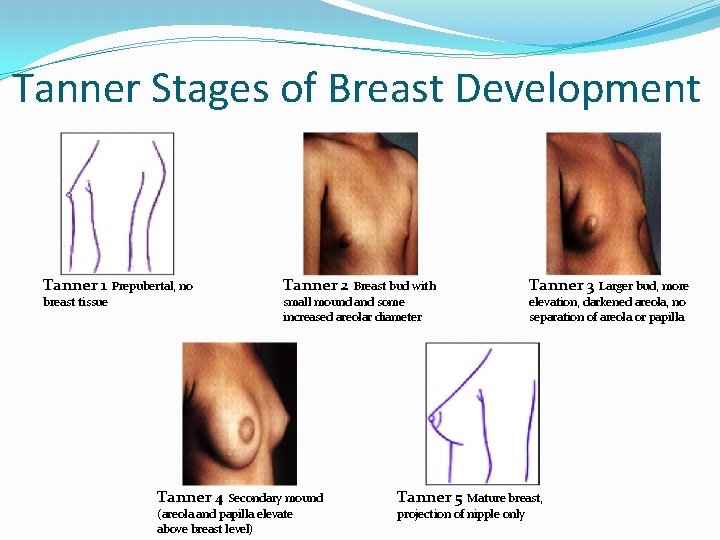
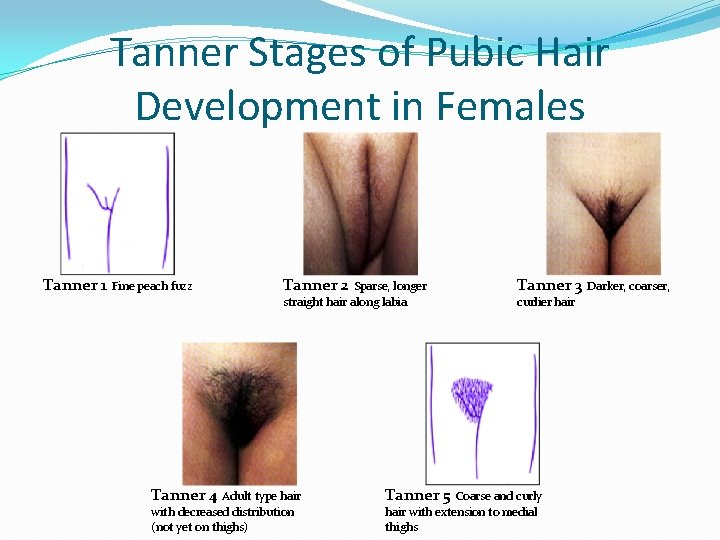
Sexual Maturity Rating (Tanner Stage) Rating scale describing secondary sex characteristics Does not always correlate with chronological age Based on: Pubic hair development for males and females Breast development for females Testicular and penile development for males Uses of sexual maturity rating Objective measure to follow progression of development Easily describe stage of development to other providers Does not always correlate with chronological age
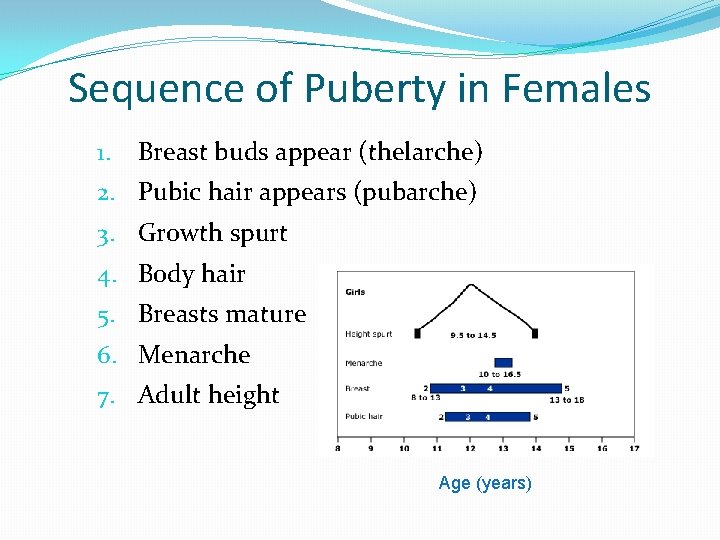
Sequence of Puberty in Females 1. Breast buds appear (thelarche) 2. Pubic hair appears (pubarche) 3. Growth spurt 4. Body hair 5. Breasts mature 6. Menarche 7. Adult height Age (years)
Tanner Stages of Breast Development Tanner 1 Prepubertal, no Tanner 2 Breast bud with Tanner 3 Larger bud, more breast tissue small mound and some increased areolar diameter elevation, darkened areola, no separation of areola or papilla Tanner 4 Secondary mound Tanner 5 Mature breast, (areola and papilla elevate above breast level) projection of nipple only
Tanner Stages of Pubic Hair Development in Females Tanner 1 Fine peach fuzz Tanner 2 Sparse, longer Tanner 3 Darker, coarser, straight hair along labia curlier hair Tanner 4 Adult type hair Tanner 5 Coarse and curly with decreased distribution (not yet on thighs) hair with extension to medial thighs
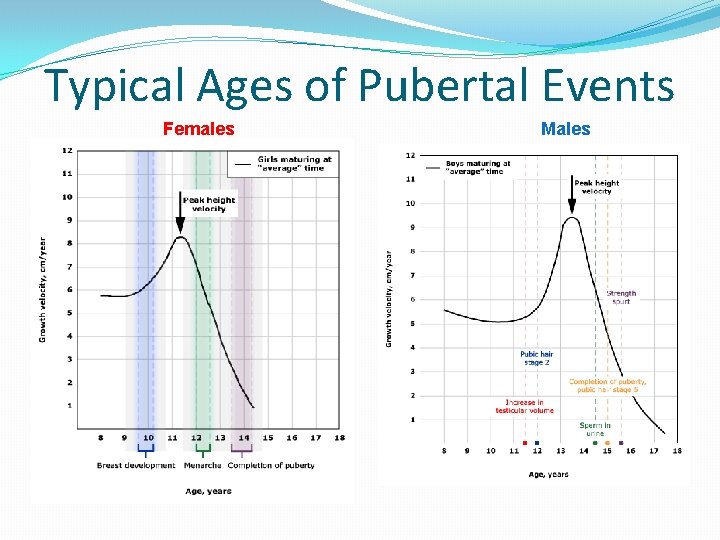
Peak Growth Velocity in Females Peak velocity is 3 -4 inches per year Average 11 -11 ½ years old 2 years earlier for females than males Midway between thelarche and menarche After menarche, only gain an additional 2 inches on average
Menarche Usually during Tanner 3 -4 Average 12 yrs 4 mos (9 -17 yrs) Occurs 2. 6 years on average after thelarche Always occurs after peak height velocity Varies by race, genetic factors, nutrition
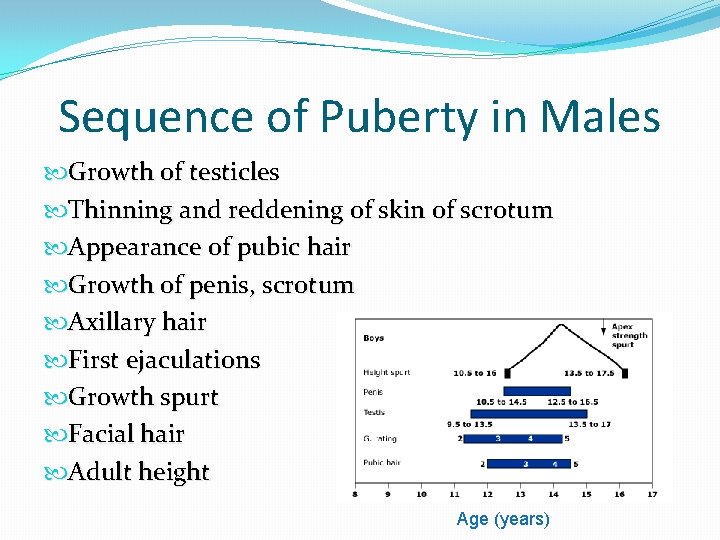
Sequence of Puberty in Males Growth of testicles Thinning and reddening of skin of scrotum Appearance of pubic hair Growth of penis, scrotum Axillary hair First ejaculations Growth spurt Facial hair Adult height Age (years)
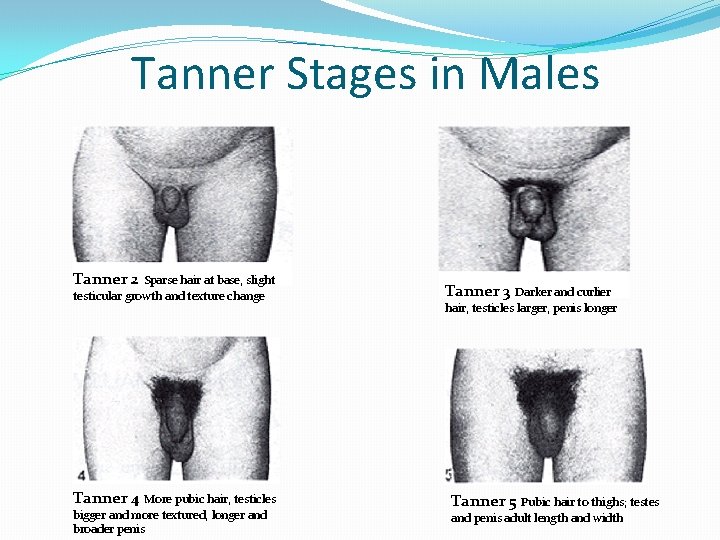
Tanner Stages in Males Tanner 2 Sparse hair at base, slight testicular growth and texture change Tanner 4 More pubic hair, testicles bigger and more textured, longer and broader penis Tanner 3 Darker and curlier hair, testicles larger, penis longer Tanner 5 Pubic hair to thighs; testes and penis adult length and width
Peak Growth Velocity in Males Occurs in late puberty (Tanner 4 -5) Growth accelerates slower in males and lasts longer Growth begins to accelerate about 9 months after the first signs of testicular enlargement Peak velocity is 3. 5 -5 inches per year On average, males grow 10 -11 inches during puberty
Typical Ages of Pubertal Events Females Males
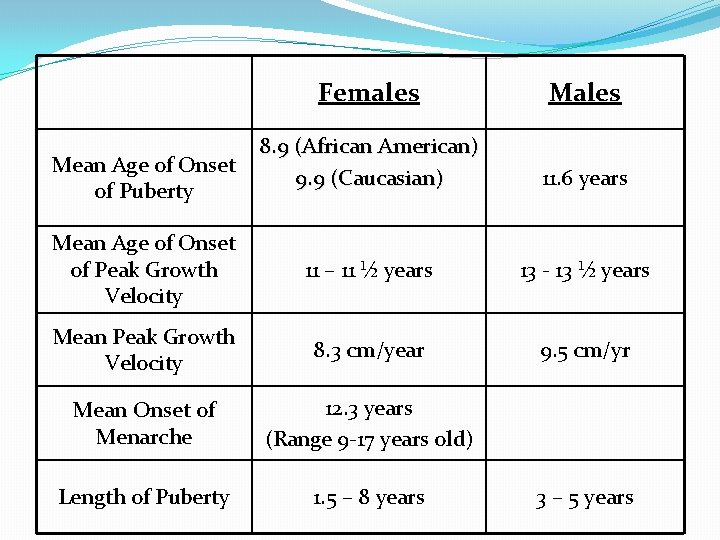
Females Males 8. 9 (African American) 9. 9 (Caucasian) 11. 6 years Mean Age of Onset of Peak Growth Velocity 11 – 11 ½ years 13 - 13 ½ years Mean Peak Growth Velocity 8. 3 cm/year 9. 5 cm/yr Mean Onset of Menarche 12. 3 years (Range 9 -17 years old) Length of Puberty 1. 5 – 8 years Mean Age of Onset of Puberty 3 – 5 years
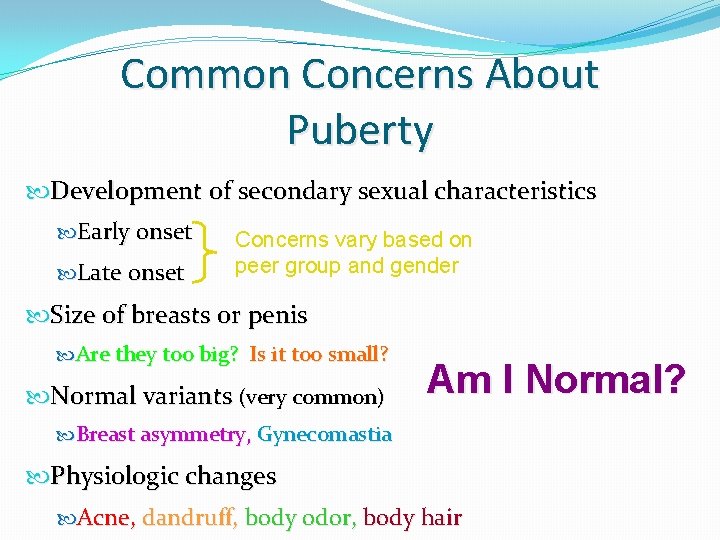
Common Concerns About Puberty Development of secondary sexual characteristics Early onset Late onset Concerns vary based on peer group and gender Size of breasts or penis Are they too big? Is it too small? Normal variants (very common) Am I Normal? Breast asymmetry, Gynecomastia Physiologic changes Acne, dandruff, body odor, body hair
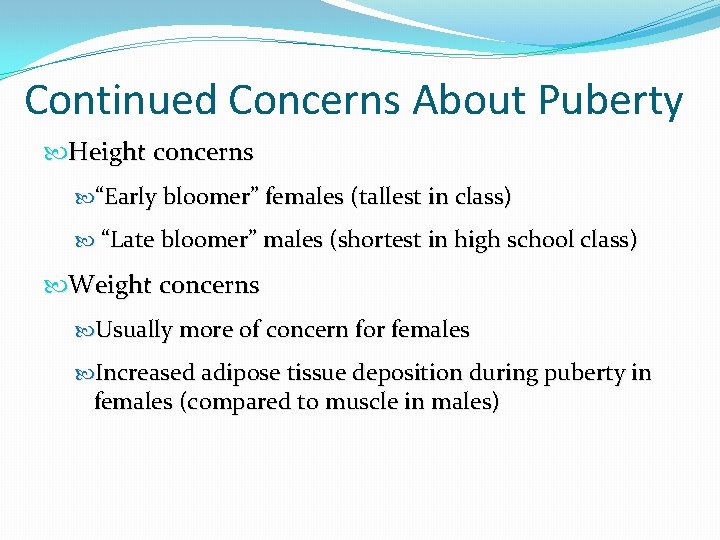
Continued Concerns About Puberty Height concerns “Early bloomer” females (tallest in class) “Late bloomer” males (shortest in high school class) Weight concerns Usually more of concern for females Increased adipose tissue deposition during puberty in females (compared to muscle in males)
Psychosocial Development during Adolescence
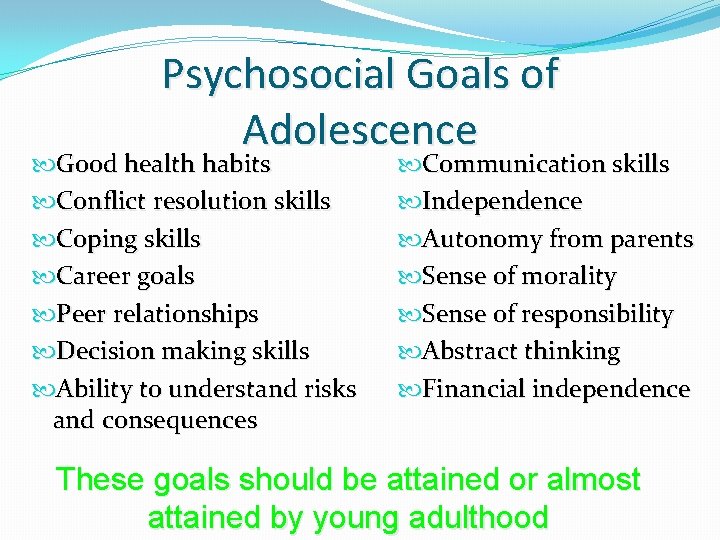
Psychosocial Goals of Adolescence Good health habits Conflict resolution skills Coping skills Career goals Peer relationships Decision making skills Ability to understand risks and consequences Communication skills Independence Autonomy from parents Sense of morality Sense of responsibility Abstract thinking Financial independence These goals should be attained or almost attained by young adulthood
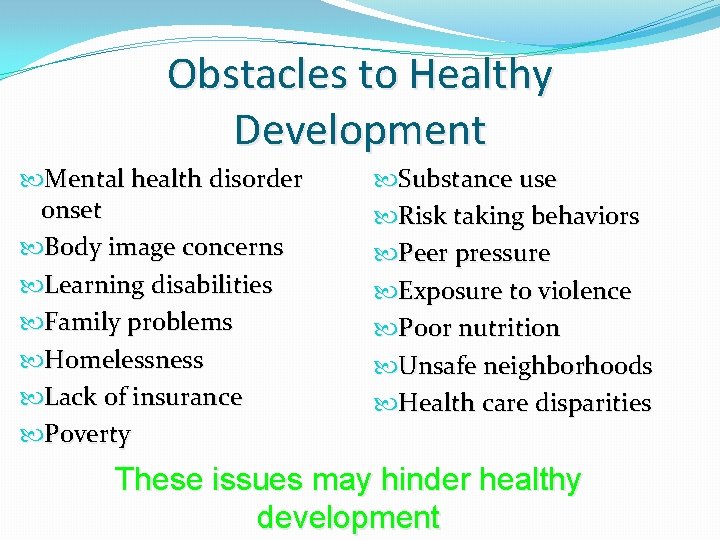
Obstacles to Healthy Development Mental health disorder onset Body image concerns Learning disabilities Family problems Homelessness Lack of insurance Poverty Substance use Risk taking behaviors Peer pressure Exposure to violence Poor nutrition Unsafe neighborhoods Health care disparities These issues may hinder healthy development
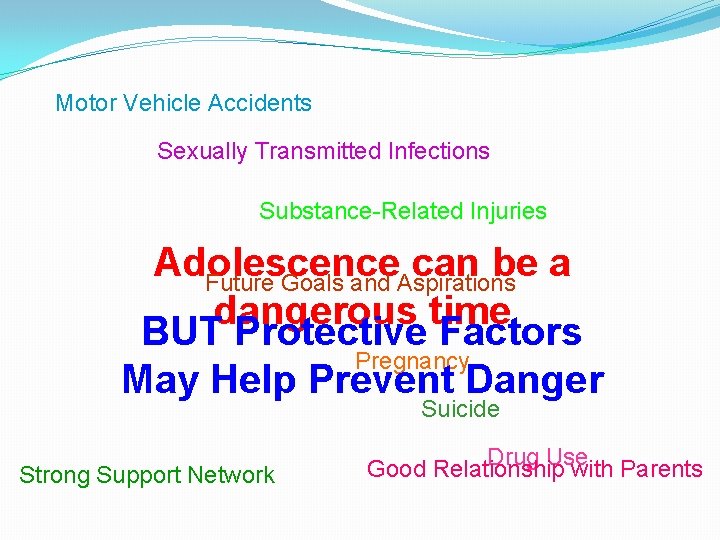
Motor Vehicle Accidents Sexually Transmitted Infections Substance-Related Injuries Adolescence can be a Future Goals and Aspirations dangerous time BUT Protective Factors Pregnancy May Help Prevent Danger Suicide Strong Support Network Drug Use Good Relationship with Parents
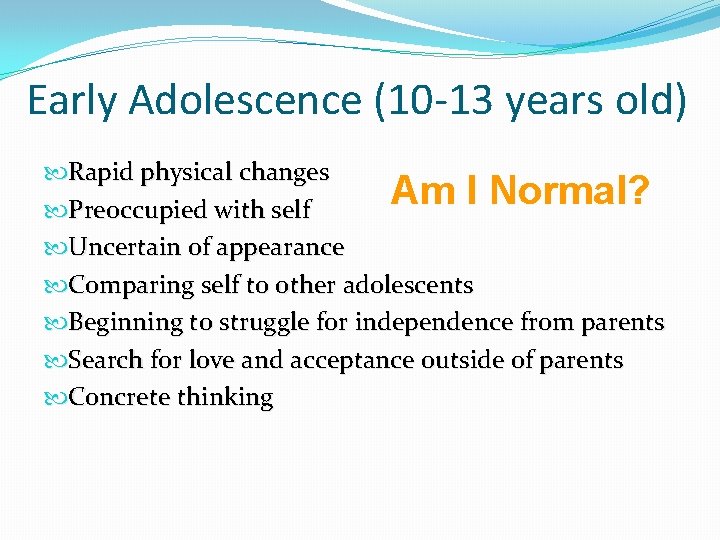
Early Adolescence (10 -13 years old) Rapid physical changes Am I Normal? Preoccupied with self Uncertain of appearance Comparing self to other adolescents Beginning to struggle for independence from parents Search for love and acceptance outside of parents Concrete thinking
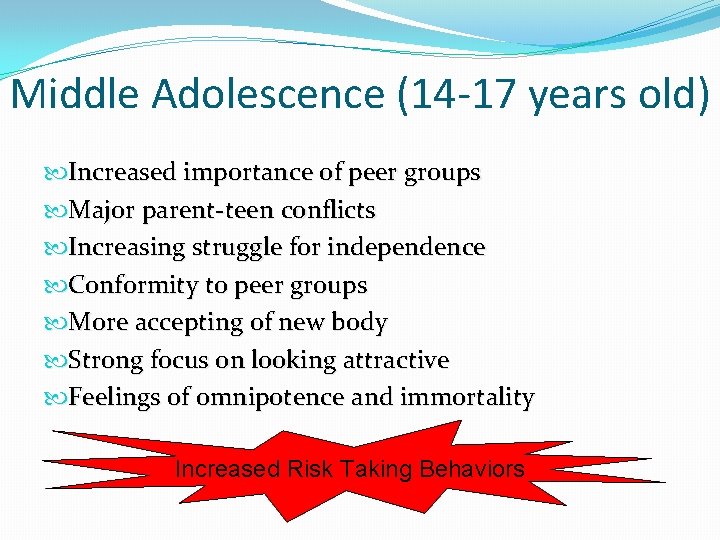
Middle Adolescence (14 -17 years old) Increased importance of peer groups Major parent-teen conflicts Increasing struggle for independence Conformity to peer groups More accepting of new body Strong focus on looking attractive Feelings of omnipotence and immortality Increased Risk Taking Behaviors
Late Adolescence (17 -21 years old) Puberty mostly complete More comfortable with adult body More comfortable with own decisions and identity Rely less on peer group for identity (has own self identity) Improved relationship with family members
Late Adolescence (17 -21 years old) Achieved abstract thinking Ability to develop vocational goals Start to be financially independent Able to make independent decisions Able to set own limits Understand risks and consequences
Sexual Development in Adolescence
Sexual Goals of Adolescence Develop sexual identity Gender role Gender identity Ex: masculine, feminine, both, neither Sexual orientation Ex: Heterosexual, homosexual, bisexual, asexual Develop capacity for intimacy
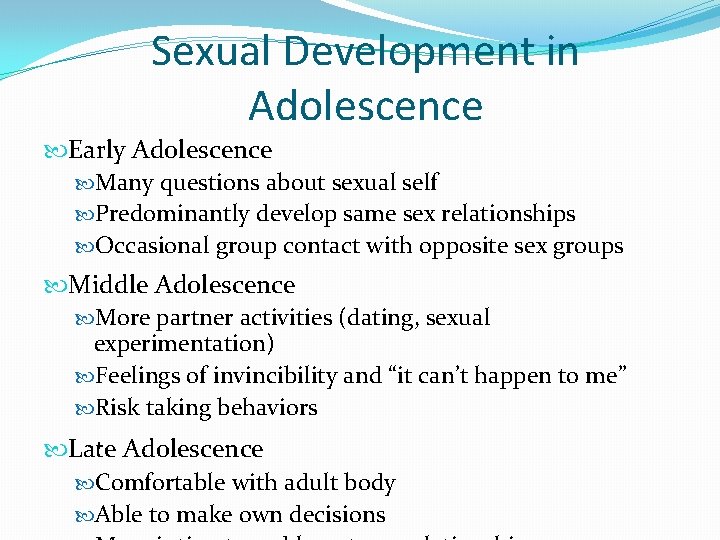
Sexual Development in Adolescence Early Adolescence Many questions about sexual self Predominantly develop same sex relationships Occasional group contact with opposite sex groups Middle Adolescence More partner activities (dating, sexual experimentation) Feelings of invincibility and “it can’t happen to me” Risk taking behaviors Late Adolescence Comfortable with adult body Able to make own decisions
A healthy 10 year old female presents for a routine physical exam. Which of the following is a TRUE statement which you could include in your discussion with the patient and her mother about what to expect during puberty? A. Puberty in females begins with the development of pubic hair B. After menarche, there is minimal growth remaining until adult height is attained C. The growth spurt occurs very late in females and usually marks the end of puberty D. The average of menarche is 14 years old E. Breast asymmetry during development is very uncommon
A healthy 10 year old female presents for a routine physical exam. Which of the following is a TRUE statement which you could include in your discussion with the patient and her mother about what to expect during puberty? A. Puberty in females begins with the development of pubic hair B. After menarche, there is minimal growth remaining until adult height is attained C. The growth spurt occurs very late in females and usually marks the end of puberty D. The average of menarche is 14 years old E. Breast asymmetry during development is very uncommon
Answer: B. Menarche occurs very late in puberty and there is usually only about 2 inches of growth remaining after menarche until adult height is attained. Thelarche, development of breast buds, usually marks the onset of puberty in females; pubarche (the development of pubic hair) usually follows. During breast development, breast asymmetry in size or shape is extremely common. The peak height velocity (growth spurt) tends to occur early in puberty for females, usually halfway between thelarche and menarche. The average of menarche is about 12 years old.
Which of the following statements about pubertal development in males is FALSE? A. Gynecomastia is rare and requires a work-up to rule-out malignancy B. Testicular enlargement usually marks the onset of puberty C. Males tend to start puberty later than females D. Males usually grow 10 -11 inches during puberty E. Deposition of muscle tissue is common towards the end of puberty
Which of the following statements about pubertal development in males is FALSE? A. Gynecomastia is rare and requires a work-up to rule-out malignancy B. Testicular enlargement usually marks the onset of puberty C. Males tend to start puberty later than females D. Males usually grow 10 -11 inches during puberty E. Deposition of muscle tissue is common towards the end of puberty
Answer: A. Gynecomastia is incredibly common in males, especially during sexual maturity rating 2 -3. Affected males should be screened for drug or medication use as well as for the presence of associated symptoms (headaches, galactorrhea, thyroid symptoms, tunnel vision) and a testicular exam should be done to rule-out masses. If all of this is negative, no further work-up should be done at this time. Gynecomastia usually resolves as puberty progresses. Puberty in males tends to begin with testicular enlargement and males tend to enter puberty later than females. The other statements are true.
Which of the following statements about friendships during adolescence is TRUE? A. Older adolescents prefer friendships with younger adolescents B. Relationships during early adolescents tend to be with individuals of the opposite gender C. Adolescents dress differently from their friends in order to stand out and gain attention D. Adolescents usually seek parental approval of their friends E. Peer groups have a powerful influence on an adolescent’s risk taking behaviors
Which of the following statements about friendships during adolescence is TRUE? A. Older adolescents prefer friendships with younger adolescents B. Relationships during early adolescents tend to be with individuals of the opposite gender C. Adolescents dress differently from their friends in order to stand out and gain attention D. Adolescents usually seek parental approval of their friends E. Peer groups have a powerful influence on an adolescent’s risk taking behaviors
Answer: E. One goal of adolescence is to become independent from their parents. This is partially accomplished through the formation of strong peer relationships. Adolescents tend to conform so that they can fit in and frequently experience peer pressure. Peer groups have an extremely powerful influence on an adolescent’s risk taking behaviors. Adolescents in all stages of development do not seek parental approval of their peer groups. Adolescents usually prefer friendships with peers in similar age groups. In early adolescence, friendships tend to be with individuals of the same gender compared to middle and late adolescence where friendships are more likely to involve individuals from the opposite gender.
An anti-smoking campaign targeting 12 -13 year olds should focus on which of the following concepts? A. Smoking decreases your life expectancy by 5 years B. Smoking turns your teeth and nails yellow and makes your hair and breath smell bad C. Smoking increases your risk of developing lung cancer D. If your parents find out that you have been smoking you will be punished E. Smoking can impact your endurance in sports and make it harder to be a star athlete F. Both B and E G. Both A and D
An anti-smoking campaign targeting 12 -13 year olds should focus on which of the following concepts? A. Smoking decreases your life expectancy by 5 years B. Smoking turns your teeth and nails yellow and makes your hair and breath smell bad C. Smoking increases your risk of developing lung cancer D. If your parents find out that you have been smoking you will be punished E. Smoking can impact your endurance in sports and make it harder to be a star athlete F. Both B and E G. Both A and D
Answer: F. 12 -13 year olds are in early adolescence, a phase which is dominated by wanting to feel normal, wanting to fit in, and constantly feeling uncertain about their appearance and comparing themselves to their peers. They are not able to process long term consequences of their actions (like decreasing their life expectancy or developing lung cancer). Since they are focused on their appearance and fitting in, anti-smoking campaigns should focus on the changes in their appearance (yellow teeth and nails and bad breath). Additionally, if they are athletes, campaigns can focus on the impact that it will have on their sport. Adolescents are not as worried about what their parents will think about their behaviors as they are struggling to become independent and are more focused on gaining acceptance from their peers than from their parents.
Recommended Reading Garofalo R, Forcier M. Adolescent Sexuality. Up. To. Date Online. Updated September 28, 2009. Peterson AC, Leffert N, Graham BL. Adolescent Development and the Emergence of Sexuality. Suicide & Life – Threat Behav. 1995; 25 Suppl: 4 -17.