23 C 59000 Consumer research Academic Reading Writing
- Slides: 36
23 C 59000 - Consumer research Academic Reading (& Writing) Ilona Mikkonen, DSc.
Agenda • What is an academic article? • What kind of sources can you typically use in academic texts? • How to read research articles (analytically and critically)?
What is an academic article? 6. 3. 2021 3
Academic journals and articles • Academic journals are periodicals in which researchers publish articles on their work • Academic articles go through a double-blind peerreview
Academic journals and articles • Academic texts report recent, original reseach and/or develop new theory/knowledge – Academic texts develop arguments: the purpose is to argue for the correctedness of the findings – Academic texts require transparency: own findings and reference have to be clearly identifiable, and all citations have to be marked • Academic articles usually have similar kind of a structure regardless of the discipline
What kinds of sources can you use in academic writing? 6. 3. 2021 6
Must be used: peer-reviewed academic articles Your references should be 80% from this category) 6. 3. 2021 7
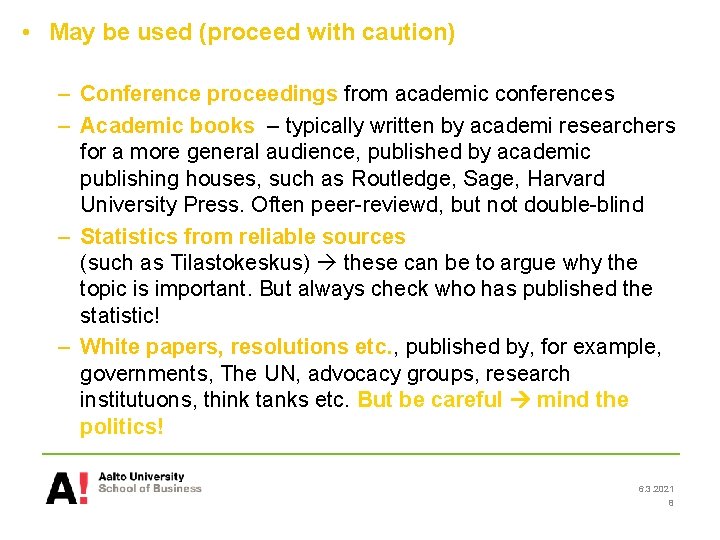
• May be used (proceed with caution) – Conference proceedings from academic conferences – Academic books – typically written by academi researchers for a more general audience, published by academic publishing houses, such as Routledge, Sage, Harvard University Press. Often peer-reviewd, but not double-blind – Statistics from reliable sources (such as Tilastokeskus) these can be to argue why the topic is important. But always check who has published the statistic! – White papers, resolutions etc. , published by, for example, governments, The UN, advocacy groups, research institutuons, think tanks etc. But be careful mind the politics! 6. 3. 2021 8
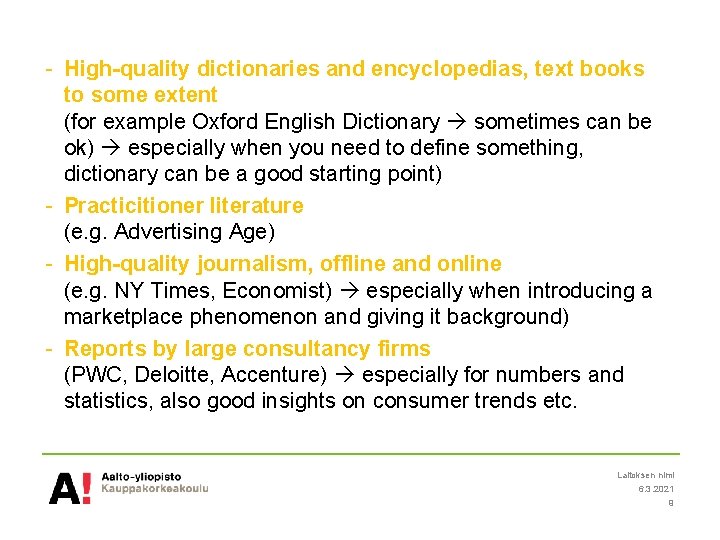
- High-quality dictionaries and encyclopedias, text books to some extent (for example Oxford English Dictionary sometimes can be ok) especially when you need to define something, dictionary can be a good starting point) - Practicitioner literature (e. g. Advertising Age) - High-quality journalism, offline and online (e. g. NY Times, Economist) especially when introducing a marketplace phenomenon and giving it background) - Reports by large consultancy firms (PWC, Deloitte, Accenture) especially for numbers and statistics, also good insights on consumer trends etc. Laitoksen nimi 6. 3. 2021 9
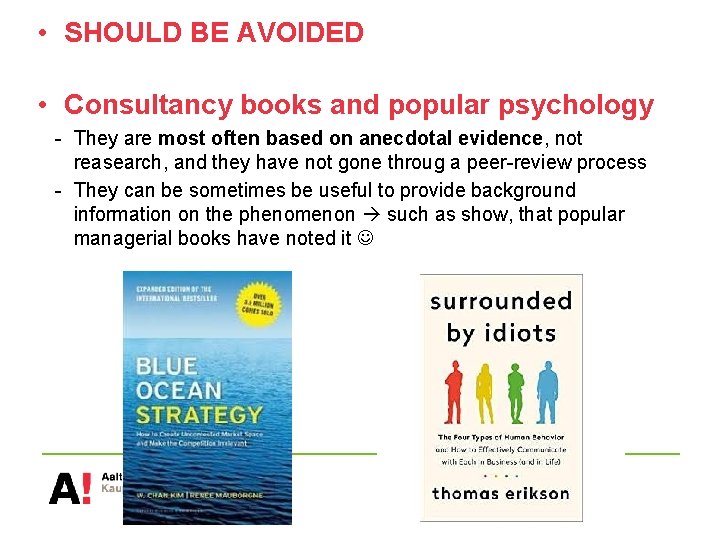
• SHOULD BE AVOIDED • Consultancy books and popular psychology - They are most often based on anecdotal evidence, not reasearch, and they have not gone throug a peer-review process - They can be sometimes be useful to provide background information on the phenomenon such as show, that popular managerial books have noted it
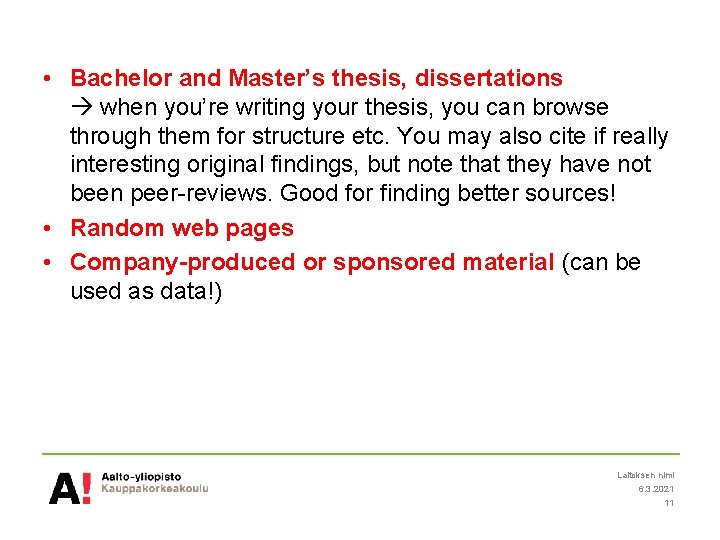
• Bachelor and Master’s thesis, dissertations when you’re writing your thesis, you can browse through them for structure etc. You may also cite if really interesting original findings, but note that they have not been peer-reviews. Good for finding better sources! • Random web pages • Company-produced or sponsored material (can be used as data!) Laitoksen nimi 6. 3. 2021 11
How to read research articles? 6. 3. 2021 12
How to read articles • How do you normally read for pleasure (books or journalism)? • Reading research is less about reading than it is about studying – You are looking for facts and ideas, not entertainment!
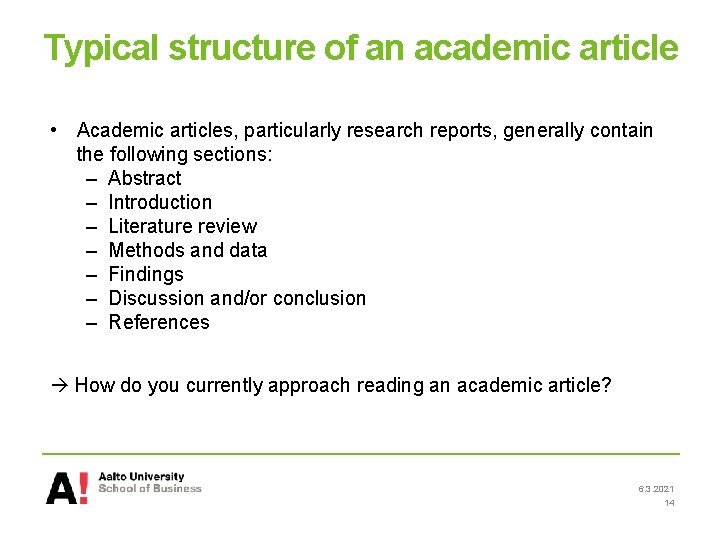
Typical structure of an academic article • Academic articles, particularly research reports, generally contain the following sections: – Abstract – Introduction – Literature review – Methods and data – Findings – Discussion and/or conclusion – References How do you currently approach reading an academic article? 6. 3. 2021 14
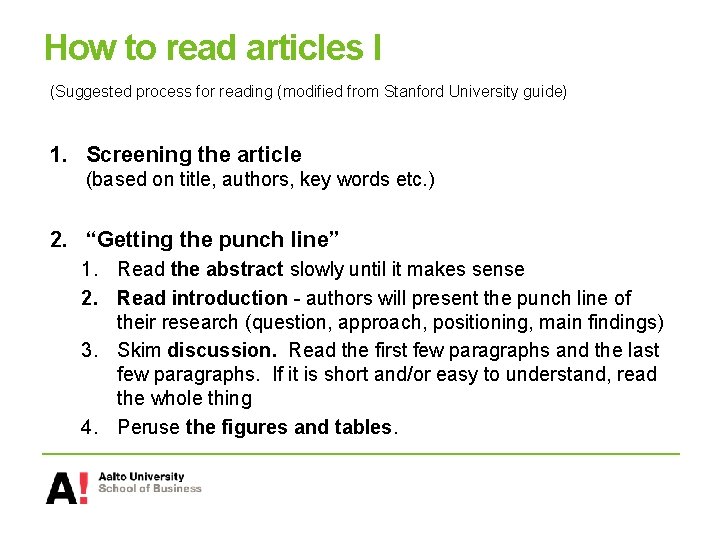
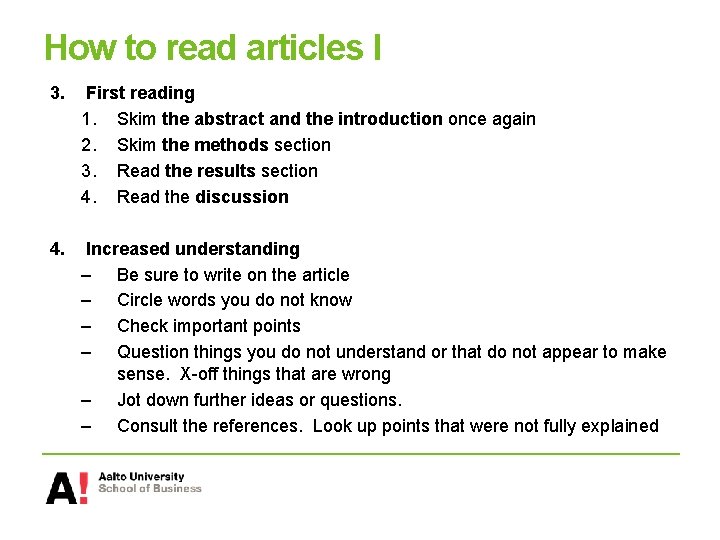
How to read articles I (Suggested process for reading (modified from Stanford University guide) 1. Screening the article (based on title, authors, key words etc. ) 2. “Getting the punch line” 1. Read the abstract slowly until it makes sense 2. Read introduction - authors will present the punch line of their research (question, approach, positioning, main findings) 3. Skim discussion. Read the first few paragraphs and the last few paragraphs. If it is short and/or easy to understand, read the whole thing 4. Peruse the figures and tables.
How to read articles I 3. First reading 1. Skim the abstract and the introduction once again 2. Skim the methods section 3. Read the results section 4. Read the discussion 4. Increased understanding – Be sure to write on the article – Circle words you do not know – Check important points – Question things you do not understand or that do not appear to make sense. X-off things that are wrong – Jot down further ideas or questions. – Consult the references. Look up points that were not fully explained
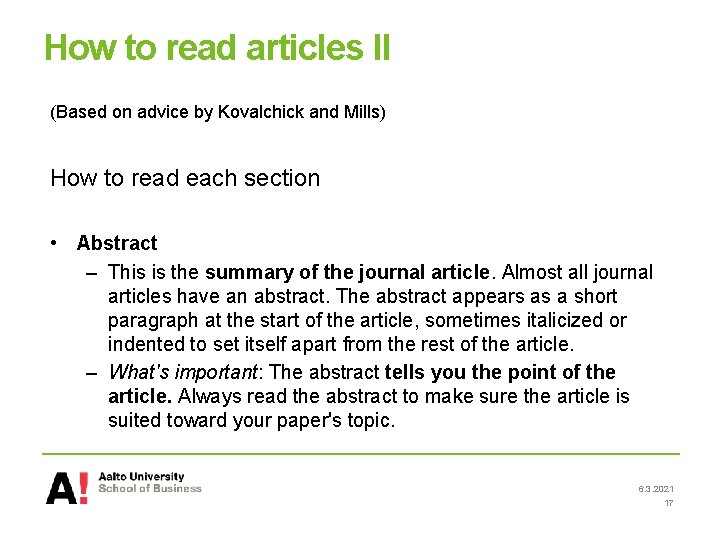
How to read articles II (Based on advice by Kovalchick and Mills) How to read each section • Abstract – This is the summary of the journal article. Almost all journal articles have an abstract. The abstract appears as a short paragraph at the start of the article, sometimes italicized or indented to set itself apart from the rest of the article. – What's important: The abstract tells you the point of the article. Always read the abstract to make sure the article is suited toward your paper's topic. 6. 3. 2021 17
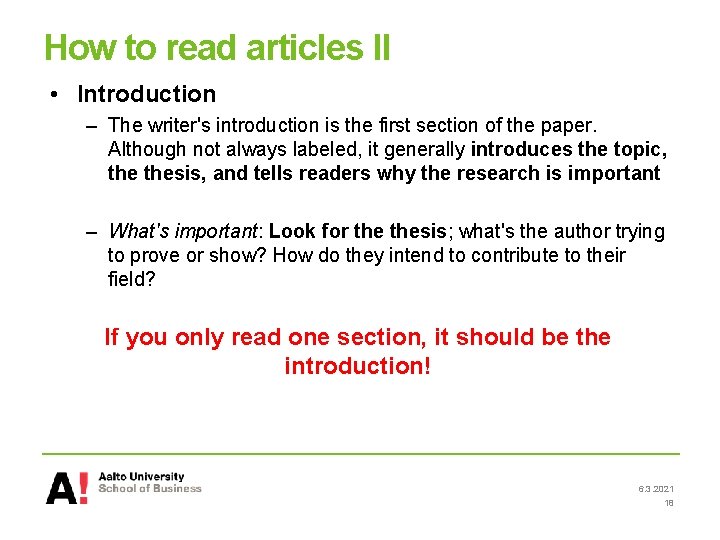
How to read articles II • Introduction – The writer's introduction is the first section of the paper. Although not always labeled, it generally introduces the topic, thesis, and tells readers why the research is important – What's important: Look for thesis; what's the author trying to prove or show? How do they intend to contribute to their field? If you only read one section, it should be the introduction! 6. 3. 2021 18
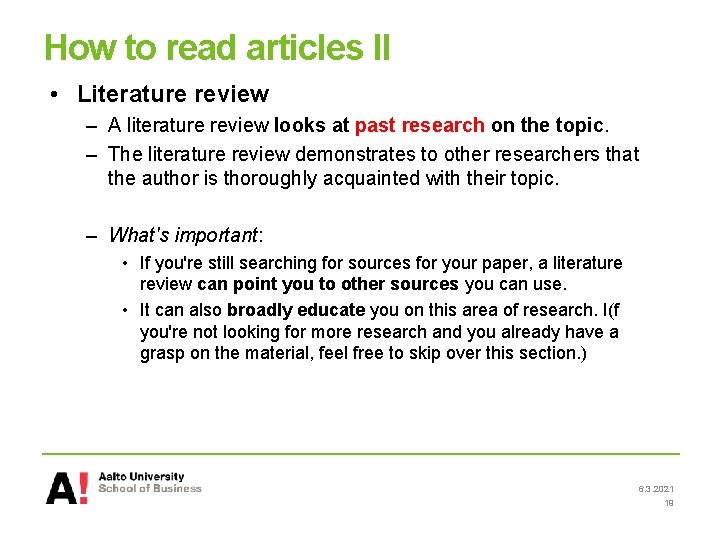
How to read articles II • Literature review – A literature review looks at past research on the topic. – The literature review demonstrates to other researchers that the author is thoroughly acquainted with their topic. – What's important: • If you're still searching for sources for your paper, a literature review can point you to other sources you can use. • It can also broadly educate you on this area of research. I(f you're not looking for more research and you already have a grasp on the material, feel free to skip over this section. ) 6. 3. 2021 19
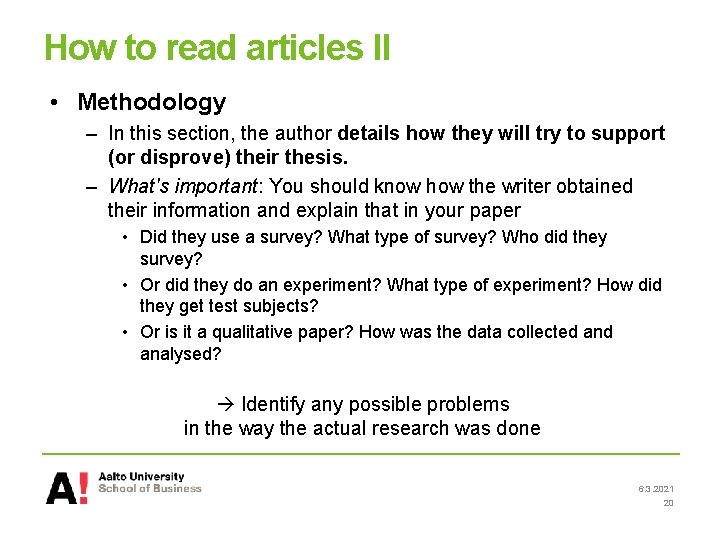
How to read articles II • Methodology – In this section, the author details how they will try to support (or disprove) their thesis. – What's important: You should know how the writer obtained their information and explain that in your paper • Did they use a survey? What type of survey? Who did they survey? • Or did they do an experiment? What type of experiment? How did they get test subjects? • Or is it a qualitative paper? How was the data collected analysed? Identify any possible problems in the way the actual research was done 6. 3. 2021 20
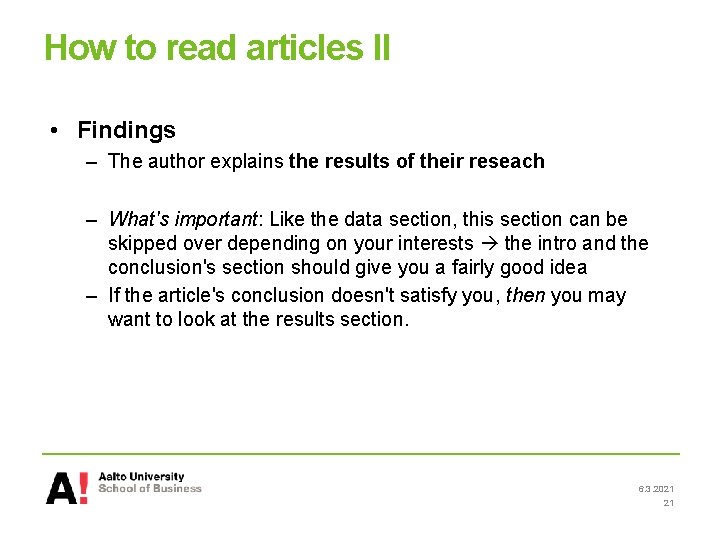
How to read articles II • Findings – The author explains the results of their reseach – What's important: Like the data section, this section can be skipped over depending on your interests the intro and the conclusion's section should give you a fairly good idea – If the article's conclusion doesn't satisfy you, then you may want to look at the results section. 6. 3. 2021 21
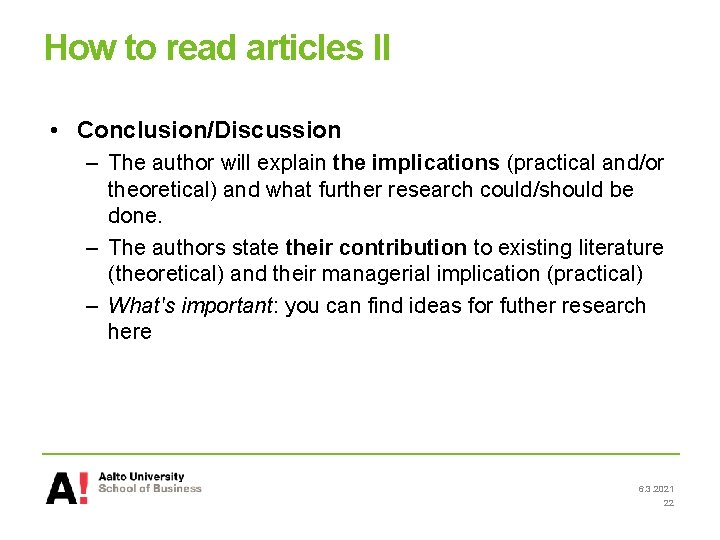
How to read articles II • Conclusion/Discussion – The author will explain the implications (practical and/or theoretical) and what further research could/should be done. – The authors state their contribution to existing literature (theoretical) and their managerial implication (practical) – What's important: you can find ideas for futher research here 6. 3. 2021 22
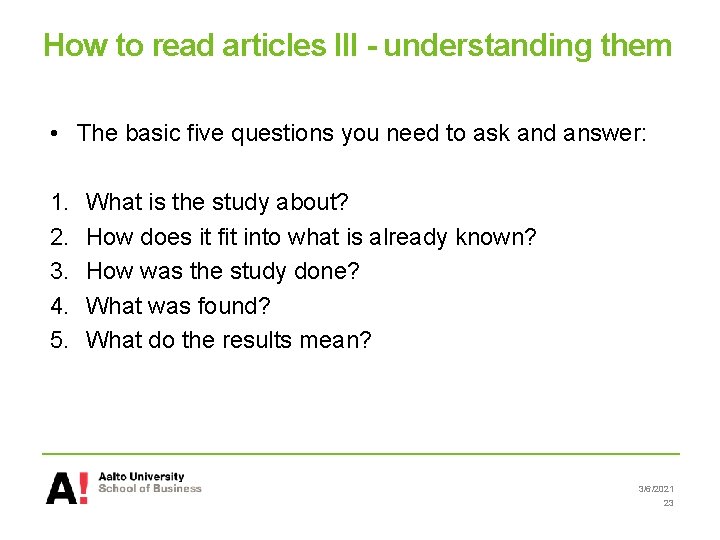
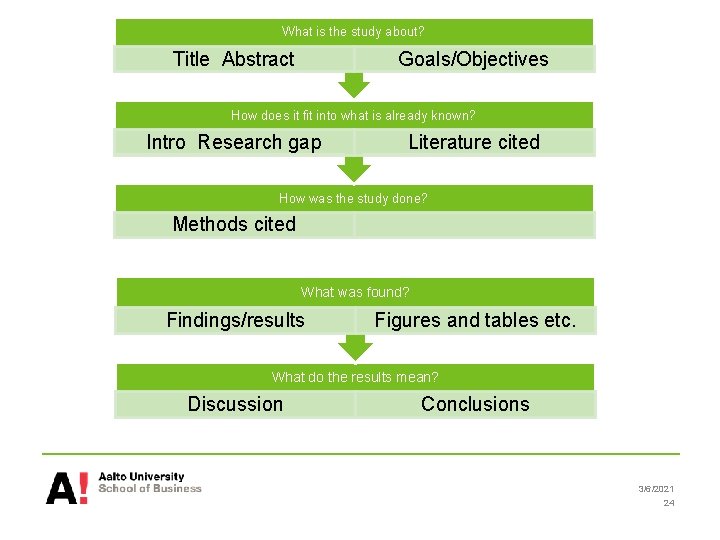
How to read articles III - understanding them • The basic five questions you need to ask and answer: 1. 2. 3. 4. 5. What is the study about? How does it fit into what is already known? How was the study done? What was found? What do the results mean? 3/6/2021 23
What is the study about? Title Abstract Goals/Objectives How does it fit into what is already known? Intro Research gap Literature cited How was the study done? Methods cited What was found? Findings/results Figures and tables etc. What do the results mean? Discussion Conclusions 3/6/2021 24
How write academic text? 6. 3. 2021 25
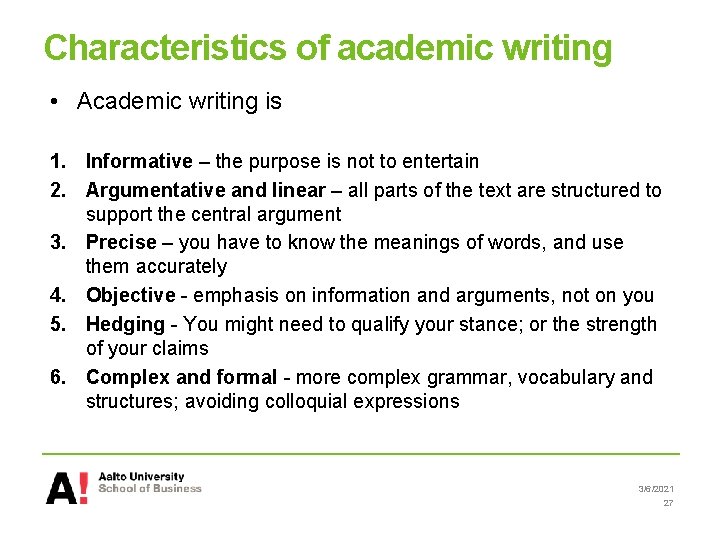
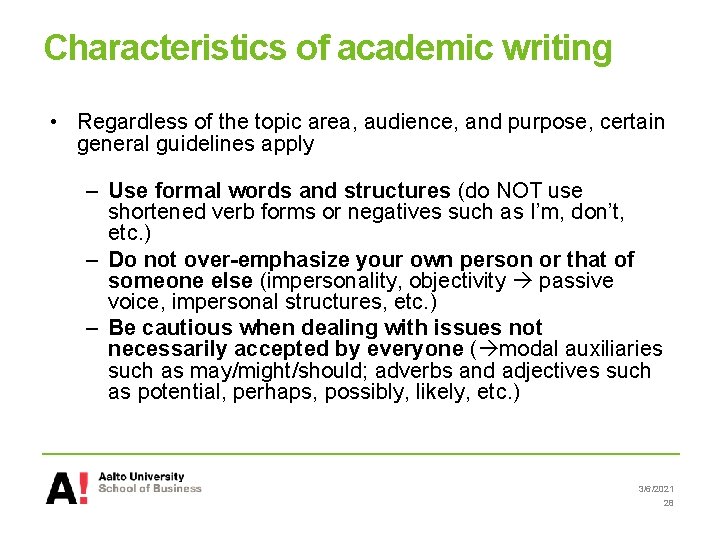
Characteristics of academic writing • Academic writing is 1. Informative – the purpose is not to entertain 2. Argumentative and linear – all parts of the text are structured to support the central argument 3. Precise – you have to know the meanings of words, and use them accurately 4. Objective - emphasis on information and arguments, not on you 5. Hedging - You might need to qualify your stance; or the strength of your claims 6. Complex and formal - more complex grammar, vocabulary and structures; avoiding colloquial expressions 3/6/2021 27
Characteristics of academic writing • Regardless of the topic area, audience, and purpose, certain general guidelines apply – Use formal words and structures (do NOT use shortened verb forms or negatives such as I’m, don’t, etc. ) – Do not over-emphasize your own person or that of someone else (impersonality, objectivity passive voice, impersonal structures, etc. ) – Be cautious when dealing with issues not necessarily accepted by everyone ( modal auxiliaries such as may/might/should; adverbs and adjectives such as potential, perhaps, possibly, likely, etc. ) 3/6/2021 28
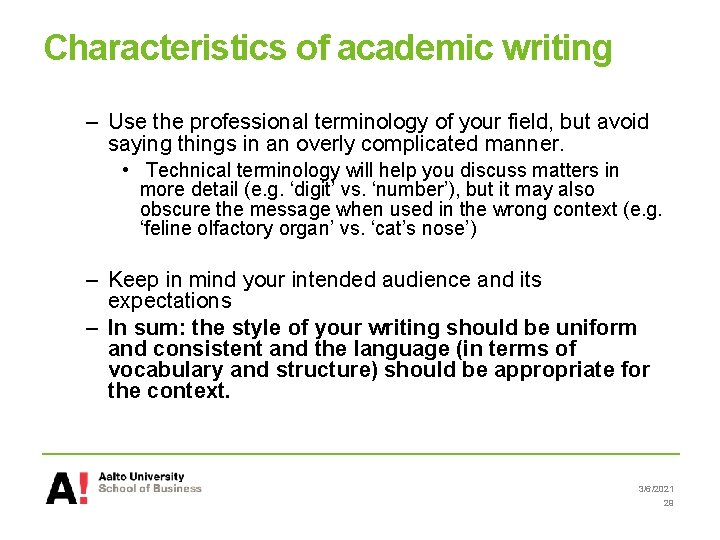
Characteristics of academic writing – Use the professional terminology of your field, but avoid saying things in an overly complicated manner. • Technical terminology will help you discuss matters in more detail (e. g. ‘digit’ vs. ‘number’), but it may also obscure the message when used in the wrong context (e. g. ‘feline olfactory organ’ vs. ‘cat’s nose’) – Keep in mind your intended audience and its expectations – In sum: the style of your writing should be uniform and consistent and the language (in terms of vocabulary and structure) should be appropriate for the context. 3/6/2021 29
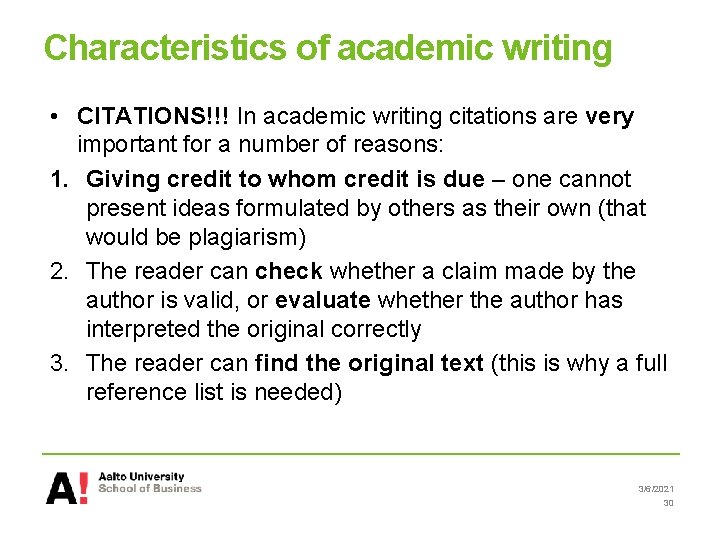
Characteristics of academic writing • CITATIONS!!! In academic writing citations are very important for a number of reasons: 1. Giving credit to whom credit is due – one cannot present ideas formulated by others as their own (that would be plagiarism) 2. The reader can check whether a claim made by the author is valid, or evaluate whether the author has interpreted the original correctly 3. The reader can find the original text (this is why a full reference list is needed) 3/6/2021 30
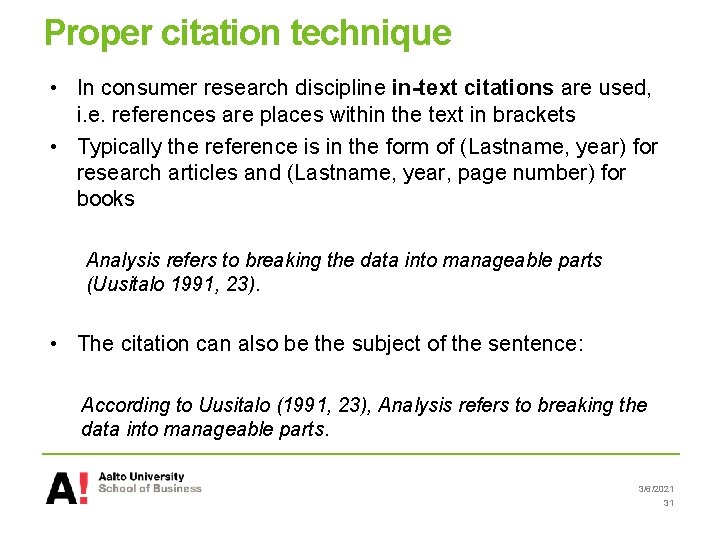
Proper citation technique • In consumer research discipline in-text citations are used, i. e. references are places within the text in brackets • Typically the reference is in the form of (Lastname, year) for research articles and (Lastname, year, page number) for books Analysis refers to breaking the data into manageable parts (Uusitalo 1991, 23). • The citation can also be the subject of the sentence: According to Uusitalo (1991, 23), Analysis refers to breaking the data into manageable parts. 3/6/2021 31
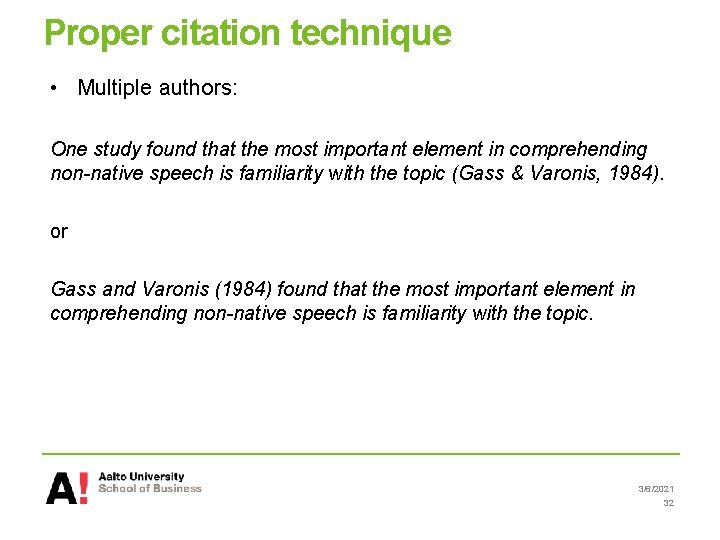
Proper citation technique • Multiple authors: One study found that the most important element in comprehending non-native speech is familiarity with the topic (Gass & Varonis, 1984). or Gass and Varonis (1984) found that the most important element in comprehending non-native speech is familiarity with the topic. 3/6/2021 32
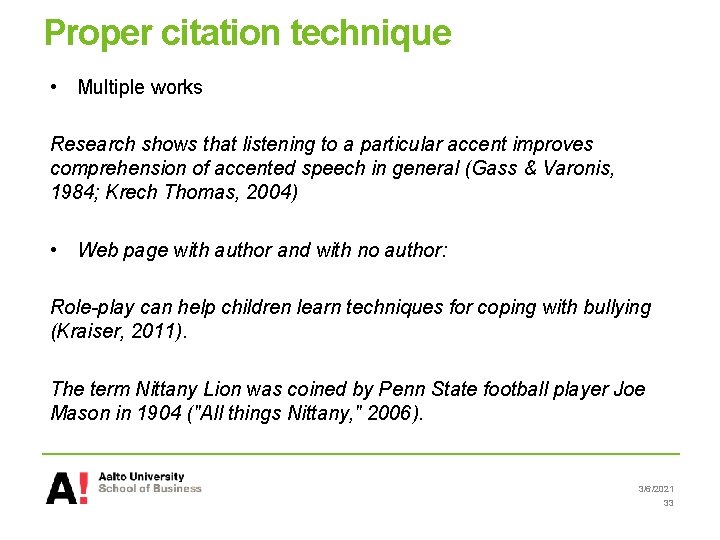
Proper citation technique • Multiple works Research shows that listening to a particular accent improves comprehension of accented speech in general (Gass & Varonis, 1984; Krech Thomas, 2004) • Web page with author and with no author: Role-play can help children learn techniques for coping with bullying (Kraiser, 2011). The term Nittany Lion was coined by Penn State football player Joe Mason in 1904 ("All things Nittany, " 2006). 3/6/2021 33
Proper citation technique • For more information on proper citations and reference lists, please check out: https: //guides. libraries. psu. edu/apaquickguide/overview 3/6/2021 34
Two important rules: Rule #1: YOU LEARN TO WRITE BY WRITING! Rule #2: QUALITY COMES FROM REVISION! 3/6/2021 35
Question, comments, grievances 3/6/2021 36